Introduction
Individuals with psychopathy (PP) show little concern about the consequences of their actions for others and themselves. They often show poor planning skills and fail to avoid behaviours that have been punished previously (Hare, Reference Hare1991). The latter is reflected in, for example, the amount and types of incidents occurring in clinical settings (Hildebrand, Reference Hildebrand2005) and in their poor response to treatment and the high relapse rates of criminal behaviour (D'Silva et al. Reference D'Silva, Duggan and McCarthy2004).
In line with these observations, psychopathic individuals show performance deficits in different stimulus–response and stimulus–reinforcement learning situations. Cleckley (Reference Cleckley1976) found individuals with PP to have a reduced capacity to learn from experience. Other studies have demonstrated abnormally low levels of aversive learning (Flor et al. Reference Flor, Birbaumer, Hermann, Ziegler and Patrick2002), instrumental learning (Mitchell et al. Reference Mitchell, Fine, Richell, Newman, Lumsden, Blair and Blair2006) and avoidance learning (Newman & Kosson, Reference Newman and Kosson1986; Blair et al. Reference Blair, Mitchell, Leonard, Budhani, Peschardt and Newman2004). The latter is the process by which one learns that omitting a certain response will result in the termination or prevention of an aversive stimulus. Additionally, impairments in decision making to rewarding and punishing stimuli have been found (Blair et al. Reference Blair, Morton, Leonard and Blair2006). Furthermore, studies of post-error slowing, the phenomenon of slower response times (RTs) following erroneous trials, have shown that individuals with PP fail to utilize feedback to alter future responses (Newman, Reference Newman1987). Finally, recent behavioural data from a probabilistic response–reversal task indicated that individuals with PP showed learning deficits in the reversal phase only, in which the earlier learned reinforcement contingencies were suddenly reversed (Budhani et al. Reference Budhani, Richell and Blair2006).
These findings are mainly in line with the integrated emotion system (IES) interpretation of PP (Blair, Reference Blair2005; Blair et al. Reference Blair, Mitchell and Blair2005), which assumes orbitofrontal and amygdala abnormalities in PP. The model predicts individuals with PP to show deficits in both stimulus–reinforcement learning involving the amygdala and reversal learning served by orbitofrontal areas and the basal ganglia (Cools et al. Reference Cools, Clark, Owen and Robbins2002; Clarke et al. Reference Clarke, Robbins and Roberts2008). Importantly, the model would not predict deficits in stimulus–response learning, a process that relies on the posterior medial frontal cortex (pMFC), including the pre-supplementary motor area (pre-SMA) and the anterior cingulate (Carter et al. Reference Carter, Braver, Barch, Botvinick, Noll and Cohen1998).
In our view, the above suggests that psychopathic individuals have difficulties in using negative feedback or error information to adapt their behaviour. Holroyd & Coles (Reference Holroyd and Coles2002) proposed the reinforcement learning (RL) theory of performance monitoring, which assumes that whenever outcomes are worse than expected, an error signal is conveyed from the basal ganglia to the anterior cingulate cortex (ACC). Upon arrival of this error signal in the ACC, the error-related negativity (ERN), an event-related potential (ERP) component measurable at the scalp, is generated (Dehaene et al. Reference Dehaene, Posner and Tucker1994; Carter et al. Reference Carter, Braver, Barch, Botvinick, Noll and Cohen1998; Holroyd et al. Reference Holroyd, Dien and Coles1998; Holroyd & Coles, Reference Holroyd and Coles2002). The ERN occurs not only when participants make errors but also when they receive feedback indicating that they gave an incorrect response (for an overview on ERN and performance monitoring, see Ullsperger & Falkenstein, Reference Ullsperger and Falkenstein2004).
The onset of the ERN coincides with response initiation (rERN; Gehring & Fencsik, Reference Gehring and Fencsik2001), or occurs 200 ms after the delivery of error feedback (fERN; Milter et al. Reference Mars, de Bruijn, Hulstijn, Milter, Coles, Ullsperger and Falkenstein1997). The former reflects internal error signals, the latter external error signals. Studies have demonstrated that the ERN is generated at the first moment in time when the error can be detected (Holroyd & Coles, Reference Holroyd and Coles2002; Nieuwenhuis et al. Reference Nieuwenhuis, Ridderinkhof, Talsma, Coles, Holroyd, Kok and van der Molen2002). Thus, fERNs are elicited when the negative feedback itself was not, or was only partly, predicted by earlier events. This is, for example, the case when subjects are still learning the correct stimulus–response mapping by trial and error. However, as the system gradually learns the stimulus–response mapping, subjects will eventually be able to detect errors at the moment of response onset. At an electrophysiological level, this is reflected in the fERN ‘propagating back in time’ and ‘becoming’ an rERN. Consequently, while learning takes place, rERN amplitudes increase (Holroyd & Coles, Reference Holroyd and Coles2002).
Although several studies have investigated learning in individuals with psychopathic traits at a behavioural level, learning deficits in individuals diagnosed with PP have never been studied in relation to the underlying electrophysiological markers of performance or error monitoring. Until now, most studies either focused on individuals with behavioural patterns related to PP (Dikman & Allen, Reference Dikman and Allen2000; Hall et al. Reference Hall, Bernat and Patrick2007) or investigated aspects of error monitoring unrelated to learning (Munro et al. Reference Munro, Dywan, Harris, McKee, Unsal and Segalowitz2007; Brazil et al. Reference Brazil, de Bruijn, Bulten, von Borries, van Lankveld, Buitelaar and Verkes2009). An investigation of reward and avoidance learning in low socialized individuals (a concept related to PP; Kosson & Newman, Reference Kosson and Newman1989) has shown diminished rERN amplitudes only in the punishment condition (Dikman & Allen, Reference Dikman and Allen2000). Another study demonstrated reduced rERN amplitudes in healthy individuals scoring high on externalizing psychopathology, a factor comparable to the behavioural deficit cluster in individuals with PP (Hall et al. Reference Hall, Bernat and Patrick2007). Only two studies have investigated the rERN directly in individuals diagnosed with PP. Munro et al. (Reference Munro, Dywan, Harris, McKee, Unsal and Segalowitz2007) used a neutral and an emotional choice–reaction task and found reduced rERNs in the emotional task only. Brazil et al. (Reference Brazil, de Bruijn, Bulten, von Borries, van Lankveld, Buitelaar and Verkes2009) reported no differences in rERN amplitude between healthy controls and individuals with PP on a neutral task, but did demonstrate problems in the conscious evaluation and signalling of errors. Taken together, these studies point towards learning deficits associated with a failure to detect and use internal and external error signals.
The present study was designed to examine the relationship between error monitoring and reinforcement learning in individuals diagnosed with PP, by investigating the rERN and fERN and the relationship between the two while learning progresses. To investigate this, a probabilistic learning task was used in which participants learned stimulus–response mappings based on feedback about their performance (trial-and-error learning; see, for example, Holroyd & Coles, Reference Holroyd and Coles2002; Nieuwenhuis et al. Reference Nieuwenhuis, Ridderinkhof, Talsma, Coles, Holroyd, Kok and van der Molen2002, Reference Nieuwenhuis, Nielen, Mol, Hajcak and Veltman2005). A crucial aspect of the task is that the imperative stimulus presented on each trial differed in the degree to which the response was predictive of the value of the feedback (50, 80 and 100%).
Compared with healthy controls, we expected individuals with PP to display learning difficulties, reflected behaviourally by reduced accuracy and electrophysiologically by smaller amplitudes of rERN, fERN and a slower propagation in time of the fERN to become an rERN.
Method
Participants
Thirteen male violent offenders aged between 18 and 55 years (mean=37, s.d.=9.5 years) diagnosed with a psychopathy score of ⩾26 according to the Hare Psychopathy Check List – Revised (PCL-R; Hare, Reference Hare1991) were selected from the in-patient population of a forensic psychiatric institute in The NetherlandsFootnote † (mean PCL-R score=31, s.d.=3.4). Educational level was coded according to the Dutch educational system (1=primary education, 2=secondary education, 3=higher education; mean education patients=2.8, mean education controls=2.3). Eighteen healthy male controls matched for age (mean age=37, s.d.=6.5 years) and educational level and without a criminal record or a history of psychiatric disorders were recruited by advertisement. Participants in both groups were checked for drug use and for medical/neurological history. Exclusion criteria were: use of alcohol >3 units/day during the week preceding the experimental measure and use of alcohol within 24 h of the measurement; use of cannabis or other illicit drugs within the week before measurement and use of psychotropic medication other than oxazepam during the 5 days before measurement; use of oxazepam within 12 h before measurement; smoking within 3 h before measurement; history of trauma capitis, visual and auditive disorders, neurological disorders, first-degree relative with any relevant neurological disorders. The study was approved by the local Medical Ethical Committee and carried out in accordance with the Declaration of Helsinki.
Task and procedure
Participants received written information about the experiment and gave their written consent before being screened for psychiatric exclusion criteria by trained psychologists using the SCID-II (Groenestijn et al. Reference Groenestijn, Akkerhuis, Kupka, Schneider and Nolen1999) and the M.I.N.I. (van Vliet et al. Reference van Vliet, Leroy and van Megen2000). The psychiatric exclusion criteria included: depressive disorder, bipolar disorder, schizophrenia, schizo-affective disorder, schizophreniform disorder, delusional and other psychotic disorders, schizoid or schizotypal personality disorder, current alcohol and substance intoxication, first-degree relatives with DSM-IV Axis I schizophrenia or schizophreniform disorder. Participants performed the experimental task and received a financial reimbursement. Additionally, all subjects received a bonus earned during the experiment.
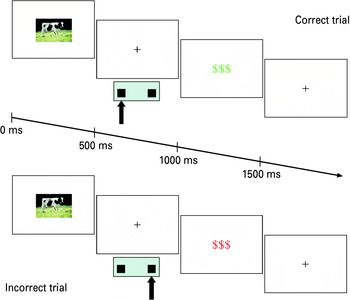
Participants performed a probabilistic learning task requiring a two-choice decision to an imperative visual stimulus (Holroyd & Coles, Reference Holroyd and Coles2002) (see Fig. 1). Following each response, a feedback stimulus representing reward information was presented, informing participants whether their response was correct (green dollar signs: +2 cents), incorrect (red dollar signs: −2 cents) or too late (a cherry; −4 cents).
Trial details for a correct and an incorrect trial. Each trial started with the presentation of the imperative stimulus for 500 ms, a blank screen with a fixation cross (500 ms), the presentation of a feedback stimulus (500 ms), and then a blank screen with a fixation cross (500 ms). For each imperative stimulus, one of two buttons had to be pressed with the index finger (right or left). A response deadline (1000 ms) was used to ensure that participants made sufficient errors in the 100% easy learning condition.

The amount of learning possible was manipulated in three different conditions (50, 80 and 100%) by varying the degree to which the response was predictive of the value of the feedback. For stimuli in the 50% control condition, the value of the feedback was uncorrelated with the selected response, making it impossible to learn stimulus–response mappings. In the 100% and 80% learning conditions, participants could learn the stimulus–response mappings to varying degrees.
In each experimental block, participants were presented with a new set of six different stimuli (for task and stimulus details, see Nieuwenhuis et al. Reference Nieuwenhuis, Ridderinkhof, Talsma, Coles, Holroyd, Kok and van der Molen2002, Reference Nieuwenhuis, Nielen, Mol, Hajcak and Veltman2005), that is two for each condition. The two stimuli from the 100% condition mapped congruently to either the left or the right response button throughout the entire block. For two stimuli, feedback was delivered randomly (50% condition). Of the two remaining stimuli, one required a left button press in 80% (‘80% valid’) but a right button press in 20% of the trials (‘80% invalid’), and vice versa for the other stimuli.
Participants started with a bonus of €2.50 and were informed about the status of this bonus at the end of each block. The aim was to determine the financially most beneficial strategy by trial and error. First, participants completed a practice block of 100 trials followed by four experimental blocks of 300 trials each. The six stimuli in each block were presented randomly 50 times each (Holroyd & Coles, Reference Holroyd and Coles2002; Nieuwenhuis et al. Reference Nieuwenhuis, Ridderinkhof, Talsma, Coles, Holroyd, Kok and van der Molen2002, Reference Nieuwenhuis, Nielen, Mol, Hajcak and Veltman2005). Fig. 1 depicts details of the duration of the trial, which are identical to previous studies using the same paradigm (Holroyd & Coles, Reference Holroyd and Coles2002; Nieuwenhuis et al. Reference Nieuwenhuis, Ridderinkhof, Talsma, Coles, Holroyd, Kok and van der Molen2002, Reference Nieuwenhuis, Nielen, Mol, Hajcak and Veltman2005).
Electrophysiological recording
A QuickAmp amplifier (Brainproducts, Germany) with an ActiCap system holding 32 active electrodes was used for data acquisition. A electroencephalogram was recorded at a sampling rate of 500 Hz and referenced to the left ear, but was re-referenced offline to the average of both ears. Signals were filtered offline using a band-pass filter of 0.019–20 Hz.
Data analysis
Trials with RTs <150 ms or >700 ms were excluded from the analyses (6.06%, s.d.=5.44%;Nieuwenhuis et al. Reference Nieuwenhuis, Ridderinkhof, Talsma, Coles, Holroyd, Kok and van der Molen2002, Reference Nieuwenhuis, Nielen, Mol, Hajcak and Veltman2005). For the ERP analyses, single-trial epochs were extracted relative to the presentation of the feedback stimulus for the fERNs and relative to the response for the rERN. Single-trial electroencephalography (EEG) signals were corrected for electro-oculography (EOG) artefacts (Gratton et al. Reference Gratton, Coles and Donchin1983) and averaged for each subject and condition separately using a 200-ms pre-response/feedback baseline.
In line with previous studies using the current paradigm (Holroyd & Coles, Reference Holroyd and Coles2002; Nieuwenhuis et al. Reference Nieuwenhuis, Ridderinkhof, Talsma, Coles, Holroyd, Kok and van der Molen2002, Reference Nieuwenhuis, Nielen, Mol, Hajcak and Veltman2005), difference waves were created by subtracting the individual averages for correct responses/feedback from the individual averages for incorrect responses/feedback. The rERN amplitude was defined as the most negative peak of the response-locked difference waves at electrode Cz in a window of 0–200 ms (de Bruijn et al. Reference de Bruijn, Schubotz and Ullsperger2007). For the fERN, a window of 200–400 ms (de Bruijn et al. Reference de Bruijn, Schubotz and Ullsperger2004; Mars et al. Reference Mars, de Bruijn, Hulstijn, Milter, Coles, Ullsperger and Falkenstein2004) on the feedback-locked difference waves was chosen.
Analyses were conducted using repeated-measures general linear models (GLMs) with group (psychopaths, controls) as a between-subject factor and block half [first (BH1) and second (BH2)], block (1, 2, 3, 4) and condition as possible within-subject factors. Depending on the independent variable entered into the GLM, the number of levels for the factor condition varied. First, to test the validity of our design, all four levels (100%, 80% valid, 80% invalid, 50%) were entered. Second, to investigate learning processes in more detail, the two learning conditions (100% and 80%) were analysed by means of a repeated-measures GLM with group as a between-subject factor and BH1, BH2 and condition as within-subject factors. Because any response-locked error-related activity in the 50% condition is known to result from random fluctuations in the EEG signal (Nieuwenhuis et al. Reference Nieuwenhuis, Ridderinkhof, Talsma, Coles, Holroyd, Kok and van der Molen2002, Reference Nieuwenhuis, Nielen, Mol, Hajcak and Veltman2005) and learning cannot occur, we excluded this condition from the analyses. Note that for the rERN analyses the factor ‘condition’ includes the 80% condition but that no distinction is made between valid and invalid trials, as the actual validity of a trial in the 80% condition is unknown to the subject until the moment of feedback.
Results
Behavioural results
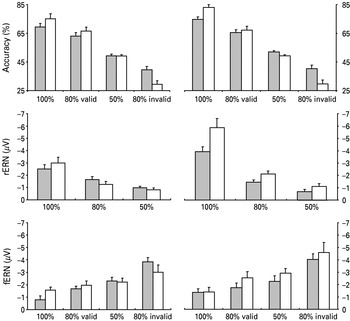
Confirming the validity of our design, an overall analysis of condition (100%, 80% valid, 80% invalid and 50%) revealed that accuracy was highest in the 100% condition, followed by the 80% valid condition, and lowest in the 80% invalid condition [F(3, 27)=86.0, p<0.001]. Accuracy in the 50% condition was around chance level (see Fig. 2).
Behavioural accuracy for individuals with psychopathy (PP) and controls for each condition and the two block halves ( , block half 1; □, block half 2). Error bars indicate standard errors. Mean amplitudes are shown for the response error-related negativity (rERN) and feedback ERN (fERN), for each of the two groups, each condition and the two block halves. Error bars indicate standard errors.

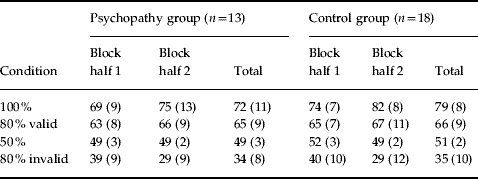
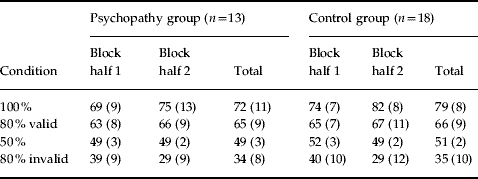
An analysis of the two learning conditions (100% and 80% valid) including block half revealed no overall group differences between psychopathic individuals and controls in accuracy [F(1, 29)=1.65, p=0.209]. However, the significant interaction between condition and group showed that, compared to controls, psychopathic subjects were less accurate in the 100% condition but not in the 80% valid condition [F(1, 29)=6.90, p=0.014]. Planned comparisons by means of an independent t test confirmed this [two-tailed t test 100%: t(29)=2.00, p=0.055; 80% valid: t(29)=0.449, p=0.657]. Accuracy was higher in the second block half than in the first [F(1, 29)=23.8, p<0.001] and this was the same for both groups [F(1, 29)=0.03, p=0.87]. The interaction between condition and block half revealed that the increase in accuracy with block half was more pronounced for the 100% condition (6.9%) than for the 80% valid condition [2.6%; F(1, 29)=14.9, p=0.001]. Most importantly, the three-way interaction between condition, block half and group showed a clear trend towards significance [F(1, 29)=4.05, p=0.054]. Psychopathic individuals show less increase in accuracy between block halves for the 100% condition compared to controls, but a steeper increase between block halves in the 80% valid condition (see Table 1 and Fig. 2). These effects were confirmed by planned independent t tests [two-tailed t test 100% BH1: t(29)=1.74, p=0.093; 100% BH2: t(29)=2.05, p=0.049; 80% valid BH1: t(29)=0.804, p=0.428; t(29)=0.136, p=0.892].
Mean percentage correct responses (and standard deviations) for each group, condition and both block halves separately and across block halves (total)
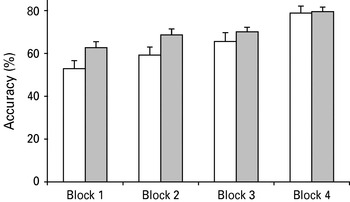
To examine acquisition and generalization of learning rules in the two learning conditions (100% and 80% valid), we investigated accuracy per block. Accuracy increased with each block [F(3, 27)=37.2, p<0.001; all contrasts: p<0.05] without an interaction between block and group [F(3, 27)=1.78, p=0.175]. Planned comparisons showed that individuals with PP had lower accuracy in the first block but not in the fourth [F(1, 29)=5.07, p=0.03, see Fig. 3].
Average amount of correct responses (%) in the two learning conditions (100% and 80% valid) for control (□) and psychopathic individuals (, PP), separately for each block. Error bars indicate standard errors.

ERP findings
fERN
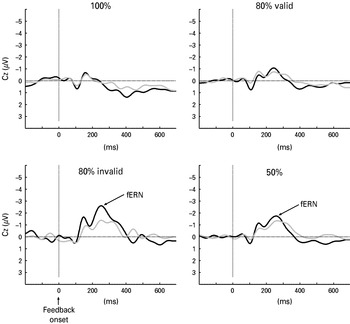
In line with previous studies (Nieuwenhuis et al. Reference Nieuwenhuis, Ridderinkhof, Talsma, Coles, Holroyd, Kok and van der Molen2002, Reference Nieuwenhuis, Nielen, Mol, Hajcak and Veltman2005), comparison of fERN amplitudes between conditions revealed that amplitudes were largest in the 80% invalid condition, in which negative feedback was most unexpected, followed by the 50% condition, the 80% valid condition, and finally the 100% condition [F(3, 27)=7.97, p=0.001, all contrast p<0.05, see Figs 2 and 4].
Grand average feedback error-related negativity (fERN) difference waves (incorrect feedback minus correct feedback) for the control group (—) and the psychopathy ( , PP) group for electrode site Cz and all four conditions (100%, 80% valid, 50% and 80% invalid). Feedback was given at 0 ms; the fERN is indicated by the arrow.

For the fERN in the learning condition (80% valid, 80% invalid and 100%), we did not find any differences in fERN amplitudes between groups or block half, or any interaction between the two (all p's >0.10; see Figs 2 and 4 for mean amplitudes).
rERN
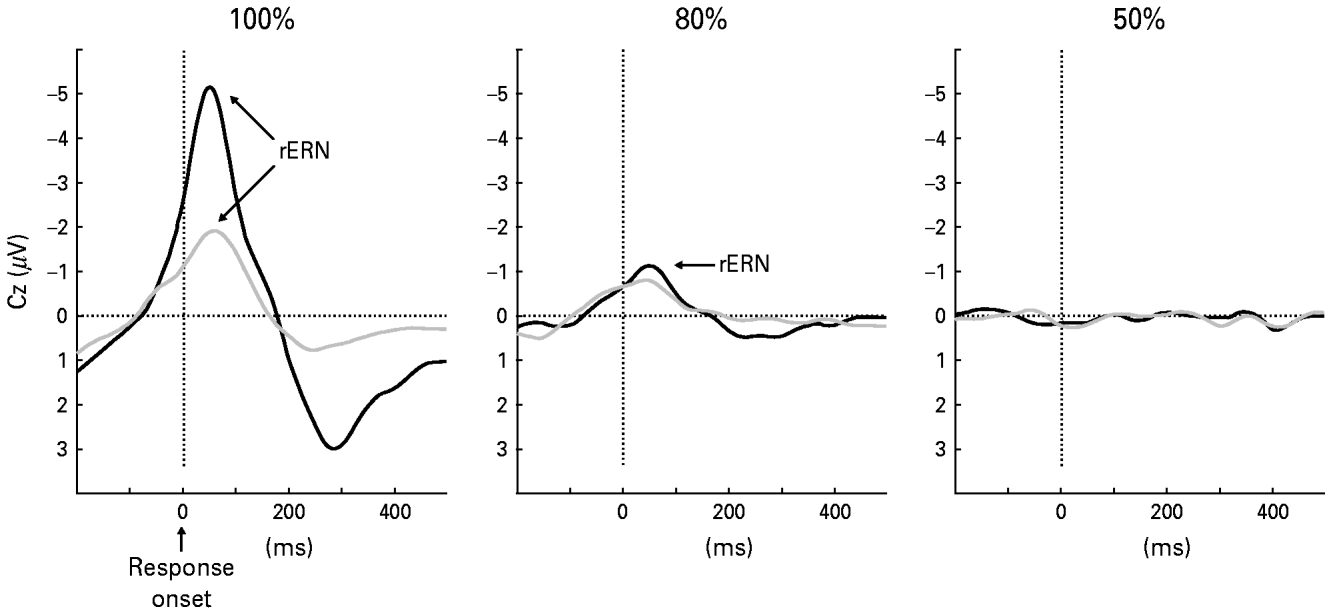
Comparison of rERN amplitudes revealed a main effect of condition [F(2, 28)=42.9, p<0.001, all contrast p⩽0.003]. Amplitudes were largest in the 100% condition, followed by the 80% condition, and almost absent in the 50% condition (see Figs 2 and 5).
Grand average event-related potential (ERP) difference waves (incorrect responses minus correct responses) for the 100%, 80% and 50% condition for the control group (—) and the psychopathy (
, PP) group at electrode Cz. Responses were given at 0 ms; feedback error-related negativity (fERN) is indicated by an arrow.
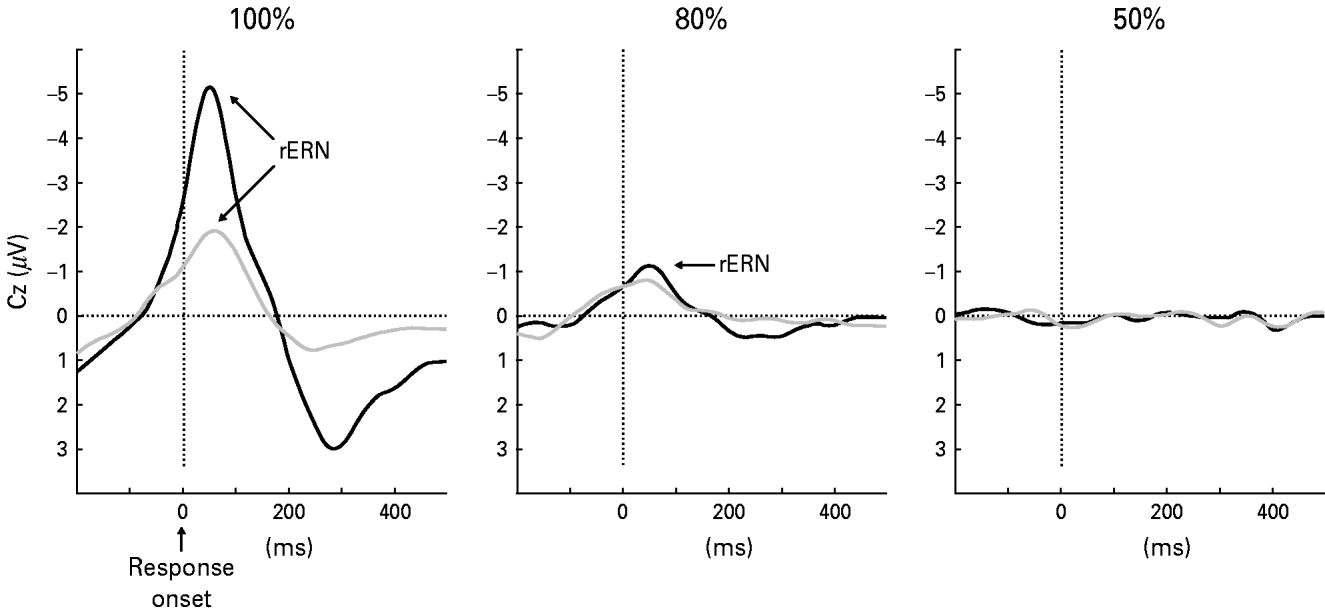
For the rERN in the learning conditions (80% and 100%), we found a main effect for group [F(1, 29)=7.94, p=0.009] and a main effect for block half [F(1, 29)=8.50, p=0.007; see Figs 2 and 5]. The interaction between condition and block half revealed that amplitudes in the 100% condition were larger in BH2 than in BH1, but such a difference was present to a lesser extent or absent in the 80% condition [F(1, 29)=9.03, p=0.005]. This was confirmed by means of a paired t test [two-tailed rERN100BH1 – rERN100BH2: t(30)=3.383, p=0.002; rERN80BH1 – rERN80BH2: t(30)=1.2, p=0.240].
The significant interaction between group and condition showed that, although amplitudes in the 80% condition did not differ between groups, subjects with PP displayed smaller amplitudes in the 100% condition [F(1, 29)=11.4, p=0.002]. Most importantly, the interaction between group and block half was significant [F(1, 29)=7.29, p=0.011], indicating that subjects with PP showed a smaller difference in amplitudes between BH1 and BH2 compared with control subjects. Finally, the three-way interaction between group, condition and block half was not significant [F(1, 29)=0.285, p=0.598].
Discussion
The present study has revealed that individuals with PP showed lower accuracy in a reinforcement-learning paradigm. Furthermore, diminished rERN but normal fERN amplitudes were found in psychopathic individuals.
The current study investigated the relationship between error-monitoring and learning in individuals with PP and healthy controls. At an electrophysiological level, psychopathic individuals showed similar responses as controls to negative external feedback, reflected in the fERN. However, individuals with PP did display problems in using this signal to optimize performance, which was reflected in both the behavioural and electrophysiological data. Behaviourally, patients showed reduced accuracy in the 100% learning condition but not in the 80% learning condition. Additionally, the PP group had a smaller increase in accuracy between block halves in the 100% learning condition and the accuracy rate analyses over blocks demonstrated that individuals with PP had specific problems in the initial learning phase in the first block, but not in the later blocks. Importantly, diminished learning was also associated with the compromised propagation of the fERN to become an rERN. This was mainly reflected in a diminished increase in rERN amplitudes while learning progressed.
Behavioural findings
To master the present task, subjects have to learn the rules and apply them to new pictures in subsequent blocks. Therefore, accuracy is expected to be low in the initial learning phase (the first block) but to increase rapidly during the generalization process (later blocks). Although this pattern was found in both groups, individuals with PP showed diminished accuracy during the first block, suggesting a deficit in initial rule learning. Similar accuracy levels in the last block suggest that psychopathic individuals do reach the same performance level as healthy controls but need more time to do so.
Of note, differences in accuracy were only found in the easiest learning condition and not for the more difficult 80% condition. One explanation for this finding is based on the so-called low-fear hypothesis of PP (Lykken, Reference Lykken1957), which assumes that psychopathic individuals are insensitive to punishment because of a low level of fear. Furthermore, some studies suggest that punishment-based learning is more impaired in PP than reward-based learning (Blair et al. Reference Blair, Mitchell, Leonard, Budhani, Peschardt and Newman2004). If we assume that subjects with PP are impaired in learning based on (negative) feedback, subjects with PP will use substantially less trials to learn from than control subjects in the 100% condition. This then leads to a greater degree of uncertainty, which in turn leads to less accurate responding. In the 80% condition, however, accuracy does not depend solely on the amount of feedback information used. In this condition accuracy increases if the subject reacts as if this was a 100% condition, ignoring the 20% invalid unpredictable trials. Performance thus depends on how many valid trials are processed as useful information and how much of the invalid information is ignored. Therefore, it does not depend on the total amount of feedback information used but on the proportion of valid versus invalid feedback that is used to learn the rule. This is not affected in individuals with PP, which explains why they show the same levels of accuracy in this condition.
Impaired learning under conditions of reward and punishment in psychopathic individuals has been shown before. For example, psychopathic individuals showed impairments in passive avoidance learning (Newman & Kosson, Reference Newman and Kosson1986; Blair et al. Reference Blair, Mitchell, Leonard, Budhani, Peschardt and Newman2004) and on a differential reward/punishment task (Blair et al. Reference Blair, Morton, Leonard and Blair2006).
Contrary to the present results, Budhani et al. (Reference Budhani, Richell and Blair2006) found no acquisition problems in psychopathic individuals during the initial learning phase of a probabilistic response-reversal task. However, some important differences between the response-reversal task by Budhani et al. (Reference Budhani, Richell and Blair2006) and the present task exist that may explain the different outcomes. First, the current task involved more complex learning material because we included three different reinforcement contingencies whereas Budhani et al. (Reference Budhani, Richell and Blair2006) included only two. Second, the total number of stimulus–response associations to be learned in our study was 24. In the response-reversal task of Budhani et al. (Reference Budhani, Richell and Blair2006), only six stimuli had to be associated with a response. Third, their task had no RT restriction whereas the present study used a deadline of 1000 ms. It seems plausible that these differences in complexity largely account for the divergent findings of the two studies. Moreover, the differences demonstrate that possible impairments in PP may only become evident in more complex situations and might be missed in less demanding tasks.
Electrophysiological findings
According to the RL theory (Holroyd & Coles, Reference Holroyd and Coles2002), the fERN elicited by negative feedback is used to update and learn the earliest predictor of punishment. The error signal is carried to the pMFC, where it is used as a reinforcement-learning signal, guiding the adaptation of behaviour. Although individuals with PP show intact processing of external negative feedback at an electrophysiological level, they do not seem to use the error signal to optimally form an internal template of the rules (stimulus–response mappings) at hand. For an rERN to occur, detection of a mismatch between expected and real outcome has to take place (Holroyd & Coles, Reference Holroyd and Coles2002). Prerequisite for this is an internal template of the rules to which the current behaviour can be compared. As no internal template is formed, a comparison between real and expected outcome cannot be made and hence learning, reflected in adaptive behaviour, is compromised. The reduced rERN amplitude thus reflects higher uncertainty due to diminished learning at an electrophysiological level (Pailing & Segalowitz, Reference Pailing and Segalowitz2004). It has been demonstrated that the performance of individuals with PP in certain learning paradigms is modulated by reward but not by punishment (Blair et al. Reference Blair, Morton, Leonard and Blair2006). Additionally, it has been reported that low socialized individuals (a trait closely related to PP) show diminished rERNs under conditions of punishment but not reward (Dikman & Allen, Reference Dikman and Allen2000). With regard to the current task, individuals with PP might have learned based on reward cues, but not on punishment cues, which leads to diminished learning performance as only some of the trials (the rewarded but not the punished) are used to adapt behaviour.
An earlier investigation of the rERN in individuals diagnosed with PP outside a learning context (Munro et al. Reference Munro, Dywan, Harris, McKee, Unsal and Segalowitz2007) reported no indications for diminished amplitudes. Although Brazil et al. (Reference Brazil, de Bruijn, Bulten, von Borries, van Lankveld, Buitelaar and Verkes2009) replicated this finding at an electrophysiological level, their behavioural data demonstrated problems in error signalling in individuals with PP. This suggests that rERN amplitudes are only decreased in PP when related to explicit behavioural adaptations or learning processes but not in the context of simple error detection in a neutral task.
Integration
It is noteworthy that the currently found learning deficits in individuals with PP would not have been predicted by the IES (Blair, Reference Blair2005; Blair et al. Reference Blair, Mitchell and Blair2005) hypothesis of PP. The IES interpretation proposes that an underlying amygdala deficit (Kiehl et al. Reference Kiehl, Smith, Hare, Forster, Brink and Liddle2001; Blair, Reference Blair2003; Pridmore et al. Reference Pridmore, Chambers and McArthur2005) leads to impairments in stimulus–reinforcement associations but not in stimulus–response associations in individuals with PP. However, although the amygdala plays a central role in the first process, other brain structures are involved in the second. Functional magnetic resonance imaging (fMRI) and ERP studies using similar paradigms to the current one have demonstrated an important role for the pMFC (including the ACC and pre-SMA; Holroyd et al. Reference Holroyd, Nieuwehuis, Yeung, Nystrom, Mars, Coles and Cohen2004; Mars et al. Reference Mars, Coles, Grol, Holroyd, Nieuwenhuis, Hulstijn and Toni2005) and the basal ganglia (Holroyd & Coles, Reference Holroyd and Coles2002; Ullsperger & von Cramon, Reference Ullsperger and von Cramon2006) in learning from errors. Currently, the IES interpretation of PP does not include these processes and brain areas and hence does not allow for any specific predictions to be made. Therefore, we argue that, for a better understanding of the learning deficits in PP, neurocognitive models should also focus on the areas involved in the processing of internal and external error messages and the subsequent adaptation of behaviour.
To summarize, our results indicate that learning from negative feedback is compromised in PP. These results are supported by both behavioural and electrophysiological data. Deviancies in error processing may play a crucial role in the learning deficiencies associated with PP. The IES interpretation of PP predicts deficits in certain forms of learning, but does not relate these deficits to the processing of errors. Furthermore, although the model includes aspects of stimulus–response learning and stimulus–reinforcement learning, aspects of internal and external error processing relevant to trial-and-error learning are not included. This differentiation between learning processes also fits with a more recent model of decision making proposed by Rushworth et al. (Reference Rushworth, Behrens, Rudebeck and Walton2007), in which the orbitofrontal cortex, the ACC and the amygdala are part of a neural network involved in learning, action monitoring and social behaviour. Our data suggest that extending the IES interpretation to include error monitoring and areas involved in error monitoring, in addition to more diverse forms of learning, may lead to a broader understanding of the relationship between learning and PP.
Acknowledgements
E.D.B. was supported by a VENI grant from the Netherlands Organization for Scientific Research (NWO) (451-07-022).
Declaration of Interest
None.