1. Introduction
Studies on the behaviour in flow of soft particles such as capsules, vesicles and other biomimetic sacs have attracted growing interest in the past decade (Vlahovska, Podgorski & Misbah Reference Vlahovska, Podgorski and Misbah2009; Barthès-Biesel Reference Barthès-Biesel2011; Li, Vlahovska & Karniadakis Reference Li, Vlahovska and Karniadakis2013; Abreu et al. Reference Abreu, Levant, Steinberg and Seifert2014). These objects are peculiarly useful in biotechnology to control drug delivery in the human body. Their ability to model some membrane properties of red blood cells (RBCs) (Noguchi & Gompper Reference Noguchi and Gompper2005; Freund Reference Freund2014; Winkler, Fedosov & Gompper Reference Winkler, Fedosov and Gompper2014) makes it possible to test each RBC membrane characteristic independently and to investigate the collective motion of RBCs without taking into account the complexity of living cells (Breyiannis & Pozrikidis Reference Breyiannis and Pozrikidis2000; Doddi & Bagchi Reference Doddi and Bagchi2009; Lei et al. Reference Lei, Fedosov, Caswell and Karniadakis2013; Zhao & Shaqfeh Reference Zhao and Shaqfeh2013; Krüger, Kaoui & Harting Reference Krüger, Kaoui and Harting2014; Kumar, Henriquez Rivera & Graham Reference Kumar, Henriquez Rivera and Graham2014).
All of these soft particles share the common characteristic of being drops bounded by a membrane with specific mechanical properties which depend on the kind of constitutive material. Indeed, the membrane of a vesicle is an incompressible bidimensional liquid (a lipid bilayer) with a resistance to bending with no membrane shear elasticity. The membrane of a polymersome is different, as lipids are replaced by copolymers which confers additionally a high shear membrane viscosity. Capsules are very different, as their membranes are made of cross-linked natural or artificial polymers. Their membranes are considered to be 2D elastic solids with a shear and dilatation resistance. However, in fact little is known experimentally on the constitutive law that governs the mechanical response of the membrane to stress, i.e. the relationships between the tensions along the membrane and the local extension ratios. As experiments on capsule membranes are often limited to the determination of the shear elastic modulus in the linear regime, we can only assume the probable existence of several membrane mechanical behaviours. The challenge is to shed light on the nonlinear behaviour of such membranes. For example, a capsule with a membrane made of polysiloxane bursts with minute deformations (4 %, Walter, Rehage & Leonhard Reference Walter, Rehage and Leonhard2001), while capsules with a membrane made of cross-linked proteins sustain moderate to intermediate deformations (Risso, Colle-Paillot & Zagzoule Reference Risso, Colle-Paillot and Zagzoule2006; Lefebvre et al. Reference Lefebvre, Leclerc, Barthès-Biesel, Walter and Edwards-Lévy2008) and even huge deformations, as demonstrated in this paper. Two theoretical models have emerged in the community as generic models to study numerically the behaviour of capsules in flow. The Skalak model has been developed to mimic the membrane mechanics of RBCs (Skalak et al. Reference Skalak, Tozeren, Zarda and Chien1973) with notably a limit to membrane incompressibility. The bidimensional Neo-Hookean (NH) model, a peculiar case of the Mooney–Rivlin model, has been inspired by results on materials such as rubber (Macosko Reference Macosko1994). These two models have the major and supplementary advantage of describing two kinds of mechanical responses: the strain-hardening behaviour for the Skalak model and the strain softening for the NH model. Consequently, to the best of our knowledge, simulations of the dynamics of capsules in various flows have mainly used these models: elongation flow (Lac et al. Reference Lac, Barthès-Biesel, Pelekasis and Tsamopoulos2004; Dodson & Dimitrakopoulos Reference Dodson and Dimitrakopoulos2009; Walter et al. Reference Walter, Salsac, Barthès-Biesel and Le Tallec2010; Dimitrakopoulos Reference Dimitrakopoulos2014), shear flow (Ramanujan & Pozrikidis Reference Ramanujan and Pozrikidis1998; Bagchi & Kalluri Reference Bagchi and Kalluri2009; Vlahovska et al. Reference Vlahovska, Young, Danker and Misbah2011; Yazdani, Kalluri & Bagchi Reference Yazdani, Kalluri and Bagchi2011; Dupont, Salsac & Barthès-Biesel Reference Dupont, Salsac and Barthès-Biesel2013; Wang et al. Reference Wang, Sui, Selt and Wang2013), Poiseuille in a capillary (Queguiner & Barthès-Biesel Reference Queguiner and Barthès-Biesel1997; Pozrikidis Reference Pozrikidis2005) and with a diffuser at the outlet (Zhu et al. Reference Zhu, Roral, Mitra and Brandt2014). Here, we also compute the results using a more elementary model, the generalized Hooke model.
The membrane properties of capsules depend on the fabrication process and notably here on the fact that the membrane results from chemical reactions localized at the interface of an initial drop. The closed geometry brings some constraints to the system which cannot be taken into account by a study on planar membranes. It explains also the continuous development of many techniques to study whole capsules.
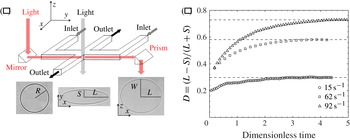
However, experimental investigations of capsules in flow are scarce, in contrast to numerical studies. Thus, the nonlinear behaviour of a capsule in an elongation flow has only been studied in the seminal paper of Chang & Olbricht (Reference Chang and Olbricht1993) with a millimetric biphasic capsule with a membrane of nylon. Numerical simulations predict a non-axisymmetric shape which cannot be confirmed by only one view (
 $z=0$
, figure 1
a) of the capsule as in the experiment of Chang & Olbricht (Reference Chang and Olbricht1993). In this paper, we propose an original method to image the 3D shape of the capsule, namely the sections of capsules in the planes
 $z=0$
and
 $y=0$
(figure 1
a).
Experimental set-up. (a) The two perpendicular cross-sections of the deformed capsule at the centre of the cross are visualized by two light paths. A spherical capsule of radius
 $R$
is deformed by elongation flow and its shape is characterized by its semi-axis length (
 $L$
,
 $S$
) in the
 $z=0$
plane and (
 $L$
,
 $W$
) in the
 $y=0$
plane. (b) Saturation of the Taylor parameter D with the dimensionless time
 $\dot{{\it\epsilon}}t$
for different elongation rates
 $\dot{{\it\epsilon}}$
on one capsule.

In this paper, we investigate experimentally and numerically the deformation of bio-microcapsules in planar elongation flow. In § 2, the experimental set-up and notably the original optical approach are detailed to provide the way to capture the 3D shape of microcapsules up to 180 % of stretching. The numerical methods are based on the association of the boundary integral method (BIM) with the finite element method (FEM) to take into account the membrane elasticity. In § 3, we show that the large range of deformation in the two planes of deformation allows us to determine unambiguously the constitutive law of the membrane of capsules made of pure human serum albumin (HSA): the generalized Hooke model of known Poisson ratio
 ${\it\nu}_{s}$
. We show also that the shear elastic modulus
 $G_{s}$
varies strongly with the capsule size and the HSA concentration, in agreement with recent results (de Loubens et al.
Reference de Loubens, Deschamps, Georgelin, Charrier, Edwards-Lévy and Leonetti2014). The results are highlighted by the excellent agreement – experiments versus numerics – of the variations of the three axes of the shape with the capillary number, validating once more the generalized Hooke model. In § 4, we conclude and discuss the results in the light of the literature.
2. Methods
2.1. Experimental method
Microcapsules were prepared by interfacial cross-linking of HSA with terephthaloyl chloride in a water-in-oil emulsion: 15 %–25 % HSA concentration in the drop,
 $C_{HSA}^{3D}$
, and 1000–1700 r.p.m. stirring speed (Andry, Edwards-Levy & Levy Reference Andry, Edwards-Levy and Levy1996). This leads to various spherical micro-objects embedded in glycerol with radii varying from 30 to
 $80~{\rm\mu}\text{m}$
.
The capsules were deformed in a planar elongational Stokes flow
 $u_{\infty }=\dot{{\it\epsilon}}(x,-y,0)$
in the centre of a cross-like channel with a square section of
 $1~\text{mm}^{2}$
(figure 1), where
 $\dot{{\it\epsilon}}$
is the rate of elongation. The fluid was injected through the inlets by a glass syringe mounted on a home-made pump based on a PI M235-52S actuator. The whole system was built in PMMA with the needles sticking inside to prevent a long transient time. The channel was mounted on an inverted Olympus IX-71 microscope with a magnification of
 $20\times (0.851~{\rm\mu}\text{m}~\text{pixel}^{-1})$
.
Chang & Olbricht (Reference Chang and Olbricht1993) have analysed the shape of millimetric biphasic capsules in the view
 $z=0$
. Here, the two perpendicular cross-sections of the capsule were visualized in
 $z=0$
by the classic optical top-down path of the microscope and
 $y=0$
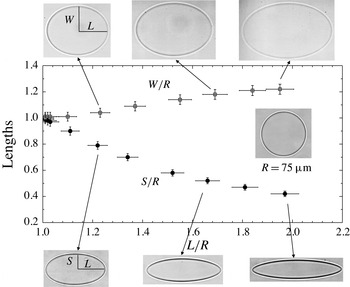
by mounting a mirror and a prism to have two collected light paths, see figure 1. Capsule images in the two views and a typical variation of (
 $W,S$
) with
 $L$
are provided in figure 2.
Typical variations of
 $S$
and
 $W$
versus
 $L$
for a capsule of radius
 $R=75~{\rm\mu}\text{m}$
. The error bars represent
 $\pm 2$
pixels on each length.

A high-speed Photron Fastcam SA3 camera recorded up to 4000 f.p.s. The flow was characterized by particle-tracking velocimetry. The value of
 $\dot{{\it\epsilon}}$
varied from 1 to
 $500~\text{s}^{-1}$
with a standard deviation below 5 % in a region of
 $520~{\rm\mu}\text{m}$
diameter around the stagnation point; see de Loubens et al. (Reference de Loubens, Deschamps, Georgelin, Charrier, Edwards-Lévy and Leonetti2014) for details. Experiments were carried out at a temperature of
 $22\pm 0.5\,^{\circ }\text{C}$
controlled with a precision of
 $0.1\,^{\circ }\text{C}$
. The viscosity of the glycerol,
 ${\it\eta}$
, ranged from 0.99 to 1.18 Pa s. The time for the flow to reach its stationary value depended only on the pump (
 ${\approx}20~\text{ms}$
) as the viscous time was typically 1 ms. To measure steady small deformations, capsules were trapped one by one at the stagnation point of the channel by regulating the hydrostatic pressure at the outlets and moving the piston of the syringe back and forth as often as necessary. Then, flow was applied. The deformation saturated before the capsule left the field of view (circles in figure 1
b). To obtain steady high deformations up to 180 %, capsules were trapped one by one at the stagnation point and gently sucked up in one branch of the channel up to 5 mm from the stagnation point. Flow was applied. The capsule was coming from one branch of the channel already deformed and going back by one of the two perpendicular branches in passing by the stagnation point with a saturated dynamics (squares and triangles in figure 1
b). We checked that these two ways were equivalent for deformations of
 $L$
up to 60 %. All the capsules returned to their initial spherical shapes and their volumes were constant during the stretching, assuming an ellipsoidal shape, 5 % of variation in agreement with the experimental errors. Beyond 180 % of stretching, the first results indicated that the capsules break at the tips for
 $L/R\approx 3$
. This study is beyond the scope of this paper.
The three axes of the ellipsoid (
 $L$
,
 $S$
,
 $W$
) were measured as the Taylor parameter
 $D=(L-S)/(L+S)$
. Twenty-five capsules were analysed. All of the following results are reported in the steady state. Each capsule was studied for approximately seven elongation rates. The deformation of the capsules in the flow was characterized by the capillary number
 $\mathit{Ca}$
, which is defined as the ratio of the hydrodynamic viscous stress
 ${\it\eta}\dot{{\it\epsilon}}$
to the elastic response
 $G_{s}/R$
, with
 $G_{s}$
the surface shear modulus:
 $\mathit{Ca}={\it\eta}\dot{{\it\epsilon}}R/G_{s}$
.
2.2. Numerical method
The shapes of the capsules were calculated numerically in elongation flow as a function of
 $\mathit{Ca}$
in the Stokes flow regime. Far from the capsule, the elongation flow is not perturbed. The membrane is a 2D impermeable (fixed volume) elastic solid involving the continuity of the velocity at the interface. There is no bending resistance, no membrane viscosity and no contrast of fluid viscosity. The mechanical equilibrium involves the balance between the jump of the hydrodynamical stress tensor and the membrane force, which is derived from the surface density energy
 $W^{NH}$
for the strain-softening NH model,
 $W^{Sk}$
for the strain-hardening Skalak model and
 $W^{H}$
for the generalized Hooke model:
 $$\begin{eqnarray}\displaystyle & \displaystyle W^{NH}=\frac{G_{s}}{2}\left(I_{1}-1+\frac{1}{1+I_{2}}\right), & \displaystyle\end{eqnarray}$$
 $$\begin{eqnarray}\displaystyle & \displaystyle W^{Sk}=\frac{G_{s}}{2}\left(I_{1}^{2}+2(I_{1}-I_{2})+CI_{2}^{2}\right), & \displaystyle\end{eqnarray}$$
 $$\begin{eqnarray}\displaystyle & \displaystyle W^{H}=\frac{G_{s}}{4}\left(2(I_{1}-I_{2})+\frac{1}{1-{\it\nu}_{s}}I_{1}^{2}\right), & \displaystyle\end{eqnarray}$$
 $I_{1,2}$
are the usual surface strain invariants,
 ${\it\nu}_{s}$
is the surface Poisson ratio (
 $-1<{\it\nu}_{s}<1$
) for a 2D material and
 $C$
is a positive dimensionless parameter:
 ${\it\nu}_{s}=C/(1+C)$
.
Our simulations are based on the boundary element method (Pozrikidis Reference Pozrikidis2003) for flow resolution, the method used most often for dynamics of soft particles in Stokes flow (Biben, Farutin & Misbah Reference Biben, Farutin and Misbah2011; Boedec, Leonetti & Jaeger Reference Boedec, Leonetti and Jaeger2011; Zhao & Shaqfeh Reference Zhao and Shaqfeh2011, and references in the introduction). Membrane forces are solved by an FEM for the calculation of membrane forces (Walter et al. Reference Walter, Salsac, Barthès-Biesel and Le Tallec2010). The membrane is discretized using Loop subdivision elements (Loop Reference Loop1987). The number of elements used varies between 1280 for small to 20 480 for large deformations. The relative error on the inner volume conservation is less than 0.05 %. Our simulations with the Skalak and NH models are in excellent agreement with reference results in the literature: see supplementary data 1 available at http://dx.doi.org/10.1017/jfm.2015.69 (Lac et al. Reference Lac, Barthès-Biesel, Pelekasis and Tsamopoulos2004; Dodson & Dimitrakopoulos Reference Dodson and Dimitrakopoulos2009; Walter et al. Reference Walter, Salsac, Barthès-Biesel and Le Tallec2010; Dimitrakopoulos Reference Dimitrakopoulos2014).
3. Results and discussion
3.1. Determination of the constitutive law
Experimentally, the steady-state shape of capsules in elongation flow is non-axisymmetric. In both cross-sections, the shape is an ellipse but with different small axis (
 $S$
,
 $W$
):
 $S$
decreases while
 $W$
increases with the stretching (figure 2). However,
 $W/R$
deviates from the resting state value (i.e. from 1 to at least 1.05) for
 $L/R$
larger than 1.3. The linear variation of
 $S$
with
 $L$
and the small change of
 $W$
in the limit of small deformations (
 $L/R<1.1$
) are in agreement with asymptotic theories (Barthès-Biesel, Diaz & Dhenin Reference Barthès-Biesel, Diaz and Dhenin2002). At the highest level of deformation (
 $L/R\approx 2.8$
which corresponds to a stretching of 180 %),
 $S$
decreases by 70 % and
 $W$
increases by 30 %. Hence, the maximal stretches of the perimeters of the ellipses in the planes
 $z=0$
and
 $y=0$
are respectively 270 % and 310 %. These large deformations constitute the key differences from previous experiments where the dilatation of the perimeter of capsules moving in a capillary was limited to 20 % (Risso et al.
Reference Risso, Colle-Paillot and Zagzoule2006; Lefebvre et al.
Reference Lefebvre, Leclerc, Barthès-Biesel, Walter and Edwards-Lévy2008) or the radial extension of compressed capsules was less than 30 % (Carin et al.
Reference Carin, Barthès-Biesel, Edwards-Lévy, Postel and Andrei2003). If
 $A$
is the area of the capsule and
 $A_{o}$
is its value in the resting state,
 $A/A_{o}$
varies from 1 to 1.2 (20 %) for
 $L/R=1.6$
and to 1.8 (80 %) for
 $L/R=2.5$
. Finally, small, moderate and high deformations can be defined as
 $L/R<1.1$
,
 $L/R<1.4$
and
 $L/R>1.4$
.
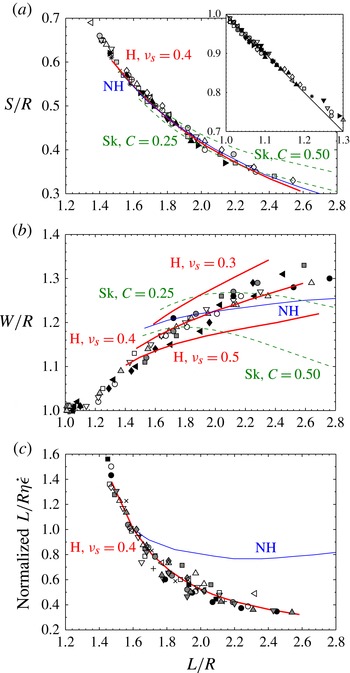
Remarkably, whatever the initial concentration of proteins in the drops and the size of the capsules, all the deformations follow master curves considering the smaller lengths
 $S/R$
and
 $W/R$
as functions of the largest one
 $L/R$
, see figure 3. The deviation between the capsules is less than approximately 5 % for similar values of
 $L/R$
. We emphasise that there is no fitting parameter and no preliminary knowledge of the shear elastic modulus to collapse the experimental data. As we will demonstrate in the following, this purely geometrical analysis and the large deformation allow us to conclude unambiguously on the constitutive law by comparing experimental data with numerical curves.
Variation of the characteristic lengths
 $S/R$
,
 $W/R$
and
 $(L/R{\it\eta}\dot{{\it\epsilon}})/(L/R{\it\eta}\dot{{\it\epsilon}})_{L/R=1.6}$
as a function of
 $L/R$
in elongation flow. Symbols are for experimental results and curves for numerical ones, with H for the generalized Hooke model (bold line), Sk for the Skalak model (dashed line) and NH for the NH model. Here,
 ${\it\nu}_{s}$
is the surface Poisson coefficient for H and
 $C$
is a parameter of Sk. Errors correspond to approximately
 $\pm 5\,\%$
on the half-length
 $W/R$
. Each symbol corresponds to one capsule stretched by several different elongation rates. Numerical simulations are available in supplementary data 2.

Consider the classic view
 $z=0$
, i.e. the visualization used in previous experiments on drops, vesicles and capsules (Chang & Olbricht Reference Chang and Olbricht1993; Stone Reference Stone1994; Kanstler, Segre & Steinberg Reference Kanstler, Segre and Steinberg2007). For
 $L/R<1.8$
, the Skalak, NH and Hooke models are in agreement with the experimental data if the fitting parameter
 $C$
of the Skalak model is well chosen:
 $C\approx 0.5$
. At larger deformations, the Hooke and NH results are still in agreement with experiments. However, the curve
 $S$
as a function of
 $L$
, for
 $C=0.5$
, differs from the master curve satisfied by the experimental results (figure 3
a). This comparison shows that if this view cannot completely discriminate the models, the Skalak numerical curves are very sensitive to the parameter
 $C$
of the model depending on the regime of deformations.
Consider the perpendicular view
 $y=0$
visualized for the first time (figure 3
b). At large stretching, the numerical results differ markedly. In the Skalak model,
 $W$
increases as a function of
 $L$
and has a maximum that corresponds to
 $L/R=1.8$
(2.1) for
 $C=0.5$
(0.25). The experimental data do not show any maximum;
 $W/R$
increases with the stretching without saturation which differs from the decrease of
 $W/R$
at very large stretching for the Skalak model. This comparison allows us to exclude the Skalak model for HSA microcapsules. The numerical curve obtained with the NH model crosses the experimental data (
 $1.9<L/R<2$
). At low (large) stretching, the NH results overestimate (underestimate)
 $W/R$
. The slope of
 $W$
versus
 $L$
is clearly different between experiments and NH simulation, contrary to the Hooke model. Thus, even if the qualitative trend is correct, the NH model does not describe quantitatively the deformations of capsules, contrary to the Hooke model.
It is possible to go further, considering now the hydrodynamic stress
 ${\it\eta}\dot{{\it\epsilon}}$
. The ratio
 $L/R{\it\eta}\dot{{\it\epsilon}}$
decreases continuously when
 $L$
increases for the Hooke model, whereas this ratio saturates and increases weakly at larger stretching for the NH model (figure 3
c). The experimental results differ markedly from the NH curve and are in excellent agreement with the Hooke curve. We conclude that the generalized Hooke model with a Poisson ratio
 ${\it\nu}_{s}=0.4\pm 0.1$
is the most relevant to describe the experimental results for HSA microcapsules.
3.2. Deformations with the capillary number: the shear elastic modulus
Now that the relevant elastic model has been established, the variation of the Taylor parameter
 $D=(L-S)/(L+S)$
with
 $\mathit{Ca}$
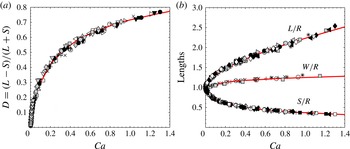
is calculated numerically (figure 4
a). For each studied capsule, experiments provide the values of
 $D$
for approximately seven different elongation rates. For each capsule, the experimental data set is collapsed onto the numerical curve using the last free parameter, the shear elastic modulus
 $G_{s}$
. The error of the regression is less than 10 %. The value of
 $G_{s}$
ranged from 0.7 to
 $16.6~\text{mN}~\text{m}^{-1}$
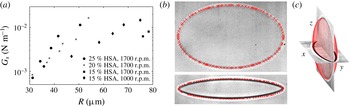
(figure 5). As observed in the linear regime (de Loubens et al.
Reference de Loubens, Deschamps, Georgelin, Charrier, Edwards-Lévy and Leonetti2014),
 $G_{s}$
increases with the initial concentration of proteins,
 $C_{HSA}^{3D}$
, and the size of the capsules, which questions the physical mechanisms involved during the process of cross-linking of the membrane (Gunes et al.
Reference Gunes, Pouzot, Ulrich and Mezzenga2011). In a first approximation assuming a total reaction at the interface, the increasing HSA concentration of the membrane
 $C_{HSA}^{2D}\approx R\,C_{HSA}^{3D}/3$
with
 $R$
and
 $C_{HSA}^{3D}$
supports the observed variations.
Deformation as a function of the capillary number
 $\mathit{Ca}$
. (a) The fitting of the experimental data on the numerical master curve
 $D=f(\mathit{Ca})$
for the Hooke law and a Poisson coefficient of 0.4 provides the shear elastic modulus
 $G_{s}$
. (b) Comparison of the experimental and numerical evolution of the three main axes with
 $\mathit{Ca}$
. Each symbol corresponds to one capsule stretched by several different elongation rates. Numerical simulations are available in supplementary data 2.

(a) Shear elastic modulus as a function of the radius
 $R$
and the HSA concentration. (b) Capsule profiles compared with numerical simulation (red) for the Hooke model in
 $y=0$
(top) and
 $z=0$
(bottom). The capsule has a radius of
 $47~{\rm\mu}\text{m}$
and a stretching
 $L/R$
of 2. (c) The same highly deformed capsule image with experimental and 3D numerical profiles highlights the unexpected flatness of the tri-axial ellipsoid shape. A high-resolution image is available in supplementary data 3.

Finally, it is possible to compare experimental and numerical variations of the semi axes (
 $L$
,
 $S$
,
 $W$
) with the capillary number (figure 4
b). It is noteworthy that the agreement is excellent, supporting once again the generalized Hooke model and the self-consistency of our approach. The dispersion around the numerical simulations is less than
 $\pm 3\,\%$
.
3.3. Discussion
To the best of our knowledge, Lefebvre et al. (Reference Lefebvre, Leclerc, Barthès-Biesel, Walter and Edwards-Lévy2008) were the first to investigate the constitutive law of capsules experimentally. They concluded that membranes made of albumin obey an NH model by studying the deformation of a capsule inside a narrow capillary. We expected the same for our study on HSA capsules, as the method of fabrication is the same and the proteins are of the same family. What could be the origin of this discrepancy? On the one hand, the two proteins differ markedly by their number of amino acids, as illustrated by their molar masses, 45 kDa and 66 kDa for ovalbumin and HSA respectively. Moreover, the purity of the ovalbumin used was approximately 70 % (Sigma-Aldrich, A5253), while in our study the HSA was pure at 98 %. These two elements might make the comparison questionable. On the other hand, Lefebvre et al. (Reference Lefebvre, Leclerc, Barthès-Biesel, Walter and Edwards-Lévy2008) only used the Skalak and NH models to compare experiments with simulations. The generalized Hooke model could describe their experimental results inside a capillary more properly. Further investigations of both the deformation of ovalbumin capsules in an elongation flow and the comparison with the numerical profiles deduced from the Hooke model of axisymmetric capsules moving along a capillary seem to be necessary to clarify the constitutive law of ovalbumin capsules.
4. Conclusion
The behaviour of soft bio-microcapsules in elongation flow has been studied up to the nonlinear regime just before bursting. By a combination of experimental and numerical investigations, we determined unambiguously the constitutive law (or strain–energy) that governs the mechanics of a capsule membrane made of HSA, namely the bidimensional generalized Hooke model. This method could be applied to all capsules that support large stretching, to distinguish clearly the 2D membrane elastic models. Capsules made of chitosan and cross-linked proteins should be good candidates. By extension, this method might be applicable to a wide range of soft particles. In contrast, it needs to be improved for stiffer membranes, with a feedback to maintain the capsule for a longer time at the stagnation point.
Bending resistance was not necessary to capture the overall shape of our capsules with the Hooke model. Indeed, the comparison between the experimental and numerical profiles shows excellent agreement, see figure 5(b). It should be noted that the 3D comparison highlights the unexpected flatness of the tri-axial ellipsoidal shape of a capsule in the high-deformation regime, see figure 5(c) and supplementary data 3. For a small resistance to bending, we could expect localized contributions at the tips or along the membrane in the form of wrinkles in the moderate regime of deformations for which no stationary numerical solution exists (Finken & Seifert Reference Finken and Seifert2006). However, we did not observe any effect on the studied capsules made of HSA. However, if wrinkles are not deep, they could only be seen in the
 $x=0$
plane, an open issue. In the regime of high deformation studied here, the shear and dilatational elastic energy dominates the bending energy. More generally, our general method based on the deformation of a capsule in an elongation flow and the comparison experiments versus numerical simulations should be valid whatever the resistance to bending.
Finally, the robustness of our conclusions was achieved by combining a novel set-up that visualizes the two perpendicular cross-sections of capsules, a range of high capillary numbers and the softness of these capsules associated with numerical simulations. These conditions can be fulfilled in many configurations of flow. A good candidate is the study of the shape dynamics of HSA capsules in a shear flow.
Acknowledgements
We thank F. Edwards-Lévy for the preparation of microcapsules and details on ovalbumin and HSA. This work has benefited from financial support from the ANR CAPSHYDR (11-BS09-013-02), from Labex MEC (ANR-11-LABX-0092), from A*MIDEX (ANR-11-IDEX-0001-02) and from CNES. This work was granted access to the HPC resources of Aix-Marseille Université financed by the project Equip@Meso (ANR-10-EQPX-29-01).
Supplementary data
Supplementary data is available at http://dx.doi.org/10.1017/jfm.2015.69.