Iodine, an essential trace element, is used for the synthesis of thyroid hormones to maintain normal physiological function(Reference Zimmermann and Boelaert1,Reference Zhou, Si and Han2) . There is a U-shaped relationship between iodine intake and thyroid disorders. Both deficient and excessive iodine intake have been demonstrated to affect thyroid function, impairing neurological and physical development(Reference Pearce and Zimmermann3). Lactating women require adequate iodine intake to meet the iodine requirements of both themselves and their infants. Iodine deficiency during lactation may affect the second critical stage of infant brain development, causing irreversible damage(Reference Stinca, Andersson and Herter-Aeberli4,Reference Næss, Aakre and Strand5) . The WHO, the UNICEF and the Iodine Global Network recommended the iodine intake for lactating women at 250 µg/d to meet the iodine requirement of breastfed infants(6).
In general, iodine is predominantly excreted in urine through the kidneys. Iodine nutrition status is usually assessed by the urinary iodine concentration (UIC)(6–Reference Oblak, Hribar and Hristov8). However, in lactating women, iodine can be discharged through the breast milk, resulting in decreased urinary iodine excretion (UIE). In 2007, considering the extra iodine excretion through breast milk in lactating women, WHO recommended that the median UIC of lactating women should be ≥ 100 µg/L, indicating that the iodine status of lactating women was adequate(6). However, the current evaluation criteria used by UIC to assess the iodine nutritional status of lactating women may lead to misleading conclusions, especially for those women at risk of iodine deficiency. Lactating women with iodine deficiency increased the proportion of iodine discharged from milk to meet the iodine demand of the infants(Reference Andersen, Møller and Laurberg9,Reference Henjum, Kjellevold and Ulak10) . Studies have shown that breast milk iodine concentration (BMIC) may be a promising biomarker of iodine status in lactating women(Reference Nazeri, Dalili and Mehrabi11–Reference Liu, Sharp and Luo13). Currently, there is no clear standard for BMIC. Many scholars have reached a consensus on an appropriate BMIC of 100–200 µg/L according to the iodine requirement of infants(Reference Andersen, Møller and Laurberg9,Reference Dold, Zimmermann and Aboussad14,Reference Nazeri, Kabir and Dalili15) . Andersson et al. suggested that it was necessary to use UIC and BMIC to comprehensively evaluate the iodine intake of lactating women(Reference Andersson and Braegger7), according to the unique physiological characteristics of lactating women(Reference Nazeri, Mirmiran and Hedayati16).
Clarifying the metabolism of iodine in urine and breast milk is important for evaluating the iodine status in lactating women. Peter et al. showed that 40–45 % of the iodine intake from the diet was fed to infants through milk, based on data of lactating women with iodine deficiency and excess(Reference Laurberg and Andersen17). In 2017, a study conducted in an iodine-deficient area found that there was a constant iodine excretion by milk (33 %)(Reference Dold, Zimmermann and Aboussad14). The fractional breast milk iodine excretion (FBMIE) was increased in lactating women who consumed low amounts of iodine(Reference Li, Wang and Cheng18). Currently, data on iodine metabolism related to fractional urine iodine excretion (FUIE) and FBMIE in lactating women are limited. This study was conducted to explore the iodine metabolism of FUIE and FBMIE in lactating women with adequate iodine. We estimated the distribution of iodine in breast milk and urine in lactating women and proposed a method to accurately assess the iodine status of lactating women using spot UIC.
Experimental methods
Participants
According to the national standards (GB/T19380–2016) of China, data from the Institute of Endemic Diseases of Henan Province and Tianjin City showed that these areas have adequate iodine. This study was conducted in Tianjin City and Luoyang City in Henan Province, China, from October 2021 to June 2023. The inclusion criteria were as follows: (1) residing locally for at least 2 years; (2) mothers aged between 18 and 44 years; (3) no exposure to iodine-containing supplements or drugs during the past 6 months; (4) no smoking; (5) mothers and infants who had not undergone X-ray or computed tomography examinations in the past year; (6) no history of thyroid disease and normal thyroid function during lactation; (7) infants aged between 0 and 6 months; (8) infants exclusively breastfed; and (9) full-term delivery and singleton birth. Based on previous iodine balance studies(Reference Li, Wang and Cheng18), we established a statistical power of 0·8, α error of 0·05, and an effect size of 1.4. G-Power (version 3.1.9) was used to calculate the sample size; the minimum required sample size was thirty-seven. Seventy pairs of lactating women and infants were recruited from Tianjin and Luoyang. After excluding nine lactating women who had difficulties in sample collection and seven infants who fell ill during the study, fifty-four healthy lactating women were included in the final analysis. All study protocols were approved by the Ethics Committee of Tianjin Medical University, China (approval number: TMUhMEC2020033). Written informed consent was obtained from all the participants.
Daily iodine intake
The participants completed a 24-h dietary record for 3 d to assess food iodine intake. An electronic scale (Huibao; weighing range: 0·1 g–2 kg) and dietary intake records were distributed to all participants. The participants recorded the variety and weight of all the foods consumed during the study. We gave participants regular reminders to record their dietary intake. Lactating women were instructed to avoid consuming high-iodine foods such as laver, kelp, iodine supplements and drugs during the investigation. The iodine content of all foods was obtained from the Chinese Food Composition(Reference Yang, Wang and Pan19). All lactating women were asked to drink from the plastic cups we provided and to record the volume of water during the survey. During the dietary survey, a 5 mL drinking water sample was obtained from each participant’s household into a plastic container (Thermo Fisher Scientific) and kept at –20°C for analysis. We used Modified Food Weighted Records to assess salt iodine intake based on our previous study(Reference Duan, Liu and Zhang20). The Modified Food Weighted Records method included weighing household salt, sodium-containing condiments, pickled foods and leftover cooked salted foods, recording information on individuals eating at home and weight data and calculating salt intake based on this information. The participants were required to collect 10 g of salt in sealed bags and store it at room temperature until analysis. In our study, because mothers did not eat cold food during the investigation, salt was added to the cooking. In the process of calculating the iodine intake of salt, we considered the loss of 20 % iodine during cooking. The iodine intake of each recorded food item was calculated by multiplying the amount of food consumed by the food’s iodine content.
24-h urine sample collection
We collected 24-h urine samples from lactating women for 3 consecutive days to determine 24-h UIE. Participants were required to empty their bladders before 08: 00 a.m. on the first day of the study and then collect all urine samples into the containers we provided within the following 24 h. After remixing, the 24-h urine volume was measured. Urine samples (10 mL) were separated into aliquots in a centrifuge tube (Thermo Fisher Scientific) and stored at −80℃ until analysis. The 24-h UIE was obtained by multiplying the 24-h UIC by 24-h urine volume.
Breast milk sample collection
In total, 24-h breast milk excretion was assessed using the infant weighing method. Lactating women were required to weigh their infants and collect breast milk by manual or breast pump before and after each breastfeeding from the study start time in the morning to the same time the following day. All lactating women were asked not to feed their infants with previously excreted milk. An electronic baby scale (EB522-PK, Huibao; weighing range: 5 g–20 kg; division value: 5 g) was provided to each lactating woman to weigh the infant. Milk samples (5 mL) were collected in polyethylene plastic tubes (Thermo Fisher Scientific) before and after breastfeeding during 24 h to determine the iodine concentration. The investigators transported the breast milk samples each day, and the samples were frozen at −80°C until analysis. Those who used breast pumps to collect milk besides breastfeeding were asked to weigh and record the extra milk output. The lactating women recorded all information regarding the weight of their infants before and after breastfeeding. The 24-h breast milk excretion was the sum of the weight gain after breastfeeding every time, the extra milk output and the milk samples collected before and after each breastfeeding. The iodine concentrations of breast milk before and after breastfeeding were measured, and the average BMIC of these values reflected the BMIC for the current lactation period. The 24-h breast milk iodine excretion (BMIE) was calculated by multiplying the average 24-h BMIC by 24-h breast milk excretion.
Laboratory analysis
According to the Chinese standard (GB 26878), the iodised salt content in Henan Province and Tianjin City was standardised at 30 mg/kg. The qualified iodised salt content was 21–39 mg/kg. The UIC, BMIC, water iodine concentration and salt iodine concentration were analysed using inductively coupled plasma mass spectrometry (iCAPQ, Thermo Fisher Scientific) in the Central Laboratory of Preventive Medicine, Tianjin Medical University. All samples were analysed using tellurium (Te) at a concentration of 100 μg/L as the internal standard. Urine samples were diluted with 0·25 % tetramethylammonium hydroxide. Trace element urine L-2 (Seronorm) was used as the standard reference material for urine samples. Breast milk samples were digested for 180 min at 90°C using 0·5 % ammonia. For breast milk samples, standard reference materials (SRM1549a for whole milk powder) were obtained from the National Institute of Standards and Technology. A 7 mmol/L ammonia diluent was used to dilute the water samples 11-fold. The salt sample was dissolved in ultrapure water and then diluted 100-fold with a 7 mmol/L ammonia solution as the diluent. The intra- and inter-assay coefficients of variation for the UIC, BMIC, water iodine concentration and salt iodine concentration were < 5 %.
Statistical analysis
Data analysis was conducted using SPSS (version 22.0; SPSS Inc.), GraphPad Prism 8.0 software (GraphPad Software, Inc.) and the R Programming Language (version 4.2.1). Normally distributed data were expressed as mean (sd); otherwise, the median (Q1, Q3) was reported. The differences between normally distributed data were evaluated using one-way ANOVA. The difference between non-normally distributed data was examined using the Kruskal–Wallis H test. Spearman correlation analysis was performed to assess the correlation of variables. Locally weighted scatter plot smoothing was performed to assess the best fit between FUIE and FBMIE (ordinate), maternal daily iodine excretion (DIE) and maternal daily iodine intake (abscissa). Piecewise linear regression was fitted using a piecewise function with FUIE and FBMIE as dependent variables and maternal DIE as the independent variable. Threshold and saturation effects were used to estimate the inflection point of the model. A P-value < 0·05 indicated that the difference was statistically significant.
Results
Basic information
The age range of the fifty-four lactating women was 20–39 years. In this survey, 89 % of lactating women had an educational level of bachelor’s degree or above. The mean BMI of lactating women was 23·6 (sd 2·78) kg/m2. Infants aged 2–6 months were included in this study. All infants had weight-for-age z-scores, height-for-age z-scores and weight-for-height z-scores ranging from −2 to 2, suggesting normal growth and development(21). There were no significant differences in the baseline characteristics of lactating women and their infants between Tianjin and Luoyang (all P > 0·05). Table 1 shows the basic characteristics of fifty-four lactating women and their infants.
The basic characteristics of the fifty-four lactating women and their infants

WAZ, weight-for-age Z-score; HAZ, height-for-age Z-score; WAH, weight-for-height Z-score.
Daily iodine intake of lactating women
Table 2 shows the daily iodine intake (DII) of lactating women. There was no significant difference in food iodine intake, water iodine intake, salt iodine intake and DII during the 3 d (all P > 0·05). Among the sources of iodine in the diet, salt contributed 51·9 % of the total iodine intake, and the contribution rates of food iodine and water iodine accounted for 39·1 and 9·0 %, respectively. The edible salt in lactating women was iodised, with a qualified rate of 74·1 %. The mean salt intake and salt iodine concentration were 8·32 (sd 2·76) g/d and 25·4 (sd 6·06) mg/kg, respectively. Considering a 20 % loss of iodine in salt during cooking(6), the mean salt iodine intake during the 3 d was 165·8 (sd 78·4) μg/d. The mean DII during 3 d was 323·7(sd 80·1) μg/d.
Daily iodine intake of fifty-four lactating women (μg/d)

* The contribution rate of food iodine intake, water iodine intake and salt iodine intake to daily iodine intake. The contribution rate was calculated using the mean values of the 3-d survey.
Urinary iodine and breast milk iodine excretion of lactating women
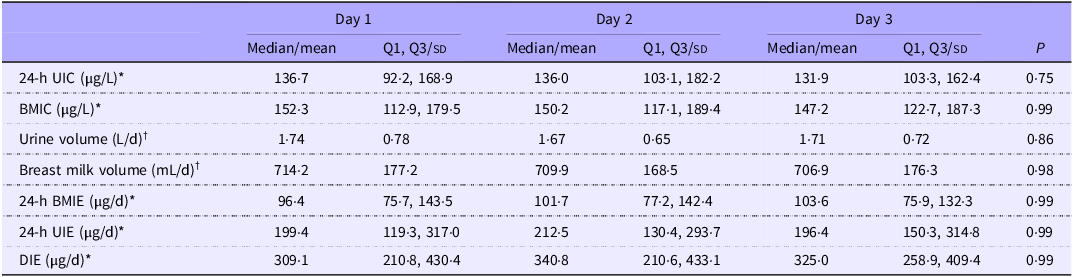
According to the 24-h UIC, BMIC, breast milk excretion and urine volume of lactating women, the median (Q1, Q3) 24-h BMIE and 24-h UIE were 98·9 (77·0, 140·7) μg/d and 201·7(132·5, 310·9) μg/d, respectively. DIE was calculated by adding UIE and BMIE. No significant difference was detected in 3 d of 24-h UIC, BMIC, 24-h BMIE, 24-h UIE or DIE (all P > 0·05) (Table 3).
The iodine excretion through urine and breast milk in fifty-four lactating women

UIC, urinary iodine concentration; BMIC, breast milk iodine concentration; BMIE, breast milk iodine excretion; UIE, urinary iodine excretion; DIE, daily iodine excretion.
*Data are presented as median (Q1, Q3); †Data are presented as mean (sd).
Associations between urinary iodine and milk iodine excretion
According to the correlation analysis, the DIE of lactating women was moderately correlated with the DII (r = 0·48, P = 0·01). There was a moderate association between 24-h BMIE and 24-h UIE (r = 0·34, P = 0·01). 24-h BMIE was moderately associated with DII (r = 0·44, P = 0·02), while DII was not associated with 24-h UIE (P > 0·05).
The inspection of the locally weighted scatter plot smoothing showed that FUIE was significantly higher than FBMIE (P < 0·001). As the iodine excretion levels increased, the FUIE initially increased, reached a steady state and finally increased again, whereas the FBMIE exhibited an inverse pattern. Through piecewise linear regression, we observed that when the DIE ranged from approximately 258 μg/d to 476 μg/d, the FBMIE and FUIE remained relatively stable. The median FBMIE was 40·91 % (Q1, Q3: 28·47 %, 46·58 %), which was lower than the median FUIE of 59·09 % (Q1, Q3: 50·19 %, 72·56 %) (Fig. 1(a)).
(a) Associations between estimated maternal daily iodine excretion and fractional excretion in urine and breast milk. (b) Associations between estimated maternal daily iodine intake and fractional excretion in urine and breast milk. The grey line is the LOWESS line for the fractional excretion in urine; the black line is the LOWESS line for the fractional excretion in breast milk. LOWESS, locally weighted scatter plot smoothing line.

Generally, in a state of iodine homeostasis, approximately 92 % of the total daily iodine intake in adults is excreted through urine(Reference Van der Reijden, Galetti and Burki22). UIC, a reliable indicator, was used for the assessment of iodine nutritional status(Reference Perrine, Cogswell and Swanson23). The calculation formula was as follows:
 ${{{24{\rm{\;h\;UIC\;}}\left( {{\rm{\mu g}}/{\rm{L}}} \right){\rm{\;}} \times {\rm{\;}}24{\rm{\;h\;urine\;volume\;}}\left( {\rm{L}} \right)}}\over{{0\cdot92}}} = {\rm{DII}}\left( {{\rm{\mu g}}/{\rm{d}}} \right)$
. In our study, we found that when the total DIE ranged from 258 μg/d to 476 μg/d, approximately 94 % of the ingested iodine was excreted. Specifically, the FUIE was found to be 59·09 % within this excretion range. We further proposed a formula for calculating the daily iodine intake in lactating women. The formula was as follows:
 ${{{24{\rm{\;h\;UIC\;}}\left( {{\rm{\mu g}}/{\rm{L}}} \right) \times {\rm{\;}}24{\rm{\;h\;urine\;volume\;}}\left( {\rm{L}} \right){\rm{\;}}}}\over{{0\cdot59 \times 0\cdot94}}} = {\rm{DII}}\left( {{\rm{\mu g}}/{\rm{d}}} \right)$
.
Figure 1(b) indicates that in lactating women with adequate iodine (240–600 μg/d), the FBMIE remained relatively constant at 31·48 % (95 % CI: 27·16 %, 36·22 %). Further analysis revealed that as DII increased, FUIE decreased, whereas FBMIE initially declined gradually, plateaued and increased slightly. In the stage of DII below 600 μg/d, FUIE was higher than FBMIE. Given the small sample size beyond this range, further research is required to validate these findings.
Discussion
Breast milk serves as the sole source of iodine for exclusively breastfed infants; therefore, an appropriate BMIC is vital for the normal growth and development of infants(Reference Henjum, Kjellevold and Ulak10,Reference Huang, Li and Hwu24) . Many studies showed that BMIC values ranging from 100 to 200 μg/L have indicated adequate iodine intake for breastfed infants(Reference Andersen, Møller and Laurberg9,Reference Henjum, Kjellevold and Ulak10,Reference Dold, Zimmermann and Aboussad14,Reference Nazeri, Kabir and Dalili15) . In our study, the median BMIC and UIC were 150·26 µg/L and 135·06 μg/L, respectively. According to the UIC cut-offs for iodine adequacy in lactation suggested by the WHO/UNICEF/Iodine Global Network(6), the iodine status of lactating women in Tianjin and Luoyang, where iodised salt was covered, was adequate.
The WHO recommends using the median UIC to evaluate iodine status in a population(6). In adults, iodine is primarily excreted through the urine. Many studies have used 24-h UIE to estimate 24-h iodine intake(Reference Beckford, Grimes and Margerison25–Reference Griebel-Thompson, Sands and Chollet-Hinton27), indicating increased iodine excretion with iodine intake. We found that DIE in lactating women was positively associated with DII, which was consistent with the findings of Bath et al. (Reference Bath, Sleeth and McKenna26). Lactating women need to increase iodine intake to meet iodine requirements because a part of the iodine intake is transported into the mammary gland and excreted through breast milk. Jin et al. found that under iodine deficiency, FBMIE increased with decreasing iodine excretion, while FUIE decreased, then FBMIE and FUIE remained stable(Reference Jin, Coad and Skeaff28). A study conducted in three iodine-sufficient areas showed that the fraction of iodine excretion in breast milk was higher than that in urine under low iodine intake(Reference Dold, Zimmermann and Aboussad14). We observed that FBMIE and FUIE remained relatively stable when the DIE was 258–476 μg/d, and FBMIE increased when the DIE was < 258 μg/d, while FUIE decreased. This suggested that maternal iodine intake affected the distribution of iodine in milk and urine. Particularly when iodine intake was low, maternal iodine was preferentially allocated to milk. Even under the condition of insufficient iodine nutrition, the iodine requirement of infants can be met by breast milk(Reference Jin, Coad and Skeaff28). This may be due to the regulatory mechanism of the mammary gland, where iodine is transported into breast milk through the increased expression of the sodium iodide symporter, which increases the secretion of breast milk iodine(Reference Fu, Gao and Guo29). Peter et al. proposed that mothers delivered 40–45 % of their DII to their infants(Reference Laurberg and Andersen17), based on data from lactating women with abnormal iodine nutrition. These results are similar to those of the present study.
In our study, the median UIC and BMIC of lactating women were 135·06 μg/L and 150·26 μg/L, respectively, which demonstrated that the lactating women were at the appropriate level of iodine. When the DII ranged from 240 μg/d to 600 μg/d, lactating women delivered 31·48 % (95 % CI: 27·16 %, 36·22 %) of the ingested iodine to breast milk. Meanwhile, we found that the median BMIE (98·9 μg/d) was close to the recommended level (85 μg/d) for infants aged 0–6 months in China, indicating that the iodine status of the investigated lactating women can meet the iodine requirements of infants. This suggested that BMIE was an important index for evaluating iodine levels in lactating women. During lactation, iodine was mainly excreted via urine and milk, with only a small amount excreted through faeces(Reference Liu, Sharp and Villanueva12). Our results found that the FBMIE and FUIE were all less than 50 %. When iodine intake increased, we speculated that the lactating women would excrete more iodine through urine and faeces to reduce the potential harmful effects on the infants. Animal studies showed that the expression of sodium iodide symporter protein in the mammary gland decreased with the increase of iodine intake, which indicated that the ability to transport iodine in the mammary gland changed with iodine intake(Reference Fu, Gao and Guo29). The mammary gland played a regulatory role in reducing the harm of excessive iodine to offspring, thus increasing the amount of iodine excretion through urine and faeces. Further studies are needed to clarify the characteristics of iodine excretion under excess iodine intake.
Given the challenges associated with collecting 24-h urine samples during the investigation, spot urine samples are typically collected to estimate daily iodine intake. The DII could be estimated using spot urine samples when the DIE ranges from 258 to 476 μg/d. Based on the FUIE (59 %) and total iodine excretion ratio (94 %), the formula used to estimate DII was as follows:
 ${{{{\rm{UIC}}\left( {{\rm{\mu g}}/{\rm{L}}} \right){\rm{\;}} \times {\rm{\;}}\left( {0\cdot0009{\rm{\;L}}/{\rm{h}}/{\rm{kg}} \times 24{\rm{\;h}}/{\rm{d}}} \right){\rm{\;}} \times {\rm{\;body\;weight\;}}\left( {{\rm{kg}}} \right)}}\over{{0\cdot59 \times 0\cdot94}}} = {\rm{DII}}\left( {{\rm{\mu g}}/{\rm{d}}} \right)$
. The average 24-h urine volume for adults is approximately 1·5 L(Reference Charlton, Ware and Baumgartner30), which is consistent with the extrapolation results of children (0·0009 L/h/kg)(Reference Beckford, Grimes and Margerison31). We referred to the method of assessing daily iodine intake in adults(32) and combined the FUIE and total iodine excretion ratio obtained from our study in lactating women to obtain the present formula. Based on this formula, spot UIC can more conveniently assess the iodine nutritional status of lactating women, thereby avoiding the difficulties associated with collecting 24 h urine samples in population surveys. In addition, it considered the distribution of iodine excretion in lactating women.
In this study, we discovered the iodine metabolic characteristics of Chinese lactating women at appropriate iodine levels, particularly the fractional iodine excretion in breast milk and urine, which significantly differ from those of adults. In general, adults excrete approximately 90 % of ingested iodine through urine, so the evaluation of iodine nutrition of adults was based on UIC(Reference Zimmermann, Jooste and Pandav33). However, our research found that lactating women excreted approximately 59·09 % of iodine through urine. We obtained a formula for calculating iodine intake of lactating women by using spot UIC, which was used to accurately evaluate the iodine nutritional status of lactating women. The present study has some limitations. First, given that participants who met the inclusion criteria and completed the entire survey were recruited from iodine-sufficient areas, future studies should include individuals with different levels of iodine intake and expand the sample size. Second, more random urine samples should be collected from lactating women with appropriate iodine levels to verify the practical applicability of this formula. Moreover, the excretion of iodine via faecal, respiratory and sweat pathways was not assessed, potentially resulting in an underestimation of iodine excretion.
Conclusions
Under conditions of adequate iodine intake, lactating women delivered approximately 31·48 % of their DII to infants through milk. In a state of stable iodine excretion ranging from 258 to 476 μg/d, mothers excreted approximately 59·09 % of iodine through urine, providing a valuable reference for assessing the iodine nutritional status of lactating women using spot urine samples.
Acknowledgements
The authors thank Tianjin Medical University for their contribution and support. We also thank Tianjin Key Laboratory of Environment, Nutrition and Public Health and the Key Laboratory of Prevention and Control of Major Diseases in the Population for providing the experimental platform for this research.
This work was supported by the National Natural Science Foundation of China (grant number 81920108031).
Y. Z.: Writing – original draft, Data curation and Software. X. Z.: Conceptualisation, Data curation. H. H. M.: Investigation, Methodology. X. M. J.: Methodology and Data Curation. Z. X. Z., Z. C. Z., X. J. H., P. X. W. and X. Z. J.: Data curation. W. Q. Z.: Supervision, Funding acquisition. Z. N. S.: Supervision, Writing – review and editing.
All of the authors have no conflicts of interest.