Introduction
The English language was first taken to Ireland in the late twelfth century and enjoyed a modest position in late medieval Irish society, a position which betrayed no sign of the later dominance of English in Ireland as in so many countries to which the language was taken during the period of English colonialism. The fate of the English language after initial settlement was determined by the existence of Irish and Anglo-Norman as widely spoken languages in the country. Irish was the continuation of forms of Celtic taken to Ireland in the first centuries BCE and the native language of the great majority of the population at the time settlers from Britain first arrived in Ireland. Anglo-Norman was the form of French used by the nobility in England and particularly in the marches of south and south-west Wales, the region from which the initial settlers in the south-east of Ireland came.
The Anglo-Normans shifted to Irish in the centuries following the invasion of 1169 due to inroads into the towns of the east coast – the stronghold of initial settlers (both English and Anglo-Norman) from the late Middle Ages – which were made by Irish speakers. In their castles in the countryside the Anglo-Normans were absorbed linguistically by the surrounding Irish-speaking population. By the end of the fifteenth century they could with justification be described as ‘more Irish than the Irish themselves’. This section of the Irish population was known as the ‘Old English’ (Irish: Sean-Ghaill) and were distinct from settlers who arrived in Ireland in the seventeenth century as the result of various conquests and takings of land by the English.
The countryside was populated by a series of ‘plantations’, arrangements of land in which English aristocracy had possession and administered the land via bailiffs with local Irish working as labourers. Initially, the plantation system was not successful (in the centre and south-west of the country), but in the north it was, given that the settlers were non-aristocratic and came in large numbers from central and lowland Scotland to build a livelihood for themselves in the northern province of Ulster. This particular group formed the core of the later Protestant population of the north of Ireland and is clearly identifiable by accent to this day.
The above historical facts justify a division of the history of English in Ireland into two large time blocks, one from approx. 1200 to 1600 and another from approx. 1600 to the present-day.
Language shift
The rise in status and power for the English in Ireland meant that their language exercised a strong influence on the native Irish whose own language was excluded from public affairs in Ireland due to a series of draconian legal measures, known collectively as the Penal Laws. It was clear from the seventeenth century onwards that advancement in Irish society demanded competence in English and so increasingly large numbers of native Irish shifted to the language of the colonial power.
The shift was not sudden and it is clear from historical documents that bilingualism were found to a varying extent and that bilingual audiences existed, for instance in eighteenth-century Dublin. But the absence of schooling in Irish and the urging of native leaders to switch to English meant that any kind of stable bilingualism with a functional distribution according to public and private usage, i.e. diglossia, was never really a viable scenario for the native Irish. And so for the majority of the population language shift was what increasingly characterised their linguistic behaviour with the ultimate rise of generations of native speakers of English who were overwhelmingly descendants of Irish speakers.
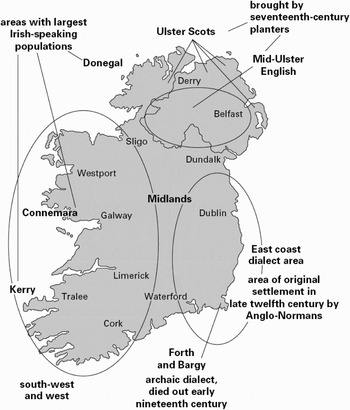
The move away from Irish towards English happened earliest in the east of the country, in the area from just north of Dublin down to Waterford. This is nowadays a distinct dialect area with features stemming from the first period, i.e. before 1600 (see Hickey, Reference Hickey, Kirk and Baoill2001).
The dialect of Forth and Bargy in the south-east corner of the country is the only complete survival of English from the first period, i.e. before 1600. This was the subject of antiquarian interest in the late eighteenth and nineteenth centuries and glossaries of it were published, e.g. Barnes (Reference Barnes1867). This material has been re-edited recently (Dolan and Ó Muirithe eds, Reference Dolan and Muirithe1996 [1979]) and a linguistic analysis is contained in Hickey (Reference Hickey2007, section 2.4).
The western seaboard of Ireland is the large region in which the Irish language survived longest. From Co. Donegal down to Co. Kerry there are still pockets of Irish native speakers, remnants of a much wider distribution in the west which existed up to the end of the nineteenth century.
Consequences of shift
The change in language for the majority of the Irish-speaking population has been viewed by many linguists as the chief source of non-standard features in Irish English though some scholars attribute these to inherited regional and/or archaic features of English or to independent developments. The case for contact has been discussed extensively in the literature (see the review in Hickey, Reference Hickey2007: section 4.2 and the references in Filppula, Reference Filppula1999 and Corrigan, Reference Corrigan2010).
The north-south split
The dialects of the northern province, Ulster, are quite different from those in the south. The main reason for this is that they derive from Lowland Scots and forms of northern English which were taken to Ulster during the plantations of the seventeenth century. These varieties led to easily recognisable forms of English arising in the north. However, the English of the two main ethnic groups in the north, Protestants and Catholics, are not usually distinguishable by their English (but see McCafferty, Reference McCafferty2001 for some differences with regard to innovation and conservatism in the respective communities).
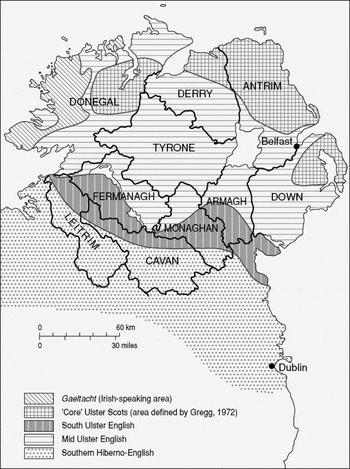
Ulster speech has been treated in many publications, some of these book-length, such as Adams (ed., 1964), an early collection of articles, or Mallory (ed., 1999), a more recent volume. In Ulster, the status of Ulster Scots is a topic of considerable controversy, not only among linguists (see the discussion in Hickey, Reference Hickey2007: section 3.3). Treatments of it as a separate language are Fenton (Reference Fenton2006), a lexical study, and Robinson (Reference Robinson1997), a more general one.
The question of names
There are different designations for the many varieties of English spoken on the island of Ireland. In the north of the country, terms are used which reflect historical origin, e.g., Ulster Scots for the English deriving from the initial Lowland Scots settlers, Mid-Ulster English for geographically central varieties which are largely of northern English provenance. Contact English is found occasionally to refer globally to varieties spoken in areas where Irish is also spoken. In general treatments of English in the south of Ireland, three main terms can be found.
– Anglo-Irish is an established term in literature to refer to works written in English by authors born in Ireland. It is also found in politics to refer to relations between England and Ireland. Within the context of other varieties – Canadian English, for instance – the term is still used to refer to English in Ireland (Kirwin, Reference Kirwin and Clarke1993).
– Hiberno-English is a learned label derived from the Latin term Hibernia ‘Ireland’. The term enjoyed a certain currency in the 1970s and 1980s, but in the 1990s, many authors ceased to employ it, as it contributes nothing in semantic terms and is unnecessarily obscure, often requiring explanation to a non-Irish audience or readership.
– Irish English is the simplest and most convenient term. It has the advantage that it is parallel to the designations for other varieties, e.g., American, Australian, Welsh English, and can be further differentiated where necessary. Throughout the present article this term will be used.
The main dialect divisions in Ireland

Ireland as a linguistic area
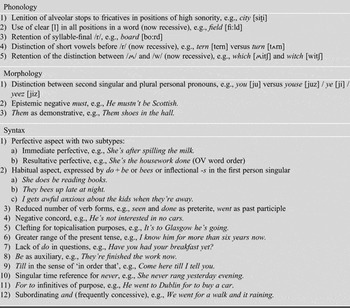
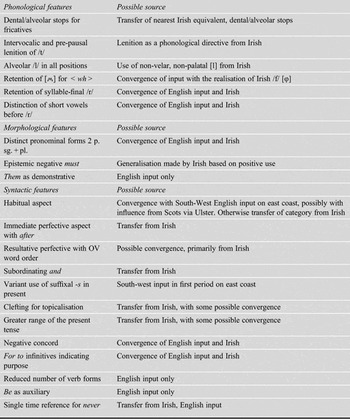
Despite the different forms of English referred to above and despite their differing geographical distributions there is a kernel of features shared by many if not all vernacular varieties of English on the island of Ireland (Hickey, Reference Hickey and Mallory1999a) (See Table 1). In more supraregional varieties some features are not to be found, e.g. a distinction between tern [tern] and turn [t^rn], but this is an effect of standardisation through which less local pronunciations are adopted by speakers. For the south of Ireland (and in many instances for the north also) the following features are shared by all vernacular varieties. However, not all the features are strongly diagnostic of Ireland as a linguistic area as they are also found in forms of English in England, quite apart from anglophone varieties overseas.
Shared features in vernacular varieties of Irish English

Interpreting features of Irish English
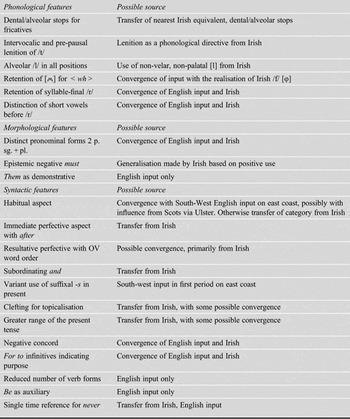
In the scholarly literature on Irish English, language transfer during contact has been put forward as a source for some features and retention of archaic and/or dialect features from input varieties for others. Indeed both sources have been postulated for a few features. Furthermore, more universal tendencies in language development in a situation of unguided adult second language acquisition have been seen as responsible for some other features (see the discussion in Corrigan, this issue), especially those which might derive from the pragmatics of language shift, such as topicalisation or the use of paratactic clause sequences.
Dialect divisions in the north of Ireland

Apart from the putative source of specifically Irish English features, there have been various suggestions concerning the linguistic models to use in interpreting such features. For instance, in the area of aspect, there have been attempts to use grammaticalisation models (Kallen, Reference Kallen1989) and prototype theory (Hickey, Reference Hickey and Tristram2000a) to arrive at a satisfactory description of the linguistic facts. Greene (Reference Greene1979) and Ó Sé (Reference Ó Sé1992, Reference Ó Sé2004) are influential articles describing the verbal systems of Irish.
Transportation
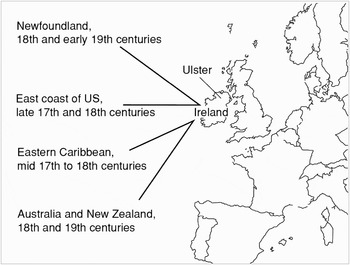
During the colonial period (1600–1900) the emigration from Ireland (Fitzgerald and Lambkin, Reference Fitzgerald and Lambkin2008), both north and south, was generally motivated by the desire to escape unfavourable circumstances in Ireland or the emigration was orchestrated by the English authorities; the latter was the case with deportation. There are two occasions when significant groups of Irish were deported to overseas locations and exercised an influence on a variety during its formative years. The first was in the south-east Caribbean, notably on Barbados (and later on Montserrat), where Irish were deported in the 1650s by Oliver Cromwell. The second was in Australia where deportations of Irish took place in the early days of the country, i.e. in the decades immediately following the initial settlement of 1788 in the Sydney area.
Another type of emigration has to do with religious intolerance, whether perceived or actual. During the eighteenth century the tension between Presbyterians of Scottish origin in Ulster and the mainstream Anglican church over the demands of the latter that the former take an oath and sacramental test resulted in an increasing desire to emigrate (along with economic pressure), in this case to North America (see below).
A further reason for emigration is economic necessity. This kind of emigration is what later came to characterise the movement of very large numbers of Irish to Britain, Canada and above all to the United States in the nineteenth century, but it was also a strong contributory factor with the Ulster Scots in the eighteenth century.
Ulster Scots in the United States
The situation in Ulster of the early seventeenth century was characterised by a combination of economic and religious factors. But there is consensus among historians today (Miller, Reference Miller1985; Foster, Reference Foster1988: 215f.; Bardon, Reference Bardon1996: 94) that economic reasons were probably more important, the increase in rents and tithes along with the prospect of paying little rent and no tithes or taxes in America. Added to this were food shortages due to failures of crops, resulting in famine in 1728/9 and most severely in 1741. Foster (Reference Foster1988: 216) stresses that the nature of Ulster trade facilitated emigration: the ships which carried flax seed from America were able to carry emigrants on the outward journey. Up to 1720 the prime destination was New England and this then shifted somewhat southwards, to Pennsylvania (from where the Irish frequently pushed further south, Algeo, Reference Algeo and Algeo2001: 13f.; Montgomery, Reference Montgomery and Algeo2001: 126) and later to South Carolina. The rate of emigration depended on the situation in Ireland. In the late 1720's, in the 1760's and in the early 1770's there were peaks of emigration which coincided with economic difficulties triggered by crop failure or destruction in Ireland (Montgomery, Reference Montgomery and Tristram2000: 244f.).
Suggestions for sources of key features of Southern Irish English
The option of emigration in the eighteenth century was open more to Protestants than to Catholics. The latter would equally have had substantial motivation for emigrating: after all the Penal Laws, which discriminated against Catholics in public life, were in force from at least the mid-seventeenth to the end of the eighteenth century. However, the Protestants who left were not necessarily in a financially better position, indeed many were indentured labourers who thus obtained a free passage. Foster (Reference Foster1988loc. cit.) assumes that the Protestants were more ready to move and subdue new land (as their forefathers, who came from Scotland, had done in Ulster to begin with).
Emigration from Ireland during the colonial period

The Ulster Scots emigration (Wood and Blethen (eds), 1997) is not only important because of its early date but because it established a pattern of exodus to America which, apart from Merseyside and to a much lesser extent Tyneside, became the chief destination of Irish emigration in the northern hemisphere (Miller and Wagner, Reference Miller and Wagner1994). Estimates suggest that throughout the eighteenth century emigration ran at about 4,000 a year and totalled over a quarter of a million in this century alone (Duffy (ed.), 1997: 90f.).
The Catholic dimension to Irish emigration
Of all countries which absorbed Irish immigrants it was the United States which bore the lion's share. The figure for the entire period of emigration to America is likely to be something in the region of 6–7 million (Montgomery, Reference Montgomery and Algeo2001: 90) with two peaks, one in the eighteenth century with Ulster Scots settlers (see previous section) and the second in the mid-nineteenth century, the latter continuing at least to the end of that century. The greatest numbers of Irish emigrants went in the years of the Great Famine (at its height in 1848–9) and immediately afterwards, with a reduction towards the end of the century.
For the years 1847 to 1854 there were more than 100,000 immigrants per year. These Irish show a markedly different settlement pattern compared to their northern compatriots who left in the previous century. Whereas the Ulster Scots settled in Pennsylvania and South Carolina, the Catholic Irish, from the mid-nineteenth century onwards, stayed in the urban centres of the eastern United States accounting for the sizeable Irish populations in cities like New York and Boston (Algeo, Reference Algeo2001: 27; Montgomery, Reference Montgomery and Tristram2000: 245). The reason for this switch from a rural way of life in the homeland to an urban one abroad is obvious: the memories of rural poverty and deprivation, the fear of a repetition of famine, were so strong as to deter the Irish from pushing further into the rural mid west unlike other groups such as Scandinavian or Ukrainian immigrants.
The desire to break with a background of poverty explains why the Irish abandoned their native language. It was associated with backwardness and distress and the leaders of the Catholics – such as Daniel O'Connell – were advocating by the beginning of the nineteenth century that the Irish switch to English as only with this language was there any hope of social betterment.
Diminished tolerance and their own desire to assimilate rapidly meant that virtually no trace of nineteenth-century Irish English was left in the English spoken in the eastern United States where the later Irish immigrants settled (but see Laferriere Reference Laferriere, Allen and Linn1986 for possible traces in Boston English). In addition this emigration was quite late, and further removed from the formative years of American English, than was the earlier Ulster Scots movement to the New World. Nonetheless, there may be some lexical elements from Irish in American English, such as dig ‘grasp’ < Irish tuigim ‘understand’, slew ‘large number’ < Irish slua ‘crowd’, phoney ‘bogus’ < Irish fáinne ‘ring’ (putatively traced to the Irish practice of selling false jewellery) or so long ‘goodbye’ < Irish slán ditto where the transition from [s] to a velarised [t] could have suggested an extra syllable to English speakers.
Canada
The Irish emigration to Canada must be divided clearly into two sections. The first concerns those Irish who settled in Newfoundland and the second those who moved to mainland Canada, chiefly to the province of Ontario, the southern part of which was contained in what was then called Upper Canada.
The oldest emigration is that to Newfoundland which goes back to seasonal migration for fishing with later settlement in the eighteenth and early nineteenth centuries and is a special case (Hickey, Reference Hickey2002a). The second layer is that of nineteenth century immigrants who travelled up the St Lawrence river to reach inland Canada. There was further diffusion from there into the northern United States. The numbers of these immigrants is much less for Canada, only a fifth of the numbers which went to the United States (upwards of 300,000 leaving for Canada during the entire nineteenth century). But seen relatively, this is nonetheless significant and some scholars maintain that elements of Irish speech are still discernible in the English of the Ottawa Valley (Pringle and Padolsky, Reference Pringle and Padolsky1981, Reference Pringle and Padolsky1983).
Newfoundland
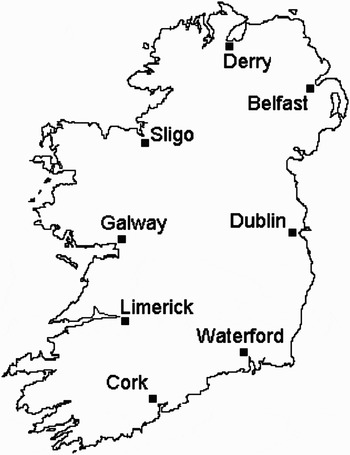
The Newfoundland settlement of Canada is unique in the history of overseas English. The initial impetus was the discovery of the abundant fishing grounds off the shores of Newfoundland, the continental shelf known as the Grand Banks. Irish and West Country English fisherman began plying across the Atlantic in the seventeenth century in a pattern of seasonal migration which took them to Newfoundland to fish in the summer months. The English ships traditionally put in at southern Irish ports such as Waterford, Dungarvan, Youghal and Cork to collect supplies for the long transatlantic journey. Knowledge of this movement by the Irish led to their participation in the seasonal migration. Later in the eighteenth century, and up to the third decade of the nineteenth century, several thousand Irish, chiefly from the city and county of Waterford (Mannion (ed.), 1997), settled permanently in Newfoundland, thus founding the Irish community there (Clarke, Reference Clarke and Kallen1997) which together with the West Country community forms the two anglophone sections of Newfoundland to this day.
Among the features found in the English of this area which can be traced to Ireland is the use of ye for ‘you’-PL (which could be a case of convergence with dialectal English), the perfective construction with after and present participle, as in He's after spilling the beer, and the use of an habitual with an uninflected form of do plus be. Although Clarke (Reference Clarke and Kallen1997: 287) notes that the positive use of this is unusual in general Newfoundland English today – her example is That place do be really busy – it is found in areas settled by southeastern Irish. This observation correlates with usage in conservative vernacular forms of southeastern Irish English today (Hickey, Reference Hickey, Kirk and Baoill2001: 13) and is clearly suggestive of an historical link.
There are also reports of lexical items of putative Irish origin such as sleeveen ‘rascal’, pishogue ‘superstition’, crubeen ‘cooked pig's foot’, etc. (Kirwin, Reference Kirwin and Clarke1993: 76f.; Reference Kirwin and Algeo2001). For a detailed discussion of these and similar features of Newfound-land English, see the relevant sections in Clarke (Reference Clarke2010) and Hickey (Reference Hickey2002a).
Mainland Canada
Mainland Canada was also settled by Irish. Here the Irish were among the earliest immigrants and so formed a ‘charter group’ and hence enjoyed a relatively privileged status in early Canadian society. By the 1860s the Irish were the largest section of the English-speaking population in Canada and constituted some 40% of the British Isles immigrants in the newly founded Canadian Confederation. In mainland Canada the Irish came both from the north and south of the country but there was a preponderance of Protestants (some two thirds in the nineteenth and twentieth centuries) as opposed to the situation in Newfoundland where the Irish community was almost entirely Catholic.
The Protestants in Canada had a considerable impact on public life. They bolstered the loyalist tradition which formed the base of anglophone Canada.Footnote 1 As these Irish Protestants were of Ulster origin they also maintained their tradition of organisation in the Orange Order which was an important voluntary organisation in Canada.
In mainland Canada the Irish dispersed fairly evenly throughout the country, even if there was a preponderence in Ontario and in the Ottawa Valley. There is nothing like the heavy concentration of Scotch-Irish in Appalachia (Montgomery Reference Montgomery1989) or that of later, post-Famine Irish in the urban centres of the north-east USA such as New York and Boston (see above).
The influence of nineteenth century immigration on Canadian English is not as evident as in Newfoundland. Nonetheless, one should mention one feature which Canadian English has in common with varieties of English in the north of Ireland (Gregg, Reference Gregg1973), what is known in linguistic literature as ‘Canadian Raising’ (Chambers, Reference Chambers1973). The essence of this phenomenon is a more central starting point for the diphthongs /ai/ and /au/ before a voiceless consonant than before the corresponding voiced one: house, lout [həus, ləut] but houses, loud [hauziz, laud].
The Caribbean
Although the Caribbean is an area which is not immediately associated with Irish influence, the initial anglophone settlement of the area, in the so-called ‘Homestead Phase’, did involve considerable Irish input. The island of Barbados was the earliest to be settled by the British (Holm, Reference Holm and Burchfield1994), as of 1627, and Cromwell in the early 1650s had a sizeable number of Irish deported as indentured labourers. This input to Barbados is important to Caribbean English for two reasons. The first is that it was very early and so there was Irish input during the formative years of English there (before the large-scale importation of slaves from West Africa). The second reason is that the island of Barbados quickly became overpopulated and speakers of Barbadian English moved from there to other locations in the Caribbean and indeed to coastal South Carolina and Georgia, i.e. to the region where Gullah was later spoken (Hancock, Reference Hancock1980, Littlefield, Reference Littlefield1981).
The views of linguists on possible Irish influence on the genesis of English varieties in the Caribbean vary considerably. Wells (Reference Wells1980) is dismissive of Irish influence on the pronunciation of English on Montserrat. Rickford (Reference Rickford1986) is a well-known article in which he postulates that southern Irish input to the Caribbean had an influence on the expression of habitual aspect in varieties of English there, especially because do + be is the preferred mode for the habitual in the south of Ireland.Footnote 2
Australia
Anglophone settlement in Australia began in 1788 and in the eighty years up to 1868 various individuals were deported there from both Britain and Ireland. The Irish section of the population ranged somewhere between 20% and 30%. Given the sizeable numbers of Irish among the original settlers of Australia one would expect an influence on the formation of Australian English commensurate with their numbers. But the features traceable to Irish input are few and tenuous, for instance the use of shwa for a short unstressed vowel in inflectional endings, e.g. naked British Eng: [̍neikid], Australian Eng: [̍nεikәd], or the use of epistemic must in the negative, e.g. He mustn't be in the office today, ‘He can't be in the office today’ (possibly due to Scottish influence as well). Another candidate for Irish influence could be the retention of initial /h/, e.g. hat, humour, home all with [h-]. This sound has disappeared in urban vernaculars in Britain and its continuing existence in Australian English could be due to Irish influence.
The low prestige of the Irish sector of the early Australian community is probably the chief reason for the lack of influence on later Australian English (the same holds for New Zealand). This lack of influence presupposes that the Irish community was easily identifiable and so easily avoidable in speech. It can be assumed that the language of rural immigrants from Ireland in the later eighteenth and during the nineteenth century was a clearly identifiable contact variety of Irish English and so its features would have been avoided by the remainder of the English-speaking Australian (or New Zealand) population (Burridge, Reference Burridge and Hickey2010). A feature of Australian English like negative epistemic must resulted from regularisation across the positive and negative, which the Irish had already carried out, and could have been adopted easily by the Australians they were in contact with.
Another fact which may be indicative of the status of early Irish settlers in Australia is that the inflected form of you for the plural, youse, is found in vernacular usage in Australia. This form is definitely of Irish origin (see Hickey Reference Hickey, Taavitsainen and Jucker2003 for a detailed discussion) and was probably adopted by the English in Australia through contact with the Irish, but on a level, outside formal usage, which was characteristic of Irish English in the early years of this country.
Sociolinguistic developments in Ireland
The three major cities of Ireland – Dublin, Belfast and Derry – have all been the subject of sociolinguistic investigations. Belfast English was described in a monograph by J. Milroy (Reference Milroy1981) which, for its historical part, draws on the work of Patterson (Reference Patterson1860) on mid-nineteenth-century Belfast English. L. Milroy (Reference Milroy1987) is a book-length treatment of social network analysis – based on her work in Belfast during the 1970s and 1980s – and is regarded as a seminal work of modern sociolinguistics. Linguistic developments in Derry have been examined and analysed in McCafferty (Reference McCafferty2001).
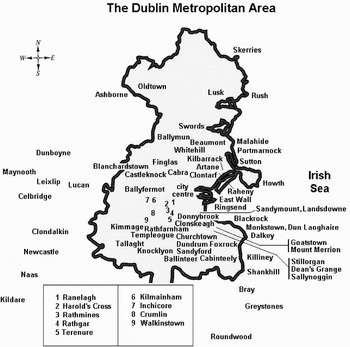
The situation in Dublin in the 1990s was one in which younger middle-class speakers developed new varieties of English which were deliberately, albeit unconsciously, different from the local vernacular. The emergent forms served as the code for the newly affluent inhabitants of Dublin in the burgeoning Irish economy of the time. An investigation into Dublin English emphasizing the origins of and current developments in metropolitan Irish English can be found in Hickey (Reference Hickey2005).
The pronunciation shift in Dublin English undoubtedly represents the major instance of language change in present-day Ireland. To understand the workings of this shift, one must realise that in the course of the 1980s and 1990s, the capital city Dublin underwent an unprecedented expansion in population size and in relative prosperity with a great increase in international connections to and from the metropolis.
The in-migrants to the city, who arrived there chiefly to avail themselves of the job opportunities resulting from the economic boom, formed a group of socially mobile, weak-tie speakers, a key locus for language change. The change which arose was reactive in nature: fashionable speakers began to move away in their speech from their perception of popular Dublin English, a classic case of dissociation in an urban setting (Hickey, Reference Hickey2005). This dissociation (Hickey, Reference Hickey2000b) was realised phonetically by a reversal of the unrounding and lowering of vowels typical of Dublin English hitherto. The reversal was systematic in nature, with a raising and rounding of low back vowels, the retraction of the /ai/ diphthong and the raising of the /ɔi/ diphthong representing the most salient elements of the change (Hickey, Reference Hickey, Foulkes and Docherty1999b). These changes are shown in the chart at the bottom of page 13.
The main towns and cities in Ireland

The vowel shift was accompanied by some consonantal changes, e.g. the rise of a retroflex [ɻ], as in sore [so:ɻ], and of a velarised [ɫ], as in field [fi:ɫd]. These along with most of the vowel shift (bar the retraction of /ai/) became the model for supraregional speech among young people in the 1990s and into the 2000s so that older mainstream speech is no longer emulated by anyone growing up in present-day Ireland.
Scholarly research on Irish English
The modern era of Irish English studies can be said to begin with P. L. Henry's 1957 monograph (there had been some earlier studies, notably P. W. Joyce (Reference Joyce1910) – a popular book on vernacular English in Ireland – and Hogan (Reference Hogan1927) – an academic study with an historical slant). But it was Alan Bliss who was to revitalise the linguistic study of Irish English in the late 1960s and 1970s. Nowadays he is best known for his work on the representation of Irish speech in literature: see Bliss (1979). In this field one also finds Duggan (Reference Duggan1969 [1937]), an early study, Wall (Reference Wall1995), a lexical guide, and Amador-Moreno (Reference Amador-Moreno2006) a detailed study of a single author. The poetry of the first period – the early fourteenth-century Kildare Poems – is available in a recent edition: see Lucas (Reference Lucas1995). In the sphere of translation the main work is Cronin (Reference Cronin1996).
A number of edited volumes have appeared in the past three decades which cover a broad ranges of themes, e.g. Ó Muirithe (ed., 1977), Dolan (ed., 1990), Kallen (ed., 1997), Cronin and Ó Cuilleanáin (eds, 2003), Boisseau and Canon-Roger (eds, 2006) and the four volumes of conference proceedings which appeared as Tristram (ed., Reference Tristram1997, Reference Tristram2000, Reference Tristram2003, Reference Wall2005). A guide to other literature, in both book and article form, can be found in the sourcebook Hickey (Reference Hickey2002b). A new overview geared towards newcomers to the field can be found in Amador-Moreno (Reference Amador-Moreno2010).
The Dublin metropolitan area

Present-day issues and future trends
The lexicon of Irish English has traditionally been a focus of attention with many word lists published already in the nineteenth century. This tradition has been continued in the work of many scholars who have produced dictionaries for Irish English in general (Clark, Reference Clark1977 [1917] is an early work in this field) and also for the speech of regions of Ireland, e.g. Traynor (Reference Traynor1953) for Donegal, Todd (Reference Todd1990) and Macafee (Reference Macafee1996) for the north in general. Moylan (Reference Moylan1996) is a treatment of English in Kilkenny while Beecher (Reference Beecher1991) deals with local Cork English. The most general treatments are to be found in Dolan (Reference Dolan2004 [1998]), Share (Reference Share2003 [1997]), Ó Muirithe (Reference Ó Muirithe1996, Reference Ó Muirithe2004) all of which contain much local vocabulary which derives from the Irish language and/or from archaic forms of English which survived in Ireland. The language of travellers in Ireland has been the subject of a recent edited volume: see Kirk and Ó Baoill (eds, 2002).
The grammar of Irish English is the area which has received special attention by linguists in the field and is attested in the very many articles devoted to this field (see the references in Hickey, Reference Hickey2002b). Results of grammatical research have also appeared in monograph form, e.g. in Henry (Reference Henry1995), Filppula (Reference Filppula1999), and in the relevant chapters of Hickey (Reference Hickey2007) and of Corrigan (Reference Corrigan2010). See also the articles by McCafferty and Corrigan, this issue.
The phonology of Irish English has been dealt with in many articles, e.g. by James and Lesley Milroy (on Belfast English) and in monograph form by Harris (Reference Harris1985). Hickey (Reference Hickey2004) is a sound atlas with extensive coverage of all regional varieties of Irish English along with an accompanying DVD which provides the sound files.
Changes in vowel constellations in Dublin English

The spread of Irish English during the colonial period (1600–1900) and the question of Irish input to overseas varieties of English has been examined in Hickey (ed., 2004). Issues of language and politics have been treated in depth by Tony Crowley, in the sourcebook Crowley (Reference Crowley2000), and in the monograph Crowley (Reference Crowley2005). See further the article by McDermott, this issue.
A number of new research avenues have been opened up in recent years. One is the exploitation of corpora for the description and analysis of standard Irish English, a research agenda associated first and foremost with John Kirk and Jeffrey Kallen (see Kirk, this issue). These scholars have been responsible for the compilation and publication of ICE – Ireland (Kirk and Kallen, Reference Kirk and Kallen2008), the Irish component of the International Corpus of English. Another new avenue is represented by the extension of research into media studies, e.g. the language of film as shown by Walshe (Reference Walshe2009).
But perhaps the most recent research avenue is the pragmatics of Irish English: several studies have appeared based on data collected in the past few years, for instance by researchers working at the University of Limerick. The collection by Barron and Schneider (eds, 2005) offers a good overview of this area. Mention should be made in this context of the pragmatically annotated version of ICE – Ireland prepared by John Kirk. See also the articles by Vaughan and Clancy and by O'Keeffe, this issue.
There are a number of areas in Irish English which are still awaiting data collection and analysis. The investigation of second language varieties as spoken by the many emigrant groups in present-day Ireland is one such area.Footnote 3 Another is that of urban sociolinguistic research: several large cities in Ireland have never been investigated linguistically. There are no studies of English in Cork or Limerick, to mention just two cities.Footnote 4 But research of this kind will crucially depend on institutional support for young scholars in Ireland. To date this has been wanting and it remains to be hoped that Irish institutions of higher education, along with Irish academic publishers, will see the value of researching varieties of English in Ireland. The reluctance to offer formal support to the study of the English language in Ireland has many sources (Hickey in press), not least the complex, ambivalent attitude of Irish people to their former native language Irish and the attendant unwillingness to explicitly acknowledge English as the native language of virtually the entire Irish-born population. If this attitude is overcome then the way will be open for mature linguistic research into the English language in Ireland, carried out by Irish scholars accorded recognition similar to that given to researchers into varieties of English in other anglophone countries.
 RAYMOND HICKEY is Professor of English Linguistics at the University of Duisburg and Essen. Originally from Dublin, he has worked on the English language in Ireland for some 30 years. He has written several books on Irish English, including A Sound Atlas of Irish English (Mouton de Gruyter, 2004), Dublin English. Evolution and Change (John Benjamins, 2005) and Irish English, History and Present-day Forms (Cambridge University Press, 2007). His other academic interests include eighteenth-century English and language contact. Email: raymond.hickey@uni-due.de. Websites: Irish English Resource Centre: www.uni-due.de/IERC. Irish English Network: www.uni-due.de/IEN.