Introduction
We have shown that prenatal marijuana exposure (PME) predicts early age of onset of marijuana use (EAOM) (Day et al. Reference Day, Goldschmidt and Thomas2006), which is significantly associated with the development of psychotic symptoms (PS) and disorders (Arseneault et al. Reference Arseneault, Cannon, Poulton, Murray, Caspi and Moffitt2002; Zammit et al. Reference Zammit, Allebeck, Andréasson, Lundberg and Lewis2002; Lynskey et al. Reference Lynskey, Heath, Bucholz, Slutske, Madden, Nelson, Statham and Martin2003; Stefanis et al. Reference Stefanis, Delespaul, Henquet, Bakoula, Stevanis and van Os2004; Konings et al. Reference Konings, Henquet, Maharajh, Hutchinson and van Os2008; Skinner et al. Reference Skinner, Conlon, Gibbons and McDonald2011). There is, however, no research on the association between PME and PS. This paper will explore whether there is an association between PME and PS and whether this association is mediated by EAOM.
A recent national survey on prenatal drug use found that in 2004–2005, marijuana use was reported by 2.8% of pregnant women (SAMHSA, 2012). This rate, however, is likely underestimated, and varies widely by age, race, and social class. The importance of studying the effects of PME is highlighted by several recent trends. One, recreational marijuana is legal in two states, medical marijuana is legal in 20 states (ONDCP, 2014) and both of these numbers are likely to increase. Two, marijuana use has increased steadily in the past decade while, at the same time, the belief that marijuana is harmful has decreased (SAMHSA, 2013). Three, the average potency of marijuana has increased from 3.4% Δ9-tetrahydrocannabinol (THC) in 1993 to 8.8% THC in 2008 (Mehmedic et al. Reference Mehmedic, Chandra, Slade, Denham, Foster, Patel, Ross, Khan and El Sohly2010), and four, as marijuana becomes more available, the price will decrease, leading to an increase in use (Kilmer et al. Reference Kilmer, Caulkins, Liccardo Pacula, MacCoun and Reuter2010). Thus, it is likely that prenatal marijuana use will increase in the future and that the dose/joint will be greater.
Cannabinoid receptors appear in the fetal brain around the 14th week of gestation (Biegon & Kerman, Reference Biegon and Kerman2001) and are concentrated in the hippocampus, cerebellum, amygdala, and cerebral cortex of the brain (Fride, Reference Fride2002), the areas that subserve cognitive and behavioral functioning. The cannabinoid receptors play an important role in the development of neuronal connectivity (Harkany et al. Reference Harkany, Mackie and Doherty2008) and intercellular signaling (Navarrete & Araque, Reference Navarrete and Araque2008). Interference with endocannabinoid signaling during fetal development can lead to long-term changes in synaptic structure and function (Berghuis et al. Reference Berghuis, Rajnicek, Morozov, Ross, Mulder, Urban, Monory, Marsicano, Matteoli, Canty, Irving, Katona, Yanagawa, Rakic, Lutz, Mackie and Harkany2007). Exogenous cannabinoids such as THC interact with the cannabinoid receptors and are known to affect brain development in animals (e.g. Kumar et al. Reference Kumar, Chambers and Pertwee2001) and humans, leading to subsequent effects of PME including increased mood and anxiety symptoms (Gray et al. Reference Gray, Day, Leech and Richardson2005), behavior, cognitive, and psychiatric problems (Day et al. Reference Day, Richardson, Goldschmidt, Robles, Taylor, Stoffer, Cornelius and Geva1994, Reference Day, Leech and Goldschmidt2011; Goldschmidt et al. Reference Goldschmidt, Day and Richardson2000; Richardson et al. Reference Richardson, Ryan, Willford, Day and Goldschmidt2002; Larkby et al. Reference Larkby, Goldschmidt and Day2007; Trezza et al. Reference Trezza, Campolongo, Cassano, Macheda, Dipasquale, Carratu, Gaetani and Cuomo2008).
Early adolescence is also an important period in brain development. During this time, development occurs in the limbic structures of the brain and, in parallel, the number of cannabinoid CB1 receptors increases in the corticolimbic region (Spear, Reference Spear2000; Giedd et al. Reference Giedd, Keshavan and Paus2006). In early adolescence, there is significant maturation in complex processes such as working memory (Luna et al. Reference Luna, Garver, Urban, Lazar and Sweeney2004), executive functioning, and emotional capacity (Yurgelun-Todd, Reference Yurgelun-Todd2007). Exogenous cannabinoids, such as THC, interfere with the functioning of the endogenous cannabinoid system (ECS) and may affect the maturation of the cortical neuronal networks during this vulnerable period (Bossong & Niesink, Reference Bossong and Niesink2010), which may lead to a dysregulation of the ECS and a subsequent an increase in PS and psychosis (Malone et al. Reference Malone, Hill and Rubino2010).
In the most recent U.S. Monitoring the Future study, rates of marijuana use were 16.5% in the 8th grade at age 13 years and 35.8% in the 10th grade at age 15 years (Johnston et al. Reference Johnston, O'Malley, Miech, Bachman and Schulenberg2014). Thus, a substantial number of adolescents initiate marijuana at an early age. There is a large body of work investigating the effects of marijuana use during early adolescence on the development of psychosis and PS. Analyses from the Dunedin study found that early marijuana users (by age 15) had more PS than did controls who were not early users, and a fourfold increase in schizophreniform disorders by age 26 (Arseneault et al. Reference Arseneault, Cannon, Poulton, Murray, Caspi and Moffitt2002). Studies have repeated this finding in a variety of populations (Zammit et al. Reference Zammit, Allebeck, Andréasson, Lundberg and Lewis2002; Lynskey et al. Reference Lynskey, Heath, Bucholz, Slutske, Madden, Nelson, Statham and Martin2003; Stefanis et al. Reference Stefanis, Delespaul, Henquet, Bakoula, Stevanis and van Os2004; Konings et al. Reference Konings, Henquet, Maharajh, Hutchinson and van Os2008; Hides et al. Reference Hides, Lubman, Buckby, Yuen, Cosgrave, Baker and Yung2009; Shapiro & Buckley-Hunter, Reference Shapiro and Buckley-Hunter2010; Skinner et al. Reference Skinner, Conlon, Gibbons and McDonald2011). There was a dose–response association between level of marijuana use and the number of PS (Hides et al. Reference Hides, Lubman, Buckby, Yuen, Cosgrave, Baker and Yung2009; Skinner, et al. Reference Skinner, Conlon, Gibbons and McDonald2011). Use of other drugs in this developmental period was not associated with PS (Zammit et al. Reference Zammit, Allebeck, Andréasson, Lundberg and Lewis2002; Henquet et al. Reference Henquet, Krabbendam, Spauwen, Kaplan, Lieb, Wittchen and van Os2005).
Earlier, we reported that PME predicted EAOM and frequency of marijuana use among 14-year-olds, controlling for the offspring's current alcohol and tobacco use, pubertal stage, sexual activity, delinquency, peer drug use, family history of drug abuse, and characteristics of the home environment, including parental depression, current drug use, and strictness/supervision (Day et al. Reference Day, Goldschmidt and Thomas2006). The current paper will explore the association between PME, EAOM, and PS. We will test three hypotheses: (1) PME will predict a higher rate of PS in exposed offspring at 22 years; (2) this association will remain significant after controlling for gender, race, prenatal exposure to other substances, and the young adult's current use of alcohol, tobacco, and illicit drugs other than marijuana; and (3) this association will be mediated by EAOM.
Method
Study design and sample selection
In the Maternal Health Practices and Child Development Study (MHPCD), women were recruited from a prenatal clinic between 1982 and 1985, and interviewed at their fourth-month prenatal visit. This time point was selected to eliminate women with early fetal loss and elective abortions and women who came in late for prenatal care, and to ensure that we would have data on all of the study women at standardized times during pregnancy. Women were at least 18 years of age and English-speaking. All women attended the same general prenatal clinic and were not considered medically high-risk. A sequential sample of 1360 women was interviewed at this first phase. The refusal rate was 15%. Medical record review indicated that the women who refused did not differ from the participants on the basis of insurance status (private v. public), age, or race. In the initial sample of 1360 women, 30.1% used marijuana in the first trimester and 3.8% reported an average daily use (average joints/day) of ⩾2 joints.
From this initial sample, all women who used marijuana an average of ⩾2 joints a month and a random sample of women who used less or not all were selected for the marijuana cohort. A parallel study of the effects of prenatal alcohol exposure (PAE) was also conducted using women from the initial cohort of 1360. In the PAE study, all women who drank ⩾3 drinks per week and a random sample of all other women were selected for the sample. The two study cohorts had a 48% overlap and are combined for these analyses, resulting in a total cohort of 829 women. Women selected for the studies were interviewed again at the seventh prenatal month, birth, 8 and 18 months, 3, 6, 10, 14, 16, and 22 years.
At delivery, 66 mother–child pairs were removed from the cohort, resulting in a birth cohort of 763 pairs. Losses included 18 fetal deaths, two twin births, one adoption, and 45 children who did not receive a physical examination at birth (21 delivered elsewhere, eight mothers refused the birth examination, and 16 were lost to follow-up). Twins were eliminated because size and physiological status at birth are affected in multiple births.
At the 22-year follow-up, 608 young adult offspring, 80% of the birth cohort, remained in the study. Attrition was due to death (n = 11), adoption/institutionalization (n = 21), lost to follow-up (n = 56), refusal (n = 30), moved out of the Pittsburgh area (n = 29), and unable to participate due to low cognitive functioning (n = 8). There were no significant differences in prenatal marijuana, alcohol, or tobacco exposures or maternal socioeconomic status at birth between those included in the 22-year analyses (n = 608) and those who were not interviewed at this phase (n = 155). Eleven subjects did not complete the psychiatric interview, and one of the offspring reported no marijuana use, but tested positive for THC. These cases were excluded, resulting in a sample of 596 offspring for analysis.
Ethical standards
Each phase of this research was approved by the Institutional Review Board of the University of Pittsburgh. A Certificate of Confidentiality provided assurance of confidentiality to the participants.
The authors assert that all procedures contributing to this work comply with the ethical standards of the relevant national and institutional committees on human experimentation and with the Helsinki Declaration of 1974, as revised in 2008.
Measures
Marijuana use
Maternal marijuana use was measured for the year prior to pregnancy, across the first, second, and third trimesters, and for the previous year at subsequent follow-up phases. We developed a method to measure marijuana consumption from conception to pregnancy recognition, recognition to confirmation of pregnancy, and from confirmation to the end of the first trimester (Day et al. Reference Day, Wagener, Taylor and Pinkert1985). From this, we created measures of first trimester PME that are weighted by the amount of marijuana consumed during each of these three time periods and by the duration of each of these three time periods for each mother. We assessed the minimum, usual, and maximum quantity and frequency of use. We asked about marijuana, sinsemilla, and hashish and combined these reports in our measure of marijuana exposure, weighting them according to the amount of Δ9-THC in each (Gold, Reference Gold1989; Julien, Reference Julien1997). Offspring marijuana use at 22 years was assessed using the same instrument and summarized as average joints/day.
Age of marijuana initiation
At 14, 16, and 22 years, offspring were asked the age at which they first used marijuana. Use was defined as more than just a ‘puff’. Age of initiation reported at the 14-year phase was used in the analyses unless initiation had not yet occurred. For these latter subjects, age of initiation reported at the 16- or 22-year phase was used in the analyses. EAOM was defined as initiation prior to age 15. Thirty-eight percent of the offspring initiated use before age 15 and 83% had used marijuana by age 22.
Other drug use: mothers and offspring
In parallel with marijuana exposure, the usual, maximum, and minimum quantity and frequency were assessed for wine, beer, liquor, and wine and beer coolers. Alcohol use was summarized as average daily volume (ADV). We used the same method, described above for PME, to identify the three phases of first trimester use. Number, frequency, brand, and history of tobacco cigarettes were ascertained. Tobacco was expressed as the average number of cigarettes smoked per day. For other illicit drugs, the name and type of drug, quantity, frequency, pattern, and method of use were recorded but because it was infrequent, use was combined into a dichotomous variable (use/no use) for these analyses. At 22 years, the offspring were interviewed with the same instrument as the mothers.
Psychotic symptoms
The PS variable was the sum of positive responses to 24 questions from the psychosis section of the Diagnostic Interview Schedule (DIS-IV; Robins et al. Reference Robins, Cottler, Bucholz, Compton, North and Rourke2000). The symptoms included 14 possible delusional beliefs and 10 hallucinatory experiences. The assessors were trained to use the DIS and were blind to the subject's prenatal exposure. Reliability of the interviewers was assessed frequently both by observation and by auditory recordings. The mean number of symptoms in the sample was 1.1 (s.d. = 1.8, range 0–15). For descriptive purposes, we categorized PS as none, 1 or 2, and ⩾3.
Analysis
Negative binomial regression models were applied to assess the effects of PME on the rate of PS, controlling for significant covariates. In the Poisson distribution, the expected mean and variance are assumed to be equal and the negative binomial was applied to adjust for over-dispersion. The regression coefficients and dispersion parameters were estimated using maximum likelihood. To assess overall goodness-of-fit, the deviance parameter was compared to a χ2 distribution with degrees of freedom equal to the model residual. Covariates included prenatal exposure to alcohol and tobacco, gender, race, and current use of alcohol, tobacco, and illicit drugs. The analyses were conducted hierarchically to assess the effect of EAOM on the association between PME and PS. Models were run excluding and including EAOM.
Statistical tests of mediation are not available within the negative binomial regression framework. Therefore, in addition to the above analyses, we dichotomized PS to ⩾3 symptoms and tested whether the indirect effects of PME on PS via EAOM was significant using structural equation modeling (SEM). A logit regression was used to estimate the pathways and mediation was tested as the product of the pathways from PME to EAOM and from EAOM to PS.
Results
Study sample description
In the first trimester, 74% of the women had completed high school, 61% earned less than $400 per month, the median age was 22 years (range 18–42), 33% of the women were primigravidous, and 68% were not married. At the first trimester, 41% of the women reported using marijuana, 64% drank alcohol, and 53% smoked cigarettes. The mean first trimester marijuana use among users was 0.9 joints/day (range 0.001–7), mean alcohol use was 0.9 drinks/day (range 0.006–20), and mean number of cigarettes was 15.3/day (range 0.5–50). Twelve percent of the women reported illicit drug use other than marijuana, including 4.0% who reported cocaine use. Average birth weight of the offspring was 3198 g (7 lb) (range 1040–4990 g), 8% were premature (<37 weeks gestation), and 10% were small-for-gestational age (SGA: birth weight <10th percentile for gestational age). This was, in general, a healthy sample. Few infants had major anomalies: 6% had ⩾2 minor physical anomalies.
At the 22-year assessment, 47% of the young adults were male and 43% were Caucasian. On average, they were 22.8 years of age (range 21–26). Sixty-five percent were not living with their mothers, 86% had graduated from high school, 48% had attended college, vocational, or technical school, 7% had graduated from a 4-year college, and 60% were working at a job for pay. Few (6%) of the offspring were married; 37% had at least one child. At 22 years, 50% of the offspring used marijuana currently, 92% drank alcohol, 43% smoked tobacco cigarettes, and 17% used illicit drugs other than marijuana.
Characteristics of prenatal marijuana users
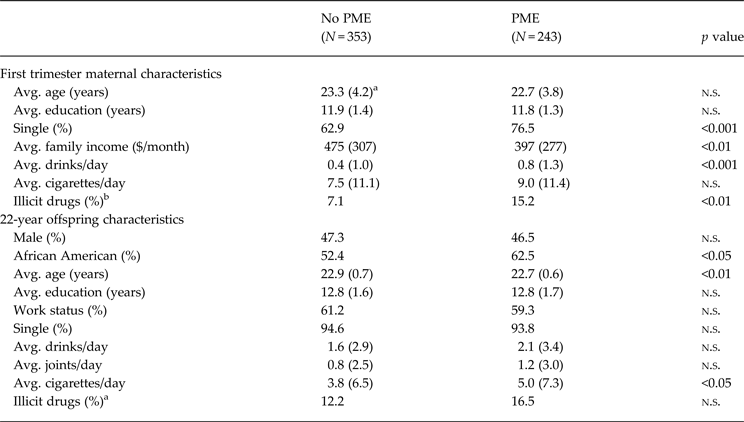
Women who used marijuana during the first trimester were more likely to be single, to have a lower family income, and to use more alcohol and other illicit drugs than women who did not use marijuana in the first trimester (Table 1). These two groups did not differ in age, education, or first trimester tobacco use.
Maternal and offspring characteristics by prenatal marijuana exposure (PME) in the first trimester

a Standard deviation.
b Excluding marijuana.
Characteristics of offspring with PME
Offspring with first trimester marijuana exposure were more likely to be African American, younger, and to use more tobacco at 22 years of age than the non-exposed offspring. The two groups of offspring did not differ in gender, education, work or marital status, or current alcohol, marijuana, or other illicit drug use (Table 1).
Does PME predict a higher rate of PS in exposed offspring at 22 years?
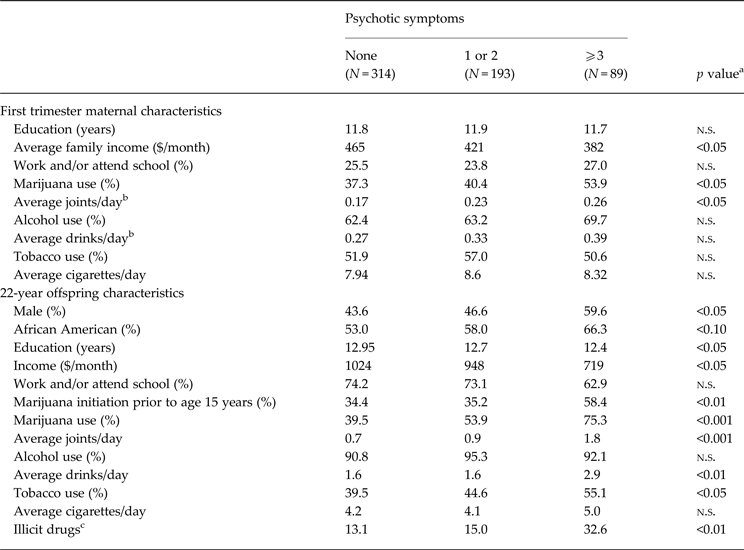
Fifty-three percent of the 22-year-olds reported no PS; 32% and 15% reported 1 or 2, or ⩾3 PS, respectively. The offspring who reported ⩾3 PS were more likely to have been exposed to marijuana prenatally (53.9, 40.4 and 37.3% for ⩾3, 1–2, and no PS, respectively), and at higher levels than those who reported 1–2 or no PS (Table 2). The offspring with ⩾3 PS were more likely to be male, African American, and to have lower education and income than those with fewer or no PS.
Level of psychotic symptoms at 22 years by maternal and offspring characteristics

a Overall significance using χ2 for the dichotomous variables and Kruskal–Wallis for the continuous variables.
b Log transformation was used to reduce skewness.
c Excluding marijuana.
The number of PS was also significantly associated with earlier initiation of marijuana. Among those with ⩾3 PS, 58.4% had an EAOM, compared to 35.2% and 34.4% for those with 1–2, and none, respectively. Among those with ⩾3 PS, the percent of offspring using marijuana at age 22 was 75.3%, compared to 53.9% and 39.5% among those with 1–2 and no PS, respectively. The level of use also differed with PS, with those with ⩾3 PS using an average of 1.8 joints/day, compared to 0.9 and 0.7 joints/day among those with 1–2 and no PS, respectively. Current alcohol, tobacco, and other illicit drug use were also significantly associated with the number of PS (Table 2).
Is the association between PME and PS significant after controlling for significant covariates?
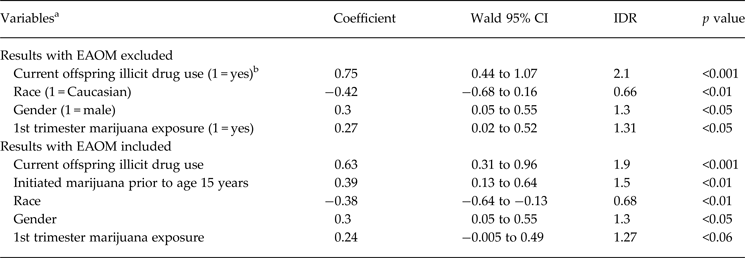
In the multivariable analyses, the actual count of PS was used rather than the descriptive categories. A negative binomial regression was used to examine the association between PME and PS, controlling for other significant predictors (Table 3). The incidence density ratio (IDR) for PME was 1.3 (p < 0.05), an indication that the estimated rate of PS among those with PME was 1.3 times higher than that of the non-exposed young adults when all other covariates were fixed. Other significant predictors of PS included offspring current illicit drug use other than marijuana, race (Caucasians had fewer PS), and gender (males had more PS).
Results of the negative binomial regression predicting psychotic symptoms

CI, Confidence interval; IDR, incidence density ratio; EAOM, early age of onset of marijuana.
a Listed in order of significance.
b Excluding marijuana.
Does EAOM mediate the relationships between PME and PS?
In the second step, EAOM was included in the model (Table 3). Although the addition of EAOM decreased the significance of PME as a predictor of the number of PS, the actual change from 1.31 to 1.27 was minimal. The IDR for EAOM showed that EAOM was associated with a 1.5 times increased risk of PS. Current illicit drug use, race, and gender remained significant predictors of PS with EAOM in the model.
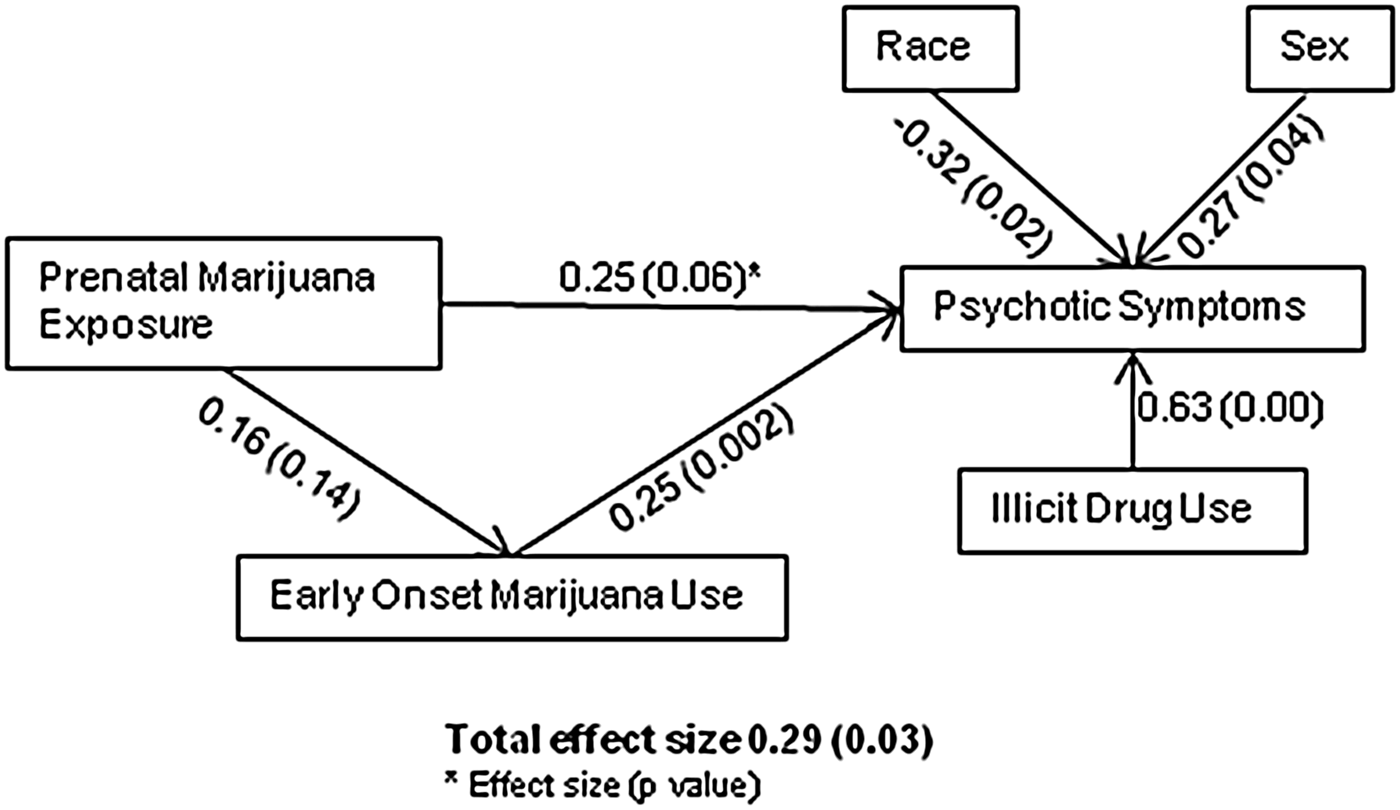
Statistical tests of mediation are not available within the negative binomial regression framework. Therefore, we used SEM to test the direct and indirect effects on PS, including the significant covariates from the regression model, and ⩾3 PS as the outcome. The estimated pathways and their significance levels are presented in Fig. 1. The coefficients for the direct, indirect, and total effects of PME on PS were 0.25 (p = 0.06), 0.04 (p < 0.02), and 0.29 (p < 0.03), respectively. The indirect pathway was a small and non-significant portion of the total effects. In this model, the path between PME and EAOM was not significant due to the correlation between EAOM and current drug use. The association between PME and EAOM was significant in the earlier analyses using different models.
Relations among prenatal marijuana exposure, early onset marijuana use and psychotic symptoms: Structure Equation model.

To avoid multicollinearity, we did not control for current offspring marijuana use in the negative binomial regression model because current use was significantly related to both early initiation (66.7% of early initiators reported current use v. 38.9% among others, χ2 = 43, p < 0.001) and use of illicit drugs other than marijuana (85% of illicit drug users reported using marijuana v. 42% of those who did not use illicit drugs, p < 0.001). In a separate analysis, we tested whether inclusion of current marijuana use would improve the model fit. Controlling for EAOM, use of illicit drugs, PME, race, and gender, current marijuana use was only marginally related to PS (χ2 = 3.2, p = 0.07), while the association between EAOM and PS remained significant (χ2 = 6.0, p = 0.01). In an additional analysis we tested the potential of an interaction between PME and EAOM on PS. The interaction was not significant.
Discussion
This report is from a prospective study of PME in which offspring were followed from gestation through 22 years of age. There was a significant bivariable association between first trimester marijuana exposure and PS at 22 years. After controlling for covariates, PME continued to predict PS with an increased risk of 1.3. Addition of EAOM to the model decreased the risk of PME to PS very slightly to 1.27. SEM analysis indicated that there was a significant total effect (p = 0.03) and that the direct effect of PME on PS was marginally significant (p = 0.06) and was not mediated by EAOM. This association, as discussed in the Introduction, is biologically plausible.
The effects of PME on PS are relatively modest. However, the effects on the long-term outcome in the exposed population are not minimal. In a meta-analysis of the epidemiology of PS in 61 cohorts, Linscott & van Os (Reference Linscott and van Os2013) found a median prevalence of 7.2%. By contrast, 15% of the offspring in our low-income, urban cohort reported ⩾3 PS at age 22; 32% had 1 or 2.
While only a small proportion of those with PS will develop a psychotic disorder, subjects with subclinical symptoms have also less optimal outcomes, not limited to psychosis. Fisher et al. (Reference Fisher, Caspi, Poulton, Meier, Houts, Harrington, Arseneault and Moffitt2013) reported that 11-year-olds with ⩾2 symptoms of psychosis had higher rates of anxiety, depression, PTSD, substance dependence, and suicide attempts and completions by age 38 compared to those with fewer or no symptoms at age 11. Gale et al. (Reference Gale, Wells, McGee and Oakley Browne2011) reported that the rates of anxiety, mood, and substance disorders increased with the number of PS, and another study (Rossler et al. Reference Rossler, Riecher-Rossler, Angst, Murray, Gamma, Eich, van Os and Gross2007) noted higher levels of functional impairment among those with higher numbers of symptoms. Thus, the long-term effects of PS appear to be dose–response, have a broad effect on mental health functioning, and are not limited to the development of psychoses.
There are some limitations of this study sample that must be noted. Pregnant women were recruited from a prenatal clinic. They were low-income and evenly distributed by race (Caucasian/African American). It is possible that these findings may not generalize to a general population sample. We also did not have biological measures of prenatal marijuana use. We compensated for this by carefully training our interviewers, developing an instrument that was easy to respond to (Day et al. Reference Day, Wagener, Taylor and Pinkert1985), and using a bogus pipeline procedure (Jones & Sigall, Reference Jones and Sigall1971). Given the high rates of marijuana use reported, it is likely that our reports are good estimates. There are also limitations with biological measures. The window of detection is limited, whereas we were able to assess a longer time period, and biological measures do not assess duration or patterns of use, which we were able to assess in detail during the interview (Richardson et al. Reference Richardson, Huestis, Day and Bellinger2006).
Strengths of this study include detailed measures of other prenatal exposures, which allows us to control for the effects of prenatal alcohol, tobacco, and illicit drug exposure on the rate of PS in young adulthood. This was a prospective study, decreasing the likelihood of memory and reporting bias, and has excellent follow-up rates, decreasing the probability of bias by attrition. In addition, we used a standardized psychiatric assessment instrument.
The rate of marijuana use in this cohort was high due to the demographic characteristics of the sample. This was a low-income population of young, single, mothers, half of whom were Caucasian and half were African American. These rates are similar to other studies of comparable populations such as a pilot study by Zuckerman (Reference Zuckerman and Pinkert1985) that reported a rate of 31% and Tennes et al. (Reference Tennes, Avitable, Blackard, Boyles, Hassoun, Holmes, Kreye and Pinkert1985) who found that 34% of the women used marijuana during pregnancy. In addition, our measure of use uniquely includes the time period from conception to the confirmation of pregnancy, a period when women are still using at their pre-pregnancy rate.
It is possible that some of the association between PME and PS is explained by other consequences of PME. Women who use marijuana during pregnancy differ in many ways and these characteristics could also predict the rate of PS. Further, one research group has argued that increased familial risk explains the relationships between cannabis and PS rather than the cannabis itself (Proal et al. Reference Proal, Fleming, Galvez-Buccolllini and DeLisi2014). Others (Caspi et al. Reference Caspi, Moffitt, Cannon, McClay, Murray, Harrington, Taylor, Arseneault, Williams, Braithwaite, Poulton and Craig2005; Henquet et al. Reference Henquet, Di Forti, Morrison, Kuepper and Murray2008; Radhakrishnan et al. Reference Radhakrishnan, Wilkinson and D'Souza2014), have argued that there is a gene–environment interaction in the development of PS and that cannabis is one of the factors that increases the risk of PS. Giordano et al. (Reference Giordano, Ohlsson, Sundquist, Sundquist and Kendler2014) controlled for familial factors and found that while these factors attenuated the association, the association remained significant. Thus, there are multiple risk factors for PS and the characteristics of the sample may have affected the associations we have found.
This report identifies a potential additional pathway to the expression of PS and the resultant probability of increased rates of psychotic disorders. This analysis needs to be replicated by others and it will be important for adjust for additional confounders such as familial characteristics that might predict PME, EAOM, and PS. Consideration of the negative aspects of PME is particularly important now, given the political and social changes in the acceptability of marijuana use and a likely increase in the rate of marijuana use during pregnancy. It is critical to consider the effects of marijuana exposure during gestation as a potential target for intervention and prevention of consequences.
Acknowledgements
Work on this manuscript was supported by grants from the National Institute on Drug Abuse (DA03874); National Institute on Alcohol Abuse and Alcoholism (AA018116); Dr Day PI.
Declaration of Interest
None