Surgical techniques for children with complex congenital cardiac disease have continually improved, and enhanced medical treatment has contributed to long-term survival of these children.Reference Wernovsky1 Decreased mortality rates have not been without persistent morbidities. There is concern about the increasing numbers of children who have survived their congenital cardiac disease but have ongoing health and developmental difficulties upon entering the educational system and the community.Reference Creighton, Robertson and Sauvé2–Reference Limperopoulos, Majnemer and Shevell4 There is evidence that children who have survived life-saving surgery for congenital cardiac disease experience neurodevelopmental challenges such as learning disabilities, fine and gross motor delays, and behavioural problems.Reference Shillingford and Wernovsky5, Reference Mahle, Clancy, Moss, Gerdes, Jobes and Wernovsky6 As a result, there is increasing concern regarding the influence that congenital cardiac disease and associated surgery has on the functioning and well-being of the affected children and their families.Reference Majnemer, Limperopoulos, Shevell, Rohlicek, Rosenblatt and Tchervenkoc7
Functional outcomes in children have traditionally been measured by the Vineland Adaptive Behavioral SystemReference Sparrow, Balla and Cicchhetti8 and the Adaptive Behavioral Assessment System.Reference Harrison and Oakland9 Adaptive behaviour has been defined as the level to which individuals meet the standards of personal self-determination and social conscientiousness expected for their age and culture.Reference Horn and Fuchs10 It is agreed that adaptive behaviour is multi-dimensional,Reference McGrew and Bruininks11 dynamic, and relative to age.Reference Horn and Fuchs10 Measurement of adaptive behaviour supplements cognitive assessment in the diagnosis of mental retardation to provide a comprehensive assessment.Reference Majnemer, Limperopoulos, Shevell, Rohlicek, Rosenblatt and Tchervenkoc7, Reference Horn and Fuchs10, 12, 13 Majnemer et alReference Majnemer, Limperopoulos, Shevell, Rohlicek, Rosenblatt and Tchervenkoc7 point out the need for a better understanding of potentially modifiable functional limitations of children with early complex cardiac surgery.
This study aimed to describe and compare the early childhood functional outcomes of survivors of life-saving cardiac surgery as measured by adaptive behaviour, using the Adaptive Behavioral Assessment System II, in an inception cohort of children after the Norwood staged procedure for hypoplastic left heart syndrome or the arterial switch operation for transposition of the great arteries at 6 weeks of age or younger. A secondary aim was to determine if children in this cohort have specific adaptive skill area strengths and weaknesses within their individual functional profile.
Materials and methods
Programme
The children were part of a larger study within the Registry and Follow-Up of Complex Pediatric Therapies Program as previously described.Reference Creighton, Robertson and Sauvé2, Reference Robertson, Joffe and Sauvé14, Reference Neufeld, Clark and Robertson15 They were from six centres in Western Canada: Vancouver, British Columbia; Edmonton and Calgary, Alberta; Regina and Saskatoon, Saskatchewan; and Winnipeg, Manitoba. Owing to technical problems, data for behavioural items in the self-care skill area from one centre were not used.
Subjects
This prospective, descriptive inception cohort study involved 73 children who had the Norwood staged procedure or arterial switch operation at 6 weeks of age or younger at the Stollery Children’s Hospital, Edmonton, Alberta between 2002 and 2005, and whose functional outcome status was evaluated at 18–24 months following surgery. This was a convenience sample of all children available. The criteria of less than 6 weeks of age ensured that neonates with the most severe cardiac malformations requiring life-saving neonatal surgery were included in our sample. The study period beginning after September, 2002 corresponds to a change in the stage 1 palliation for hypoplastic left heart syndrome from the modified Blalock–Taussig to the right ventricle to pulmonary artery shunt.Reference Atallah, Dinu and Joffe16 In all, 28 children (mortality 19%) with hypoplastic left heart syndrome and the Norwood staged procedure using a right ventricle to pulmonary artery shunt at first stageReference Atallah, Dinu and Joffe16 and 45 children (0% mortality) with transposition with or without ventricular septal defect after the arterial switch operation comprised the study group. The study excluded children who had chromosome abnormalities (3) or cerebral palsy (1). No child had a vision or hearing loss. Socio-economic status, as calculated for the main or highest income earner, was determined using the Blishen Index (dependent upon employment, education, and prestige value of an occupation), with a standard population mean of 43 and standard deviation of 13.Reference Blishen17 Maternal education was measured in total years of schooling.
Ethics and consent
We obtained ethics board approvals and informed consent from the parents or guardians of all of the registered children. No parents declined to participate in the study.
Measure
To ascertain the functional abilities of the children, parents completed the Adaptive Behavioral Assessment System IIReference Harrison and Oakland9 questionnaire. Established test administration protocols were followedReference Harrison and Oakland9 and the same individual scored all of the forms.
The Adaptive Behavioral Assessment System II is an instrument designed to measure and assess realistic, independent behaviours of individuals and the usefulness of interactions with others, while including consideration of community contexts.Reference Harrison and Oakland9 The composite scores have age-based standard scores with a mean of 100 and a standard deviation of 15. There are nine skilled areas grouped into three composite domain areas, such as conceptual (communication, functional academics, and self-determination); social (leisure and social); and practical (community use, home living, health and safety, and self-care). The motor skill area is separate and included with the nine skilled areas in the total General Adaptive Composite score. In total, 10 age-specific skill area scaled scores with mean normative data of 10 and a standard deviation of 3 are also available from the raw scores calculated from specific test items.
The standardisation sample for the Adaptive Behavioral Assessment System II comprised 2100 individuals at birth to 5 years of age according to gender, race, and different levels of disabilities.Reference Harrison and Oakland9 The average reliability coefficient for the adaptive domains ranged from 0.91 to 0.98. The test–retest reliability coefficients range from 0.70 to 0.90.Reference Harrison and Oakland9 Validity has been indicated in all instrument scores by an internal consistency of 0.90.Reference Harrison and Oakland9
We used the parent report form for children 0–5 years 11 months in this study. A decision was made in advance to explore in detail any of the skill area scaled scores in either group with mean scores lower than 1 standard deviation below the population mean. For these, the Likert-type scale response for each individual behaviour item was recorded.
Data analysis
We used descriptive statistics to compare the children of the two surgical groups (Norwood and arterial switch) in relation to sex, family’s socio-economic status, mother’s education, age at form completion, and population size of home community of the family. The scaled scores for the 10 skill areas and the standard scores for the four domains of the Adaptive Behavioral Assessment SystemReference McGrew and Bruininks11 for the Norwood and arterial switch groups, as well as behavioural items, were compared using independent t-tests. Bonferroni correction was used for multiple tests. The proportion of children in a skill area within each surgical group with scores within the extremely low range (below minus 2 standard deviations) was compared using Fisher’s Exact significance test. Differences between single skill area scaled scores and average scaled scores were calculated. For each child a significant difference was determined if the difference between the skill area and mean scaled scores occurred in less than 5% of the standardisation sample.Reference Harrison and Oakland18 A p-value of less than 0.05 was used unless otherwise indicated. All analyses were performed using SPSS version 15 (SPSS Inc., Chicago, Illinois, United States of America).
Results
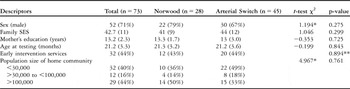
The population is described in Table 1. No statistically significant differences between the Norwood and arterial switch surgical subgroups were identified on any of the descriptive variables (Table 1).
Descriptive variables of 73 children after Norwood staged procedure or the arterial switch operation: n (%), mean (standard deviation).

SES = socio-economic statusReference Blishen17
*Values represent χ2values
**Fisher’s exact (two-sided)
Exploratory significant p-values of <0.05
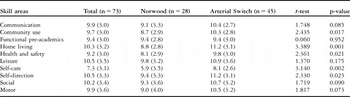
Most of the children functioned at an adaptive level normal for age (Table 2a). After Bonferroni correction of multiple univariate analysis, the arterial switch group had scores similar to those of the Norwood group in all skill areas except for home living and self-care. For home living, this difference between groups was partly related to the high scores within the arterial switch group. The self-care scores for the Norwood group were lower than those for the arterial switch group, with a mean more than 1 standard deviation below normative values (Table 2a), which contributed to the significant difference within the Practical domain (Table 2b).
Scaled scores of the Adaptive Behavioral Assessment SystemReference McGrew and Bruininks11 for children after complex neonatal cardiac surgery: mean (standard deviation).

After Bonferroni correction p-values ⩽0.005 remain significant
Domain standard scores of the Adaptive Behavioral Assessment SystemReference McGrew and Bruininks11 for children after complex neonatal cardiac surgery: mean (standard deviation).

GAC = general adaptive composite (includes all domains): conceptual (communication, functional pre-academics, self-direction); social (leisure, social); practical (self-care, home living, community use, health and safety)
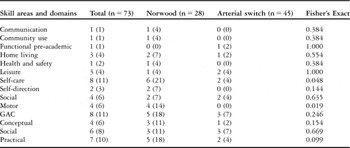
There were no differences between surgical groups in the proportion of children with extremely low scores in the skill area or domain scores (Table 3). However, two to four times more children were delayed on composite scores than the normative population. Extremely low scores, under 2 standard deviations, occur in less than 2.3% of the normative population. Of the 10 skill area scaled scores, 11% of the total group and 21% of the Norwood group had extremely low scores in self-care (Table 3).
Proportion of children after complex neonatal cardiac surgery with scores below minus 2 standard deviations on the Adaptive Behavioral Assessment SystemReference McGrew and Bruininks11: n (%).

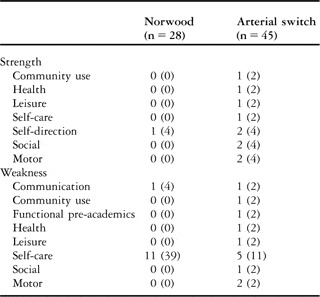
Individual strength and weaknesses relative to individual mean scaled scores are presented in Table 4 using the population cut-off of 5%. No individual child had strength in any skill area. The only weakness found to be more common in any child in this study was self-care; 39% of the Norwood group, and 11% of the arterial switch group had low individual self-care scores (Table 4).
Number (%) of children with a strength or weakness for an individual child in a named area.

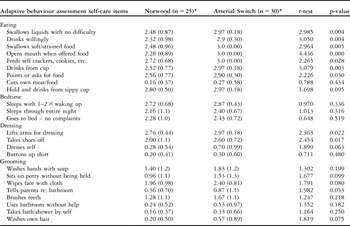
As self-care was the only skill area with a mean more than 1 standard deviation below the normative value for the Norwood group and the only individual skill area to demonstrate weakness beyond the population cut-off for both groups, the behavioural items used to comprise this scaled score were analysed. The items were grouped into four categories, eating, bedtime, dressing, and grooming. The feeding items in the self-care scaled score were different between the two surgical groups (Table 5). The Norwood group reported lower scores for items relating to feeding.
Specific self-care behavioural items between surgical groups: mean of Likert score 0–3 (standard deviation).

Significance = <0.005, <0.016, <0.012, and <0.006 following Bonferroni correction for eating, bedtime, dressing, and grooming, respectively
*Missing raw data
Discussion
This study is the first to present a detailed comparison and analysis of specific skill areas of adaptive behaviour, specifically focusing on self-care results among the survivors of the Norwood staged procedure and the arterial switch operation in early childhood. This study supports a recent concern voiced about the functional abilities of children, as a comorbidity of complex congenital cardiac disease.Reference Majnemer, Limperopoulos, Shevell, Rohlicek, Rosenblatt and Tchervenkoc7, Reference Limperopoulos, Majnemer and Shevell19 We also determined that 10% of survivors, which is more than four times the expected population, have delays on the General Adaptive Composite Score of the Adaptive Behavioral Assessment System II. Although differences were found between the two study groups, the prominent difference was that of self-care.
Few studies report functional outcomes for children with hypoplastic left heart syndrome. It has been posited that children with surgically palliated hypoplastic left heart syndrome are already disadvantaged with neurological morbidity and therefore have been excluded from analysis in some studies.Reference Majnemer, Limperopoulos, Shevell, Rohlicek, Rosenblatt and Tchervenkov20, Reference Limperopoulos, Majnemer, Shevell, Rosenblatt, Roblicek and Tchervenkov21 However, two studies reported on functional abilities specifically in infants with hypoplastic left heart syndrome. In one of the earliest outcome studies including 11 children with surgically palliated hypoplastic left heart syndrome who were born between 1986 and 1991, it was reported that 8 of the 11 (73%) children with a mean age of 38 months had a severe functional disability (greater than 2 standard deviations) on the WeeFIM, the functional independence measure they used to assess self-care, sphinctre control, transfer, locomotion, communication, and social cognition.Reference Rogers, Msall and Buck22 Gross motor delays were reported in five of the children (45%). In another study that included 13 children (mean age 4.4 years) with surgically palliated hypoplastic left heart syndrome who had their surgeries between 1990 and 1996, more positive outcomes were reported, including adaptive behaviour scores based on Vineland Adaptive Behavior Scales that were in the range of a lower adaptive score with a standard deviation of minus 1, especially in motor skills, for children less than 3 years of age when compared with their matched family controls.Reference Kern, Hinton, Nereo, Hayes and Welton23 Another follow-up evaluation with a large sample size from a more recent treatment era found that greater than 85% of the children after the Norwood staged procedure had motor skills that were average for age.Reference Atallah, Dinu and Joffe16
In contrast to the Norwood surgical approach, which involves three surgeries in the pre-school period, children with transposition typically require one complex surgery in the first weeks of life to complete the repair of their malformed hearts. Although the adaptive scores in the arterial switch group, in this study, suggest that these children are functioning at a level that is normal for their age, except for a greater percentage of lower scores than the normal population for self-care, there is convincing evidence that socialisation, speech, expressive language, behavioural problems, and cognitive abilities in later years (school-age and adolescence) may be of concern.Reference Neufeld, Clark and Robertson15, Reference Karl, Hall and Ford24–Reference Bellinger26 This suggests that ongoing monitoring is needed.
The findings in this study demonstrated that the children in the Norwood group were on par with the children in the arterial switch group in many functional abilities. The Norwood group of children was functioning at an average level for their age group in communication, pre-school academics, leisure, and self-direction. Despite this positive finding, there is an indication that children undergoing the Norwood staged procedure can have increasing problems in later years.Reference Mahle, Clancy, Moss, Gerdes, Jobes and Wernovsky6, Reference Hagemo, Skarbo, Rasmussen, Fredriksen and Schage27
The high percentage of individual weakness in self-care in this study confirms earlier studies in pre-school and school-age children after neonatal cardiac surgery, demonstrating some self-care scores lower than the normal population.Reference Creighton, Robertson and Sauvé2, Reference Shillingford and Wernovsky5, Reference Limperopoulos, Majnemer and Shevell19 In the breakdown of the items within the self-care skill area of the Adaptive Behavioral Assessment System II, children in this study who were in the Norwood group have a low self-care score related to significantly less skill in feeding in comparison to the children in the arterial switch group. Many babies with hypoplastic left heart syndrome require tube feeding due to feeding issues and poor weight gain during the first year of life. Decreased oral stimulation during infancy may contribute to oral aversions and subsequent feeding issues that sometimes result in long-term tube feeding. This may be the cause of poorer feeding skills in the Norwood group. Of the eight children in our Norwood cohort, two who required gastrostomy tube feedings post-surgery continued with tube feeding after 2 years of age. It has been shown that tube-feeding regimes in the first year following surgery are a struggle for parents.Reference Rempel and Harrison28
In addition, the practical composite score of the Adaptive Behavioral Assessment System II was significantly lower than the conceptual or social composite scores. This finding demonstrates that children with congenital cardiac disease at 18–24 months are falling behind their peers in areas of self-care and independence. Further research is required to see if parental anxiety and overprotection contribute to this, as hypothesised by others.Reference Majnemer, Mazer and Lecker29
Early intervention programmes for low birth weight children decreased the prevalence of mental and physical development delay at 1 and 2 years of age when compared to a control group.Reference Spittle, Orton, Doyle and Boyd30, Reference Resnick, Eyler, Nelson, Eitzman and Bucciarelli31 This finding shows the potential resiliency in these children to adapt and the positive effect of early intervention services on adaptive behaviours, as reflected in cognitive and physical improvement. It has been suggested that pre-school children are able to assess their own vulnerability, are able to verbalise these perceptions and, therefore, are able to determine what they “can and cannot” do.Reference Gleason and Evans32 Research with pre-school children and their parents demonstrated that the parents and children who agreed on their perceptions of the child’s vulnerability could work together in the assessment of the children’s health.Reference Gleason and Evans32 Therefore, if parents perceive their child as resilient and able to reach developmental milestones, perhaps it could contribute to improved outcomes for the child because the child would share in this optimism, with improvement in functional abilities. Developing motor skills, speech patterns, cognitive ability, and social interactions incrementally in all of these areas has a scaffolding effect as these children learn and adopt more complex skills and thereby shape their psychosocial development. Individual assessment to understand each child’s capabilities is required.
The strength of this study is that data were collected prospectively, and two specific groups with two different types of congenital cardiac disease were included, so that differences could be detected. The study has a broad geographic base, including children from across Western Canada, all of whom received their surgical intervention at the same centre. All parents completed the same form and it was scored by the same person. Despite the age-based standard Adaptive Behavioral Assessment System scores and the crucial time period of development represented in this study, that is, 18–24 months, a potential limitation of the findings is that only a small repertoire of skill areas are reported on for children of this young age. In addition, we acknowledge that the parental report of the behaviours of their young chronically ill children often reflect more optimismReference Rempel, Harrison and Williamson33 than professionals deem appropriate, and thus the higher than standardised scores for the children in the arterial switch group may be questioned by some. A further limitation was the missing raw data for the completion of the self-care items (see Table 5).
In conclusion, we stress that it is essential for young children to develop age-appropriate independent skills in daily living activities prior to transitioning into the school environment. It would be beneficial to conduct further research to explore and understand the influences that contribute to the child’s intellectual competence and functional abilities in order to design relevant interventions prior to school entry. Clinically relevant knowledge pertaining to the process by which children with congenital cardiac disease adapt, through examination of their strengths and weaknesses related to self-care and functionality, could provide direction for facilitating the child’s meaningful involvement in, and contribution to, their family, school, and community.
Acknowledgements
We gratefully acknowledge the participation and support of parents and children from across Western Canada who participated in this study. We acknowledge the contributions of the cardiac surgeons, Dr Ivan Rebeyka and Dr David Ross, and the co-chairs of The Registry and Follow-up of Complex Pediatric Therapies Program, Dr Reg Sauvé (Alberta Children’s Hospital, Calgary, Alberta) and Dr Ari Joffe (Stollery Children’s Hospital, Edmonton, Alberta). We are also grateful for the commitment of the coordinators and physicians associated with the developmental sites across Western Canada. The Capital Health Employee Education Fund funded GA’s graduate studies.