INTRODUCTION
The increasing industrialization and enhancement of human activities leads to rising levels of contaminants in aquatic habitats. This requires permanent monitoring of the presence and effects of pollutants. For detecting chemicals in aquatic ecosystems, analytical methods are established and different groups of bioindicators such as bivalves are available (Arndt et al. Reference Arndt, Nobel and Schweizer1987; Reeders et al. Reference Reeders, bij de Vaate, Noordhuis, Nalepa and Schloesser1993; Gunkel, Reference Gunkel1994). Besides established free-living sentinel species, recent studies suggest that fish parasites might also be useful as monitoring organisms for the detection of chemical pollution (Sures, Reference Sures2003). Due to their excellent ability to accumulate different substances, intestinal parasites, especially fish acanthocephalans, have been suggested as suitable bioindicators for metal pollution (summarized by Sures Reference Sures2003, Reference Sures2004 a; Vidal-Martinez et al. Reference Vidal-Martinez, Pech, Sures, Purucker and Poulin2010). The accumulation capacity of acanthocephalans has been shown to exceed even that of established free-living sentinel organisms such as the zebra mussel, Dreissena polymorpha Pallas, 1771 (see Sures et al. Reference Sures, Taraschewski and Rydlo1997, Reference Sures, Steiner, Rydlo and Taraschewski1999 a). Accordingly, fish-acanthocephalan systems represent promising monitoring tools for the detection of chemical pollution in aquatic systems, especially if contaminant levels are low, e.g. in pristine areas such as the Antarctic (Sures and Reimann, Reference Sures and Reimann2003). For practical reasons the fish host must be widely distributed and easily sampled (Kennedy, Reference Kennedy1997) in order to use endoparasites and their hosts as bioindicators. Moreover, the parasites have to be highly abundant and prevalent in their host species (Sures, Reference Sures2004 a). Promising host-parasite systems for freshwater habitats are cyprinid fish species such as barbel, Barbus barbus Linne, 1758, infected with the palaeacanthocephalan Pomphorhynchus laevis Zoega, 1776 (see Sures, Reference Sures2004 b). Different benthic crustacean species serve as intermediate hosts for P. laevis (Rumpus and Kennedy, Reference Rumpus and Kennedy1974). As they form a substantial part of the diet of benthivore fishes, high infection intensities are commonly described for fish species such as barbel.
Although several aspects of the mechanism and kinetics of metal uptake in acanthocephalans have been elucidated by Sures (Reference Sures2001), there are still some open questions concerning the applicability of fish parasites as sentinels. For example, the effect of the acanthocephalan infrapopulation size on the process of metal accumulation in fish-parasite systems is not known. Some authors reported that fish parasites are able to reduce element concentrations in their host tissues (Sures and Siddall, Reference Sures and Siddall1999), which might correlate with the infrapopulation size (Thielen et al. Reference Thielen, Zimmermann, Baska, Taraschewski and Sures2004). Moreover, there are no data available concerning metal accumulation in relation to the sex of fish acanthocephalans, which could also play a considerable role. Indeed, several metabolic pathways are different according to gender in acanthocephalans (Crompton and Nickol, Reference Crompton and Nickol1985), and previous studies on experimental infections of terrestrial mammals with acanthocephalans provided contradictory results on metal accumulation according to parasite sex (Scheef et al. Reference Scheef, Sures and Taraschewski2000; Sures et al. Reference Sures, Franken and Taraschewski2000 a, Reference Sures, Jürges and Taraschewskib).
The present field study was designed to address these aspects using the fresh water cyprinid Barbus barbus. Barbel is the second largest cyprinid species in Europe and it is widespread throughout large river systems. It is well known for its high infection levels with the acanthocephalan Pomphorhynchus laevis in the Danube River (Kakacheva-Avramova, Reference Kakacheva-Avramova1962, Reference Kakacheva-Avramova1977; Margaritov, Reference Margaritov1959, Reference Margaritov1966; Moravec et al. Reference Moravec, Konecny, Baska, Rydlo, Scholz, Molnar and Schiemer1997; Schludermann et al. Reference Schludermann, Konecny, Laimgruber, Lewis, Schiemer, Chovanec and Sures2003; Thielen et al. Reference Thielen, Zimmermann, Baska, Taraschewski and Sures2004; Laimgruber et al. Reference Laimgruber, Schludermann, Konecny and Chovanec2005; Nachev and Sures, Reference Nachev and Sures2009). Accordingly, the model system B. barbus-P. laevis was taken for studying the differences in accumulation with respect to infrapopulation size and the sex of the acanthocephalan.
MATERIALS AND METHODS
Sample collection
A total of 27 barbels were collected in September 2006 from local fishermen in the area of Kozloduy, Bulgaria, around river kilometer 685 of the Danube River. After capture, the fish were frozen and transported to the laboratory, where length, weight, sex and age were determined for each fish. The specimens were dissected using standard parasitological techniques. Tissue samples from fish (muscle, intestine and liver) and parasites were taken using stainless steel dissecting tools, which were previously cleaned with 1% ammonium-EDTA solution and double-distilled water to avoid contamination. The sample material was rinsed with physiological solution (0·8% NaCl Suprapure) and frozen at −20°C until metal analyses. After collection and identification of the acanthocephalans the following parasitological parameters were calculated according to Bush et al. (Reference Bush, Lafferty, Lotz and Shostak1997) – prevalence (P, %), intensity range (IR), abundance (A) and mean intensity (MI) of the infection. The fresh weight and sex (distribution of ♂♂ and ♀♀) of the collected acanthocephalans was also recorded.
Fish were divided into groups according to their infection status. The first group (lightly infected group, LI) comprised barbels (n=9) infected with less then 20 acanthocephalans. For the second group (heavily infected group, HI) fish (n=9) showed a mean infection intensity exceeding 100 worms. Another group consisted of fish (n=8) with an infection intensity around the mean value (80·2 worms per fish) obtained for all collected fishes. This group was used to compare a sex-specific metal accumulation.
Molecular identification of Pomphorhynchus laevis
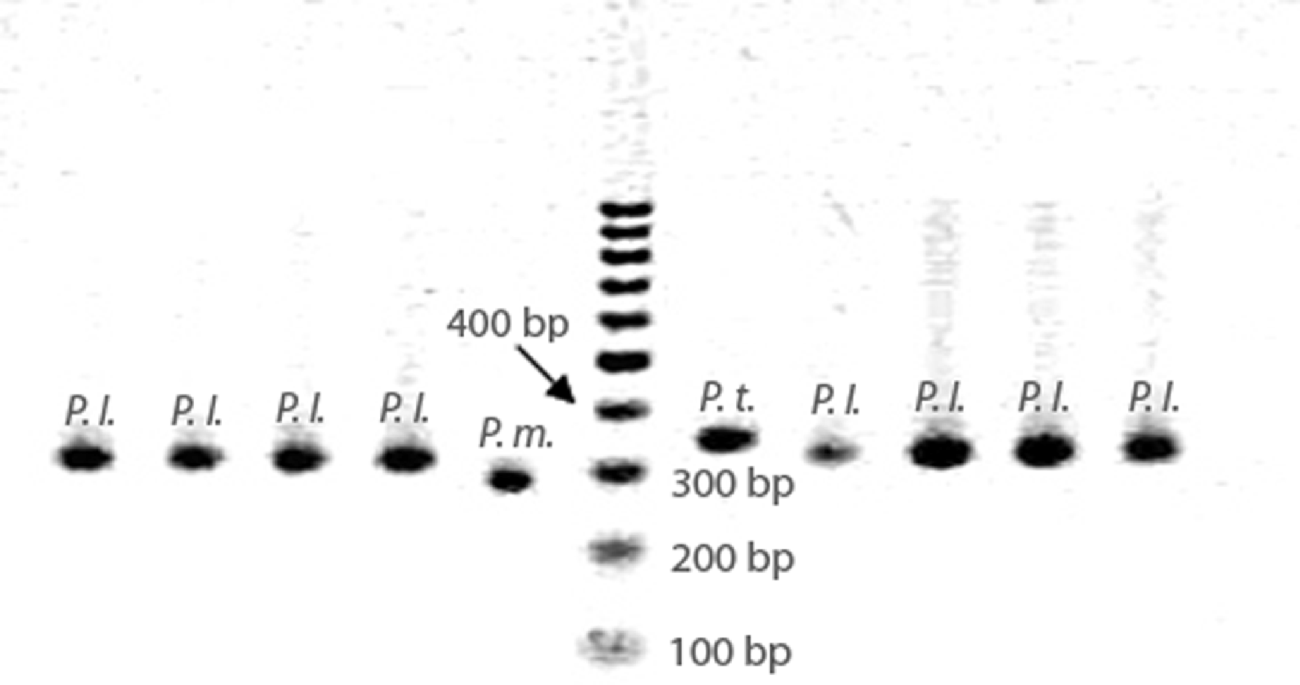
While the parasite species was identified as P. laevis using morphological traits, the possibility of co-infection with other closely related acanthocephalan species such as Pomphorhynchus tereticollis Rudolphi, 1890 persists, due to their similarity in morphology, biology and transmission (Perrot-Minnot, Reference Perrot-Minnot2004). Therefore, a molecular method was used for parasite identification. DNA was extracted from 200 parasites taken randomly from different fishes following the procedure described by Franceschi et al. (Reference Franceschi, Bauer, Bollache and Rigaud2008). Species identification was performed using a diagnostic PCR to amplify a portion of the internal transcribed spacer (ITS) rDNA gene (see Franceschi et al. Reference Franceschi, Bauer, Bollache and Rigaud2008 for primers and PCR conditions). For each PCR reaction, 1 negative (reaction solution without template DNA) and 3 positive controls (template DNA from already identified P. laevis, P. tereticollis and Polymorphus minutus Goeze, 1782) were carried out. The sizes of the PCR products determined the parasite species (Franceschi et al. Reference Franceschi, Bauer, Bollache and Rigaud2008): the products for P. laevis, P. tereticollis and P. minutus were 320, 350 and 290 bp, respectively (Fig. 1). The analyses revealed that all acanthocephalans were P. laevis, which confirmed the absence of co-infection by different acanthocephalan species (Fig. 1).
Molecular identification of acanthocephalan species, according to the size of the PCR product of the partial ITS sequence. The central line is the molecular weight marker. P. l., Pomphorhynchus laevis; P. m., Polymorphus minutus; P. t., Pomphorhynchus tereticollis.

Heavy metal analysis
The fish and parasite samples were prepared for analysis using microwave-assisted digestion following the procedure described by Zimmermann et al. (Reference Zimmermann, Menzel, Berner, Eckhardt, Stüben, Alt, Messerschmidt, Taraschewski and Sures2001). Up to 300 mg (wet weight) of sample, previously homogenized, was weighed and placed into 150 ml perfluoralkoxy (PFA) vessels, into which a mixture of 1·3 ml of nitric acid (65% HNO3, Suprapure) and 2·5 ml of hydrogen peroxide (30% H2O2, Suprapure) was added. Subsequently, the vessels were heated for 90 min at approximately 170°C using the microwave digestion system MDS-2000 (CEM GmbH, Kamp-Lintfort, Germany). After digestion the clear sample solution was brought up to volume with doubly distilled water in a 5 ml volumetric glass flask and kept in polypropylene sample tubes until analysis.
The concentrations of arsenic (As), cadmium (Cd), colbalt, (Co), copper (Cu), iron (Fe), manganese (Mn), molybdenum (Mo), nickel (Ni), lead (Pb), tin (Sn), vanadium (V) and zinc (Zn) were analysed using inductively coupled plasma mass spectrometry (ICP-MS). The analyses were carried out with a quadrupole ICP-MS system (Perkin Elmer – Elan 5000) operating at 1100 W plasma power, 13·3 L/min plasma gas flow, 0·75 L/min auxiliary gas flow and 0·95 L/min nebuliser gas flow and an auto-sampler system (Perkin Elmer AS-90) connected with a peristaltic pump with a sample flow of 1 ml/min. To avoid contamination and memory effects the wash time between measurements was set at 10 sec (with 1% HNO3, Suprapure). Before analyses, the samples were diluted 1:10 using a solution of 1% HNO3 (Suprapure) with a concentration of 10 ng/L of yttrium (Y) and thulium (Tm) as internal standards. In order to control the accuracy and stability during measurements a standard solution (ICP Multielementstandard IV solution, Merck, Darmstadt, Germany) was analysed after every 10 samples.
The calibration was carried out with a series of 11 dilutions of a standard solution (ICP Multielementstandard solution, Merck, Darmstadt, Germany). Element concentrations were calculated as mg L−1 using corresponding regression lines (correlation factor ⩾0·999). To check the accuracy of the analytical procedure, standard reference material (DORM-3, National Research Council, Canada) of dogfish (Squalus acanthias) was analysed and the values of 8 certified elements were checked. Detection limits for the investigated elements were calculated as the 3-fold standard deviation of concentrations found in 12 procedural blanks.
Data analyses and statistical treatment
Bioconcentration factors were calculated according to Sures et al. (Reference Sures, Siddall and Taraschewski1999 b) as follows: (C[P.laevis]/C[host tissue]). If tissue concentrations for one element were below the respective detection limit, the detection limit was used to calculate the bioconcentration factor.
As our data did not meet conditions for parametric analyses, even after transformation, non-parametric tests were applied. For comparisons of element concentrations in tissues and P. laevis between heavily infected and lightly infected barbels a Mann-Whitney U-test was used with a significance level of P⩽0·05. Wilcoxon matched pair test was applied to determine differences between element concentrations of females and males as well as between fish tissues and the parasites. All statistical tests were performed using STATISTICA 6.0.
RESULTS
Fish samples
The mean (±s.d.) weight and size of the barbels was 376±139 g and 34·6±4·9 cm, respectively. The age varied between 2 and 5 years, whereas most fishes were 3–4 years old. Only 1 out of all collected fish was not infected with the acanthocephalan P. laevis. This fish was not considered in the following analyses. As expected, the parasite occurred with a high level of infection (P 97·1%, MI 80·2 and A 77·9).
Analytical procedure
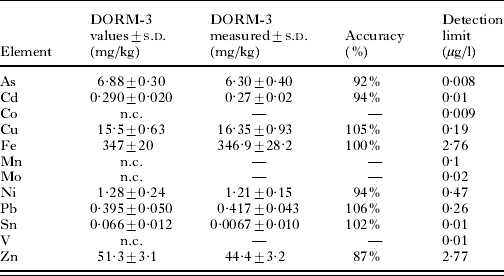
Detection limits and mean concentrations of elements in the reference material (DORM-3) are listed in Table 1. For 8 metals present in the standard reference material, accuracy rates ranging between 87 and 106% were obtained with the highest accuracy for iron (100%).
Trace metal concentrations in Dogfish Muscle Certified Reference Material (DORM-3), accuracy and detection limits determined by ICP-MS analyses

n.c., Element not certified.
Element concentrations in barbel and Pomphorhynchus laevis
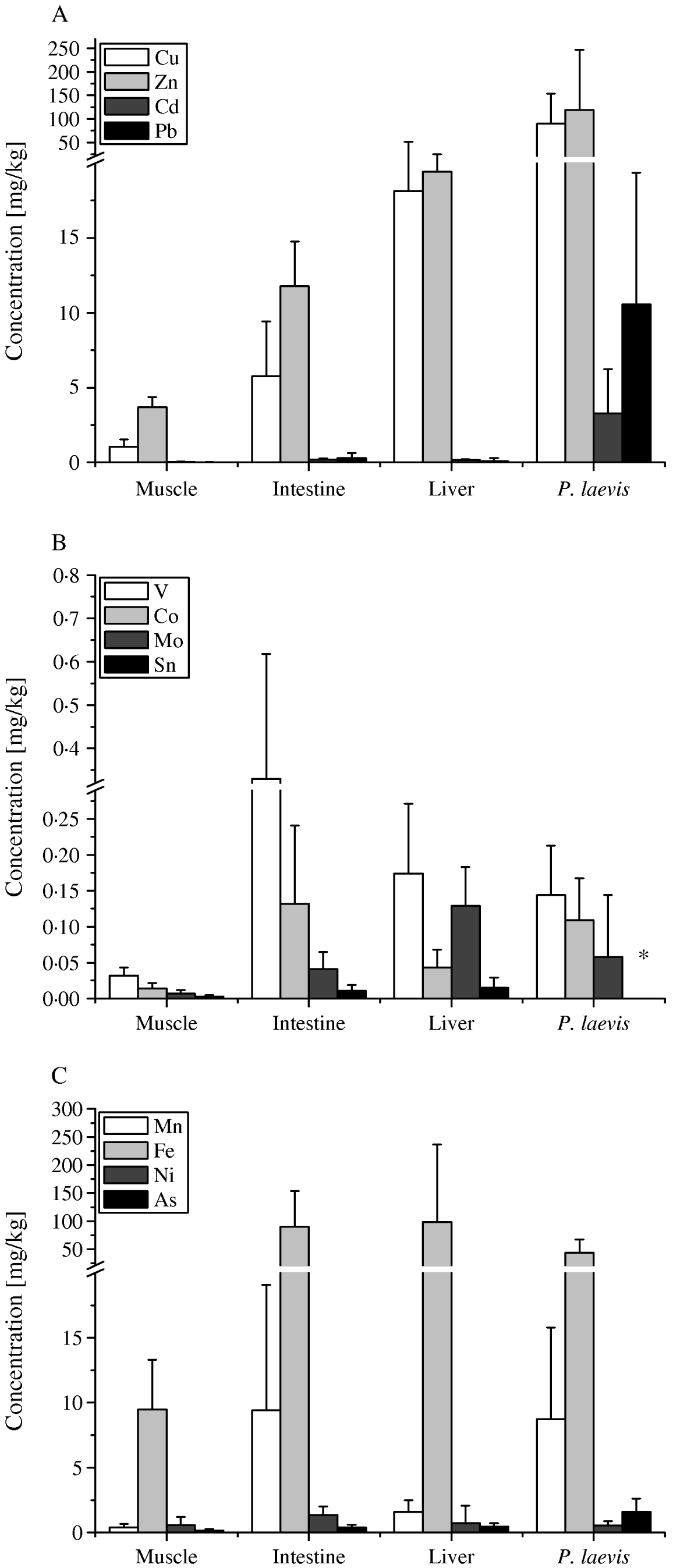
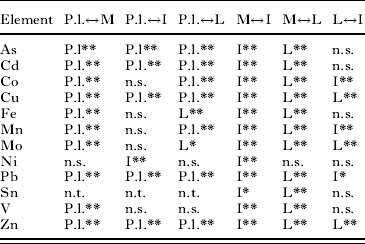
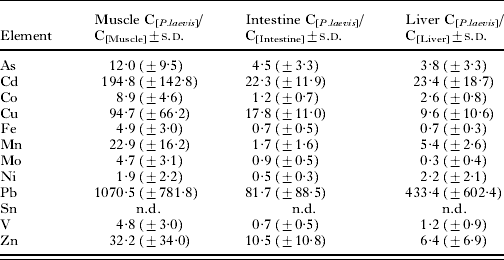
The concentrations of the 5 elements As, Cd, Cu, Pb and Zn were found to be significantly higher in the acanthocephalan P. laevis when compared with the host tissues (Fig. 2 and Table 2). With the exception of Sn, the levels of all other metals were higher in the parasite than in the muscle of barbel. The element Sn was below or close to the detection limit in the parasites, whereas the levels in the host were significantly higher.
Mean (±s.d.) element concentrations (A–C) in organs of barbels and its intestinal parasite Pomphorhynchus laevis. *Concentrations of Sn in P. laevis samples are not displayed as they were below the detection limit.

Differences between element concentrations in barbel organs and Pomphorhynchus laevis

M, muscle; I, intestine; L, liver; P.l., Pomphorhynchus laevis.
* Significant at P⩽0·05 (Wilcoxon matched pair test).
** Significant at P⩽0·01 (Wilcoxon matched pair test).
n.t., Not tested as concentration in Pomphorhynchus laevis was below the detection limit.
n.s., Not significantly different (Wilcoxon matched pair test).
In the case of significant difference, the site for higher concentration is given in each cell.
Comparisons of metal concentrations among the fish tissues showed only one clear pattern: the concentrations of all elements were lowest in the muscle (with the exception of Sn). Otherwise, some elements such as Cu, Mo and Zn, were present at higher concentrations in the liver; and other elements such as Co, Mn and Pb were present at significantly higher levels in intestinal samples.
The mean bioconcentration factors revealed, that 8 elements (As, Cd, Co, Cu, Mn, Pb, V, Zn) were present overall in higher levels (BCF>1) in the parasites (Table 3). The metal accumulation capacity of P. laevis with respect to host muscle in decreasing order was as follows: Pb>Cd>Cu>Zn>As>Mn>Co>V>Mo>Ni. Nearly the same pattern was observed for the intestine and liver, with Pb>Cd>Cu>Zn>As>Mn>Co>V for the intestine and Pb>Cd>Cu>Zn>As>Mn>Co>Ni>V for the liver. The remaining elements were detected only in low concentrations in the parasite samples (see Table 3). The mean concentrations were found to be up to 1070 times higher for Pb and 195 times higher for Cd compared to the host tissues. The ratios for As, Cu and Zn showed the same tendency with the highest mean values of 12, 95 and 32, respectively.
Bioconcentration factors C[P.laevis]/C[barbel tissue] for Pomphorhynchus laevis calculated with respect to different host tissues

n.d., Concentrations for Pomphorhynchus laevis below detection limit.
Accumulation differences with respect to parasite infrapopulation size and sex
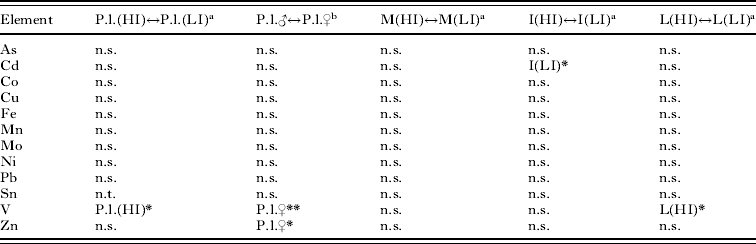
In general, comparisons between the element concentrations of lightly and heavily infected barbels showed no significant differences (Table 4). Concerning the parasites, the only significant differences were found for V, with higher levels in the heavily infected group. Fish liver of this group also contained significantly higher vanadium amounts (see Table 4). In contrast, the concentrations of Cd detected in the intestinal tissue were significantly higher in the lightly infected group (Table 4).
Differences in element concentrations between heavily infected (HI) and lightly infected (LI) barbels, as well as between male and female Pomphorhynchus laevis

M, muscle; I, intestine; L, liver; P.l., Pomphorhynchus laevis.
* Significant at P⩽0·05.
** Significant at P⩽0·01.
a Mann-Whitney U-test.
b Wilcoxon matched pair test.
n.s., Not significantly different.
n.t., Not tested.
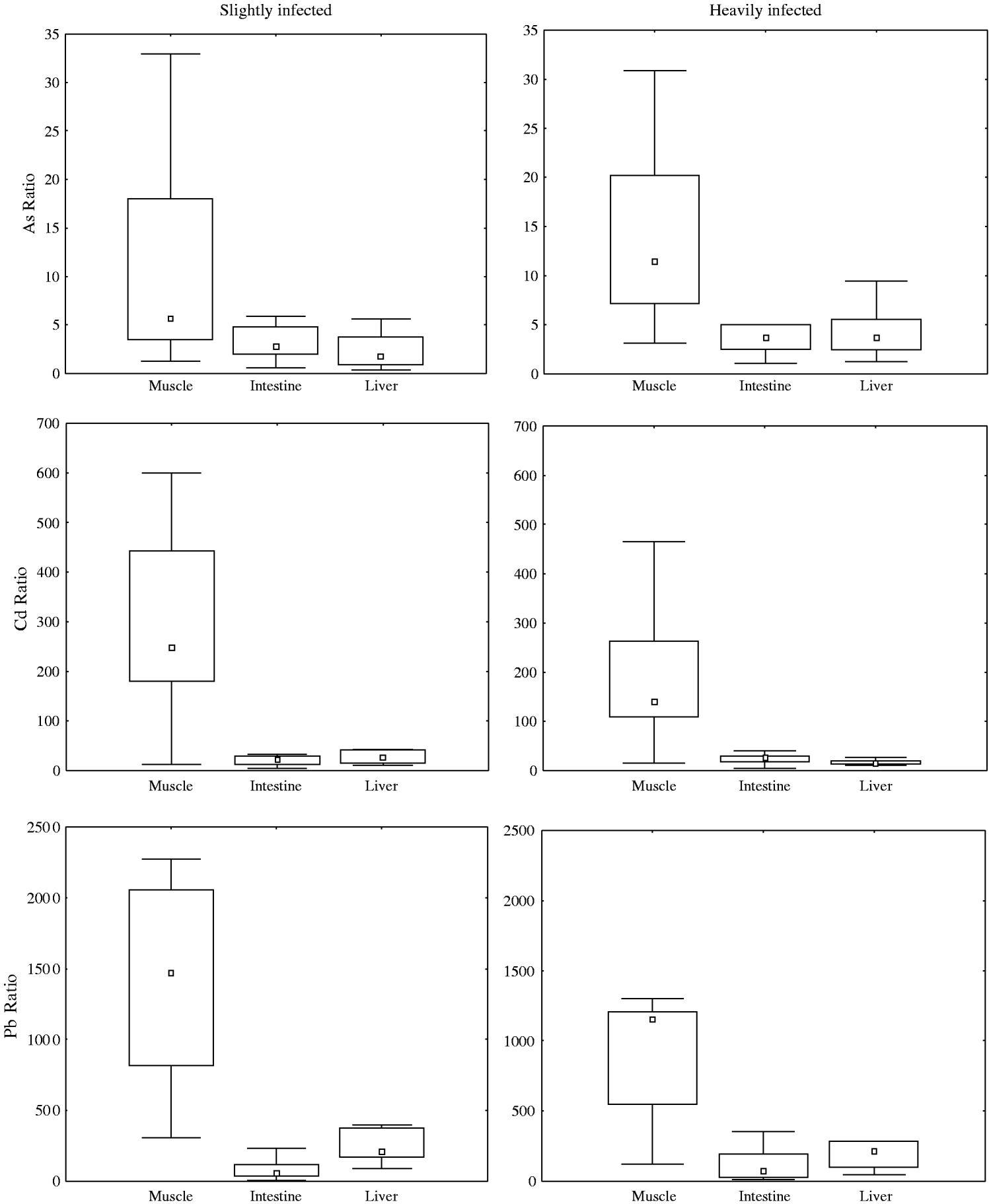
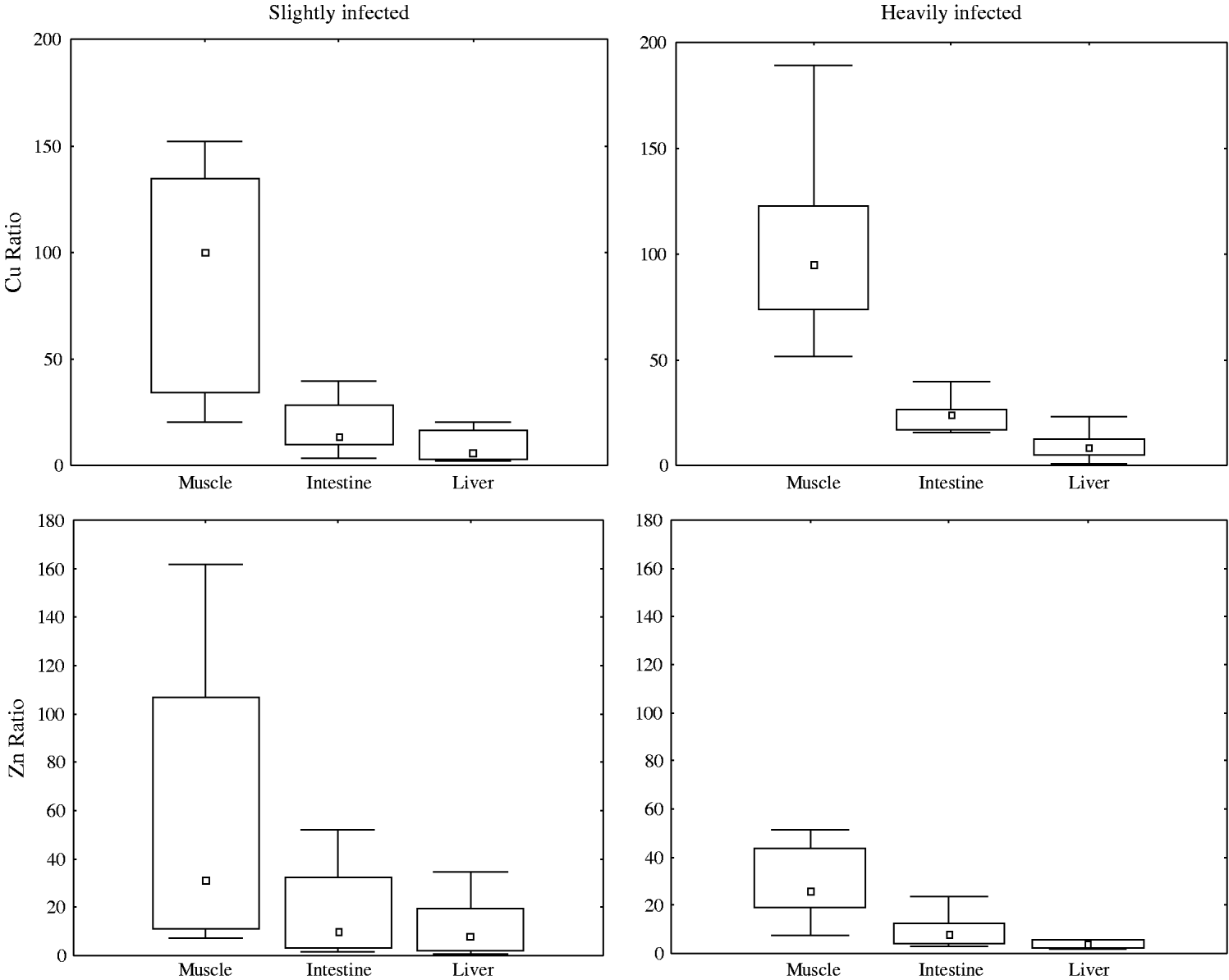
Comparisons of bioconcentration factors calculated for the metals present in significantly higher levels in P. laevis (As, Cd, Cu, Pb, Zn), showed no differences with respect to infrapopulation size. Lightly infected fishes displayed more variation in the values obtained for muscle tissue. However, the pattern of distribution, as well as the ratio ranges for other organs was similar (see Fig. 3 and Fig. 4).
Comparisons of the ratios C[P.laevis]/C[organ barbel] obtained for the toxic elements arsenic, cadmium and lead between heavily and lightly infected barbels. Dots are medians, boxes are interquartile ranges and error bars are interdecile ranges.

Comparisons of the ratios C[P.laevis]/C[organ barbel] obtained for the essential elements copper and zinc between heavily and lightly infected barbels. Dots are medians, boxes are interquartile ranges and error bars are interdecile ranges.

When comparing element concentrations with respect to parasite sex, similar values were found for females and males of P. laevis. Only the essential elements Zn and V were detected in significantly higher concentrations in the females (see Table 4).
DISCUSSION
As expected, and previously reported in various studies on metal accumulation in the host-acanthocephalan system (reviewed by Sures, Reference Sures2003, Reference Sures2004 b), many of the analysed elements were found in higher concentrations in the acanthocephalan P. laevis, compared to its host's tissues. Some toxic and essential elements such as As, Cd, Cu, Pb and Zn were present at significantly higher levels in the parasite. The same results were obtained by Schludermann et al. (Reference Schludermann, Konecny, Laimgruber, Lewis, Schiemer, Chovanec and Sures2003) for Cd, Pb and Zn from a field study in the Austrian part of the River Danube. The bioconcentration factors were quite similar in both studies, with the exception of Pb, which was more highly accumulated in P. laevis in the present study. The present lead concentrations confirmed previous results of an investigation on chub naturally infected with P. laevis from the River Ruhr in Germany (Sures et al. Reference Sures, Taraschewski and Jackwerth1994). In the latter study mean Pb values were found to be up to 2700 times higher in the parasite compared with muscle and 770 and 280 times higher than liver and intestine, respectively. The mean Pb concentrations in the fish organs were similar to those obtained during the present investigation, only the amounts detected in the parasite were higher. This discrepancy could be due to differences in lead levels of the Ruhr and Danube rivers. For example, the average concentration of lead in the water of the River Ruhr was 5 μg/L (Umweltbundesamt, 1992), whereas Pb concentrations in the River Danube near the fish sampling site varied between 2·3 and 2·8 μg/L for the period of 2003–2005 (TNMN, 2009). The mean bioconcentration factors calculated with respect to fish muscle differ in the same order as the water concentrations. Whereas the levels in host tissues were comparable, the acanthocephalans showed a higher Pb accumulation. This supports the use of P. laevis as an accumulation indicator due to its sensitive and linear response to aqueous metal concentrations, which was also demonstrated in laboratory exposure studies (Sures, Reference Sures2004 b).
With respect to parasite infrapopulation size, our study revealed that the intensity of infection usually plays no significant role for metal accumulation in the host-parasite system. Almost all elements were found in both groups (LI and HI) in similar concentrations in the parasite and host tissues. Accordingly, in general, metal accumulation is not influenced by the parasite infrapopulation size. The only significant difference was found for the element vanadium in P. laevis. Recently, laboratory studies demonstrated that infections with acanthocephalans can reduce heavy metal burdens in the host (Sures and Siddall, Reference Sures and Siddall1999; Sures et al. Reference Sures, Dezfuli and Krug2003) when comparing uninfected fish with infected conspecifics. Due to the lack of a sufficient number of uninfected fish in the present study, these laboratory findings could not be proven under field conditions.
A further aspect needing clarification in order to use acanthocephalans as accumulation indicators is the evaluation of possible effects of parasite sex on metal accumulation. Until now, there are only few studies based on acanthocephalans of terrestrial mammals that provide data on differences in element accumulation patterns between male and female worms. Scheef et al. (Reference Scheef, Sures and Taraschewski2000) and Sures et al. (Reference Sures, Jürges and Taraschewski2000 b) reported higher concentrations of lead and cadmium in females of the acanthocephalan Moniliformis moniliformis Bremser, 1811 in experimentally infected and subsequently metal-exposed rats. In contrast, element levels analysed by Sures et al. (Reference Sures, Franken and Taraschewski2000 a) in pigs naturally infected with Macracanthorhynchus hirudinaceus Pallas, 1781 showed the opposite tendency—male worms contained higher concentrations of each element. Accordingly, the low number of publications and the contradictory results do not allow general conclusions. Additionally, the mechanism of metal uptake in the fish-acanthocephalan system differs from that of terrestrial mammals. According to previous studies, acanthocephalans in freshwater fish are exposed to bile-bound metals in the small intestine (Sures and Siddall, Reference Sures and Siddall1999) after metals were taken up by fish gills, transported into the liver and then excreted with the bile into the intestine (Hofer and Lackner, Reference Hofer and Lackner1995; reviewed by Sures, Reference Sures2001). In contrast, excretion of metals in mammals occurs mainly through the kidneys (Merian, Reference Merian, Merian, Anke, Ihnat and Stoeppler2004). Therefore data from studies on terrestrial mammals might be completely different from results obtained from fish hosts. Considering the results of the present study, no clear evidence exists for a possible impact of parasite sex on heavy metal uptake. The only metals found at significantly higher concentrations in females were V (at P<0·05) and Zn (at P≈0·05), from which at least the latter element can be considered essential and is therefore regulated by the fish. Concentrations of other elements and especially those of potential importance in metal monitoring surveys were not significantly different when comparing both sexes.
The absence of differences for most element concentrations with respect to parasite sex, as well as with respect to infrapopulation size together with the enormous accumulation capacity, underline the possible use of P. laevis as an excellent sentinel for metal pollution. The importance of detecting metals with toxic effects on biota persists due to their adverse effects on the functionality of aquatic ecosystems (Merian, Reference Merian, Merian, Anke, Ihnat and Stoeppler2004). Furthermore, the EC-Water Framework Directive (WFD, 2000) has the objective of a good chemical quality status for all European waters. Accordingly, pollutant levels in surface waters have to be monitored to decide if their concentrations meet environmental quality standards. In order to use host-parasite systems as bioindicators to detect metal pollution, the contribution of all possible factors, which might affect metal uptake in the system should be elucidated in detail. In this context the present study evaluated possible influences of parasite sex and infrapopulation size and the results re-verified the acanthocephalan P. laevis as a highly suitable accumulation indicator, which meets all criteria suggested for ideal sentinels (see Beeby, Reference Beeby2001; Sures, Reference Sures2004 a).
ACKNOWLEDGEMENTS
Thanks are due to Landesgraduiertenförderung Baden-Württemberg for financial support for M.N. Thanks are also due to Christine Dubreuil for her help in parasite molecular identification.