Introduction
The informal system of care to older adults is recognised as comprising family, friends and neighbours (Novak Reference Novak1995; Wolff and Kasper Reference Wolff and Kasper2006). However, researchers who study informal caring overwhelmingly have focused on care provided by kin (Nocon and Pearson Reference Nocon and Pearson2000). Contributions of non-kin often are absent from contemporary discourses in caring (e.g. Szinovacz and Davey Reference Szinovacz and Davey2008). When non-kin are included in survey samples, this category is often excluded from analysis, not reported separately, treated as adjuncts to more central research interests, or placed in a residual category such as ‘other’ which has no conceptual meaning (e.g. Brown Reference Brown2007; Wolff and Kasper Reference Wolff and Kasper2006). As a result, non-kin care-giving is poorly understood, leaving a large gap in understanding the complexities of the informal care sector.
This knowledge gap is especially troublesome given growing alarm about the ability of families to provide care to an ageing population. Smaller family sizes and increasing rates of divorce and remarriage have led to concerns about the weakening of filial obligation (Lowenstein and Daatland Reference Lowenstein and Daatland2006). In addition, greater geographic dispersal of families, and high rates of female labour force participation have limited the availability of proximate carers (Silverstein and Giarusso Reference Silverstein and Giarrusso2010). In the face of reduced public-sector provision of formal care, there are forecasts of reduced family caring capacity and a widening care gap (Himes and Reidy Reference Himes and Reidy2000; Mestheneos and Triantafillou Reference Mestheneos and Triantafillou2005; Wenger Reference Wenger, Weisstub, Thomasma, Guatheir and Tomossy2001), and evidence that despite increasing levels of disability, fewer frail older adults are receiving informal care (Wolff and Kasper Reference Wolff and Kasper2006).
It may be because friend and neighbour relationships are seen as discretionary, and perhaps unreliable, that less attention has been paid to their place in the informal care sector. Yet non-kin represent a sizeable minority of informal carers. In Canada, approximately 20 per cent of all informal carers of older adults with long-term health problems provide care to non-kin (Keating et al. Reference Keating, Fast, Frederick, Cranswick and Perrier1999). In fact, there is evidence that 15 per cent of older adults receiving assistance due to a long-term health problem have care networks comprised solely of non-kin (Fast et al. Reference Fast, Keating, Otfinowski and Derksen2003). Assistance from friends and neighbours has been shown to serve a critical role in keeping older adults in their own homes (Burns et al. Reference Burns, Abernethy, Leblanc and Currow2011; Nocon and Pearson Reference Nocon and Pearson2000), and may extend independence longer than assistance from family carers (Wenger Reference Wenger1993). In order to more fully understand the ways in which the informal sector provides care for older adults, a closer look at the care provided by friends and neighbours is warranted.
Within the category of kin carers distinctions have long been made among spouses, adult children and other more extended family relationships, based on assumptions of differences in their caring obligations and experiences (Finch and Mason Reference Finch and Mason1990, Reference Finch and Mason1993; Lima et al. Reference Lima, Allen, Goldscheider and Intrator2008). Researchers have used these distinctions to explore in depth the ways in which members of these kin groups provide care (e.g. Lashewicz and Keating Reference Lashewicz and Keating2009; Lee, Spitze and Logan Reference Lee, Spitze and Logan2003). Rarely have such distinctions been drawn among those who have no kin relationship to the cared-for person. When all non-kin are bundled into a single category, potentially significant differences are obscured that might demonstrate diversity in obligations to care and in types and amount of care provided.
More than 20 years ago, Crohan and Antonucci (Reference Crohan, Antonucci, Adams and Blieszner1989) called for a move beyond the generic non-kin categorisation to better understand how these relationships contribute to the long-term care of older adults. Given the dual pressures of population ageing and family fragility, taking on this challenge is long overdue. The purpose of this study is to further our understanding of the characteristics and contributions of non-kin informal carers of older adults with long-term health problems, with a specific focus on distinctions between friend and neighbour carers.
Conceptual framework: hierarchies of obligation
This study contributes to our understanding of the supply side of informal care by investigating the interpersonal (relationship type, emotional closeness and geographical proximity) and socio-demographic (gender, age, education, income, employment status and competing family roles) predictors and patterns of informal care provided by friends and neighbours. These variables have been highlighted by researchers investigating family carers as important push/pull factors, operating by either obligating kin to provide care, or providing ‘legitimate excuses’ to limit care (Cantor Reference Cantor1979; Cantor and Brennan Reference Cantor and Brennan2000; Finch and Mason Reference Finch and Mason1990, Reference Finch and Mason1993; Qureshi and Walker Reference Qureshi and Walker1989). They also have practical significance, in that these variables are often used to model the future supply of informal carers (e.g. Pickard Reference Pickard2008).
Relationship type is central to the investigation of the nature and amount of informal care being provided. A number of researchers have developed normative or behavioural hierarchies of obligation to provide informal care for older adults that are categorised based on relationship type (Cantor Reference Cantor1979; Cantor and Brennan Reference Cantor and Brennan2000; Finch and Mason Reference Finch and Mason1990, Reference Finch and Mason1993; Penning Reference Penning1990; Qureshi and Walker Reference Qureshi and Walker1989). Carers who are higher up in the hierarchy will be more likely to provide assistance, regardless of the task (Penning Reference Penning1990). The relative order of relationships in these hierarchies is largely determined by differences in filial obligation and other social norms that influence obligations to provide informal care, with gender, geographical proximity and relationship closeness also playing a role (Cantor and Brennan Reference Cantor and Brennan2000; Finch and Mason Reference Finch and Mason1990, Reference Finch and Mason1993; Qureshi and Walker Reference Qureshi and Walker1989).
While many of these hierarchies include non-kin (at or near the bottom), none of them distinguishes types of non-kin, despite differences in the nature of friend and neighbour relationships and the social norms governing them. Such differences in how relationships are developed and maintained reflect societal views of appropriate behaviour in relationships (Ikkink and van Tilburg Reference Ikkink and van Tilburg1998; Sabatelli and Shehan Reference Sabatelli, Shehan, Boss, Doherty, Larossa, Schumm and Steinmetz1993). Friendship in Western cultures is described as voluntary, informal, personal and private and has been distinguished from other interpersonal relationships, such as neighbours and kin, by its basis in free choice and mutual attraction (Allan Reference Allan2008, Reference Allan, Dannefer and Phillipson2010). Neighbours, by definition, are people who live near one another (Bulmer Reference Bulmer1986). There are no assumptions of mutual attraction or intimacy. In fact, the maintenance of social distance and respect for privacy are important aspects of neighbour relationships (Crow, Allan and Summers Reference Crow, Allan and Summers2002). In contrast, friends are important later-life sources of moral and emotional support, companionship and affection (Armstrong and Goldsteen Reference Armstrong and Goldsteen1990). Long-term friendships are characterised by delayed reciprocity and may take on the guise of pseudo kinship (Young, Seale and Bury Reference Young, Seale and Bury1998) in terms of the provision of assistance (Jerrome Reference Jerrome1990).
We hypothesise that these normative and interpersonal distinctions between friend and neighbour relationships would place friends above neighbours in the hierarchy of obligation and lead to differences in approaches to the provision of care, with friends more likely to provide assistance with all forms of instrumental care and provide higher levels of care in terms of intensity and duration. While friends and neighbours are not subject to the same social norms as kin, ‘obligating’ them to provide care in the same way that kin are obligated, various aspects of these relationships including social norms, relationship closeness and geographical proximity may operate as subtle forms of obligation influencing expectations and the willingness of friends and neighbours to provide care.
Normative hierarchies of who should provide care do not always directly correspond to behavioural hierarchies of who actually provides care. Research on patterns of informal care provision has identified a number of ‘legitimate excuses’ for not following normative rules including competing family obligations, employment, lack of resources, incompetence and geographical proximity (Finch and Mason Reference Finch and Mason1993; Qureshi Reference Qureshi1990). While some socio-demographic variables, such as gender and age, are not ‘legitimate excuses’ in and of themselves, De Koker (Reference De Koker2009) argues that these characteristics influence the likelihood of getting other ‘legitimate excuses’ accepted. For example, men are more likely than women to claim incompetence and have this excuse accepted as legitimate (Finch and Mason Reference Finch and Mason1993). To the extent that there is agreement on the legitimacy of excuses they also comprise a component of the normative belief system governing the informal care of older adults (Qureshi Reference Qureshi1990). It is expected that these ‘legitimate excuses’ will be related to lower levels of care provision (De Koker Reference De Koker2009).
Research on non-kin caring
There is a small body of literature on care provided by friends and neighbours to older adults which illustrates the state of knowledge about these carers. Given lack of recent examination of the non-kin sector, much of the extant information is somewhat dated (e.g. Arling Reference Arling1976; Armstrong and Goldsteen Reference Armstrong and Goldsteen1990; Barker and Mitteness Reference Barker, Mitteness, Gubrium and Sankar1990; Cantor Reference Cantor1979; O'Bryant Reference O'Bryant1985; Wenger Reference Wenger1990); although, there is a small body of more recent research (e.g. Barker Reference Barker2002; Himes and Reidy Reference Himes and Reidy2000; Nocon and Pearson Reference Nocon and Pearson2000). Here we review findings that describe characteristics of non-kin carers, the types of tasks and amount of care provided, and factors that may influence the amount of care provided. Where possible, differences between friends and neighbours are highlighted, although there is little empirical work to inform the question of whether there are distinctions among friend and neighbour carers.
Carer characteristics
Older age may be a ‘legitimate excuse’ for not providing instrumental care to non-kin. Non-kin members of social networks, especially friends, typically are age peers (McPherson, Smith-Lovin and Cook Reference McPherson, Smith-Lovin and Cook2001; Uhlenberg and Jong Gierveld Reference Uhlenberg and de Jong Gierveld2004). In contrast, findings from previous research on non-kin caring show that these carers span a broader age range. From classic studies on friend and neighbour relationships (Cantor Reference Cantor1979), to contemporary research on non-kin carers (Barker Reference Barker2002), findings are consistent: both friends and neighbours who assist are likely younger than the recipient. For example, Wenger (Reference Wenger1990) found that in rural Wales, younger, retired neighbours often take on the role of ‘good neighbour’ and perform instrumental tasks. Non-kin carers of older adults in Barker's (Reference Barker2002) study, from the United States of America (USA), ranged in age from 22 to 87, although the majority (53%) were under the age of 65. This age difference may be even more pronounced at higher levels of care. Barker and Mitteness (Reference Barker, Mitteness, Gubrium and Sankar1990) found that almost all (95%) of the 29 informal, non-kin primary carers in their study were at least a decade younger than the care recipient.
Studies also indicate that the majority (approximately 80%) of non-kin carers are female (Barker Reference Barker2002; Nocon and Pearson Reference Nocon and Pearson2000). Often these carers are without the competing role demands of marriage (Barker Reference Barker2002; Himes and Reidy Reference Himes and Reidy2000) or employment (Himes and Reidy Reference Himes and Reidy2000; Nocon and Pearson Reference Nocon and Pearson2000), and most live in close proximity (Barker Reference Barker2002; Barker and Mittness Reference Barker, Mitteness, Gubrium and Sankar1990). This is consistent with the idea of competing role demands providing ‘legitimate excuses’ for limiting care, and gender role expectations providing higher obligations to provide care. Geographical proximity can simultaneously increase obligation for those who live close, while providing a ‘legitimate excuse’ for those who live further away to limit care.
Less attention has been given to the education or income of non-kin carers. Barker (Reference Barker2002) noted that the non-kin carers in her study had modest economic resources despite having relatively high levels of education (43% had a college degree). Himes and Reidy (Reference Himes and Reidy2000) found that friend carers had lower levels of education than family carers. Research on social class differences in friendship patterns and expectations suggest that exchanges of support are more common among working-class than middle-class friends (Walker Reference Walker1995), potentially increasing obligations to provide informal care to non-kin in these groups.
Emotional closeness may be a key to understanding why friends or neighbours might become or remain involved in informal caring relationships with non-kin. Non-kin carers may represent those relationships that have become so close and have such strong commitment that they are thought of in terms of family relationships (Spencer and Pahl Reference Spencer and Pahl2006). In the presence of a strong emotional connection, non-kin may feel obligated to provide instrumental assistance. Barker (Reference Barker2002) found that more than 80 per cent of non-kin carers in her study were characterised by strong affective bonds, with 56 per cent using kin terms to describe the closeness of their relationship.
Types of tasks
There has been little systematic research on tasks that are provided by friends and neighbours to older adults with chronic health problems. Much of what we know about the range of tasks comes from qualitative studies. Types of instrumental support noted in studies looking at friend carers include transportation, shopping, meal preparation, sewing and mending, household repairs, and yard work (Armstrong and Goldsteen Reference Armstrong and Goldsteen1990; Wenger Reference Wenger1990). Tangible assistance is also frequently provided to neighbours (Bulmer Reference Bulmer1986). Similar to the tasks assisted with by friends, forms of neighbour help commonly mentioned include monitoring, shopping, errands, yard work and home maintenance (Boyce Reference Boyce2006; Nocon and Pearson Reference Nocon and Pearson2000; Wenger Reference Wenger1990). There is also evidence that non-kin may provide assistance with more intimate care tasks such as personal care and money management, and even unpleasant tasks like cleaning up after toileting accidents (Barker Reference Barker2002; Nocon and Pearson Reference Nocon and Pearson2000; Young, Seale and Bury Reference Young, Seale and Bury1998). Given evidence of privacy norms between neighbours, it seems likely that such care would be not be provided to neighbours because receipt of such assistance would violate these norms, whereas the personal nature of friendships may allow for this type of assistance.
While previous research tells us that friends and neighbours do help with a wide range of tasks, we do not have generalisable information on how common it is for them to help with particular tasks, nor can we say for certain whether differences exist in the types of tasks provided by friends and neighbours.
According to the hierarchical-compensatory model, informal carers behave as ‘generalists’ (Rook and Schuster Reference Rook, Schuster, Pierce, Sarason and Sarason1996), with preferred sources of help providing assistance regardless of the task (Cantor Reference Cantor1979; Cantor and Brennan Reference Cantor and Brennan2000). To the extent that friends are emotionally closer to the care recipient, and fall higher up the care hierarchy than neighbours, they may be more likely to provide assistance with all types of instrumental tasks.
Amount and duration of care
Given the distinct social norms and expectations surrounding specific non-kin relationships, differences may exist between friends and neighbours in the number of tasks and overall amount of time spent providing care, including duration of that care. Because of social norms of distance and privacy ascribed to neighbour relationships, their helping behaviours might be restricted to fewer tasks or fewer hours so as not to be perceived as intruding on their neighbours' lives. On the other hand, neighbours are better situated than friends to help on a daily basis because of their geographic proximity (Litwak Reference Litwak1985; Wenger Reference Wenger1990), and it is the tasks that must be completed on a daily basis which are the most time consuming.
Non-kin carers have been found to provide various levels of assistance. In a study of bereaved friends, Burns et al. (Reference Burns, Abernethy, Leblanc and Currow2011) found that among the 265 ‘hands on’ carers, 65 provided daily care and 200 intermittent care. Another study (Barker Reference Barker2002) reported contact frequency by neighbours, friends and other non-kin carers of the elderly at 40 per cent (daily), 31 per cent (several times a week) and 29 per cent (once a week). In looking at hours of assistance per week, Himes and Reidy (Reference Himes and Reidy2000) found that women provided an average of 8.1 hours per week over the past year to friends, including any type of help or assistance for short- or long-term needs. When non-kin carers are designated as primary carers, their assistance is described as regular and frequent, or intense (Barker and Mitteness Reference Barker, Mitteness, Gubrium and Sankar1990; Nocon and Pearson Reference Nocon and Pearson2000).
Norms about the continuity of relationships among friends and neighbours help inform the nature of their involvement. Ikkink and van Tilburg (Reference Ikkink and van Tilburg1998) found that social norms make it difficult for friends to withdraw from unreciprocated support-giving, although this is not the case for neighbours. Given these norms, it seems likely that friends will provide care for longer durations than neighbours. While the majority of non-kin primary carers to clients of a large home health care agency were providing care for less than one year, approximately one-third had cared for five years or more (Barker and Mitteness Reference Barker, Mitteness, Gubrium and Sankar1990). The median duration of caring in Barker's (Reference Barker2002) study of non-kin carers who were ‘committed amateurs’ was two years. Unfortunately, extant literature on duration of care does not distinguish between friends and neighbours.
Predictors of amount of care
While the hierarchies of obligation framework provides a rationale for who will provide care, this same rationale can be applied to the amount of care provided. Given the paucity of research on predictors of the amount of care provided by non-kin, we review empirical findings about informal carers in general that indicate gender, age, education, income, competing roles (spouse, parent, employee), proximity and relationship closeness influence the amount of care provided.
Consistent with other types of domestic responsibilities, participation in care for older people is affected by gender. Women spend significantly more time providing informal care than men (National Alliance for Caregiving and AARP 2009), and this is expected to hold true regardless of relationship status. Age is another factor that could influence the amount of care provided by non-kin. On average adults over the age of 65 provide more hours of care per week than younger adults (National Alliance for Caregiving and AARP 2009). Higher levels of support may also be provided by individuals with lower levels of socio-economic resources, as they are more likely to be engaged in exchanges of support with others and have individuals with higher needs in their social networks (Walker Reference Walker1995). Research on care-giving in the USA has found that carers in lower-income households provide more care than those in higher-income households (National Alliance for Caregiving and AARP 2009).
The roles of spouse, parent and employee require time and energy that can interfere with caring activities. These competing demands are often viewed as ‘legitimate excuses’ for not providing normatively obligated support (Qureshi Reference Qureshi1990). Given assumptions that non-kin are not obligated by social norms to provide informal care, it seems likely that competing demands for their time would reduce the amount of care they provide. There is evidence that married or working women were less likely to provide care to a friend than to a family member (Himes and Reidy Reference Himes and Reidy2000). Gallagher and Gerstel (Reference Gallagher and Gerstel1993) found that being married significantly reduced the hours of help provided to friends, although employment was not a significant predictor.
Proximity and emotional closeness are important factors that influence informal care-giving. The amount of ongoing instrumental care provided by others is argued to be particularly sensitive to geographical proximity, with tasks that require daily assistance being more constrained than tasks that can be performed on an intermittent basis (Litwak and Kulis Reference Litwak and Kulis1987). Emotional closeness is positively correlated with the amount of care provided (Keating and Dosman Reference Keating and Dosman2009; Wellman and Wortley Reference Wellman and Wortley1990). There has been no examination of whether the emotional closeness of friendship trumps the proximity of neighbours in determining amount of care.
Research questions
Overall, previous research on friends' and neighbours' care to older adults is scarce and often not generalisable. We do not have a clear sense of the characteristics of non-kin carers, what and how much they do, or the factors influencing the amount of care provided. In addition, the potentially unique roles of friends and neighbours in providing care have not been explored. This study addresses these critical gaps by answering the following sets of research questions:
1 What are the characteristics of non-kin carers? Are there significant differences in the characteristics of friend and neighbour carers?
2 What types of care tasks do non-kin provide? Are there significant differences in the types of tasks provided by friend versus neighbour carers?
3 How much care is provided by non-kin in terms of amount and duration? Are there significant differences in the amount or duration of care provided by friend and neighbour carers?
4 What interpersonal and socio-demographic factors predict the amount of time spent providing care by non-kin? To what extent do these factors explain differences in the amount of time spent by friends and neighbours providing care?
Methods
Source of data
We used the 1996 General Social Survey, Cycle 11: Social and Community Support (Statistics Canada 1998). The General Social Surveys are nationally representative surveys on a variety of topics. Data are collected using random digit dialling. The target population is all persons 15 years of age and over residing in Canada, excluding residents of the Yukon and Northwest Territories and full-time residents of institutions. Households without telephones, which account for less than 2 per cent of the total Canadian population, were excluded from the survey (Statistics Canada 1998). The sample for Cycle 11 was 12,756 individuals, representing an 85.3 per cent response rate.
The analysis sample
To be included in this study the respondent had to be a friend or neighbour providing informal assistance to an adult age 65 or older with one or more of: personal care, bills and banking, home maintenance, housekeeping, meal preparation and clean-up, shopping or transportation. In addition, the reason for providing assistance had to be because of a long-term health or physical limitation of the care recipient. A long-term health or physical limitation was defined as any condition lasting or expected to last more than six months and considered either chronic or permanent, including failing health. Neighbours and friends who reported providing assistance due to temporary difficult times such as bereavement, acute illness or other reasons (e.g. convenience or mutual benefit) were not included in this study. This resulted in a sample size of 324.
Respondents were not asked to self-identify as carers, but were defined so because they provided assistance with activities of daily living (ADL) or instrumental activities of daily living (IADL) to someone because of a long-term health or physical limitation (Keating et al. Reference Keating, Otfinowski, Wenger, Fast and Derksen2003). The advantage of this approach is that it includes those who are actively involved in assisting someone with a chronic condition regardless of whether they self-identify as a carer (O'Connor Reference O'Connor2007). This definition of a carer assumes that assistance provided to an older adult with a long-term health or physical limitation is being used to compensate for losses in the elder's functional status, distinguishing it from routine assistance (Keating et al. Reference Keating, Fast, Frederick, Cranswick and Perrier1999), and is consistent with the definition of a care-giver used by Statistics Canada (1998).
Measures
Respondents were asked to select their relationship to the person they had been assisting from a checklist of kin and non-kin relationship categories. In addition to an extensive list of specific kin relationships, a number of non-kin options were available including ex-spouse or ex-partner, friend, neighbour, co-worker, governmental organisation, non-governmental organisation, paid employee, and other, which included same-sex partners. Only those who identified themselves as friends or neighbours were included in this study. Type of non-kin relationship was coded as a dichotomous variable (friend=1). While friends and neighbours are not theoretically mutually exclusive groups they were treated as such in this study, with the respondent determining how best to characterise the relationship.
The age of the carer was measured as a continuous variable. In addition, a categorical age variable was included in the bivariate analyses with the age groups 15–44, 45–64, 65–74 and 75+. Carer gender was measured using a dummy variable (female=1). Competing roles were measured using three dichotomous variables indicating whether or not the respondent was married, had a minor child in the household or was currently employed. Education was included as a continuous variable in the multivariate analyses. In the bivariate analysis education was collapsed into a categorical variable with five categories (less than high school, high school, some post-secondary, certificate or diploma from a trade school or community college, bachelor's degree or higher). In all analyses, annual household income was measured as a categorical variable with five categories (less than CA $15,000, $15,000 to less than $30,000, $30,000 to less than $60,000, $60,000 or more). The reference category in the multivariate analyses was annual household income of less than $15,000.
In addition to relationship type, geographical proximity and relationship closeness represented interpersonal relationship characteristics. The proximity variable distinguished among respondents who lived in the same building, the same neighbourhood or community (30 minutes or less by foot or bus), the surrounding area (less than an hour by car), and those outside the surrounding area. The reference group in the multivariate analyses was the same building. To measure relationship closeness respondents were asked ‘How would you describe your relationship with {person x}?’ Responses included very close, close, friendly, indifferent and hostile. Very close was the reference category in the multivariate analyses. None of the respondents in this study reported a hostile relationship with the care recipient.
Respondents were asked if they provided assistance with any part of someone's personal care (such as assisting with bathing, toileting, care of toenails/fingernails, brushing teeth, shampooing and hair care, or dressing), bill paying or banking, home maintenance and outside work, house cleaning, laundry or sewing, meal preparation or clean-up, transportation, or shopping for groceries or other necessities in the 12 months preceding the survey. These seven tasks represent one ADL (personal care) and six IADL's (bills and banking, home maintenance, housekeeping, meals, transportation and shopping). Each task was included as a dichotomous variable indicating whether or not the respondent had provided assistance with that task (yes=1).
The amount and duration of care was indicated by the total number of tasks assisted with, the amount of time spent providing care, and the length of time the respondent had been providing care. The total number of tasks was a count of the number of tasks (out of seven) provided by the respondent. Total time spent caring was calculated as the average number of hours per week spent on all tasks for the care receiver in the 12 months preceding the survey. This variable was logged in the multivariate analyses due to the skewed distribution. Respondents were asked how long ago they began providing assistance with each task. Response categories included less than one month, six months to less than one year, one year to less than two years, or two years or more. Length of caring was calculated using the task that the respondent had been providing for the longest period of time.
Statistical methods
Bivariate analyses were used to compare friend and neighbour carers on demographic characteristics and caring contributions. Chi-square tests were used for categorical variables, and one-way ANOVA for continuous variables. To retain as many cases as possible pairwise deletion was used for the bivariate analyses. Ordinary least-squares (OLS) regression was used to determine significant predictors of the average number of hours of informal care (logged) provided by non-kin, and to estimate differences between friends and neighbours. The coefficients in a model with a logged dependent variable can be interpreted as a per cent change in the (non-logged) dependent variable using the following formula (eb−1)×100. For the multivariate logistic and OLS regressions multiple imputations of the independent variables were used to retain all cases that had a valid response for the dependent variable. Missing values were imputed for 1.5 per cent of the sample on education, 21.9 per cent of the sample on income and 0.3 per cent of the sample on relationship closeness. With multiple imputation, multiple separate data sets are imputed, allowing missing values to take on a different solution for each imputation (Acock Reference Acock2005). The analyses are then run on each data set and the parameter estimates pooled to provide a single solution. This solution incorporates the variability of the different imputations, producing unbiased standard errors (Acock Reference Acock2005). This study used 100 imputed data sets for the multivariate analyses.
Where appropriate, the assumptions surrounding the OLS method were tested and verified. According to the Shapiro–Wilkes test for normality, the errors were normally distributed, allowing for hypothesis testing and generalisation to the population (Gujarati Reference Gujarati1995). Variance inflation factors were examined and indicated that multicollinearity was not a problem (Chen et al. Reference Chen, Ender, Mitchell and Wells2003; Wissmann, Toutenburg and Shalabh Reference Wissmann, Toutenburg and Shalabh2007). All analyses were weighted to be nationally representative by accounting for unequal probabilities of selection (Statistics Canada 1998).
Results
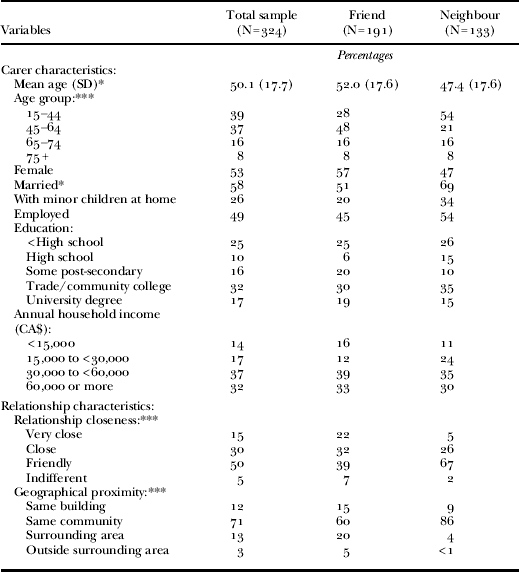
Table 1 presents weighted descriptive statistics of the sample and the results of the bivariate analyses comparing friend and neighbour carers on socio-demographic and interpersonal characteristics. Approximately 41 per cent of the non-kin carers in the sample were neighbours and 59 per cent were friends. Friend carers were significantly older on average than neighbour carers (52.0 versus 47.4, respectively; p<0.05). The majority of neighbour carers were between the ages of 15 and 44, whereas friend carers were more likely to be between the ages of 45 and 64. Neighbour carers were more likely than friend carers to be married (69% versus 51%), but the two groups did not significantly differ in gender, labour force participation, education, annual household income or having a minor child in the household. Significant differences in geographical proximity to the care recipient existed between friends and neighbours (p<0.001), although the majority of both groups lived within 30 minutes by foot or bus. Friend carers are more likely than neighbours to describe their relationship as very close (p<0.001), although friendly is the term most commonly used by both groups to characterise their relationships with the care recipient.
Weighted descriptive statistics and bivariate analyses of carer and relationship characteristics by non-kin relationship type

Note: 1. SD: standard deviation.
Significance levels: *p<0.05, **p<0.01, ***p<0.001 (difference between friends and neighbours).
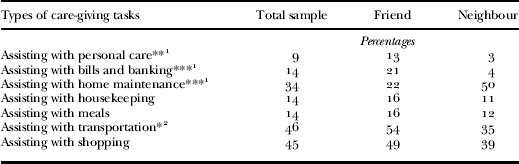
The types of assistance provided by friend and neighbour carers and the results of bivariate chi-squared analyses are reported in Table 2. For friends, the most common type of assistance provided was transportation, whereas for neighbours it was home maintenance. Friend carers were significantly more likely than neighbour carers to assist with personal care (p<0.05), bills and banking (p<0.001) and transportation (p<0.05). Neighbour carers were significantly more likely to assist with home maintenance (p<0.001). In additional analyses, these differences remained significant even after controlling for gender, age, education, income, competing demands (spouse, parent, worker), proximity and relationship closeness, except transportation which became marginally significant (p=0.085) after controlling for relationship closeness. No significant differences were found in the likelihood of assisting with housekeeping, meals or shopping.
Bivariate analyses of types of assistance provided by friend and neighbour care-givers
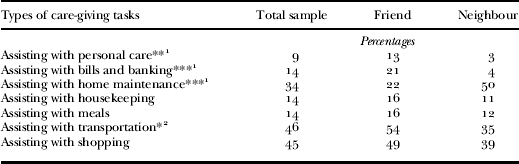
Notes: 1. Difference between friend and neighbour carers remains significant (p<0.05) after controlling for gender, age, education, income, marital status, having a minor child in the household, labour force participation, proximity and relationship closeness. 2. Difference between friend and neighbour carers remains significant (p<0.05) after controlling for gender, age, education, income, marital status, having a minor child in the household, labour force participation and proximity, but becomes marginally significant (p=0.085) after controlling for relationship closeness.
Significance levels: *p<0.05, **p<0.01, ***p<0.001 (difference between friends and neighbours).
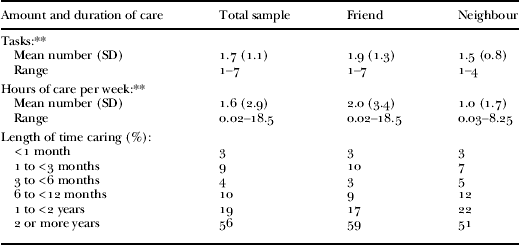
Table 3 describes the amount and duration of care provided by friends and neighbours. Friends provided assistance with a greater number of tasks (p<0.01) and more hours of care per week on average (p<0.01) than neighbours. Neighbours helped on average with 1.5 tasks for an average of one hour per week, whereas friends helped on average with 1.9 tasks for an average of two hours per week. Friend and neighbour carers did not differ significantly in the length of time they had been providing care. The majority of both groups had been providing care for two or more years.
Bivariate analyses of amount and duration of care provided by friend and neighbour carers
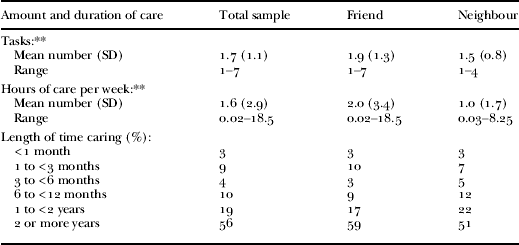
Note: SD: standard deviation.
Significance levels: *p<0.05, **p<0.01, ***p<0.001 (difference between friends and neighbours).
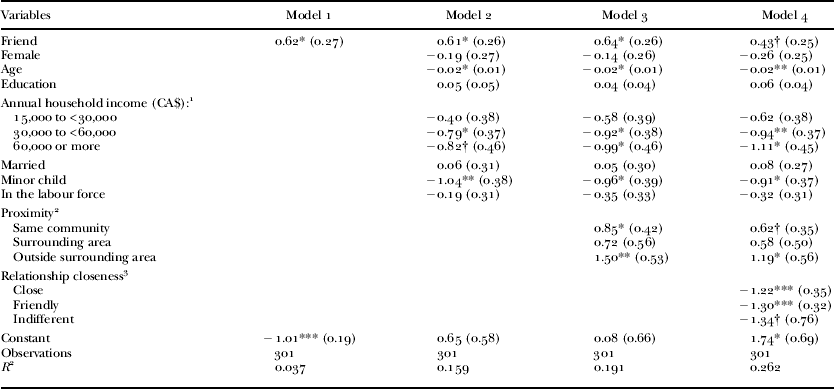
The results of the multiple imputation OLS models predicting the log of the number of hours of care provided per week are presented in Table 4. Model 1 shows a significant difference in the amount of informal care provided by friends and neighbours (p<0.05). In Model 2, the individual characteristics of gender, age, education, and income were added, as well as indicators of marital status, minor child in the household and labour force participation. After controlling for these variables, friends still provided significantly more care than neighbours (p<0.05). In addition, age had a negative relationship with the amount of care provided (p<0.05), respondents with household incomes from $30,000 to less than $60,000 (p<0.05), or greater than $60,000 (p<0.10) provided less care than those with incomes below $15,000 and respondents who had minor children at home provided less care than those who did not (p<0.01). Proximity was added in Model 3. Respondents living in the same community (p<0.05) or outside the surrounding area (p<0.01) provided significantly more care per week than those who lived in the same building. When individual characteristics and proximity are controlled, friend carers still provided significantly more hours of care per week than neighbour carers (p<0.01).
Results of multiple imputation ordinary least-squares regression of the average number of hours of care per week logged on various covariates
Notes: Results are based on averages from 100 imputed data sets. Robust standard errors in parentheses. 1. Reference category is <$15,000. 2. Reference category is same building. 3. Reference category is very close.
Significance levels: † p<0.10, *p<0.05, **p<0.01, ***p<0.001.
Model 4 adds the relationship closeness variable. Non-kin carers who described their relationship with the care receiver as very close provided significantly more hours of care per week than carers who described their relationship as close (p<0.001), friendly (p<0.001) or indifferent (p<0.10). Controlling for relationship closeness diminishes the magnitude of the friend coefficient by 32.8 per cent and the difference between friends and neighbours becomes marginally significant (p<0.10). In this final model, age, income, having a minor child in the home, proximity and relationship closeness were all significant predictors of the number of hours of care per week provided by non-kin. Overall, this model explained 26.2 per cent of the variation in the amount of care provided by non-kin. Additional analyses (not shown) tested for interactions between gender and all of the covariates in Model 4. Only the interaction with indifferent relationship closeness was statistically significant (p<0.001), with two other interactions (gender by close relationship and gender by friendly relationship) approaching significance (p<0.10). In the interaction model none of the relationship closeness variables themselves were statistically significant, suggesting that relationship closeness is not a significant predictor of amount of care provided by men, whereas for women, those who classify their relationship as close, friendly or indifferent provide significantly less care than women who classify their relationship as very close.
Discussion
This study contributes to our understanding of the supply side of informal care by focusing on the characteristics of non-kin carers, what and how much they do, and the factors influencing the amount of care provided. In addition, distinctions in the roles of friends and neighbours in providing care were identified. Despite the lack of clear normative beliefs ‘obligating’ non-kin to provide instrumental support and personal care (Allan Reference Allan1986, Reference Allan1988; Johnson Reference Johnson and Milardo1988; Penrod et al. Reference Penrod, Kane, Kane and Finch1995), these results demonstrate the important contributions friends and neighbours make to the long-term informal care of older adults with a chronic health or physical limitation. Our findings on the interpersonal and socio-demographic characteristics of non-kin carers, and their influence on the types and amount of care provided, have important implications for future research, theory and practice related to informal care.
Carer characteristics
Notably, both neighbours and friends in this study were younger than the cared-for person. While all of the care recipients were age 65 or older, 75 per cent of both friend and neighbour carers were less than age 65. This finding is consistent with previous research focused specifically on friend or neighbour carers, but counter to enduring views that friends are age peers who share long-standing patterns of interaction and mutual support. Neighbour carers were significantly younger than friends. Most were under age of 45, perhaps reflecting the age-integrated nature of most Canadian communities. This is contrary to what one might expect, given evidence from Great Britain that younger adults demonstrate less ‘neighbourliness’ than older adults, in terms of frequency of contact with neighbours, and the proportion of neighbours known (Summerfield and Babb Reference Summerfield and Babb2003). However, this finding is congruent with other data showing that the percentage of Canadians who report doing a favour for a neighbour declines with age (Turcotte and Schellenberg Reference Turcotte and Schellenberg2006). Given the age distribution of non-kin carers, recent research on informal caring in Canada that focuses on the caring experiences of adults age 45 and older (e.g. Cranswick and Dosman Reference Cranswick and Dosman2008) may be overlooking an important segment of informal carers. More than half of neighbour carers and one-quarter of friend carers in this study were younger than 45.
The gender composition of carers in this study was more balanced (54% female) compared to previous research on non-kin caring in which women predominated. The difference may lie in the fact that previous studies focused on primary carers, or ‘committed amateurs’ involved in regular direct care provision (Barker Reference Barker2002; Nocon and Pearson 1990). The more equal gender balance in this study also could be a result of the inclusion of time spent on ‘male’ caring activities such as home maintenance and of carers who are not necessarily taking on primary responsibilities. Alternatively, this finding could suggest a different pattern of caring among non-kin that may not be as strongly governed by traditional gender role expectations as family care-giving relationships. This would be consistent with research on neighbouring in later life that found older men who live with others were significantly more likely to do favours for neighbours than their female counterparts (Perren, Arber and Davidson Reference Perren, Arber and Davidson2004).
Types of tasks
The most common tasks non-kin assisted with in this study were transportation, shopping and home maintenance. This is comparable to previous research on care provided by non-kin (Barker Reference Barker2002), and research on informal care-giving in general (Wolff and Kasper Reference Wolff and Kasper2006). Assistance with these tasks is particularly important in keeping older adults in their own homes longer (Andel, Hyer and Slack Reference Andel, Hyer and Slack2007). Significant differences between friends and neighbours were observed with regard to assisting with home maintenance (which includes outside work) and transportation. These findings make sense given the nature of friend and neighbour relationships. Not only are neighbours close by to notice when something may need to done in someone's yard or around their home, they also have a vested interest in the neighbourhood and may be more sensitive to these types of care needs than other carers, and thus more likely to assist with them. For similar reasons, friends may be more sensitive to transportation needs. Though we cannot tell from these data whether their higher levels of intimacy with the cared-for person means that they are more responsive to the personal transportation needs of the care recipient, or whether assistance with transportation has become necessary in order to maintain shared social activities outside the care recipient's home.
Friends were also significantly more likely than neighbours to be providing assistance with more private tasks such as personal care, and bills and banking, even after controlling for other covariates including relationship closeness. Overall, these findings suggest that there are some instrumental care tasks that are better suited to friends, some that are better suited to neighbours, and some where the friend/neighbour distinction does not matter. These findings are consistent with Crow, Allan and Summer's (2002) contention that social distance is an element of neighbour relationships and suggest that neighbourliness has clear boundaries when it comes to providing care. This challenges the idea of informal carers being ‘generalists’ (Rook and Schuster Reference Rook, Schuster, Pierce, Sarason and Sarason1996), at least when it comes to caring for neighbours, and emphasises the importance of the nature of the task in determining who will provide assistance. Rather than a single hierarchy of informal carers, more specialised hierarchies may be warranted. While this view is consistent with a task-based model of care-giving (Litwak Reference Litwak1985), advocates of this model generally do not distinguish between different types of instrumental care.
Amount and duration of care
Analyses of amount of care provided by friends and neighbours offers insight into the caring capacity of these two groups and the diversity in the amount of care they provide. On average friends provided assistance with more tasks and spent more time providing care. Differences in the amount of care provided by friends and neighbours were largely explained by relative levels of relationship closeness. These findings suggest that friends fall higher in the hierarchy of carers than neighbours and justify an expansion of previously established hierarchies to further distinguish between different types of non-kin. Despite the considerable overlap in the types of instrumental support provided by friends and neighbours and the relatively close geographical proximity of both groups, friends clearly provide more intense amounts of care and assist concurrently with a broader range of tasks.
The premise that non-kin do not have the necessary commitment and cannot be relied upon to provide instrumental assistance for extended periods of time is not supported by the findings in this study. Three-quarters of these carers had been providing care for a year or more, with the majority providing care for two or more years. Since the amount of time care-giving was top-coded at two years, it was not possible to address possible differences in long-term care provision.
Predictors of amount of care
Gender, education, marital status and employment did not have an impact on the amount of care provided by non-kin. As expected, non-kin carers in lower-income households provided more care than those in higher-earning households, and carers with minor children in the home provided less care than those without. Contrary to the hierarchies of obligation framework and findings in previous research (Voorpostel and Van Der Lippe Reference Voorpostel and Van Der Lippe2007), non-kin at a distance (more than an hour away) provided more care per week on average than those who lived close by in the same building. This finding is counterintuitive and warrants more exploration. Given that only 3 per cent of non-kin carers lived outside the surrounding area this may be a distinctive group of carers. The circumstances under which those who live far away actually provide care may necessitate higher levels of care; or perhaps these distant carers were factoring in their travel time when reporting the amount of time spent providing care. Conversely, it could be that those who live in the same building as the care recipient provide less care than expected given their close proximity. Additional post-estimation analyses (not shown) did not find any significant differences between non-kin who live in the same community, the surrounding area and outside the surrounding area in the amount of care provided. Non-kin carers who live in the same building as the care recipient may not be called upon to provide as much assistance because of the nature of living in apartments or other multi-family residential arrangements. For example, home maintenance and outside work, one of the most common tasks assisted with by non-kin, are often taken care of by property managers in multi-dwelling units. Also, in these housing arrangements there are a greater number of proximate non-kin who could potentially provide care and if multiple helpers emerge the needed contributions of any one carer diminishes.
While previous research on informal care in general has shown that increasing age is associated with higher levels of care provision (National Alliance for Caregiving and AARP 2009), this study found that care provided by non-kin decreased with advancing age. Earlier findings, however, were based on bivariate, cross-sectional analysis, where age could have been confounded with relationship type, as spouses are typically older and provide high levels of care. These findings concerning the younger age of non-kin carers and the decline in amount of care provided at older ages draw our attention to intergenerational relationships with non-kin as sources of instrumental support in later life. They also raise questions about how friend and neighbour patterns of assistance might continue to develop in increasingly age-segregated societies (Hagestad and Uhlenberg Reference Hagestad and Uhlenberg2006). While the majority of non-kin carers in our study were considerably younger than the care recipient, research on the age-segregation of personal networks in later life has demonstrated that few older adults have regular contact with younger non-kin (Uhlenberg and Jong Gierveld Reference Uhlenberg and de Jong Gierveld2004). The potential reduction in contact with younger non-kin also poses concerns for age-segregated retirement communities that are becoming increasingly common in the United Kingdom and elsewhere (Evans Reference Evans2009).
The importance of relationship closeness in explaining differences in the amount of care provided by friends and neighbours suggests the need to better understand the process by which people define themselves as friend or neighbour. While neighbours by definition live nearby, the majority of friends in this study also were proximate. Proximate carers may be friends with long-standing close relationships, or neighbours who redefine their relationship in the face of care needs that go beyond what is normative for a neighbour (Jerrome and Wenger Reference Jerrome and Wenger1999). However, not all non-kin caring relationships in this study were recast as friendships. More than half of neighbour carers had been providing care for more than two years but only one-third described their relationship as close or very close. In addition, the idea that non-kin carers represent a special case of particularly close relationships was not supported. The most common characterisation of both friend and neighbour relationships was friendly.
Allan (Reference Allan, Dannefer and Phillipson2010) notes that friendships are typically non-instrumental, meaning that instrumental assistance is provided because of the friendship, rather than the friendship existing because of the assistance. However, it is possible that these caring friend and neighbour relationships represent a different form of friendship or neighbourliness than is typical of these relationships (France Reference France1997). Longitudinal research would help reveal why some neighbour caring relationships might evolve into friendships while others do not. In addition, it is likely that within the broad category of self-defined friendship in this study there are a number of friendship sub-types that could further refine our understanding of the care provided by ‘friends’. Barker (Reference Barker2002) noted four relationship styles among non-kin carers in her study that were discerned based on types of assistance given and relationship closeness, providing one starting point for further understanding of the diversity of non-kin caring relationships. While the distinction between friends and neighbours may be blurred because of the relatively close proximity of both, and the act of providing or being called on to provide care may lead to the redefinition of the relationship, the self-ascribed label of friend or neighbour has an important influence on the types of tasks assisted with and the intensity of care provided. Our sense is that while older adults may see a blurring of the distinction between friends and neighbours (Jayakody Reference Jayakody, Jackson, Chatters and Taylor1993), carers may have a clearer sense of the distinction for them. Until we have more information on the nature of the caring journey undertaken by friends and neighbours with older adults, this relationship distinction is a useful proxy for the nature of the caring relationship and the activities embedded within it.
Limitations and new directions
A key limitation to any study that utilises secondary data is that the research is restricted to the variables and their definitions that were included in the original study. While we know that the non-kin carers in this study were not providing care as employees or volunteers, and that the reason for care was not primarily for mutual benefit, we do not know anything about if or how the care provided was reciprocated or compensated. Furthermore, the lack of information about the care recipient and other sources of care for that person inhibited our ability to investigate how patterns of non-kin care might vary depending on the care needs and resources of the care recipient. Limited information was available on the age and gender of the care recipient, which are both strongly related to receiving assistance due to a long-term health problem (Turcotte and Schellenberg Reference Turcotte and Schellenberg2006). Additional analyses (not shown) did not find that age or gender of the care recipient influenced the amount of care provided by non-kin, nor did it explain any differences in the amount or type of care provided by friends or neighbours.
In this study we were able to describe only those neighbours and friends who became involved in care-giving, leaving remaining gaps in our understanding of how friends and neighbours contribute to the informal care sector. We do not know anything about the history of these relationships prior to the provision of care, or how these individuals emerged as carers. Future research needs to place non-kin carers within the context of the social and care networks of care recipients to determine the extent to which contributions of friends and neighbours are contingent on network composition. In addition, the cross-sectional nature of the data in this study provides only a snapshot of these caring relationships. Longitudinal research is necessary in order to understand how these relationships evolve as the care needs of the care recipient change, and with what consequences for the carer and the care receiver.
In this study, we have used the most recent Canadian nationally representative data set that captures detailed helping behaviours of persons aged 15 years and older. Since the data for this study were collected, Canada has seen an increase in the number of older adults, and the number of informal carers (Cranswick and Dosman Reference Cranswick and Dosman2008). Along with increases in life expectancy at age 65, older Canadians are also experiencing higher rates of obesity and chronic diseases, lower levels of institutionalisation resulting in older adults living longer in the community with a long-term health problem or physical limitation, and increases in the proportion of older adults needing help with preparing meals, doing everyday housework, personal care and moving inside the house (National Advisory Council on Aging 2006; Turcotte and Schellenberg Reference Turcotte and Schellenberg2006). Between 1998 and 2005 the proportion of female seniors living at home who needed assistance with one or more IADLs increased from 23 to 28 per cent, while dependency for male seniors remained steady at about 15 per cent (National Advisory Council on Aging 2006). These changes suggest a greater demand for informal care, but whether or not friends and neighbours have stepped up to meet that demand is an empirical question that remains to be answered. We argue that the structural forces contributing to the types of tasks assisted with and the relative differences between friend and neighbour carers observed in this study likely have some level of stability (Allan Reference Allan1998). At the very least the findings can be viewed as a benchmark from which to evaluate change and raise important questions to be addressed in future research.