











1. Introduction
Approximation theory is concerned with approximating complex or unknown functions by other simpler functions. The problems of approximation of functions by polynomials, splines, rational functions, trigonometric functions and wavelets have been well studied. Similarly, one of the main tasks in the problems of learning, curve fitting and pattern recognition is to develop suitable models for given data sets. In particular, curve fitting is a process of constructing a curve that has the best fit to a given data set. The theory of non-parametric curve estimations has been developed well, and many researchers have established several types of estimators, see [Reference Györfi, Kohler, Krzyzak and Walk12–Reference Hart14, Reference Li and Racine16, Reference Tsybakov30] and references given in these books.
In many real-world applications, data arise from unknown functions, and a function that interpolates these data is required to be generated. The interpolation problem is finding a function f in some class of functions and interpolating those data in a given data set  $\mathcal D$. Polynomials, splines and rational functions have been applied in interpolation methods. However, in many practical problems, sampled signals are of irregular forms, and fractal theory can provide new technologies for making complicated curves and fitting experimental data. A fractal function is a function whose graph is the attractor of an iterated function system. A fractal interpolation function (FIF) is a continuous fractal function interpolating points in a given data set. The theory of FIFs is developed for the interpolation problem with a class of fractal functions. It generalizes traditional interpolation techniques through the property of self-similarity. The concept of FIFs defined through an iterated function system was introduced by Barnsley [Reference Barnsley2, Reference Barnsley3]. It is known that the theory of FIFs can be applied to model discrete sequences (see [Reference Marvasti and Strahle19, Reference Mazel and Hayes22, Reference Mazel23]). Various types of FIFs and their approximation properties have been discussed in [Reference Barnsley, Elton, Hardin and Massopust4, Reference Barnsley and Massopust5, Reference Chand and Kapoor8–Reference Chand and Viswanathan10, Reference Katiyar, Chand and Kumar15, Reference Luor17, Reference Massopust20, Reference Massopust21, Reference Navascués24–Reference Navascués and Sebastián27, Reference Viswanathan and Chand32–Reference Wang and Yu35], see also the references given in the literature.
The theory of reproducing kernel Hilbert spaces (RKHSs) has been proven to be a powerful tool in functional analysis, integral equations and learning theory. The notion of positive definite functions plays a role in reproducing kernels in RKHSs, see the excellent monographs [Reference Aronszajn1, Reference Berlinet and Thomas-Agnan6, Reference Cucker and Zhou11, Reference Paulsen and Raghupathi28, Reference Vapnik31]. In [Reference Bouboulis and Mavroforakis7], Bouboulis and Mavroforakis constructed fractal-type reproducing kernels. They showed that the spaces of some types of FIFs are RKHSs, and the connection between FIFs and RKHSs was established.
This paper aims to discuss the RKHS consisting of FIFs further and apply such RKHS to curve fitting problems. Curve-fitting aims to obtain a suitable function that has a good approximation to the given data set. Such problems have been well studied in non-parametric regression and machine learning. Although FIFs are constructed to be interpolation functions, the theory of FIFs has many applications in approximation theory. In [Reference Marvasti and Strahle19, Reference Mazel and Hayes22, Reference Rasmussen and Williams23], FIFs were applied to model discrete sequences. In [Reference Massopust24–Reference Navascués26], fractal function spaces with linearly independent sets of α-fractal functions were studied. The author also discussed the role that these fractal function spaces play in approximation theory. Since the theory of RKHSs is a useful tool in approximation theory and machine learning, we are interested in RKHSs that consist of FIFs and their applications to curve fitting problems.
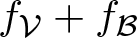
For a given data set, we aim to fit the data by a linear combination of linearly independent FIFs rather than a single FIF constructed from the data set directly. Moreover, we consider functions of the form  $f_{\mathcal V}+f_{\mathcal B}$, where
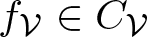
 $f_{\mathcal V}$ belongs to an RKHS of regular continuous functions and
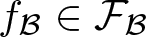
 $f_{\mathcal B}$ belongs to an RKHS of FIFs. Combining these two types of functions can make solutions to curve-fitting problems more general and flexible.
In  $\S$ 2, the construction of a particular type of FIFs which are applied in this paper is given. Each FIF is established from a continuous function and can be treated as a fractal perturbation of that continuous function. In
 $\S$ 3, we prove that, for fixed parameters, the set
 $\mathcal F$ of these FIFs is a linear space, and there is a one-to-one correspondence between
 $C[I]$ and
 $\mathcal F$. Here,
 $C[I]$, defined below, is the space of continuous functions on the interval I. We also show that, for a finite set of linearly independent functions in
 $C[I]$, we get linearly independent FIFs. Then, for applications in curve fitting problems, a finite-dimensional RKHS
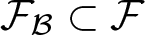
 $\mathcal F_{\mathcal B}\subset\mathcal F$ is established, and the reproducing kernel
 $\mathbf k$ for
 $\mathcal F_{\mathcal B}$ is defined by a basis of
 $\mathcal F_{\mathcal B}$. In
 $\S$ 4, suppose a data set
 $\mathcal D=\{(t_k, y_k) : k=0,1,\ldots,N\}$ is given, and we aim to find a function to fit the data in
 $\mathcal D$. The type of functions considered here is the sum of a regular continuous function and an FIF. Therefore, we also consider a finite-dimensional RKHS
 $C_{\mathcal V}$ of some classes of regular continuous functions with the reproducing kernel
 $\mathbf k^*$, and we study the problem of learning a function in
 $C_{\mathcal V}\oplus\mathcal F_{\mathcal B}$ for
 $\mathcal D$ by minimizing the regularized empirical error
 \begin{align}
\frac{1}{N+1}\sum_{k=0}^N (y_k-(f_{\mathcal V}(t_k)+f_{\mathcal B}(t_k)))^2 + \lambda_1\|f_{\mathcal V}\|_{C}^2+\lambda_2\|f_{\mathcal B}\|_{\mathcal F}^2
\end{align}
for  $f_{\mathcal V}\in C_{\mathcal V}$ and
 $f_{\mathcal B}\in \mathcal F_{\mathcal B}$ with fixed non-negative regularization parameters λ 1 and λ 2. Here
 $\|\cdot\|_{C}$ and
 $\|\cdot\|_{\mathcal F}$ are norms on
 $C_{\mathcal V}$ and
 $\mathcal F_{\mathcal B}$, respectively. We show that the solution of Equation (1.1) can be written in the form
 \begin{align}
f=f_{\mathcal V}+f_{\mathcal B}=\sum_{m=0}^N\gamma_m\mathbf k^*_{t_m} +\sum_{j=0}^N \alpha_j\mathbf k_{t_j},
\end{align}
where  $\mathbf k_{t_m}^\ast(\cdot)=\mathbf k^\ast(\cdot,t_m)$ and
 $\mathbf k_{t_j}(\cdot)=\mathbf k(\cdot,t_j)$, and the coefficients γm and αj can be solved by a system of linear equations.
Throughout this paper, let  $t_0 \lt t_1 \lt t_2 \lt \cdots \lt t_N$ and
 $I=[t_0,t_N]$, where N is a positive integer and
 $N\ge 2$. For each
 $k=1,\ldots,N$, let
 $I_k=[t_{k-1},t_k]$ and
 $J_{k}=[t_{j(k)}, t_{l(k)}]$. Here
 $j(k), l(k)\in\{0,1,\ldots,N\}$ and
 $j(k) \lt l(k)$. To avoid trivial cases, we assume
 $J_k\neq I_k$. We will denote by
 $C[I]$ the set of all real-valued continuous functions defined on I. Define
 $\|f\|_\infty=\max_{t\in I}|f(t)|$ for
 $f\in C[I]$. For a given set of points
 $\mathcal D=\{(t_k, y_k):k=0,1,\ldots,N\}$, let
 $C_{\mathcal D} [I]$ be the set of functions in
 $C[I]$ that interpolate all points in
 $\mathcal D$. It is known that
 $(C[I], \|\cdot\|_{\infty})$ is a Banach space and
 $C_{\mathcal D} [I]$ is a complete metric space, where the metric is induced by
 $\|\cdot\|_\infty$.
2. Construction of FIFs
The approach to constructing FIFs in this section has been treated in [Reference Luor18]. We show the details here for readers’ convenience.
Let  $u\in C[I]$ and
 $\mathcal D=\{(t_k, y_k):y_k=u(t_k), k=0,1,\ldots,N\}$. For
 $k=1,\ldots,N$, let
 $L_{k} : J_{k}\to I_k$ be a homeomorphism such that
 $L_{k}(t_{j(k)})=t_{k-1}$ and
 $L_{k}(t_{l(k)})=t_k$, and define
 $M_k : J_k\times\mathbb{R}\to\mathbb{R}$ by
 \begin{align}
M_{k}(t,y)=s_ky+u(L_{k}(t))-s_kp_k(t),
\end{align}
where  $-1 \lt s_{k} \lt 1$ and pk is a polynomial on Jk such that
 $p_k(t_{j(k)})=y_{j(k)}$ and
 $p_k(t_{l(k)})=y_{l(k)}$. Then
 $M_{k}(t_{j(k)}, y_{j(k)})=y_{k-1}$,
 $M_{k}(t_{l(k)}, y_{l(k)})=y_k$, and
 \begin{align}
|M_{k}(t,y)-M_{k}(t,y^*)|\le |s_{k}||y-y^*|\,\text{for all }\, t\in J_{k}\,\text{and }\, y,y^*\in\mathbb{R}.
\end{align}
Define  $W_{k}:J_{k}\times\mathbb{R}\to I_k\times\mathbb{R}$ by
 $W_{k}(t,y)=(L_{k}(t),M_{k}(t,y))$. For
 $h\in C_{\mathcal D}[I]$ and for each
 $k=1,\ldots,N$, let
 $A_{k}=\{(t, h(t)) : t\in J_{k}\}$. Then
 $W_{k}(A_{k})=\{(L_{k}(t),M_{k}(t, h(t))) : t\in J_{k}\}$. Since
 $L_{k}:J_{k}\to I_k$ is a homeomorphism,
 $W_{k}(A_{k})$ can be written as
 \begin{align*}
W_{k}(A_{k})=\{(t, M_{k}(L_{k}^{-1}(t),h(L_{k}^{-1}(t)))) : t\in I_k\}.
\end{align*}
Hence  $W_{k}(A_{k})$ is the graph of the continuous function
 $h_{k} : I_k\to\mathbb{R}$ defined by
 \begin{align*}
h_{k}(t)=M_{k}(L_{k}^{-1}(t), h(L_{k}^{-1}(t))).
\end{align*}
It is easy to see that  $h_{k}(t_{k-1})=y_{k-1}$ and
 $h_{k}(t_k)=y_k$. Define a mapping
 $T:C_{\mathcal D}[I]\to C_{\mathcal D}[I]$ by
 $T(h)(t)=h_k(t)$ for
 $t\in I_k$, that is, for
 $h\in C_{\mathcal D}[I]$ and
 $t\in I_k$,
 \begin{align}
T(h)(t)=s_kh(L_{k}^{-1}(t))+u(t)-s_k p_k(L_{k}^{-1}(t)).
\end{align}
For  $h_1, h_2\in C_{\mathcal D}[I]$, we have
 \begin{align*}
\|T(h_1)-T(h_2)\|_\infty\le s\|h_1-h_2\|_\infty,\quad s=\max\{|s_{1}|,\ldots,|s_N|\}.
\end{align*}
Since  $0\le s \lt 1$, we see that T is a contraction mapping on
 $C_{\mathcal D}[I]$.
Theorem 2.1. (Luor [Reference Luor18, Theorem 2.1]). The operator T given by Equation (2.3) is a contraction mapping on  $C_{\mathcal D}[I]$.
Definition 2.2. The fixed point  $f_{[u]}$ of T in
 $C_{\mathcal D}[I]$ is called an FIF on I corresponding to the continuous function u.
The FIF  $f_{[u]}$ given in Definition 2.2 satisfies the equation for
 $k=1,\ldots,N$:
 \begin{align}
f_{[u]}(t)=s_k\biggl\{f_{[u]}(L_{k}^{-1}(t))-p_k(L_{k}^{-1}(t))\biggr\}+u(t),\quad t\in I_k.
\end{align}
If  $s_k=0$ for all k, then
 $f_{[u]}=u$. Therefore,
 $f_{[u]}$ can be treated as a fractal perturbation of u.
3. RKHSs of FIFs
3.1. Introduction to RKHSs
We give a brief introduction to RKHSs. We refer the readers to [Reference Berlinet and Thomas-Agnan6] and [Reference Paulsen and Raghupathi28] for more details. Recall that a m × m real matrix  $\mathbf A=[a_{i,j}]$ is positive semi-definite if and only if for every
 $\alpha_1,\ldots,\alpha_m\in\mathbb{R}$ we have that
 $\sum_{i,j=1}^m \alpha_i\alpha_j a_{i,j}\ge 0$. We call
 $\mathbf A$ positive definite if and only if for every
 $\alpha_1,\ldots,\alpha_m\in\mathbb{R}$ with
 $\alpha_1^2+\cdots+\alpha_m^2\neq 0$, we have
 $\sum_{i,j=1}^m \alpha_i\alpha_j a_{i,j} \gt 0$.
Let Ω be a set. The function  $\mathbf{k}:\Omega\times\Omega\to\mathbb{R}$ is positive semi-definite (definite) if for every positive integer m and every choice of distinct points
 $t_1,\ldots,t_m$ in Ω, the matrix
 $[\mathbf{k}(t_i,t_j)]$ is positive semi-definite (definite). Here, we call k a kernel if it is symmetric and positive semi-definite. By Moore’s theorem (Paulsen and Raghupathi [Reference Paulsen and Raghupathi28, Theorem 2.14]), there exists an RKHS
 $\mathcal H$ of functions defined on Ω with an inner product
 $\langle\cdot,\cdot\rangle_{\mathcal H}$ such that
 $\mathbf k$ is the reproducing kernel for
 $\mathcal H$. For each
 $t\in\Omega$, define
 $\mathbf k_t(z)=\mathbf k(z,t)$,
 $z\in\Omega$. Then
 $\mathbf k_t\in\mathcal H$ and for
 $f\in\mathcal H$, we have
 $f(t)=\langle f,\mathbf k_t\rangle_{\mathcal H}$. Moreover,
 $\mathbf k(z,t)=\mathbf k_t(z)=\langle\mathbf k_t,\mathbf k_z\rangle_{\mathcal H}$ for
 $t,z\in\Omega$, and the set
 $\text{span}\{\mathbf k_{t} : t\in\Omega\}$ is dense in
 $\mathcal H$.
Throughout the following subsections, we suppose that N,  $t_0,\ldots,t_N$,
 $t_{j(1)}$,
 $\ldots$,
 $t_{j(N)}$,
 $t_{l(1)}$,
 $\ldots$,
 $t_{l(N)}$ and
 $s_1,\ldots,s_N$ are all fixed numbers, and
 $L_1,\ldots,L_N$ given in
 $\S$ 2 are fixed functions. Let
 $\mathcal F$ be the subset of
 $C[I]$ such that each f in
 $\mathcal F$ is an FIF corresponding to some function
 $u\in C[I]$ and is constructed by the approach given in
 $\S$ 2 with linear polynomials pk for
 $k=1,\ldots,N$.
3.2.  $\mathcal F$ is a linear space

If  $u\equiv 0$, the interpolated data set is
 $\{(t_k,0):k=0,1,\ldots,N\}$ and each pk is the zero polynomial on Jk. The mapping T defined by Equation (2.3) is reduced to
 $T(h)(t)=s_kh(L_{k}^{-1}(t))$ for
 $h\in C_{\mathcal D}[I]$. The zero function is the fixed point of T and hence
 $f_{[u]}\equiv 0\in\mathcal F$.
Suppose that  $f, g\in\mathcal F$ and
 $a, b\in\mathbb{R}$. Then f and g are FIFs on I corresponding to some u and v in
 $C[I]$, respectively. For
 $t\in I_k$, we have
 \begin{align}
f(t)&=s_{k}f(L_{k}^{-1}(t))-s_kp_k(L_{k}^{-1}(t))+u(t),
\end{align}
 \begin{align}
g(t)&=s_{k}g(L_{k}^{-1}(t))-s_kq_k(L_{k}^{-1}(t))+v(t),
\end{align}
where pk is a linear polynomial on Jk such that  $p_k(t_{j(k)})=u(t_{j(k)})$,
 $p_k(t_{l(k)})=u(t_{l(k)})$, and qk is a linear polynomial on Jk such that
 $q_k(t_{j(k)})=v(t_{j(k)})$,
 $q_k(t_{l(k)})=v(t_{l(k)})$. Then
 \begin{align*}
(af+bg)(t)=s_k(af+bg)(L_{k}^{-1}(t))-s_k(ap_k+bq_k)(L_{k}^{-1}(t))+(au+bv)(t),\quad t\in I_k.
\end{align*}
Since  $ap_k+bq_k$ is a linear polynomial that satisfies
 \begin{align*}
(ap_{k}+bq_k)(t_{j(k)})=(au+bv)(t_{j(k)}), \, (ap_{k}+bq_k)(t_{l(k)})=(au+bv)(t_{l(k)})
\end{align*}
for  $k=1,\ldots,N$, we see that af + bg satisfies Equation (2.4) with
 $f_{[u]}$, pk, and u being replaced by af + bg,
 $ap_k+bq_k$ and au + bv, respectively. This shows that af + bg is an FIF in
 $\mathcal F$ corresponding to the function au + bv, and hence
 $\mathcal F$ is a linear space.
3.3. One-to-one correspondence between $C[I]$ and $\mathcal F$


Note that functions in  $\mathcal F$ only depend on functions in
 $C[I]$. When
 $u\in C[I]$ is given, the data set for interpolation,
 $\mathcal D=\{(t_k, y_k):y_k=u(t_k), k=0,1,\ldots,N\}$, and all linear polynomials pk are determined. Then, the unique FIF
 $f_{[u]}$ in
 $\mathcal F$ can be obtained by the approach in
 $\S$ 2.
Theorem 3.1. The mapping  $\Phi: C[I]\to\mathcal F$ defined by
 $\Phi(u)=f_{[u]}$ is a one-to-one and onto bounded linear mapping.
Proof. We first show that Φ is bounded. For  $u\in C[I]$ and
 $t\in I_k$,
 \begin{align*}
|f_{[u]}(t)-u(t)| &= |s_k| |f_{[u]}(L_k^{-1}(t))-p_k(L_k^{-1}(t))|\\
&\le |s_k|\biggl(\sup_{z\in J_k}|f_{[u]}(z)|+\sup_{z\in J_k}|p_k(z)|\biggr)\\ &\le |s_k|\biggl(\|f_{[u]}\|_\infty + \max\{|u(t_{j(k)})|, |u(t_{l(k)})|\}\biggr).
\end{align*}
This implies that  $\|f_{[u]}-u\|_\infty \le s\|f_{[u]}\|_\infty+s\|u\|_\infty$, where
 $s=\max\{|s_1|,\ldots,|s_N|\}$. Then
 \begin{align*}
\|f_{[u]}\|_\infty \le \|f_{[u]}-u\|_\infty + \|u\|_\infty \le s\|f_{[u]}\|_\infty+(s+1)\|u\|_\infty
\end{align*}
and hence
 \begin{align}
\|\Phi(u)\|_\infty = \|f_{[u]}\|_\infty \le \biggl(\frac{1+s}{1-s}\biggr)\|u\|_\infty, \qquad u\in C[I].
\end{align}
The boundedness of Φ is obtained by Equation (3.3).
Suppose  $u, v\in C[I]$ and
 $\Phi(u)=f_{[u]}$,
 $\Phi(v)=f_{[v]}$. Then
 $f_{[u]}$ and
 $f_{[v]}$ satisfy the Equations (3.1) and (3.2) with f and g being replaced by
 $f_{[u]}$ and
 $f_{[v]}$, respectively. Then, for
 $a, b\in\mathbb{R}$,
 $af_{[u]}+bf_{[v]}$ is in
 $\mathcal F$ and is constructed from the function au + bv. This shows that
 $\Phi (au+bv)=af_{[u]}+bf_{[v]}=a\Phi (u)+b\Phi (v)$, and Φ is linear.
The mapping Φ is onto since every f in  $\mathcal F$ is constructed from a function u in
 $C[I]$.
In the following, we show that Φ is one-to-one. Since Φ is linear, we prove that  $f_{[u]}\equiv 0$ only when
 $u\equiv 0$. If
 $f_{[u]}(t)=0$ for all
 $t\in I$, then the interpolated data set is
 $\{(t_k,0):k=0,1,\ldots,N\}$ and then each pk is the zero polynomial on Jk. Since
 $f_{[u]}$ satisfies Equation (2.4), we have
 $u(t)=0$ for all
 $t\in I$.
Note that  $\mathcal F$ is a subset of
 $C[I]$ and each function in
 $\mathcal F$ is an FIF constructed by the approach given in
 $\S$ 2. For fixed numbers N,
 $t_0,\ldots,t_N$,
 $t_{j(1)}$,
 $\ldots$,
 $t_{j(N)}$,
 $t_{l(1)}$,
 $\ldots$,
 $t_{l(N)}$,
 $s_1,\ldots,s_N$ and for fixed functions
 $L_1,\ldots,L_N$, Theorem 3.1 shows that each function
 $f\in\mathcal F$ is an FIF corresponding to a function
 $u\in C[I]$, and for different functions in
 $C[I]$, we get different FIFs.
Corollary 3.2. If  $u_1,\ldots,u_n$ are linearly independent functions in
 $C[I]$, then
 $f_{[u_1]}$,
 $\ldots$,
 $f_{[u_n]}$ are linearly independent.
Proof. Let  $\sum_{i=1}^n a_if_{[u_i]}\equiv 0$. Since
 $f_{[u_i]}=\Phi(u_i)$ for each i and Φ is linear, we have
 $\Phi(\sum_{i=1}^n a_iu_i)\equiv 0$. This implies
 $\sum_{i=1}^n a_iu_i\equiv 0$ by the one-to-one property of Φ. Since
 $u_1,\ldots,u_n$ are linearly independent, we have
 $a_1=\cdots=a_n=0$.
3.4. Finite-dimensional RKHSs of fractal interpolants
Suppose that an inner product  $\langle \cdot, \cdot\rangle_{\mathcal F}$ on
 $\mathcal F$ is defined. Let
 $\mathcal B=\{\phi_0, \phi_1, \ldots, \phi_\eta\}$ be a linearly independent set of functions in
 $\mathcal F$ and let
 $\mathcal F_{\mathcal B}$ be the subspace
 $\mathcal F_{\mathcal B}=\text{span}\{\phi_0, \phi_1, \ldots, \phi_\eta\}$. Then
 $\mathcal F_{\mathcal B}$ is a finite-dimensional Hilbert space with a basis
 $\mathcal B$. Let
 $\mathbf A=[A_{i,j}]$, where
 $A_{i,j}=\langle\phi_i,\phi_j\rangle_{\mathcal F}$. By [Reference Paulsen and Raghupathi28, Proposition 2.23],
 $\mathbf A$ is a positive definite matrix; hence,
 $\mathbf A$ is invertible. Define
 \begin{align}
\mathbf k(t',t)=\sum_{j=0}^{\eta}\sum_{m=0}^{\eta}\phi_j(t')\phi_m(t)B_{j,m},\quad t',\, t\in I,
\end{align}
where the matrix  $\mathbf B=[B_{j,m}]$ is the inverse of
 $\mathbf A$. Here, we show that
 $\mathbf k$ is positive semi-definite. Since
 $\mathbf B$ is symmetric, let
 $\mathbf B^{1/2}$ be the matrix such that
 $\mathbf B^{1/2}\mathbf B^{1/2}=\mathbf B$. Let
 $\ell$ be any positive integer and let
 $z_1,\ldots,z_\ell$ be any choice of distinct points in I. Let
 $\Psi=[\phi_i(z_j)]$. Then for any column vector
 $\mathbf d=[d_1,\ldots,d_\ell]^T$ in
 $\mathbb{R}^\ell$,
 \begin{align*}
\sum_{p=1}^\ell\sum_{q=1}^\ell d_p d_q \mathbf k(z_p, z_q)=\mathbf d^T\Psi^T\mathbf B\Psi\mathbf d=(\mathbf B^{1/2}\Psi\mathbf d)^T(\mathbf B^{1/2}\Psi\mathbf d)\ge 0.
\end{align*}
Let  $\mathbf k_t(\cdot)=\mathbf k(\cdot,t)$ and we write
 $\mathbf k_t$ in the form
 \begin{align}
\mathbf k_t(\cdot)=\sum_{j=0}^{\eta}\biggl(\sum_{m=0}^{\eta}\phi_m(t)B_{j,m}\biggr)\phi_j(\cdot).
\end{align}
Then for  $f=\sum_{k=0}^\eta a_k\phi_k\in\mathcal F_{\mathcal B}$ and
 $t\in I$,
 \begin{align}
\langle f,\mathbf k_t\rangle_{\mathcal F}=&\sum_{k=0}^{\eta}\sum_{j=0}^{\eta} a_k\biggl(\sum_{m=0}^{\eta}\phi_m(t)B_{j,m}\biggr)\langle\phi_k,\phi_j\rangle_{\mathcal F} \nonumber\\
=&\sum_{k=0}^{\eta}\sum_{m=0}^{\eta} a_k\phi_m(t)\biggl(\sum_{j=0}^{\eta}A_{k,j}B_{j,m}\biggr)
=\sum_{k=0}^{\eta} a_k\phi_k(t)=f(t).
\end{align}
We also have  $\mathbf k(t',t)=\mathbf k_t(t')=\langle \mathbf k_t, \mathbf k_{t'}\rangle_{\mathcal F}$ for
 $t, t'\in I$.
Theorem 3.3. The space  $\mathcal F_{\mathcal B}$ is a finite-dimensional RKHS with the reproducing kernel
 $\mathbf k$ defined by Equation (3.4).
By Equation (3.5), we have
 \begin{align}
\mathbf k_{t_i}=\sum_{j=0}^{\eta}\biggl(\sum_{m=0}^{\eta}\phi_m(t_i)B_{j,m}\biggr)\phi_j,\qquad i=0, 1, \ldots, N.
\end{align}
In general,  $\mathbf k_{t_0},\ldots,\mathbf k_{t_N}$ may not be linearly independent. Since each
 $\mathbf k_{t_i}$ is a function in
 $\mathcal F_{\mathcal B}$,
 $\mathbf k_{t_0},\ldots,\mathbf k_{t_N}$ are linearly dependent when
 $\eta \lt N$.
Proposition 3.4. Let  $\mathbb{K}=[\mathbf k(t_i,t_j)]$ and
 $\Psi_i=[\phi_0(t_i), \phi_1(t_i),\ldots,\phi_\eta(t_i)]^T$ for
 $i, j=0,\ldots,N$. Then, the following three statements are equivalent.
(1)
$\mathbf k_{t_0},\ldots,\mathbf k_{t_N}$ are linearly independent.(2) The column vectors
$\Psi_0, \Psi_1, \ldots, \Psi_N$ are linearly independent.(3) The matrix
$\mathbb{K}$ is positive definite.


Proof. We first show that statements (1) and (2) are equivalent. Suppose that
 \begin{align*}
c_0\mathbf k_{t_0}+\cdots+c_N\mathbf k_{t_N}=\sum_{j=0}^{\eta}\biggl(\sum_{i=0}^N\sum_{m=0}^\eta c_iB_{j, m}\phi_m(t_i)\biggr)\phi_j\equiv 0.
\end{align*}
Since  $\phi_0,\ldots,\phi_{\eta}$ are linearly independent, we have
 $\mathbf B\Psi\mathbf C=\mathbf0$, where
 $\mathbf B=[B_{j,m}]$,
 $\mathbf C=[c_0,\ldots, c_N]^T$,
 $\mathbf 0$ is the zero column vector, and
 $\Psi=\lbrack\phi_m(t_i)\rbrack$ is the matrix with column vectors
 $\Psi_i$,
 $i=0,\ldots,N$. Since
 $\mathbf B$ is invertible, we have
 $\Psi\mathbf C=\mathbf 0$. Therefore,
 $\mathbf k_{t_0},\ldots,\mathbf k_{t_N}$ are linearly independent if and only if the equation
 $\Psi\mathbf C=\mathbf 0$ has only one solution,
 $c_i=0$ for
 $i=0,\ldots,N$, if and only if
 $\Psi_0, \Psi_1, \ldots, \Psi_N$ are linearly independent.
The following shows that statements (1) and (3) are equivalent. Since  $\mathbf k(t_i,t_j)=\langle \mathbf k_{t_j}, \mathbf k_{t_i}\rangle_{\mathcal F}$ for
 $i, j=0,\ldots,N$, we see that, for
 $\alpha_0,\ldots,\alpha_N\in\mathbb{R}$,
 \begin{align}
\sum_{i=0}^N\sum_{j=0}^N\alpha_i\alpha_j\mathbf k(t_i,t_j)=\biggl\langle\sum_{j=0}^N\alpha_j \mathbf k_{t_j}, \sum_{i=0}^N\alpha_i\mathbf k_{t_i}\biggr\rangle_{\mathcal F}=\biggl\|\sum_{j=0}^N\alpha_j \mathbf k_{t_j}\biggr\|^2_{\mathcal F}\ge 0.
\end{align}
The matrix  $\mathbb{K}$ is positive definite if and only if for every
 $\alpha_0,\ldots,\alpha_N\in\mathbb{R}$ with
 $\alpha_0^2+\cdots+\alpha_N^2\neq 0$, we have
 $\sum_{i=0}^N\sum_{j=0}^N\alpha_i\alpha_j\mathbf k(t_i,t_j) \gt 0$. Then statements (1) and (3) are equivalent and can be obtained by Equation (3.8).
If N is large, functions  $\mathbf k_{t_0},\ldots,\mathbf k_{t_N}$ are usually linearly dependent. In the following, we investigate the dependence of these functions. Let
 $u_j=\Phi^{-1}(\phi_j)$ for
 $j=0, 1, \ldots, \eta$ and
 $\mathcal U_i=[u_0(t_i), u_1(t_i),\ldots,u_\eta(t_i)]^T$ for
 $i=0,1,\ldots,N$. Since
 $u_j(t_i)=\phi_j(t_i)$, we have
 $\mathcal U_i=\Psi_i$ for each i, where
 $\Psi_i$ is given in Proposition 3.4.
Proposition 3.5. If  $\mathbf k_{t_\delta}=\sum_{i=1}^s\beta_i\mathbf k_{t_{r(i)}}$, where
 $\beta_i\neq 0$,
 $\delta, r(i)\in\{0,1,\ldots,N\}$ and
 $r(i)\neq\delta$ for
 $i=1,\ldots,s$, then
 $\mathcal U_\delta=\sum_{i=1}^s\beta_i\mathcal U_{r(i)}$. The converse is also true.
Proof. By Equation (3.5), we have
 \begin{align*}
\mathbf k_{t_{\delta}}&=\sum_{j=0}^{\eta}\biggl(\sum_{m=0}^{\eta}\phi_m(t_\delta)B_{j,m}\biggr)\phi_j=\sum_{i=1}^s\beta_i\biggl\{\sum_{j=0}^{\eta}\biggl(\sum_{m=0}^{\eta}\phi_m(t_{r(i)})B_{j,m}\biggr)\phi_j\biggr\}\\
&=\sum_{j=0}^{\eta}\biggl(\sum_{m=0}^{\eta}\sum_{i=1}^s\beta_i\phi_m(t_{r(i)})B_{j,m}\biggr)\phi_j.
\end{align*}
This implies
 \begin{align}
\sum_{j=0}^{\eta}\biggl\{\sum_{m=0}^{\eta}\phi_m(t_\delta)B_{j,m}-\sum_{m=0}^{\eta}\sum_{i=1}^s\beta_i\phi_m(t_{r(i)})B_{j,m}\biggr\}\phi_j=0.
\end{align}
Since  $\phi_0,\ldots,\phi_{\eta}$ are linearly independent, we have
 \begin{align}
\sum_{m=0}^{\eta}\biggl(\phi_m(t_\delta)-\sum_{i=1}^s\beta_i\phi_m(t_{r(i)})\biggr)B_{j,m}=0,\quad j=0,1,\ldots,\eta.
\end{align}
Then
 \begin{align*}
\mathbf B(\Psi_\delta-[\Psi_{r(1)},\ldots,\Psi_{r(s)}]\beta)=\mathbf 0,
\end{align*}
where  $\mathbf B=[B_{j,m}]$,
 $\beta=[\beta_1,\ldots, \beta_s]^T$, and
 $\mathbf 0$ is the zero column vector. Here
 $\Psi_\ell=[\phi_0(t_\ell), \phi_1(t_\ell),\ldots,\phi_\eta(t_\ell)]^T$ for
 $\ell=\delta, r(1),\ldots,r(s)$. Since
 $\mathbf B$ is invertible, we have
 $\Psi_\delta=\sum_{i=1}^s\beta_i\Psi_{r(i)}$. The equalities
 $\mathcal U_i=\Psi_i$ for each i show that
 $\mathcal U_\delta=\sum_{i=1}^s\beta_i\mathcal U_{r(i)}$.
Conversely, if  $\mathcal U_\delta=\sum_{i=1}^s\beta_i\mathcal U_{r(i)}$, then Equation (3.10) holds and we have Equation (3.9). This implies
 $\mathbf k_{t_\delta}=\sum_{i=1}^s\beta_i\mathbf k_{t_{r(i)}}$.
4. Curve fitting problems
Let  $\mathcal D=\{(t_k,y_k):k=0,1,\ldots,N\}$ be a given data set. Suppose that
 $t_{j(1)}$,
 $\ldots$,
 $t_{j(N)}$,
 $t_{l(1)}$,
 $\ldots$,
 $t_{l(N)}$ and
 $s_1,\ldots,s_N$ are all fixed numbers, and
 $L_1,\ldots,L_N$ given in
 $\S$ 2 are fixed functions. Let
 $\mathcal F$ be the space of FIFs that are constructed by the approach given in
 $\S$ 2 with a function
 $u\in C[I]$, where
 $I=[t_0,t_N]$, and linear polynomials pk on
 $J_k=[t_{j(k)}, t_{l(k)}]$ such that
 $p_k(t_{j(k)})=u(t_{j(k)})$ and
 $p_k(t_{l(k)})=u(t_{l(k)})$ for
 $k=1,\ldots,N$. Let
 $\mathcal B=\{\phi_0, \phi_1, \ldots, \phi_\eta\}$ be a linearly independent set of functions in
 $\mathcal F$ and let
 $\mathcal F_{\mathcal B}=\text{span}\{\phi_0, \phi_1, \ldots, \phi_\eta\}$. Suppose that an inner product
 $\langle \cdot, \cdot\rangle_{\mathcal F}$ on
 $\mathcal F$ is defined. Theorem 3.3 shows that
 $\mathcal F_{\mathcal B}$ is a finite-dimensional RKHS with a basis
 $\mathcal B$, and the reproducing kernel
 $\mathbf k$ is given by Equation (3.4).
Let  $\mathcal V=\{v_0, v_1, \ldots, v_\xi\}$ be a linearly independent set of functions in
 $C[I]$ such that
 $\mathcal B\cup\mathcal V$ is also linearly independent. Let
 $C_{\mathcal V}=\text{span}\{v_0, v_1, \ldots, v_\xi\}$. Suppose that an inner product
 $\langle \cdot, \cdot\rangle_{C}$ on
 $C[I]$ is defined. By a similar approach given in
 $\S$ 3.4, we see that
 $C_{\mathcal V}$ is also a finite-dimensional RKHS with the kernel
 $\mathbf k^*$ defined by
 \begin{align}
\mathbf k^*(t',t)=\sum_{j=0}^{\xi}\sum_{m=0}^{\xi}v_j(t')v_m(t){B}^*_{j,m},\quad t',\, t\in I,
\end{align}
where the matrix  $[B^*_{j,m}]$ is the inverse of
 $A^*=[\langle v_i, v_j \rangle_{C}]$.
Consider the problem of learning a function in  $C_{\mathcal V}\oplus\mathcal F_{\mathcal B}$ from
 $\mathcal D$ by minimizing the regularized empirical error
 \begin{align}
\frac{1}{N+1}\sum_{k=0}^N (y_k-(f_{\mathcal V}(t_k)+f_{\mathcal B}(t_k)))^2 + \lambda_1\|f_{\mathcal V}\|_{C}^2+\lambda_2\|f_{\mathcal B}\|_{\mathcal F}^2
\end{align}
for  $f_{\mathcal V}\in C_{\mathcal V}$ and
 $f_{\mathcal B}\in \mathcal F_{\mathcal B}$ with fixed non-negative regularization parameters λ 1 and λ 2. Here
 $\|f_{\mathcal V}\|_{C}^2=\langle f_{\mathcal V},f_{\mathcal V}\rangle_{C}$ and
 $\|f_{\mathcal B}\|_{\mathcal F}^2=\langle f_{\mathcal B},f_{\mathcal B}\rangle_{\mathcal F}$. The function
 $f_{\mathcal V}+f_{\mathcal B}$ is in
 $C_{\mathcal V}\oplus\mathcal F_{\mathcal B}$, and the first item of Equation (4.2) is the empirical mean squared error. It is often to add a complexity penalty item to the objective function to avoid overfitting. In the RKHS approach, we may choose the squared norm of functions in RKHS as the penalty item. In this paper, the penalty item is given by
 $\lambda_1\|f_{\mathcal V}\|_{C}^2+\lambda_2\|f_{\mathcal B}\|_{\mathcal F}^2$.
 $\|f_{\mathcal V}\|_{C}^2$ and
 $\|f_{\mathcal B}\|_{\mathcal F}^2$ measure the complexity of the functions, and λ 1 and λ 2 control the strength of the complexity penalty. If
 $\lambda_1=\lambda_2=0$, minimizing Equation (4.2) is reduced to the least mean squared error problem. If there exists an interpolation function for
 $\mathcal D$ in
 $C_{\mathcal V}\oplus\mathcal F_{\mathcal B}$, it is a solution for the least mean squared error problem, and the empirical mean squared error is equal to 0.
Let  $\mathbf k$ and
 $\mathbf k^*$ be the kernels defined by Equations (3.4) and (4.1), respectively. Let
 $\mathcal F_{\mathcal D}=\text{span}\{\mathbf k_{t_0}, \mathbf k_{t_1},\ldots,\mathbf k_{t_N}\}$ and
 $C^*_{\mathcal D}=\text{span}\{\mathbf k^*_{t_0}, \mathbf k^*_{t_1},\ldots,\mathbf k^*_{t_N}\}$, where
 $\mathbf k_{t_i}$ is given by Equation (3.7) and
 \begin{align}
\mathbf k^*_{t_i}=\sum_{j=0}^{\xi}\biggl(\sum_{m=0}^{\xi}v_m(t_i)B^*_{j,m}\biggr)v_j,\qquad i=0, 1, \ldots, N.
\end{align}
We see that  $\mathcal F_{\mathcal D}$ is a subspace of
 $\mathcal F_{\mathcal B}$ and
 $C^*_{\mathcal D}$ is a subspace of
 $C_{\mathcal V}$.
For  $f_{\mathcal B}\in\mathcal F_{\mathcal B}$, let
 $\mathbf P_{\mathcal F_{\mathcal D}}(f_{\mathcal B})$ be the orthogonal projection of
 $f_{\mathcal B}$ on
 $\mathcal F_{\mathcal D}$. Then
 \begin{align*}
f_{\mathcal B}(t_i)-\mathbf P_{\mathcal F_{\mathcal D}}(f_{\mathcal B})(t_i) = \langle f_{\mathcal B}-\mathbf P_{\mathcal F_{\mathcal D}}(f_{\mathcal B}), \mathbf k_{t_i}\rangle_{\mathcal F}=0,\quad i=0,\ldots,N,
\end{align*}
and hence  $f_{\mathcal B}(t_i)=\mathbf P_{\mathcal F_{\mathcal D}}(f_{\mathcal B})(t_i)$ for
 $i=0,\ldots,N$. Similarly, for
 $f_{\mathcal V}\in C_{\mathcal V}$,
 $f_{\mathcal V}(t_i)=\mathbf P_{C^*_{\mathcal D}}(f_{\mathcal V})(t_i)$ for each i, where
 $\mathbf P_{C^*_{\mathcal D}}(f_{\mathcal V})$ is the orthogonal projection of
 $f_{\mathcal V}$ on
 $C^*_{\mathcal D}$. Since
 $\|\mathbf P_{\mathcal F_{\mathcal D}}(f_{\mathcal B})\|_{\mathcal F}\le\|f_{\mathcal B}\|_{\mathcal F}$ and
 $\|\mathbf P_{C^*_{\mathcal D}}(f_{\mathcal V})\|_{C}\le\|f_{\mathcal V}\|_{C}$, we see that if a function
 $f_{\mathcal V}+f_{\mathcal B}$ minimizes the regularized empirical error given in Equation (4.2), where
 $f_{\mathcal V}\in\mathcal C_{\mathcal V}$ and
 $f_{\mathcal B}\in\mathcal F_{\mathcal B}$, then
 $f_{\mathcal V}\in\mathcal C^*_{\mathcal D}$ and
 $f_{\mathcal B}\in\mathcal F_{\mathcal D}$. Therefore, a solution of Equation (4.2) can be written in the form
 \begin{align}
f=f_{\mathcal V}+f_{\mathcal B}=\sum_{m=0}^N\gamma_m\mathbf k^*_{t_m} +\sum_{j=0}^N \alpha_j\mathbf k_{t_j}.
\end{align}
This implies
 \begin{align*}
f(t_i)=\sum_{j=0}^N \gamma_j\mathbf k^*(t_i, t_j)+\sum_{j=0}^N \alpha_j\mathbf k(t_i, t_j)\qquad i=0,1,\ldots,N,
\end{align*}
and
 \begin{align*}
\|f_{\mathcal V}\|_{C}^2&=\langle f_{\mathcal V}, f_{\mathcal V}\rangle_{C}=\biggl\langle \sum_{j=0}^N \gamma_j\mathbf k^*_{t_j}, \sum_{i=0}^N \gamma_i\mathbf k^*_{t_i}\biggr\rangle_{C}=\sum_{j=0}^N\sum_{i=0}^N \gamma_j\gamma_i\mathbf k^*(t_i, t_j).\\
\|f_{\mathcal B}\|_{\mathcal F}^2&=\langle f_{\mathcal B}, f_{\mathcal B}\rangle_{\mathcal F}=\biggl\langle \sum_{j=0}^N \alpha_j\mathbf k_{t_j},\sum_{i=0}^N \alpha_i\mathbf k_{t_i}\biggr\rangle_{\mathcal F}=\sum_{j=0}^N\sum_{i=0}^N \alpha_j\alpha_i\mathbf k(t_i, t_j).
\end{align*}
Then, Equation (4.2) can be reduced to
 \begin{align}
&\frac{1}{N+1}\sum_{i=0}^N\biggl(y_i-\sum_{j=0}^N \gamma_j\mathbf k^*(t_i, t_j)-\sum_{j=0}^N \alpha_j\mathbf k(t_i, t_j)\biggr)^2 \nonumber\\
&\qquad + \lambda_1\sum_{j=0}^N\sum_{i=0}^N \gamma_j\gamma_i\mathbf k^*(t_i,t_j)+\lambda_2\sum_{j=0}^N\sum_{i=0}^N \alpha_j\alpha_i\mathbf k(t_i,t_j).
\end{align}
It is not hard to see that the solutions  $\{\gamma_j\}$ and
 $\{\alpha_j\}$ that minimize Equation (4.5) satisfy the following equations
 \begin{align*}
&\sum_{i=0}^N \biggl(\sum_{j=0}^N \gamma_j\mathbf k^*(t_i,t_j)+\sum_{j=0}^N \alpha_j\mathbf k(t_i,t_j)-y_i\biggr)\mathbf k^*(t_i,t_{\ell})\\
&\qquad+\lambda_1 (N+1)\sum_{i=0}^N \gamma_i\mathbf k^*(t_i,t_{\ell})=0,\\
&\sum_{i=0}^N \biggl(\sum_{j=0}^N \gamma_j\mathbf k^*(t_i,t_j)+\sum_{j=0}^N \alpha_j\mathbf k(t_i,t_j)-y_i\biggr)\mathbf k(t_i,t_n)\\
&\qquad +\lambda_2 (N+1)\sum_{i=0}^N \alpha_i\mathbf k(t_i,t_n)=0,
\end{align*}
for  $\ell, n=0,1,\ldots,N$. Let
 $\mathbf D=[\gamma_0, \gamma_1,\ldots, \gamma_N]^T$,
 $\mathbf C=[\alpha_0, \alpha_1,\ldots, \alpha_N]^T$,
 $\mathbb{Y}=[y_0,y_1,\ldots,y_N]^T$,
 $\mathbb{K}=[\mathbf k(t_i,t_j)]$,
 $\mathbb{K}^*=[\mathbf k^*(t_i,t_j)]$, and let
 $\mathbf 0$ be the zero column matrix. We can write the equations in the matrix forms
 \begin{align}
&\mathbb{K}^*(\mathbb{K}^*\mathbf D+\mathbb{K}\mathbf C-\mathbb{Y})+\lambda_1 (N+1)\mathbb{K}^*\mathbf D=\mathbf 0,
\end{align}
 \begin{align}
&\mathbb{K}(\mathbb{K}^*\mathbf D+\mathbb{K}\mathbf C-\mathbb{Y})+\lambda_2 (N+1)\mathbb{K}\mathbf C=\mathbf 0.
\end{align}
Putting the two matrix equations together, we have
 \begin{align}
\begin{bmatrix} \mathbb{K}^*&\mathbf 0\\ \mathbf 0&\mathbb{K} \end{bmatrix}\biggl(\begin{bmatrix} \mathbb{K}^*&\mathbb{K}\\ \mathbb{K}^*&\mathbb{K} \end{bmatrix} +(N+1) \begin{bmatrix} \lambda_1\mathbf I&\mathbf 0\\ \mathbf 0&\lambda_2\mathbf I \end{bmatrix}\biggr) \begin{bmatrix} \mathbf D\\ \mathbf C \end{bmatrix} = \begin{bmatrix} \mathbb{K}^*&\mathbf 0\\ \mathbf 0&\mathbb{K} \end{bmatrix} \begin{bmatrix} \mathbb{Y}\\ \mathbb{Y} \end{bmatrix}.
\end{align}
Here  $\mathbf I$ is the
 $(N+1)\times (N+1)$ identity matrix and
 $\mathbf 0$ is the
 $(N+1)\times (N+1)$ zero matrix. If
 $\lbrack\mathbf D^T\,\mathbf C^T\rbrack^T$ is a column matrix that satisfies Equation (4.8), then
 \begin{align}
f=[\mathbf k^*_{t_0},\ldots,\mathbf k^*_{t_N}]\mathbf D+[\mathbf k_{t_0},\ldots,\mathbf k_{t_N}]\mathbf C
\end{align}
is a function in  $C_{\mathcal V}\oplus\mathcal F_{\mathcal B}$ that minimizes Equation (4.2).
If  $\mathbb{K}^*$ and
 $\mathbb{K}$ are invertible, then Equations (4.6) and (4.7) imply
 $\lambda_1\mathbf D=\lambda_2\mathbf C$. In the case that
 $\lambda_2=0$ and
 $\lambda_1\neq 0$, we have
 $\gamma_m=0$ for
 $m=0,\ldots,N$, and
 $f\in \mathcal F_{\mathcal B}$. Similarly, in the case that
 $\lambda_1=0$ and
 $\lambda_2\neq 0$, we have
 $\alpha_j=0$ for
 $j=0,\ldots,N$, and
 $f\in C_{\mathcal V}$. If
 $\lambda_1=\lambda_2\neq 0$, then
 $\mathbf D=\mathbf C$.
The empirical error defined in Equation (4.5) is equal to
 \begin{align}
&\frac{1}{N+1}\|\mathbb{Y}-\mathbb{K}^*\mathbf D-\mathbb{K}\mathbf C\|_2^2+\lambda_1\mathbf D^T\mathbb{K}^*\mathbf D+\lambda_2\mathbf C^T\mathbb{K}\mathbf C\nonumber\\
& \quad =\frac{1}{N+1}(\mathbb{Y}^T-\mathbf D^T\mathbb{K}^*-\mathbf C^T\mathbb{K})(\mathbb{Y}-\mathbb{K}^*\mathbf D-\mathbb{K}\mathbf C)+\lambda_1\mathbf D^T\mathbb{K}^*\mathbf D+\lambda_2\mathbf C^T\mathbb{K}\mathbf C\nonumber\\
& \quad =\frac{1}{N+1}\mathbb{Y}^T(\mathbb{Y}-\mathbb{K}^*\mathbf D-\mathbb{K}\mathbf C).
\end{align}
The last equality is based on Equations (4.6) and (4.7). If  $\mathbb{K}^*$ is invertible, then Equation (4.6) implies that
 $\mathbb{Y}-\mathbb{K}^*\mathbf D-\mathbb{K}\mathbf C=\lambda_1 (N+1)\mathbf D$, and Equation (4.10) can be reduced to
 $\lambda_1\mathbb{Y}^T\mathbf D$. Similarly, if
 $\mathbb{K}$ is invertible, then Equation (4.7) implies that
 $\mathbb{Y}-\mathbb{K}^*\mathbf D-\mathbb{K}\mathbf C=\lambda_2 (N+1)\mathbf C$, and Equation (4.10) can be reduced to
 $\lambda_2\mathbb{Y}^T\mathbf C$.
Let Φ be the operator given in Theorem 3.1. For the basis  $\mathcal B=\{\phi_0, \phi_1, \ldots, \phi_\eta\}$ of the RKHS
 $\mathcal F_{\mathcal B}$, let
 $\mathcal U=\{u_i:u_i=\Phi^{-1}(\phi_i), i=0, 1, \ldots, \eta\}$. Let
 $C_{\mathcal U}=\text{span}\{u_0, u_1,\ldots,u_\eta\}$. If we choose
 $\langle\cdot, \cdot\rangle_{C}$ to be an inner product on
 $C_{\mathcal U}$, then
 $C_{\mathcal U}$ is a finite-dimensional RKHS with the kernel
 $\tilde{\mathbf k}$ defined by
 \begin{align}
\tilde{\mathbf k}(t',t)=\sum_{m=0}^{\eta}\sum_{j=0}^{\eta}u_m(t)u_j(t')\tilde{B}_{j,m},\quad t,\, t'\in I,
\end{align}
where the matrix  $[\tilde{B}_{j,m}]$ is the inverse of
 $\tilde{A}=[\langle u_i, u_j \rangle_{C}]$. Consider the problem of learning a function in
 $C_{\mathcal V}\oplus C_{\mathcal U}$ by minimizing the regularized empirical error
 \begin{align}
\frac{1}{N+1}\sum_{k=0}^N (y_k-(f_{\mathcal V}(t_k)+u(t_k)))^2 + \lambda_1\|f_{\mathcal V}\|_{C}^2+\lambda_2\|u\|_{C}^2,
\end{align}
where  $f_{\mathcal V}\in\mathcal C_{\mathcal V}$ and
 $u\in C_{\mathcal U}$. In the following, we show that if we define
 $\langle f, g\rangle_{\mathcal F}=\langle\Phi^{-1}(f), \Phi^{-1}(g)\rangle_{C}$ for
 $f, g\in\mathcal F$, and if
 $f_{\mathcal V}+u$ minimizes Equation (4.12), then
 $f_{\mathcal V}+\Phi(u)$ minimizes Equation (4.2). Suppose that
 $f_{\mathcal V}+u$ minimizes Equation (4.12). Then by a similar approach, u can be written in the form
 $u=\sum_{i=0}^N \tilde\alpha_i\tilde{\mathbf k}_{t_i}$, where
 \begin{align}
\tilde{\mathbf k}_{t_i}=\sum_{j=0}^{\eta}\biggl(\sum_{m=0}^{\eta}u_m(t_i)\tilde B_{j,m}\biggr)u_j,\qquad i=0, 1, \ldots, N,
\end{align}
and the vectors  $\mathbf D$ and
 $\tilde{\mathbf C}=[\tilde\alpha_0, \tilde\alpha_1,\ldots, \tilde\alpha_N]^T$ satisfy
 \begin{align}
\begin{bmatrix} \mathbb{K}^*&\mathbf 0\\ \mathbf 0&\tilde{\mathbb{K}} \end{bmatrix}\biggl(\begin{bmatrix} \mathbb{K}^*&\tilde{\mathbb{K}}\\ \mathbb{K}^*&\tilde{\mathbb{K}} \end{bmatrix} +(N+1) \begin{bmatrix} \lambda_1\mathbf I&\mathbf 0\\ \mathbf 0&\lambda_2\mathbf I \end{bmatrix}\biggr) \begin{bmatrix} \mathbf D\\ \tilde{\mathbf C} \end{bmatrix} = \begin{bmatrix} \mathbb{K}^*&\mathbf 0\\ \mathbf 0&\tilde{\mathbb{K}} \end{bmatrix} \begin{bmatrix} \mathbb{Y}\\ \mathbb{Y} \end{bmatrix},
\end{align}
where  $\tilde{\mathbb{K}}=[\tilde{\mathbf k}(t_i,t_j)]$. Since
 $A_{m,j}=\langle\phi_m,\phi_j\rangle_{\mathcal F}=\langle u_m, u_j\rangle_{C}=\tilde{A}_{m,j}$,
 $A=\tilde A$ and then
 $[B_{j,m}]=[\tilde B_{j,m}]$. By
 $u_m(t_i)=\phi_m(t_i)$,
 $m=0,1,\ldots,\eta$ and
 $i=0,1,\ldots,N$, we have
 $\Phi(\tilde{\mathbf k}_{t_i})=\mathbf k_{t_i}$ for each i. By Equations (3.4) and (4.11),
 $\mathbf k(t_i,t_j)=\tilde{\mathbf k}(t_i,t_j)$ for each
 $i, j$ and hence
 $\mathbb{K}=\tilde{\mathbb{K}}$. This implies that Equations (4.14) and (4.8) have the same solutions. Note that
 $\|\Phi(u)\|^2_{\mathcal F}=\|u\|_{C}^2$ and
 $\Phi(u)(t_k)=u(t_k)$ for
 $k=0,1,\ldots,N$. Therefore, if
 $f_{\mathcal V}+u$ minimizes Equation (4.12), then
 $f_{\mathcal V}+\Phi(u)$ minimizes Equation (4.2). In general, this conclusion may be false if we define
 $\langle \cdot, \cdot\rangle_{\mathcal F}$ in another way.
Remark 4.1. Gaussian process regression is a Bayesian-based machine learning model that produces a posterior distribution for an unknown regression function [Reference Rasmussen and Williams29]. The positive semi-definite kernel  $\mathbf k$ defined by Equation (3.4) can be applied to Gaussian process regression as the covariance function. Applications of FIFs and
 $\mathbf k$ to the Gaussian process are interesting and valuable directions for future research.
5. An example
5.1. Data description
The monthly mean total sunspot number is obtained by taking the arithmetic mean of the daily total sunspot numbers over all days of each calendar month. The data set we used in our example is the series of monthly mean total sunspot numbers from 1990/01 to 2017/01. There are 325 data in total. These data are open and available on the webpage https://www.sidc.be/SILSO/datafiles.
We choose the monthly mean total sunspot numbers for 1990/01, 1993/01,..., 2014/01, and 2017/01 as our data in  $\mathcal D$. To simplify our example, we set
 $\mathcal D=\{(k,y_k):k=0,1,\ldots,9\}$. The data curve of the monthly mean total sunspot numbers and data points in
 $\mathcal D$ are shown in Figure 1.
Monthly mean total sunspot numbers.

Values of parameters.

Define  $\langle f, g\rangle_{\mathcal F} = \int_I f(t)g(t)dt$ for
 $f, g\in\mathcal F$. For
 $k=1,\ldots,9$, let
 $J_k=I=[0, 9]$ and let Lk be the linear polynomial that satisfies the conditions
 $L_{k}(0)=k-1$ and
 $L_{k}(9)=k$. For
 $j=0, 1, \ldots, 9$, let uj be the Gaussian function defined by
 \begin{align}
u_j(t)=\frac{1}{h}\exp \biggl[-\frac{(t-t_j)^2}{h^2}\biggr], \qquad h \gt 0.
\end{align}
In this example,  $t_j=j$, and we set h = 0.7. We construct
 $\phi_j=\Phi(u_j)$ by the approach given in
 $\S$ 2 with linear polynomials pk and parameters sk given in Table 1. We also define
 $\langle f, g\rangle_{\mathcal C} = \int_I f(t)g(t)dt$ for
 $f, g\in\mathcal C$, and let
 \begin{align*}
v_j(t)=\cos \biggl(\frac{\pi jt}{|I|}\biggr),\quad j=0, 1, \ldots, \xi.
\end{align*}
In this example,  $|I|=9$ and we choose ξ = 9.
Let  $\mathbf k^*$ and
 $\mathbf k$ be defined by Equations (4.1) and (3.4), respectively. By choosing
 $\lambda_1=0.02$,
 $\lambda_2=0.03$, we compute the coefficients γk and αk by Equation (4.8) and then establish
 \begin{align}
f=f_{\mathcal V}+f_{\mathcal B}=\sum_{m=0}^9\gamma_m\mathbf k^*_{t_m} + \sum_{j=0}^9 \alpha_j\mathbf k_{t_j},
\end{align}
where each  $\mathbf k^*_{t_m}$ is given by Equation (4.3) with ξ = 9 and each
 $\mathbf k_{t_j}$ is given by Equation (3.7) with η = 9. The graph of f is shown in Figure 2. The fractal curve with
 $\lambda_1=0.02$ and
 $\lambda_2=0$ is shown in Figure 3. The fractal curve with
 $\lambda_1=0$ and
 $\lambda_2=0.03$ is demonstrated in Figure 4. If we choose
 $\lambda_1=\lambda_2=0$, we obtain the fractal interpolation curve which is shown in Figure 5.
Fractal curve of  $f_{V}+f_B(\lambda_1=0.02,\lambda_2=0.03)$.

Fractal curve of  $f_V+f_B (\lambda_1=0.02, \lambda_2=0)$.

Fractal curve of  $f_V+f_B (\lambda_1=0, \lambda_2=0.03)$.

Fractal curve of  $f_V+f_B (\lambda_1=0, \lambda_2=0.0)$.

A function in  $\mathcal C_{\mathcal V}$ that minimizes
 \begin{align}
\frac{1}{N+1}\sum_{k=0}^N (y_k-(f_{\mathcal V}(t_k)))^2 + \lambda_1\|f_{\mathcal V}\|_{C}^2
\end{align}
with N = 9 is given by  $f_{\mathcal V}=\sum_{m=0}^9\gamma_m\mathbf k^*_{t_m}$, where
 $\mathbf D=[\gamma_0, \gamma_1,\ldots, \gamma_9]^T$ satisfies
 \begin{align}
\mathbb{K}^*(\mathbb{K}^*+\lambda_1 (N+1)\mathbf I)\mathbf D=\mathbb{K}^*\mathbf Y.
\end{align}
If we set  $\lambda_1=0.02$, the graph of
 $f_{\mathcal V}$ is shown in Figure 6.
A function in  $\mathcal F_{\mathcal B}$ that minimizes
 \begin{align}
\frac{1}{N+1}\sum_{k=0}^N (y_k-(f_{\mathcal B}(t_k)))^2 + \lambda_2\|f_{\mathcal B}\|_{\mathcal F}^2
\end{align}
Fractal curve of  $f_V (\lambda_1=0.02)$.

with N = 9 is given by  $f_{\mathcal B}=\sum_{j=0}^9\alpha_j\mathbf k_{t_j}$, where
 $\mathbf C=[\alpha_0, \alpha_1,\ldots, \alpha_9]^T$ satisfies
 \begin{align}
\mathbb{K}(\mathbb{K}+\lambda_2 (N+1)\mathbf I)\mathbf C=\mathbb{K}\mathbf Y.
\end{align}
If we set  $\lambda_2=0.03$, the graph of
 $f_{\mathcal B}$ is shown in Figure 7.
Fractal curve of  $f_B (\lambda_2=0.03)$.

Similar graphs of functions for the case ξ = 4 are given in Figures 8–12.
Remark 5.1. In this paper, the parameters  $\{s_k\}$ given in Table 1 are just an example of the graphs of fractal functions constructed by our approach. These parameters are not good choices for the cases shown in Figures 5 and 11. Determining parameters
 $\{s_k\}$ plays an essential role in the theory of fractal functions and applications on curve fitting problems. The study of finding the optimal values of
 $\{s_k\}$ for curve fitting problems is one of our future research directions.
Fractal curve of  $f_V+f_B (\lambda_1=0.02, \lambda_2=0.03)$.

Fractal curve of  $f_V+f_B (\lambda_1=0.02, \lambda_2=0.0)$.

Fractal curve of  $f_V+f_B (\lambda_1=0.0, \lambda_2=0.03)$.

Fractal curve of  $f_V+f_B (\lambda_1=0.0, \lambda_2=0.0)$.

Fractal curve of  $f_V (\lambda_1=0.02)$.

Funding Statement
This work was supported by the Ministry of Science and Technology, R.O.C., under Grant MOST 110-2115-M-214-002.



