Introduction
The premise of problem-solving justice has instantaneously seductive appeal for penal reformers. Guided by the philosophical principle of therapeutic jurisprudence, its fundamental basis requires sentencers to play a greater role in offender rehabilitation (see Wexler, Reference Wexler2001). Providing a ‘human face to the delivery of justice’ (Ward, Reference Ward2014: 2), it differs from traditional mechanisms which distance the offender from the process of sentencing and the judge from the process of punishment. Problem-solving justice manifests in a variety of guises, including specialist drug and alcohol courts, domestic violence courts, mental health courts and indigenous courts. While such institutions employ a variety of techniques, they are connected by a broad commitment to help offenders address the background issues relating to their offending, and often incorporate multi-agency support relating to substance abuse, self-esteem, housing, employment and finances. Particularly suited to repeat offenders with complex background circumstances, the problem-solving model recognises that certain forms of offending behaviour cannot be addressed by the penal system alone.
The problem-solving project has worldwide appeal. According to the Centre for Social Justice, there are more than 3,000 problem-solving courts in the United States and Canada (Centre for Social Justice, 2017: 17), and the model has spread across the world, notably in Australia, New Zealand, Ireland, Norway and Belgium. The US was an early adopter, with examples including the Miami drug court (established in 1989), the New York Midtown community court (established in 1993) and the Red Hook Community Justice Center, established in 2000. International evaluations have variously highlighted improvements in offender compliance with court sanctions, greater levels of offender accountability, and improved collaboration with external agencies (see Flynn, Reference Flynn2005 and Lee et al., Reference Lee, Cheesman, Rottman, Swaner, Lambson, Rempel and Curtis2013 for US evaluations; Richardson et al., Reference Richardson, Thom, McKenna, Weiner and Brank2013 for an Australian analysis; Slinger and Roesch, Reference Slinger and Roesch2010 for a Canadian analysis).
Despite its international appeal, problem-solving justice has had limited uptake in England and Wales, however.Footnote 1 Although a handful of problem-solving Community Courts were established as pilots during the mid-2000s, their evaluations – while important – cannot be generalised, and successive governments have been unwilling to further invest in an approach that is lacking ‘credible data’. While advocates continue to argue that problem-solving should be better mainstreamed in the criminal justice system of England and Wales, their arguments are sometimes based on the fact that the model has great potential rather than a proven track record in reducing reoffending rates. Berman and Fox questioned a full decade ago whether problem-solving was ‘simply a fad that will fade away over time, or the beginning of a fundamental shift in how the criminal justice system works’ (Berman and Fox, Reference Berman and Fox2009: 8). Their question remains just as pertinent today.
With an explicit focus on collaboration, empowerment and multi-agency working, the problem-solving promise has much to offer women offenders in particular. Decades of academic research has highlighted that women constitute a vulnerable cohort of offenders, and often experience disadvantage in relation to domestic (domestic violence, childcare, single parenthood), personal (mental illness, low self-esteem, substance misuse) and social (poverty, isolation and unemployment) circumstances (Home Office, 2007; see also Heidensohn, Reference Heidensohn1985; Worrall, Reference Worrall1990; McIvor, Reference McIvor2009); a situation exacerbated by austerity (see Povey, Reference Povey2017; see also Fawcett Society, 2012). While there exists limited commentary on problem-solving among the women’s penal policy network, it has been discussed as a ‘promising approach’ (Centre for Justice Innovation, 2016; see also Jacobson and Fair, Reference Jacobson and Fair2016) that could play a greater role in the ‘panoply of provision for women’ (Gelsthorpe, Reference Gelsthorpe2017: 7). Given the need to increase the evidence base around problem-solving, it is regretful that relatively limited empirical work has been conducted in this area to date.
Commencing with a brief introduction to the problem-solving project in England and Wales, this article goes on to outline its place on the women’s penal policy agenda. Drawing on the findings of fifty-eight expert interviews and a survey of eighty-six sitting magistrates, it questions whether problem-solving justice has the potential to ‘solve’ or ‘create’ additional problems for women offenders serving their punishments in the community. Revealing a plurality of views from unequivocal support to ethical unease, it presents the findings under the general themes of ‘practical workability’ and ‘moral dilemmas’. The array of practical barriers, while exacerbated by Her Majesty’s Courts and Tribunals Service (HMCTS) bureaucracy and the legislation currently governing probation are not, as highlighted by Donoghue (Reference Donoghue2014: 59), ‘insurmountable’. More fundamental questions must be asked on a moral level, however. Although offering a real opportunity to keep those at risk of short-term custodial sentences out of prison (due to a combination of intensive, multi-agency working and judicial oversight), problem-solving has, at the same time, the potential to entangle more women in the criminal justice net due to the greater number of requirements that it places on court users. This unfortunate dichotomy must be considered by policymakers in any discussion of its wider implementation. If yet-to-be-collected data can prove that problem-solving courts can empower offending women to turn their lives around, then this strategy should be fully explored by the Ministry of Justice under the current Female Offender Strategy (Ministry of Justice, 2018a). But, if there is continued uncertainty over effectiveness (other than potential) then specialist problem-solving courts present a risky strategy, however seductive their promise.
Problem-solving on the Policy Agenda
The problem-solving concept can be traced back to several policy innovations developed during the New Labour administrations of 1997-2010. One early foray into the concept of the offender ‘review’ came in the form of the Drug Treatment and Testing Order (DTTO), introduced under the Crime and Disorder Act 1998. The order required offenders to report back to the court on progress made with drug and alcohol abstinence tests.Footnote 2 Home Office interest in court specialisation was initially mentioned in a 2002 White Paper Justice for All (Home Office, 2002), with a further focus on ‘community justice’ outlined in the 2003 White Paper Respect and Responsibility: Taking a Stand Against Anti-Social Behaviour (Home Office, 2003). Policy proposals were published alongside new legislation which provided courts with the power to request progress reviews as part of normal community orders. This provision (s.178 of the Criminal Justice Act 2003) has remained dormant to date.Footnote 3
The first manifestation of the community court model, the North Liverpool Community Justice Centre (NLCJC), opened in 2005. Based on the Red Hook Community Justice Center in New York, NLCJC operated as a one-stop-shop and provided court users with a range of services (relating to drugs, alcohol and housing, for example) under one roof. Alongside Liverpool, problem-solving pilot courts were also established in Stockport, Salford and London. In its 2009 Green Paper Engaging Communities in Criminal Justice (Home Office, 2009), the government signalled a clear intention to ‘mainstream’ key aspects of the problem-solving model into the courts, ensuring greater judicial engagement with offenders and the enactment of s.178 of the 2003 Act to allow for greater numbers of review hearings. The General Election of 2010 and subsequent formation of the Conservative-Liberal Democrat Coalition stalled this agenda, although it is important to note that much of this blueprint was to later re-emerge as part of the new administration’s commitment to ‘transforming’ the justice system.
Evaluations of the pilot courts established under New Labour were underway during the early years of the Coalition. Evidence of their effectiveness at reducing reoffending was conflicting, however. Praised for its innovative approach, effective partnership working and clear judicial impact, NLCJC evaluators expressed concern that its lack of robust data collection was extremely unfortunate. While research demonstrated support for the NLCJC among sentencers and practitioners (see Mair and Millings, Reference Mair and Millings2011), an evaluation conducted by the Ministry of Justice in 2012 found ‘no evidence that the [centre] had a positive impact on reoffending for any particular type of offender, according to age, gender, disposal or index offence’ (Ministry of Justice, 2012: i). Stating that those accessing the centre were ‘more likely to breach the conditions of their order’ (2012a: i), it concluded that there was ‘no evidence that the [centre] was any more effective at reducing reoffending than other courts’ (2012a: iii). The government announced the closure of the court the following year. The results of the Stockport evaluation were equally conflicting.Footnote 4
Despite the closure of the pilots, the concept of problem-solving justice maintained its political appeal. Its commitment to therapeutic jurisprudence fitted neatly with the Coalition/Conservative government’s commitment to a ‘rehabilitation revolution’, and an official recognition that persistent offenders required more holistic interventions than had previously been available. The ‘monitoring’ element of problem-solving echoed the emerging penal narrative and the punitive undertones of Transforming RehabilitationFootnote 5 which, far from a manifestation of the Post-War rehabilitative ideal, are aligned to Garland’s (Reference Garland2001) concept of the ‘new rehabilitation’.Footnote 6 Former Prime Minister David Cameron made a wide-ranging speech on prison reform in 2016.Footnote 7 His ‘new rehabilitation’ tone echoed the agenda of his then Justice Secretary Michael Gove who was clearly struck by the problem-solving concept. Gove established a Ministry of Justice working groupFootnote 8 to examine how to deliver problem-solving courts in England and Wales, with several new pilots announced. Sadly, the plans were abandoned in the wake of mass disturbance throughout the prison estate later that year.
Court reform remained topical in the Parliamentary arena, however. In 2016 the House of Commons Justice Select Committee deliberated future avenues for the magistracy, recommending the lifting of s.178 ‘so that suitably trained and experienced magistrates can supervise community orders in all courts, provided that consistent sitting can be arranged’ (House of Commons Justice Select Committee, 2016: 47). The government pledged to:
Look in more detail at the evidence of what works for Problem Solving Courts and… explor[e] how best to take this forward. This includes taking lessons learned from existing initiatives… and considering the potential for review hearings (House of Commons Justice Select Committee, 2016: 22).
While promising to set out its plans in ‘due course’, problem-solving soon fell off the penal agenda. It was not mentioned in the (currently shelved) Prisons and Courts Bill of 2016-17, nor does it seem of interest to the current Secretary of State for Justice.
Women Offenders and the Problem-Solving Project
Given its guiding philosophy, it is surprising that very few specialist problem-solving courts have been developed for women. The focus of the approach – on empowerment and multi-agency working – aligns with successive policies adopted by both Labour and Conservative governments. The Labour-led Corston Report of 2007 called for the government to treat women offenders ‘both holistically and individually’ and endorsed the work of the NLCJC as an avenue that should be further explored. Six years later, the Coalition government, in its Strategic Objectives for Female Offenders 2013, promised to ‘look at the scope… for improved sentencing options that combine a sufficiently punitive element with rehabilitative support that would give sentencers robust community sentencing options as an alternative to the use of short custodial sentences’ (Ministry of Justice, 2013: 5). Echoing key aspects of the problem-solving approach, the language was framed within the rhetoric of Transforming Rehabilitation and held an optimistic view that the new private probation companies would develop more innovative ways to work with women offenders.
The current plan for women offenders, the Female Offender Strategy, was published in 2018. In it, the government has publicly acknowledged its desire to see fewer women sent to prison for short terms. Reiterating the value of holistic, multi-agency working, the Strategy outlines a vision for greater levels of collaborative working between the police, criminal justice agencies and voluntary organisations. While recognising that more work must be done to ensure that ‘the judiciary have confidence in non-custodial sentences’ (2018a: 7), there are no plans to introduce ‘reviews’ for women, despite (albeit limited) existing practice to learn from.
While subject to limited political and scholarly attention, Manchester and Salford magistrates’ court has operated a problem-solving approach for eligible women offenders since 2014. In the absence of the enactment of s.178 of the Criminal Justice Act 2003, it cannot operate as a bona fide problem-solving court, but instead operates under the auspices of a Drug Court (requiring offenders to return to the same group of magistrates to report on progress). Yet while adopting the Drug Court model, it has limited judicial ‘teeth’; those attending reviews are not subject to a DRR (a specific court order with clearly defined sanctions for breach), and there are no specified consequences for non-attendance. With no judicial power over the process, non-attendance is treated like non-attendance at a probation meeting. If an unsuitable reason for non-attendance is provided then probation may initiate breach proceedings, which may result in a return to court with more onerous requirements added to an order. There is a real risk, therefore, that those women who fail to attend the additional review hearings designed to help them may become even more tangled in the criminal justice net.
This process, although not perfect, has been further complicated by the Transforming Rehabilitation arrangements. The introduction of the Rehabilitation Activity Requirement (RAR) under the Offender Rehabilitation Act 2014 means that – at the time of writing – magistrates now oversee a problem-solving order with no clear indication about what the sentence will actually involve (the CRC probation officer decides on the exact activities undertaken by a woman within a framework decided by an NPS probation officer). The CRC probation officer will not, however, be assigned to the female client until after sentencing (as it is no longer possible for the court to adjourn for a sentence planning meeting to occur), when the sentence plan has already been decided upon (see Birkett, Reference Birkett2018 for a discussion of sentencing developments under the Offender Rehabilitation Act 2014). Such developments clearly undermine the collaborative ambition of the problem-solving model.
The attempt to run a specialist women’s problem-solving court under such circumstances is to be lauded, although data relating to its effectiveness is lacking. A recent evaluation of criminal justice diversion schemes for women offenders in Manchester did briefly mention the court, however. Raising strikingly similar issues to the original Community Court evaluations, the authors concluded that while the court had a great deal of support at the outset and was heralded as ‘gold standard’ by all involved, professionals expressed apprehensions about the potential for up-tariffing (Kinsella et al., Reference Kinsella, Clarke, Lowthian, Ellison, Kiss and Wong2018). Practical workability was also an issue (original partners were no longer ‘round the table’ and CRC staff were precluded from working with women at court (Reference Kinsella, Clarke, Lowthian, Ellison, Kiss and Wong2018: 25)), with the authors questioning whether the court was still operating at the time of the report’s publication (Reference Kinsella, Clarke, Lowthian, Ellison, Kiss and Wong2018: 25).
Evidence from Scotland is more promising. The Angiolini Commission on Women Offenders of 2012 (Scottish Government, 2012) led to the establishment of 2012 led to the establishment of the current problem-solving courts attended by women in Aberdeen and Forfar. Although small-scale, a recent evaluation of the problem-solving court in Aberdeen revealed moderate success in re-offending rates, although the report authors acknowledged that the small sample of women reviewed (thirty) made it difficult to derive clear conclusions (Eunson et al., Reference Eunson, Murray, Graham, Malloch and McIvor2018). More evaluations of this nature are badly needed in order to build the evidence base around specialist women’s problem-solving courts.
Despite a general consensus that the approach could have real benefits for women, several drawbacks must be considered. Gelsthorpe (Reference Gelsthorpe2017), in a recent think-piece on the subject, has outlined four potential ‘pitfalls’: (i) problem-solving courts have the potential to exacerbate net-widening and draw women deeper into the criminal justice system; (ii) the greater levels of commitment required from women (in the form of regular reviews) may compound any problems relating to compliance; (iii) those magistrates sitting on such reviews will require more training if the model is to be extended; and (iv) the potential impact of problem-solving justice should not be overstated. These prudent warnings, some of which were highlighted in existing evaluations (see Kinsella et al., Reference Kinsella, Clarke, Lowthian, Ellison, Kiss and Wong2018), are deliberated in the sections that follow.
Methods and Data
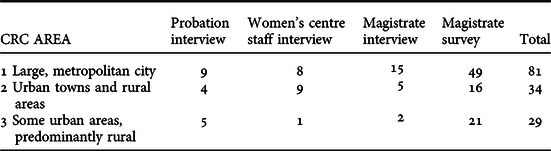
This article forms part of a much larger project on the sentencing and punishment of women under the new Transforming Rehabilitation arrangements (see Birkett, Reference Birkett2019). The data presented here relates to the results of a survey responded to by eighty-six magistrates (52 female, 34 male) in addition to fifty-eight semi-structured interviews with magistrates, probation officers and women’s centre workers.Footnote 9 Both survey and interview data were collected in three CRC (probation) areas across the South of England (see Table 1). Area 1 covers a large metropolitan area, Area 2 covers both urban towns and rural areas and Area 3 covers some urban areas but is predominantly rural. Interviews were conducted with magistrates and probation officers across several locations in each area. Interviews were conducted with practitioners at two women’s centres in Area 1, two centres in Area 2 and one centre in Area 3.
Initial clearance for the practitioner part of the project was provided by the National Offender Management Service (NOMS). Recruitment for the probation officers adopted a purposive and snowballing approach, with key participants recommending other colleagues who specifically worked with women. At the same time, contact was made with the managers of the women’s centres that operated in each of the research sites. All participants were provided with a pseudonym, and the professional position of the practitioners is also included: SPO – Senior Probation Officer, PO – Probation Officer, PSO – Probation Service Officer and WCW – Women’s Centre Worker. The difficulties in securing interviews with probation officers at the time of fieldwork cannot be overestimated. The issue was particularly challenging in Area 1 where the research was met with resistance and suspicion. Fieldwork was equally challenging in Areas 2 and 3, although much of this related to the small number of female staff working with women who were spread across large regions.
Access to magistrates was provided by the Magistrates’ Association. A call for interview participants was distributed in an email newsletter and individuals were asked to get in touch if interested. Due to a low response rate in two of the locations, a decision was made to conduct a follow-up survey. Containing the same questions as the interview schedule (with some space for ‘free text’ answers), this was advertised to relevant magistrates through the Magistrates’ Association member distribution list. It is recognised that the survey responses likely produced different data from that collected during in-depth interviews, although all participants were encouraged to contact the researcher if they wished to discuss further. Interviewed magistrates were given a pseudonym, while survey respondents are identified by their respondent number. Such limitations notwithstanding, this is one of the largest studies on those involved in the sentencing, punishment and support of women offenders to date.
The interview transcripts and survey responses were coded and thematic analysis was employed. The findings are broadly consistent with those identified in other research studies, policy reports, HM Inspectorate of Probation reports and Parliamentary Committee reports. The views of magistrates and practitioners remained broadly the same across all three research sites (those that supported gender-specific provision versus those that did not), although those in Area 3 (predominantly rural) had different, largely practical, concerns about the introduction of specialist courts. The results indicate moderate support for the problem-solving model among magistrates, probation officers and women’s centre workers. Magistrates were particularly concerned about resources (court time and financial constraints), practicalities (such as the current listing system) and perceived unequal treatment. Practitioners, on the other hand, were apprehensive about up-tariffing and the increased potential for sentence ‘overload’. They also expressed scepticism about how the model would work within the new probation arrangements.
The magistrates
Fifty-six of the eighty-six (65%) respondents to the magistrate survey expressed an interest in problem-solving justice, with positive comments relating to the potential to improve compliance, the potential to empower offenders and the potential to play a greater role in the rehabilitation process. Positive responses noted that the approach could help offenders to foster greater “feeling[s] of self-worth” (82, Area 2, Female), that it could provide “extra help for those women really wanting to turn their lives around” (35, Area 3, Female), and that it afforded magistrates “the ability to get to know the offender and [encourage] real engagement” (10, Area 3, Female).
Interviewees across all three areas were particularly amenable to the model and expressed support for a pilot scheme in their local court. There was, despite almost no training on this issue, a general recognition that women often responded differently to men when being punished and that they were, by and large, more responsive to ‘carrot’ (rather than ‘stick’) techniques (see Birkett, Reference Birkett2016). Interested interviewees highlighted the potential to build relationships and provide encouragement to offenders; something they were prevented from doing under the current framework. Several of those in Areas 1 and 2 had experience sitting in Drug Courts (one had been involved in a Community Court pilot) and were supporters of the ‘review’ model with its potential to break the cycle of offending.
It is an important way to address the problems that people have directly. They’re coming back to the same Bench time and time again, so you build up rapport with them (‘Jeremy’, Area 2).
Although having no experience of sitting in a Drug Court, ‘Susan’ (Area 1) felt that the approach was “infinitely logical” as:
The offender actually feels like you’re slightly more on their side, whereas I think there can be a feeling very much of ‘them and us’ in the way the court’s structured, the fact that we generally, we’re physically higher, and all those kind of things.
Other magistrates were drawn to the increased potential for collaboration. ‘Steven’ (Area 1) felt that it would give women “a degree of ownership” over their rehabilitation. ‘Mary’ (Area 1) similarly felt that women’s engagement with sentence planning would lead to greater “buy-in”:
I also think, on a very human level, it feels like at least in part a constructive process, rather than punishment… I think that is also a good thing.
While ‘Chris’ (Area 3) did not support the idea, he did feel that court processes needed to develop a “feedback loop… because otherwise, there’s no chance of seeing how they’re progressing and seeing if the sentence that was given was successful, or if there’s anything else that needs to be done and help given”. Magistrates routinely highlighted that the only time they saw offenders back in the court was when they had breached the terms of their order. They were presented with information about what did not work, but nothing about what did.
Operating on the frontline of the justice system, most magistrate concerns related to practical workability. Frustrations predominantly related to the current listing arrangements, insufficient HMCTS resources to allow for new innovations and, for some magistrates, apprehensions about greater time commitments. Specific concerns relating to travel and viability were of particular focus for those sitting in Area 3 (and some parts of Area 2) who did not feel that there were enough women in the immediate locality to develop specialist provision.
Other magistrate concerns focused on the more fundamental questions of effectiveness and perceived unequal treatment. Despite his general expressions of support, ‘Jeremy’ (Area 2) cautioned that the Drug Courts were not always successful and that other ‘review’ models might not be the straightforward answer that advocates perceived them to be. ‘George’ (Area 1) similarly explained that while colleagues sitting in the Drug Courts felt that they were doing valuable work, “they couldn’t demonstrate the benefit even though intuitively it sounded like the right thing to do”.
Although in the minority, several magistrate interviewees felt that the development of specialist problem-solving courts was unfair. ‘Sandra’ (Area 1), for example, equated it to “shop[ping] around for your punishment”. Her views were more widely articulated among survey respondents who highlighted the requirement to provide – and be seen to provide – equal treatment for all. Various concerns were expressed about cherry picking women as a “special case” (50, Area 2, Female), court hearings becoming “chummy review[s]” (52, Area 3, Male), and magistrates “lean[ing] towards being social workers” (29, Area 3, Female).
It is telling that neither interviewees nor survey respondents seemed particularly concerned about the potential threat of net-widening. Such views are consistent with the concept of benevolent repression; that some sentencers are prone to make women’s punishment more intrusive in the name of ‘help’ (see Worrall, Reference Worrall1981). Issues of net-widening were of utmost concern for those working with women on the ground, however.
The practitioners
All probation officers expressed a pragmatic interest in the approach and felt that the development of specialist review courts for women could be a positive innovation. They were, however, deeply sceptical about practical workability in the face of drastic cuts to the holistic, multi-agency approach that it required. Highlighting the dwindling lack of services (relating to social housing, access to drug and alcohol treatment, help with mental health issues and budgets for travel) alongside a growing strain in relations between NPS and CRC staff, several felt that the model was unachievable in the current circumstances. While expressing particular concern about net-widening, women’s centre workers were particularly attracted to its focus on collaboration and empowerment and felt that it would give them more opportunities to engage with women during the sentencing process.
It is certainly the case that the Transforming Rehabilitation reforms have added complexity to existing supervision arrangements. At the time of writing, there is no CRC presence allowed in the courts, so it is up to NPS staff to work on the initial sentence plan before handing over to the CRC officer that will have eventual responsibility for working with the woman. This is a cumbersome process that undermines the clear levels of collaboration (and at the very least communication) that the problem-solving model requires. ‘Judith’ (SPO, Area 1), for example, explained that the Offender Rehabilitation Act 2014 had resulted in a growing “schism between [the NPS] and the people that are delivering the services” (see Birkett, Reference Birkett2019).
All practitioners felt that magistrates would require more training if the model was to be implemented, arguing that they needed to be more ‘in touch’ with court users. Women’s Centre workers in particular expressed concerns that magistrates were too “detached” (‘Beth’, WCW, Area 2) and that the sentencing process needed to be “a lot more human” (‘Charlotte’, WCW, Area 2). ‘Karen’ (WCW, Area 2) felt that magistrates needed more knowledge of “what they are sentencing [women] to”. Practitioners did, however, recognise that magistrates often had limited information about the specialist services (including the centres) that worked with women. Their views echo research highlighting magistrates lack of knowledge about community options (Hough et al., Reference Hough, Jacobson and Millie2003; Hedge, Reference Hedge2007) and the requirement for greater levels of training on this issue (Gibbs, Reference Gibbs2014), particularly with regards to women (Calderbank et al., Reference Calderbank, Fuller and Hardwick2011; Birkett, Reference Birkett2016; Marougka, Reference Marougka2012; see also Ministry of Justice, 2018b).
Like magistrates, practitioners also expressed moral unease about the model. Concerns related to the threat of up-tariffing and net-widening rather than perceptions about unequal treatment, however. Practitioners raised the valid point, highlighted in previous research, that in requiring women to engage with a wide range of services and return to court for regular reviews, the actions of well-meaning sentencers could actually set them up to fail. In addition to taking away women’s agency, many felt that only certain women would be able to cope with the additional pressures that it placed on them. ‘Alice’, a probation officer in Area 2 felt that:
There is a possibility that some women would respond [to the problem-solving model] but I think that others would absolutely not. They don’t turn up for their [drug review hearings]… It’s just more punitive, which is not what they need.
‘Emily’, a probation officer in the same area agreed that:
The courts pile on a whole load of other stuff that they have to do which is not the best thing to do. Women will feel overwhelmed and if they have trouble turning up anyway then they’re getting into more trouble because of that.
Women’s Centre workers expressed analogous concerns. ‘Joanne’ (WCW, Area 2) explained that “if someone has got five appointments in a week to see four different people when their life is already chaotic, we’re setting them up to fail”. ‘Lexie’ (WCW, Area 2) simply viewed the approach as “a prison sentence in disguise”.
It is certainly the case that if women struggle to comply with the terms of their order then they may find themselves serving a short term in custody, the very outcome that the court was trying to avoid. Indeed, evidence has already demonstrated that there has been an increase in recalls to custody for women in breach of supervision requirements following the implementation of the Offender Rehabilitation Act 2014 (see also Prison Reform Trust, 2018). Any developments to existing practice must not compound this issue.
Solving or Creating Problems?
Largely supportive of, but also expanding, Gelsthorpe’s (Reference Gelsthorpe2017) cautions, the findings of this research have exposed a complex mixture of views relating to practical workability and moral unease. All participants felt that, in the face of budget cuts to HMCTS, the wider roll of the model would be unlikely in the current climate. The views of each cohort differed on a moral level, however. Magistrates were generally supportive of the problem-solving approach but concerns about fairness (in relation to the development of specialist courts for women) were more prevalent in the survey. The development of specialist courts was of particular interest to practitioners, conversely. Such participants stressed the need to achieve a delicate balance between additional help for women and simply overwhelming them.
Administration
It is certainly the case that administrative hurdles relating to HMCTS present a clear barrier. To achieve consistency of the Bench (a core requirement of the problem-solving model), the current system for court listings and rotas would need to be amended in order to enable to the same person (or group of people) to sit on the same case. The current systems allow this for Drug Courts, so there is no reason why this method could not be utilised more widely. The cost of establishing specialist courts for women was highlighted by both magistrates and probation officers who are operating in increasingly streamlined conditions. The reality, however, is that in operating as Drug Courts (one afternoon per week, for example) women’s problem-solving courts would require limited additional resourcing.
Effectiveness
Magistrates articulated valid concerns around effectiveness. To date, no evaluation has been published of the Manchester women’s problem-solving court and the evaluation of the Aberdeen court was limited. More research is badly needed. A properly funded pilot court, along the lines of the Community Courts (and harnessing the lessons learned from Manchester and Aberdeen) would need to be established in order to ascertain if the approach – in its authentic form – could be effective for women. As things stand, the problem-solving project provides another example of poor data collection threatening to hinder penal progress for women (see Gelsthorpe and Hedderman, Reference Gelsthorpe and Hedderman2012; Radcliffe et al., Reference Radcliffe, Hunter and Vass2013). More quality data could result in a compelling rationale for the roll-out of the model.
Collaborative provision
The postcode lottery of specialist services for women certainly presents a serious obstacle to the problem-solving vision (see for example Her Majesty’s Inspectorate of Probation, 2016; Howard League, 2016; Marples, Reference Marples2013; Plechowicz, Reference Plechowicz, Annison, Brayford and Dearing2015; Radcliffe et al., Reference Radcliffe, Hunter and Vass2013). Without the necessary agencies to create the holistic, multi-agency scaffolding required to support women in the community, a specialist order simply cannot exist. The government’s current Female Offender Strategy places great focus on multi-agency working and acknowledges the important work of the voluntary sector (in particular the women’s centres) in this regard. Yet years of cuts to the women’s penal field means that specialist services are scant, stretched and remain under-resourced. The Strategy has pledged £5 million (Ministry of Justice, 2018a: 8) to fund community provision for women and this must be used to support existing services that are already positioned to provide the holistic support that the problem-solving model requires.
Magistrate training
Any expansion of the problem-solving model would certainly require investment in training opportunities, something of particular concern to magistrates who have seen Judicial College and HMCTS training budgets slashed to almost nothing (see Gibbs, Reference Gibbs2014; see also McIvor, Reference McIvor2009). Budget issues notwithstanding, many magistrate participants revealed an appetite for further specialisationFootnote 10 , and accredited training (in the form of e-learning which is already used in some cases) could be provided to those wishing to take part in problem-solving reviews. Aligned to recent government thinking, the problem-solving model undoubtedly plays to the often-unused skills that sentencers wish to develop (see Ward, Reference Ward2014).
Suitability
The final, and perhaps most fundamental, hurdle relates to the suitability of the problem-solving approach for women. Although not an issue raised by magistrates, most practitioners expressed concern that the model should not be used as a route to up-tariffing in the name of ‘help’. Their professional experience was that many women struggled to ‘juggle’ their orders with the multiple complexities in their lives and they expressed concern that problem-solving had potential to set women up to fail. The problem-solving model should not be touted as the universal answer for all women serving community orders, and suitable holistic support should continue to be provided for those who would not respond positively to additional court reviews. Problem-solving must not be another mechanism for the over-surveillance of women.
The above hurdles present a dilemma for problem-solving advocates. Some, such as improved court listings and magistrate training, are relatively straightforward to overcome if the political support is in place. Other hurdles, relating to suitability and effectiveness, are clearly more fundamental in nature and require greater levels of investigation. None of them are, as Donoghue (Reference Donoghue2014: 59) suggests, ‘insurmountable’. Implementation issues notwithstanding, it is certainly the case that problem-solving courts have the potential to simultaneously solve and create problems for those they aim to help.
Conclusion
Donoghue (Reference Donoghue2014), in her recent work on problem-solving justice, has argued that the approach creates a crucial window of opportunity to engage with hard to reach groups of offenders. Successive government strategies and decades of academic research place women offenders in this category. It is widely evidenced that women respond better to holistic, multi-agency support that places specific emphasis on empowerment and collaboration (see Gelsthorpe et al., Reference Gelsthorpe, Sharpe and Roberts2007). Broadly aligned to current government thinking, there is little doubt that problem-solving justice is a very appealing concept: the promise of greater levels of collaboration and empowerment for female service users, the promise of greater levels of offender engagement for probation, and the promise of an enhanced role for magistrates looking to play a greater role in the rehabilitation process.
This article provides timely data that reaches beyond the seductive appeal of problem-solving justice for women, however. In so doing it highlights three main warnings to heed. It is clear that the model could not work everywhere; in addition to geographical variations relating to need, the postcode lottery of women’s services means there are limited resources available to support specialist problem-solving courts in each region. This situation has been exacerbated by the Transforming Rehabilitation arrangements and the new legislation governing probation. The current lack of data pertaining to the effectiveness of such courts presents another hurdle. If the government is serious about developing more effective options for punishing women in the community then it could revisit the Community Court plans of the mid-2000s and look to establish a pilot as part of its current Female Offender Strategy. This will require both political commitment and appropriate funding. Finally, and most fundamentally, specialist problem-solving courts have the potential to further criminalise women already entangled in the criminal justice net. This presents a serious issue for policymakers committed to reducing the number of women in prison and threatens to undermine the current orthodoxy on ‘best practice’. Although popular abroad, it is clear that more research is badly needed to ascertain whether the seductive promises of problem-solving justice can live up to reality in England and Wales.
Research areas and participants