I. Introduction
When scholars and litigants think about federal district courts, the judicial officers who come to mind are Article III–appointed US district judges. Yet today, nearly half of full-time federal trial judges are Article I US magistrate judges.Footnote 1 Moreover, the increase in full-time magistrate judgeships exceeds that of authorized Article III district judgeships. Thirty years ago, only one-third of federal trial judges were magistrate judges (313 magistrate judges compared to 631 district judges). This growth trend is likely to continue because the US Judicial Conference increases the number of magistrate judgeships based on district court caseload, which itself has grown at a faster rate than Congress’s willingness to authorize new district judgeships.
Over the 5 decades since magistrate judges were introduced, empirical studies of federal district courts have grown dramatically (e.g., Williams and George Reference Williams2013; Wofford Reference Wofford2017; Krell Reference Krell2019; Burch and Williams Reference Burch2020; Hazelton Reference Hazelton2021). Models have grown in sophistication, concurrent with increased availability of data. One constant, however, remains in the federal courts literature: ascribing the work of district courts to Article III district judges and (perhaps unintentionally) discounting the relevance of magistrate judges to understanding federal litigation.
The absence of magistrate judges from empirical court studies matters. Theories of federal trial courts, and the corresponding empirical tests, rest on assumptions about the appointment and tenure of the judicial actors involved in the cases. District court studies use as the unit of observation the Article III judge, and their policy preferences are based on observable characteristics: political party affiliation, appointing president (and senators), or preappointment campaign contributions of district judges (Giles, Hettinger, and Peppers Reference Giles2001; Epstein et al. Reference Epstein2007; Bonica and Sen Reference Bonica2017).
By contrast, comparable metrics for magistrate judges are absent. When evaluating trial court rulings, researchers assume that the trial judge’s incentives turn on reputation, promotion to the court of appeals, reversal by the appellate court, and judicial philosophy. By design, researchers intentionally ignore the most significant incentive affecting most government actors (including term judges): job security (Mayhew Reference Mayhew1974; Wood and Waterman Reference Wood1994). But for magistrate judges, who lack lifetime tenure, reappointment is a necessary calculus to their job security (Shepherd Reference Shepherd2009; Kang and Shepherd Reference Kang2013; Johnson Reference Johnson2015).
These models present a parsimonious version of the world where the Article III trial judge alone adjudicates legal disputes. This simplification, however, requires credible assumptions. The decision to simplify models of federal trial courts by excluding magistrate judges is reasonable only if magistrate judges have a modest effect on the processes or outcomes being studied. If magistrate judges merely play a supporting role like that played by law clerks, staff attorneys, and others, then we may not need to account for magistrate judges in research on federal litigation (McCabe Reference McCabe1979). But if magistrate judges wield greater authority and discretion, then we must revise our assumptions and models of trial court decision making to account for the role that these Article I judges perform.
We posit that a complete understanding of most federal judicial decision making must account for the role of magistrate judges. First, as federal caseloads have increased, so too have the number of magistrate judges. Second, these judges collectively take on a significant role in federal court adjudication, including the plurality of disputes that resolve before a trial verdict. Third, unlike their Article III counterparts, magistrate judges do not perform a uniform set of tasks but rather vary considerably by jurisdiction. While the precise effect of magistrate judges goes beyond the scope of our article, our findings provide evidence warranting this line of inquiry.
In this article, we seek to address the question of whether magistrate judges should be included in theoretical and empirical models of federal district courts. We begin by explaining the meaningful ways in which federal magistrate judges differ from federal district judges. We focus on the differences that have proven significant in judicial decision-making models: method of selection, job security, scope of authority, and autonomy. Section III uses descriptive data to examine what portion and part of federal trial court work is carried out by magistrate judges rather than Article III district judges. Then, in Section IV, we use original data to assess whether the fact that magistrate judges rather than district judges fulfill the judicial function has a measurable effect on trial court outcomes. We find that the magnitude of magistrate judge impact is simultaneously significant and highly variable from one district court to another. Our findings provide compelling evidence rejecting the long-standing view that district judges are equivalent to district courts. We conclude by advocating for a recalibration of our models of trial adjudication to recognize the substantive as well as procedural effect that magistrate judges have on federal district courts.
II. Distinguishing Magistrate Judges from District Judges
Magistrate judgeships differ from district judgeships in ways relevant to judicial decision-making models: method of selection, job security, scope of authority, and autonomy. We focus in this section on these salient differences.
A. Magistrate Judge Selection and Retention
Federal trial judges—Article I and Article III—arrive on the district court through dissimilar processes and under disparate conditions. District judges are chosen through a politicized and public process, are evaluated based on their political bona fides and personal lives, and are nearly free from control once appointed. Magistrate judges, by contrast, are chosen through a formal and confidential merit process, are evaluated based on their ability to get work done efficiently and effectively, and are supervised by those who select them.
The Article I magistrate judge appointment process has little in common with the more familiar Article III method. Congress originally delegated unconditional discretion over magistrate selection to district judges. After litigators and repeat parties voiced concern over the uneven quality of magistrate appointees (Smith Reference Smith1987; McCabe Reference McCabe2016), Congress responded by passing the Federal Magistrate Act of 1979, creating explicit steps in the selection process (Smith Reference Smith1987; Judicial Conference of the United States 2014). The overhauled process now channels and constrains the selection through its formality, confidentiality, and focus on substance: the district court issues a call for applications when a vacancy is created, candidates submit a long and detailed application, a district-level merit panel of local attorneys and nonattorneys conducts interviews and a substantive evaluation of applicants and makes a written recommendation of the five best candidates, district judges vote on the recommended candidates (and only those candidates), and the new magistrate judge is announced (28 U.S.C. § 631; Foschio Reference Foschio1999). The only visible steps in this process are the first and the last—the announcement of an open position and the announcement of who will fill it—allowing district judges greater latitude in their selection among the finalists.
The goals of individuals who select district judges versus magistrate judges sharply contrast (George and Yoon Reference George2016). Whereas elected officials picking district judges are seeking to maximize reelection chances, district judges choosing magistrate judges are trying to maximize their workload relief. Presidents and senators want district judges who satisfy their supporters, their political party, and the attentive public (Epstein and Segal Reference Epstein2005). District judges likely care about magistrate judges’ perspectives, including ideological views, when those viewpoints affect the magistrate judge’s work. District judges’ most pressing considerations are their caseloads.
District judges retain authority over whomever they select to be a magistrate judge, whereas presidents and senators know that they have only a few weak levers to control district judges after their appointment (e.g., refuse to dispense promotions or pay increases or pursue costly discipline such as impeachment). District judges, in contrast, have numerous mechanisms of control over their judicial appointees. District judges direct assignments to magistrate judges and dictate the quantity and nature of their workload. District judges can also refuse to renew a magistrate judge’s contract when it expires.
B. Magistrate Judge Tenure and Scope of Duties
Both magistrate judges and district judges are federal judicial branch employees. Their salaries and retirement benefits are roughly comparable: full-time magistrate judges earn 92% of the salary of district judges.Footnote 2 Both become eligible for a pension equal to their final salary if they serve for 14 or 15 years and reach the age of 65 (28 U.S.C. §§ 371, 377(a)).
Their job tenure, however, is a key difference between the positions. District judges enjoy lifetime tenure. Magistrate judges are appointed for an 8-year, renewable term. District judges decide whether to renew a magistrate judge at the end of the 8-year term.Footnote 3 A majority of district judges may remove a magistrate judge during that term for incompetence, misconduct, or neglect of duty (28 U.S.C. § 631(i)). By contrast, Congress may remove a district judge only for “high crimes and misdemeanors” through the Article I impeachment process.
Another notable distinction between the two judicial offices lies in the scope of judicial duties. While Congress, within constitutional limits, defines the scope of authority of district judges, district judges generally set the boundaries of magistrate judge authority. In short, district judges can take it upon themselves to handle all aspects of a case, whereas magistrate judges can do only a subset of these tasks. District judges have wide discretion in determining what tasks to delegate to magistrate judges.
These meaningful differences between district and magistrate judges—selection, job security, autonomy, and scope of work—only matter if magistrate judges play an important role in the federal trial courts. The next two sections explore that question in distinct ways.
III. Magistrate Judge Use Across the Country
Magistrate judges’ possible roles and responsibilities have steadily grown since their inception in 1968 (Seron Reference Seron1983; Baker Reference Baker2005; Koller Reference Koller2011; Lee and Davis Reference Lee2016). Magistrates, as they were originally known, perform different tasks, depending on the type of case. In criminal matters, magistrate judges handle initial proceedings in criminal cases, to dispose of certain minor criminal offenses, to set bail for more major offenses, and to conduct pretrial matters (Federal Magistrates Act of 1968, Pub. L. No. 90-578, § 101, 82 Stat. 1113). In civil matters, magistrate judges typically handle pretrial matters, including discovery. In 1979, Congress expanded magistrate judges’ power by allowing them to conduct trials in civil cases with the consent of both parties, to hear all federal misdemeanor cases, and to try cases with or without a jury (28 U.S.C. §§ 636(a)(3), 636(c), 636(e)). More recently, the Federal Courts Improvement Act of 2000 granted limited contempt powers to magistrate judges (28 U.S.C. § 636(e)). Thus, in relatively short order, magistrate judges have emerged as a potentially integral part of the federal judiciary “capable of performing virtually any task that a district judge may delegate” (Hanks Reference Hanks2015, 48). With so much district court autonomy, their actual work depends on the district judges on the courts in which they serve and “what duties will best meet the needs of the court and its judges” (McCabe Reference McCabe2014, 51).
In what follows, we examine magistrate judges’ work in presiding over case matters and making procedural and substantive decisions. In district courts, procedural determinations, such as the admissibility of witnesses or permitting the plaintiff to amend her complaint, “can have an enormous impact on the scope of the subsequent litigation and thus the likelihood that a given litigant will ultimately prevail” (Kim et al. Reference Kim2009, 92). We compile and analyze descriptive data from the Administrative Office of the US Courts (AO). These national data allow us to observe the sizable reliance on and variability in the use of magistrate judges across district courts and across time for multiple important civil and criminal case proceedings, including activities that are closely connected to ultimate case outcomes. We graph key pieces of AO annual workload figures from 2000 through 2016. To enable comparison across districts, we report the number of magistrate judge actions in a district in a single year (a “district-year”) per filed case or defendant of that type.
A. Pretrial and Preliminary Matters
We begin with the judicial work most frequently associated with magistrate judges: pretrial and preliminary matters. The most common civil pretrial matters handled by magistrate judges are attorney conferences (e.g., settlement efforts or discovery disputes) and motions. A magistrate judge may hold a motion hearing with or without ruling on the issue presented. If the motion is nondispositive, the district judge may assign the task of hearing and deciding the motion entirely to the magistrate judge (28 U.S.C. § 636(b)(1)(A)). If the motion is dispositive, then the magistrate judge hears the motion and makes findings and a recommendation to the district judge.
To better understand the variation across districts in how magistrate judges are used to manage the civil pretrial process, we develop a measure of the Combined Civil Pretrial Matters Rate. To create this measure, we add the number of magistrate judge matters handled, per district court, for settlement conferences, other pretrial conferences, motion hearings without a decision, and motion decisions from 2000 to 2016. We then divide that total number for each district court by the total number of filed civil cases in the district during that same time frame.
Figure 1 depicts the resulting Combined Civil Pretrial Matters Rate for three groups of district courts: those with median rates, those with rates in the top 10% of all districts, and those with rates in the bottom 10%. As the figure reveals, the median combined magistrate judge activity rate in civil filed matters is 1.35 per filed case. The top 10% of district courts use magistrate judges for civil pretrial matters much more frequently (up to nearly five times total per filed case), while the bottom 10% of districts have magistrate judges handle civil pretrial matters in, on average, less than one-third of their filed civil cases.
Distribution across districts of the combined number of civil pretrial matters handled by magistrate judges per filed civil case (2000–2016). Data source: Administrative Office of the US Courts, annual judicial business tables. Data exclude territory district courts.

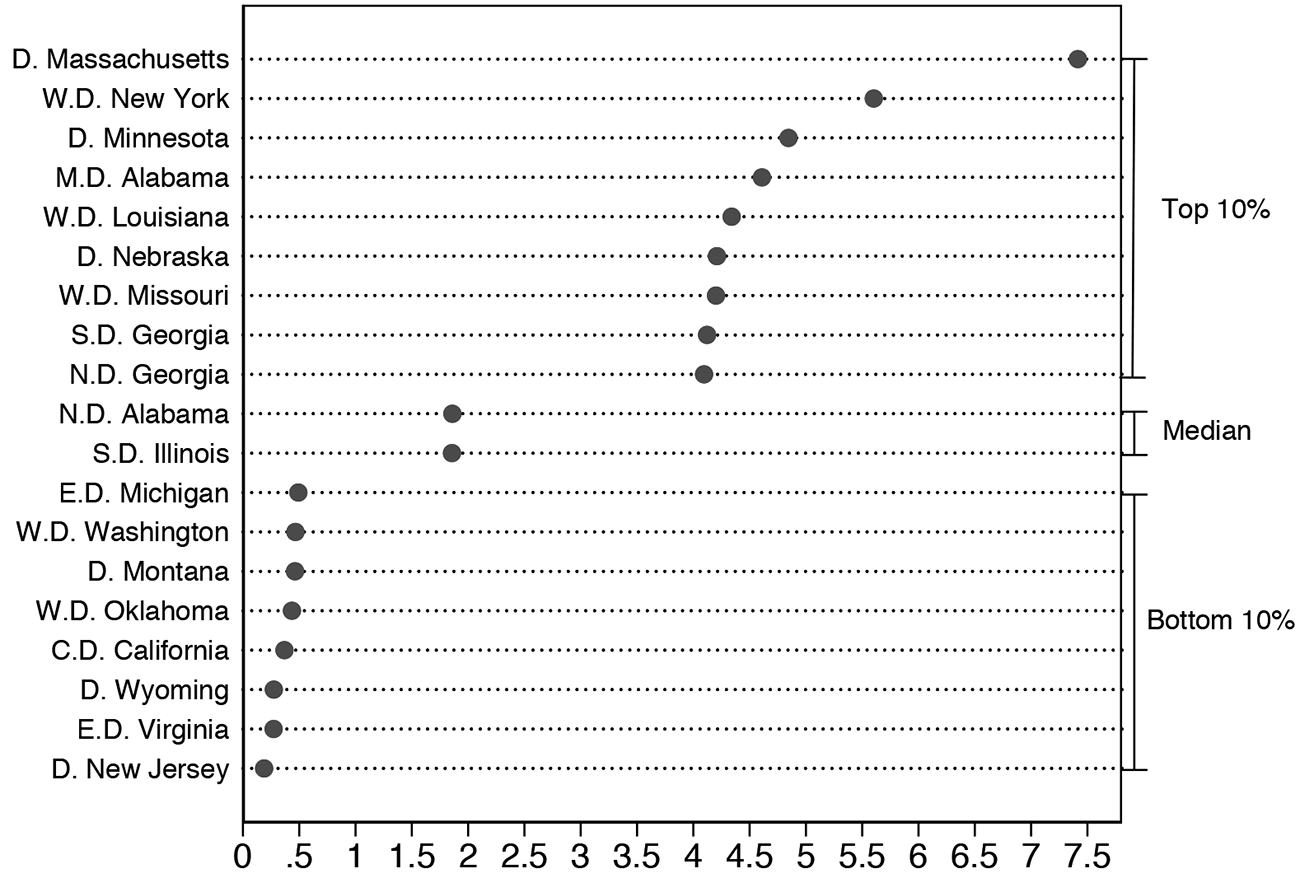
We take a similar approach to our analysis of magistrate judge participation rates in the most common criminal pretrial matters: pretrial conferences, motion decisions, guilty plea proceedings, motion hearings, and writs. Consistent with our civil pretrial findings, we observe sizable levels of magistrate judge activity in key criminal pretrial matters in many districts. Figure 2 depicts a Combined Criminal Pretrial Matters Rate for the median district courts, along with those in the top and bottom 10% (computed in the same way as the combined civil pretrial rates described above). The median combined magistrate judge activity rate in criminal pretrial matters is 1.82 per filed criminal defendant. The top 10% of district courts use magistrate judges for criminal pretrial matters much more frequently (up to nearly 7.5 total per defendant), while the bottom 10% of districts have magistrate judges handle criminal pretrial matters for, on average, less than a third of their defendants.
Distribution across districts of the combined number of criminal pretrial matters handled by magistrate judges per filed civil case (2000–2016). Data source: Administrative Office of the US Courts, annual judicial business tables. Data exclude territory district courts.

Magistrate judges frequently handle a range of felony preliminary proceedings including search warrants, arrest warrants, initial appearances, arraignments, preliminary examinations, detention hearings, and bail review. Figure 3 plots the Combined Felony Preliminary Proceedings Rate by which district courts use magistrate judges. We can see that every district is active in some notable way when it comes to using magistrate judges to handle felony preliminary proceedings, with the bottom 10% of districts having rates ranging from 1.43 to 2.5 per defendant. The top 10% of districts lean very heavily on magistrate judges for these proceedings, with rates from 4.8 to 5.7 per defendant.
Distribution across districts of the combined number of felony preliminary proceedings handled by magistrate judges per filed civil case (2000–2016). Data source: Administrative Office of the US Courts, annual judicial business tables. Data exclude territory district courts.

Our data on pretrial and preliminary matters, taken together, provide strong evidence of district courts’ reliance on magistrate judges. Certain districts use magistrate judges relatively frequently to handle civil and criminal pretrial and preliminary matters while others opt to use them infrequently. Three district courts—the Eastern District of Virginia, the Western District of Oklahoma, and the Western District of Washington—rank among the 10% lowest districts for magistrate judge use in two categories. On the other side, six districts rank in the top 10% for two pretrial/preliminary magistrate judge use categories: the District of Colorado, the District of Massachusetts, the District of Minnesota, the Southern District of Georgia, the Western District of Louisiana, and the Western District of Missouri. Looking at the cumulative weight of these magistrate judge use data also confirms the zero-sum nature of these judges’ time. We see no districts where magistrate judge use ranks highly across all three categories, and, indeed, we see examples in which high use in one category is balanced by very low use in another (such as the District of Wyoming, the Southern District of Georgia, and the Western District of Missouri).
We find that magistrate judges are key decision makers in the range of pretrial matters that dominate federal litigation. District judges, to varying degrees, are relying on magistrate judges to direct the early crucial stages of litigation, the point at which many cases end. Congress, however, authorized district courts to go further and allow magistrate judges to fulfill the judicial role at the merits stage. We next look at whether district judges haven ceded greater authority to magistrate judges.
B. Substantive and Merits Decisions
Magistrate judges also affect merits outcomes either directly, with party consent, or indirectly, through highly influential recommendations to district judges. In a civil action, both parties may consent to all proceedings, including trial (with or without a jury), being conducted by a full-time magistrate judge (28 U.S.C. § 636(c)(1)). Thus, the magistrate judge has power over the entry of final judgment in the dispute, acting as a district judge is otherwise authorized to act.
Party consent may operate through an opt-out or an opt-in system, with the former system likely to result in higher rates of magistrate judge use. In a number of districts, magistrate judges are on the random case-assignment wheel for all or some civil cases, and magistrate judges are randomly assigned a case from the outset (Alexander, Dahlberg, and Tucker Reference Alexander2019). Any party may choose to opt out of the assignment to a magistrate judge, and then the case is reassigned to a district judge. Other districts take a less active approach, choosing instead to assign cases to district judges but then immediately refer them to a magistrate judge and simultaneously encourage the parties to consent to that magistrate judge’s jurisdiction. The remaining districts continue to allow party consent to occur later in the process. But even there, the timing of the official entry of the consent may happen almost immediately before the magistrate judge’s opinion and order resolving the case.Footnote 4
Despite a persistent belief that magistrate judges are limited to pretrial matters, party consent to having their case assigned to a magistrate judge rather than a district judge is not rare and, in some districts, is common. From 2000 to 2016, the median district in the data has a magistrate judge serving as the presiding judge in about 6% of its civil cases. Again, substantial interdistrict variation is the norm. In some districts, there is effectively no chance that the parties in a case will consent to a magistrate judge acting in lieu of the district judge for the entirety of their case. In other districts, however, 25%, 33%, or even nearly 50% of the civil cases are formally resolved on the merits by magistrate judges filling the role of the district judges. Figure 4 presents our findings.
Distribution across districts and years of the number of civil consent cases (Section 636(c)) terminated by magistrate judges per filed civil case (2000–2016). Data source: Administrative Office of the US Courts, annual judicial business tables.

District judges may also assign magistrate judges the task of issuing Reports and Recommendations (R&Rs) on the resolution of civil case evidentiary and dispositive motions (such as motions to dismiss and motions for summary judgment). While district judges do not have the power to formally assign final decision-making authority directly to the magistrate judges without the consent of the parties, magistrate judges’ R&Rs are afforded significant deference by district judges. Indeed, prior empirical evidence indicates that district judges rarely fail to adopt magistrate judge R&Rs (Eisenberg Reference Eisenberg1981; Boyd Reference Boyd2016; Alexander et al. Reference Alexander2019). Thus, when a district judge asks a magistrate judge to issue an R&R, the district judge is signaling a preference to rely on the magistrate judge’s judgment to resolve the case.
Magistrate judges in many district courts are advising district judges on the resolution of civil motions. The median R&R rate across 2000–2016 falls between 6% and 10%. A few districts have few or no recorded R&Rs in civil cases in multiple years (including Wyoming and both districts in Wisconsin). Other districts are regularly on the upper end of the distribution, with a third to one-half of their civil cases including an R&R from a magistrate judge, as reflected in figure 5.
Distribution across districts and years of the number of reports and recommendations issued by magistrate judges per filed civil case (2000–2016). Data source: Administrative Office of the US Courts, annual judicial business tables. The figure excludes one extreme outlier.

Viewed together, figures 1–5, and our underlying discussion, reveal notable variation in the use of magistrate judges across districts and time. What explains the ways and degree to which districts lean on magistrate judges? Magistrate judges are a “flexible corps” of judges for individual district courts, allowing them to address their specific workload and other needs (Hanks Reference Hanks2015). As former district and magistrate judge Dennis Cavanaugh (Reference Cavanaugh2008, 7–9) has argued, “District courts utilize magistrate judges differently for many reasons, including the varying caseload demands and the mixes of cases, differences in court culture, different views of the most effective role of magistrate judges, and sometimes to benefit from the particular skills of incumbent magistrate judges.”
IV. Magistrate Judge Adjudication: A Case Study
In order to gain a more complete picture of magistrate judge authority, we now shift our focus from an overview of national trends in magistrate judge participation rates to the role that magistrate judges play in processing a specific type of district court case: Social Security Administration (SSA) disability cases. We choose these cases in part because of their prevalence among federal court dockets. In 2016, SSA disability cases composed over 6% of the total civil cases (excluding prisoner petitions) in district courts. In some districts, this exceeds 25%.
SSA cases represent appeals from decisions of administrative agencies. The claimant seeking disability benefits under federal law has sought relief in a multitiered adjudication process within the SSA. After being denied benefits by an agency administrative law judge and the Appeals Council (the SSA’s appellate body), a claimant may appeal that denial to their local federal district court. The district court may only reverse or remand the case to the SSA if there is a lack of substantial evidence to support the SSA’s decision to deny a benefit award (42 U.S.C. §§ 405(g), 205). And as we discuss below, districts lean heavily on magistrate judges in managing these cases.
A. SSA Project Data
We draw upon two data sources to examine the role of magistrate judges in SSA cases. First, we continue to take advantage of the AO’s comprehensive annual data. Second, we use the new SSA Project Data collected by Boyd, Ainsworth, and Lynch.Footnote 5 The SSA Project Data include a stratified random sample of up to 40 SSA district court cases per district with termination years from 1997 to 2014. The data cover 90 district courts, excluding only the four territory district courts. The SSA Project Data are coded from docket sheets and case documents. As such, they enable us to systematically examine the frequency with which magistrate judges serve as the final decision maker in SSA cases.
B. Rationale for Magistrate Judge Involvement in SSA Cases
There are good reasons to expect heavy reliance on magistrate judges in SSA cases. First, most district court dockets have a high volume of SSA cases. For this reason, districts are looking for a way to process these cases in a timely manner without overburdening their district judges or getting in the way of the other docketed cases. The high, consistent volume also means that district courts have an incentive to develop a standardized routine for SSA cases. Allowing magistrate judges to bear the bulk of the burden in these cases and develop specialization offers a potentially desirable solution.Footnote 6
Second, SSA cases are often less complex than many civil lawsuits in district courts. Because they involve appellate review of an administrative law judge’s denial of benefits, the district court has the narrow task of reviewing whether that denial aligns with the law. There is no discovery, development of the record, extensive motions practice, settlement conferences, pretrial hearings, or trials. As such, district courts may be less hesitant than in other types of cases to turn SSA cases over to magistrate judges.
Finally, there are incentives for SSA case parties to approve of and foster vast magistrate judge participation to help speed their case determinations, including via consent to magistrate judge jurisdiction. Claimants want their cases resolved, preferably positively, as soon as possible. The faster they win, the faster the disability benefits begin. Claimant attorneys, when present, often specialize in disability law or personal injury law. Their work is high volume and low pay per case, meaning that their incentive structure mandates minimal effort per case. The SSA and its counsel, the US Attorney’s Office in the district and general counsel within the SSA, are repeat players in the district court. With that comes numerous advantages, including vast comfort from a highly standardized and speedy resolution of these cases.
C. Patterns of Magistrate Judge Use in SSA Cases
From the data and documents used in the SSA Project Data and the AO’s annual data, we can observe common patterns in how magistrate judges are used by district courts to process SSA cases.
1. Patterns related to magistrate judge consent practices in SSA cases
Party consent to magistrate judge jurisdiction is a common occurrence in SSA cases in many districts. We observe some districts where magistrate judges are on the SSA case random-assignment wheel (opt-out consent) and others that assign cases to magistrate judges well after filing. For districts that prioritize the use of magistrate judges to resolve SSA disability cases, it is not uncommon to see explicit court efforts to obtain the parties’ consent to magistrate judge jurisdiction.
In figure 6, we use the SSA Project Data to plot, by district, the percentage of SSA cases ultimately decided by a magistrate judge.Footnote 7 Figure 6 focuses on the top and bottom 10% of districts in the data, along with the median districts. The median district court value is just over 18% of outcomes decided by magistrate judges. Districts on the low end have very close to 0% of their cases formally concluded by magistrate judges. Magistrate judges often still play a notable referral role in the SSA cases in these districts, but the districts do not actively encourage consent and likely have alternative preferred ways to handle SSA cases. This stands in stark contrast to the top 10% of districts in the data, where the percentage of SSA cases in the data ultimately decided by magistrate judges is at or above 70%.
Percentage of Social Security case outcomes decided by magistrate judges (MJs). Data source: SSA Project Data. Data exclude Reports and Recommendations.

2. Patterns related to magistrate judge referral and R&Rs in SSA cases
While districts vary in the frequency and timing when referring SSA matters to magistrate judges, notable patterns emerge. Most (but not all) districts refer at least some SSA matters to magistrate judges, whether those matters are preliminary, nondispositive activities like case scheduling, motion timing, or attorney withdrawals or are issuing R&Rs. Some districts have standing orders that refer SSA cases, as a matter of practice, immediately to magistrate judges for these preliminary matters.
Turning to a more systematic examination of the data, figure 7 reveals the significant role played by magistrate judges in issuing R&Rs in SSA cases. Once again using the AO’s reported annual data, the figure plots the distribution of SSA R&Rs issued by magistrate judges across districts and years, from 2000 to 2016. The figure allows us to draw a number of conclusions. First, R&Rs are quite common in SSA cases. The median annual R&R rate per SSA case ranges from 0.20 to around 0.40. There are still a few districts with SSA R&R rates at or very near 0, but even more notable are the large interquartile ranges (with sizes of up to 0.65) and high reaches of the full boxplot quartiles/whiskers (nearly always above a rate of 1).
Distribution across districts and years of the number of reports and recommendations issued by magistrate judges per filed social security case (2000–2016). Data source: Administrative Office of the US Courts, annual judicial business tables. Data exclude the four territory districts. The figure excludes one extreme outlier.

As we expect, figure 7’s R&R rates stand in sharp contrast to those present for all civil cases. In figure 5, median R&R rate values for all civil cases never rose above 0.15. The distribution of figure 5’s civil R&Rs also has a much tighter spread than we observe in figure 7.
D. Overall District-Level Reliance on Magistrate Judges in SSA Cases
Combining the SSA Project Data’s insights on magistrate judge outcomes with the AO’s data about R&Rs in SSA cases (fig. 7) allows us to observe the significant role that magistrate judges perform on SSA cases, either through R&Rs or primary oversight during the pretrial stage. Of note, it appears that four districts—Colorado, the Eastern District of New York, the Northern District of Alabama, and the Southern District of Iowa—rely on magistrate judges for R&R and consent jurisdiction in under 5% of their SSA cases. Another 14 districts have notable magistrate judge R&R and consent roles in under 25% of their SSA cases. Interestingly, many of these low-magistrate-judge SSA districts rank in the top 10% in figure 1 for their magistrate judge rates of handling civil pretrial matters. While some of these districts rely on magistrate judges to fulfill similar-to-civil pretrial duties in SSA cases in these districts, given the nature of SSA cases and their low complexity relative to other civil lawsuits, some districts likely opt to handle their SSA cases with other judges, including senior status district judges, while allocating their magistrate judge resources to other district needs.
E. Magistrate Judges’ Involvement in SSA Cases: Does It Matter?
There are logical reasons to explain why district judges heavily rely on magistrate judges in many SSA cases. However, this frequent practice also raises at least a few potential concerns about significant magistrate judge use that are worth addressing in more detail. SSA disability cases, despite being handled efficiently as routine cases by many district courts, are policy-rich disputes that attract substantial political attention and ire from the public and interest groups. Each year, the federal government expends approximately $200 billion in disability payments to about 20 million disabled Americans through the SSA (SSA 2015). Additionally, SSA disability cases in district courts are appellate cases rather than matters of first instance. It is hard to imagine litigants consenting to have non–Article III judges decide their appeals in the federal circuit courts or the courts approving a policy that would allow law clerks or non–Article III judges to recommend case outcomes, on the record, that are nearly always adopted by the circuit judges. If such practices would not be acceptable (or even constitutional) for appellate cases resolved in the federal circuit courts, why would they be permissible in the federal district courts?
Another potential concern with the heavy reliance on magistrate judges in resolving SSA cases is that they may decide the cases differently than district judges. Existing scholarship on magistrate judges provides scant evidence that magistrate judges behave inconsistently with district judges. Most relevant to the current research is Krent and Morris’s (Reference Krent2015) study of SSA disability appeals decided from 2010 to 2012 in district courts finding no differences between remand rates for district and magistrate judges.Footnote 8 Similarly, Boyd’s (2016) study of magistrate judges in employment discrimination litigation finds virtually no difference in whether a plaintiff or defendant wins litigation based on whether the case’s assigned judge is a district or magistrate judge. After viewing the relationship between district and magistrate judges through the lens of principal-agency theory, Boyd and Sievert (Reference Boyd2013) find evidence of consistency between magistrate judges and district judges: magistrate judges assigned to cases by the consent of the parties are more likely to rule in favor of liberal positions (e.g., in support of civil rights and personal injury plaintiffs) when their districts’ district judges are themselves liberal. In his study of discovery, Zambrano (Reference Zambrano2017) finds a small difference in district and magistrate judge rulings in the discovery setting.
Despite the limited prior evidence on decision-making differences, we posit that SSA cases may result in magistrate judges diverging from district court judges. District judges, on average, are busy and have packed and inflexible caseloads (Taha Reference Taha2004; Morriss, Heise, and Sisk Reference Morriss2005; Boyd Reference Boyd2015). By contrast, magistrate judges, while also busy, may have more workload flexibility (Cavanaugh Reference Cavanaugh2008) and thus can more easily provide “careful consideration” of the cases before them. As the district courts have argued, magistrate judge case assignment, by the parties’ consent, can “promote timely and careful consideration” of the case.Footnote 9 Surveys of magistrate judges also indicate that these judges relish opportunities to take on more-demanding and time-consuming judicial roles (Hanks Reference Hanks2015).
Magistrate judge–assigned SSA disability cases may resolve differently than district judge–assigned ones because of the greater time, energy, and flexibility that magistrate judges necessarily devote to their decision making. Recall that in SSA cases, district judges serve as appellate judges, reviewing the decisions of SSA administrative law judges (ALJs) to deny benefits to disability claimants. There are no appeals in which the SSA is appealing an ALJ’s award of benefits to a claimant. SSA ALJs make their denial decisions in a difficult climate that includes nonadversarial hearings and high caseloads that can reach over 1,000 cases per year per ALJ (Fahrenthold Reference Fahrenthold2014). While all district judges examine SSA disability denials under a deferential standard of review, the thoroughness of this review likely depends on a judge’s circumstances. Busy district judges may be much more likely to defer to the ALJs in this review and, thus, more mechanically affirm the ALJs, even when the quality of the ALJs’ decisions is questionable. Magistrate judges, by contrast, may be more likely to have the time and flexibility to assess the case record, including the claimant’s arguments, the evidence, and the ALJ’s evaluation of the case and handling of the original hearing. This opens the door for magistrate judges to be more likely, on average, than district judges to remand the case to the ALJ for additional proceedings. Our hypothesis captures our expectation:
Hypothesis. Magistrate judge–assigned SSA disability cases will be more likely to be remanded to the ALJ for additional proceedings than district judge–assigned SSA cases.
To empirically assess whether there is support for our hypothesis, we use SSA Project Data for nine full federal district courts: the Central District of California, the District of Arizona, the District of Idaho, the District of Maryland, the District of South Dakota, the Eastern District of Kentucky, the Eastern District of Pennsylvania, the Middle District of Alabama, and the Southern District of California.Footnote 10 Our dependent variable is Pro-Claimant, a dichotomous variable coded as 1 if the claimant receives a favorable outcome in the district court, including all reversals and remands, and coded as 0 for all outcomes that affirm the ALJ’s denial of benefits to the claimant. We drop from our analysis all transferred cases and filing and administrative errors. After excluding these cases, our nine-district-court data set was left with approximately 5,700 cases.
Our independent variable of interest is Magistrate Judge. This is a dichotomous variable that captures whether the case’s outcome judge is a magistrate judge (coded as 1) or an Article III district judge (coded as 0). Within our unweighted data, district judges decided 62% of the outcomes, while magistrate judges decided 38% of the outcomes.
Beyond the status of the case’s judge, we control for other key factors that may affect whether there is a pro-claimant outcome in the SSA case. We account for the type of SSA disability action that the claimant has brought with the variable SSI Title XVI. SSA disability benefit cases are brought two ways under federal law: through the Title XVI Supplemental Security Income (SSI) program (coded as 1) and through the Social Security Disability Insurance (SSDI) program (coded as 0). Coded based on the claimant’s selected nature of suit code, SSDI-brought claims are made by individuals who have paid sufficient Social Security taxes to be vested, while SSI-brought claims are made by low-income disabled, blind, or aged claimants and are funded from general tax revenues. Because of the nature of the weaker-positioned claimants in SSI cases, we expect these cases to be less likely to result in a pro-claimant outcome than SSDI cases.
Additionally, we control for Judge Ideology. Our measure of judicial ideology uses the senatorial courtesy-based score from Giles et al. (Reference Giles2001) and Epstein et al. (Reference Epstein2007) that ranges from −1 (most liberal) to +1 (most conservative). Since magistrate judges were not selected through Article III’s political appointment process, they do not have a comparable ideology score similar to district judges. Following prior studies, we create a proxy ideology score for magistrate judges that accounts for their distinct selection process in their district by using the median (active) district judge ideology score for the year that the magistrate judge was first appointed to his district court. We expect that, all else equal, more-conservative judges will be less likely to issue pro-claimant rulings in SSA cases.
Our model includes the variable Pro Se Claimant to account for SSA claimants representing themselves without counsel throughout their SSA appeal. This variable is coded as 1 for pro se claimants and 0 for those with counsel during some or all of their district court appeal. Consistent with what is well documented in other legal settings (e.g., Galanter Reference Galanter1974; Haire, Lindquist, and Hartley Reference Haire1999; Smith Reference Smith1999), we anticipate that pro se claimants will face significant disadvantages and be much less likely than represented parties to receive favorable outcomes in their SSA cases. Finally, we include district and year fixed effects in our modeling to account for differences that may emerge in decisions in given districts and years of the data.
Table 1 provides the results of our logistic regression for the likelihood a district court outcome favors the claimant.Footnote 11 As expected by our hypothesis, the presence of a magistrate judge as the assigned case judge increases the likelihood that the claimant prevails in her SSA disability case. Figure 8 further explores the substantive effect of the type of judge for a case’s outcome: for magistrate judges, the average predicted probability of a pro-claimant outcome is .59, meaning that 59% of the SSA disability cases in the nine districts examined here do not end with an affirmance of the SSA’s denial of benefits when a magistrate judge serves as the case’s outcome judge. This number falls to just .46 for district judges’ cases. The right side of the figure plots the difference between these two—.13—and the 95% confidence interval around this difference. Because the difference’s confidence interval does not contain 0, we know that the difference between magistrate judge and district judge case outcomes is statistically meaningful.
Logistic Regression Results for Whether an SSA Case’s Outcome is Pro-Claimant

Note.—SEs are clustered on the individual judge. The model’s percentage reduction in error is 16.8%. Baseline year is 2007; baseline district is the Southern District of California. Modeling includes sampling weights.
 .
* p < .10.
** p < .05 (two-tailed).
Predicted probability of a pro-claimant case outcome based on whether the outcome judge is a magistrate judge or a district judge and the average difference between the values for magistrate and district judges

The control variables Judge Ideology and Pro Se Claimant perform as expected. For the former, the results provide marginal evidence that as the case’s assigned judge becomes more conservative, the more likely the SSA’s denial of benefits will be upheld (and the less likely there will be a pro-claimant decision). Similarly, when the SSA claimant is pro se, he is much less likely to receive a favorable district court outcome than those claimants represented by counsel.
This analysis of magistrate judges’ effects on outcomes provides just a first step, given its focus on a single, unique type of district court case and its examination of only nine federal district courts. Future data-driven efforts can better untangle cases in which magistrate judges work in tandem with district judges from those in which district judges or magistrate judges operate alone. Additionally, more information and statistical analysis is needed to understand whether nonrandom selection effects in the cases that magistrate and district judges hear or distinctions between types of SSA case remands drive some of the differences we observe. Nonetheless, these empirical findings provide evidence that the variability in how district courts use and rely on magistrate judges matters for parties involved in cases and affects outcomes, at least in SSA disability cases. Given the large number of SSA disability cases heard in district courts each year, this alone is a meaningful finding and is likely to provide encouragement to claimants to eagerly welcome magistrate judge participation in resolving their cases. Additionally, our findings raise the question whether magistrate judges decide cases differently than district judges in other fact-intensive types of cases. This divergence might be most likely in cases in which magistrate judges’ time and flexibility relative to district judges position them to evaluate the case more thoroughly. For similar reasons, magistrate judges may also manage their cases differently than district judges in ways that may indirectly, but importantly, affect case outcomes and the timing of settlement.
V. Discussion and Conclusion
District courts, and the judges that compose them, play a central role in the federal judicial system. The role, duties, and function of Article III district judges are remarkably consistent across the 94 district courts. Yet, despite the conventional wisdom among the public and many judicial scholars, district judges are not the sole decision makers within district courts. Rather, magistrate judges perform a significant role in trial adjudication and now account for nearly half of the trial judges in federal districts. The Supreme Court itself has noted that “the role of the magistrate in today’s federal judicial system is nothing less than indispensable” (Peretz v. United States, 501 U.S. 923, 928 [1991]). Moreover, in contrast to district judges, magistrate judges vary considerably in the tasks they perform, both within and across districts.
This article increases our understanding of magistrate judges, both systemically and within particular areas of law. We find strong evidence that magistrate judges spend their time in starkly divergent capacities, for both criminal and civil cases, across and within districts, circuits, time, and issue areas. The data reveal that in many cases and across several district courts, district judges lean heavily on magistrate judges to resolve disputes using the same power vested in district judges. This includes, among other things, placing magistrate judges on the random-assignment wheel for case filings, encouraging parties to consent to magistrate judge jurisdiction, referring cases to magistrate judges immediately upon filing, having magistrate judges hold pretrial conferences and resolve preliminary motions, and relying on magistrate judges to issue reports and recommendations regarding many dispositive motions. While magistrate judges lack the statutory authority to issue a final order without the parties’ consent, within these decision-making activities, they nevertheless wield significant authority and discretion. And as our preliminary evidence on Social Security disability cases reveals, this reliance on magistrate judges can affect case outcomes.
As anticipated in a principal-agency theoretical framework and discussed in other related research (e.g., Boyd and Sievert Reference Boyd2013), magistrate judges are positioned to act as agents for district judges. District judges have some control over which cases magistrate judges hear, either in whole or in part. At the case level, district judges can reverse or vacate some magistrate judge orders (Chesley Reference Chesley2016). This control extends beyond an individual case to employment itself. When a magistrate judge completes her term, district judges determine whether to renew it (28 U.S.C. § 631). Accordingly, success as a magistrate judge requires developing a close collaboration with at least one—preferably more—district judges to establish a favorable foundation for renewal.
At the same time, magistrate judges are imperfect agents of district judges. The differences we observe in the role of magistrate judges are the direct result of Congress’s grant of substantial discretion to district courts. Credit is also due to the idiosyncratic preferences of chief district judges and other district judges and the autonomy and creativity found in the district courts to handle atypical caseload pressures that emerge (as in the case of Social Security appeals). Magistrate judges serve as one of the tools that district judges have in their toolbox to manage their caseload demands. Just as district judges differ from one another in their reliance on law clerks (Rosenthal and Yoon Reference Rosenthal2011), so too do they vary in their delegation to magistrate judges. In some instances, the delegation is infrequent or limited; in others, it is standard protocol. Our article reveals these variations but leaves unanswered whether they are beneficial or detrimental for the federal court system.
What is clear now, however, is that a failure to incorporate magistrate judges in the growing number of quantitative and qualitative studies of federal trial courts will almost certainly negatively affect the reliability and generalizability of their results. Indeed, viewed together, our evidence indicates that empirical district court studies excluding magistrate judges are likely to do the following things:
-
• Miss countless judicial decisions pretrial and preliminary matters that shape criminal and civil case development and eventual outcomes
-
• Attribute case outcomes and dispositive motion decisions solely to district judges when, in reality, magistrate judges often carry the bulk of decision-making authority when issuing R&Rs
-
• Overlook a nonrandom set of cases in which the parties have consented to full jurisdiction before a magistrate judge, meaning no district judge is involved in any case decisions
-
• Observe a very different set of cases based on one’s district courts of focus since vast district-by-district variability exists in how frequently and in what ways magistrate judges are used
-
• Draw conclusions about judicial behavior that may not hold for cases assigned to magistrate judges (at least in the case of SSA disability appeals)
As such, moving beyond the simplifying assumption that district courts are equivalent to district judges is an important step toward a more complete understanding of federal trial courts.
We believe that our article, by providing evidence on the importance of magistrate judges and their variability in judicial function, invites a new line of research in judicial behavior that more fully accounts for the complexities of magistrate judge staffing and federal trial court process and outcome decision making. This includes projects examining the fit of principal-agency theory to the magistrate judge role as well as the factors that influence how magistrate judges decide matters before them (e.g., reappointment timing, opt-in vs. opt-out consent jurisdiction). We offer two more examples ripe for future inquiry. One is the extent to which the inclusion of magistrate judges better explains judicial decision making at the trial level. Another, given their increasing role presiding over pretrial matters, is the influence of magistrate judges on the selection of cases that parties resolve before trial compared with those decided by the court and therefore enter the common law corpus. We look forward to these new lines of research.