



1 Introduction
There is a massive body of literature on “neostability” for first order theories dedicated to exploration and study of forking-like relations for various classes of unstable theories. The main classes: NIP theories, simple theories, theories with the strict order property, theories with the tree property of types 1 and 2, were all presented by Shelah in [Reference Shelah20]. In mid 1976 Shelah set the program which he named classification theory for non-elementary classes. A few years later the focus shifted to abstract elementary classes (AECs).
An appropriate generalization of stability for AECs was introduced in [Reference Shelah22] building on many previous papers including [Reference Grossberg and Shelah7, Reference Shelah18]. In the last 40 years starting with [Reference Grossberg and Shelah8] much was discovered about analogues of superstability. See [Reference Grossberg and Vasey10, Reference Leung14, Reference Vasey29] for some recent work.
In this article we propose progress towards “neostability of AECs”, more precisely, exploring an analogue of NIP and its negation. We propose a definition (under a certain cardinal arithmetic axiom) of NIP. Using techniques from papers by Shelah [Reference Shelah24], Jarden and Shelah [Reference Jarden and Shelah11] and Mazari-Armida [Reference Mazari-Armida15], we obtain a characterization of NIP in AECs using frames (a forking-like relation).
The notion of the
 $\lambda $
-stable AEC was first studied in [Reference Shelah22] using non-splitting. Various frameworks of forking-like relations were introduced. In [Reference Shelah24], Shelah introduced the local notion of the good
 $\lambda $
-frame, an axiomatization of forking-like relations for structures of cardinality
 $\lambda $
in AECs, as a parallel of superstability. In [Reference Boney and Grossberg3] Boney and Grossberg established that for “nice” AECs, stability implies existence of strong independence relations on the subclass of saturated models, which allows types of arbitrary length. In [Reference Boney, Grossberg, Kolesnikov and Vasey4] it was shown that this relation and several others are unique/canonical (if they exist).
Although good
 $\lambda $
-frames are nice and powerful, sometimes they might not exist. There are several weaker notions, where some of the axioms of a good
 $\lambda $
-frame are weakened or dropped. Vasey worked with good
 $^- \lambda $
-frames in [Reference Vasey29] and good
 $^{-S} \lambda $
-frames in [Reference Vasey28]. Jarden and Shelah defined semi-good
 $\lambda $
-frames in [Reference Jarden and Shelah11]. Mazari-Armida introduced w-good
 $\lambda $
-frames in [Reference Mazari-Armida15], which is weaker than all the axiomatic frames mentioned above.
Definition 1.1. Let K be an AEC,
 $\lambda \geq LS(K)$
.
 $K_\lambda $
has NIP if for all
 $M\in K_\lambda $
,
 $|gS(M)|\leq \text {ded } \lambda .$
Our definition of NIP will be discussed further in the next section.
Our main results are as follows.
Theorem 1.2 (
 $2^{\lambda ^+}>2^\lambda $
).

Let K be an AEC categorical in
 $\lambda \geq LS(K)$
, and
 $1\leq I(\lambda ^+,K)<2^{\lambda ^+}$
.
 $K_\lambda $
has NIP if and only if there is a w*-good
 $\lambda $
-frame on K except possibly without (Continuity). Moreover,
-
(1) (
$\text {ded } \lambda =\lambda ^+<2^\lambda $
) If
$\mathfrak s_{\lambda -unq}$
is
$\lambda $
-compact, then the w*-good frame satisfies in addition that if
$p\in S^{bs}(M)$
, then there is
$N\geq _K M$
and
$q\in S^{bs}(N)$
extending p that does not fork over N. In particular, for any
$N'\geq _K N$
there is
$q'\in gS(N')$
extending q that does not fork over N. -
(2) If K is
$(<\lambda ^+,\lambda )$
-local, then
$\mathfrak s_{\lambda -unq}$
has (Continuity).


Theorem 1.3. Suppose K is
 $(<\aleph _0)$
-tame,
 $M\in K$
,
 $C\subseteq |M|$
,
 $\lambda :=|C|\geq \beth _3(LS(K))$
and
 $(\text {ded } \lambda )^{2^{LS(K)}}= \text {ded } \lambda $
. Suppose
 $|gS^1(C;M)|>\text {ded } \lambda $
. Then there is
 $N\in K$
,
 $\langle \bar a_n\in ^m |N|\mid n<\omega \rangle $
and
 $\phi $
in the language of Galois Morleyization such that for every
 $w\subseteq \omega $
there is
 $b_w\in |N|$
such that for all
 $i<\omega $
,
 $$ \begin{align*}N\models \phi(\bar a_i,b_w) \iff i\in w. \end{align*} $$
Theorem 1.4. If K can encode subsets of
 $\mu :=\beth _{(2^{LS(K)})^+}$
, then it can encode subsets of any cardinal. That is, if there are
 $M\in K$
,
 $\{a_i\mid i<\mu \}\subseteq |M|$
,
 $\{b_w\mid w\subseteq \mu \}\subseteq |M|$
such that for all
 $w\subseteq \mu $
,
 $$ \begin{align*}i\in w\iff \phi(a_i,b_w),\end{align*} $$
then we can replace
 $\mu $
above by any cardinal.
It is interesting to comment that Shelah already implicitly discussed similar results in [Reference Shelah23] dealing with Grossberg’s question “Does
 $I(\lambda , K)=I(\lambda ^{++},K)=1$
imply
 $K_{\lambda ^{++}}\neq \emptyset $
” and in its followup [Reference Shelah24], Chapter II of [Reference Shelah26], [Reference Shelah25], and Chapter VI of [Reference Shelah27]. More specifically, in [Reference Shelah27, claim VI.2.3] and [Reference Shelah27, claim VI.2.5], Shelah considered the number of branches of a tree as a bound of Galois types over a model.
2 Preliminaries
Notation 2.1.
-
(1) For any structure M in some language, we denote its universe by
$|M|$
, and its cardinality by
$\|M\|$
. -
(2) For cardinals
$\lambda $
and
$\mu $
,
$[\lambda ,\mu ):=\{\kappa \in \text {Card}\mid \lambda \leq \kappa <\mu \}$
.
$[\lambda ,\infty ):=\{\kappa \in \text {Card}\mid \lambda \leq \kappa \}$
. -
(3)
$K_{[\lambda ,\mu )}:=\{M\in K\mid \|M\|\in [\lambda ,\mu )\}$
.
$K_\lambda :=K_{[\lambda ,\lambda ^+)}$
.


Definition 2.2. For K an AEC, we say:
-
(1) K has the amalgamation property (AP) if for all
$M_0\leq M_\ell $
for
$\ell =1,2$
, there is
$N\in K$
and K-embeddings
$f_\ell :M_\ell \to N$
for
$\ell =1,2$
such that
$f_1 \restriction _{M_0}=f_2 \restriction _{M_0}$
. -
(2) K has the joint embedding property (JEP) if for all
$M_0$
,
$M_1\in K$
there are
$N\in K$
and K-embeddings
$f_\ell :M_l\to N$
for
$\ell =0,1$
. -
(3) K has no maximal models (NMM), if for all
$M\in K$
there is
$N>_K M$
.








Remark 2.3. For a property P, e.g., amalgamation, we say that
 $K_\lambda $
has P or that K has
 $\lambda $
-P if we restrict to
 $K_\lambda $
in the above definition.
Definition 2.4.
-
(1)
$K^3_\lambda :=\{(a,M,N)\mid M, N\in K_\lambda , M<_K N, a\in |N|-|M|\}$
. -
(2) For
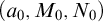
$(a_0,M_0,N_0)$
,
$(a_1,M_1,N_1)\in K^3_\lambda $
, we say
$(a_0,M_0,N_0)\leq (a_1, M_1,N_1)$
if
$M_0\leq M_1$
,
$a_0=a_1$
and
$N_0\leq _K N_1$
. -
(3) For
$(a_0,M_0,N_0)$
,
$(a_1,M_1,N_1)\in K^3_\lambda $
and K-embedding
$h:N_0\to N_1$
,
$(a_0,M_0,N_0)\leq _h (a_1, M_1, N_1)$
if
$h\restriction _{M_0}:M_0\to M_1$
is a K-embedding and
$h(a_0)=a_1$
.








Definition 2.5.
-
(1) For
$(a_0,M_0,N_0), (a_1,M_1,N_1)\in K^3_\lambda $
,
$(a_0,M_0,N_0) E_{at}(a_1,M_1,N_1)$
if
$M_0=M_1$
, and there are
$N\in K$
,
$f_0:N_0\to N$
, and
$f_1:N_1\to N\ K$
-embeddings such that
$f_0(a_0)=f_1(a_1)$
and
$f_0\restriction _{M_0}=f_1\restriction _{M_0}$
. -
(2) E is the transitive closure of
$E_{at}$
. -
(3) For
$(a,M,N)\in K^3_\lambda $
, the Galois type of a over M in N is
$\textbf {gtp}(a/M,N):=[(a,M,N)]_{E}$
. -
(4) For
$M\in K_\lambda $
,
$gS(M):=\{\textbf {gtp}(a/M,N)\mid (a,M,N)\in K^3_\lambda \}$
.







For
 $M_0\leq _K M\in K_\lambda $
and
 $p=\textbf {gtp}(a/M,N)\in gS(M)$
, define
 $p\restriction _{M_0}:=\textbf {gtp}(a/M_0,N)$
.
For
 $M_0\leq _K M_1$
and types
 $p\in gS(M_0)$
and
 $q\in gS(M_1)$
, we say
 $p\leq q$
if
 $p=q\restriction _{M_0}$
.
Remark 2.6. If
 $K_\lambda $
has AP then
 $E_{at}=E$
.
Definition 2.7. Assume that
 $K_\lambda $
has AP. For M,
 $N\in K$
,
 $p\in gS(M)$
, and K-embedding
 $h:M\to N$
, we define
 $h(p):=\textbf {gtp}(h'(a)/h[M], N)$
, where
 $h':M'\to N'$
extends h and
 $(a,M,M')\in p$
. Note that
 $h(p)$
does not depend on the choice of
 $(a,M,M')$
or
 $h'$
. See [Reference Leung14, proposition 3.1] for a proof.
Definition 2.8. Let
 $\langle M_i\mid i<\delta \rangle $
be increasing continuous. A sequence of types
 $\langle p_i\in gS(M_i)\mid i<\delta \rangle $
is coherent if there are
 $(a_i,N_i)$
for
 $i<\delta $
and
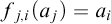
 $f_{j,i}:N_j\to N_i$
for
 $j<i<\delta $
such that:
-
(1)
$f_{k,i}=f_{j,i}\circ f_{k,j}$
for all
$k<j<i$
; -
(2)
$\textbf {gtp}(a_i/M_i,N_i)=p_i$
; -
(3)
$f_{j,i}\restriction _{M_j}=id_{M_j}$
; -
(4)
$f_{j,i}(a_j)=a_i$
.


The notion of coherent sequence of types first appeared in [Reference Grossberg and VanDieren9, 2.12], Here we use the version in [Reference Mazari-Armida15, 3.14] that avoids the use of a monster model.
Fact 2.9 [Reference Baldwin1, Theorem 11.3(1)].
Let
 $\delta $
be a limit ordinal and
 $\langle M_i\in K\mid i\leq \delta \rangle $
increasing continuous, and
 $\langle p_i\in gS(M_i)\mid i<\delta \rangle $
a coherent sequence of types. Then there is
 $p\in gS(M_\delta )$
an upper bound of
 $\langle p_i\in gS(M_i)\mid i<\delta \rangle $
, where the order is the one from Definition 2.5(5).
Fact 2.10 [Reference Baldwin1, Theorem 11.3(2)].
Let
 $\delta $
be a limit ordinal,
 $\langle M_i\in K\mid i\leq \delta \rangle $
increasing continuous, and
 $\langle p_i\in gS(M_i)\mid i<\delta \rangle $
a sequence of types with upper bound
 ${p\in gS(M_\delta )}$
. Then there are
 $\langle N_i\mid i\leq \delta \rangle $
and
 $\langle f_{j,i}\mid j<i\rangle $
that witness
 $\langle p_i\in gS(M_i)\mid i\leq \delta \rangle $
being a coherent sequence.
Definition 2.11 [Reference Shelah23, Definition 0.22(2)].
Let
 $\mu>\lambda $
.
 $N\in K_{\mu }$
is saturated in
 $\mu $
above
 $\lambda $
if for all
 $M\leq _K N$
,
 $\lambda \leq \|M\|<\mu $
, N realizes
 $gS(M)$
.
Definition 2.12 [Reference Shelah23, Lemma 0.26(1)].
Let
 $\mu>\lambda $
.
 $N\in K_{\mu }$
is homogeneous in
 $\mu $
for
 $\lambda $
if for all
 $M_1\leq _K N$
,
 $M_1\leq _K M_2\in K_\lambda $
,
 $\lambda \leq \|M_1\|\leq \|M_2\|<\mu $
, there is K-embedding
 $f:M_2\to N$
above
 $M_1.$
Fact 2.13 [Reference Shelah23, Lemma 0.26(1)].
Let
 $\mu>\lambda $
. If
 $K_\lambda $
has AP then
 $M\in K_{\mu }$
is saturated over
 $\mu $
for
 $\lambda $
if and only if M is homogeneous over
 $\mu $
for
 $\lambda $
.
Definition 2.14 [Reference Shelah17].
For a cardinal
 $\lambda $
,
 $$ \begin{align*} \text{ded } \lambda :=\sup\{& \kappa \mid \exists \text{ a regular } \mu \text{ and a tree } T\ \text{with}\ \leq \lambda\ \text{nodes and}\ \kappa\ \text{branches of } \text{length } \mu\}. \end{align*} $$
Fact 2.15 [Reference Shelah20, Theorem II.4.11].
Let T be a complete first order theory and
 $\phi $
a formula in its language.
 $\lambda $
is an infinite cardinal such that
 $2^\lambda>\text {ded } \lambda $
. The following are equivalent:
-
(1)
$\phi $
has the independence property. -
(2)
$|S_\phi (A)|> \text {ded } |A|$
for some infinite set A,
$|A|=\lambda $
. -
(3)
$|S_\phi (A)|=2^{|A|}$
for some infinite set A,
$|A|=\lambda $
.


Fact 2.16 [Reference Shelah20, Theorem II.4.12].
Let T be a complete theory in countable language, and
 $f_T(\lambda ):=\sup \{|S(M)|\mid M\models T$
,
 $\|M \|=\lambda \}$
. Then
 $f_T(\lambda )$
is exactly one of:
 $\lambda $
,
 $\lambda +2^{\aleph _0}$
,
 $\lambda ^{\aleph _0}$
,
 $\text {ded } \lambda $
,
 $(\text {ded } \lambda )^{\aleph _0}$
or
 $2^\lambda $
(see also [Reference Jerome Keisler12]).
It is reasonable to propose the following definition.
Definition 2.17. Let K be an AEC,
 $\lambda \geq LS(K)$
.
 $K_\lambda $
has NIP if for all
 $M\in K_\lambda $
,
 $|gS(M)|\leq \text {ded } \lambda .$
At present it is unclear that we have discovered the “correct” notion. In fact, it is plausible that there are several different notions that are equivalent when K is an elementary class, but distinct for some non-elementary K. One weakness of our definition is that unlike the corresponding first order notion, it is probably not absolute.
Grossberg raised the following question.
Question 2.18. Is there an equivalent notion which does not rely on extra set theoretic assumptions (at least for AECs K with
 $LS(K)=\aleph _0$
which are also
 $PC_{\aleph _0}$
)?
Question 2.19. Is there a global characterization of NIP?
Fact 2.20 [Reference Jarden and Shelah11, Theorem 2.5.8].
Assume K has JEP, AP, and NMM. Suppose there is
 $S^{bs}\subseteq gS$
family of types on K satisfying only (Density), (Invariance), and for all
 $M\in K_\lambda $
,
 $|S^{bs}(M)|\leq \lambda ^+$
(see Definitions 3.1 and 3.3).
-
(1) If
$\langle M_\alpha \in K_\lambda \mid \alpha <\lambda ^+ \rangle $
is increasing and continuous, and there is a stationary set
$S\subseteq \lambda ^+$
such that for every
$\alpha \in S$
and every model N, with
$M_\alpha \leq _K N$
, there is a type
$p\in S^{bs}(M_\alpha )$
which is realized in
$M_{\lambda ^+}:=\bigcup _{i<\lambda ^+} M_i$
and in N, then
$M_{\lambda ^+}$
is saturated in
$\lambda ^+$
above
$\lambda $
. -
(2) For all
$M\in K_\lambda $
,
$|gS(M)|\leq \lambda ^+$
.


The following is an example of an AEC satisfying NIP that is not elementary or stable.
Example 2.21 [Reference Jarden and Shelah11, Example 2.2.4].
Let
 $\lambda $
be a cardinal. Let P be a family of
 $\lambda ^+$
subsets of
 $\lambda $
. Let
 $\tau := \{R_\alpha : \alpha < \lambda \} $
where each
 $R_\alpha $
is an unary predicate. Let K be the class of models M for
 $\tau $
such that for each
 $a\in |M|$
,
 $\{ \alpha \in \lambda \mid M \models R_\alpha (a)\} \in P$
. Note that K is not elementary. Let
 $\leq _K$
be the substructure relation on K. The trivial
 $\lambda $
-frame on
 $K_\lambda $
satisfies the axioms of a semi-good
 $\lambda $
-frame [Reference Jarden and Shelah11, Definition 2.1.3], so in particular by Fact 2.20
 $K_\lambda $
satisfies NIP. On the other hand, it is unstable.
The next is an algebraic example of an AEC that satisfies NIP and is not elementary or stable.
Example 2.22. (
 $\text {ded } \lambda =(\text {ded } \lambda )^{\aleph _0}$
) Let K be the class of divisible ordered abelian groups (denoted by
 $K'$
) omitting the type of an infinitesimal element. That is, a model G of this class K is an Archimedean divisible ordered group (for each
 $x\in G$
and
 $n\in \mathbb N$
, there is
 $y\in G$
such that
 $ny=x$
). The class
 $K'$
(before omitting the type) admits quantifier elimination. The order makes
 $K'$
unstable. Because
 $K'$
is NIP (in the sense of first order model theory), its number of syntactic types is bounded by
 $\text {ded } \lambda $
. Because of QE, the Galois types (viewing
 $K'$
as an AEC) agree with first order syntactic types. For every pretype in
 $K'$
, denoted by
 $(a,M,N)$
, such that a is not infinitesimal and M is archimedean, we can find
 $N'$
such that
 $a\in |N|$
,
 $|M|\subseteq |N|$
by taking the divisible hull of
 $a\cup |M|$
. Thus the Galois types in K are no more than those in
 $K'$
. Thus K is an AEC that is NIP, unstable, and non-elementary.
Question 2.23. Are there other (perhaps more interesting than the previous two) examples of NIP that arise naturally in algebra or analysis?
Definition 2.24 [Reference Shelah27, Definitions VI.1.12(1)].
We say
 $S_*$
is a
 $\leq _{K_\lambda }$
-type-kind when:
-
(1)
$S_*$
is a function with domain
$K_\lambda $
; -
(2)
$S_*(M)\subseteq gS(M)$
for all
$M\in K_\lambda $
; -
(3)
$S_*(M)$
commutes with isomorphisms.


Definition 2.25 [Reference Shelah27, Definitions VI.2.9].
-
(1) For
$M\in K$
and
$\Gamma \subseteq gS(M)$
,
$\Gamma $
is inevitable if for all
$N>_K M$
there is
$a\in |N|-|M|$
with
$\textbf {gtp}(a/M,N)\in \Gamma $
. -
(2) For
$M\in K$
and
$\Gamma \subseteq gS(M)$
,
$\Gamma $
is
$S_*$
-inevitable if for all
$N>_K M$
, if there is
$p\in S_*(M)$
realized in N then there is
$q\in \Gamma $
realized in N.


Definition 2.26 [Reference Shelah27, Definitions VI.1.12(2)].
For
 $\leq _{K_\lambda }$
-type-kinds
 $S_1$
and
 $S_2$
, say
 $S_1$
is hereditarily in
 $S_2$
when: for
 $M\leq _K N$
and
 $p\in S_2(N)$
we have
 $p\restriction _M\in S_1(M)\implies p\in S_1(N)$
. When
 $S_2$
is just
 $gS$
(all types) we omit “in
 $S_2$
” and say
 $S_1$
is hereditary.
Definition 2.27. Let
 $M\in K_\lambda $
.
 $p\in gS(M)$
is
 $<\mu $
-minimal if for all
 $M\leq N\in K_\lambda $
,
 $|\{q\in gS(N): q\restriction _M=p\}|<\mu $
.
 $$ \begin{align*} S^{<\mu-min}(M):=\{p\in gS(M)\mid p\text{ is }<\mu \text{-minimal}\}.\end{align*} $$
Remark 2.28.
 $S^{<\mu -min}$
and
 $S^{\lambda -al}$
(defined in Lemma 3.13) are hereditarily in
 $gS$
.
The following principle known as the weak diamond was introduced by Devlin and Shelah [Reference Devlin and Shelah5].
Definition 2.29. Let
 $S\subseteq \lambda ^+$
be a stationary set.
 $\Phi _{\lambda ^+}^{2}(S)$
holds if and only if for all
 $ F: (2^{\lambda }) ^{<\lambda ^+} \rightarrow 2$
there exists
 $ g: \lambda ^+ \rightarrow 2$
such that for all
 $ f: \lambda ^+ \rightarrow 2^{\lambda }$
the set
 $\{ \alpha \in S : F(f \upharpoonright _{\alpha }) = g(\alpha ) \}$
is stationary.
Fact 2.30 [Reference Shelah27, Claim VI.2.18].
(
 $2^{\lambda } < 2^{\lambda ^+}$
) Assume K has amalgamation and no maximal model in
 $\lambda $
. If
-
(1)
$S_*$
is
$\leq _{K_\lambda }$
-type-kind and hereditary; -
(2)
$S_*\subseteq gS^{<\lambda ^+-min}$
, and -
(3) there is
$M \in K_\lambda $
such that:-
(a)
$|gS_*(M)|\geq \lambda ^+$
, and -
(b) if
$M \leq _K N\in K_\lambda $
, no subset of
$S_*(N)$
of size
$\leq \lambda $
is
$S_*$
-inevitable,
-


then
 $I(\lambda ^+,K)=2^{\lambda ^+}$
.
Fact 2.31 [Reference Shelah27, Claim VI.2.11(2)].Footnote 2
For every
 $M\in K_\lambda $
we have
 $|S_*(M)|\leq \lambda $
when:
-
(1) K has AP in
$\lambda $
, and -
(2)
$S_*$
is a hereditary
$\leq _{K_\lambda }$
-type-kind in
$gS$
, and -
(3) for every
$M\in K_\lambda $
there is an
$S_*$
-inevitable
$\Gamma _M\subseteq gS(M)$
of cardinality
$\leq \lambda $
.


3 The w*-good frame
In this section we define w*-good frames, and show that
 $K_\lambda $
has NIP if and only if K has a w*-good
 $\lambda $
-frame under additional assumptions. We work with an AEC K and
 $\lambda \geq LS(K)$
.
Definition 3.1 [Reference Shelah26, Section III.0].
Let
 $\lambda <\mu $
, where
 $\lambda $
is a cardinal, and
 $\mu $
is a cardinal or
 $\infty $
. A pre-
 $[\lambda ,\mu )$
-frame is a triple
 such that:
-
(1) K is an AEC with
$\lambda \geq LS(K)$
and
$K_\lambda \neq \emptyset $
. -
(2)
$S^{bs}\subseteq \bigcup _{M\in K_{[\lambda ,\mu )}}gS(M)$
. Let
$S^{bs}(M):=gS(M)\cap S^{bs}$
. Types in this family are called basic types. -
(3)
is a relation on quadruples
$(M_0,M_1,a,N)$
, where
$M_0\leq _K M_1\leq N$
,
$a\in |N|$
and
$M_0,M_1,N\in K_{[\lambda ,\mu )}$
. We write , or we say
$\textbf {gtp}(a/M_1,N)$
does not fork over
$M_0$
when the relation holds for
$(M_0,M_1,a,N)$
. -
(4) (Invariance) If
$f:N\cong N'$
and , then . If
$\textbf {gtp}(a/M_1,N)\in S^{bs}(M_1)$
, then
$\textbf {gtp}(f(a)/f[M_1],N')\in S^{bs}(f[M_1])$
. -
(5) (Monotonicity) If
and
$M_0\leq _K M_0'\leq _K M_1'\leq _K M_1\leq _K N'\leq _K N\leq _K N"$
with
$N"\in K_{[\lambda ,\mu )}$
and
$a\in |N'|$
, then and . -
(6) (Non-forking Types are Basic) If
then
$\textbf {gtp}(a/M,N)\in S^{bs}(M).$


 is a relation on quadruples



 , or we say


 holds for


 , then
 . If


 and


 and
 .
 then

Definition 3.2 [Reference Mazari-Armida15, Definition 3.6].
A pre-
 $[\lambda ,\mu )$
-frame
 is a w-good frame if:
-
(1)
$K_{[\lambda ,\mu )}$
has AP, JEP, and NMM. -
(2) (Weak Density) For all
$M<_K N\in K_\lambda $
, there is
$a\in |N|-|M|$
and
${M'\leq N'\in K_{[\lambda ,\mu )}}$
such that
$(a,M,N)\leq (a,M',N')$
and
$\textbf {gtp}(a/M',N')\in S^{bs}(M')$
. -
(3) (Existence of Non-Forking Extension) If
$p\in S^{bs}(M)$
and
$M\leq _K N$
, then there is
$q\in S^{bs}(N)$
extending p which does not fork over M. -
(4) (Uniqueness) If
$M\leq _K N$
both in
$K_{[\lambda ,\mu )}$
,
$p,q\in S^{bs}(N)$
both do not fork over M, and
$p\restriction _M=q\restriction _M$
, then
$p=q$
. -
(5) (Strong ContinuityFootnote 3 ) If
$\delta <\mu $
a limit ordinal,
$\langle M_i\mid i\leq \delta \rangle $
increasing and continuous,
$\langle p_i\in S^{bs}(M_i)\mid i<\delta \rangle $
, and
$i<j<\delta $
implies
$p_j\restriction M_i=p_i$
, and
$p_\delta \in S(M_\delta )$
is an upper bound for
$\langle p_i\mid i<\delta \rangle $
, then
$p_\delta \in S^{bs}(M_\delta )$
. Moreover, if each
$p_i$
does not fork over
$M_0$
then neither does
$p_\delta $
.


Definition 3.3. A pre-
 $[\lambda ,\mu )$
-frame
 is a w*-good frame if
 $\mathfrak s$
satisfies:
-
(1)
$K_{[\lambda ,\mu )}$
has AP, JEP, and NMM. -
(2) (Uniqueness). See Definition 3.2.
-
(3) (Basic NIP) For all
$M\in K_{[\lambda ,\mu )} |S^{bs}(M)|\leq \text {ded } \|M\|$
. -
(4) (Few Non-Basic Types) For all
$M\in K_{[\lambda ,\mu )}$
,
$|gS(M)-S^{bs}(M)|\leq \lambda .$
-
(5) (ContinuityFootnote 4 ) Let
$\delta <\mu $
be a limit ordinal,
$\langle M_i\mid i\leq \delta \rangle $
increasing and continuous,
$\langle p_i\in S^{bs}(M_i)\mid i<\delta \rangle $
, and
$i<j<\delta $
implies
$p_j\restriction _{M_i}=p_i$
, and
$p_\delta \in gS(M_\delta )$
is an upper bound for
$\langle p_i\mid i<\delta \rangle $
. If each
$p_i$
does not fork over
$M_0$
then
$p_\delta \in S^{bs}(M_\delta )$
and
$p_\delta $
also does not fork over
$M_0.$
-
(6) (Transitivity) If
$p\in S^{bs}(M_2)$
does not fork over
$M_1\leq _K M_2$
, and
$p\restriction _{M_1}$
does not fork over
$M_0\leq _K M_1$
, then p does not fork over
$M_0$
.


Although the author cannot find a proof or counterexample, w-good and w*-good frames are likely to be incomparable.
Remark 3.4. (Continuity) is weaker than (Strong Continuity). Without not forking over
 $M_0$
one cannot deduce that
 $p_\delta \in S^{bs}(M_\delta ).$
Remark 3.5. In a w-good frame (Transitivity) is implied by several other properties including (Existence of Non-Forking Extension). For a w*-good frame, where (Existence of Non-Forking Extension) does not hold in general, we need to explicitly include (Transitivity) as an axiom.
Definition 3.6. When
 $\mu =\lambda ^+$
in the previous definitions, we say
 $\mathfrak s$
is a pre-/w-good/w*-good
 $\lambda $
-frame.
From now on we build a w*-good
 $\lambda $
-frame on K assuming the following.
Hypothesis 3.7 (
$2^{\lambda ^+}>2^\lambda $
).

We fix K an AEC and a cardinal
 $\lambda \geq LS(K)$
such that K is categorical in
 $\lambda $
. Furthermore
 $1\leq I(\lambda ^+,K)<2^{\lambda ^+}$
, and
 $K_\lambda $
has NIP.
As K is categorical in
 $\lambda $
, then K has
 $\lambda $
-AP by the following fact, which appeared in [Reference Shelah21, 3.5] first, and a clearer proof can be found in [Reference Grossberg and Zhang6, 4.3].
 $\lambda $
-JEP follows from categoricity, and
 $\lambda $
-NMM follows from categoricity and
 $K_{\lambda ^+}\neq \emptyset .$
Fact 3.8 [Reference Shelah21, Theorem 3.5] (
$2^\lambda <2^{\lambda ^+}$
).

If
 $I(\lambda , K)=1\leq I(\lambda ^+,K)<2^{\lambda ^+}$
, then K has the
 $\lambda $
-AP.
Definition 3.9.
 $p=\textbf {gtp}(a/M,N)$
has the extension property if for every K-embedding
 $f:M\to M_1\in K_\lambda $
there is
 $q\in gS(M_1)$
extending
 $f(p)$
.
Definition 3.10.
 $p=\textbf {gtp}(a/M,N)$
is
 $\lambda $
-unique
Footnote
5
. If
-
(1)
$p=\textbf {gtp}(a/M,N)$
has the extension property, and -
(2) for every
$M\leq _K M' \in K_\lambda $
, p has at most one extension
$q\in gS(M')$
with the extension property.


Fact 3.11 [Reference Shelah27, Claim VI.2.5(2B)].
If
 $K_\lambda $
has AP and
 $\lambda \geq LS(K)$
,
 $\textbf {gtp}(a,M,N)$
has
 $\geq \lambda ^+$
realizations in some extension of M (necessarily in
 $K_{\geq \lambda ^+})$
if and only if
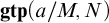 $ \textbf {gtp} (a/M,N)$
has the extension property.
Now we define the w*-good
 $\lambda $
-frame.
Definition 3.12. The preframe
 $\mathfrak s_{\lambda -unq}$
is defined such that:
-
(1)
$S^{bs}(M):=\{p=\textbf {gtp}(a/M,N)\mid p \text { has the extension property}\}$
. -
(2)
$p=\textbf {gtp}(a/M,N)\in S^{bs}(M)$
does not fork over
$M_0\leq _K M$
if
$p\restriction _{M_0}$
is
$\lambda $
-unique.


Lemma 3.13.
 $S^{\lambda -al}(M):=\{p\in gS(M)\mid p\text { has }\leq \lambda \text {-many realizations}\}$
satisfies
 $|S^{\lambda -al}(M)|\leq \lambda $
. By realizations we mean realizations in any
 $\leq _K$
-extension of M in
 $K_{\lambda ^+}$
. So
 $\mathfrak s_{\lambda -unq}$
satisfies (Few Non-Basic Types).
Proof. Suppose not, i.e.,
 $|S^{\lambda -al}(M)|\geq \lambda ^+$
.
Claim. There is no
 $\Gamma \subseteq S^{\lambda -al}(M)$
,
 $|\Gamma |\leq \lambda $
that is inevitable.
Otherwise, suppose there exists such
 $\Gamma $
. By Fact 2.31, taking
 $S_*$
to be
 $gS$
, and
 $\Gamma _M$
to be
 $\Gamma $
, we have
 $|gS(M)|\leq \lambda $
, so in particular
 $|S^{\lambda -al}(M)|\leq \lambda $
, contradiction.
Now by the claim and Fact 2.30, taking
 $S_*$
there to be
 $S^{\lambda -al}$
and
 $\mu $
there to be
 $\lambda ^+$
, we have
 $I(\lambda ^+,K)=2^{\lambda ^+}$
, contradiction.
Thus from now on in this section we also assume
 $|S^{\lambda -al}(M)|\leq \lambda $
.
Lemma 3.14.
 $\mathfrak s_{\lambda -unq}$
satisfies the following properties in Definitions 3.1–3.3:
-
(1) (Invariance).
-
(2) (Monotonicity).
-
(3) (Non-Forking Types are Basic).
-
(4) AP, JEP, and NMM.
-
(5) (Basic NIP).
-
(6) (Uniqueness).
-
(7) (Transitivity).
Proof. Easy. We prove (Transitivity) as an example. Suppose
 $p\in S^{bs}(N)$
does not fork over
 $M_1\leq _K N$
, and
 $p\restriction _{M_1}$
does not fork over
 $M_0\leq _K M_1$
. Then
 $(p\restriction _{M_1})\restriction _{M_0}$
is
 $\lambda $
-unique, i.e.,
 $p\restriction _{M_0}$
is. Thus p does not fork over
 $M_0$
.
The following property is essential for the next lemma.
Definition 3.15. A type family
 $S_*$
is
 $\lambda $
-compact if for every limit ordinal
 $\delta <\lambda ^+$
, for every
 $\langle M_i\in K_\lambda : i<\delta \rangle $
an increasing continuous chain and for every coherent sequence of types
 $\langle p_i\in S_*(M_i): i<\delta \rangle $
, there is an upper bound
 $p_\delta \in S_*(\bigcup _{i < \delta } M_i)$
to the sequence such that
 $\langle p_i\in S_*(M_i): i<\delta +1 \rangle $
is a coherent sequence.
For certain results in this article we need to assume that the basic types (i.e., those with the extension property) is
 $\lambda $
-compact, which, for example, holds for AECs with the disjoint AP,Footnote
6
where every type has the extension property. Many classes of modules have the disjoint AP (see [Reference Mazari-Armida and Rosicky16, Remark 2.10] and [Reference Baldwin, Eklof and Trlifaj2, Remark 2.2]). Also, this assumption also holds in quasiminimal AECs [Reference Vasey31, Definition 4.1], where there is at most one non-algebraic type.Footnote
7
Lemma 3.16 (
$\text {ded } \lambda =\lambda ^+<2^\lambda $
).

Suppose that
 $S^{bs}$
is
 $\lambda $
-compact. If
 $p\in S^{bs}(M)$
, then there is
 $N\geq _K M$
and
 $q\in S^{bs}(N)$
extending p that does not fork over N. In particular, for any
 $N'\geq _K N$
there is unique
 $q'\in gS(N')$
extending q that does not fork over N.
Proof. It suffices to show that there is a
 $\lambda $
-unique type above any basic type. By Fact 2.20 let
 $\mathfrak C\in K_{\lambda ^+}$
be saturated in
 $\lambda ^+$
over
 $\lambda $
. It is also homogeneous in
 $\lambda ^+$
over
 $\lambda $
by Fact 2.13. Let
 $(a,M,N)\in K^3_\lambda $
such that
 $\textbf {gtp}(a/M,N)$
has the extension property and there is no
 $\lambda $
-unique type above
 $\textbf {gtp}(a/M,N)$
. Build
 $(a_\eta ,M_\eta ,N_\eta )\in K^3_\lambda $
for
 $\eta \in {}^{<\lambda }2$
and
 $h_{\eta ,\nu }$
for
 $\eta <\nu \in {}^{<\lambda }2$
such that:
-
(1)
$(a_{\langle \rangle },M_{\langle \rangle },N_{\langle \rangle })=(a,M,N)$
. -
(2)
$(a_\eta ,M_\eta ,N_\eta )\leq _{h_{\eta ,\nu }} (a_\nu ,M_\nu ,N_\nu )$
for
$\eta < \nu $
. -
(3)
$h_{\eta ,\rho }=h_{\nu ,\rho }\circ h_{\eta ,\nu }$
for
$\eta <\nu <\rho $
. -
(4)
, , and . -
(5)
, both having
$\lambda ^+$
-many realizations. -
(6) If
$\eta \in {}^\delta 2$
for
$\delta $
a limit ordinal, take
$M_\eta $
and
$N_\eta $
to be directed colimits.


 ,
 , and
 .
 , both having


Construction: Base case and limit case are clear. At successor stage use non-
 $\lambda $
-uniqueness to get two distinct extensions, each having
 $\lambda ^+$
-many realizations.
Enough: Let
 $M\leq _K \mathfrak C\in K_{\lambda ^+}$
be saturated over
 $\lambda $
. Build
 $g_\eta :M_\eta \to \mathfrak C$
for
 $\eta \in {}^{\leq \lambda } 2$
such that:
-
(1)
$g_\eta \circ h_{\eta ,\nu }=g_\nu $
for
$\nu < \eta $
. -
(2)
.


 .
Sub-Construction: We carry out the construction by induction on the
 $\ell (\eta )$
, the length of
 $\eta $
. For the base case take
 $g_{\langle \rangle }$
to be inclusion
 $M\leq _K \mathfrak C$
. At limit use the universal property of
 $M_\eta $
as a directed colimit. For the successor case, for
 $\eta $
of length
 $\alpha =\beta +1$
, suppose we have
 $g_\eta $
.

Use basic extension to obtain the right square and g, and then obtain the middle square and h. Finally the left triangle is by saturation of
 $\mathfrak C$
. Now define
 to be the composition of the top row from right to left.
Sub-construction is enough: For each branch
 $\eta \in {}^{\lambda }2$
, take directed colimit to obtain
 $(a_\eta ,M_\eta ,N_\eta )$
. Obtain
 $f_\eta :M_\eta \to \mathfrak C$
by the universal property of colimits such that
 $f_\eta \circ h_{\nu ,\eta }=g_\nu $
for all
 $\nu <\eta $
, and obtain
 $f^{\prime }_\eta :N_\eta \to \mathfrak C$
extending
 $f_\eta $
by saturation over
 $\lambda $
. Since each
 $f^{\prime }_\eta (a_\eta )\in |\mathfrak C|$
, but
 $\|\mathfrak C\|=\text {ded } \lambda <2^\lambda $
, there must be
 $\eta \neq \nu \in {}^\lambda 2$
such that
 $f^{\prime }_\eta (a_\eta )=f^{\prime }_\nu (a_\nu )$
. Let
 $\alpha <\lambda $
be the least such that
 $\eta (\alpha )\neq \nu (\alpha )$
. Without loss of generality say
 $\eta (\alpha )=0$
and
 $\nu (\alpha )=1$
. Then the following diagram commutes:

with  since
 $f^{\prime }_\eta (a_\eta )=f^{\prime }_\nu (a_\nu )$
, contradicting requirement (5) of the construction.
Remark 3.17. The proof of Lemma 3.16 is along the argument of Mazari-Armida in [Reference Mazari-Armida15, 4.13] and [Reference Shelah27, VI.2.25], and the difference is that there the saturated model over
 $\lambda $
lies in
 $K_{\lambda ^{++}}$
. For completeness we included all the details.
Question 3.18. Lemma 3.16 is a weaker form of (Existence of Non-Forking Extension). Is it possible to obtain (Existence of Non-Forking Extension) in its full strength, by perhaps considering another family of basic types and non-forking relation? One could imitate the w-good
 $\lambda $
-frame in [Reference Mazari-Armida15] and use
 $\lambda $
-unique types as basic ones, and then Lemma 3.16 gives a proof of (Weak Density). However, then it is hard to show that having such a frame implies NIP.
The following definition is [Reference Shelah22, Definition 1.8], which is defined for types of any finite length. Here we only need it for length
 $1$
. Thus we use the version from [Reference Baldwin1, Definition 11.4(1)].
Definition 3.19.
-
(1) K is
$(\kappa ,\lambda )$
-local if for every increasing continuous chain
$M=\bigcup _{i<\kappa }M_i$
with
$\|M\|=\lambda $
and for any
$p,q\in gS(M)$
: if
$p\restriction _{M_i}=q\restriction _{M_i}$
for all i then
$p=q$
. -
(2) K is
$(< \kappa , \lambda )$
-local if K is
$(\mu ,\lambda )$
-local for all
$\mu <\kappa $
.





Lemma 3.20. If K is
 $(<\lambda ^+,\lambda )$
-local, then
 $\mathfrak s_{\lambda -unq}$
has (Continuity).
Proof. Let
 $M_i$
,
 $i<\delta $
be increasing continuous.
 $p_i\in S^{bs}(M_i)$
increasing and for
 $i<j<\delta $
we have
 $p_j\restriction _{M_i}=p_i$
, all non-forking over
 $M_0$
and
 $p_\delta $
upper bound. Suppose
 $p_\delta $
has
 $\leq \lambda $
-many realizations. Then there is a set S of cardinality
 $\lambda ^+$
of realizations of
 $p_0$
, such that for each
 $a\in S$
, by locality there is
 $i< \delta $
such that a realizes
 $p_i$
but not
 $p_{i+1}$
. By pigeonhole principle for some
 $i<\delta $
there are
 $\lambda ^+$
-many realizations of
 $p_i$
that are not realizations of
 $p_{i+1}$
. Since there are
 $\leq \lambda $
-many types in
 $S(M_{i+1})$
that have
 $\leq \lambda $
-many realizations, there must be another type in
 $S(M_{i+1})$
with
 $\lambda ^+$
realizations distinct from
 $p_{i+1}$
, which contradicts
 $\lambda $
-uniqueness of
 $p_{i+1}$
.
For the moreover part, if
 $p_0$
does not fork over
 $M_0$
, so
 $p_0=p_\delta \restriction _{M_0}$
is
 $\lambda $
-unique, i.e.,
 $p_\delta $
does not fork over
 $M_0$
.
Theorem 3.21 (
$2^{\lambda ^+}>2^\lambda $
).

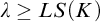
Let K be an AEC categorical in
 $\lambda \geq LS(K)$
, and
 $1\leq I(\lambda ^+,K)<2^{\lambda ^+}$
.
 $K_\lambda $
has NIP if and only if there is a w*-good
 $\lambda $
-frame on K except possibly without (Continuity). Moreover,
-
(1) (
$\text {ded } \lambda =\lambda ^+<2^\lambda $
) If
$\mathfrak s_{\lambda -unq}$
is
$\lambda $
-compact, then the w*-good frame satisfies in addition that if
$p\in S^{bs}(M)$
, then there is
$N\geq _K M$
and
$q\in S^{bs}(N)$
extending p that does not fork over N. In particular, for any
$N'\geq _K N$
there is
$q'\in gS(N')$
extending q that does not fork over N. -
(2) If K is
$(<\lambda ^+,\lambda )$
-local, then
$\mathfrak s_{\lambda -unq}$
has (Continuity).


Proof. The moreover part follows from Lemma 3.16.
Question 3.22. Are there other positive consequences of NIP that rely on weaker assumptions?
4 Syntactic independence property
In this section we assume tameness, and use Galois Morleyization to show that the negation of NIP leads to being able to encode subsets, as a parallel of first order independence property.
Hypothesis 4.1. Let
 $\kappa $
be an infinite cardinal and K an AEC. Let
 $\tau =L(K)$
be its underlying language.
We first extend the definition of Galois types to longer lengths and set-valued domains.
Definition 4.2.
-
(1)
$K^3:=\{(\bar a,A,N)\mid N\in K, A\subseteq |N|, \bar a\text { is a sequence from }|N|\}$
. -
(2) For
$(\bar a_0,A,N_0), (\bar a_1,A,N_1)\in K^3$
,
$(\bar a_0,A,N_0) E_{at}(\bar a_1,A,N_1)$
if there are
$N\in K$
,
$f_0:N_0\to _A N$
, and
$f_1:N_1\to _A N K$
-embeddings such that
$f_0(\bar a_0)=f_1(\bar a_1)$
,
$f_0\restriction _A=f_1\restriction _A$
. -
(3) E is the transitive closure of
$E_{at}$
. -
(4) For
$(\bar a,A,N)\in K^3$
, the Galois type of
$\bar a$
over A in N is
$\textbf {gtp}(\bar a/A,N):=[(\bar a,A,N)]_{E}$
. -
(5) For
$N\in K$
and
$A\subseteq |N|$
,
$\alpha $
an ordinal or
$\infty $
,
$gS^{<\alpha }(A;N):=\{\textbf {gtp}(\bar a/A,N)\mid (\bar a,A,N)\in K^3 \text { and }\bar a\in {}^{<\alpha } |N|\}$
.
$gS^{\alpha }(A;N)$
is defined similarly.


Remark 4.3. In the case where
 $A=|M|$
for
 $M\in K$
,
 $\bigcup _{N\geq _K M} gS^1(|M|, N)$
is what we defined as
 $gS(M)$
in Definition 2.5.
The following technique first appeared in [Reference Vasey30], which allows one to work with Galois types in a syntactic way.
Definition 4.4. Let
 $\kappa $
be an infinite cardinal and K an AEC. The
 $(<\kappa )$
-Galois Morleyization of K is
 $\hat K$
, an AEC (except that the language might not be finitary) in a (
 $<\kappa )$
-ary language
 $\hat \tau $
extending
 $\tau $
such that:
-
(1) The structures and the substructure relation
$\leq _{\hat K}$
in
$\hat K$
are the same as K. -
(2) For each
$p\in gS^{<\kappa }(\emptyset )$
, there is a predicate of the same length
$R_p\in \hat \tau $
. For each
$M\in K$
and
$\bar a\in |M|$
, define
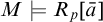
$M\models R_p[\bar a]$
if and only if
$\textbf {gtp}(\bar a/\emptyset , M)=p.$
By extension, one can interpret quantifier-free
$L_{\kappa ,\kappa }(\hat \tau )$
formulas. -
(3) The
$(<\kappa )$
-syntactic type of
$\bar a\in ^{<\kappa } |M|$
over
$A\subseteq |M|$
is
$\textbf {tp}_{\text {qf-} L_{\kappa ,\kappa }(\hat \tau )}(\bar a/A,M)$
, the set of all quantifier-free
$L_{\kappa ,\kappa }(\hat \tau )$
formulas with parameters from A that
$\bar a$
satisfies. For a particular quantifier-free
$L_{\kappa ,\kappa }(\hat \tau )$
-formula
$\phi (\bar x,\bar y)$
,
$$ \begin{align*}\textbf {tp}_\phi (\bar b/A,M):=\{\phi (\bar x,\bar a)\mid \bar a\in A, M\models \phi (\bar b,\bar a)\}.\end{align*} $$
-
(4) For
$M\in K$
and
$A\subseteq |M|$
,
$S^{<\alpha }_{\text {qf}-L_{\kappa ,\kappa }(\hat \tau )}(A;M):=\{\textbf {tp}_{\text {qf-} L_{\kappa ,\kappa }(\hat \tau )}(\bar b/A, M)\mid \bar b\in {}^{<\alpha }|M|\}$
.





Remark 4.5. There are
 $\leq 2^{<(LS(K)^++\kappa )}$
formulas in
 $\hat \tau $
.
Definition 4.6. For a theory T in first order logic, and
 $\Gamma $
a set of T-types,
 $\tau $
a language contained in the language of T, let
 $EC(T,\Gamma )$
denote the class of models of T omitting all types in
 $\Gamma $
. Let
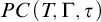 $PC(T,\Gamma ,\tau )$
denote the class of models of T omitting all types in
 $\Gamma $
as
 $\tau $
-structures.
Fact 4.7 [Reference Vasey30, Corollary 3.18(2)].
Under the notation of the previous definition, K is
 $(<\kappa )$
-tame if and only if for each ordinal
 $\alpha $
,
 $M\in K$
,
 $A\subseteq M$
,
 $\textbf {gtp}(\bar b/A,M)\mapsto \textbf {tp}_{\text {qf-} L_{\kappa ,\kappa }(\hat \tau )}(\bar b/A,M)$
from
 $gS^\alpha (A;M)$
to
 $S^\alpha _{\text {qf}-L_{\kappa ,\kappa }(\hat \tau )}(A;M)$
is bijective.
Notation 4.8. For any formula
 $\varphi $
and a condition i,
 $\varphi ^i$
means
 $\varphi $
itself when i holds, and
 $\neg \varphi $
otherwise. For example, at the end of the proof of the next theorem, the formula is
 $\phi (c_i,x)$
and the condition is
 $i\in w$
. When
 $i\in w$
holds,
 $\phi (c_i,x)^{i\in w}$
is
 $\phi (c_i,x)$
. When
 $i\notin w$
,
 $\phi (c_i,x)^{i\in w}$
is
 $\neg \phi (c_i,x)$
.
Theorem 4.9. Suppose K is
 $(<\aleph _0)$
-tame,
 $M\in K$
,
 $C\subseteq |M|$
,
 $\lambda :=|C|\geq \beth _3(LS(K))$
and
 $(\text {ded } \lambda )^{2^{LS(K)}}= \text {ded } \lambda $
. Suppose
 $|gS^1(C;M)|>\text {ded } \lambda $
. Then there is
 $N\in K$
,
 $\langle \bar a_n\in ^m |N|\mid n<\omega \rangle $
and
 $\phi $
in the language of Galois Morleyization such that for every
 $w\subseteq \omega $
there is
 $b_w\in |N|$
such that for all
 $i<\omega $
,
 $$ \begin{align*}N\models \phi(\bar a_i,b_w) \iff i\in w. \end{align*} $$
Proof. Let
 $\hat K$
be the
 $(<\aleph _0)$
Galois Morleyization of K. Note that both classes have the same Galois types. By Shelah’s Presentation Theorem
 $\hat K=PC(T,\Gamma , \hat \tau )$
with
 $|T|\leq 2^{LS(K)}$
, with the language of T containing
 $\hat \tau $
. Then by tameness and the previous fact
 $|S^{1}_{\text {qf}-L_{\omega ,\omega }(\hat \tau )}(C;M)|>\text {ded } \lambda $
, so for some quantifier-free formula
 $\phi (\bar y,x)$
in
 $ L_{\omega ,\omega }(\hat \tau )$
with
 $|S_\phi (C;M)|> \text {ded } \lambda $
, since there are
 $\leq 2^{LS(K)}$
-many quantifier-free
 $L_{\omega ,\omega }(\hat \tau )$
-formulas.
Without loss of generality
 $C=\lambda =|C|$
. Let
 $\mu :=(\text {ded } \lambda )^+$
. For notational simplicity we view
 $S_{\phi }(C; M)$
as S, a family of subsets of
 $ ^{\ell (\bar y)}C$
, where
 $$ \begin{align*}A\in S\iff \{\phi(\bar a, x)\mid \bar a\in A\}\in S_\phi(C;M). \end{align*} $$
We also assume
 $\bar y$
has length
 $1$
. The proof for other cases is similar.
Claim. For all
 $\alpha <\lambda $
, if
 $|\{A\cap \alpha \mid A\in S\}|\geq \mu $
, then
 $\alpha \geq (\beth _2(LS(K)))^+$
.
Proof of Claim.
Suppose there is
 $\alpha < \lambda $
,
 $|\{A\cap \alpha \mid A\in S\}|\geq \mu $
. Since
 $\{A\cap \alpha \mid A\in S\}$
is the set of branches of the a subtree of
 $^{<\alpha }2$
,
 $\text {ded } \lambda < \mu \leq \text {ded } |^{<\alpha } 2|\leq \text {ded } 2^{|\alpha |}$
, so
 $2^{|\alpha |}>\lambda \geq \beth _3(LS(K))$
, so
 $|\alpha |> \beth _2(LS(K))$
. Thus the claim holds.
We may assume
 $\lambda> \beth _2(LS(K))$
and for all
 $\alpha <\lambda $
,
 $|\{A\cap \alpha \mid A\in S\}|<\mu $
. If this holds, then we are done since
 $\lambda \geq \beth _3(LS(K))>\beth _2(LS(K))$
. If not, replace
 $\lambda $
with smallest
 $\alpha <\lambda $
such that
 $|\{A\cap \alpha \mid A\in S\}|\geq \mu .$
By minimality for all
 $\beta <\alpha $
,
 $|\{A\cap \beta \mid A\in S\}|<\mu $
. Such
 $\alpha $
might be small, but by the claim
 $\alpha \geq (\beth _2(LS(K)))^+,$
and this is enough for the rest of the argument.
For each
 $\alpha \leq \lambda $
let
 $S^0_\alpha :=\{\langle A\cap \alpha ,\alpha \rangle \mid A\in S\}$
.
 $\bigcup _{\alpha <\lambda } S^0_{\alpha }$
is a tree when equipped with
 $$ \begin{align*}(A_1,\alpha_1)\leq (A_2,\alpha_2) \iff \alpha_1\leq \alpha_2 \land A_1=A_2\cap \alpha_1. \end{align*} $$
Let
 $$ \begin{align*}S^1_\alpha:=\{s\in S^0_\alpha\mid |\{t\in S^0_\alpha\mid s\leq t\}|\geq \mu\}, \end{align*} $$
and
 $$ \begin{align*}S^1_\lambda:=\{s\in S^0_\lambda\mid \forall \alpha<\lambda( s\restriction_\alpha\in S^1_\alpha)\}. \end{align*} $$
We build
-
(1) for
$n<\omega $
,
$S_n\subseteq S^1_\lambda $
, and -
(2) for each
$(B,i)$
such that
$B\subseteq A$
for some
$(A,\lambda )\in S_n$
and
$i<\lambda $
,-
(a)
$\lambda>\alpha ^{B}_i(n,0)>\ldots >\alpha ^{B}_i(n,n-1)>i$
, a sequence of ordinals, -
(b)
$(D^{(B,i)}_{u,n},\lambda )\in S^1_\lambda $
for each
$u\subseteq n$
, and
-
-
(3)
$p_n\in S^{n+2^n}_T(\emptyset )$
for
$n<\omega $
,


such that:
-
(1)
$S_0=S^1_\lambda $
; -
(2)
$|S_n|\geq \mu \geq (\beth _2(LS(K)))^+$
for all n; -
(3)
$S_{n+1}\subseteq S_n$
for all n; -
(4) the variables of
$p_n$
are
$x_i$
for
$i<n$
ordered naturally and
$y_S$
for
$S\subseteq n$
; -
(5)
$p_n\subseteq p_{n+1}$
for all n. This means the
$p_{n+1}$
restricted to
$x_i$
for
$i<n$
and
$y_S$
for
$S\subseteq n$
is equal to
$p_n$
; -
(6) for all
$n<m$
,
$(A,\lambda )\in S_n$
and
$(B,\lambda )\in S_m$
,
$i,j\in \lambda $
-
(7) for all
$(A,i)\in S_n$
and
$w\subseteq n$
,
$(A,i)\leq (D^{(A,i)}_{w,n},\lambda )$
and
$\alpha ^A_i(n,i)\in D^{(A,i)}_{w,n}\iff i\in w$
.


Construction: We build these objects by induction on n. When
 $n=0$
let
 $D^{(\emptyset ,0)}_{\emptyset ,0}$
be any element in
 $S^1_\lambda $
. Assume we have built
 $S_n$
,
 $\alpha ^{A\cap i}_i(n,j)$
for
 $(A,\lambda )\in S_n$
and
 $p_n$
.
Fix
 $s=(A,i)$
for
 $i<\lambda $
such that for some B,
 $A\subseteq B$
and
 $(B,\lambda )\in S_n$
. Clearly
 $T_s:=\{t\in \bigcup _{\beta <\lambda } S^1_\beta \mid s\leq t$
and t extends to an element in
 $S_n\}$
is a tree. For every
 $s\leq t\in S_n$
,
 $B_t:=\{t^*\mid s\leq t^*\leq t\}$
is a branch of
 $T_s$
, and
 $t_1\neq t_2\implies B_{t_1}\neq B_{t_2}$
. Since
 $$ \begin{align*}|S^0_\lambda-S^1_\lambda|=|\bigcup_{\alpha<\lambda, s\in S^0_\alpha-S^1_\alpha}\{t\in S^0_\lambda\mid s\leq t\}|<\mu,\end{align*} $$
 $T_s$
has
 $\geq \mu $
-many branches, and hence
 $|T_s|>\lambda $
. Then for some
 $i'$
,
 $|T_s\cap S^1_{i'}|>\lambda $
. Let
 $s_{ j}=(A_{j}, i')\in T_s\cap S^1_{i'}$
for
 $j<\lambda ^+$
. Since there are
 $\leq \lambda $
finite tuples of ordinals
 $<\lambda $
, we may assume
 $\alpha _{i'}^{A_j}$
are the same for all j. Now let
 $\alpha ^A_i(n+1,k):=\alpha ^{A_j}_{i'}(n, k)$
for all
 $k<n$
. Let
 $\alpha ^A_i(n+1,n)$
be the least
 $\alpha $
such that
 $s_{0}(\alpha )\neq s_{1}(\alpha )$
, i.e.,
 $\alpha \in A_0-A_1$
or
 $\alpha \in A_1-A_0$
. Without loss of generality assume the latter case. For
 $w\subseteq (n+1)$
, let
 $D^{(A,i)}_{w,n+1}:=D^{(A_0,i')}_{w,n}$
if
 $n\notin w$
and
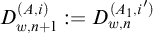 $D^{(A,i)}_{w,n+1}:=D^{(A_1,i')}_{w,n}$
if
 $n\in w$
.
Note that
 $i<\alpha ^A_i(n+1,n)<i'<\alpha ^A_i(n+1,n-1)<\ldots <\alpha ^A_i(n+1,0)$
. Since
 $|S_n|\geq (\beth _2(LS(K)))^+$
, and there are
 $\leq \beth _2(LS(K)) T$
-types, by the pigeonhole principle there is
 $S_{n+1}\subseteq S_n$
,
 $|S_{n+1}|\geq (\beth _2(LS(K)))^+$
such that for all
 $(A,i)$
,
 $ (B,j)\in S_{n+1}$
,

is the same, and define this type to be
 $p_{n+1}$
. This finishes the construction. Note that here since
 $D^{(A,i)}_{w,n+1}$
is an element of
 $S^1_\lambda \subseteq S^0_\lambda =S$
, i.e. a
 $\phi $
-type, the “T-type” of
 $D^{(A,i)}_{w,n+1}$
is just the T-type of a realization of it, which can be fixed at the beginning of the proof.

is consistent, and by Morley’s method we are done.
Similar to the order property, this analogue of the independence property for AECs also has a Hanf number
 $\beth _{(2^{LS(K)})^+}$
.
Theorem 4.10. If K can encode subsets of
 $\mu :=\beth _{(2^{LS(K)})^+}$
, then it can encode subsets of any cardinal. That is, if there are
 $M\in K$
,
 $\{a_i\mid i<\mu \}\subseteq |M|$
,
 $\{b_w\mid w\subseteq \mu \}\subseteq |M|$
such that for all
 $w\subseteq \mu $
,
 $$ \begin{align*}i\in w\iff \phi(a_i,b_w),\end{align*} $$
then we can replace
 $\mu $
above by any cardinal.
Proof. We fix
 $\hat K$
and
 $\phi $
as in the proof of the previous theorem. Let
 $\lambda =(2^{LS(K)})^+$
. Suppose K can encode subsets of
 $\mu :=\beth _{(2^{LS(K)})^+}$
. That is, there are
 $M\in K$
,
 $\{a_i\mid i<\mu \}\subseteq |M|$
,
 $\{b_w\mid w\subseteq \mu \}\subseteq |M|$
such that for all
 $w\subseteq \mu $
,
 $$ \begin{align*}i\in w\iff \phi(a_i,b_w).\end{align*} $$
For each
 $i_0<\ldots <i_{n-1}<\mu $
and
 $u\subseteq n$
, choose some subset
 $w\subseteq \mu $
such that
 $i_j\in w \iff \phi (a_{i_j},b_w)\iff j\in u$
, and let
 $b_{u,n}^{i_0,\ldots ,i_{n-1}}:=b_w$
. We build
 $\langle F_n\subseteq \mu \mid n<\omega \rangle $
,
 $\langle X_{\xi ,n}\subseteq \mu \mid \xi \in F_n, n<\omega \rangle $
and
 $p_n\in S^{n+2^n}_T(\emptyset )$
such that:
-
(1) for all
$n<\omega $
,
$|F_n|=\lambda $
; -
(2)
$|X_{\xi ,n}|>\beth _\beta (2^{LS(K)})$
when
$\xi $
is the
$\beta $
-th element of
$F_n$
; -
(3)
.


 .
Let
 $F_0=\lambda $
and
 $X_{\xi ,0}:=\mu $
for all
 $\xi $
. Suppose we have constructed everything for stage n. Fix
 $g:\lambda \to F_n$
an increasing enumeration. Let
 $G_n:=\{g(\beta +n+1)\mid \beta <\lambda \}$
. For each
 $\xi =g(\beta +n+1)\in G_n$
, consider the map
 from
 $[X_{\xi ,n}]^{n+1}$
(increasing
 $(n+1)$
-tuples from
 $X_{\xi ,n}$
) to
 $S_T^{n+2^n}(\emptyset )$
. Since
 $|X_{\xi ,n}|>\beth _{\beta +n+1}((2^{LS(K)})^+)$
, by the Erdős–Rado theorem, there is a monochromatic subset
 $X_{\xi , n+1}\subseteq X_{\xi ,n}$
such that
 $|X_{\xi ,n+1}|>\beth _\beta ((2^{LS(K)})^+)$
. That is, there is a type
 $p_{\xi ,n+1}$
such that for all
 $i_0<\ldots <i_n$
,
 . By the pigeonhole principle there is
 $F_{n+1}\subseteq G_n$
of cardinality
 $\lambda $
and
 $p_{n+1}$
such that for all
 $\xi \in F_{n+1}$
,
 $p_{\xi ,n+1}=p_{n+1}$
.
Then

is consistent for any cardinal
 $\kappa $
. By Morley’s method we are done.
Lemma 4.11 (Morley’s method).
Let T be a first order theory with built-in Skolem functions and
 $\Gamma $
a set of T-types. Let
 $\langle c_i\mid i<\alpha \rangle $
be new constants. Let
 $p_{S}$
be a T-type in
 $|S|$
variables for every finite subset S of
 $\alpha $
, and
 $T^*$
a theory not containing any of the new constants such that:
-
(1)
$T^*\supseteq T\cup \{p_S(\langle c_{\gamma }\mid \gamma \in S \rangle ) \mid S\subseteq \alpha \text { finite}\}$
is consistent; -
(2) each
$p_S$
is realized in some
$M\in EC(T,\Gamma )$
.


Then there is
 $N\in EC(T^*, \Gamma )$
.
Proof. Let M be a model of
 $T^*$
and without loss of generality
 $M=EM(\{c_i\mid i<\alpha \})$
. We show that M omits all types from
 $\Gamma $
. Suppose not, i.e.,
 $a\in |M|$
realizes some
 $q\in \Gamma $
. Write a as
 $\tau ^M(c_{i_0},\ldots , c_{i_k})$
for some term
 $\tau $
in the language of T. Let
 $S:=\{c^M_{i_0},\ldots , c^M_{i_k}\}$
and
 $\langle b_0,\ldots , b_k\rangle \subseteq N^*\in EC(T,\Gamma )$
realizing
 $p_S$
. Then for some
 $\varphi (y)\in q$
,
 $N^*\models \neg \varphi (\tau (b_0,\ldots ,b_k))$
. As
 $p_S$
is complete,
 $\neg \varphi (\tau (x_0,\ldots ,x_k))\in p_S$
. Thus
 $M\not \models \varphi (\tau (c_{i_0},\ldots ,c_{i_k}))$
, i.e.,
 $M\models \neg \varphi (a)$
, so a does not realize q.
Acknowledgments
This article was written while working on a Ph.D. thesis under the direction of Rami Grossberg at Carnegie Mellon University, and I would like to thank Professor Grossberg for his guidance and assistance in my research in general and in this work specifically. I would also like to thank Jeremy Beard for checking the proofs and John Baldwin, Jeremy Beard, Will Boney, Artem Chernikov, James Cummings, Samson Leung, Marcos Mazari-Armida, Pedro Marun, and Andrés Villaveces for their help, comments, and suggestions. I would like to thank the referee for many insightful comments and suggestions, and raising Questions 2.19, 2.23, and 3.22.



