In a 1905 issue of the Quarterly Review, American essayist Edward Wright published what was to become a seminal article entitled “The Romance of the Outlands.”Footnote 1 In it, he described an emerging genre in Anglophone literature that mythologized the imperial reach of western civilization. In their article on Wright's essay, Richard Maxwell and Katie Trumpener argue that the turn-of-the-century explosion of “exotic romances” identified by Wright—work by authors such as Joseph Conrad, Jack London, and Lafcadio Hearn—was not confined to the English-language context, but was also evident in “a similar wave of frontier romances” elsewhere in Europe that included several “influential [Soviet] frontier narratives,” such as Vsevolod Pudovkin's 1928 Storm over Asia and Viktor Turin's 1929 Turksib, “heroic films about the Sovietization of Central Asia.”Footnote 2 Maxwell and Trumpener's passing comment is striking because “frontier romances,” or what might be identified as “Soviet Westerns,” have not been a broadly-demarcated genre in early Soviet culture. Further, Turksib has not traditionally been treated in this category, but rather as an example of the kul΄turfil΄m, or staged documentary, which was promoted in official circles in the 1920s.Footnote 3 Some recent scholarly attention has been paid to the phenomenon of Soviet or “Red” Westerns, but the emphasis has been on what scholars such as Sergei Lavrent΄ev identify as the heyday of the genre, the 1960s and 70s.Footnote 4
In this discussion, I propose to borrow Lavrent΄ev's term and read Turksib as a “Red Western,” or as a film that is indebted to an American cinematic, visual, and literary tradition in its production of a vision of a Soviet frontier. While it is cast in the mold of a kul΄turfil΄m, the movie transcends this genre in significant ways to become a visual and narrative example of a discourse that I call frontierority, one that proved to be central to the articulation of Soviet identity in the 1920s and early 1930s. Drawing from prerevolutionary cultural paradigms for Russian national and imperial growth, as well as from a key American myth of the train's role in vanquishing the frontier (valorized in Hollywood and elsewhere), Turksib is a film meant to realize notions of territorial largesse in an ideologically acceptable manner—that is, to reconfigure the imperialist-capitalist model of the frontier in socialist terms. Turin's film is one of several early Soviet movies that dramatize a socialist frontier, including Storm over Asia and Aerograd; films such as these reveal the challenge of distinguishing expansion, industrialization, and modernization in socialist rather than capitalist—and in avowedly anti-imperial rather than colonial—terms.Footnote 5
Turksib tells the story of the completion of the Turkestan-Siberia railroad between 1926 and 1931: the laying of 1,445 km of track from Tashkent to Semipalatinsk with the aim of transporting Siberian grain to Turkestan so that cotton could be produced there instead. In doing so, Turksib produces a Soviet frontier imaginary in a similar way to the American subgenre of the railroad western, the most prominent and pertinent example of which in the 1920s was John Ford's early classic, The Iron Horse (1924).Footnote 6 Ford's film tells a “national story” of expansion across a continent via construction of the Transcontinental Railroad. Less a story of a lone hero facing great odds or injustice (as Westerns are often imagined, especially in their late twentieth-century iteration), The Iron Horse is an example of the Western as an epic of collective, technological nation-building. This form answered to a perceived need in the Soviet context for narrative and visual realizations of a similar kind of national-imperial story.Footnote 7 While Ford's film may initially seem an unlikely comparison for Turksib, western scholars and film reviewers have consistently articulated a connection between The Iron Horse and Turksib since the latter's appearance, as I discuss below.Footnote 8 There has been, however, no close examination of the striking parallels between these films, despite the fact that the comparison reveals key points about the vision of a socialist frontier in Turin's film. Reading Turin's film against Ford's, this paper shows how the socialist frontier is imagined as both a borrowing from and an inversion of critical aspects of an American frontier mythology.
This paper examines the rhetoric of frontieriority, as defined below, both generally and in its particular expression in the Russian and Soviet context. I focus on the ways in which Turksib engages with a rhetoric of frontier nation building found in The Iron Horse; in so doing, I uncover how Turin's film projects a vision of the Soviet frontier as a site of awakening, spontaneous collectivity, epic labor, technological sublimity, and, perhaps most importantly, a space where violence and the threat of indigenous extinction have been transcended.
The Frontier Mythos
I use the term frontieriority to denote the symbolic, mythological discourse generated by the perceived existence of a contiguous imperial periphery in certain western and European cultures in the nineteenth and twentieth centuries. While this discourse is in part shaped by the geopolitical realities of cultural and territorial expansion, it is at heart a mythological mode, a means of representing these same geopolitical realities in ideologically appealing terms to tell a motivational national-imperial story. The discourse of frontieriority places rhetorical emphasis on newness; a struggle with nature; triumph over a primitive past; a vision of an idealized future civilization; and the contestation of territory and violence.Footnote 9 It also places emphasis on identity itself, for the frontier is understood to mark the outer edge of the self, the nation, the empire—and this outer edge is precisely the point at which an entity comes to know itself through contact with an “other.” It is at the limits and edges that identity is made, even identities based on the very notions of expansion and outer limits.Footnote 10 In his once influential thesis, Frederick Jackson Turner argued that it was the perceived existence of a frontier—more than its concrete reality—that inspired the spontaneous production of democratic society in America.Footnote 11 In Turner's model, the frontier is understood to be where the nation regenerates or produces itself in its most pure form. The idea that this regeneration is brought about by the violence inherent to the frontier zone came to be a “structuring metaphor of the American experience.”Footnote 12 In film, literature, and art, the genre of the Western crystallized around the symbolic idea of the frontier, such that it came to be understood as the embodiment of the national story.Footnote 13
Scholars of Russian history have shown that notions about the connection between the frontier and the character of the nation were at work in the Russian context as well, though not necessarily in the same terms.Footnote 14 As Willard Sunderland notes, there was a long tradition of comparing Russian eastward expansion with the American example:
In Russian colonizing discourse, Russian steppes were compared to American prairies; Russian colonists were depicted as pioneers or squatters . . . ; whole Russian regions were described as American in their potential . . . ; and Russian writers, though often critical of America's treatment of its ‘aboriginals,’ lauded the American formula of frontier development (i.e. settlement + railroads + hard work + rational planning + private capital = progress) as a model for Russians to follow.Footnote 15
Cultural perceptions of Russia's frontiers were complicated, however, by “competing visions” of and “profound ambivalence” toward Russian colonization that stemmed from a lack of societal consensus about peasants, non-Russian peoples and territories, the Russian nation, and the empire itself.Footnote 16 Russian expansion was perceived as having a special character that distinguished it from other colonial powers. In particular, the nineteenth-century Russian historian Sergei Mikhailovich Solov΄ev attributed what he perceived as Russia's lack of stable national identity—its polusedlost΄ (semi-settledness)—to the existence of an eastern frontier that he argued was in constant flux and that siphoned off the best elements of the population.Footnote 17 Alexander Morrison has described how military and government elites sought a natural boundary to Russian expansion in Central Asia throughout the nineteenth century. The failure to find such a “natural” boundary led to what he calls “reluctant imperialism”: Russians felt they could not halt their eastward expansion because there was nothing to limit it.Footnote 18 Svetlana Gorshenina similarly identifies a nineteenth-century emphasis on the “theory of natural boundaries,” or the pursuit of seemingly geographically-ordained constraints on the Russian empire, particularly in Central Asia. She points to a Russian historiographical tradition in which expansion was seen as distinct from British, French, and American imperialism due to the perception of Russian expansion as natural and national.Footnote 19 Like Gorshenina, Jeff Sahadeo argues that certain prerevolutionary myths of Russian expansion have prevented adequate comparison with European colonial examples. These myths include the image of Russians as “gentle conquerors” who instinctively understood the needs of the peoples of Central Asia and who were assigned the “special mission” of civilizing Russia's Asian neighbors.Footnote 20
This legacy of Russian imperial thought in which comparison with the American model was coupled with a vision of Russia's unique expansionist mission is pertinent to the early Soviet period, in which the symbolic role of the periphery was arguably reworked in a more Turnerian vein—the perceived existence of a frontier did not so much detract from Soviet identity as form a crucial part of it. The “outer edge” of Soviet space could be configured as the site of spontaneous production of a socialist, rather than capitalist, society. This generation of a new model would serve to erase the imperial legacies of the tsarist past and establish a universalizing, post-national reality. State authorities deliberately directed cultural attention to the periphery in the 1920s in an attempt to destabilize old hierarchies and legitimate the Soviet appropriation of Russia's old imperial boundaries.Footnote 21
In her recent study of Soviet film, Emma Widdis considers how Soviet space was imagined in the 1920s and 30s. She especially notes the effort to eliminate hierarchies of center and periphery, an effort which was characterized by metaphors of exploration (razvedka) and study.Footnote 22 The Soviet prostor—or expanse—was not perceived as negative or hostile, but as “material from which a new world was to be constructed . . . ”Footnote 23 Widdis defines these metaphors in light of Vladimir Papernyi's characterization of images of Soviet space in the 1920s as “horizontal” (“Culture One”) versus the dominant “vertical” image of the 1930s (“Culture Two”).Footnote 24 Both concepts touch on the importance of the frontier or “outer edge” to a newly forming Soviet identity but do not directly address the importance of the frontier itself. To borrow Mary Louise Pratt's term, the frontier in early Soviet imagination proved to be a “contact zone” par excellence, or space where Soviet and non-Soviet encounters could be envisioned in idealistic terms: the image of a “primitive other” experiencing a “first encounter” with socialist modernity worked as a convenient metaphor for the Soviet experience more generally.Footnote 25
While historians have elucidated the origins and complexities of Soviet nationalities policy, these discussions overlook the centrality of a discourse of frontieriority to early artistic articulations of Soviet consciousness.Footnote 26 Although it rapidly became clear that universal socialism was not feasible in a material sense, the idea of ideological and territorial expansiveness remained a principal tenet of the Soviet state—despite the official disavowal of imperialism. Similar to the American context, the production of a frontier imaginary in the cultural sphere proved to be a useful tool for managing this paradox by glossing over—even appearing to resolve—anxieties about imperialism while simultaneously glorifying expansiveness. As Colin MacCabe notes, this is a strategy of imperial films: they “constitute themselves in disavowal” of their very empire-building nature.Footnote 27
Kate Brown has argued that demarcating the difference between the American and Soviet frontiers proves to be difficult in practice: Central Asia and the American Midwest are more similar than one would expect. Brown argues that the “spatial affinities” of places such as Karaganda, Kazakhstan and Billings, Montana are not coincidental, given their shared histories of government-sponsored settlement under harsh natural conditions, exploitation of labor and resources, construction of “insta-cities,” and eradication of signs that the land was ever used for anything but profit.Footnote 28 As her examples attest, elements of the capitalist frontier paradigm worked extremely well in the socialist version. Arguably, this is true even at the level of genre: a “Western” loosely interpreted could tell the story of the American West as much as it could the story of Soviet Central Asia. Viktor Turin's Turksib provides an illuminating example of just this phenomenon: the film harnesses certain attributes of the capitalist-imperialist model of frontieriority—novelty, victory over nature, defeat of primitivism, and boundlessness—while it simultaneously elides the ideologically unacceptable implications of this model, that is, individualism, stripped-down market economics, violence, and extinction, which structured Western frontier rhetoric both implicitly and explicitly.
It is perhaps no accident, then, that a Soviet film about Central Asia such as Turksib demonstrates similarities with the Western genre. Indeed, Alexander Prusin and Scott Zeman comment that “Soviet Central Asian historical films functioned in many ways like the American Western and proved popular with Soviet audiences and filmmakers for many of the same reasons that Westerns did in the United States . . . the similarities between the two genres go well beyond the general to specific visual and thematic similarities.”Footnote 29 They argue that these films depicted Soviet power as “helping to raise up the peoples of the region from their centuries-old torpor” and that the popularity of the genre provided a “unique opportunity to deal with controversial issues under the guise of . . . standard plots, characters, and so forth.” Thus this genre “offered a fertile environment in which to explore more penetrating questions and even create potentially subversive texts.”Footnote 30
Other aspects of representing Central Asia on screen fit into the discourse of a Soviet frontier imaginary as well. As scholars have noted, Central Asian films continued an Orientalist tradition developed over the imperial period.Footnote 31 Russia's cultural fascination with its frontiers established them early on as an ambivalent space that reflected “eastern” aspects of Russian identity yet allowed Russia to “be identified with the practitioners of Orientalism” and thus to “demonstrate its distance from the East.”Footnote 32 A discursive strain of “underwriting and resisting” the conquest of the Caucasus persistently accompanied a rhetoric celebrating conquest.Footnote 33 As with all frontier narratives, Central Asia in Soviet film served as a stage set for problems based in the center, in this case Moscow.”Footnote 34 Moreover, Central Asia films performed an important task of integrating Central Asia into a larger Soviet whole and of creating an imagined inclusive Soviet identity: “the Soviet ‘film machine’ . . . offered a simulacrum of a multitude, a diverse and yet unified populace.”Footnote 35 One might also add that nomadic Asia—or the east—was for many Russian thinkers associated with the very ideas of revolution and the future.Footnote 36
How does Turksib harness these threads of imperial legacy and new Soviet identity to produce a new kind of frontier identity? In the following sections, I will consider the relevance of the train to frontier discourse and Viktor Turin's artistic approach before looking closely at the ways in which Turksib both subverts and builds on the American Western frontier/railroad paradigm.
Romancing the Train
Construction of a rail line linking Turkestan to Siberia was planned in the late nineteenth century as a means of linking Central Asia to the Trans-Siberian Railroad, but the slow development of rail networks in imperial Russia meant that the project was not initiated before the Revolution, despite a late nineteenth-century spurt of government-led construction driven in part by looming conflict with Japan.Footnote 37 Given the slowdown in railroad construction across Russian territory during the years of World War I and the Revolution, Soviet investment in rail construction in the east and Central Asia in the 1920s was directed at the completion of tsarist-era projects and motivated by the same reasons: manipulation of resources and defense.Footnote 38
Aside from its pragmatic purpose, the train has played a unique symbolic role in both Russian and Soviet culture. Shaped by the larger context of the Russian encounter with modernity, both popular and high culture perceptions of the train before the Revolution frequently cast it as a harbinger of apocalypse or as marking the advent of an out-of-control machine age in which human life would be mechanized beyond recognition.Footnote 39 In the early Soviet era, the train was viewed alternately as a positive symbol of modernity and progress and as a metaphor for history “derailed” or out of control.Footnote 40 Lenin summed up this dichotomy when he labeled the train “a potent symbol of imperialist domination as well as of Soviet power”—it was imperative to harness this “instrument for oppressing a thousand million people” to another purpose.Footnote 41 The train was made use of by early Soviet filmmakers as a multifaceted emblem of revolution itself, both for its function as an instrument of dynamic, mobile vision and for its usefulness as a means of exploring new Soviet space and integrating or appropriating it.Footnote 42 Furthermore, the train embodied a “visualization of the ideological weight of the machine aesthetic during the 1920s.”Footnote 43 Trains had a prominent place in pre-WWII Soviet film (such as the 1929 Man with a Movie Camera and the 1934 Three Songs of Lenin), but Turksib was arguably unusual for its sole focus on the train.Footnote 44 Similar to the American context, the train in Turksib is understood in positive terms as an instrument of progress, egalitarianism, and national and imperial suturing, rather than as a technology of dislocation, alienation, or violent accident, as was more common in contemporary European films.Footnote 45 In this, it stays close to the symbolic trifecta of train-film-frontier that so deeply informed early Hollywood movies: many were Westerns and/or featured trains, such as the seminal The Great Train Robbery (1903). As scholars have noted, the newness of the medium of cinema was metaphorized in the depiction of spaces and things associated with novelty and invention, such as the train with its unprecedented speed, and the frontier with its associations of regeneration and strength.Footnote 46
Viktor Turin, Hollywood, and the Origins of a Soviet Western
It was just this Hollywood mix that Viktor Turin (1895–1945) was in a unique position to bring to Soviet film. Turin had left Russia for the United States in 1912 and studied at MIT for five years before moving to Hollywood, where he worked for Vitagraph Studios as a librettist and an actor until he returned to the Soviet Union in 1922 to work as a director.Footnote 47 Turksib, Turin's most important film, portrays one of the first stroiki, or hero shock projects, of the first Five Year Plan.Footnote 48 The film was produced for the new studio Vostokkino, which had been established with the express purpose of “enlightening the backward east;” however, a film like Turksib was directed more at educating the Soviet audience of the center about the periphery. The film was a surprising success with both domestic and international audiences, arguably because it was “translated” from a familiar narrative model.Footnote 49
As noted above, Turksib was officially categorized as a kul΄turfil΄m, but it does not fit neatly within this generic frame. Turin had been trained in the creation of American fictional films, and this approach bled into his work.Footnote 50 The film is partially staged; in the parlance of the day, it is both acted (or “played”/igrovaia), and “unplayed” (neigrovaia).Footnote 51 Turin himself articulated his approach in hybrid terms: “The greatest defect in most of the culture-films produced up to now seems to be the absence of a precisely articulated theme . . . From the very outset it is necessary to approach the work of filming Turksib not as one would approach a culture-film . . . but as a film . . . demanding no less attention than the making of any story film.”Footnote 52 In the director's own words, then, Turksib was meant to do more than simply document the railroad's construction. Unlike the contemporary press, which emphasized the railroad's role in enabling the process of Kazakh nation-building, Turksib would harness the project to a larger narrative.Footnote 53
The Iron Horse and Turksib in the Press
Turksib and The Iron Horse have persistently been paired in English-language scholarship and the popular press ever since Turin's film appeared, a fact that makes it all the more striking that no detailed comparison has been drawn to date. While Soviet reviewers were necessarily silent on this topic, the presence of the comparison in American commentary suggests that parallels between the films have been obvious to more than one observer. This is clear from pieces such as a 1930 review of Turksib in The New York Times that identified it as “A Russian ‘Iron Horse’ picture.”Footnote 54 Similarly, a 1935 Museum of Modern Art press release described Turksib as influenced by American Westerns.Footnote 55 More significantly, in her 1931 essay “Films without a Hero,” the early film critic C. A. Lejeune noted a link between Turksib, The Iron Horse, and another seminal “epic Western” (and direct precursor to The Iron Horse), James Cruze's The Covered Wagon.Footnote 56 She argues that Turksib emerged from the “cleft” created by Cruze and Ford's new style of film and views all three as “hero-less” films that tell a mythical story of the frontier defined as “that fight with nature to span a continent.”Footnote 57 In comparing the dramatization of railroad construction in The Iron Horse and Turksib, Lejeune argues that each film “has got a sense of movement and power, a kind of worship for the ruthlessness of the machine.”Footnote 58 The films’ celebratory conjoining of the machine power of the train with the domination of space is precisely the rhetoric of frontieriority in Lejeune's understanding.
More recently, English-language reviewers of early film have noticed anew the link between the films, naming, for example, Turksib and The Iron Horse as “the silent era's two great railway movie epics” (and identifying Turin as a “Western fan”), or linking the films as “two outstanding silent films about railroad construction.”Footnote 59 In the latter review, Turksib is directly linked to Ford's film: “like The Iron Horse, Turksib is an epic. Taken together, the film's bounty of mostly brief shots composes a hymn to national purpose, the arduous piecemeal task of realizing a daunting enterprise and achieving a noble end. Metaphorically, the building of the Turkestan-Siberian Railroad everywhere suggests the realization of the Union of Soviet Socialist Republics itself.”Footnote 60 Noël Burch argues that the railroad marked the history of cinema in “spectacular ways” and specifically names The Iron Horse and Turksib as examples.Footnote 61 Jack Ellis and Betsy McLane describe Turksib as having the “vastness of scale as the American epic westerns” The Covered Wagon and The Iron Horse.Footnote 62 In their overview of westerns, Fenin and Everson note the apparent influence of The Iron Horse on Turksib: “There were, of course, inherent technical problems to duplicating The Iron Horse. And yet, odd scenes in Russia's documentary Turksib . . . suggested that many of Ford's ideas had been noticed and appreciated . . . Turksib . . . often had a special similarity visually, in panoramic scenes stressing the immensity of the open wilderness, and comparing it with the seemingly small locomotive challenging its right to remain a wilderness. And, as in The Iron Horse, Turksib's climax was a race against time to finish the road.”Footnote 63
Just how does Turksib parallel The Iron Horse, and to what end? A reading of Turksib against the most important railroad-frontier movie of its time provides illuminating perspectives on the telling of a Soviet frontier tale, from the depiction of large-scale construction projects that foster social harmony to staged encounters between the “primitive” and the “modern”—or native and European—that elide the troubling complexities of extinction.
The Railroad that Unites the Land: The Iron Horse and Turksib
John Ford's 1924 breakout film portrays the building of the Transcontinental Railroad in 1860s America. It should be noted that it was hardly the first train movie or the first Western; it was, however, an extremely successful film that was among the first to present the union of the train and the frontier west in iconic terms on the screen.Footnote 64 Among other things, The Iron Horse is a narrative of the technological domination of space and of the collective efforts involved in such domination. It is also a story about Native American resistance to that domination and, obliquely, of a people displaced by the presence of the continent-spanning railroad.
Based loosely on historical facts, The Iron Horse tells the story of the young Davy Brandon, whose dream is to build the transcontinental railroad. Davy faces many setbacks to accomplishing this dream: his father is murdered; a wedge is driven between Davy and his true love (the daughter of the Union Pacific Railroad Company director); he encounters foul play on the part of corrupt administrators, violence from Native Americans, and disruption caused by internal labor disputes. There are many points at which the entire project is nearly derailed. Turksib lacks such an obstacle-driven narrative, but, as I hope to show, this may itself be understood as a kind of rewriting of Ford's more conventional tale of Manifest Destiny.
The original titles proposed for Ford's film included The Trans-Continental Railroad and The Iron Trail.Footnote 65 The official title Vostokkino assigned to Turksib was The Steel Path (Stal΄noi put΄), a play on the Russian terms for railroad, zheleznaia doroga (“iron road”) or stal΄noi kon΄ (“steel steed”), and a reference to Stalin and the metaphor of the path.Footnote 66 In the case of both films, the alternate titles—“The Iron Trail” and “The Steel Path”—evoke an image of territorial expansion by means of the train. The titles actually used—The Iron Horse and Turksib—similarly call forth ideas of national technological prowess inherently linked to a frontier periphery.
To compare The Iron Horse and Turksib more broadly, both films share the premise that construction of a long-distance rail line will unite not just physical territory, but also the component parts of a larger, recently fragmented sociopolitical whole. Indeed, contemporary reviews of The Iron Horse emphasized this aspect of the film: “We here have something which the screen, and only the screen, can do, namely to tell the story of a nation's life and development in a graphic form beyond any other art;” “. . . the distinctive strength of The Iron Horse is in its poetic sense of history, its vision of the building of a nation by uniting a continent . . .”Footnote 67 In The Iron Horse, the brief presence of Lincoln and references to Confederate and Yankee veterans bring the very recent past of the Civil War into explicit focus. There are no direct references to historical events in Turksib, yet the memory of the Revolution and the Russian Civil War hover in the background, as does the Turkestan Revolt of 1916. In both films, the railroad is meant to bring new territory into the fold of an imperio-national space and it is meant to reconstitute a recently-distressed entity into a new and improved union.
Both Turksib and The Iron Horse are driven by the plot of the construction project, and they are fittingly styled as epic dramas of technological accomplishment and the collective unity of mass labor. Ford's film celebrates the completion of the railroad as a manifestation of American know-how and ingenuity, a special success because it was completed seven years ahead of schedule. It is hard to ignore the resonance of this emphasis to chroniclers of an early Soviet shock project. Indeed, the last shots of Turksib place heavy emphasis on the expected (and, as it turned out, overly optimistic) date of the railroad's completion, 1930. In this, the drama of the railroad's construction is configured as a “race” against nature and against time. In seeming to collapse the distinction between the two, the Turksib serves as a metaphor for the proposed vanquishing of history that underlay Soviet dialectics.Footnote 68 It is precisely this status as a post-historical space that makes the device of the frontier so productive in Soviet rhetoric; yet, one cannot overlook the fact that this idea is also of critical importance in the American context where the frontier is configured as a place where the “primitive” world of the Native Americans vanishes in the face of modernity.
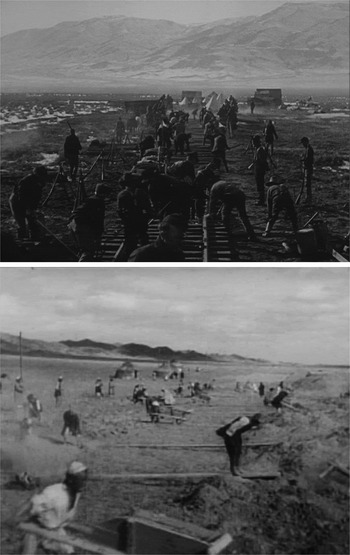
Not surprisingly, given both films’ emphasis on work projects, The Iron Horse and Turksib include multiple scenes of mass labor. Images of construction work serve as visual embodiments of a collective, whether that be of Yankees and Confederates, left, (see Figure 1) or Russians and Kazakhs, right. (see Figure 2).
Images of Collective Labor on the American (1) and Soviet (2) Frontier.

The films’ portrayal of labor dovetails and diverges in intricate and revealing ways, however. Perhaps in order to underscore an ultimate message of camaraderie and cooperation, class and racial tensions form a central part of the narrative of The Iron Horse; in contrast, they are a conspicuous absence in Turksib.
Ford's film focuses on various interpersonal conflicts: enmity between the railroad builders and the Native Americans, hostility between workers and management, and ethnic tensions among the workers, especially between the self-styled “domestic” laborers (Irish) and the “foreign,” ranging from Italian to Chinese. Leaving aside the complex presence of Native Americans for the moment, it is clear that among the railroad workers, ethnic divisions play a much greater role than the Confederate/Yankee split that is mentioned at various points in the film. Davy Brandon's closest companions are a Yankee and a Confederate veteran; the two are the best of friends and their relationship is a living model of national reunion. The “domestic-foreign” divide proves far more troublesome: the “foreign” Italian and “domestic” Irish workers do not possess an earlier experience of brotherhood to which they can return, but are instead pushed into community through their participation in the railroad project. The Italian workers come into conflict with railroad management over the fact that they have not been paid (the pay train was attacked and robbed by Native Americans). The Italians threaten to strike; in contrast, the Irish workers readily agree to work temporarily without pay. Unlike the “foreigners,” they trust management, but also, and more importantly, they are depicted as understanding that the job of building the train transcends their individual needs and interests: it is labor for the good of the nation to which they belong. After a rousing speech by the railroad director's daughter, the Italians are persuaded to continue working. In committing this act of self-sacrifice for the greater good, it is clear that the Italians have undergone a kind of citizenship ceremony. No Chinese laborers or Native Americans are present at this moment of joining, nor does the film grant them the possibility of attaining belonging through committing themselves to the national project, though there is some indication that this may not always be the case: Chinese and European workers are shown laying rails side-by-side at the very end of the film.Footnote 69 The question in The Iron Horse of who is the national worker is one that proves relevant to Turksib as well.
In Ford's version of the railroad-constitutes-the-nation tale, some of the problems in building the line come from within: leading players in the railroad's construction are corrupt. These include an easily-bribed foreman who attempts to murder Davy in order to prevent his exposure of a deceitful landowner hiding the existence of a mountain pass that would greatly expedite the railroad's construction. Despite the explicit anti-strike message of the movie, criticism is also leveled at middle management. The director of the railroad project alone remains above the fray; he is portrayed as a pure-souled venture capitalist whose only desire is to facilitate national progress, a task for which he has been authoritatively mandated. In an early scene he is shown in conversation with President Lincoln, who insists he begin the railroad project despite resistance in Congress to spending such large funds on a construction project during wartime. Lincoln is presented in the film as a quasi-divine leader, one with the foresight to look towards future union even in the midst of the most divisive strife, and his tasking of the railroad director functions as a divine mandate.
How do these portrayals of labor and management relate to Turksib? There is no visible class conflict in Turin's film, nor is there any apparent trace of ethnic conflict, despite the fact that tensions between Russian and Kazakh workers were high on the actual construction site.Footnote 70 Instead, the film presents a “benevolent” hierarchy between Russian and Kazakh workers: the Russian engineers are heroes and Russian bodies attract the camera's attention. Terms such as “foreign” do not appear in the film, and there is no presence of management per se, with the exception of a small crowd of surveyors. As MacCabe has argued, the “fundamental justification” of empire is the “promise of harmony,” an idea that is carried out in Turksib.Footnote 71 The idealization of the laborers and of labor itself is a broadly Soviet gesture, yet, in this case, it also functions as an important reversal of The Iron Horse, where interpersonal and interethnic strife are the main drivers of the plot. On the utopian Soviet frontier, such conflicts do not exist, or, perhaps more to the point, no longer exist: the old, imperial model of relations has seemingly been dissolved in this “post-historical” space. In Ford's film, the railroad's construction is disrupted by corruption and by Native Americans, who are demonized as forces hostile to technological and social progress; a perfect society is still in the process of being made. In Turksib there is a different struggle, that between labor and landscape: an unforgiving physical environment is the chief threat to construction, not “primitive” locals; social harmony has already been attained, on film at least.Footnote 72
In principle, the Kazakhs might be expected to occupy a similar place in Turksib to the Native Americans in Ford's film—they are also indigenous nomads whose territory and self-determination will be affected by the forces of imperial conquest that the railroad represents. Lavrent΄ev states as much with his point that Soviet audiences recognized a parallel between American settlers and Soviet revolutionaries: both were envisioned as bold outcasts engaged in building a new, more just world. In this formula, non-Russian natives were cast in a position similar to that of the Native Americans in the American Western.Footnote 73 Yet in Turksib, the Kazakhs are portrayed only as devoted co-workers and by-standers who welcome, rather than impede, the presumed instrument of their potential extinction. This is one of the most significant points of inversion between the two films. In the Iron Horse, the real tensions of transcontinental railroad construction are played up in order to demonstrate their facile resolution. Turksib, in contrast, works to downplay or even elide such tensions completely—but it is precisely here that important contradictions make themselves felt in Turin's film in ways that recall The Iron Horse. For example, an iconic image from Turksib is that of a camel sniffing train tracks in the middle of the desert. (see Figure 3).
A “First Encounter” between Camel and Train Tracks.

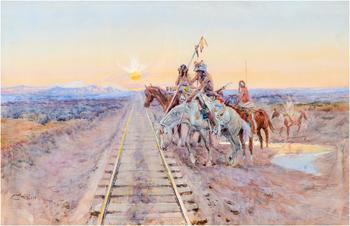
It is an image that might be said to encapsulate a certain mythos of the Soviet frontier: the camel, a nomadic and “primitive” denizen of the Central Asian desert, comes face to face with modernity. On the surface, the image projects a “happy ending” of co-existence in which the train will enhance the camel's life (here a stand-in for the nomadic population) and strengthen the Soviet economy in the process; the viewer is supposed to understand that the camel smells a good thing.Footnote 74 Yet this visual demonstration of the union of “primitive” and “modern” may also be read as an expression of anxiety about the collision or intersection of two worlds. Viktor Shklovsky, author of the text accompanying the film, suggests as much when he describes the camel as smelling “competition” in the train tracks.Footnote 75 In making the threat of extinction explicit, Shklovsky echoes the tragic-elegiac mode so frequently used in representations of the American West. While it appears to be unique in Soviet film history, Turksib's image of the camel sniffing the rails has many American precursors. Just one relevant example is the 1924 painting “Trail of the Iron Horse” by the well-known Western painter Charles Marion Russell.Footnote 76 (see Figure 4).
Charles Marion Russell's “Trail of the Iron Horse” (1924). Image courtesy of the Coeur d'Alene Art Auction.

Produced in the same year as Ford's film, this painting captures an ambivalent European view of the “primitive” (Native American) encounter with forces of “modernity” and expansion. The presumably white viewer looks down the line of tracks as if on the train at horsemen who confront an alien entity that bisects their plane of existence. The title suggests that the horsemen lack the correct frame of reference to comprehend what they have encountered; they understand it as the tracks of an animal. The viewer is meant to feel sympathy for these men and their horses—they appear to be equally alienated from the white European world of the train. Given the fate of Native Americans and their lifeways, the horse here can hardly be said to be smelling a good thing. This aspect of American frontier discourse in which pride in European “progress” is mixed with a Rousseauian dismay at the destruction of the “noble savage” is one that in some measure haunts Turksib. While Turin's scene purports to suggest a happy coexistence of train and camel, what I would call an “anxiety of extinction” familiar from American westerns is felt in the striking similarity of the images.Footnote 77 The film formally allows little to no space for ruminating on any potentially negative consequences of the railroad's presence in the steppe, yet the image asks the viewer to at least consider the camel's—and by extension, its masters’—situation.
It is important to consider just how significantly Turin's image of the camel is also a rewriting of the scenario of The Iron Horse, wherein the Native Americans are portrayed as actively impeding construction of the railroad and are made to pay in drastic terms for this hostility.Footnote 78 Like many Westerns, The Iron Horse paints a complex picture where Native Americans are concerned: the seeming necessity of destroying these “impeders of progress” is countered by an elegiac contemplation of the Native plight in which a “primitive” people are in the process of being displaced, even extinguished, by a device of urban mobility and domination.Footnote 79 Arguably, this elegiac mode is not a conventionally-pronounced feature of Russian or Soviet frontier rhetoric; however, in Turin's film, the elegiac mode of the American Western is referenced, apparently in order to highlight its inapplicability in the Soviet context. And yet the fact of the reference remains. It is made all the more poignant in hindsight, given the tragic parallels between the fate of Native American tribes in the US and that of the Kazakhs during collectivization.Footnote 80
Turin's Soviet “rewriting” of the conflicted European view is further developed toward the end of the film. Like any good Western, Ford's The Iron Horse features an extended chase scene in which hostile Native Americans pursue the train with the intent of destroying it and everyone onboard. Horsemen encircle the stopped train and engage in a shoot-out with the townspeople and railroad workers aboard the train. (see Figure 5 and Figure 6).
The Chase Scene in The Iron Horse.

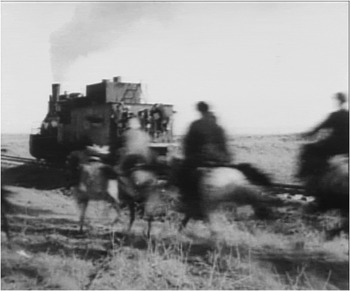
In these climactic scenes, the Natives are portrayed as fierce adversaries, even as they are ultimately the losers of the battle: the real horse cannot defeat his iron double, just as the “primitive” Native cannot defeat his “civilized” European twin. In Turksib, however, the theme of native defeat is skewed differently. In a second iconic scene, a ragtag group of Kazakh men and boys on a motley collection of horses and camels race the train through the desert. (see Figure 7).
The Chase Scene in Turksib.

This is no attack, however, but rather a welcoming ceremony that demonstrates Kazakh acceptance of the railroad in their midst.Footnote 81 In The Iron Horse, the Native Americans resist their impending extinction and the film suggests that it is this very resistance that both makes them deserve to be extinguished and earns them status as an object of admiration. In Turksib, the Kazakhs are shown to embrace their potential extinction in a staged welcoming ceremony for modernity; any sense of anxiety over changes to their way of life is formally absent. As with the earlier scenes portraying a struggle between labor and landscape, this staging suggests a peculiarly Soviet version of a John Henry myth in which technology is a hero rather than a destroyer, and what might be construed as tragic—the defeat of human efforts by a machine—is reconfigured in triumphalist terms. The fact that the chase scene recalls The Iron Horse and the genre of the Western so strongly, however, also serves as an opening through which tension over the Kazakhs’ fate makes itself felt and it becomes possible to read this scene if not in tragic, then at least in elegiac, terms.
In a final comparative note on the two films, the romance of the train itself that is suggested by the title The Iron Horse is ultimately overshadowed in the American film by the drama of the train builders. The story of Davy Brandon, the intelligent, honorable worker who overcomes adversity doubles for that of the Transcontinental Railroad itself—both face potential derailings, but finally succeed in reaching their end point. It is no coincidence that Davy is reunited with his love at the Golden Spike ceremony. The Iron Horse presents an idealized vision of American character in Davy Brandon, the perfectly mobile frontiersman who succeeds ultimately in coming to rest. Through his travels and travails he covers and encloses frontier space: he is shown as a child setting off for the west with his father, then as an adult as a pony express rider and, later, a railroad worker, whose happiest moment is the joining of the Central Pacific and the Union Pacific tracks at Promontory Summit. In Turksib, in contrast, the train is the ultimate hero of the film. There is no individual hero, but rather, a set of idealized encounters between Russians and Kazakhs, between Kazakhs, camels, and trains, and between laborers and nature that demarcate Soviet frontier space as a site of harmonious, if frenetic, work devoted to the construction of large-scale national projects.Footnote 82 There is no bildung to overcome. To the contrary, the final scenes of the film suggest the projected attainment of an unparalleled synesthesia: images of the number “30” flash repeatedly over rapid cuts from images of Turkestan, Siberia, and the train itself in motion, suggesting a simultaneity of space, time, and motion, or the realization of the complete integration of the periphery in the chronotope of the train.
Building the Socialist Frontier
In the preceding sections, I considered the points of connection between Ford and Turin's films, but the image of a socialist frontier is developed in Turksib in other, less directly parallel ways. The awakening of sleeping forces, the transformation of the desert into a site of mass labor, stark scenes of an unforgiving natural environment, and the employment of the technological sublime are some of the rhetorical techniques that mark Turksib as a Soviet frontier narrative beyond the context of The Iron Horse.
The East Awakened
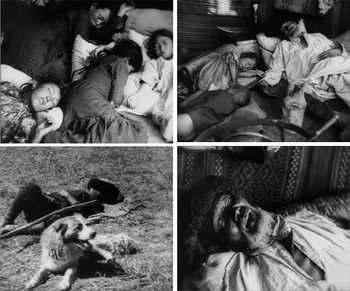
Sleep is a common colonial metaphor for regions perceived as untapped or unexplored and it was used as much in nineteenth-century Russian imperial rhetoric of the Asiatic East as it was in that of the American West.Footnote 83 A frontier is generally understood as a peripheral space where powerful forces are on the verge of—or in the process of—awakening. Notably, the sleep metaphor is realized in literal terms in Turksib: mid-way through the film, the viewer is presented with the intertitle “Noon. | Life is asleep. |” The accompanying images show Kazakh nomads sprawled haphazardly, outside and inside, lost in mid-day mass slumber. (see Figure 8, Figure 9, Figure 10, and Figure 11).
The Colonial Sleep Metaphor Realized.

The scene cuts to the intertitle “And the tombs of the East stand sentry,” accompanied by the image of an ancient tomb. An association of nomadic culture with deathly torpor could not be more marked.
The images of the sleeping nomads reference conventional depictions of the east as somnolent, but they might also be read as an allusion to the Soviet rhetorical concern with rooting out “Oblomovism,” or the “social disease” of stagnation, inertia, and laziness that Lenin and others associated with imperial Russian life.Footnote 84 The fact that the “problem” of Central Asia was frequently used in Soviet culture as a stand-in for the “problem” of the recalcitrant peasantry suggests that an Oblomovian context may well be pertinent to what is at least in part configured as a modernist fairy tale in Turksib: an “old” culture is rescued from paralyzing stagnation by the princes of new technology in the shape of Russian surveyors and engineers.Footnote 85 The film relies here on an anthropologic trope of “first encounters” between “primitive” peoples and “modern” life. Like Sleeping Beauty, the Kazakhs seem to await the arrival of the spell-breaker who will restore them to life—such an “awakening” does indeed occur when a truck full of Russian surveyors in high-tech gear arrives in the village.
The arrival of the surveyors sets the desert in motion: in the next scenes the screen is repeatedly filled with imagery of machinery and equipment in use and with wide-angle shots of hundreds of workers laying the ground for the railroad. (see Figure 12, Figure 13, and Figure 14).
The Desert “Awakens.”

Distant mountains are the only topographical anchor in these latter shots; they serve to emphasize the herculean nature of the workers’ task and the scale of their endeavor. The workers move in unison, demonstrating that urban industrial techniques can be transplanted to the desert. While some observers have understood these scenes as a “chilling” portrayal of “human labour . . . as part of a machine-like process,” it is clear that such a reading was hardly the intended reception: these scenes are meant to portray human industry in a positive light, as a force that can overcome an intractable, even deathly, environment.Footnote 86 The urban quality of these labor scenes is notable: the “empty” plain has been turned into an outdoor factory; the “city” has spontaneously appeared in the periphery.Footnote 87 Arguably, this is a distinct hallmark of Turin's socialist frontier: a collective, industrial, productive society seems to emerge spontaneously once Soviets come into contact with this “outer” territory, while the slothful legacy of Russian underdevelopment is banished definitively. A key distinction of this frontier imaginary is that the space is not perceived as undiscovered, but rather as contested—the narrative is one of vanquishing or erasing the legacy of imperial presence and of reconfiguring the “primitive” or “pre-national” denizens into an integrated modern workforce.
A Western Landscape
An elemental natural backdrop is an essential visual trope of the Western that helps to cast the action in epic terms. The topography is typically one of wide emptiness, as well as stark contrasts of light and dark, large and small. It is meant to be a “backdrop of epic magnitude and even, at times . . . a source of regenerating power.”Footnote 88 The dramatic space of Westerns suits the medium of film: the camera can make powerful wide-angle shots of vast space with tiny riders coming into view or disappearing in the distance. Symbolic aspects of the plot, such as man against nature, can be signaled through sharp juxtapositions of light and shadow. The landscape of Turksib is one of stark contrasts—light versus dark, small versus large—that frame the workers’ assault on the barren plain and craggy rocks. In the case of Turksib, such juxtapositions are meant to underscore the epic scale of the workers’ accomplishment rather than an individual hero's confrontation with natural or societal obstacles. The Soviet surveyors stand out distinctly against a stark desert, arguably functioning as technological “cowboys” gaining control of the land. (see Figures 15, Figure 16, Figure 17, and Figure 18).
Soviet Surveyors take on the Landscape.

In the images above, a confrontation between technology and the landscape is enacted in shots of suited men drilling into large, seemingly unbreakable, rocks. In the second image, the driller is filmed from below, silhouetted against a threatening sky; the clouds in the foreground appear to be smoke generated by the drilling. The scene is dominated by contrasting figures of rocks, clouds, men, and machines: a few shots of the craggy rock on its own help to provide the appropriately awe-inspiring sense of the scale of the endeavor. The intertitle describes the surveyors as “the advance guard of the new civilization”—their encounter with the land marks the arrival of modernity to the region and the seeming transformation of “emptiness” into utility. Their arrival is also framed by the intertitles as a military attack: “And across the unconquered land/the first patrol/the attack begins.” This is a rare moment in Turksib in which the potential violence of the frontier is explicitly acknowledged. Importantly, however, the conflict here is framed as being between the laborers and the land rather than between indigenous Kazakhs and Russians; the surveyors are fighting a war with terrain. This emphasis is further notable in Turksib because of the absence of staged class conflict. The film treats the engineers as heroes rather than denigrating them, as might be expected in this period. Most importantly, the very real conflicts that existed on the construction site are excluded from the film's narrative entirely. As I have discussed above, the elision of any potential violence in the Turksib frontier zone is significant for several reasons; suffice it to say here that this elision is a hallmark of imperial cinema, where tensions hover at the margins, notable for their absence.Footnote 89 The main drama of the film—forging the railroad in a difficult natural environment—is encapsulated in the intertitle: “From the railhead into the wild.”
The Technological Sublime
With its demonstration of railroad building, Turksib enacts a modernist myth of machines overcoming nature, something that is a key component of the frontier imaginary. As Leo Marx demonstrates in his seminal discussion of the railroad's presence in American symbolic geography: “The railroad was perceived as—and often in fact was—an implement for the penetration of the wilderness, and for taking dominion over the vast spaces of the continent. The conquest of nature (including the Indians) was regarded as the nation's ‘Manifest Destiny,’ and so the new machine power seemed to have appeared at a providential moment, just as Americans were poised for the final rush to the Pacific.”Footnote 90 The motif of the railroad as “an embodiment of national power about to be unleashed” attained great prominence in American art, popular and otherwise, in the second half of the nineteenth century. Further, as David Nye comments, the train was perceived as a “liberating machine” and a “miracle . . . a magic power . . . by which the forest is thrown open, the lakes and rivers are bridged, and all Nature yields to man.”Footnote 91 This theme of nature's vanquishment by man and machine is echoed in Turksib with intertitles like: “The dour land is broken/torn asunder/by the labour of man.” While the conquest of nature is a familiar feature of Soviet discourse, the film's specific portrayal of the train as a key instrument for the conquest of remote territory bears striking parallels with the discursive practice that produced the American frontier imaginary.
The glorification of the machine in Turksib need hardly be noted as a central trope of Soviet rhetoric; however, it is useful in this context to consider it as a distinct mode or visual language that might be best characterized by the term “technological sublime.” Coined by Perry Miller in the 1960s, the term refers to the feelings of awe provoked (or intended to be provoked) in popular consciousness by impressive man-made objects that dominate or challenge the natural landscape. The experience of this powerful, shared emotion has been understood as a means of fusing society into a collective whole. The technological sublime “is an integral part of contemporary consciousness” that serves as a means of reinvesting “the landscape and the works of men with transcendent significance” in an increasingly desacralized physical world.Footnote 92 Soviet rhetoric depended on a discourse of technological sublimity, but it is worth noting just how much the fetishization of machine power and technological structures was also a key discursive practice in the American frontier context; in both it represented a form of secularized divinity.
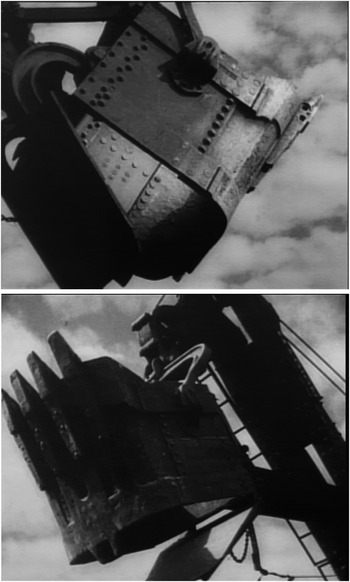
Arguably, much of Turksib is shot in the mode of the technological sublime. The camera's close attention to the edifice of the steam shovel serves as an illustrative example. In several shots, its bucket dominates the screen, very nearly blotting out the sky.Footnote 93 (see Figure 19 and Figure 20).
The Steam Shovel as an Example of the Technological Sublime.

In these images, the bucket mediates between the ground and the heavens. The viewer's gaze is directed up at it from below, underscoring its quasi-divine power. Almost nothing else is shown in such proximity in Turksib, with the notable exception of a bare-chested worker earlier in the film. (see Figure 21).
The Physical Counterpart to the Steam Shovel.

Despite the unlikelihood of a comparison between the sublime and the human, these shots seem to ask the viewer to do just that: to compare these two “machines.” The steam shovel and the anonymous worker with a shovel—his glistening skin and exposed musculature—suggest that his body is meant to be viewed with some of the same awe as the shining, massive steam shovel.Footnote 94
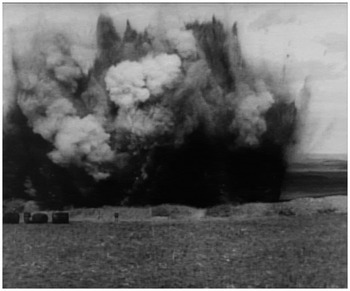
While the landscape of Turksib is not conventionally sublime—there are no waterfalls or Alpine peaks—its vast starkness is supplemented by images of explosions, pointing to the power contained in the building of the railroad; it is its own kind of natural wonder. (see Figure 22). There is also the train itself. It first appears in the latter portion of the film, moving off into an empty landscape—it looks small against a large backdrop of land and sky. Men on horseback watch it move off into apparent nothingness: it seems to have been swallowed by the plain. Moments later, however, the train appears on the screen again, racing along a cliff, coming closer to the edge. (see Figure 23 and Figure 24).
The Explosive Sublime.

Dramatic Perspectives on the Train.

The camera is positioned below the cliff, as if poised to capture the train in its fall. It stops just in time, a “miracle” of technological mastery. The viewer also finds herself positioned on the roof of the train, just as in an exciting chase (presumably a reference to the camera position in the The Great Train Robbery). Together, the train and the viewer conquer the vast space on the screen. In a final shot, the train is portrayed as driving out of the screen, through a tunnel generated by its own steam, suggesting that it was the train itself that produced the film the viewer has just seen. (see Figure 25). This closing image realizes a perfect merger of cinematic and rail technologies with the open, stark space of the periphery.
A Final View of the Train.

There is an irony to both The Iron Horse and Turksib in that they valorize the train in the 1920s, precisely at the point when this particular technology faced an extinction of its own as “new frontiers” of transportation opened with the automobile and the airplane. Yet, the train dominating the outlands is a key chronotope in frontier discourse. Turksib borrows elements from the American frontier myth, problematic as this myth may be, and recasts them in Soviet terms of awakening, collective effort, the sublime power of technology, and, most importantly, the establishment of a harmonious, post-violent, multi-ethnic world. Such a portrayal underscores the role of frontier rhetoric as a justification of imperial activity. The full ideological force of the claims made in Turksib can only be fully grasped when Turin's film is read against the American paradigm, when it is clear just what is unmade or remade to produce Soviet frontieriority.