Introduction
Social anhedonia (SocAnh) refers to the reduced ability to experience pleasure in the social context, which is closely related to negative symptoms in schizophrenia (Blanchard, Horan, & Brown, Reference Blanchard, Horan and Brown2001; Buck & Lysaker, Reference Buck, Lysaker and M2014). Along the schizophrenia spectrum, SocAnh could be a marker for psychosis proneness. Previous studies have found that individuals with schizotypy and healthy controls mainly differed in scores on items measuring SocAnh (67.5%), but not physical anhedonia (27.87%) (Chan et al., Reference Chan, Wang, Yan, Zhao, McGrath, Hsi and Stone2012b). In addition, a similar level of SocAnh has been observed in individuals with schizotypy and schizophrenia patients (Wang et al., Reference Wang, Lui, Zou, Zhang, Zhao, Yan and Chan2014b). Longitudinal studies suggest that individuals with elevated SocAnh had a higher probability of developing schizophrenia spectrum disorders, but showed no difference in the probability of developing bipolar disorder or depression (Gooding, Tallent, & Matts, Reference Gooding, Tallent and Matts2005; Kwapil, Reference Kwapil1998). Moreover, previous studies have shown that individuals with SocAnh exhibit affective impairments similar to schizophrenia patients, such as difficulties in processing emotional facial expressions (Germine, Garrido, Bruce, & Hooker, Reference Germine, Garrido, Bruce and Hooker2011) and having low-pleasure beliefs (Yang et al., Reference Yang, Yang, Zou, Shi, Wang, Xie and Chan2018a). Therefore, investigation of this population may help to better understand the development of hedonic deficits along the psychosis continuum and facilitate early detection and intervention.
Previous research suggests that schizophrenia patients report diminished pleasure when envisioning and predicting their future (anticipatory pleasure), but may still have intact ‘on-line’ pleasure experience (consummatory pleasure) (Cohen & Minor, Reference Cohen and Minor2010; Kring & Barch, Reference Kring and Barch2014). Anticipatory pleasure deficits have also been detected in first-degree relatives of schizophrenia patients (Hanssen et al., Reference Hanssen, van der Velde, Gromann, Shergill, de Haan, Bruggeman and Van Atteveldt2015; Li et al., Reference Li, Yan, Lv, Yi, Zhang, Wang and Chan2018) and individuals with SocAnh (Wang et al., Reference Wang, Liu, Li, Wei, Jiang, Geng and Chan2016; Yang et al., Reference Yang, Xie, Zou, Wang, Li, Shi and Kring2018b). Reduced activation in the ventral striatum has been consistently observed in unmedicated schizophrenia patients when anticipating rewards (Dowd & Barch, Reference Dowd and Barch2012; Esslinger et al., Reference Esslinger, Englisch, Inta, Rausch, Schirmbeck, Mier and Zink2012; Wulff et al., Reference Wulff, Nielsen, Rostrup, Svarer, Jensen, Pinborg and Glenthøj2020) and has been correlated with more severe negative symptoms (Dowd & Barch, Reference Dowd and Barch2012). Previous studies have also shown that individuals with SocAnh exhibit hypo-activation in the pulvinar, the claustrum and the insula during the anticipation of positive pictures (Chan et al., Reference Chan, Li, Li, Zeng, Xie, Yan and Jin2016). These findings suggest the presence of aberrant brain activations in regions involved in reward anticipation in both clinical and subclinical groups. However, previous studies have mainly used monetary or affective pictures as stimuli that may not resemble daily-life experience. Neural activity in response to the anticipation of other rewards, such as personal future events, remains unclear in the schizophrenia spectrum.
Prospection, the ability to simulate and pre-experience personal future episodes (Szpunar, Reference Szpunar2010), may be an important process underlying anticipatory pleasure (Gilbert & Wilson, Reference Gilbert and Wilson2007; Kring & Caponigro, Reference Kring and Caponigro2010; Painter & Kring, Reference Painter and Kring2016). Prospection recruits a core network including brain regions such as the prefrontal cortex (PFC), the medial temporal lobe and the posterior cingulate cortex (PCC), which overlaps with the default mode network (Andrews-Hanna, Reidler, Sepulcre, Poulin, & Buckner, Reference Andrews-Hanna, Reidler, Sepulcre, Poulin and Buckner2010; Schacter, Benoit, & Szpunar, Reference Schacter, Benoit and Szpunar2017). Preliminary studies on small samples of healthy participants show that the ventral medial PFC (VMPFC) (Benoit, Szpunar, & Schacter, Reference Benoit, Szpunar and Schacter2014; D'Argembeau, Xue, Lu, Van der Linden, & Bechara, Reference D'Argembeau, Xue, Lu, Van der Linden and Bechara2008; Gerlach, Spreng, Madore, & Schacter, Reference Gerlach, Spreng, Madore and Schacter2014) and the caudate (D'Argembeau et al., Reference D'Argembeau, Xue, Lu, Van der Linden and Bechara2008; Gerlach et al., Reference Gerlach, Spreng, Madore and Schacter2014) are engaged in envisioning positive future events. Moreover, task-related functional connectivity analysis reveals that when prospecting positive future episodes, the core network is coupled with reward processing regions such as the caudate and the nucleus accumbens (Gerlach et al., Reference Gerlach, Spreng, Madore and Schacter2014).
Prospection impairments have been found in schizophrenia patients and individuals with SocAnh. In schizophrenia patients, lack of details when prospecting positive future events is associated with negative symptoms (Raffard, Esposito, Boulenger, & Van der Linden, Reference Raffard, Esposito, Boulenger and Van der Linden2013). On the other hand, Yang et al. (Reference Yang, Xie, Zou, Wang, Li, Shi and Kring2018b) suggested that although individuals with SocAnh may still maintain the ability to generate vivid future events, they pre-experience these events less positively than controls. While the prospection fMRI task has been applied to healthy people (Verfaellie, Wank, Reid, Race, & Keane, Reference Verfaellie, Wank, Reid, Race and Keane2019), depressed people (Hach, Tippett, & Addis, Reference Hach, Tippett and Addis2014) and patients with multiple sclerosis (Ernst et al., Reference Ernst, Noblet, Gounot, Blanc, de Seze and Manning2015), it has not been applied to individuals in the schizophrenia spectrum. Investigating neural activity when envisioning positive future events in individuals with SocAnh may provide new insights into the mechanism underlying anticipatory pleasure deficits.
The present study aimed to examine brain activations and functional connectivity during the prospection of positive future episodes in individuals with SocAnh. We hypothesized that (1) compared with controls, reduced activations in regions such as the caudate and the VMPFC during positive prospection (v. neutral prospection) would be detected in individuals with SocAnh; and (2) altered functional connectivity between reward processing regions and areas in the core network when envisioning positive future events (v. neutral ones) would also be found in individuals with SocAnh.
Methods and materials
Subjects
All participants were college students in Beijing who were selected based on their scores on the Chapman Scale for Social Anhedonia (CSAS) (Chan et al., Reference Chan, Wang, Yan, Zhao, McGrath, Hsi and Stone2012b; Chapman, Chapman, & Raulin, Reference Chapman, Chapman and Raulin1976). Mean and s.d. from a previous study which administered the CSAS in 2994 Chinese college students were used as a reference in this study (mean = 7.40, s.d. = 5.03) (Yang et al., Reference Yang, Xie, Zou, Wang, Li, Shi and Kring2018b). Participants whose scores were 1.96 s.d. above the mean were recruited into the SocAnh group (n = 49), while the control group (n = 33) consisted of participants who had scores below the mean. All participants completed two rounds of screening including a phone interview and a detailed screening list with specific instructions as per the study by Yang et al. (Reference Yang, Xie, Zou, Wang, Li, Shi and Kring2018b). Exclusion criteria included (1) current substance abuse; (2) a family history of psychotic disorders; (3) a personal history of brain injury, psychiatric or neurological disorders; (4) left-handedness; and (5) any contraindications for MRI scanning. The present study was approved by the Ethics Committee of the Institute of Psychology, the Chinese Academy of Sciences. Written informed consent was obtained from all participants.
Chapman Scale for Social Anhedonia
The Chinese version of CSAS was used in this study to measure reduced pleasure experience during social interactions (Chan et al., Reference Chan, Wang, Yan, Zhao, McGrath, Hsi and Stone2012b; Chapman et al., Reference Chapman, Chapman and Raulin1976). The scale had a Cronbach's α coefficient of 0.85 (Chan et al., Reference Chan, Wang, Yan, Zhao, McGrath, Hsi and Stone2012b). The CSAS consists of 40 items with true–false answers. The total score was calculated for every participant. A higher score indicates a higher level of anhedonia in the social interaction context.
IQ estimation
The Short form of the Chinese version of the Wechsler Adult Intelligence Scale-Revised (WAIS-R) was adopted in this study (Gong, Reference Gong1992). IQ was estimated based on scores on four subtests including information, arithmetic, similarities and digit span (Gong, Reference Gong1992). This method has been widely used in healthy people (Chan et al., Reference Chan, Shi, Lai, Wang, Wang and Kring2012a), schizotypal individuals (Zou et al., Reference Zou, Geng, Liu, Wei, Jiang, Wang and Chan2015) and patients with psychotic disorders (Wang et al., Reference Wang, Zou, Xie, Yang, Zhu, Cheung and Chan2018).
Patient Health Questionnaire 9 (PHQ-9)
The PHQ-9 was used to measure depressive symptoms over the last 2 weeks (Kroenke, Spitzer, & Williams, Reference Kroenke, Spitzer and Williams2001). It consists of nine self-reported items scored on a 0–3 scale, with a total score ranging from 0 to 27. A higher score indicates more severe depressive symptoms. The PHQ-9 has been found to have high internal consistency and reliability in Chinese populations (Wang et al., Reference Wang, Bian, Zhao, Li, Wang, Du and Zhao2014a; Xia et al., Reference Xia, Lin, Ding, Dong, Shen, Du and Xu2019).
Positive prospection fMRI task
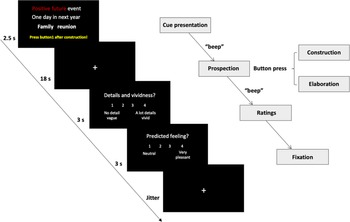
The task consisted of two prospection conditions (positive and neutral) and a control imagination condition. During prospection, participants were instructed to generate personal future episodes which were likely to occur within the next year. Pairs of words were used as cues to prompt prospection (e.g. ‘family reunion’ in the positive condition; ‘customer service’ in the neutral condition). The positive condition contained 24 cues and the neutral condition contained 12 cues. These cue words were selected from 90 pairs of words which were rated on a seven-point scale by an independent sample of college students (n = 43, 16 female, age 20.23 ± 1.63 years, education 14.70 ± 0.94 years). Cues in the two conditions were significantly different on pleasantness based on ratings of this independent sample (positive: 5.82 ± 0.32; neutral: 3.90 ± 0.32; t = 16.97; p < 0.001) and arousal (positive: 4.77 ± 1.02; neutral: 3.56 ± 0.33; t = 5.27; p < 0.001), but not on familiarity (positive: 5.20 ± 0.62; neutral: 5.52 ± 0.54; t = −1.52; p = 0.14) and sociality (positive: 4.13 ± 0.76; neutral: 3.77 ± 0.63; t = 1.40; p = 0.17). Prospection was divided into two stages, similar to previous studies (Addis, Wong, & Schacter, Reference Addis, Wong and Schacter2007; Ernst et al., Reference Ernst, Noblet, Gounot, Blanc, de Seze and Manning2015): (1) construction, during which future events were initially established (participants were asked to figure out the time/location/persons present of these events); and (2) elaboration, focusing on details of future episodes (participants were asked to generate as much details as possible). After prospecting each event, participants were asked to complete two ratings: (1) the feeling when this event occurred (1 = neutral, 4 = very pleasant); and (2) details and vividness (1 = no detail/vague, 4 = a lot of details/vivid) (Fig. 1).
Schematic representation of a positive prospection trial.

The control task, similar to Benoit et al. (Reference Benoit, Szpunar and Schacter2014), contained 12 pairs of words representing objects of different sizes (e.g. ‘bag–pencil’). Participants were instructed to think of a third object related to the cue words (e.g. ‘book’) and compare the sizes of these objects by making a sentence (e.g. ‘the bag is bigger than the book, which is bigger than the pencil’). The sentence was completed during the construction stage. In the elaboration stage, participants were asked to imagine the characteristics of each object (e.g. colour, shape and texture). At the end of each control trial, participants were asked to rate the task difficulty (1 = very easy, 4 = very difficult) and details/vividness (1 = no detail/vague, 4 = a lot of details/vivid). A detailed description of cue words is provided in the online Supplementary Materials (Table S1).
In the pre-scan session, participants were provided with detailed instructions and practised on a computer until they fully understood the procedure. During scanning, they completed three runs, each of which consisted of eight positive trials, four neutral trials and four control trials, which were randomly presented. At the beginning of each trial, the task type and cue words were presented for 2.5 s. Then participants heard a beep and closed their eyes for an 18 s prospection/control imagination phase. They were then asked to press button 1 to mark the end of the construction stage and were asked to elaborate on the event/objects details in the remaining time. When they heard a second beep, they were asked to open their eyes and complete the two aforementioned ratings (3 s for each). The trials were separated by short periods of fixation jittered between 1.5 and 3.5 s (mean = 2.5 s).
An interview was conducted immediately after the scan to identify the generated future events and objects. In addition, participants were asked to rate each future event on a seven-point scale with respect to current pleasure (pleasure during prospection), predicted pleasure, importance and familiarity of future events, and social interactions involved in future episodes. Trials with no generated future events were excluded in the subsequent analysis. There was no significant group difference in the number of missing trials (SocAnh, mean = 1.22, s.d. = 2.35; control, mean = 0.59, s.d. = 1.41; t = 1.46; p = 0.15).
MRI acquisition
MRI scanning was performed on a 3T GE MR scanner at the Institute of Psychology, the Chinese Academy of Sciences. Functional images were obtained using an echo-planar imaging sequence: TR = 2000 ms, TE = 30 ms, flip angle = 90°, matrix = 64 × 64 voxels and FOV = 224 mm. Thirty-seven interleaved axial slices (slice thickness = 3.5 mm) were acquired to cover the whole brain. Each participant completed three functional runs, each of which lasted 8.1 min (242 volumes). In addition, high-resolution (1 × 1 × 1 mm3) structural images were acquired with a sagittally oriented 3D MPRAGE sequence (TR = 6.90 ms, TE = 2.99 ms, TI = 450 ms, FOV = 256 mm, flip angle = 8°, matrix = 256 × 256 and 176 slices). The images were examined by a radiologist to exclude incidental anatomical abnormalities.
Statistical analysis
Two-sample t tests were conducted to examine group differences in demographics (except χ2 test for gender), CSAS and PHQ scores and ratings during/after scanning. Pearson correlations between ratings on positive future events and CSAS and PHQ scores were calculated in each group. Bonferroni correlation was applied to control for multiple comparisons.
Imaging data were processed and analysed using the Statistical Parametric Mapping Software (SPM12, http://www.fil.ion.ucl.ac.uk/spm) and Data Processing & Analysis for Brain Imaging (DPABI3.0, http://www.rfmri.org/dpabi) Software (Yan, Wang, Zuo, & Zang, Reference Yan, Wang, Zuo and Zang2016) in MATLAB R2016a (MathWorks Inc., Natick, MA, USA). The preprocessing procedures were: (1) the first five time points were discarded; (2) slice-timing and head motion correction were performed; (3) wavelet despiking was performed; (4) T1 images were co-registered to functional images and segmented into grey matter, white matter and cerebrospinal fluid; (5) functional images were normalized to standard Montreal Neurological Institute space and resliced to 3 mm cubic voxels; and (6) smoothing was performed with an 8 mm full-width at half-maximum Gaussian kernel. After preprocessing, four participants (three from the SocAnh group) were excluded due to excessive head motion (>2 mm, 2° in more than one run). Brain images were visualized using the BrainNet Viewer (Xia, Wang, & He, Reference Xia, Wang and He2013).
Haemodynamic responses were estimated using a general linear model. For each trial, the construction stage and elaboration stage were modelled separately with trial-specific durations. Specifically, haemodynamic activity related to the construction stage was modelled with the duration from the onset of the prospection phase to the button press, while the duration of the elaboration stage was set as the remaining of the prospection phase after the button press. Six conditions were included: positive_construction (Pos_C), positive_elaboration (Pos_E), neutral_construction (Neu_C), neutral_elaboration (Neu_E), control_construction (Con_C) and control_elaboration (Con_E). A high-pass filter with a 128 s cut-off period was applied to remove low-frequency drifts. For each participant, we first contrasted the prospection phase with the control imagination phase [prospection contrast: (Pos_C + Pos_E + Neu_C + Neu_E) − (Con_C + Con_E)]. Then for prospection, the main effect of emotion [(Pos_C + Pos_E) − (Neu_C + Neu_E)], the main effect of stage [(Pos_C + Neu_C) − (Pos_E + Neu_E)] and their interaction [(Pos_C − Neu_C) − (Pos_E − Neu_E)] were examined using proper contrasts.
In the second-level analysis, one-sample t test was conducted for the prospection contrast in all participants to verify brain activations correlated with the generation of future events. One-sample t tests were also applied for other contrasts in each group. Then two-sample t tests were used to investigate group differences in effects of emotion, stage and their interaction. Contrast values of significant clusters in the two-sample t tests were extracted using Marsbar (http://marsbar.sourceforge.net/) (Brett, Anton, Valabregue, & Poline, Reference Brett, Anton, Valabregue and Poline2002) and correlated with scores on the CSAS, the PHQ and ratings in each group. Bonferroni correction was applied to control for multiple comparisons. In order to control for the influence of trial-specific duration on prospection and emotion contrast, a control analysis modelling the entire prospection phase was conducted. Details of data processing and results are shown in online Supplementary Materials.
Finally, psychophysiological interaction (PPI) analysis was carried out to identify brain regions that exhibited altered connectivity with a seed region of interest (ROI) in response to the emotional context (positive v. neutral) during prospection. Each ROI was defined as the overlap between a 6 mm sphere (centre of the sphere: peak coordinates of a significant cluster in the two-sample t tests) and activations in the prospection contrast (p < 0.05, cluster size >10). BOLD signals were extracted from each ROI for each participant. Each PPI design matrix consisted of a physiological variable (ROI time course) and a psychological variable (positive v. neutral) and their interactions. Two-sample t tests were performed for the interaction contrast to examine group differences in emotion-related connectivity. A cluster-level FWE 0.05 correction (initial p < 0.001, cluster size >50) was applied to all analysis using the SPM12. In addition, small volume correction was used in the bilateral caudate (masks were generated based on the AAL atlas).
Results
Behavioural results
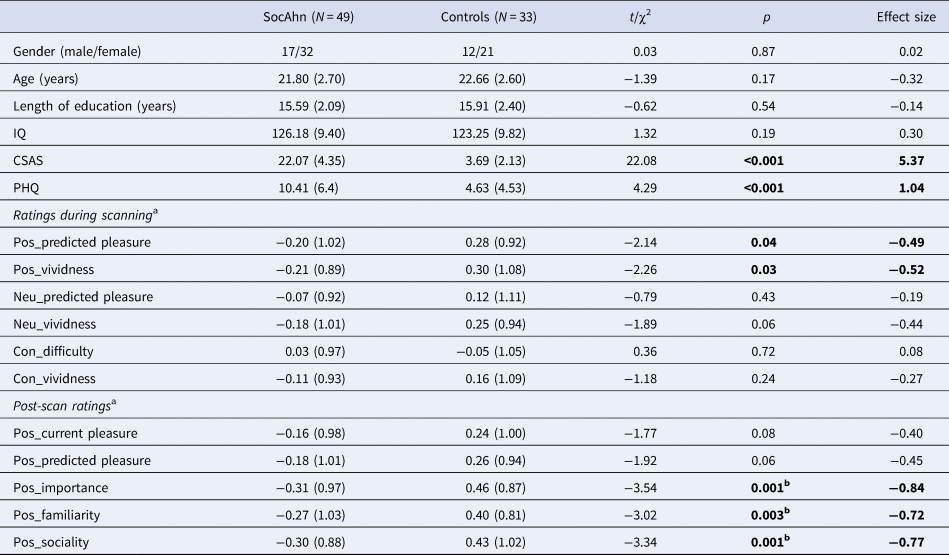
The two groups were matched in gender ratio, age, length of education and estimated IQ (Table 1). The SocAnh group scored higher on the PHQ than the control group (t = 4.29, p < 0.001). Regarding ratings during scanning, individuals with SocAnh reported less predicted pleasure (t = −2.14, p = 0.04, uncorrected) and reduced vividness (t = −2.26, p = 0.03, uncorrected) than controls when prospecting positive future events, but these results did not survive multiple comparison correction. In the post-scan interview, ratings on importance (t = −3.54, p = 0.001) and familiarity (t = −3.02, p = 0.003) of positive future events were significantly lower in the SocAnh group than in controls. In addition, positive future events of individuals with SocAnh involved fewer social interactions (t = −3.34, p = 0.001) than those of controls (Table 1).
Group comparisons on demographics, and ratings during and after scanning

SocAhn, individuals with social anhedonia; CSAS, Chapman Scale for Social Anhedonia; Pos, positive; Neu, neutral; Con, control.
Bold significants p < 0.05.
a Ratings were standardized before comparisons.
b Results remained significant after the Bonferroni correction.
Correlation analysis revealed that CSAS score was correlated with the importance of positive future events (r = −0.45, p = 0.002), current pleasure (r = −0.38, p = 0.009) and predicted pleasure (r = −0.40, p = 0.006) in positive prospection, but these correlations became non-significant after Bonferroni correction. No significant correlations between PHQ score and ratings on positive future events were found in both groups.
Functional MRI results
One-sample t test in all participants revealed that prospection (v. control imagination) was correlated with activation of the typical prospection network, consisting of regions such as the MPFC, the medial temporal lobe, the PCC and cerebellar areas (online Supplementary Table S2, Fig. S1). These findings supported the effectiveness of our task manipulation.
Effects of emotion and stage
The construction stage and elaboration stage lasted around 4 and 14 s in each condition (positive, neutral and control). No group difference was found for the duration of each stage in each condition (online Supplementary Table S3).
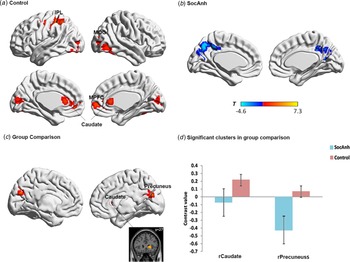
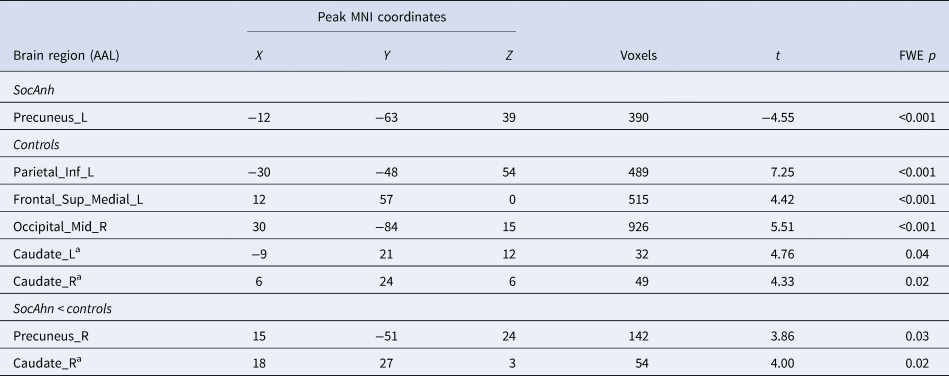
To investigate the effect of emotion, one-sample t test in each group demonstrated that, in the control group, the left MPFC, the left inferior parietal lobe, the right medial occipital gyrus and the bilateral caudate were more activated when envisioning positive future episodes relative to neutral ones (Table 2, Fig. 2a). However, preferential engagement of these regions was not observed in the SocAnh group. Instead, less engagement of the left precuneus in positive prospection (relative to neutral prospection) was detected in individuals with SocAnh (Table 2, Fig. 2b). Two-sample t test results indicated that compared with controls, individuals with SocAnh exhibited reduced activations in the right caudate and the precuneus during positive prospection (v. neutral prospection) (Table 2, Fig. 2c).
Brain activations for the emotion contrast (positive prospection v. neutral prospection). (a) Brain regions engaged in the control group. (b) Brain activations in the SocAnh group. (c) Significant clusters in group comparison (control–SocAnh). (d) Contrast values extracted from significant clusters in group comparison. SocAnh, social anhedonia; IPL, inferior parietal lobe; MOG, medial occipital gyrus; MPFC, medial prefrontal cortex; rCaudate, right caudate; rPrecuneus, right precuneus. Threshold: initial p < 0.001 with cluster-level FWE 0.05 correction.

Brain activations during positive prospection (v. neutral prospection) in two groups

aSmall volume correction was applied; SocAhn, individuals with social anhedonia; Frontal_Sup_Medial_L, left medial superior frontal gyrus; Parietal_Inf_L, left inferior parietal lobule; Occipital_Mid_R, right middle occipital gyrus.
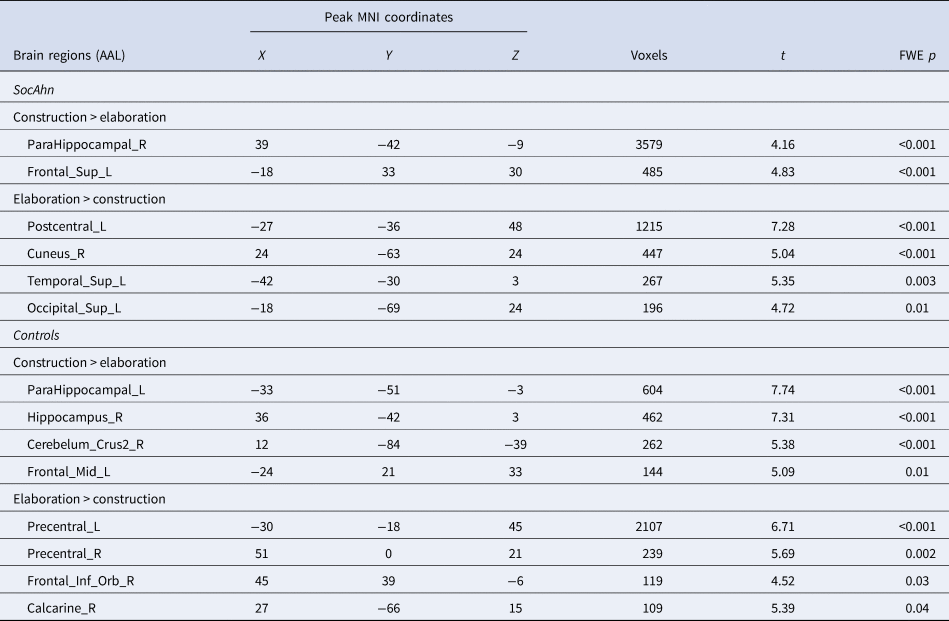
Regarding the effect of stage, one-sample t test in each group yielded a similar pattern: regions such as the superior and medial frontal cortex, the hippocampus, the parahippocampal cortex and the precuneus were more activated in the construction stage of future events than in the elaboration stage; while regions including the parietal lobe, the superior temporal lobe and the occipital gyrus were preferentially engaged in the elaboration stage of future episodes than in the construction stage (Table 3). Two-sample t test results revealed no significant group difference in activation for the stage contrast. In addition, no significant clusters were found for the interaction contrast in both groups, suggesting that there was no significant emotion difference in the construction and elaboration of future events in all participants.
Brain activations during event construction and elaboration stages in two groups

SocAhn, individuals with social anhedonia; L, left; R, right; Frontal_Sup_L, left superior frontal gyrus; Frontal_Mid_L, left middle frontal gyrus; Frontal_Inf_Orb_R, right orbital inferior frontal gyrus; Precentral_L, left precentral gyrus; Postcentral_L, left postcentral gyrus; Occipital_Sup_L, left superior occipital gyrus; Temporal_Sup_L, left superior temporal gyrus.
Contrast values of significant clusters (the right caudate and the precuneus) in the two-sample t test were extracted (Fig. 2d) and correlated with scores on the CSAS and the PHQ, and ratings on positive future events in each group. We found that in the control group, activation in the caudate was correlated with social interactions during positive prospection (r = 0.36, p = 0.04, uncorrected). However, this correlation became non-significant after correcting for multiple comparisons.
Emotion-related connectivity
We examined how connectivity between each ROI and whole-brain voxels was modulated by emotional context (positive, neutral) during prospection using PPI analysis. The right caudate and the precuneus, in which activations were significantly different between the two groups, were selected as ROIs.
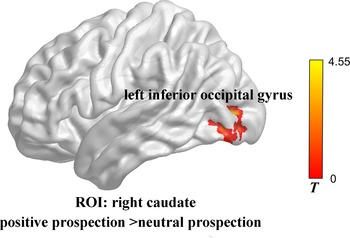
A stronger connectivity between the right caudate and the inferior occipital gyrus (IOG, peak MNI coordinate: −36 −81 −6; peak T: 4.55; voxels: 98) was observed for the positive prospection > neutral prospection contrast in individuals with SocAnh relative to controls (Fig. 3). For the same contrast, the two groups did not differ in connectivity between the precuneus and whole-brain voxels.
PPI results for positive prospection > neutral prospection condition: enhanced connectivity between the right caudate and the inferior occipital gyrus was found in individuals with social anhedonia, compared with controls. ROI, region of interest; Threshold: initial p < 0.001 with cluster-level FWE 0.05 correction.

Discussion
This study examined brain activations and functional connectivity during the prospection of positive future episodes in individuals with SocAnh and controls. We found that compared with controls, individuals with SocAnh exhibited reduced activation at the right caudate and the precuneus during positive prospection (v. neutral prospection). Moreover, increased functional connectivity between the right caudate and the IOG during positive prospection (v. neutral prospection) was observed in individuals with SocAnh, relative to controls. However, individuals with SocAnh exhibited similar brain activation pattern for the construction v. elaboration contrast, regardless of emotion context, compared with controls.
One of our important findings is the aberrant activation at the precuneus and the caudate during positive prospection (v. neutral prospection) in individuals with SocAnh. It has been reported that the precuneus may be associated with the extraction and representation of visuospatial information during prospection (Verfaellie et al., Reference Verfaellie, Wank, Reid, Race and Keane2019; Viard, Desgranges, Eustache, & Piolino, Reference Viard, Desgranges, Eustache and Piolino2012). Therefore, reduced engagement of the precuneus may indicate difficulties in positive future scene simulation in SocAnh individuals. The caudate has been suggested to support concrete simulations of personal plans to achieve future rewards (D'Argembeau et al., Reference D'Argembeau, Xue, Lu, Van der Linden and Bechara2008; Gerlach et al., Reference Gerlach, Spreng, Madore and Schacter2014). Dampened activation at the caudate may reflect reduced anticipation of positive future events in individuals with SocAnh. Moreover, our results are consistent with those from previous studies reporting reduced activation in the caudate during reward anticipation in schizophrenia patients (Esslinger et al., Reference Esslinger, Englisch, Inta, Rausch, Schirmbeck, Mier and Zink2012; Wulff et al., Reference Wulff, Nielsen, Rostrup, Svarer, Jensen, Pinborg and Glenthøj2020), supporting similar neural alterations underlying anticipatory pleasure deficits in both clinical and subclinical populations along the schizophrenia spectrum. However, previous research using the same monetary/affective picture stimuli did not find any altered activity in the caudate in individuals with SocAnh (Chan et al., Reference Chan, Li, Li, Zeng, Xie, Yan and Jin2016). Apart from the influence of sample size, this may suggest that the positive prospection task, with more self-involvement, may be more sensitive in detecting subtle changes in reward anticipation in subclinical groups.
Another important finding was the altered functional connectivity during positive prospection in individuals with SocAnh. Engagement of the IOG has been consistently observed in prospection and might be associated with the mental representation of visual information during prospection (Ernst et al., Reference Ernst, Noblet, Gounot, Blanc, de Seze and Manning2015; Szpunar, Watson, & McDermott, Reference Szpunar, Watson and McDermott2007). Increased functional connectivity between the caudate and the IOG, which could suggest an increase in the exchange of information between these regions, might reflect that individuals with SocAnh exert more effort in evaluating and anticipating rewards in prospection compared with controls. Previous studies have demonstrated aberrant resting-state functional connectivity between the striatum and cortical regions (Sabaroedin et al., Reference Sabaroedin, Tiego, Parkes, Sforazzini, Finlay, Johnson and Fornito2019; Wang et al., Reference Wang, Liu, Li, Wei, Jiang, Geng and Chan2016) and its correlation with pleasure experience in individuals with SocAnh (Wang et al., Reference Wang, Liu, Li, Wei, Jiang, Geng and Chan2016). Our results provide further evidence supporting the involvement of altered cortico-striatal functional connectivity in anticipatory pleasure experience in individuals with SocAnh.
Interestingly, one-sample t tests in each of the groups and the between-group comparison did not yield any significant cluster for the emotion and stage interaction contrast. This suggests that brain activations in response to emotional context may be similar in both stages of prospection in all participants. This may also suggest that reduced activations when envisioning positive future events are present in both the construction and elaboration stages in individuals with SocAnh. As for the effect of stage, no group difference was found between the construction and elaboration contrasts. Therefore, individuals with SocAnh may maintain a normal pattern of brain activations during the two stages of prospection, regardless of the emotional context. In addition, this activation pattern for the construction v. elaboration contrast is consistent with previous findings in healthy people (Addis et al., Reference Addis, Wong and Schacter2007; Ernst et al., Reference Ernst, Noblet, Gounot, Blanc, de Seze and Manning2015), which provides additional support for the effectiveness of our task manipulation.
This study has several limitations. First, we did not administer any structured interview in the recruitment procedure. However, two rounds of screening including detailed exclusion criteria were used in this study. This method has been commonly adopted in studies investigating SocAnh. Despite this limitation, our findings could provide additional information on the neural mechanisms underlying anticipatory pleasure deficits in individuals with SocAnh. Additional assessments should be applied to control for potential undiagnosed psychopathology in future research. Second, no significant correlations between activation in ROIs (the caudate and the precuneus) and CSAS score and ratings on positive future events were found, which may be due to the small sample size and subtle changes in the subclinical population. More efforts are needed to clarify how SocAnh affect neural correlates underlying positive prospection. Third, the cross-sectional design of this study could not differentiate the effect of the trait SocAnh from the depressive state observed in our sample. Further studies are needed to disentangle the influence of SocAnh and depressive symptoms on envisioning positive future events. Finally, future fMRI studies including both positive and negative prospection are needed to explore the effect of valence and arousal of emotion on neural activity during prospection. We believe that the positive prospection task could be a sensitive supplementary measurement to examine the neural correlates of anticipatory pleasure because: (1) it is analogous to our daily experience and has a high level of personal involvement; and (2) it corresponds well to the hypothesis that prospection could be a component process of anticipatory pleasure (Painter & Kring, Reference Painter and Kring2016). Future studies examining the neural correlates of envisioning positive future events in schizophrenia patients and other subclinical groups along the psychosis continuum could provide new insights into the development of anticipatory pleasure deficits in the schizophrenia spectrum. Moreover, training on simulating positive future events could have a clinical application with its potential role in boosting motivation and facilitating emotion regulation (Chen et al., Reference Chen, Luo, Wu, Zhou, Wang, Feng and Wang2020; Favrod et al., Reference Favrod, Nguyen, Fankhauser, Ismailaj, Hasler, Ringuet and Bonsack2015).
Notwithstanding these limitations, our results deepen the understanding of neural mechanisms underlying anticipatory pleasure deficits in individuals with SocAnh. We found reduced activations in the caudate and the precuneus, but increased functional connectivity between the caudate and the IOG when envisioning positive future events in individuals with SocAhn. These findings suggest that altered cortico-striatal circuitry may play a role in anticipatory pleasure deficits in this subclinical group.
Supplementary material
The supplementary material for this article can be found at https://doi.org/10.1017/S0033291721000970
Financial support
This study was supported by grants from the National Key Research and Development Programme (2016YFC0906402), National Science Fund China (81571317), and the CAS Key Laboratory of Mental Health, Institute of Psychology. These funding agents had no further role in the study design; in the collection, analysis and interpretation of the data; in the writing of the manuscript; and in the decision to submit the paper for publication.
Conflict of interest
None.
Ethical standards
The authors assert that all procedures contributing to this work comply with the ethical standards of the relevant national and institutional committees on human experimentation and with the Helsinki Declaration of 1975, as revised in 2008.