I. INTRODUCTION
Hydrogen has been known to form micropores in aluminum alloys and cause the formation of microcracks, which significantly reduces mechanical properties of alloys.Reference Lee and Hunt1–Reference Felberbaum, Landry-Desy, Weber and Rappaz6 An atomic scale analysis of the local diffusion of hydrogen in the liquid and solid aluminum is necessary for a prediction and control of the pore formation behavior. Many metallic alloys including the nickel alloys suffer from hydrogen embrittlement in the usage as structural materials, Reference Lynch7–Reference Lynch10 but the exact mechanism of hydrogen embrittlement in nickel alloys has not yet been discovered. It is expected that atomistic simulations can be a good approach to clarify the mechanism of hydrogen embrittlement.Reference Xu, Wen, Hu, Fukuyama and Yokogawa11, Reference Wen, Xu, Omura, Fukuyama and Yokogawa12
Use of hydrogen as an energy source is the most efficient way, and improving methods of hydrogen manufacturing, separation and purification of pure hydrogen has grown in recent years.Reference Goltsov and Veziroglu13 Although H2 gases are manufactured by various processes, membrane separation method has received a great attention owing to its ultimate cost effectiveness and ease of operation.Reference Adhikari and Fernando14 Among many possible choices of materials, metallic membranes are of interest for its high hydrogen selectivity and cost effectiveness.Reference Uemiya15, Reference Sholl and Ma16 Even though palladium and its alloys are most appropriate for membrane use, the extremely high cost is dragging down its practical applications, and recent researches have been focused on the development of non-palladium–based membranes using economically feasible metals.Reference Ockwig and Nenoff17 As a possible alternative, vanadium is a promising candidate because of not only its relatively low cost but also its higher permeability than palladium.Reference Steward18 In spite of these advantages, the membranes based on vanadium usually suffer from severe hydrogen embrittlement. One approach to solve this problem is to add the above-mentioned elements, Al or Ni, in hopes of preventing the formation of brittle hydrides by decreasing the solubility of hydrogen.Reference Nishimura, Komaki and Amano19–Reference Ozaki, Zhang, Komaki and Nishimura24 However, the effects of Al or Ni addition on the diffusivity (or permeability) of hydrogen and the mechanical properties of body-centered cubic (bcc) solid solutions are not clearly known and hard to analyze quantitatively because it is still impossible to experimentally observe the atomistic behavior of hydrogen atoms in metallic alloys. On the other hand, atomic scale simulation/calculation techniques can be an effective alternative.
First-principles calculations provide the most accurate results in the atomic scale. However, this method is not appropriate to investigate large-scale materials behavior because of its size (or number of atoms) limit. As another alternative, one can consider molecular dynamics (MD) simulations that can handle more than a million atoms using (semi)empirical interatomic potentials. In this case, accurate descriptions of various fundamental physical properties (structural properties, elastic properties, defect properties, thermal properties, etc.) by interatomic potentials are important. Among various semiempirical interatomic potentials, the embedded-atom method (EAM) proposed by Daw and coworkersReference Daw and Baskes25, Reference Foiles, Baskes and Daw26 has been widely used for metallic alloys. To the knowledge of the present authors, an EAM potential was developed by Ruda et al.Reference Ruda, Farkas and Abriata27 for the Al–H binary system and by Daw and Baskes,Reference Daw and Baskes25 Ruda et al.,Reference Ruda, Farkas and Abriata27 and Angelo et al.Reference Angelo, Moody and Baskes28 for the Ni–H binary system. These EAM potentials can describe some physical properties of the face-centered cubic (fcc) structure well but have a limitation in dealing with other crystal-structured metals such as bcc vanadium and cannot be extended to multicomponent systems including those elements.
For simulations of multicomponent systems composed of elements with different structures, one needs an interatomic potential model that can deal with all constituent elements simultaneously. From this point of view, the modified embedded-atom method (MEAM) interatomic potential, proposed by Baskes,Reference Baskes29 is highly applicable because it can describe a wide range of crystallographic structures [fcc, bcc, hexagonal close-packed (hcp), diamond structure, and even gaseous elements] using a common mathematical formalism. Recently, the MEAM was modified again by Lee and BaskesReference Lee and Baskes30 [second nearest-neighbor modified embedded-atom method (2NN MEAM)] to partially consider second nearest-neighbor interactions overcoming some critical shortcomings of the original MEAMReference Lee, Baskes, Kim and Cho31.
The eventual purpose of the present work is to investigate the dynamics of hydrogen atoms (hydrogen diffusion and effect of defects, e.g., grain boundaries or alloying elements) and mechanical properties (the mechanism of hydrogen embrittlement) in aluminum and nickel alloys, in an atomic scale. Those studies need interatomic potentials for the relevant metal alloys–hydrogen systems. The most essential system would be the Al–H and Ni–H binary systems and the development of potentials for those systems has the highest priority. However, since the atomistic investigation for vanadium membrane alloys is also of high impact, the potentials for the Al–H and Ni–H systems should be the one that can be easily extended to multicomponent systems including bcc vanadium. As such extensible potential formalism, the present authors select the 2NN MEAM. Therefore, the purpose of the present work is to develop 2NN MEAM interatomic potentials for the Al–H and Ni–H binary systems.
This article presents a brief description of the 2NN MEAM formalism and the procedure for the determination of potential parameters. The reliability of the developed potentials is then examined by comparing calculated fundamental physical properties with available experimental or first-principles data.
II. INTERATOMIC POTENTIAL
A. Potential formalism
In the 2NN MEAM, the total energy of a system is approximated as

where F i is the embedding energy as a function of background electron density  . Sij and ϕij (Rij) are the screening function and the pair interaction between atoms i and j separated by a distance Rij. For the calculation of the embedding energy, functional form of the background electron density should be defined first. Although EAM potentials concern only spherically averaged atomic electron densities, MEAM potentials introduce additional angular terms to account for directional character of bonding. The background electron density is computed by combining several partial electron density terms for different angular contributions with weight factors t (h) (h = 1–3). Each partial electron density is a function of atomic configuration and atomic electron density. The atomic electron densities ρa(h) (h = 0–4) are given as

where ρ o the atomic electron density scaling factor and β (h) the decay lengths are adjustable parameters; re is the nearest-neighbor distance in the equilibrium reference structure.
To compute the total energy in Eq. (1), a functional form of the pair interaction ϕij (Rij) is also necessary. However, in the MEAM, the value of pair interaction ϕij (Rij) is computed not from a specific functional form but from a known value of the total energy and the embedding function for an atom in an equilibrium reference structure. Here, the equilibrium reference structure is defined as a structure where individual atoms are on exact lattice points. The total energy per atom for the equilibrium reference structure is obtained from the zero-temperature universal equation of state by Rose et al.Reference Rose, Smith, Guinea and Ferrante32 as a function of nearest-neighbor distance R.

where d is an adjustable parameter,

and

r e is the equilibrium nearest-neighbor distance, E c is the cohesive energy, B is the bulk modulus, and Ω is the equilibrium atomic volume of the reference structure. Although the original MEAM considers only first nearest-neighbor interactions by using a strong many-body screening function,Reference Baskes33 the 2NN MEAM considers also second nearest-neighbor interactions by adjusting the screening parameters, C min, so that the many-body screening becomes less severe.
To describe an alloy system, pair interaction between different elements needs to be determined. For this, a similar technique that is used to determine pair interaction for pure elements is applied to binary alloy systems. A binary reference structure, where one type of atom has only the same type of atoms as second-nearest neighbors, is chosen. The total energy per atom of the reference structure is computed again using the universal equation of state. Then, the pair interaction between different elements is obtained from the known values of the total energy per atom and the embedding energy of the reference structure. Detailed formulation for binary MEAM formalism is available in literature.Reference Baskes29–Reference Lee, Baskes, Kim and Cho31, Reference Baskes33, Reference Lee, Shim and Baskes34
B. Determination of binary potential parameters
The 2NN MEAM potential for a binary system is based on the 2NN MEAM potentials for individual constituent elements. In the present work, potentials for pure Al and Ni from Lee et al.Reference Lee, Shim and Baskes34 were taken without any modification. For H, the potential originally developed by BaskesReference Baskes29 and slightly modified by Lee was used to better describe the Fe–H binary systemReference Lee and Jang35. The 2NN MEAM potential parameters for pure elements, Al, Ni, and H, are listed in Table I.
2NN MEAM potential parameter sets for Al, Ni, and H.

The units of the cohesive energy E c, equilibrium nearest-neighbor distance r e, and bulk modulus B are eV, Å, and 1012dyne/cm2, respectively. The reference structures of Al, Ni, and H are fcc, fcc, and dimer respectively.
a This is an α value as defined in Eq. (5). Bulk modulus B is not defined for a gaseous element.
2NN MEAM, second nearest-neighbor modified embedded-atom method; fcc, face-centered cubic.
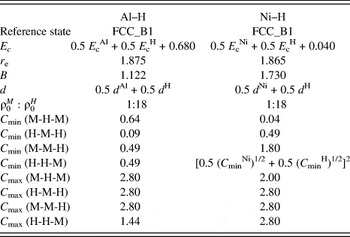
The parameterization of binary 2NN MEAM potential parameters starts by determining the four parameters in the universal equation of state as shown in the Eqs. (3)–(5). E c, r e, and B are material properties if the reference structure is a stable phase structure that exists under specific equilibrium conditions of the relevant system. Experimental data for that phase can be used directly. Otherwise, the parameter values should be optimized so that experimental information for other phases or high-level calculation results can be reproduced, if available, or assumptions should be made. The parameter d is a model parameter related with the (∂B/∂P) value of the binary reference structure. When the reference structure is not a stable phase, it is difficult to estimate a reasonable value of d for the alloy system. For such alloy systems, d is given an average value of those for pure elements.
In addition to the parameters for the universal equation of state, model parameters C min and C max are determined. As shown in Table I, each element has its own value of C min and C max. C min and C max determine the extent of screening of an atom (k) to the interaction between two neighboring atoms (i and j). For pure elements, the three atoms are all the same type (i-k-j = A-A-A or B-B-B). However, in case of binary alloys, one of the interacting atoms and/or the screening atoms can be of different type (there are four cases: i-k-j = A-B-A, B-A-B, A-A-B, and A-B-B). Different C min and C max values may have to be given in each case. Another model parameter is the atomic electron density scaling factor ρ o. As shown in Eq. (2), the values of all atomic electron densities become ρ o for an equilibrium reference structure (R = r e). This parameter is often omitted when describing the potential model for pure elements because it does not have effect on calculations. However, for alloy systems, especially for systems where the constituent elements have different coordination numbers, the ratio of scaling factors has a great effect on calculations.
The above 13 parameters are determined by fitting physical properties of the alloy system obtained from experiments or first-principles calculations. After investigating the relationship between parameters and physical properties by a systematic trial and error approach, an optimized set of parameters is determined. Some parameters have a negligible effect on the properties considered, and those parameters are given a default assumed value.
Although the Al–H binary phase diagramReference Manchester36 shows no intermediate phase, some experimental and first-principles information are available for the metastable α-AlH3.Reference Turley and Rinn37–Reference Qiu, Olson, Opalka and Anton44 The structure of the metastable phase α-AlH3 is too complicated to be used as a reference structure, and the NaCl type AlH hydride was chosen as the reference structure. Since no experimental or higher level calculation data were available for the NaCl type AlH reference structure, the potential parameters r e and B were optimized to reproduce lattice parameters and bulk modulus of the α-AlH3 phase. The parameter E c of the reference structure was determined to reproduce simultaneously the heat of formation of the α-AlH3 phase and the dilute heat of solution of hydrogen in fcc Al. The parameter d was given a default assumed value (the average of those for pure elements) because the necessary information to determine the value of this parameter (∂B/∂P of AlH) was not available. Remaining parameters, C min, C max, and the atomic electron density scaling factor ρo, were optimized so that given experimental information on physical properties of hydrogen atoms in fcc phase are closely reproduced. The available physical properties in the literature are dilute heat of solution, vacancy–hydrogen binding energy, and migration energy barrier of hydrogen. The knowledge that tetrahedral site is the preferred interstitial site for hydrogen atoms in fcc Al was also used for the parameter optimization.
In the case of the Ni–H system, experimental reportsReference Alefeld and Völkl45–Reference Mueller, Blackledge and Libowitz48 were available for the existence of the NaCl type NiH hydride as an equilibrium phase under high pressures of H2, and this phase was chosen as a reference structure. The E c, r e, and B parameter values were directly determined from corresponding experimental or first-principles values for NiH with some adjustment to better describe the migration energy barrier of hydrogen in fcc Ni. The parameter d was given a default assumed value. The dilute heat of solution, vacancy–hydrogen binding energy, migration energy barrier of hydrogen, and the information that octahedral interstitial site is preferred for hydrogen atoms in fcc Ni were also available in the literature. The C min, C max, and ρo values were optimized so that experimental information on those properties are closely reproduced.
Table II shows the finally determined MEAM potential parameter sets for the Al–H and Ni–H binary systems.
2NN MEAM potential parameter sets for the binary M–H (M = Al, Ni) systems.

The units of the cohesive energy E c, equilibrium nearest-neighbor distance r e, and bulk modulus B are eV, Å, and 1012dyne/cm2, respectively. The reference structure is NaCl type metastable hydride for both systems.
III. CALCULATION OF PHYSICAL PROPERTIES
In this section, fundamental physical properties of individual binary systems are calculated and compared with experimental data and/or other calculations. Because the 2NN MEAM formalism includes up to second nearest-neighbor interactions, a radial cut off distance should be at least larger than the second nearest-neighbor distance in structures under consideration. All calculations were performed with a radial cut-off distance of 4.7 Å for Al–H and 4.0 Å for Ni–H, which are between the second and third nearest-neighbor distances of fcc Al and fcc Ni, respectively. Moreover, if not designated, all MEAM values presented in this section are those calculated at 0 K. The calculations were performed using a homemade MD (and statics) code, KISSMD, which is based on the Velocity Verlet algorithm and is available online.Reference Lee, Ko, Kim and Kim49
The properties calculated in this study can be divided into two groups. The first group is the fundamental physical properties: lattice parameters, bulk modulus, and heat of formation of metastable hydrides, and dilute heat of solution, vacancy–hydrogen binding energy, and migration energy barrier of hydrogen in fcc solid solutions. Those are the properties used for parameter optimization. The comparison between calculation and experimental or first-principles values will show the quality of fitting. The second group is those properties with experimental information or higher level calculation values not used for parameter optimization. The diffusivity of hydrogen atoms in fcc solution phases and the adsorption energy of a hydrogen atom on Ni surfaces are selected because experimental information is available for those properties in one hand and reproducing diffusivity correctly is thought to be important for the present purpose on the other hand.
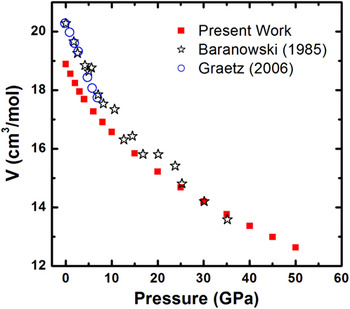
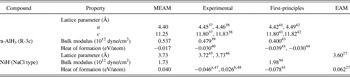
No stable hydride exists on the Al–H binary phase diagramReference Manchester36; however, several experimental works have reported the formation of metastable hydrides at high pressures.Reference Turley and Rinn37–Reference Sinke, Walker, Oetting and Stull40 The most stable aluminum hydride, α-AlH3 (space group R-3c), was relatively selected for calculation and comparison in this study. The calculated lattice parameters, bulk modulus, and heat of formation of α-AlH3 are compared with experimental data and/or other calculations in Table III. The calculated variation of molar volume of α-AlH3 with respect to pressure is also compared with experimental data in Fig. 1. In the case of the Ni–H binary system, NaCl type NiH was selected for the same type of comparison as shown in Table III. The two experimental values for the heat of formation are of the opposite sign from each other even though the absolute values are small. It should be noted here that the measurement was made for nonstoichiometric nickel hydrides (NiHx) with different H/Ni ratios, whereas the present MEAM calculation was carried out for the stoichiometric NiH.
Molar volume change of AlH3 for pressures 0–35 GPa, calculated using the present second nearest-neighbor modified embedded-atom method (2NN MEAM) potential, in comparison with experimental data.Reference Baranowski, Hochheimer, Strössner and Hönle39, Reference Graetz, Chaudhuri, Lee, Vogt, Muckerman and Reilly43

Physical properties of metal hydrides calculated using the present 2NN MEAM potentials, in comparison with experimental data or other calculations.

a X(H/Ni) = 0.5.
b X(H/Ni) = 0.7.
MEAM, modified; EAM, embedded-atom method.
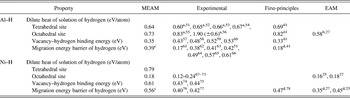
Table IV shows calculated interstitial solid solution behaviors of hydrogen in fcc Al and Ni, in comparison with experimental data and/or other calculations. The main difference between Al and Ni is that the tetrahedral (Td) site is the preferred interstitial site for hydrogen atoms in Al, whereas the octahedral (Oh) interstitial site is preferred in Ni. First-principles calculations reporting the Oh site preference in Al are also available in literatures.Reference Manninen and Nieminen79–Reference Puska and Nieminen81 However, an experiment devoted to clarify this issueReference Bugeat, Chami and Ligeon82 and a recent first-principles calculationReference Wolverton, Ozoliņš and Asta41 support the Td site preference. The agreement with the experimental dilute heat of solution obtained for a H2(g) saturation of 1 atm is good, and the small preference for hydrogen atoms in Td site is also correctly reproduced. The same calculations were performed for fcc Ni. The experimentally observed Oh site preference for hydrogen atoms is correctly reproduced. Also, the calculated dilute heat of solution of hydrogen in Oh site, 0.18 eV, is reasonably consistent with scattered experimental data (0.12–0.24 eV), also obtained for a H2(g) saturation of 1 atm.
Physical properties of hydrogen in fcc Al–H and Ni–H alloys calculated using the present 2NN MEAM potential, in comparison with experimental data or other calculations.

a Site preference is unknown.
b Octahedral site is preferred.
c Obtained from a temperature dependence of calculated diffusivity.
d Obtained from an assumed diffusion path.
It should be mentioned here that the values for the dilute heat of solution of hydrogen in T d and O h sites of Al are similar to each other (0.64 versus 0.73 eV), whereas those in Ni show a large difference (0.79 versus 0.18 eV). Further, the value for the O h site in Ni is much lower than the other quantities. To find probable explanations for those, the local strains on surrounding atoms of an interstitial hydrogen atom were examined. According to the present calculation, the distance between a hydrogen atom in T d and four first nearest-neighboring Al atoms increases by 1.3% compared to the hydrogen-free lattice structure, whereas that between a hydrogen atom in O h and six first nearest-neighboring Al atoms decreases by 1.9%. In the case of Ni, the distance between a T d hydrogen atom and first nearest-neighboring Ni atoms increases by 9.2% and that for an O h hydrogen atom increases by 3.2%. The amount of the local strain due to the interstitial hydrogen atom would contribute to the increase in dilute heat of solution. The large difference between the dilute heat of solution in T d site and O h site of Ni can be explained by the large difference in the amount of local strain in surrounding Ni atoms (9.2 versus 3.2%). On the other hand, the strain effect should not be the only factor that contributes to the dilute heat of solution. Chemical effect which implies the interaction between hydrogen and metal atoms would also be an important factor, and those can be explained qualitatively in terms of heat of formation of intermediate compounds. Table II shows that the heat of formation of NaCl type AlH (0.68 eV) is much higher than that of the same type NiH phase (0.04 eV), and this difference can be used to explain the difference between dilute heat of solution in stable interstitial sites in both elements (0.64 eV in T d of Al versus 0.18 eV in O h of Ni).
The binding energy of two defects is defined as energy difference between when the two defects are adjacent to each other and when they are separated and noninteracting. The calculated vacancy–hydrogen binding energy in fcc Al by the present potential is 0.35 eV, which is somewhat smaller than experimental data (0.43–0.53 eV) but slightly larger than a first-principles calculation (0.33 eV). The binding energy in fcc Ni is 0.61 eV, which is overestimated compared to the experimental value (0.43–0.44 eV).
All the above defect properties show a sample size dependence because of relatively long-range strains around the defect. However, the calculated values converge to certain values as the sample size (number of atoms) increases. In this study, a sample containing 1372 atoms (7 × 7 × 7 unit cells) was used and it was confirmed that the order of magnitude of numerical errors were 10−5 eV when compared with a larger sample with 4000 atoms (10 × 10 × 10 unit cells).
So far, it has been shown that the present potentials describe the fundamental physical properties of metastable hydrides and fcc solid solutions in both binary hydride systems mostly well. The developed interatomic potentials were further utilized in calculating hydrogen diffusivity to examine the applicability of the present potentials to atomistic investigations for dynamic behavior of hydrogen atoms in fcc Al and Ni solid solutions. The adsorption energy of a hydrogen atom on Ni surfaces was also calculated since experimental information was available and the surface property could be a good test bed to examine the transferability of the present potential.
The diffusivity and the migration energy barrier of interstitial atoms in solid solutions are calculated by a series of isobar–isotherm ensemble MD simulations. The directly obtainable quantity from the MD simulation is the time dependence of the mean square displacement (MSD), and diffusivity can be calculated using the following Einstein relation

where D is the diffusivity, 〈R 2(t)〉 is the MSD of atoms, and t is the time. This relation only involves true random walks of the interstitial species, and thus we considered a dilute system (0.1 at.%H) where the probability of interactions among hydrogen atoms is negligible. To diminish the statistical error, six independent MD simulations were carried out for fcc crystalline sample with 16,384 solvent atoms (16 × 16 × 16 unit cells) and averaged. The total simulation time was 50 ps with a time increment of 0.0005 ps, and the time evolution of MSD was counted at every 0.125 ps. The migration energy barrier was obtained from the temperature-dependence of diffusivity

where E m is the migration energy barrier, R is the gas constant, T is the absolute temperature, and D 0 is the preexponential factor.
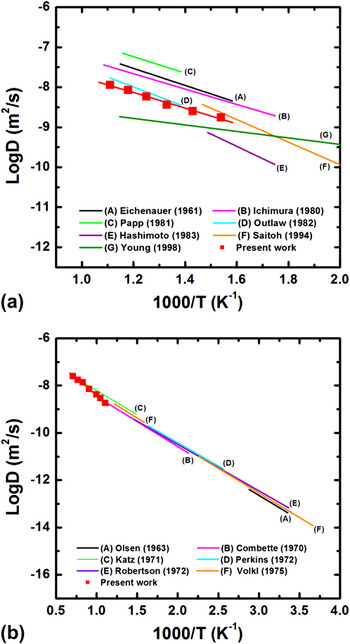
The calculated diffusivities of hydrogen in fcc Al and Ni are shown in Fig. 2. The migration energy barriers of hydrogen obtained by linearly fitting the Arrhenius plots are shown in Table IV. Figure 2(a) shows that the diffusivity of hydrogen in fcc Al is reproduced well within the scattering range of experimental values over many orders of magnitude. The migration energy barrier coincides with most of the experimental works as shown in Fig. 2(a) and also in Table IV. However, it should be mentioned here that the most recent experimental workReference Young and Scully61 and a recent first-principles calculationReference Wolverton, Ozoliņš and Asta41 report relatively small migration energy values compared to the previous works. In the case of Ni, many experimental data sets for the diffusivity of hydrogen are generally consistent. Figure 2(b) shows that the calculated diffusivity is in a fairly good agreement with experiments even though the migration energy barrier is slightly overestimated as shown also in Table IV.
Arrhenius plot of the diffusivity of hydrogen in (a) face-centered cubic (fcc) Al and (b) fcc Ni, calculated using the present 2NN MEAM potentials, in comparison with experimental data.Reference Eichenauer, Hattenbach and Pebler51, Reference Young and Scully61–Reference Hashimoto and Kino66, Reference Katz, Guinan and Borg77, Reference Olsen and Larkin83–Reference Madelung88

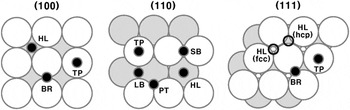
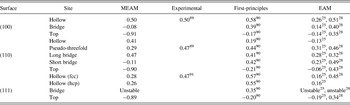
Adsorption energy is defined as the energy gained when a hydrogen atom is attached on surfaces compared to the state where the hydrogen exists as gaseous H2 molecules far from the surfaces outside the sample. The calculated and experimentally observed adsorption energies and binding sites of hydrogen for the (100), (110), and (111) surfaces of fcc Ni are presented in Table V and Fig. 3. The calculated adsorption energies are fairly good on the (100) and (110) surfaces but underestimated on the (111) surface. The adsorption site preference is correctly reproduced on the (100) and (111) surfaces but not on the (110) surface. It should be mentioned here that the EAM by Ref. Reference Angelo, Moody and Baskes28 is a modified version of that by Ref. Reference Daw and Baskes25 with a special attention to the surface property, but this potential has a limitation in extension to bcc-structured materials.
The possible sites considered for hydrogen adsorption on the (100), (110), and (111) surfaces of an fcc crystal. The large circles are metal atoms and the small circles are hydrogen atoms in various possible sites, HL (hollow), TP (top), BR (bridge), LB (long bridge), SB (short bridge), and PT (pseudo-threefold).

Adsorption energies (eV) of a hydrogen atom for several possible adsorption sites on the (100), (110), and (111) surfaces of nickel, calculated using the present 2NN MEAM potential, in comparison with experimental data or other calculations.

hcp, hexagonal close-packed.
The reasonable agreement between the present calculations and literature information on the diffusivity of hydrogen and adsorption energy on surfaces indicate the applicability of the present potential to atomistic investigations of hydrogen diffusion and effect of defects in relevant materials. The applicability of the present potentials is not confined to the present binary systems. The most significant advantage of the present 2NN MEAM formalism is that one can easily extend binary potentials into higher-order systems including the V–(Al,Ni)–H ternary and many other related multicomponent alloy systems.
IV. CONCLUSIONS
Empirical interatomic potentials for the Al–H and Ni–H binary systems are now available on the basis of the 2NN MEAM formalism. The potentials can reproduce various physical properties such as the interstitial site preference, dilute heat of solution, vacancy–hydrogen binding energy, and migration energy barrier of hydrogen atoms in fcc phase and lattice parameters, bulk modulus, and heat of formation of metastable hydrides. The potentials also reproduce the diffusivity of hydrogen in fcc Al or Ni solid solution phases in good agreement with experiments, which indicates the suitability of the potentials for atomistic investigations of dynamic behavior of hydrogen atoms and effect of point defects on it in relevant materials. Being combined with already developed 2NN MEAM potentials for other alloy systems (e.g., the V–H binary system), the present potentials can be easily extended to higher order multicomponent alloys systems, e.g., the V–(Al,Ni)–H ternary systems.
ACKNOWLEDGMENT
This work has been supported by Korea Institute of Science and Technology (2E21652).