For Chinese American communities, viewed as secluded from the mainstream society, Chinese theaters performing Cantonese opera had a special role. To the extent that Chinatown audiences perceived the images projected by the theater as an enhancement to their own self-image, these images were their most public face, both in terms of their psychological construct and in their relation to mainstream U.S. society. On the West Coast, in addition to theater visits by tourists, journalists, and locals such as composers Lou Harrison and Henry Cowell, many San Franciscans were also brought in contact with this self-representation through open public events. One example is California's Diamond Jubilee Parade of 1925, which marked the seventy-fifth anniversary of statehood. Chinatown, aside from installing forty bronze street lamps in Chinese lantern style, offered several floats of theatrical presentations featuring two elaborate operatic scenes from famous legends, winning one of the parade prizes.Footnote 1 The public face, an affirmative, self-representation of Chinese America, allowed the community important public and cultural agency.
With an increasingly lively media culture surrounding the opera theaters in the 1920s—the proliferation of print culture such as Chinese and English newspapers (advertisements and reports), playbills (sometimes bilingual, but mostly Chinese) and lyrics pamphlets (Chinese), and phonograph records—this public face of the Chinatowns was made still more consequential. The images and sonorities on the spectacular stages did not just extend beyond the bounds of the theaters, but were also massively reproduced and came to epitomize the Chinese community. As the Chinatown community sought to use the theaters and performers to validate certain themes and images, the opera theaters in turn shaped public concepts and formed a realm about Chinatown.Footnote 2
Historical Context for San Francisco's Chinatown Theaters
In the United States, the 1920s witnessed a remarkable renaissance of Chinatown theaters. When the first permanent Chinese theater on American soil, Hing Chuen Yuen, opened in San Francisco in 1868, it drew one hundred of the city's dignitaries including members of the press, the entire legal bench, state legislators, and the city's Board of Supervisors.Footnote 3 Later in the century, San Francisco's Chinatown had as many as four opera theaters running concurrently. In their glorious days they were destinations for visitors from all over the world, such as the famous Hungarian violinist Miska Hauser and Polish pianist Ignacy Jan Paderewski.Footnote 4 However, after the 1906 earthquake and fire in San Francisco, there was a sixteen-year period devoid of Chinese theaters. Then in 1924 and 1925, two extravagant theater buildings—the Mandarin Theater and the Great China Theater (a.k.a. Lun Hop Company)—were erected in the city, each costing more than $100,000 and seating between 700 and 950 people. In New York two Chinese opera theaters returned to Manhattan within a year of each other, offering nightly performances. Together these theaters, as well as smaller venues in Boston, Los Angeles, and Honolulu, constituted the golden age of Cantonese opera in the United States from the 1920s to the early 1930s.Footnote 5 Whereas this article focuses primarily on San Francisco, it is important to recognize that the Chinatown theaters that emerged in various U.S. urban spaces during this period were closely linked, sharing the same continuous wave of performers. (Their performing circuit was not even coterminous with the nation, but essentially transborder, including Cuba and Canada.)
Theatrical entertainment was always a volatile business, and it was especially so during the 1920s when Cantonese opera underwent significant shifts in its ideas and values. Scripts, role types, performing styles, settings, music, and the accompanying instruments all changed dramatically, resulting in a performance practice in constant flux. Additionally, the political situation in China was tumultuous and unstable.Footnote 6 At the same time, many severe constraints faced Chinese troupes both within the United States and at its ports of entry. A full account of the immigration issues facing the Chinatown theaters during the Chinese Exclusion period is beyond the scope of this article; suffice it to say, however, that as the effect of the 1882 Chinese Exclusion Act settled in, Chinese performers were increasingly denied entry into the country. When the troupes were admitted again in the 1920s, they were controlled closely through quotas, requirements for the posting of large bonds, and limitations on the length of stay, making the success of the theaters in this period all the more remarkable.Footnote 7 By 1923 Chinese opera performers and musicians started to arrive in the country regularly, bringing with them elaborately embroidered costumes and custom-made scenery.
Disparate and seemingly unrelated multilingual documents and newspapers form the “material basis” for this study of the vibrant scene of Chinatown opera theaters in the 1920s. These documents include court cases, Chinese Immigration Files, and Chinese-language newspapers published in cities from New York, Vancouver, and San Francisco, to Shanghai and Guangzhou, as well as playbills, the performers’ studio photographs and early recordings, and personal memoirs reminiscing about Cantonese opera performances of the 1920s in general. Although this article focuses on the theaters in San Francisco, its narrative weaves together materials across various national and linguistic boundaries. The complexity of the historical and social context necessitates this transnational approach, which in itself reflected the reality of a myriad of languages, traditions, communities, urban cities, and nations through which Chinatown theaters negotiated to their success.
The emergence of Chinatown theaters of the 1920s coincided with the rise of consumerism and mass culture in the United States.Footnote 8 The lively print culture, in particular, constructed this public face of Chinatown in significant ways. Newspaper advertisements helped facilitate Chinatown theaters’ prosperity and significance: The theaters’ programs and casts were announced daily in San Francisco's prominent Chinese newspapers throughout the 1920s and part of the 1930s; and detailed playbills containing synopses, casts, lyrics, photographs of the performers, and laudatory poems were also distributed during each evening's performance.Footnote 9 Every evening, including holidays, the stages of Chinatown theaters were busy with opera performances.
Approximately 250 different opera titles from a variety of categories were featured in each theater every year. This huge repertoire required a large staff including singers, performers, musicians, playwrights, and stagehands, as well as wardrobe keepers and painters. Their skillful collaboration in adapting, inventing, transforming, and performing enabled full-scale staging of Cantonese opera to prosper in the urban community and become an integral part of its social life. Taking into account the professionals’ roles in creating the prosperous years of Chinatown theaters is an essential component of any analysis of the symbolism and significance of these theaters. This article, with a primary focus on the actors, actresses, and playwrights, examines how the formation of their public images and that of the theaters was influenced by their performance styles, their gendered roles and performances, and their relation to the modernized image of the stage. In addition, the article considers the audience's relation to this public image: how the performances shaped, and were influenced by, different tastes and listening culture; how the performers’ public images were shaped by the mutual desires of the audience and the theaters; and how the rise of playwrights bridged the distance between performers and audiences.
Actresses Taking the Lead
At the beginning of the Cantonese opera renaissance in the 1920s, female performers were the stars of Chinatown theaters in the United States. They were generally more famous than their male counterparts, a sharp contrast to the norm of the male-dominated opera theaters in China at the time. The Qing dynasty prohibited women from appearing on stage. Only around the mid-1910s, several years after the founding of the republic, did all-female opera troupes begin to gain popularity and recognition, although they were not seen by opera connoisseurs and critics as equal to the all-male troupes in terms of artistic accomplishment. Commentators in China dismissively noted that female troupes were popular among less sophisticated audiences, especially women who were attracted by the sequined and beaded costumes, spectacular backdrops, and novel stage props.Footnote 10 Because this view was prevalent throughout the 1920s in Guangzhou and Hong Kong, male troupes and male virtuosos continued to dominate the theaters and set the artistic standards, performance styles, and interpretative practices. Although the most popular female troupes did foster famous actresses (a few even achieved celebrity status), they often acquired critical acclaim by mastering renowned actors’ performing styles. Early famous actresses were, inevitably, disciples of renowned actors and female impersonators (i.e., males crossed-dressed as females and singing in falsetto). In other words, the Cantonese opera profession existed for what Siu Leung Li called “a single ideal sex—the male—that the secondary sex”—actresses—aspired to emulate.Footnote 11 This gender hierarchy of artistry was reflected in inferior venues and lower ticket prices and salaries for all-female troupes in China.
Yet in an historical irony, the male domination of Cantonese opera in China became a main reason for the prominent influence of actresses in U.S. Chinatown theaters of the 1920s—in contrast to the nineteenth-century practice, in which these theaters were populated solely by male performers. During the early days of the 1920s renaissance, Chinatown theaters might not have attracted the top actors from China, but the best actresses were available. Actresses, rather than female impersonators, were most frequently featured as the leads, and mixed troupes became the norm. Theater managers had an additional incentive to engage actresses as well: For the large number of men in Chinatown audiences, the actresses’ presence was welcome. As a result, many distinguished female opera singers appeared in these theaters, including the legendary Li Xue Fang. Unlike their famous male counterparts, who favored the comfort and order of the professional hierarchy in China and Hong Kong, the prominent actresses clearly considered Chinatown theaters desirable posts.
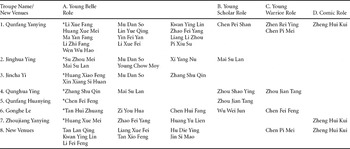
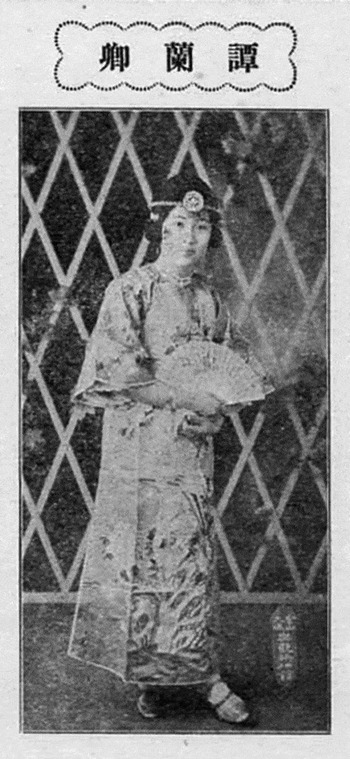
Table 1 shows the many star performers from prominent female troupes in China who appeared in U.S. Chinatown theaters during the 1920s.Footnote 12 The first column gives the troupe names. The first four were major all-female troupes that enjoyed critical acclaim on the performing circuit in major cities of southern China. Troupes 5–7 were offshoots of the primary four and also enjoyed their share of fame. Chinatown actresses affiliated with each troupe are listed in columns A, B, C, and D, organized according to their role types, for which they were primarily trained. Actresses marked with an asterisk were the leading members of their respective troupes. Because the theatrical business was in constant flux, the actresses’ affiliations varied over time, accounting for the multiple appearances of several names in this table.Footnote 13 Also included here, together with the seven troupes, is an additional category (row 8) indicating, not troupes, but rather a new style of performing venue at which prominent actresses garnered fame. Tan Lan Qing was a noted example. These venues included newer theatrical institutions, such as the Bao-Hua Theater in Guangzhou, or resident theaters of prestigious department stores. As symbols of modernity and the new elite consumer culture, these venues showcased accomplished actresses and therefore represent an additional category of prestige. Taken as a whole, the brief survey in Table 1 shows that a remarkable number of actresses in U.S. Chinatown theaters came from the top female troupes and modern venues of the Cantonese opera profession. In fact, nearly all prominent actresses in China at the time are included here.
Actresses in the United States: Role Types and Prior Affiliations with Top Female Cantonese Opera Troupes in China

For well-known actresses, U.S. Chinatown theaters offered significant attractions: higher salaries, greater appreciation, and a superior performing environment than theaters in China, as well as the prestige associated with professional engagement in the United States. According to the accounts of contemporary actors, a Chinatown engagement was particularly lucrative for leading actresses. Whereas in the United States the annual salary for an established male or female Cantonese opera performer was around $8,000, the figures for celebrity actresses were significantly higher: $14,000 for Tan Lan Qing, $16,000 for Kwan Ying Lin, $18,000 for Nu Mu Zhen, $30,000 for Mu Dan Su, and $36,000 for Li Xue Fang.Footnote 14 Not surprisingly, then, Chinatown theaters continued to draw famous actresses throughout the next decade.Footnote 15 They were great attractions. Their names had been enthusiastically exchanged among connoisseurs since the late 1910s, and some of their phonograph records were in circulation well before their U.S. appearances. Their staging helped to establish the theaters’ prominence in the community. For audiences, the pleasure of having these actresses on stage was at once visual, aural, and cerebral. Not only did the audiences frequently demand that their favorite actresses return to the stages for weeks at a time, but they also idolized them as muses and composed laudatory poems, which appeared frequently in newspapers, playbills, or individual pamphlets.
Unfortunately, even so, for many mainstream white Americans the persistent stereotype of Chinatown women as prostitutes remained prevalent. During the 1920s missionaries in Chinatown and government officials at the Immigration Bureau of the Department of Labor continued to view Chinese actresses with suspicion, accusing them of immoral conduct.Footnote 16 Yet leading actresses, rather than posing a moral threat to the community, were precious to the community and were often enshrined with star status and positive images. As such, they were put in the position traditionally reserved for the positive female in a Confucian society, an image that was eagerly cultivated and celebrated by managers, theaters, and community alike. For the overwhelmingly male Chinatown community, where many residents lived lonely bachelor lives, separated by a vast ocean from their wives, famous female opera singers embodied the community's most important positive female public figures. For instance, in 1922 a fundraising initiative was mobilized for a Chinese hospital Dong-hua and a Chinese school in San Francisco's Chinatown. The city's largest Chinese newspaper Chung Sai Yat Po printed, in its local news section, a gracious letter from opera actress Huang Xue Mei, expressing her support for the initiative and, in a self-effacing manner, contributing one hundred dollars.Footnote 17 Such open letters in the newspapers were usually from dignitaries or government officials, but Huang's letter was accorded similar respect.Footnote 18 Without even a single appearance on San Francisco Chinatown's stages, Huang, as a famous opera actress, was given the “stage” of a public figure. The community's fundraising initiatives aptly used the particular inflection of this positive image—a dutiful and loyal daughter—to rally support.
The debuts of famous actresses were significant events. Their performances heightened enthusiasm for the theater and forged a bond between the theaters and their audiences. Two general types of theatrical attractions were highlighted in the advertisements surrounding prominent actresses’ performances, reflecting the two styles that characterized the virtuoso actresses of Cantonese opera in the 1920s.
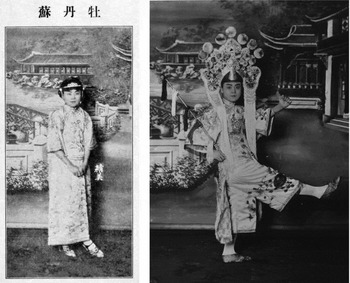
The first type can be represented by Mu Dan Su of the Mandarin Theater (Fig. 1a). Formerly a leading actress with several top all-female troupes, her virtuosic versatility in many role types constituted her trademark. Although she was primarily trained for, and established as, the young female romantic role type, Mu had also received unusually high praise in China for her gender-crossing performance of the young scholar role type (Fig. 1b). A review in the Shanghai newspaper, Shen Bao, praised her fine performance of the leading male role in her signature opera White Hibiscus at Night, a role with famously demanding male-style vocal skills. This 1923 reviewer marveled at her superb acting and singing in portraying the melancholic young man, noting that her acting connoted such delicate expression that it moved her audiences in ways unparalleled by others.Footnote 19 Mu's versatile virtuosity served her well when she first arrived in the United States in April 1926; she extended her cross-over roles further, sometimes creating operas of convoluted plots to accommodate her multiple transformations. Since Cantonese opera traditionally divided its dramatis personae into ten role types, each with its standard singing voice and performing styles, these cross-over performances were not easy.Footnote 20 Mu's skillful acting and adroit martial art movement, as well as her ability to sing in multiple vocal styles, were mesmerizing for her audience, making her one of the most popular actresses in Chinatown theaters.
Mu Dan Su: (a) actress of the Young Belle role type; (b) cross-dressed as a Young Male Scholar role type, from the playbill collection of the Mandarin Theater. Reprinted by permission of Him Mark Lai Papers, Asian American Studies Collections, Ethnic Studies Library, University of California, Berkeley.

Cross-over performance such as Mu's was in demand almost from the start of the Chinatown theaters’ renaissance. Actresses enacting transformations among multiple roles were so popular that in 1923 Yang Zhou Mei of Lun Hop performed seven roles in one evening, including the young belle (twice), the young scholar, the young warrior, the comic female, the comic male, and the old warrior.Footnote 21 A production featuring Kwan Ying Lin in five role types during a single performance drew the highest ticket revenue ($1,154) for a single evening in a week-long fund-raising campaign in May 1923.Footnote 22 Zhang Shu Qin was also billed at the Mandarin Theater as playing five role types in addition to her primary romantic young belle role. An actress known for her dexterous acrobatic dance and choreographic martial movement, Zhang played the leading lady in a wide range of challenging repertoire, frequently performing transformative roles during her two-year residence in the United States.Footnote 23 These actresses dazzled audiences with their multitalented performances, crossing gender, class, and musical and vocal boundaries.
This use of multiple role- and gender-crossing on stage was a significant means of adaptation to the demands of the local community. Because of the gender imbalance in the Chinatown community, the notion of female was detached from reality for many of its residents, which heightened the enjoyment of gender performance on stage. Seeing an actress in roles other than her usual type—employing vocal qualities and acting that concealed her biological sex in one scene and expressed her sexed body in another—proved fascinating. Although in China some actresses of romantic young belle roles might be known for playing young scholars, performing as many different role types as five to seven in one evening was rare, even in bold and trendy Shanghai.Footnote 24 Chinatown theaters excelled phenomenally at staging actresses’ role-crossing.
These role-crossing performances also reflected the changing gender and social order of this volatile time, challenging the notion of gender authenticity in complex ways. When an actress, as part of a plot, performed a heroine who cross-dressed—concealing her character's gender—in order to shoulder the responsibilities of a man, her performance upheld the society's patriarchal power structure. (One example was the legendary female warrior, Hua Mulan.) Such disguise roles, although fascinating, hardly disturbed the social order. In contrast, when the role was not a part of the plot and the young-belle-role actress simply cross-dressed to play a scholar, a king, or a warrior, she transgressed the binary gender order. Often the cross-dresser combined the two types to stage the gender performance of four to seven role-crossings in an opera, deliberately celebrating the effect that gender construction can accomplish on the operatic stage.Footnote 25
The actresses’ spirited performances of role- and gender-crossing surely risked transgression, yet in an innocuous way. On the one hand, her cross-dressing had the iconoclastic effect of undermining the traditional notion of the female role. On the other hand, even with multi-transvestism, the actresses’ representation lined up with the “feminine” side of constructed gender difference. Only through their virtuosic performances was “a sort of conscious illusion . . . produced. Thus a double pleasure is given.”Footnote 26 As such, female singers such as Mu Dan Su enchanted their audiences with tantalizing role- and gender-crossing performance—all in the safe theatrical space.
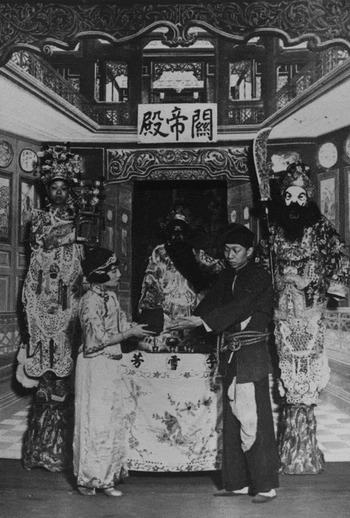
The other extreme of the actresses’ attraction during this period—especially in U.S. Chinatowns—was the sheer beauty of the female voice and the grace represented by the legendary actress Li Xue Fang, the first great Cantonese opera actress of the twentieth century (see Fig. 2). Even her fans agreed that she was not especially beautiful, although there was no question about her extraordinary voice and musical talent. With her pure and resounding high register, Li had established her unique style in many classic tragic operas. She seldom, if ever, performed the roles of salacious or evil women. In her critically acclaimed signature opera Lady White Snake, she perfected the famous melancholic arias in a newly developed vocal style. Furthermore, Li's status as the prima donna was underscored by the famous Chinese politician Kang You Wei, who pronounced her the equal of Mei Lan Fang, the most famous male singer of female roles in Peking opera and a national icon. Kang's phrase “North Mei South Li,” heightened Li's popularity, star image, and fame in the early 1920s.
Li Xue Fang, actress of the Young Belle role type (her name embroidered on the table drape). Reprinted by permission of the Chinese Theatre Collection, Museum of Performance and Design, San Francisco.

Actresses such as Li embodied the perfect feminine ideal: tenderness of expression, graceful female sexuality, a divine voice, and glamour. Insofar as these female singers embodied visually, conceptually, and sonically the society's perfect image, they were naturally adopted with enthusiasm by the Chinatown audiences and further glorified. Opera, after all, was tightly interwoven into the fabric of social customs and practices. The high natural vocal timbre of Li (an alternative to the high nasal timbre of female impersonators singing in falsetto) found increasing favor with the audiences in Chinatowns, as did the portrayal of dignified female characters in historical legends. Li was highly praised for her capability to portray the interiority of these dignified women's emotional world. In essence, her stage persona and performances, similar to her counterpart in Peking opera, Mei Lan Fang, enacted and resuscitated “ancient models of Chinese beauty.”Footnote 27 These images brought a seriousness and certain ethereality to the operatic stage, in which the theaters often took pride, and the community stood in awe.
Li's debut appearance at San Francisco's Mandarin Theater in 1927 occasioned the production of six handsomely produced booklets, each devoted to a signature opera, filled with a short biography, laudatory poems, photographs, and lyrics of the main arias. As is often the case with the production of a star image, her stage persona had been transferred into her personal virtue in the biographical accounts circulating among her fans, the critics, and the public to give rise to a desired coherence of the image. “The purity of her voice also translated in the public imagination into the ‘purity’ of her character,” similar to Pavitra Sundar's description of a Hindu cinema star.Footnote 28 Upholding the image of an active, devoted citizen, Li's charity performances were kept in high profile by the Chinese newspapers, which enthusiastically reported on them from coast to coast.Footnote 29 The press had as much interest in maintaining her public image as the theater had, since they both projected onto the star specific ideals and aspirations of the community.
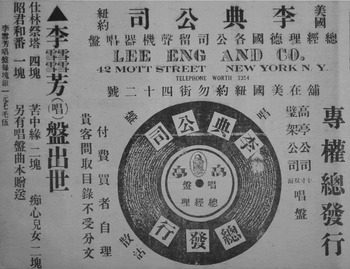
The popularity of phonograph also helped facilitate Li's public image. Although phonographs were available in Chinatowns as early as 1900, they became increasingly fashionable during the 1920s.Footnote 30 Through recordings, the artistry of Li's singing conquered her Chinatown audiences even before they entered the theaters (see Fig. 3). Advertisements for her records, some of which remain today the most distinguished historical performances, appeared in newspapers alongside the daily playbills. In fact, her popular recordings quickly became important learning tools for Cantonese opera fans, many of whom acquired enough mastery to sing along with the stage or even give private performances.
Phonograph record advertisement in the New York–based Chinese newspaper Min Qi Ri Bao 12 July 1928, “Li Xue Fang's new records released. Four titles.”

Significantly for the Chinatowns, Li Xue Fang's recordings constituted a classic sonic image and vocality for the second generation of young female Chinese Americans who aspired to the multifaceted image of the heroine her performances delineated. These young women might not speak Chinese fluently, but willingly disciplined their voice and speech patterns to emulate the elegant feminine ideal represented by actresses such as Li. This practice bespoke the powerful influence of both the opera culture and its stars.Footnote 31 Years later, when professional Cantonese opera troupes were no longer performing in Chinatowns, amateur singers—both veterans and the young—would constitute the primary force behind the continuing performance and appreciation of Cantonese opera.Footnote 32
If Li Xue Fang had the most enduring impression on the musical life of the Chinatown theaters, several other actresses with extraordinary vocal qualities and performance skills also made a significant impact, each with a particular claim to fame. These actresses similarly specialized in the young female romantic role type. Kwan Ying Lin, Tan Lan Qing, Huang Xiao Feng, and Huang Xue Mei were often praised for the beauty of their virtuosic styles. Over the course of her long engagement on U.S. Chinatown stages, Kwan Ying Lin became an iconic figure. Her arrival in early 1923 not only was marked by her lead in a month-long performance in San Francisco, but also was noted by Time magazine and other news outlets.Footnote 33 Her popularity as an itinerant performer on the transnational circuit is perhaps best captured in a poem by her granddaughter Kitty Tsui, a San Francisco writer:
Citing the community's collective memory, Tsui noted, “when [Kwan] went on stage, even the electric fans stopped.” Her legendary role in San Francisco's Chinatown was further reinforced by popular Cantonese opera films in which she starred during the 1940s and 1950s, and her later return to the city as a resident.
Taking a different path, Tan Lan Qing (Fig. 4), although popular during her residency, returned to Hong Kong to be the first actress to appear with the venerable actor Ma Shi Zen in 1932. She developed her career later in a different direction as a comic actress. Both Huang Xiao Feng and Huang Xue Mei performed exclusively in the roles of dignified graceful females in the opera and portrayed a similar public image as well.
Tan Lan Qing, actress of the Young Belle role type, from the playbill collection of the Mandarin Theater. Reprinted by permission of Him Mark Lai Papers, Asian American Studies Collections, Ethnic Studies Library, University of California, Berkeley.

Although these famous actresses’ engagements with San Francisco's theaters varied in length, they helped to anchor Cantonese opera culture in the community. Socially, these highly respected actresses legitimized the female audiences’ patronage, both of the stars—the idealized people behind the performances—and the theaters, which in turn gave actresses more prominence in theaters. As such, the theaters became a significant public space available to elite Chinese women and families. Some patronesses even took on the role of “adopted” mothers to the actresses, creating surrogate families. The conjunction of the idolized actress and her idealized characters helped establish the renaissance of Cantonese opera.
Actors Sharing the Spotlight
In the early years of the Chinatown theater renaissance, actors did not command the same respect as actresses, a sharp contrast to the dominance of male troupes in China. Although the performers or troupes that arrived at these Chinatown theaters were largely male, the men functioned primarily as supporting actors, musicians, and stagehands. The first troupe that arrived in San Francisco in 1922 had twenty-four members, of which only three were young actresses. During these early years, most of the actors were not highly educated, and most played roles that were hardly distinguishable from one opera to the next. The few who were trained for the leading male roles were paired with famous actresses. Jin Shan Bin, for example, was a capable, though not yet famous, actor in China when he first arrived in the United States. During this early period the appearances of a few esteemed actors, such as Fung Ting Gay (who portrayed the young scholar role type) in 1923 and Gong Ye Chuang (who specialized in the old bearded warrior role type) in 1924 were exceptions.Footnote 35
A turning point came in mid-1925 when, triggered by the brutality involving laborers in Shanghai, the General Strike of Canton–Hong Kong began in June and paralyzed most businesses there for more than a year. Opera theaters were severely affected, forcing the performers to find alternative venues. A sudden upsurge in recordings of Cantonese opera in Hong Kong and China was one of the strike's consequences.Footnote 36 Another was that top-tier male performers started to come to U.S. Chinatowns. The general strike—including a halt to theatrical business in the region—suspended abruptly Cantonese opera's “Red Boat” tradition, through which major actors were engaged annually from June to the following May.Footnote 37 Because of this tradition, top actors of the early 1920s seldom considered performing in U.S. theaters, and those who did were viewed as eccentric or described as having “that U.S. itch.”Footnote 38 The 1925 Canton–Hong Kong General Strike, however, disrupted the routine and made Chinatown theaters in the United States suddenly attractive to first-rate actors.
From late 1925 the arrival of these outstanding actors steered the Chinatown theaters in a new direction and at the same time restored a certain male hierarchy to the theaters. The actors introduced recent popular repertoire and brought the theaters up to date about performance practices and standards popular in Guangzhou, Hong Kong, and Shanghai. Unlike the flexible practice used in the older repertoire, the scripts of the newer operas were more fully written by professional playwrights, who themselves were becoming influential in theatrical production.
The first star to visit was Bai Ju Rong, one of four legendary actors who specialized in the role of young civic male in the first half of the century. His fame was such that his debut at the Great China Theater on 26 November 1925 needed no special advertising.Footnote 39 Celebrities such as Bai attracted large audiences, including some patrons who might not otherwise have set foot in the opera theater. Singing the young male roles that typically involved romantic intrigue and escapade, Bai received critical acclaim for his virtuosity and artistic accomplishment. He also developed a highly recognized performance style, featuring a new vocal timbre that changed from high falsetto to a more natural voice and a vernacular dialect, replacing the ancient formal dialect that was difficult to understand. Back in China, many new operas were written for him and became popular.
Although staging the repertoire of famous actors required learning new dialogue and stage direction, the theater was gradually brought up to speed, especially with the help of several other new arrivals from top male troupes. Bai's signature repertoire was featured with increasing frequency during his two years of residency, and several of his operas became part of the regular program after he left.Footnote 40 Because Bai's repertoire, playwrights, accompanying musicians, and female counterparts on stage were heavily dependent on male professionals, his residence thus marginalized actresses by subtle exclusion. Notably, the theater programs soon began to revolve more around male stars and other male professionals.
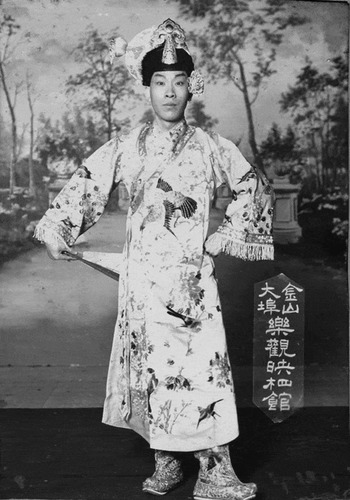
Although Bai's star status rested on his distinctive performances of young scholars, this role type was not the most popular one on the Chinatown stages. Instead, the male warrior roles were most successful, and many playbills displayed photographs of actors in military poses. Such a popular desire for male warrior role types was necessarily heightened by the political turmoil in both the United States, where racial discrimination was high, and in China, which suffered from severe domestic fragmentation and threats of foreign imperialism. The audiences were ready to confer a pseudo-reality on the appearance of the militaristic stage persona and marvel at the actors’ virility. Various stage pictures of Xin Zhu showed him in his elegant headpiece and gorgeous armor holding the inevitable weapon in one hand. At the Great China Theater, where he had debuted on 25 May 1925, his signature opera, Flooding the Enemy's Troupe, featuring him as the quintessential warrior Guan Gong, was in high demand and frequently returned to the stage.Footnote 41 Xin Zhu would go on to establish the performance standard for this opera based on the famous historical novel Romance of Three Kingdoms. Even his wife credited Xin Zhu's stardom and success in the United States to his ability to create a much-needed uplifting experience through the virility of his stage personae.Footnote 42 As a prominent public image, his masculine stage persona helped to counter the U.S. stereotype of the emasculated Chinese male, and the patriotic repertoire buoyed morale.
Praise for Xin focused on his dexterous and skillful martial art, as well as his penetrating gaze. Xin Zhu represented the younger generation of male warriors who incorporated the Peking opera style of martial movement into Cantonese opera (see Fig. 5).Footnote 43 His refined choreographic movements constituted a new trend that would develop into a quintessential Chineseness and can be seen as the precursor of the cultural icon of kungfu movies that emerged in 1970.Footnote 44 Nowhere is this historical link more poignant than in the personal story of the kungfu figure Bruce Lee, who was born in San Francisco to a Cantonese opera actor father. The elder Lee, then a resident performer for the Great China Theater, was a famous actor of the warrior role type popular in the 1920s and 30s. As with the best actresses, the Chinatown community found in young male warrior figures a positive public image, one that left an indelible impression for generations to come.
Xin Zhou, Actor of the Young Warrior role type. Reprinted by permission of the Chinese Theatre Collection, Museum of Performance and Design, San Francisco.

Even after the Canton–Hong Kong General Strike was over in 1926, China's Cantonese opera business did not revive quickly, so contracts from the U.S. Chinatown theaters remained an attractive option—with important consequences for these theaters. The parade of famous actresses in Chinatown nearly exhausted the list of top female singers in the profession at the time, but the situation was quite different for the far more numerous actors, reflecting the abundance of top-tier all-male troupes in China. As the stiff competition mobilized the theaters to try to outshine one another through vigorous recruitment, famous actors continued to arrive. The engagement of legendary Ma Shi Zen in 1930 was certainly one of the high points of this continuing effort.
Rather than merely serving as outposts for imports from Hong Kong and China, Chinatown theaters developed a unique style of performance that contributed to the performance history and tradition of Cantonese opera. Among the most important of these innovations was the mixed troupe. In China and Hong Kong mixed gender performance was not permitted until the early 1930s, whereas on Chinatown stages of the 1920s renowned actors were frequently paired with accomplished female counterparts, overriding the long-held Chinese tradition that viewed such mixed performance as “injurious to morality.”Footnote 45
More importantly, Chinatown theaters’ mixed performance represented an actualization and affirmation of heterosexual desire on stage. Because coed troupes reflected a new style that valued realism, Chinatown theaters inadvertently became sites where gender experimentation and modern heterosexual desire were played out on stage. Several performers of the U.S. theaters later became the pioneers of this practice in Hong Kong and China. On a personal level, the emergent mixed troupes, as well as the integration of women into theaters, led to many marriages. The public image and acknowledgment of these opera star couples, sanctioned socially by marriage, underscored the heterosexual masculinity of the actors and advanced heterosexual desire and representation on Cantonese opera stages. Four famous “new style” couples of the Cantonese opera, all of whom collaborated during their U.S. residencies, are especially notable: Jin Shang Bin and Xin Gui Fei, Kwan Ying Lin and Qu Run Cai, Ban Ri'an and Shanghai Mei, and Xin Zhu and Xi Yang Nu. The wedding ceremony of Kwan and Qu was held at the Oakland home of a local patroness—her “adopted” mother—who would continue to sponsor Kwan during her later returns to Chinatown theaters.Footnote 46 The prestige of this patroness—a founder of San Francisco's YWCA and the eldest daughter of Lew Hing, the owner of the Bay Area's single largest employer of Chinese workers—attests to the legitimacy of the new coed theaters of fine Cantonese opera performance among the elite.Footnote 47
The actors’ artistic innovations thrived in the stimulating cultural milieu, cosmopolitan locations, and volatile social context offered by the Chinatown stages. One important innovation was the development of a more natural voice, credited to Jin Shang Bin who, in the early years of Mandarin Theater, collaborated with actresses on repertoire concerning the love romance. He was known for initiating a new male vocal style, ping ho, that minimized the use of nasal sounds. This innovation precipitated a shift of vocal style from the more stylized falsetto to the more natural representation of male speech, another important step toward realism. This more natural voice eventually replaced the older vocal practice in Cantonese opera as a whole in the next decade.
Finally, the presence of both actresses and female impersonators at Chinatown theaters altered the gender dynamics of the theater in an irrevocable way. A fuller discussion in the next section will address this intricate situation, but in terms of the general trend, the eventual decline of female impersonators in Cantonese opera history was anticipated by their relatively poor reception on the Chinatown stage in San Francisco. Although they were famous in China and highly regarded by a faction of traditionalist audiences in the United States, the three female impersonators that Chinatown theaters engaged between 1924 and 1927 did not achieve the success of the top actresses. Laudatory poems, which peppered the daily playbills, expressed the literati fans’ appreciation, but the actors’ relatively limited appearances as leads in comparison to actresses showed the general audience's lack of interest. From the contemporary fellow actors’ indignation, in their reminiscences, at the way in which U.S. Chinatown audiences favored secondary actresses over top-notch actors, we can see the degree to which the new trend had upset the gender hierarchy in the profession.Footnote 48
Satisfying the Audiences: Genders, Desires, and Classes
In her discussion of the tradition of Chinese opera, Zhang Yihe described its audiences as ranging historically from aristocrats to villagers.Footnote 49 In the United States, Chinatown theaters similarly attracted audiences ranging from wealthy merchants and middle-class intelligentsia to common people and menial laborers. Some people valued the opera for its vocal mastery, refined arias, and literary lyrics, whereas others attended the performances for its spectacle and theatrical entertainment. Still others saw the opera theater as an upholder of bourgeois morality and cultural legacy or for its potential engagement with contemporary political and social concerns. Among the audience members were also non-Chinese tourists and local residents.
The social elite particularly supported the traditional female impersonator, whose distinctive mode of femininity possessed an aesthetic value separate from his sexed body and whose vocal prowess was viewed as extraordinary. The fans of female impersonators comprised opera connoisseurs, traditionalists, and some intelligentsia, most of whom were politically and culturally prominent in the community. As such, the critical acclaim for these actors was often given prominent “public space” in print, shaping public opinion about them.
One example was the Great China Theater playbill of 6 September 1926, in which Xiao Ding Xiang was billed as the leading lady in Spider Web, a mythological opera that had been popular with audiences in China. Printed on the playbill were lengthy adulatory poems in a florid style, paying tribute to Xiao's beautiful voice, his learned style, his graceful acting, his delicate figure, and his attractive stage presence. The poems, musing on the brilliant ambiguity of two genders embodied in one person, suggested that Xiao's artful feminine beauty would be the envy of every real maiden.Footnote 50 This tribute was typical of the rhetoric in laudatory poetry and criticism at the time, which reinforced the notion that performing femininity was an art in itself rather than just an act of mimicry. For these audiences, the art of actors like Xiao was in acting women—in creating and perfecting “the tenderness, loyalty, courage and elegance of Chinese women” through their performances.Footnote 51 From this perspective, actresses did not have an advantage over actors in performing female roles, because the gender performance had little to do with the sexed body and concerned itself mostly with talent and the mastery of skills—stylized gestures, expressive performance, emotive acting, graceful movement, and virtuosic singing.
The appeal of the actresses was due to a number of factors, including the realism of straight-sex performance and the more natural voice of female singers. Both suggest modernity. Even if implicit, there was an apologetic element about the deviant connotations associated with female impersonators in the U.S. context.Footnote 52 The initial plan that the Mandarin Theater in San Francisco submitted to the Department of Labor for approval in 1924 pointed to its use of actresses for female roles as an indication of its bona fide business and modernized theater practices, as distinguished from the subversive use of female impersonators in old theaters. (On the application, this modern adjustment was highlighted, together with details and pictures of the new theater's construction using steel, concrete, and Class A structure.) Furthermore, wealthy merchants and families could be drawn more freely into the stardom of actresses, bestowing on them generous gifts, which was more awkward with female impersonators. Finally, for some audiences, the actresses represented a new, modern phase of Cantonese opera, where the beauty and youthfulness of the women breathed new life into the traditional art. Actresses were often featured as title characters in operas with modern content, involving contemporary plots, dresses, hair styles and ornaments, and portraying more independent-minded female characters. These opera performances resonated with present-day concerns and suited the tastes of cosmopolitan-minded audiences, reflecting a more modern aesthetic. In their glamorous pictures, the actresses typically sported the shiny curls of short permed hair, fur mufflers, and tilted stylish hats that resembled the current Hollywood fashions. These talented young actresses with their modern wardrobes became idols for the younger generation, showing a cosmopolitan self-image. If they did not actually set the fashion, these actresses certainly embodied the fashionable image sought by the community.
A unique aspect of the burgeoning mixed troupe on Chinatown stages was the fascinating choice of casting options for couples during a time of transition, in which neither the traditional or the newer modes of gender performance prevailed. The various combinations raised a host of issues: novelty, equality, modernity, and self-image. To be sure, casting actresses as the leading female characters with actors as the leading male characters was most common. Although unremarkable today, such “natural” gender on Cantonese opera stage was novel at the time, deemed as bending toward the naturalism of contemporary spoken drama and other forms of cosmopolitan culture in the United States: musical theater, European opera, and cinema.Footnote 53
The popular pairing of male and female singers, which encouraged the production of new operas depicting contemporaneous events, prompted the theaters at times to walk a fine line between propriety and suggestiveness, commercial demand and respectability. Actresses were preferred in contemporary plots for at least two reasons. The body of a female impersonator could be easily disguised under layers of heavily embroidered period costumes, but could hardly be concealed beneath the modern clothing of the Chinese Republic era (plain with no frills or ruffles). Furthermore, the impersonators’ stylized performance of femininity was ill-suited for contemporary plots. Many actresses with natural grace and beauty excelled in these contemporary operas. Yet, at the same time, the actresses whose bodies were publicly displayed in modern attire risked being viewed as sex objects. As evidenced by a few playbill photographs, some wore modern-style garments, including bathing suits, that accentuated the inherent sensual possibilities of displaying the female body. Obviously, then, the new public agency that actresses asserted on the mixed troupe stage came with the risk of “commodifying their bodies as vehicles for the pleasure of audiences.”Footnote 54 The theaters did exploit such erotic-charged publicity opportunities, but sporadically, and actresses flirting with commodifying their youthful bodies through alluring photos and suggestive text on the playbills were generally of less significance.
More significantly for the stage, the gender fluidity and new equality for actresses allowed unprecedented and rich portrayals of characters, who were no longer locked in the representational worlds of either single-sex or mixed-sex troupes. Two types of role allocation were particularly noteworthy. The first was the pairing of a female impersonator as the leading lady with an actress playing the leading male. With multiple stellar performers of both genders available, nothing except audience demand would have necessitated the use of female singers for the leading male roles. Nor was such pairing in the spirit of parody. Rather, this casting reflected the strength and unique characteristics of individual performers. For example, the Mandarin Theater featured Mu Dan Su playing her signature role of the male protagonist in White Hibiscus at Night while the newly arrived famed female impersonator, Wu Xing Deng, played the despondent beautiful young girl. As curious as this casting seems today, Cantonese opera was still based in part on traditional role types with relatively little regard to the biological sex of the performer. At the same time, however, these role types were performed in distinct ways by men and women. The mutability of sexual difference and the awareness of sexual ambiguity gave rise to this double pleasure, enhanced by the added urgency and challenge of concealing the sexed bodies.
This transitional period also gave rise to a hybrid in which a character was double-cast with a female impersonator and an actress. Billed for the same role, each performer played to his or her strengths as called for by the plot. Audiences were quite adaptable to this fluidity. Performing in 1923, the well-known female impersonator Xiao Li Kang was frequently cast together with a young actress for a female title character, providing the audiences the dual pleasure of a visually attractive feminine presence and the skillful singing of the female impersonator, depending on the scenes. This double casting was also suited for story lines that follow a female character from maiden to mature woman or even old age. This hybrid casting, common at the Chinatown theaters though rarely found elsewhere, shows another manifestation of the fluid and complex relationship between biological sex and role type in Cantonese opera during this period.
The opera performances were enjoyed by a wide spectrum of social and economic classes, as shown by the range of ticket prices. With theaters built to accommodate 700 to 950 people, the business aimed for a broad clientele. More importantly, without the patronage of the working class, the theaters would not have survived. In 1926 at the Mandarin Theater and Great China Theater, the most expensive box seat was $1.50 (equivalent to about $18 in 2010) while the cheapest seat was only $0.50 for a regular performance that began at 6 p.m. This price was reduced first at 8:30 p.m. and then again at 9:30 p.m. The cheapest seats could be had at a discount for $0.25 after 9:30 p.m. Such an arrangement subtly acknowledged the differences between members of the leisure class, who could enjoy a whole evening of performance, and the laborers, who arrived after their day of work (most Chinatown stores closed at 8 p.m.).Footnote 55
The theaters also profited from their audiences' fondness for novelty. The best seats for newly arrived performers typically sold for $1.75 during the first week. On such special evenings, the most expensive ticket could cost seven times as much as the cheapest. According to a widely circulated story, one reason for the quick termination of the visit by the legendary actor Ma Shi Zeng was his unwillingness to reduce the cheapest ticket to 25 cents after 9:30 p.m., thereby angering the laborers who boycotted his performances. His run was shortened, and the theater had to take a financial loss.Footnote 56 This possibly apocryphal story highlights the social and cultural function of the opera in the community: The opera had a social obligation to accommodate the working class.
The interests of Chinatown audiences were necessarily manifold. The visual effects, the virtuosity of the acting, the enticing voice, the melodious beauty of the music, the gender play, and the literary elegance of the script could each be the focus of attention. In addition, the opera offered the attraction of familiar stories, dramatic excitement, and virile martial dexterity. The success of the theaters was so vigorously promoted that theater managers paid performers cash bonuses instantaneously when they received vociferous ovations during performances.
Because the audiences identified with their beloved opera singers, the performers’ staged public personae actually served to represent them. The close bond that developed between audience members and opera singers is most apparent in the performers’ lengthy formal farewell notices in the newspapers, expressing deep gratitude and indebtedness. (Most of these notices came from actresses.) Golden plates, symbolizing prestige and pride, were commonly bestowed by patrons on acclaimed singers, and especially on the actresses. The singers acknowledged the high honor by wearing the plates on their chests during performances.Footnote 57 The performers’ musical talent, physical skills, and personal grace were worked up to a positive star image, which then became an important asset to the community. For example, benefit performances were staged to celebrate Dr. Frederick Lam's victory in convincing the federal government to remove liver-fluke diseases from the list of medical conditions that mandated the deportation of Chinese immigrants. Leading performers also helped to raise funds for victims of natural disasters or wars, and opera performances were an important cultural tool for the community's negotiation with non-Chinese residents. In effect, opera performers’ unique glamour and sophistication fulfilled the Chinatown community's need for a public face.
Although smaller in number, non-Chinese tourists and local residents were also attracted to the fantastic and fanciful performances at Chinatown theaters. In fact, when the Cantonese opera troupes first reappeared in the United States during the early 1920s, they aimed to reach beyond the Chinatown communities. The 1922 staging of the first troupe, at the Orpheum Theater at Seattle, was accompanied by detailed bilingual handbills. The significance of its leading actress was noted by Time magazine: “The prima donna, Kwung Ying-Lin, is called the best-known woman on the Chinese stage.”Footnote 58 The 1924 inaugural performance of San Francisco's Mandarin Theater, the decade's first purpose-built theater in Chinatown, similarly featured bilingual playbills.Footnote 59 The building, with its ornate Chinese decoration, consciously embraced a modern notion of “Chineseness.”
In an effort to project a positive image of their performers and physical space, the theaters of the 1920s therefore offered a corrective to the gendered and racialized image of Chinatown opera that had been prevalent in the popular imagination since the mid-nineteenth century—popularized by travel logs, newspaper articles, yellowface vaudeville and theaters—and was still hardly a thing of the past. In an exaggerated account of a visit to the Cantonese opera troupe performing at the Crescent Theater in 1922, a reporter for the San Francisco Chronicle described feeling feeble and weakened upon hearing the falsetto voice sung by an actor, whom he derided as “that bird.”Footnote 60 That the reporter still felt the need to reference the deviant stereotype to appease the popular racial imagination was hardly surprising given the political climate at the time, four decades after the Chinese Exclusion Act and two years before the passing of the 1924 Immigrant Act, which sanctioned the racial hierarchy of the United States by imposing national origin quotas.
Paradoxically, the non-Chinese tourists and reporters often took the new status of actresses as Chinatown's progress to modernity. In their view, the actresses’ newly stabilized position on stage gave room for role- and gender-crossing; therefore, more gender transformation was available.Footnote 61 Many reporters noted such “advancement” and raved about the new woman, such as a 1927 New York Times reporter's praise of “Chinese women's new freedom” in both sharing the Chinatown opera stage with actors, and “portraying excellently the parts of men.”Footnote 62 For these viewers, actresses contributed to subverting the old, emaciated, and feminine image of Chinatown theaters and performers.
In their concerted effort to reach out to mainstream society, the theaters presented themselves as high-class modern-style venues, and sought to educate non-Chinese spectators about the opera performance, as shown by the many positive and informative accounts of the Chinese theater in the mainstream English press.Footnote 63 The actresses, with their elaborate and embroidered wardrobes, quickly became the subject of emulation. Their images, vocal styles, and stage movement—exotic and mystical—were reconstructed in trendy yellowface “Chinese” drama, masque, and parties.Footnote 64 Furthermore, as part of the urban music scene, Chinese opera on many occasions was incorporated into Western opera, experimental music, cinema, and theater.Footnote 65 A pointed example was the opera Fay Yen Fah, written by two long time members of San Francisco's elitist Bohemian Club, which became a prominent social event for the upper class.Footnote 66 As such, “Chinese opera” became a popular trope that was manifest in multiple cultural environments and events, and across different classes of U.S. society.
Playwrights: Increasing Visibility
Although they appeared in the spotlight less frequently, the playwrights similarly performed a consequential public role. Their prominence at Chinatown theaters resulted from both a general historical trend and the particular social context. Also relevant are the community's growing demand for large and novel productions and the theaters’ aim to engage with modern concerns. The playwrights, gradually taking the leading role behind theatrical stages and recognized as erudite figures, naturally became spokespersons for the theaters as well as for the community.
Ti gang xi practice, a type of nonscripted performance prevalent when Chinatown theaters began their renaissance in the 1920s, relied on a master of story telling, jiangxi shiye, who was responsible for devising a story outline with archetypal scenes strung together. The master would convey the story and the sequences of scenes orally to performers well versed in archetypal scenes. Afterwards the performers would process the drama among themselves, called du xi, by talking through the bridges connecting the scenes or intricate parts. Backstage, a placard presenting the story outline would be fixed on the wall near the entry way to the stage, indicating the scene titles, aria types, dramatic actions, music, percussion, stage props, and so on.Footnote 67 On stage, the singers performed lyrics and music extemporaneously according to the scenario and communicated with fellow performers and accompanying musicians using discrete codes such as hand gestures. With such a practice, memorization and rehearsal were minimal. The tradition of ti gang xi worked well for Chinatown theaters. Its flexibility suited the demand for a daily change in repertoire and accommodated the frequent arrival of new performers. The use of archetypal scenes also facilitated the prompt creation of new repertoire. By the same token, the use of archetypal scenes made the operas easily comprehensible and enjoyable for audiences, an important reason for the large number of new operas on stage.
The opera playbills typically included literary synopses and poetic couplets with scene names to familiarize the audience with the evening's offering. However, sometimes a list of twenty to thirty brief names of archetypal scenes on the playbill would suffice. These stories were seldom very innovative, and often adhered closely to the clichés of the classic repertoire. During this earlier period, performers who were literarily inclined and musically creative would occasionally double as playwrights. In addition, stellar performers were sometimes billed as having “written” or “produced” the opera in which they were to perform leading roles in an attempt to project the idea that the stars perfected all aspects of a production.
Although ti gang xi was the norm for U.S. Chinatown theaters during the 1920s, in China an important transition had begun to replace this practice. From the late 1910s, professional opera playwrights started to emerge and were hired by prominent city theaters to meet the constant demand from urban audiences for new works. New repertoire written for famous performers became immensely popular in the 1920s, and many new operas were written, published, and widely circulated. It has been estimated that a prominent theater in Hong Kong or Guangzhou would on average produce a new opera each week.Footnote 68 These operas, which were more fully composed, with new musical excerpts, polished verses, and developed dialogues, became the vogue.Footnote 69
In U.S. Chinatown theaters the ti gang xi practice was used to stage both classic and more recent repertoire. The change began only gradually in late 1925. From the theaters’ perspective, performing from a written script required additional work, posing a special challenge for performers who were illiterate. Even leading performers might be accustomed to learning their parts by rote, rather than by using scripts. Yet gradually the fierce competition fostered a greater need for novelty, a demand that required the expertise of professional playwrights. The arrival of stellar actors was also an important factor. Their signature repertoire was already mostly scripted; therefore, they demanded more precision and desired new works to be written for them.
In mid-1926 Pang Yi Feng, a significant playwright who had collaborated with renowned actors and troupes in China, arrived at the Great China Theater. Wu Jin Chi came to the rival Mandarin Theater several months later, joining a staff writer who had long been working there with little acclaim. In the era of ti gang xi, the staff writers were considered primarily as facilitators. If they were mentioned at all in the playbills, their professional titles were modest, a sharp contrast to titles such as “dramatist” or even “maestro dramaturge” that were bestowed on the new playwrights. The earlier facilitator's role was gradually replaced by the dramatist responsible for the entire production. With the firm hand and grander vision of the playwrights, the theaters began to produce operas that called for larger casts and more involved plots.
Prior to their arrival, these professional playwrights worked in the rich cultural milieu of cosmopolitan cities such as Shanghai, Hong Kong, and Guangzhou, where new Cantonese operas proliferated in the 1920s. Not surprisingly, then, soon after these playwrights arrived at Chinatown theaters more ambitious new productions with elaborate stage sets were featured. As an indication of their significance, the theaters announced weeks in advance the playwrights' new works in progress and their premiere dates. Occasionally the names of famous playwrights even occupied a more prominent space on the playbills or advertisements than those of the lead performers. Pang Yi Feng, whose name was placed prominently on playbills and advertisements, often wrote operas that featured the particular talent of famous resident performers.
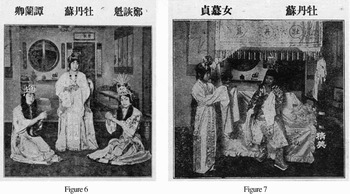
Playwrights did much more than author librettos; they also composed or arranged songs and arias, directed performances, and oversaw everything from the accompaniment to the stage productions. New lyrics for virtuoso singers were often distributed the day before the performances to entice audiences,Footnote 70 and the words of Pang Yi Feng's compositions for the legendary Bai Ju Rong usually appeared on the playbill.Footnote 71 These poetic lyrics, with annotations of aria types, enhanced audiences’ comprehension and appealed especially to elite listeners because singing along with the performers was part of the “listening pleasure.” As the playwrights gradually gained dominance, theatrical productions grew more elaborate. Monologues were replaced by much busier and well-choreographed scenes. Photographs on the playbills provided glimpses of novel and sophisticated productions, in sharp contrast to the earlier conventional headshots of individual performers. For example, the playbill of a widely advertised production by Wu Jin Chi featured a picture of three renowned actresses in dramatic poses, rather than the usual portraits of one performer.Footnote 72 Mu Dan Su posed as the legendary expatriate lady (Wen Ji) with Tan Lan Qing as her daughter and Zheng Hui Kui as her son. The photo depicts, against the domestic backdrop, the despairing yet imminent separation of the close-knit family (see Fig. 6). Another playbill photo was unusual in presenting a romantic inner chamber scene. Here Mu Dan Su cross-dressed as a young scholar, engaging in flirtatious act with young belle (Nu Mu Zhen; see Fig. 7). Both pictures reflect a shift toward the more sophisticated productions of full-scale realism involving backdrops, props, and acting.
Wen Ji's Return to the Han People, from the playbill collection of the Mandarin Theater. From left to right: Mu Dan Su as a Young Belle, Tan Lan Qing as a Young Belle, Zheng Hui Kui as a Young Scholar. Reprinted by permission of Him Mark Lai Papers, Asian American Studies Collections, Ethnic Studies Library, University of California, Berkeley.
Figure 7.Wei-gong Chun-se, from the playbill collection of the Mandarin Theater. Left: Nu Mu Zhen as a Young Belle; right: Mu Dan Su as a Young Scholar (her name embroidered on the valence). Reprinted by permission of Him Mark Lai Papers, Asian American Studies Collections, Ethnic Studies Library, University of California, Berkeley.

Furthermore, professional playwrights enhanced the opera theaters’ interaction with the life of Chinatown community on several levels. First, their new operas, based on urban settings, reflected contemporaneous political and social concerns of the community. At the Mandarin Theater, for example, a modern story published as a serial by the local newspaper Chung Sai Yat Po was adapted into an opera called An Actress. A rival newspaper She Jie Ri Bao had a story adapted as the opera Sound of a Gun Shot in a Romance. Footnote 73 Both new operas reflected the interesting settings of their urban surroundings. Then, in order to advance political and social initiatives, the playwrights also wrote operas based on political events. These operas, which might not have provided the best entertainment, were sometimes coupled with smaller light-hearted playlets; nevertheless, they fulfilled an important social function. Finally, famous playwrights acquired such a high status that their occasional appearances as guest performers or speakers became celebrated events. Because of their literary reputation—the playwrights were necessarily erudite, well versed in classical Chinese—they projected an image of opera as a highbrow and cerebral pleasure, one that met the interest of the community's wealthy merchants and middle-class intelligentsia.
When the playwrights performed in a kind of “cross-over,” another dimension of their close connection to the community was revealed. In February 1927 Pang Yi Feng appeared on stage with Bai Ju Rong, an event advertised with great fanfare. Such “amateur” performances by playwrights worked to fulfill for audiences the fantasy of taking part in the drama on stage. Many opera goers, particularly veteran opera fans, imaginatively lost themselves—or found themselves, rather—nightly in the drama of surrogate romance or proxy virile nationhood. The new playwrights thus formed a bridge between musical fantasy and mundane reality by occasionally crossing over to perform a role (as amateur singers) in the operatic world. Their public persona, in many ways, legitimized the roles and functions of “amateur performers” with an added affirmative note.
Conclusion
The prosperity of the theaters, the astonishing number of performers arriving at the ports, the stellar professional level of these singers and playwrights, and the respect they received from the community all point to the significance and liveliness of Chinatown theaters in San Francisco of the 1920s. Every night, for the audiences that filled the two theaters, the limited physical spaces were transformed into spectacles of endless possibility. Whether it be a grand palace filled with resonant voices, a battlefield with choreographed movements of martial arts, an intimate inner chamber permeated with heart-wrenching arias, or a moon-lit garden echoing enamored duets by lovers, these enchanting theaters were created by many of the best performers and playwrights of Cantonese opera during this time. The majestic stage reflected the era's quest for virtuosity, novelty, modernity, and, last but not least, cosmopolitan taste.
The early years, dominated by stellar actresses with actors in supporting roles, turned the hierarchical and patriarchal Cantonese opera profession on its head. As a result, nearly all the period's prominent Cantonese opera actresses had their North American debuts at one time or another, and several exceptional actresses, together with their famous recordings, made indelible impressions on the community. Their two distinct styles of performance prompted the theaters’ development in two ways—theatrical excitement and complexity with panache of modernity on the one hand, and musical virtuosity imbued with classic feminine ideal on the other.
The surge of famous actors starting in mid-1925 steered the theaters in a new direction. The excitement and pride in having the best Cantonese opera actors in residence prompted many to attend the theaters for the first time. It also rejuvenated somewhat the patriarchal hierarchy of the profession and occasioned the production of new fully scripted operas. Nevertheless, the overall success of mixed troupes on these stages precipitated the decline of female impersonators in Cantonese opera in general, resulting in a fascinating period of varied, and sometimes ambivalent, gender performances. Finally the prominent arrival of playwrights indicated not only the theaters’ seriousness in bringing the performances up to date with city troupes in Hong Kong and Guangzhou, but also their acknowledgment of the importance of meeting high performance standards and catering to the community's interests. Since print culture had an increasing role in constructing the public image of Chinatown theaters, the playwrights—with their shrewdness and literary skill—held the key to the theaters’ most immediate interaction with, and representation of, the community's issues and interests on stage. As the literary figures of the theaters and erudite public figures of the community, their sagacious comments and appearances gave new theatrical meaning to social events and stage lives in Chinatowns.
Chinatown theaters also offered a fascinatingly fluid and complex practice of gender performance before the roles became locked into the commonplace of gender difference in the gender-straight mixed troupe of Cantonese opera in the 1930s. Chinatown theater stages in the 1920s, therefore, while unique in their mutability of sex difference, worked well to satisfy the commercial demand for variety, as well as to suit audiences of different tastes and desires.
As a powerful testimony to the majestic stages, the magic photographic portraits of the performers poignantly reflected the theaters’ public image. May's Photo Studio, which opened in 1923 and remained the most prominent Chinese-owned studio in San Francisco for a decade, made a specialty of photographing the opera stars and stage scenes. The studio produced commercial portraits with artistic touches such as hand painting and glitter to simulate sequins on the opera costumes.Footnote 74 The strikingly dramatic poses captured in these elegant photos often enticed the viewers through the sheer power of the operatic characters. Yet the photographs, omnipresent in the playbills, newspapers, pamphlets, and even marquees, do more than denote the location and aura of the theatrical spectacles. Taken beyond the theatrical space, these visual representations were at the same time the Chinatown community's sense of its musical and artistic self, and in many ways its most public face. In the public sphere these artistic portraits of operatic eloquence challenged and dismissed the prevailing notion of Chinatown as simple and uncultured.
As film scholar Richard Dyer reminds us, “Audiences cannot make media images mean anything they want to, but they can select from the complexity of the image the meanings and feelings, the variations, inflections and contradictions, that work for them.”Footnote 75 Prima donna Li Xue Fang exemplifies this mutability of image. In China, Li, though held in highest esteem, was never exalted as a public face and quintessential female in the same way as she was in the United States. Her image here was constructed by the desire of the community, shaped by both the constraints and the missions of Chinatown theaters as a cultural institution in the U.S. cities, and facilitated by the lively print and phonograph culture. Her skillful performance, virtuous characters, and pure vocality were both the source and the product of such an image.
Imbued with artistic excellence, the theaters served as the public face of the Chinatown community in U.S. society. The performers were acutely and self-consciously aware of their role in the formation of this public image. Coming from the top tier of the opera profession, they were poised to impress, crystallizing images of dramatic power and cultural significance. The performers’ artistry converged with respectability.
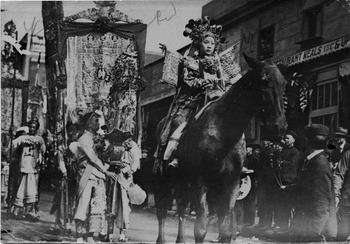
Fa Mu Lan in the Portola Parade of 1909. Photo by Louis J. Stellman; courtesy of the California State Library.

How was such a dignified image viewed in urban spaces beyond the confines of Chinatown theaters in San Francisco? Figure 8 depicts the quintessential woman warrior figure Hua Mulan (or Fa Mulan) who acted as the parade marshal at the Portola Parade in 1909.Footnote 76 Her opera costume spoke to her positive image. In armor of complex layers (padded fabric covered with metal studs), complete with the traditional four flags behind the shoulder and a headpiece with a crest of red furry balls on the crown (the many moving parts increase the movements in battle scenes), the dignified warrior on horseback was splendidly theatrical and symbolic.
Inevitably, notice would have been taken not only of the spectacle, but also of the “racial” difference presented by the Chinese opera figures, which distinguished them from (and cast them as inferior to) “normal Americanness.” Yet as the highly visible public face, the theatrical figures displayed elegantly that difference—a positive image projected through the expressive and eloquent performance tradition—while at the same time they assertively claimed the space Chinese Americans have long occupied in U.S. society. Such a public face reflected poignantly what Karen Shimakawa called the “seemingly contradictory, yet functionally essential, position of constituent element [of U.S. Americanness] and radical other.”Footnote 77 Chinatown theaters contributed significantly to the negotiation of this identity. The stellar opera performers, invaluable assets to the community, constituted an important representational agency and became an apt model for Chinese Americanness.
Glossary
Cantonese opera performers, playwrights, and terms
English transliteration of terms or names using the Pin-Yin system is listed first. In the parentheses I include Romanized Cantonese transliterations as they appeared either in primary sources or in wide circulation, whenever appropriate.
Bai Ju Rong (Bak Kui Wing, Pak Kui Wing, Bak Keui Wing) 白 駒 榮
Ban Ri'an (Boon Yat On, Poon Yat On) 半 日 安
Bao-Hua Theater 寶 華 戲 院
du xi 度 戲
Feng Qing Qi (Fung Ting Gay) 風 情 杞
Gong Ye Chuang 公 爺 創
Guan Ying Lian (Kwan Ying Lin, Kwun Ying Lin) 關 影 憐
Huang Xiao Feng (Wong Sieu Fung) 黃 小 鳳
Huang Xue Mei (Wong Suet Moy) 黃 雪 梅
jiangxi shiye 講 戲 師 爺
Jin Shan Bin 金 山 炳
Kang You Wei 康 有 為
Li Wu Tian 黎 伍 田
Li Xue Fang (Lee Suet Fong) 李 雪 芳
Ma Shi Zen (Ma Sze Tsang, Ma Si Tsang) 馬 師 曾
Mei Lan Fang 梅 蘭 芳
Mu Dan Su (Mow Dan So, Mao Dan So) 牡 丹 蘇
Nu Mu Zhen 女 慕 貞
Pang Yi Feng (Pong Yut Fung) 龐  鳳
ping ho 平 喉
Qu Run Cai (Ow Yen Choy, Au Yun Choy) 區 潤 材
Shanghai Mei (Sheung Hoi Mui) 上 海 妹
Tan Lan Qing (Tam Lan Hing) 譚 蘭 卿
ti gang xi 提 綱 戲
Wu Jin Chi 吳 錦 池
Wu Xing Deng 五 星 燈
Xi Yang Nu 西 洋 女
Xiao Ding Xiang 小 丁 香
Xiao Li Kang 肖 麗 康
Xin Gui Fei 新 貴 妃
Xin Zhu (Sun Chu) 新 珠
Yang Zhou Mei (Young Chow Moy) 揚 州 妹
Zhang Shu Qin (Cheung Suk-kam, Jung Shook Kan, Cheung Sook Kun) 張 淑 勤
Zheng Hui Kui 鄭 恢 魁
Cantonese opera titles
English translations of Cantonese opera titles and their original titles in Chinese.
An Actress 箇 女 伶
Farewell, Flowers (from the story Red Chamber) 黛 玉 葬 花
Flooding the Enemy's Troupe (from the story Romance of Three Kingdoms) 水 淹 七 軍
Lady General Hua Mulan 花 木 蘭
Lady White Snake (particularly the famous episode Memorial at the Pagoda) 仕 林 祭 塔
Mourning of the Chaste Tree Flower 泣 荊 花
Plum Tears 梅 之 淚
A Scholar Meets His Girlfriend in Disguise 金 生 挑 盒
Sound of a Gun Shot in a Romance 情 海 聲 槍
Spider Web 蜘 蛛 網
Wen Ji's Return to the Han People 文 姬 歸 漢
White Hibiscus at Night 夜 吊 白 芙 蓉