After staggering along for six years, the Doha Round of multilateral trade negotiations in the World Trade Organization (WTO) hit an impasse in July 2008; five years later Members managed to harvest a small package at the December 2013 Bali ministerial, promising to develop a work plan to complete the rest of the agenda. After the failure in July 2014 to adopt a simple ratification protocol for the Trade Facilitation Agreement, however, do they have some basis for belief in the possibility of a full resurrection of the Round?
The pharmacopeia of remedies for what ails the Doha Round is over flowing. Before choosing to prescribe any of them, we need a robust diagnosis.Footnote 1 The first step is being clear on the complaint. The WTO itself is not sick. World trade is still growing, if slowly; protectionism did not accelerate during the Great Recession; the dispute settlement system works well; and the transparency and surveillance mechanisms are used more than ever, with substantial improvements since 2008. But something is manifestly wrong with the Doha Round. Recalling the rise and decline of the Round will help to provide context for the analysis that follows.
The agenda for what became the Doha Round started to take shape at the first WTO Ministerial Conference at Singapore in 1996 when ministers agreed to a work program on what came to be known as the ‘Singapore issues’ (investment, competition policy, government procurement, and trade facilitation) while consolidating the Uruguay Round leftovers into a so-called ‘built in agenda’. An attempt to launch a ‘millennium round’ of negotiations failed at the Seattle ministerial in 1999. As mandated by the Uruguay Round agreements, separate negotiations on agriculture and services started anyway in 2000, and went nowhere. The ‘Doha Development Agenda’ was formally launched, and China joined the WTO, at the Doha Ministerial Conference in 2001. The mandate for the negotiations was clarified in July 2004 after the collapse of the Cancún Ministerial Conference in 2003, and was refined again at the Hong Kong Ministerial Conference in 2005. By the informal ministerial held in Geneva in July 2008, serious texts were on the table, if full of square brackets, and many areas were at least stable, if not closed, but that meeting ended in breakdown. The conventional story about July 2008 is that the proposed ‘special safeguard mechanism’ (SSM) for developing countries in agriculture (Wolfe, Reference Wolfe2009a), and sectoral negotiations in trade in goods, known as non-agricultural market access (NAMA), were the main obstacles to overall agreement, and that the split on both was essentially between the United States and India. Neither country stood alone, however, and these two issues were not the only obstacles to agreement. While the trade in services signaling conference showed promise, intellectual property (TRIPS) also failed, and other issues were hardly discussed (Wolfe, Reference Wolfe2010). The last attempt to salvage the core of the Round fizzled in April 2011, when the G-5 (US, EU, China, Brazil, and India) essentially gave up. The Round was kept alive, just, by the agreement on a mini-package at Bali.
This article is a discussion of the plausibility of a set of assumptions about the problems with the Doha Round. I am not trying to build a determinant causal model: explaining why 160 countries did not do something is harder than explaining why they did. Nor do I address the obvious counterfactual question: if something had been done differently, would the result have been different? But in a probabilistic model, we can at least identify the major factors that might explain these lengthy delays and frequent setbacks. International relations scholars place the factors in two groups. Each understands negotiations differently.
The first set of approaches stress the salience of power or material interests. If multilateral economic negotiations are worthy of any attention, such analysts will look outside the process for an explanation of deadlock or agreement. Negotiations are then explained by such exogenous structural factors as the identifiable economic interests of participants or their domestic industries, or by the general political, security, or economic context. If institutions enter at all, they are simply the equilibrium outcome of competing sets of domestic preferences acting as structural constraints on the possibility of agreement. If the institutions of the trade regime have any role, it would be to allow power to overcome the reality that the WTO has 160 veto points and two or three times that many veto players. These exogenous factors are things the WTO cannot change, and which might not have been anticipated, but which could lead countries to give up on the WTO if they think some other forum might be better.
The second set of approaches attributes negotiation delay to factors inside or endogenous to the negotiations. In these bargaining models, something about the process is significant to the outcome. Perhaps the agenda is more complex, allowing tradeoffs between issues. Perhaps participants acquire information about each other that was not available in some other way at the table, for example through voting that reveals their partners' preferences. Perhaps a mediator is able to help them see the possibility of agreement. Other endogenous models assume that something happens at the multilateral negotiation table in addition to bargaining, something that alters the understanding of themselves and their interests that participants brought to the table, allowing them to see their preferences in a new way. Endogenous factors are things that in principle the WTO can do something about, and perhaps ought to have anticipated – though attempting to change the institution is then only worthwhile if these factors can be shown to have contributed to the ailment.
Following the logic above, in the first section of the article I discuss the possibility that the Doha Round failed for exogenous structural reasons, while the second section considers the endogenous institutional factors where agency by Members might have been possible. In both cases, my analysis uses examples from trade in goods, the issues on which the Round broke down, but in neither case do I attempt a negotiating history of key events in the Round. A third section brings both sets of factors together in a reflection on how the shifting centre of global gravity affected the Round. This diagnosis will help first to show that resuscitation of the Round as originally conceived is unlikely, and second to provide a basis for any prescriptive claims about what comes next for multilateral trade negotiations.
1. Structural factors (exogenous)
Diagnosis of what ails Doha begins with analysis of the exogenous factors that doomed the Round. International relations scholars often start with consideration of the systemic or political/security factors that promote or constrain international collective action. Nobody doubts that the 9/11 attacks on the United States provided a powerful impetus for a successful ministerial at Doha in November 2001, barely two months later. That impetus dissipated quickly, however, in part due to the 2003 invasion of Iraq, to which the world was not so sympathetic. In retrospect, the more salient exogenous factor affecting everybody's political calculus in the WTO has been the changing role of China. We can see that challenge more clearly by considering how ongoing structural change in the world economy undermined the Doha Round. Regardless of how the Round was managed, the focus of Section 2 of this article, what the Round was designed to do in 2001 no longer made sense by July 2008. This section will also consider two other exogenous political factors often identified by commentators: the influence of public opinion and business attention.
1.1 How the markets changed during the Round, undermining the basis for agriculture and NAMA
The Doha Round agenda was influenced by assumptions about the trade flows of the 1980s and 1990s, assumptions that proved wrong in the event. It might be imagined that the financial crisis that became evident in 2008 hurt the Doha Round, but the trade collapse from the third quarter of 2008 to the first quarter of 2009 happened after the July 2008 informal ministerial, and so cannot explain the impasse, though the Great Recession, with its associated decline in GDP and rise in unemployment, might have made resumption of negotiations difficult.Footnote 2 More significant were other factors that undermined the logic of the Round. The importance of addressing unresolved issues in agriculture was part of the motivation for Doha: developed countries achieve little on agriculture in their bilateral or regional negotiations, and developing countries have huge numbers of people dependent on farming.
The standard picture of the long-run decline in real terms of commodity prices is familiar, and the pattern held until 2001. But then a decade-long boom fueled by Chinese demand caused prices to skyrocket to levels not seen since the mid-1970s. Change in commodity prices alters all sorts of pressures in the WTO, but especially in agriculture, because subsidies move inversely to prices. Export competition mattered politically to the EU, but the relative volumes of export subsidies in 2001 were already insignificant compared to domestic support – which fell anyway during the Round – in OECD countries. At 2000 prices and 2000 subsidy levels, the agriculture deal on the table would look interesting even now, but it had lost its appeal in the circumstances of 2008. The percentage of farmers' incomes coming from subsidies in OECD countries has been declining from 40% at the peak of the farm wars in the 1980s to 18% in 2010 (OECD, 2011, Figure 1.3). In contrast, Chinese farm subsidies seem to have been on an upward trend, which is not surprising in any country when the relative size and wealth of the urban population increases. Indeed, domestic support levels have been rising to levels not seen before in developing countries, and may soon rival some large developed countries (Brink, Reference Brink2013). The new disciplines proposed in the last draft for agriculture modalities (WTO, 2008a) will not have much effect on OECD subsidies that have fallen anyway, and were not designed to cut China's subsidies (Brink et al., Reference Brink, Orden and Datz2013). In consequence, much of what had been arduously negotiated will not change most trade flows mainly because the new provisions will not reduce current applied subsidies and applied tariffs. And yet farmers are strongly attached to current policies, so developed country governments would face political pain for changing things that could not be changed in the Uruguay Round, for no gain.
The other big issue was trade in goods (NAMA), where paragraph 24 of the Hong Kong Ministerial Conference declaration explicitly required a level of ambition comparable to agriculture (WTO, 2005a). Here too the mandate was based on assumptions about a world that is gone. China only joined the WTO in 2001 at Doha. Two years later, China still represented only 12.5% of US trade, but by 2010 that share was 19.5%. China is now the world's dominant trader, passing the US in 2007 and now on a par with the EU-27 (WTO, 2012: Table A6), which changes everybody's perceptions of what is at stake. The accession obligations were onerous, but China has obviously done well as a Member of the WTO. The US public, and certainly many politicians, fears China, as manifested in the chorus of demands to address supposed currency manipulation. Canadians also fear China, judging by the controversy aroused by an investment agreement concluded in 2012 but only ratified in 2014. Developing countries worry even more about further trade liberalization if the consequence is that China is better able to compete in their markets. One experienced ambassador said that if you want to understand any Member's position on any Doha issue, just assess how the issue would affect that Member's trade relationship with China.
These structural factors provided the context in which the big players could not agree on a level of ambition for market access in NAMA, notably on whether cuts in bound rates should go below applied rates, and whether Members should envisage a high degree of liberalization in selected sectors (see below). In the end, the central confrontation was between the US and China, one thinking that the Round was the last time OECD countries would have market access leverage because their tariffs would be too low to provide negotiation coin after the cut envisaged in the Round; the other thinking that, as a still-poor developing country, they had given enough in the lengthy accession negotiations. The rest of what took up time in the NAMA negotiations was, in relative terms, just noise of little economic or negotiating significance.
1.2 Domestic politics and business attention
Domestic factors always matter in trade negotiations. The exogenous domestic politics variable is frequently invoked by negotiators, academics, and journalists in explaining Doha's difficulties. This factor can be hard to assess objectively, because it has two dimensions in the minds of chief negotiators and trade ministers: (1) how they perceive the pressures from their own constituents; and (2) how they perceive the pressures on their counterparts. Both perceptions can have real effects without being objectively true.
It was commonplace to observe that governments were beset by internal worries, notably in the EU, with no domestic consensus on the need for an active role in the world. Domestic political considerations frequently trumped good economic policy in India, most recently in July 2014 when the country held out against ratification of the Trade Facilitation Agreement because of its concerns about progress on the unrelated food security agreement.Footnote 3 While not much is known about the politics of trade policy in China, resistance to further liberalization would seem to have out-weighed any nascent pressure to take a more active leadership role. Brazilian agribusiness desperately wanted more liberalization in its export markets, but manufacturers were more interested in blaming their import competition problems on supposed Chinese currency manipulation.
And what are we to make of contradictory information on the United States? US public opinion on trade was reasonably favorable when Doha was launched, but polls in a Gallup series showed a downward trend until 2008, when only 41% of Americans thought trade was an opportunity for growth. By early 2013, however, the share of respondents holding that view had risen to 57% (Jones, Reference Jones2013). We have no theory on the relation between trade policy and the evolution of public opinion over time. Was the increasing hostility to trade in Congress a cause of the negotiation problem, or simply an effect of other changes in the world? Is the continuing lack of ‘trade promotion authority’ due to opinion about trade, or to pathologies in the US political system?
If firms are not demanding action, negotiators may remain cautious about significant policy change. The data are anecdotal, but many participants observed that business was much less interested than in the Uruguay Round. But is business interest a cause of Doha's woes, or merely a symptom? Business does not see the big money, participants say. The peak associations of manufacturers and service providers loudly support the Round, but individual firms are silent, perhaps because they cannot see how their specific interests will be addressed. Binding tariffs reduces uncertainty, but firms want more immediate market access gratification. The exception is agriculture. Farm lobbies in all OECD countries continue to follow the Doha Round closely, and to make their views extremely clear to politicians.
In sum, domestic and business support for Doha was not strong anywhere, which surely did not help, but that boredom may well have been caused by Doha's difficulties rather than being causal in itself. The structural factors identified above would certainly affect how negotiators perceived the possibility of ratification of any outcome. The mere fact of having a WTO Round does not imply that its completion is, or is understood to be, in every Member's interest. These structural factors certainly affected perceptions of the outside options. If negotiators believe their country will be better off politically or economically without a proposed deal, they might walk away. Whatever they thought in 2001, by 2008 everybody saw their outside options as preferable to the deal that was emerging.
2. Institutional factors (endogenous)
The familiar endogenous story is that as Rounds have grown in topics and numbers of participants, they have taken longer to conclude, which leads either to claims that the WTO is in urgent need of reform, or to assertions that plurilaterals and regional negotiations are an alternative to a traditional WTO Round. The possibly relevant endogenous factors can be grouped as ones affecting the conduct of the negotiations, or process; and errors in how the negotiations were structured, or design. In this section, I isolate only three process factors that cannot be blamed for the impasse before discussing the design errors that did contribute.Footnote 4
2.1 Is the Single Undertaking a problem?
A great many observers think that the Single Undertaking has had its day. They think that achieving consensus on all parts of a big deal with 160 Members was part of the Doha Round problem. Others think that Rounds are no longer necessary for liberalization, making a device to hold a Round together obsolete.
Did too many Members have a seat at the table? Hardly. Most negotiation took place among small groups, most meetings had nothing like 160 Members in the room, and all we know for sure is that the major players could not agree.Footnote 5 Was the size and/or complexity of the Doha Round agenda a problem? The complexity of the agenda was a challenge for all negotiators, especially those supported by small numbers of professional staff, but Delegations received considerable support from other international organizations, from NGOs, from other Members, and from the WTO Secretariat. Many issues appeared stable in July 2008, and as we saw with the Bali package in 2013, even a simple agenda can be hard to advance.
We can see three meanings of ‘single undertaking’ in the Doha declaration (Wolfe, Reference Wolfe2009b): ‘the (1) conduct (2) conclusion and (3) entry into force of the outcome of the negotiations shall be treated as parts of a single undertaking’. The Doha mandate (1) as a single undertaking in itself is obviously dead – were it alive, the idea of a mini-package for Bali would never have arisen. And yet it remains difficult to unpick the mandate bargains of 2001, 2004, and 2005, which is why Members still publically profess commitment to finishing the Round. One of the problems in how the mandate was understood was Hong Kong paragraph 24 linking agriculture and NAMA. That artificial link became the litmus test for allowing progress, but, as shown in section 1, both of those parts of the Round failed on their own, so the link between them can hardly be blamed for the impasse. More flexibility might have helped, but the principle (2) that the result must be a package applies to most negotiations, including the mini-package agreed at Bali and any possible conclusion of something like the Trans-Pacific Partnership negotiations underway outside the WTO. This principle can neither be changed nor avoided. The WTO acquis (3) is also a reality, and it was not part of the problem in the Round.Footnote 6
The idea of ‘critical mass’ is in vogue as a supposed alternative to the Single Undertaking, but the idea is hardly new. My reading of practice is that every part of a WTO negotiation takes place among a sub-set of the Members, and participation in the eventual outcome of each part has to represent a critical mass for the issue concerned, making MFN application of the results possible without major free riders. It follows that crafting a package with a smaller group can be hard, and can be harder still if the issues are also limited. The American problem is acute. Given the heterogeneity of Congress, any significant deal must generally have something in it for multiple diverse constituencies. This logic will tend to favor deals with a critical mass of issues and participants. Consider the difficulties getting small PTAs through Congress – it was easier to mobilize concentrated opponents of the Panama agreement, for example, rather than gain support from diffuse beneficiaries.
Putting a package together is a challenge in any negotiation. The big players have asymmetric interests in the WTO, as they will in any other negotiation involving some combination of them. Countries tend to have asymmetric interests with respect to any one trading partner; and countries tend to have asymmetric interests on any one issue. For example, in the Doha Round:
-
• The US wanted NAMA sectorals, but not a deal on cotton or on ‘duty free/quota free’ access for LDCs.
-
• Brazil was keen on agriculture, not NAMA.
-
• India was keen on what others can offer in services, but pursued defensive interests in agriculture.
-
• China was keen on the Rules negotiations, especially dumping, but thought it had done enough on NAMA.
-
• The EU needed geographic indications (TRIPS) and export competition in agriculture.
-
• Nobody wanted fish subsidies on its own.
Given asymmetrical interests among them, can the five reach a deal on one issue in isolation? If any one of the five, but especially China, did not want to participate in a single-issue deal, would the others reach critical mass on their own? IF the five have to be part of a deal to get critical mass, and IF they have asymmetrical interests, THEN they have to have a package of critical mass deals to reach agreement on any one of them. In order to assemble any package, the major players will need the diffuse reciprocity that is enabled by the Single Undertaking mechanism.
If one thinks that the reason China, India, Brazil, the US, and the EU did not agree with each other is because Bangladesh did not agree with them, then the devil is the Single Undertaking. I think that the evidence does not support that diagnosis. While I do not see the SSM as the sole cause of the 2008 breakdown, on that issue it mattered that a major player like India objected. Had the only objector been a small G-33 country, the chairperson might not have noticed the objection before banging the gavel. At the end of a Round, if a package is big enough, small Members are unlikely to deny consensus, especially if the clubs have been working properly. Unfortunately, WTO clubland was dysfunctional for much of the Doha Round.
2.2 Problems in WTO clubland
Every Member of the WTO naturally insists on participation in making decisions that affect the country directly, while having influence on decisions that affect the evolving structure of rules, but plenary meetings of 160 Members in any WTO body are held only for transparency. The real work is done in smaller groups, of which the (in)famous Green Room was only one (increasingly irrelevant) manifestation. The largest players are in virtually all such meetings, however constructed, but most Members are represented by the coordinator of their club, or by a Member who holds a similar position on the key issue in question.
Three sorts of clubs (or coalitions) are relevant in the Doha Round. Clubs based on a broad common characteristic (e.g. region, or level of development, like the Africa Group or the LDCs) can influence many issues, including the Round as a whole, but weakly. Clubs based on a common objective (e.g. agricultural trade, like the G-20 and the G-33) can have a great deal of influence, but on a limited range of issues. These clubs were structured by the nature of the Doha Round agenda. To take just agriculture, the G-33 (led by Indonesia) was formed to advance the interests of import-sensitive poor farmers because the Cairns Group (led by Australia) and the G-20 (Brazil) were dominated by export interests. China hid behind other developing countries in both cases. The G-10 (led by Switzerland) defends exceptions to the agriculture market access formula for ‘sensitive’ products. Similarly, the possibility of an exception from new NAMA disciplines for a certain class of Members induced the creation of a club in support of the provision. These clubs, found in all areas of the negotiations, are single-issue lobby groups, not broad alliances. The Doha Round collapse exposed the weaknesses of vertical clubs. They work well to make distributive demands, especially in initial negotiating proposals, but badly to make integrative decisions in the later stages of a Round; they are better for blocking than for building consensus.Footnote 7 The many south–south clubs that have emerged in the WTO and elsewhere this century are striking, as many scholars have commented, but such clubs exist to make demands of developed countries, not to make mutual concessions among developing countries. And no club had a balanced view of the overall Single Undertaking.
A third sort of horizontal club exists to bridge the gaps between opposed positions. The first ‘bridge club’ was created in the Kennedy Round. After also being important in the Tokyo Round, the group was formalized as the Quadrilateral Group of Trade Ministers (US, EU, Japan, and Canada) at the 1981 Ottawa G-7 summit, and later played a central role in the Uruguay Round. The old Quad has not met at ministerial level since 1999, though officials still meet in Geneva, often with Australia. Part of the effort to re-start the Doha Round after the failed Cancún ministerial in 2003 was a process involving the principal antagonists on agriculture: the US and the EU, who are opposed to each other; and Brazil and India who are opposed both to each other and to the US and the EU. These four repeatedly tried, and failed, to sort things out as a ‘new Quad’, especially in 2006 and 2007, sometimes including Japan and Australia in a G-6. In July 2008, the Director-General convoked a new G-7 by inviting China, evidently catching the minister by surprise. During the last big push to complete the Round in the first part of 2011, the core bridge club was called the G-5, but a larger group, the G-11, also played a role. Despite trying many configurations, involving ministers away from Geneva and ambassadors at the WTO, nothing stable emerged in the Doha Round. None was effective in building an integrative consensus. In the latter part of 2013, a ‘breakfast club’ of 17 or 18 ambassadors representing all the various regions and groupings was meeting as often as once a week to try to steer the evolution of a package for Bali. The absence of a functional equivalent to the old Quad, despite valiant efforts by Pascal Lamy to bring one into being, hurt the Doha Round.
2.3 Role of politicians
At the outset of the Doha Round, I thought that the role of ministers was crucial in building bridges. Now I am not so sure. Pascal Lamy, worried by a ‘disconnect’ between Geneva and capitals, maintained close contact with ministers. If the ambassadors in Geneva were intransigent, appealing over their heads to ministers might have helped to break an impasse. Yet for many countries, their chief negotiator is the Geneva ambassador, not someone in the capital. Unlike the Uruguay Round, the Doha Round has been marked by a remarkable number of so-called mini-ministerials, but such guidance as they gave had no apparent effect on the negotiators, even though the drafting for the mini-ministerial statements was usually done by delegates in Geneva. Indeed political involvement may have been counterproductive. Officials often searched for positive deliverables for a ministerial, without regard for whether the issue was ripe for delivery. At the Hong Kong Ministerial, for example, setting a date for the elimination of export subsidies in agriculture contributed nothing to advancing the negotiations; indeed, it eventually complicated the preparations for Bali in 2013, but the debate may have prevented a hard discussion on ambition in agricultural market access, and on how much or how little flexibility would be desirable.
Political engagement in trade negotiations is essential, but tough decisions must be well prepared for ministers with limited time and even more limited technical knowledge. Elements of a package have to be assembled bit by bit. The role for ministers is to knock off the last few square brackets, and to bless the assemblage when the Single Undertaking is ripe. I now think that while ministers have to understand the issues, they cannot drive the process.
2.4 Design errors
The conclusion of the first section of this article could be summarized simply: given exogenous structural change, Doha as designed could not succeed. Many of the endogenous design errors can be attributed to the ideas held by negotiators. The Round was launched in 2001 by people who went to graduate school in the 1980s, and earlier. Developed country negotiators thought that many developing country negotiators arrived in Geneva with a chip on their shoulder having learned in university that commodity trade is bad, agriculture is bad, and infant industries are good. From this perspective, the Doha Round was mistakenly conceived as a tool to correct north/south imbalances.
From a different perspective, one could argue that Anglo-American ideas about administrative law and free trade had been highly influential in Geneva for too long. In what some have called the club model (Keohane and Nye, Reference Keohane, Nye and Porter2001), in the early years the system was based on shared ideas about fundamentals. Many developing countries have long resisted this Atlantic intellectual hegemony, but this resistance matters more when combined with economic weight. With the rise of new players in the system, the agenda may not rest on shared assessment of the issues; it may also lack a shared understanding of those issues.
A third perspective suggests that the agenda does not match the twenty-first century trading system. Emily Blanchard's contribution to this issue describes a changing trade reality following shifts in the industrial organization of production or progressive ‘unbundlings’. This new reality was not well-addressed in the Doha Round agenda, not least because of its origins in the Uruguay Round ‘built-in agenda’, the residue of the trade policy of the 1980s, based on older theoretical models. Trade theory of the twenty-first century is based on heterogeneous firm models and global value chains. These theories suggest the need for a trade policy agenda better attuned to the needs of firms. One might also observe of the trade policy of the 1980s that the easy issues had been resolved; what was left was thorny. The built-in agenda of Uruguay Round leftovers may have been neither achievable nor of interest to economic actors.
Finally, if the core of any trade agreement is market access for goods, then both the Laborde and Martin and the Decreux and Fontagné contributions to this issue suggest that there was no deal be done, not (merely) because of changes in the world, but because of how the potential bargain was constructed. NAMA illustrates the general issue. The problems include the less than full reciprocity (LFTR) principle, the related problem of finding a tariff reduction formula given the impossibility of bilateral product-by-product negotiations among so many Members, and the possibility of sectoral negotiations as a solution to the first two problems.
NAMA negotiations fit a simple developed versus developing narrative in which one side wants the rich countries to make big cuts in their remaining bound tariffs, while the other wants the large and rapidly growing poor countries to make cuts in their applied tariffs sufficiently large to ensure new market access. The difficulty can be seen in paragraph 16 of the Doha declaration in the commitment that ‘The [NAMA] negotiations shall take fully into account the special needs and interests of developing and least-developed country participants, including through less than full reciprocity in reduction commitments’. The phrase that I have italicized was recalled constantly by developing country delegates, although it is not at all clear what it means. The GATT had no provisions or procedures setting out how to measure or define reciprocity; instead, it was up to members to agree upon how best to assess the reciprocal balance (Hoda, Reference Hoda2001: 53). The Doha Round struggled with this old debate, which goes back to ‘non-reciprocity’ for developing countries in the Kennedy Round of the 1960s. Does it mean, for example with respect to any possible formula, that the rate of reduction in tariffs should be less for developing countries, that the size of the average cut should be higher for developed countries, that the final rates should be lower for developed countries – or does it describe the value of the NAMA modalities as a whole, including all the flexibilities and exceptions for developing countries? Does the mandate mean that less than full reciprocity is the objective in itself, or only that it could be allowed if necessary to meet the needs of developing countries?
The possibility of a formula approach as an alternative to bilateral request and offer negotiations was first discussed as early as 1953, but it was only in the Kennedy Round (1964–67) that participants agreed that the tariff negotiations for industrial products would be based upon a plan of ‘substantial linear tariff reductions’. A formula approach was used again in the Tokyo Round of the 1970s, and in agriculture in the Uruguay Round, although the market access negotiations for goods were based on a mix of bilateral, sectoral, and formula approaches.Footnote 8 The Doha NAMA and agriculture negotiations were formula-based in part because of the increase in the number of active members: negotiations on thousands of individual tariff lines with two or three dozen significant trading partners are not feasible for any Member, however large.
Formula approaches can be designed to cut tariffs equally; to harmonize rates; or to cut high tariffs more than low ones, the objective specified in paragraph 16 of the Doha declaration. If the formula as a modality is agreed, then negotiations will tend to focus on the value of the coefficient that determines the maximum final tariff rate for a country, and whether some groups of countries or products should have a higher or lower coefficient than others.Footnote 9 NAMA negotiators agreed to complete exemptions from the formula for many countries, including all LDCs, so it would have only been applied by approximately 40 Members (counting the EU as one), representing about 90% of non-agricultural trade in goods (a critical mass, it should be noted). The host of provisions for various groups of developing country Members applying the formula to take smaller cuts or no cuts at all on various tariff lines proved complex to define, because Members do not want to have an explicit discussion of ‘differentiation’ among developing countries, some of whom have little water in their tariffs (Indonesia) while others have a lot (India). Procedures for assimilating unbound tariffs to the formula were equally challenging.
Laborde and Martin in their contribution to this issue show how the formula approach helped to drive Doha on to the rocks. They cite Crawford Falconer, then the chair of the agriculture negotiation writing in a quasi-personal capacity at a low point in the negotiations (WTO, 2007a), who wondered
Would it in fact not be better to use a different approach entirely: drop the tiered approach, drop the complicated flexibilities, two-third proportionalities, all the specials debate etc. etc. all of which threatens to amount to an ever more complicated and ever-cascading exercise in stalemate negotiation and counterbalancing complications … For instance one could cut through all the bands and proportions and just go for a straight overall average cut target for developing countries to meet however they choose.
Members did not heed his musing, and the design errors of the Round persisted.
Developed countries have attempted to maintain a high level of ambition in the NAMA negotiations with the possibility of negotiations that might show substantial elimination of barriers in selected sectors. No simple template for such deals exists, however, despite the many such large and small deals concluded since the 1960s, meaning that a great deal of work was needed in the Doha Round to find a model (WTO, 2005b). The contentious question of whether participation in sectorals would be voluntary obscured the lack of agreement on the nature of the problem to be solved, and whether a sectoral was the best modality.
The other problem with the proposed NAMA formula, as Laborde and Martin show, is that consistent with Paragraph 16 of the Doha declaration, it was intentionally aggressive with respect to tariff peaks and tariff escalation, and yet the political economy motivation for the existing high tariffs makes them especially hard to cut. Sectoral initiatives, they argue, appear to offer an attractive potential solution to the problem that formula cuts raise political costs even more quickly than they lower economic costs. They are attractive to export-orientated interests in developed countries, deliver large and effective cuts to applied rates, and because they are negotiated on a critical mass basis, they reduce the numbers of players in the bargaining game, which allows a sectoral to respect the LTFR principle. Not surprisingly, therefore, when the sectoral negotiations collapsed in April 2011, the Doha Round as originally conceived was dead.
Finally, the positive signals exchanged in July 2008 (WTO, 2008b) notwithstanding, real negotiations were never engaged on services, while negotiators waited for a level of ambition to be set between agriculture and NAMA, consistent with paragraph 24 of the Hong Kong declaration. Was that a design error, an exogenous structural problem, or an endogenous failure of negotiators to adjust their thinking to a changing world?
3. The shifting centre of gravity in the trading system
However, we describe twenty-first century global governance, something has changed even from the immediate post-Cold War system, let alone the post World War II system centred on the north Atlantic. The endogenous and exogenous factors described above can be brought together by considering how the centre of gravity of the trading system has shifted along three dimensions. First, a key driver of previous Rounds was a need for transatlantic accommodation. The Dillon and Kennedy Rounds of the 1960s responded to the creation of the European common market, and the Tokyo Round of the 1970s responded in part to the need to renegotiate transatlantic bargains when Britain joined the common market. The EU–US compromise on agriculture at Blair House was essential for unlocking the Uruguay Round. But a transatlantic accommodation was not central this time – the EU was inside the zone of possible Doha agreement on most issues. And it is now clear that the US cannot supply the systemic public good of an open liberal multilateral trading system either alone or with European help. In formal terms, as noted by John Odell in his contribution to this issue, the old k group, the minimum number of countries necessary to supply systemic public goods, is no longer enough.
Second, in the 1990s, a belief that the world had been dominated by the North Atlantic area for too long combined with a desire to ‘rebalance’ all Uruguay Round bargains, with a cascading series of consequences, from the ‘implementation’ debates and paragraph 12 of the Doha declaration (Ndirangu, Reference Ndirangu, Mehta, Kaushik and Kaukab2011), through the Seattle breakdown when developing countries learned to exercise their collective institutional power, to calling the Round the ‘Doha Development Agenda’. Members (and scholars) were not all convinced in 2001 that the special and differential treatment demanded, notably in paragraphs 16 and 50 of the Doha declaration, would actually be good for development. As an agenda, special and differential treatment provided no basis for the kind of diffuse reciprocity that building a deal requires, not least because it forces developing countries to ask for something for nothing, which is never a winning strategy in negotiations.
The original claims for rebalancing assumed that all problems in the trading system line up on north/south divides, thereby evading the big south/south barriers in goods and agriculture, not to mention the many errors of omission and commission in services and other regulatory domains that may limit developing country participation in global value chains. Reducing the impasse to a north/south divide inherently assumes that all issues are equal for all players, and that all players are reducible to the two, without accounting for tensions among emerging economies (China supported the G-20 on agriculture, for example, but did not support the subset who met as NAMA-11), or the evident willingness of the ‘north’ to give much of the ‘south’ the Round for free. To reiterate, the bargains in a multilateral negotiation are asymmetric. The real problem might be that big developing countries now hide behind a principle that made (some) sense when their weight in trade was smaller. How much of the ‘implementation’ agenda of the 1990s could have been conceded to small countries with no harm to the system, if the large developing country markets were not included?
This understated observation from the 2011 Ministerial Conference may be the heart of the matter: ‘There was a shared sense that a key question to unlock the current impasse is the balance in contributions and responsibilities between emerging and advanced economies, although there were different views as to what the appropriate shares in this balance should be’ (WTO, 2011). The emerging economies insist on equality with the established major players, see international organization rules as a way to constrain the EU and the US rather than themselves, and tend to support the status quo. Conscious of domestic poverty and under-estimating their own growing impact on other countries and the world economy, they are unwilling to pay the costs of leadership (Kahler, Reference Kahler2013: 718, 22). India and Brazil see themselves as a voice for developing countries, which would be fine if they can help to find compromises in bridge clubs instead of expecting to benefit from the LTFR principle. The indispensable country, however, is China.
Third, the analysis that the Atlantic era had come to an end was right, but nobody anticipated in 2001 that the real dynamic would be provided by China. Generations of Atlanticism, that is of shared elite perceptions, helped underpin the post World War II order. Nothing comparable exists for the new order. Trade policy is still foreign policy, but unlike the US interest in using trade to promote European integration during the Cold War, further integration of China into the world economy presents foreign policy problems as much as opportunities. I suggested above that every previous Round only crystallized when the US and the Europeans had reached a basic accommodation. Now everyone can see that this time the blockage is across the Pacific. The WTO is the only place for a trade accommodation between the US and China, but until fundamental problems in the relationship are solved, something which is unlikely to happen in Geneva, the WTO will be blocked. And not just the WTO. Problems exist in every area of global governance, and one of the reasons is that trans-Pacific relationship. The Americans had learned how to dance with the Russians during the Cold War, as they have with the EU, but they are still trying to figure it out with the Chinese, and vice versa.
China is a trade behemoth whose institutional role is not yet commensurate with its weight in the world economy. Negotiations on China's application to join the plurilateral (limited membership) WTO Government Procurement Agreement have been disappointing so far. Updating the 1996 Information Technology Agreement is urgent, given the pace of technological change, but negotiations among the 78 participants collapsed in November 2013, largely because of Chinese sensitivities about including certain products. China has signaled an interest in joining the Trade in Services Agreement (TiSA) negotiations now underway near but not in the WTO, but whether interest will translate to serious engagement is not clear. If the devil is indeed in the details, here is one detail that might indicate China's intentions. The highlight of the Bali package was the trade facilitation deal (Hoekman, Reference Hoekman2014). Developed countries must implement all of the agreement's provisions as soon as it enters into force (if it enters into force). Developing countries, including China, may choose which provisions will be implemented immediately, and which ones will take more time. If China puts most of its implementation in the immediate category, that would be an encouraging sign that the country is ready to play a role of responsible, multilateral leadership.
4. Conclusion: what ails Doha?
The WTO is fine, even if the Doha Round as redefined after the Hong Kong ministerial is dead. The first specified function of the WTO in the 1995 Agreement Establishing the World Trade Organization is ‘to facilitate the implementation, administration and operation, and further the objectives’ of the covered agreements. These things are working well. Providing a forum for negotiations comes second in the WTO Agreement, followed by administering the dispute settlement system. We should avoid the misplaced concreteness of thinking that nothing is happening unless a large multilateral conference is able to promulgate new written rules, and if we cannot see explicit implementation of those commitments. The influence on the global trading system of the normative framework established by the WTO is undiminished. Members make active use of the transparency mechanisms and the dispute settlement system.
But business as usual in Geneva is not sustainable. The world has changed since the Uruguay Round wrapped up 20 years ago. Production is now fragmenting into global value chains. Internet-related services were virtually unimagined when the GATS was negotiated. Despite the gloomy prognosis beforehand, the Bali ministerial was a genuine success, concluding the most significant multilateral trade agreements since 1994. The challenge at the start of 2014 was to find a way to restructure other aspects of the Doha Round into an achievable package for the next ministerial in 2015. That objective was cast into doubt by the Indian hold-out on ratification of the Trade Facilitation Agreement, which froze discussions of the work program.Footnote 10
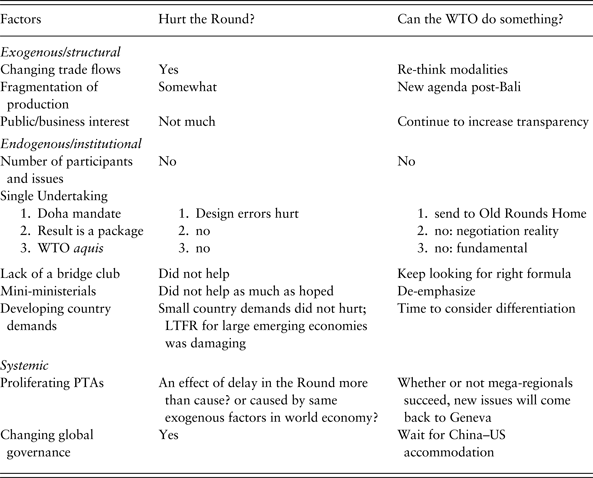
The premise of this article, therefore, is that we need a parsimonious diagnosis of the Doha impasse before trying to think about what comes after Bali. We also need a robust diagnosis before choosing to prescribe anything from the pharmacopeia of remedies for what ails the Round. If we fix some aspect of the WTO, can we expect a different outcome next time? If the problem is outside the WTO, if it is structural, will an institutional fix work? The elements of my diagnosis are summarized in Table 1.
Diagnosis and treatment of the Doha Round

4.1 First diagnose …
Taking exogenous structural factors first, the world changed in the course of the Round, although the ability to perceive that change varied among negotiators. The trends discussed in Section 1 above are clear in retrospect, but the way they altered everyone's perceptions of the outside options may have happened too slowly to be obvious. Negotiators can be trapped by old ideas, holding out for the wrong things, or things no longer attainable. Misconceptions about agriculture's winners and losers, for example, probably contributed to the deadlock (Panagariya, Reference Panagariya2012). The deal imagined in 2001 was no longer interesting in 2008, and it is not interesting now, especially given the apparent increase in Chinese and Indian domestic support highlighted in a March 2014 Cairns Group non-paper. Everyone may come to regret not agreeing to bindings on 2008 applied rates of subsidies given the increased spending that seems to be built into the new US Farm Bill. The problems with the modalities discussed above no doubt exacerbated the impact of structural change, contributing to the greater appeal of the outside options for many Members. In short, the deal on offer was not rich enough for the major players to be worth the bother. Shifts in public opinion and business boredom did not help the Round, but were not causal in creating the impasse.
Turning to endogenous institutional factors, the number of participants and the complexity of the agenda did not create the deadlock. The asymmetry of interests among the leading players alone would be enough to ensure that an outcome would only be possible with a package treated as a Single Undertaking. Members want different things from the WTO, all of which were in the original overly large Single Undertaking, but the breakdown was on core issues. It is the leads that were the problem in this opera, not the chorus, even if the leads sometimes played to the gallery. Bali showed that a mini-package is possible, but also showed that single-issue deals are hard, even on something as useful, and as internally balanced, as the Trade Facilitation Agreement. The Bali package only succeeded with the inclusion of development issues, and agriculture. And even agriculture had to have balancing issues within that micro part of the Bali mini-package.
Some think that developing countries hold the trading system hostage for irrelevant issues, but the lengthy negotiations on market access exemptions for minnows were simply a matter of being sure that the minnows would know how to live with whatever the whales agreed, and since the whales had not agreed, talking about the concerns of minnows was not a source of delay. We have no idea what smaller players would do if the largest agreed among themselves, and showed commitment to a stronger more open trading system. Most small Members are represented in clubs, so it was never hard to configure a representative Green Room, or Fireside Chat, or Enchilada Group. Members may not yet have found the right configuration for a bridge club, and new players may not really know how to behave in one. Changing tables will not change the institutional dynamic.
The fundamental puzzle remains that the leading Members did not and do not agree, and that is not a process issue. IF the G-5 had agreed among themselves as late as April 2011, and IF the other six in the G-11 had also agreed, would it have been possible to get the rest of the membership to agree on a Doha Round outcome? We cannot know, but I would give a positive estimate.
4.2 … then treat
Analysts often prescribe institutional reform as a solution to the WTO's negotiating difficulties, but given my diagnosis, treatment implies accepting that some factors are beyond the reach of the WTO, while others were not significant to the outcome. Under assumptions of bounded rationality, in which future institutional choices are heavily constrained by the status quo, Members of the WTO are unlikely to make radical departures from the current system unless it proves no longer ‘good enough’ (Jupille et al., Reference Jupille, Mattli and Snidal2013).
Treatment must begin by accepting the outcome: the original Doha Round is dead. Nobody wants to preside over this first failure by signing the death certificate, but the grieving relatives should send Doha to the Old Rounds Home and start afresh on reconfiguring the agenda and modalities in a way that would allow them to harvest the important work that was done during the Round. The Bali commitment to agree on a new work plan by the end of 2014 is an opportunity not to be missed, the deadlock over the Trade Facilitation Agreement notwithstanding. Whether or not India finds a way to compromise on the Bali package without appearing to back down, the full Doha Round package as it stood in July 2008 or April 2011 will never be agreed. The texts on the table in July and December 2008 do not provide a basis for progress, but the issues have not gone away. No new package, or series of packages on the Bali model, can be crafted by pretending that all the delicate compromises made during the Doha Round never took place. Similarly, the inherent problem in finding a balance between agriculture, NAMA, and services remains, and that balance is still important for the leading players. The Indian objective on food security may not be sensible, but until progress towards long-term compromise is evident, many other developing countries will remain sympathetic to the way that issue has been linked to ratification of the Trade Facilitation Agreement. Although the biggest beneficiaries of improved trade facilitation will be developing countries, often in increasing trade with each other, suspicions of developed countries impeded the negotiations and may delay implementation. Measures to strengthen mutual confidence among Members may be needed. Simplification of market access formulas of the sort suggested by Crawford Falconer in 2007 might be helpful on agriculture and NAMA.
The WTO need not worry over much about the noodle soup of bilateral and regional trade negotiations. In the improbable event that all the negotiations succeed, and that strong obligations are actually implemented, firms will have trouble learning how to navigate the thicket of rules without some kind of multilateral rectification. One thing is clear: with the exception of the vital trade facilitation negotiations, the Doha Round never got to grips with the regulatory issues affecting both goods and services that can be hugely disruptive to global value chains. I have a degree of skepticism that the majors can successfully conclude ambitious deals on such domestic issues outside Geneva, not least because China, India, and Brazil are not participating in the mega-regionals, and probably will not. If their acceptance of any new twenty-first century disciplines is thought important, it seems likely that those disciplines will eventually have to be negotiated at the WTO. If TPP and TTIP meet their regulatory cooperation objectives, matching what already exists in the Canada–US Regulatory Cooperation Council, and what is said to exist in the draft Canada–EU agreement, then multilateral stitching together of overlapping regional regimes will be all the more essential. A new Round seems inevitable, and sooner rather than later.
The WTO managed to launch new negotiations at Doha in 2001. What changed during the course of the Doha Round that undermined the possibility of success? China. The temptation is to think that the problem is concluding a new agreement, and that something is wrong with the WTO if it cannot do that. But failure to conclude an agreement may not signal a negotiation failure, any more than all the frenetic regional negotiations promise success. Many of the Doha Round problems were due to a general malaise in multilateralism and to structural changes in the world economy that undermined the premises of the Round. Power matters, it has shifted, and the system has not caught up. Until the US and China learn how to develop a trans-Pacific accommodation comparable to the one painstakingly established across the Atlantic, new negotiations will be stymied. That accommodation will require a recognition by both of them that China now has a leadership role in global governance, and it will probably have to be a discussion that includes money, the environment, and security, not just trade. Improvements in how the WTO negotiates are desirable, but the Doha Round did not fail for institutional reasons.