Outcome research has focused mainly on early in-hospital complications and survival after surgery for CHD. Reference McCracken, Spector and Menk1–Reference Raissadati, Nieminen, Jokinen and Sairanen3 However, the vast majority of patients are now surviving decades after their operation, effectively leaving a significant proportion of patients out of the scope of said outcome measures. Reference McCracken, Spector and Menk1–Reference Raissadati, Nieminen, Jokinen and Sairanen3 As a result, more effort should be placed on measuring postoperative morbidity and quality of life after congenital heart surgery. Reference Saha, Potiny and Rigdon4–Reference Moons, Van Deyk and De Bleser6
It is increasingly recognised that patients remain at risk for late sequelae after congenital heart surgery. Reference McCracken, Spector and Menk1,Reference Raissadati, Nieminen, Haukka, Sairanen and Jokinen2,Reference Saha, Potiny and Rigdon4 Heart failure and arrhythmias are common complications among patients and represent the two most common causes of death both early and late after congenital heart surgery. Reference Raissadati, Nieminen, Haukka, Sairanen and Jokinen2 Only limited research has been carried out in noncardiac morbidity after congenital heart surgery, with the majority of studies limited to single centers, small patient populations, single defect groups, or suboptimal follow-up coverage.
We previously examined late mortality and causes of death after congenital heart surgery. Reference Raissadati, Nieminen, Haukka, Sairanen and Jokinen2,Reference Raissadati, Nieminen, Jokinen and Sairanen3 In this retrospective investigation we combined data from four Finnish national databases to assess late morbidity after congenital heart surgery based on purchases of prescription medications.
Materials and methods
The Finnish Ministry of Social Affairs and Health granted permission for this study, and the ethical committee approved the research protocol.
Patients and data collection
We obtained patient- and operative data from the custom-built ProCardio version 8 (Research Registry of Pediatric Cardiac Surgery, Melba Group, Helsinki, Finland) database running on Filemaker Pro version 8.5 (Filemaker Inc, CA, USA), which stores data on all paediatric congenital heart surgery performed since 1953 in Finland at five university hospitals (Helsinki, Kuopio, Oulu, Tampere, and Turku) and one regional hospital (Aurora Hospital, Helsinki). Since 1997 all congenital heart surgery have been centralised to Helsinki University Central Hospital. We excluded patients who underwent closure of a patent ductus arteriosus at an age of ≤ 30 days due to the high incidence of prematurity among this population. We also excluded isolated pacemaker implantations and patients with known mental disability. Mental disability was defined using standardised assessments of IQ. Only patients who survived their first operation were included (>30 days after the operation). Patient data were obtained from January 1966 to December 2009. The Finnish national medical special reimbursement program was established in 1966, prompting us to exclude all patients who underwent their first surgery before 1966.
The Finnish Population Registry provided the vital status and date of death for all patients. Statistics Finland supplied us with four sex-, birthdate, and hospital district-matched control patients per patient, along with dates of death for controls.
Every registered Finnish resident with a Finnish identity code is partly reimbursed for the majority of prescription medications that they purchase. This reimbursement is provided by The Social Insurance Institution of Finland (Kela), which provides social security benefits to Finnish residents. 7 Morbidity was assessed by inspecting prescription medication purchases between 1999 and 2012. Kela provided us with the Anatomical Therapeutic Chemical Classification System identifier with a 7-digit accuracy, allowing us to assess the exact subclass of medications that the patients purchased. We also received information on the date of purchase and indication for the prescription when available. Medications were grouped according to the official Anatomical Therapeutic Chemical Classification System classification system. To simplify analyses, we further divided medication Anatomical Therapeutic Chemical Classification System groups into short-term and long-term medications based on the usual length of use. Short-term medications were used for a maximum of weeks, whereas long-term medications for months or years, with no overlap between medications in these groups.
Study design
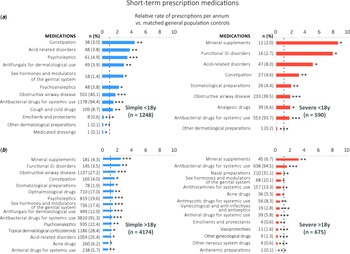
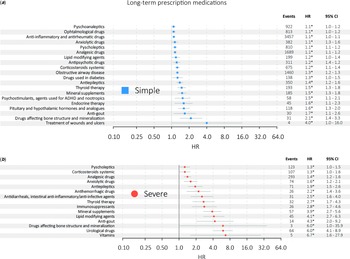
Medication groups are presented in figures and tables with an Anatomical Therapeutic Chemical Classification System (ATC) specificity of three characters. For short-term medications, the data are presented as the mean number of medication purchases by ATC-coded medication group per year between 1999 and 2012. The relative rate of short-term drug purchases was calculated by dividing the mean number of purchases in the simple and severe defect groups with that of the general population and presented as bar graphs in Figure 1. For long-term medications, the data are presented as hazard ratios for the purchase of medications compared to the general population shown in Figure 2.
Relative rate of short-term prescription medications by defect severity and age group compared to the corresponding general population. An RR above 1 indicates a higher rate of purchases of said medication among patients. We only included ATC medication groups with a statistically significant result. A) RR of short-term prescription medications among patients <18 years of age. B) RR of short-term prescription medications among patients >18 years of age.*p < 0.05, **p < 0.01, ***p < 0.001.

Hazard rate of non-cardiovascular long-term prescription medications for A) simple defects and B) severe defects compared to the general population.

Follow-up for long-term medications started at the first operation or January 1, 2000, which ever was later, and ended at death, date of emigration, or 31 December, 2012. We applied a one-year wash-in period for all first purchases of medications. As such, even though the prescription data were acquired since January 1, 1999, only prescriptions acquired after the year 2000 were counted as the first prescription.
Each patient was assigned one primary diagnosis from a severity-based hierarchical list of cardiac defects: patent ductus arteriosus, atrial septal defect, coarctation of the aorta, ventricular septal defect, tetralogy of Fallot, transposed great arteries, hypoplastic left heart syndrome, and univentricular heart. All remaining cardiac defects were collectively referred to as miscellaneous, including, for example, truncus arteriosus, total and partial atrioventricular canal, congenitally corrected transposed great arteries, pulmonary stenosis, total and partial anomalous pulmonary venous return, partial anomalous pulmonary venous drainage, Ebstein anomaly, interrupted aortic arch, isolated valve defects, aortopulmonary window, vascular ring, trauma, pericardial disease, aortic aneurysms, and heart transplants. For patients with several cardiac defects, we chose the hierarchically most severe condition to avoid overlap of defects such that simple defects were truly isolated malformations and not part of a more complex defect. Reference Nieminen, Jokinen and Sairanen8,Reference Carlgren, Ericson and Källén9 To simplify the analyses, we dichotomised defect severity into simple (patent ductus arteriosus, atrial septal defect, coarctation of the aorta, and ventricular septal defect) and severe (tetralogy of Fallot, transposed great arteries, hypoplastic left heart syndrome, and univentricular heart) defects.
Statistics
We compared the annual number of short-term medications purchased by patients to their corresponding general population controls in Figure 1. Student’s t test was used to acquire p-values in this model. Hazard ratios for first long-term medication occurrences were obtained using matching group stratified Cox proportional hazards regression models. We analysed the prevalence of polypharmacy separately for patients who were ≥18 and <18 years of age at 1999. Results for the young cohort of patients is presented in the supplementary data. We utilised the “hclust” with the “complete” method called from the “heatmap” function in R to perform hierarchical clustering analyses using Euclidean distances. Two-tailed P-values <0.05 or 95% confidence intervals not including the value 1 were considered statistically significant. We calculated Q-value estimates to control for false discovery rates, including only p-values that crossed the threshold of significance. Standard deviations are reported with mean values. Analyses were carried out using R program (R Development Core Team, Vienna, Austria, 2011) and IBM SPSS Statistics version 25.0 (SPSS, Inc., Chicago, Illinois).
Results
Patient demographics
After excluding patent ductus arteriosus operations at <30 days of life, we identified 10,635 patients who underwent congenital heart surgery between 1953 and 2009. After excluding patients operated before 1966, early deaths (<30 days after first operation) and patients with known mental disabilities, 8631 patients remained. Eight patients were excluded due to insufficient data. Thus, follow-up coverage was 99.9% with 8623 patients and a mean follow-up time of 23 years (SD ± 12.1 years).
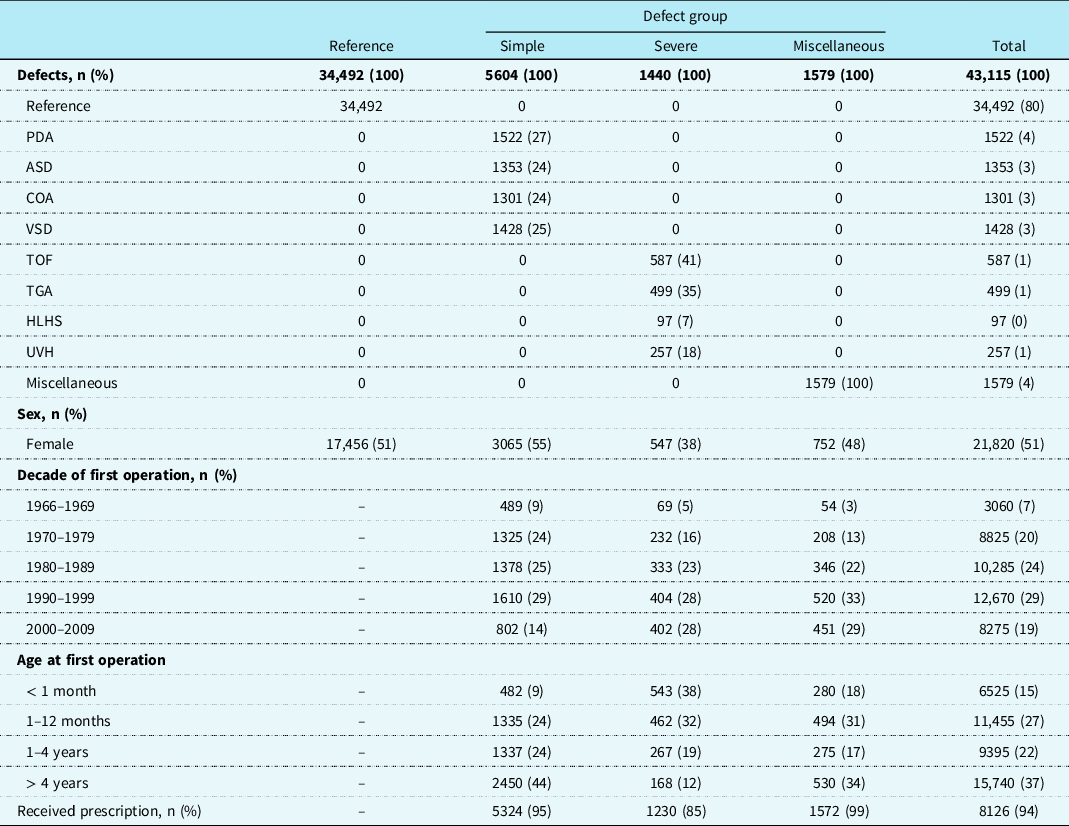
The sex ratio was equal among simple defects and male-dominant among severe defects (Table 1). The majority of patients were >4 years and <1month of age at their first operation in the simple and severe groups, respectively. All in all, 8126 (94%) patients required prescription medications between 1999 and 2012.
Characteristics of patient population

PDA, patent ductus arteriosus; ASD, atrial septal defect; COA, coarctation of the aorta; VSD, ventricular septal defect; TOF, tetralogy of Fallot; TGA, transposition of the great arteries; HLHS, hypoplastic left heart syndrome; UVH, univentricular heart defect
Short-term medication use
The number of prescriptions per year is presented in Supplemental Table 1, and the relative rate of purchases by age group is presented in Figure 1.
Functional gastrointestinal disorders and obstructive airway disease were the most common indication for short-term medications among both simple and severe defects relative to the general population (Fig 1). Propulsives represented the most common subgroup of medications purchased for functional gastrointestinal disorders. Medication for constipation was significantly more common among patients than the general population.
In absolute numbers, systemic antibiotics were the most purchased short-term medication among patients, purchased significantly more than the general population (93% patients vs. 88% controls, Fig 1). Beta-lactams, macrolides, and tetracyclines were the most common antibiotics prescribed, in that order of frequency. Patients with simple defects also required topical antifungals and gynaecological anti-infectives significantly more often than the general population (Fig 1).
Antidepressants (psychoanaleptics), hypnotics, and sedatives (including barbiturates, benzodiazepines, and melatonin) were significantly more common among patients with simple defects compared to their corresponding controls (Fig 1). This held true when stratified for age (Fig 1A). Fifteen percent (15%) of all patients required antidepressants (within the ATC group psychoanaleptics) and 8% anxiolytics (within the ATC group psycholeptics). Anxiolytic use was particularly common among young patients with simple defects (Fig 1A). Young patients with severe defects used analgesic medications more frequently than the general population, most commonly acetaminophen and opioids (Fig 1A).
Long-term medication use
The hazard ratios for long-term medication use by defect severity are presented in Figure 2 and by defect subgroup in Supplemental Table 2.
Cardiovascular drugs were the most common group of long-term medications purchased by patients (2996 patients, 35%) and are presented in the supplemental data (Supplemental Table 2).
Patients with patent ductus arteriosus and atrial septal defect required medications for diabetes significantly more often than the general population (Fig 2 and Supplemental Table 2). Patients with patent ductus arteriosus, coarctation of the aorta, and univentricular heart also required lipid-lowering medications, particularly simvastatin, significantly more frequently than the general population (Fig 2 and Supplemental table 2).
Epilepsy was significantly more common among patients compared to the general population (Fig 2). Antipsychotics and anxiolytics were also significantly more often prescribed topatients than the general population (Fig 2). Patients with simple defects required triptans for migraine episodes more often than the general population (Fig 2). Medications for attention deficit hyperactivity disorder were more common among patients with ventricular septal defect, tetralogy of Fallot, and transposed great arteries compared to the general population (Fig 2 and Supplemental Table 2).
Patients with transposed great arteries required antineoplastic medications more often than the general population (Supplemental Table 2). Antimetabolites, particularly methotrexate, were the most common medications within this group and were most frequently prescribed for rheumatic disease. Patients with patent ductus arteriosus and atrial septal defect also required anti-estrogens, gonadotropin releasing hormone analogues, and aromatase inhibitors more frequently than their control population. These agents were classified as endocrine antineoplastic agents and were used for the treatment of breast cancer, prostate cancer, and endometriosis (Fig 2 and Supplemental Table 2).
Inhaled agents for obstructive airway disease and anti-inflammatory agents were significantly more common among both simple and severe defects compared to the general population (Fig 2). Also, patients required systemic corticosteroids more often than the general population, most commonly for rheumatic disease, but also shorter courses for asthma exacerbations. Antigout medications were more common among patients with patent ductus arteriosus, coarctation of the aorta, tetralogy of Fallot, and univentricular heart; and hypothyroidism was more common among patent ductus arteriosus, atrial septal defect, ventricular septal defect, and univentricular heart patients compared to the general population (Fig 2 and Supplemental Table 2). Finally, patients with severe defects required intestinal anti-inflammatory agents, particularly sulfasalazine and mesalazine, for inflammatory bowel disease more frequently than the general population (Fig 2).
Sildenafil was the most common medication within the urological class, most frequently used for pulmonary hypertension among patients with single ventricle defects. For patients with ventricular septal defect and coarctation of the aorta, on the other hand, tamsulosin for benign prostatic hyperplasia and oxybutynin for urinary frequency and incontinence were the two most dominant urological drugs used (Supplemental Table 2).
Polypharmacy
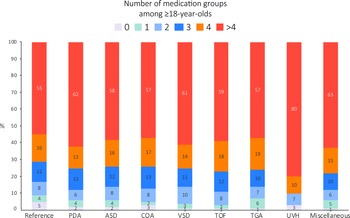
The prevalence of polypharmacy among adult patients and children is presented in Figure 3 and Supplemental Figure 1, respectively.
Prevalence of polypharmacy among patients that were ≥ 18 years of age at 1999, with their respective control patients. Numbers in the columns represent the percentage of patients within each stack. PDA; patent ductus arteriosus; ASD, atrial septal defect; COA, coarctation of the aorta; VSD, ventricular septal defect; TOF, tetralogy of Fallot; TGA, transposition of the great arteries; UVH, univentricular heart.

All in all, 7659 patients (89%) required medications from two or more ATC-groups and one-third required medications for diseases of at least five different organ systems (Fig 3 and Supplemental Figure 1). Polypharmacy was evident among all defect severities, particularly among patients with single ventricle morphology.
We performed clustering analysis with combined dendograms and heatmaps to investigate patterns of association between different classes of medications and similarities between different defect groups in terms of medication needs among adult (≥18-year-old) patients (Supplemental Figure 2). Generally, cardiovascular medications and anticoagulants (blood and blood forming agents) clustered together (Supplemental figure 2A). Notably, patients with coarctation of the aorta were more closely clustered with tetralogy of Fallot and transposed great arteries patients than with other simple defects, highlighting the relatively high morbidity among this otherwise structurally simple defect group (Supplemental Figure 2A and B). Within cardiovascular medications, peripheral vasodilators, lipid-modifying agents, and calcium channel blockers were most commonly purchased together (Supplemental Figure 2B).
Young patients also had a higher prevalence of polypharmacy among all defect groups compared to their matched control population, with more frequent polypharmacy among severe defects (Supplemental Figure 1).
Discussion
In the present study, we obtained data regarding all prescription medications filled by congenital heart surgery patients over a period of 13 years to determine their overall morbidity. With the excellent follow-up coverage enabled by the national Finnish registers, we were able to obtain to our knowledge one of the most comprehensive sets of data on late morbidity by disease group after congenital heart surgery to date.
Cardiovascular morbidity
All defect groups required cardiac glycosides, particularly digoxin, more frequently than the control population. In Finland, the most common indication for digoxin is heart failure, particularly in the setting of chronic atrial fibrillation. Chronic heart failure is the most common cause of death after congenital heart surgery and is an established late complication among patients with CHDs mostly due to residual defects, pulmonary hypertension, or suboptimal haemodynamics. Reference Raissadati, Nieminen, Haukka, Sairanen and Jokinen2,Reference Videbæk, Laursen, Olsen, Høfsten and Johnsen10
Patients required medications for diabetes, hypertension, and hyperlipidaemia more often than the general population. These findings are concerning for a higher risk of cardiovascular disease among the congenital heart surgery population, which is already evidenced by a higher need for betablockers, ACE-inhibitors, and diuretics among patients. Notably, patients with simple defects required nitrates for coronary artery syndrome more frequently than those with severe defects, which most likely reflects the older age of this subgroup of patients. Previous studies have found a high incidence of type 2 diabetes after congenital heart surgery, more so among severe defects, which was not the case among our patient population with severe defects. Reference Madsen, Marino and Woo11 In the case of severe defects or defects that have required prolonged cardiopulmonary bypass, a potential etiology is the detrimental effect of chronic hypoxia on pancreatic beta-cells, as demonstrated in both animal and human models. Reference Sherwani, Aldana and Usmani12 In the case of simple defects, however, the high incidence of diabetes and hypertension, as indicated by our results, could be secondary to poor lifestyle choices. Reference Shustak, McGuire, October, Phoon and Chun13,Reference Moola, Fusco and Kirsh14 Obesity and metabolic disease are recognised complications among patients with CHDs with over a quarter of the population affected. Reference Pinto, Marino and Wernovsky15,Reference Pemberton, McCrindle and Barkin16 The reason is likely multifactorial, including restrictions in physical activity, overtreatment of undernutrition, and poor parental lifestyle. Reference Sonneville, Rifas-Shiman, Kleinman, Gortmaker, Gillman and Taveras17,Reference Longmuir, Brothers and de Ferranti18 Families may maintain inappropriate diets and physical activity restrictions for their children due to misplaced fear of complications or inadequate weight gain, instead of an appropriate response to the temporal changes in these requirements for their children. Reference Longmuir, Brothers and de Ferranti18
Non-cardiovascular morbidity
Patients required on average more frequently antineoplastic medications compared to the general population, particularly for breast and prostate cancer. Increased risk for cancer among CHD patients is a recognised late complication, postulated to occur due to the high radiation from cardiac procedures and imaging. Reference Gurvitz, Ionescu-Ittu and Guo19,Reference Cohen, Liu and Gurvitz20 Cancer may also present as part of a constellation of disease among patients with specific chromosomal defects. Although we removed patients with mental disability from the final patient population, some chromosomal defects may still have been included. Nevertheless, our results support these findings and underscore the importance of acknowledging this risk among patients with CHDs. However, our data does not include the IV antineoplastic medications administered in a hospital setting.
Patients frequently required medications for infections and autoimmune diseases. One study described an increased rate of autoimmune diseases among patients who underwent early congenital heart surgery with a thymectomy, suggesting a possible immunologic etiology behind this phenomenon. Reference Gudmundsdottir, Söderling and Berggren21 Other studies have described an increased rate of atopic skin disease and allergies among patients that undergo thymectomy, mostly due to aberrant T regulatory cell development. Reference Tulic, Andrews and Crook22 Also, studies have shown that despite age-related thymic involution, the thymus maintains a sizeable output into late adulthood. Reference Douek, McFarland and Keiser23 It may be possible that early thymectomy could affect the immunological homeostasis among patients with CHDs. However, results from previous reports are ambiguous and thus challenging to interpret. Reference Roosen, Oosterlinck and Meyns24
Notably, patients required medications for mental health disease more often than the general population. Studies have reported an up to 30% prevalence of depression among patients. Reference Freitas, Castro and Sarmento25,Reference Pauliks26 Parent-reported results have also noted increased behavioural dysregulation among children with CHDs, which could reflect later poor academic performance and mental health issues. Reference Fredriksen, Mengshoel, Frydenlund, Sørbye and Thaulow27 Moreover, learning disabilities, attention deficit disorder, and overall poor neurodevelopmental outcome are increasingly recognised issues among patients with CHD. Reference Marino, Lipkin and Newburger28 A number of causes have been described, including altered brain maturation, hypoxia, and early exposure to anesthetics. Reference Licht, Shera and Clancy29–Reference Wilder, Flick and Sprung31 The link between cardiovascular disease and depression is well-recognised, which is most likely particularly true among this heavily comorbid patient population. Reference Lichtman, Bigger and Blumenthal32 Moreover, we recently found that patients with CHD were significantly disadvantaged from an educational and employment standpoint compared to the general population, which could also propagate mental disorders. Reference Raissadati, Knihtilä and Pätilä33
Interestingly, patients required medications for functional gastrointestinal disorders more often than the general population. One possible explanation is their heavy burden of comorbidities, including mental health disorders, and polypharmacy, which increases the risk of side-effects, often manifesting as GI disorders. Finally, the aforementioned likely lack of physical activity is a risk factor for functional GI disorders, notably constipation.
Polypharmacy
Finally, polypharmacy was highly prevalent among all defect groups and the reference population. A vast majority of all patients required at least two groups of medications regardless of the severity of the defect. Two notable findings in the cluster analysis were the clustering of coarctation of the aorta with severe defects and that of tetralogy of Fallot with simple defects in terms of cardiovascular medication. These results highlight the notable long-term morbidity of patients with coarctation of the aorta; an otherwise relatively simple structural defect.
Limitations
First, with retrospective cohort studies, one should always acknowledge the risk for selection and procedure bias. Second, criteria for receiving refunds for medications may have changed over the study period, which could leave out a portion of the drug purchases included in this study. Third, patients with CHDs are more intensely monitored compared to the general population, which may lead to more sensitive diagnosis of chronic diseases, such as diabetes or hypertension. Fourth, prescriptions acquired before 1999 were not available to us, leaving a significant proportion of data for patients operated prior to that date outside the scope of this study. As such, our data are left-truncated. Fifth, over-the-counter medications and medications administered in hospitals were not included in this study. Finally, heterogeneity in practice of healthcare providers may skew the results, which could partly explain the high number of digoxin prescriptions among the senior patient population.
Conclusions
Despite the vastly improving rates of survival after congenital heart surgery, patients remain at a significant risk for late sequelae. The rate of morbidity remains alarmingly high among this population, including both cardiovascular and non-cardiovascular diseases, as well as mental health disorders. Collectively, these results highlight the importance of long-term follow-up of patients after congenital heart surgery, regardless of the severity of their defect.
Supplementary material
To view supplementary material for this article, please visit https://doi.org/10.1017/S1047951121005060
Acknowledgements
We thank Statistics Finland and Kela for their assistance in obtaining the medication and mortality data of the patients and controls in this study.
Financial support
This study was funded by grants from the Emil Aaltonen Foundation and Medical Society of Finland.
Conflicts of interest
None of the authors have anything to disclose.