Implications
Cinta Senese is the most widespread Italian local pig breed and it represents the typical unimproved pig with high body fatness and low potential for lean tissue development. The protein requirements for this breed are not well known. The trial shows that a diet containing 80 g/kg of protein, which is a level usual in sylvo-pastoral resources, was inadequate because it caused higher fatness in carcass and paler colour and lower water holding capacity of meat. This deficiency was overcome with diet at 100 g/kg of protein that furnished the same results as diets at 130 and 160 g/kg of protein.
Introduction
The recent recovery of Italian autochthonous pigs characterised by low growth potential and high adipogenic capacity (Franci et al., Reference Franci, Gandini, Madonia, Pugliese, Chiofalo, Bozzi, Acciaioli, Campodoni and Pizzi2001; Gandini et al., Reference Gandini, Fortina, Franci, Madonia and Matassino2001) necessitates establishing a feeding strategy that provides the appropriate percentage of protein because it is difficult to apply the standard requirements that are recommended for the genetically improved pigs (National Research Council, 1998). Among the local Italian breeds, the Cinta Senese is one of the most interesting examples of the recovery and preservation of native germplasm (Franci and Pugliese, Reference Franci and Pugliese2007), its meat recently obtained the status of protected designation of origin (PDO) (EC, 2012). Cinta Senese pigs are often reared on extensive plots of natural pasture; therefore, their diet composition must be varied to compensate for the nutritive characteristics of the natural resources being rich in fibre and low in protein, while avoiding the integration of crystalline amino acids (AAs) into the diet to abide by the rules of an organic system (EC, 2008) or the ‘Cinta Senese’ PDO label (EC, 2012).
The protein requirements of the pig have been widely studied (see review of Whittemore et al., Reference Whittemore, Green and Knap2001) in terms of the growth and feeding efficiency of both the improved (Campbell et al., Reference Campbell, Taverner and Curic1984; Hansen and Lewis, Reference Hansen and Lewis1993) and autochthonous strains (Nieto et al., Reference Nieto, Lara, Garcia, Vilchez and Aguilera2003; Barea et al., Reference Barea, Nieto, Lara, Garcia, Vìlchez and Aguilera2006 and Reference Barea, Nieto and Aguilera2007). A limited number of studies have addressed the effect of the dietary protein levels on the carcass composition and, in particular, on the meat quality. The experiments using the improved pig strains generally utilised a wide range of dietary protein contents to study the effect of dietary protein on the carcass composition (Hansen and Lewis, Reference Hansen and Lewis1993; Chen et al., Reference Chen, Lewis, Miller and Yen1999). Employing a restricted range of protein content, Critser et al. (Reference Critser, Miller and Lewis1995), Tuitoek et al. (Reference Tuitoek, Young, de Lange and Kerr1997) and Tous et al. (Reference Tous, Lizardo, Vilà, Gispert, Font-I-Furnols and Esteve-Garcia2014) failed to find a significant effect on the carcass traits or the body composition. For breeds with a high ability to deposit fat, the range of the tested diets was at the lower level, which was low enough to result in a marginal deficiency, such as in an experiment on the Iberian strain (Barea et al., Reference Barea, Nieto, Lara, Garcia, Vìlchez and Aguilera2006), where differences in the carcass composition were found only for a diet with 6.2% protein content v. 8.4%, 10.6% and 12.8% protein content that, in turn, had similar effects.
This study belongs to a research project aimed at determining the protein requirement of Cinta Senese pigs relevant to their current rearing system and follows a previous investigation on in vita performance (Sirtori et al., Reference Sirtori, Acciaioli, Pugliese, Bozzi, Campodoni and Franci2010). The specific aim of this paper is to analyse how the carcass and meat traits of the Cinta Senese breed are influenced by the dietary protein content.
Material and methods
Animals and feeding
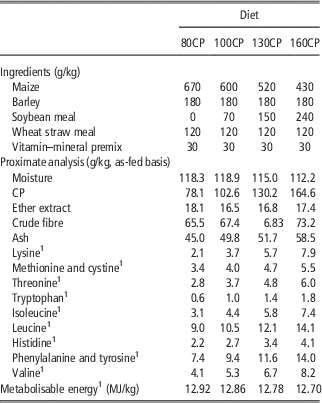
A total of 60 Cinta Senese pigs (28 gilts and 32 barrows) were equally distributed among four experimental dietary groups that were balanced for sex and live weight. Each group was subdivided in two pens of ~20 m2 each, again balanced for sex and homogeneous for weight, and containing the seven heaviest (three gilts and four barrows) and the eight lightest (four gilts and four barrows) subjects to reduce pen competitiveness. The eight pens were in the same building. At the beginning of the trial, the pigs were ~130 days old and weighed an average of 46.6 kg (50.3 and 43.4 kg on average for the heaviest and lightest pens, respectively). The animals in the groups were fed one of four diets (80CP, 100CP, 130CP and 160CP), which had different CP contents (~80, 100, 130 and 160 g/kg, respectively) and a similar metabolisable energy content (Table 1). Feeding occurred twice a day at a dose of 90 g/kg of metabolic weight (MW=live weight0.75), on the basis of the average pen weight, until the pigs reached 80 kg of live weight and 80 g/kg of MW subsequently, up to maximum of 2.5 kg/day pro capite. The diets were formulated to encompass a wide range of protein content and, in order to create diets with protein contents lower than that of cereals, wheat straw was used even though it is an unusual food for pigs. Moreover, to simulate the usual feeding regimen of the Cinta Senese pig (which may be in an organic rearing system), no synthetic amino acidic integration was provided. Therefore, the diets also differed in their essential AA contents. Table 1 reports the ingredients of diets, the proximate composition determined according to official methods (Association of Official Analytical Chemists (AOAC), 2000), and the essential AAs and metabolisable energy content calculated as sum of the relative tabulated values in the ingredients.
Composition and nutritive properties of the experimental diets for the Cinta Senese pig
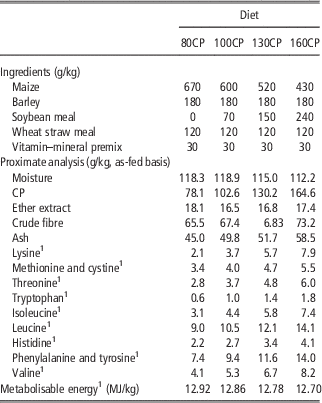
1 Determined as sum of the tabulated values of the ingredients.
Diets were administered to groups during the entire trial with no differentiation between the growing and fattening period. The effective amount of feed distributed per box was recorded daily. As no residues were left, the ration was considered totally ingested. Ration adjustment occurred every 3 or 4 weeks, when subjects were individually weighed.
Carcass and meat traits measurements
The feeding trial finished when animals reached the target slaughter weight of 145 kg, remaining on trial no longer than 289 days. Slaughtering of all animals in trial occurred on four different days, in which all the dietary groups and both sexes were adequately represented. After slaughter, the following measurements were obtained: carcass length and depth, backfat thickness (separately for inner and outer layers) at the first and last thoracic vertebra and at the gluteus medius (GM) muscle. The right side was dissected following Associazione Scientifica Produzione Animali (ASPA) methodology (Associazione Scientifica Produzione Animali, 1991), and the lean cuts (loin, neck, ham and shoulder with feet), fat cuts (backfat, belly, jowl and kidney fat) and bone cut (head) were weighed.
A portion of the loin (sample cut), including the second to the fifth lumbar vertebra and all the s.c. fat, was dissected into: total lean, longissimus lumborum (LL), psoas major (PM) and s.c. and i.m. fat and bone. The cross-sectional area of the LL at the second lumbar vertebra was measured by planimeter, following the profile traced on a transparent sheet.
On LL, moisture (by lyophilisation up to constant weight of the sample), intramuscular fat (IMF – as ether extract), protein and ash contents were determined (AOAC, 2000) and the following determinations were also carried out: (i) the pH at 45 min (pH45) and 24 h (pH24) postmortem using pH meter Delta Ohm HD 8705 (Delta Ohm S.r.L., Caselle di Selvazzano, Padova, Italy) with temperature probe TP870 and pH electrode Hamilton double pore. Calibration was performed automatically with pH 4.01 and 6.86. In pH measurements, the temperature probe automatically compensates the electrode temperature coefficient; (ii) the colour parameters CIE L* (lightness), a* (redness) and b* (yellowness), which were determined using a Minolta colorimeter CR-200 (Minolta Camera Co., Ltd, Osaka, Japan) with white and red calibration plate. The colorimeter was recalibrated to the two standards at the start of each measuring session; (iii) the water holding capacity (WHC), which was determined by the drip loss from slices stored horizontally for 48 h at 4°C, by the free water assayed using the filter paper press method (Grau and Hamm, Reference Grau and Hamm1952), and by the cooking loss in a water bath (until the internal temperature reached 70°C) of a sample of 100 g of weight and 3 cm of height and width; (iv) the Warner-Bratzler (WB) shear force on the raw and cooked meat measured using an Instron 1011 apparatus (Instron Ltd, High Wycombe, Bucks, UK) on cylindrical cores 2.54 cm in diameter (2 measures/sample).
Statistical analysis
Data were analyzed using Proc GLM of SAS (SAS, 2007) with the following model:
 $${\rm Y}_{{ijklm}} ={\rm }\mu {\plus}{\rm D}_{i} {\plus}{\rm G}_{j} {\plus}{\rm S}_{k} {\plus}{\rm P}_{{il}} {\plus}{\rm b}_{i} {\times}{\rm X}_{{ijklm}} {\plus}{\rm E}_{{ijklm}} $$
Where Y is the m th subject of the i th dietary group, j th gender, k th slaughter day of l th pen; D the diet effect (i= 1…4); G=gender effect (j=1, 2); S=slaughter day effect (k=1…4); P=pen effect within diet (l=1, 2); X=independent variable (BW or side weight) tested up to the second degree within diet; E=error random effect.
The second degree of covariate never reached significance and so only the linear one remained in the final model. In addition, the interaction, diet×gender did not reach significance (P>0.05) in a preliminary analysis and was removed from the final model.
Student’s t test was used to statistically test the differences between the least squares means.
The physical and chemical parameters of the meat were subjected to the principal component analysis (PCA, Naes et al., Reference Naes, Baardseth, Helgesen and Isaksson1996), using the Proc FACTOR of SAS (SAS, 2007) with varimax rotation, to assess the relationships among the traits as summarised in new variables.
Results
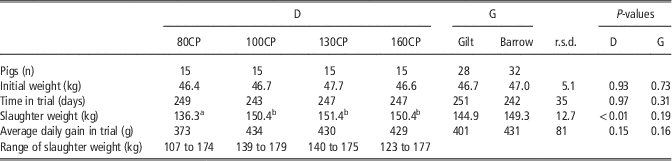
Table 2 shows a synthesis of in vita performances of experimental pigs. As explained in a previous paper (Sirtori et al., Reference Sirtori, Acciaioli, Pugliese, Bozzi, Campodoni and Franci2010), pigs that received the 80CP diet reached a lower slaughter weight at the end of the trial.
Weights and time in trial of the experimental Cinta Senese pigs
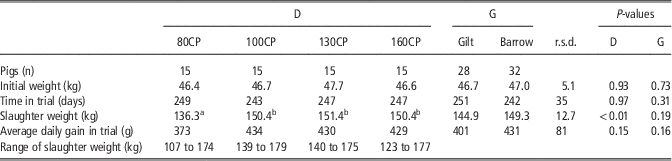
D=diet; G=gender.
a,bValues within criterion with different superscripts differ significantly at P<0.05.
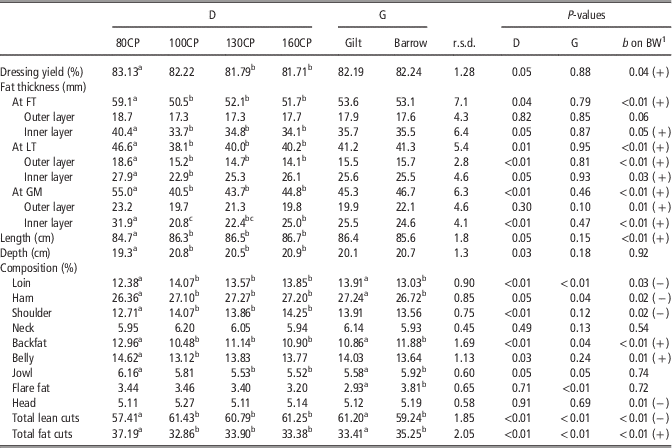
The results of the carcass characteristics are shown in Table 3. Pigs fed the 80CP diet had higher dressing percentage values, thicker backfat, particularly in the inner layer, and shorter and narrower carcasses than the pigs fed the other three diets (P<0.05). The side dissection confirmed that these pigs had fatter carcasses, as shown by the higher percentage of backfat, belly and jowl and the lower percentage of loin, ham and shoulder. The differences among the carcasses from the other three diet groups were sporadic and evident only in the backfat thickness in the inner layer of the GM locale, which was lower for the 100CP group compared with the 160CP diet group (P<0.05).
Effect of dietary protein content and gender on carcass traits and composition of Cinta Senese pig
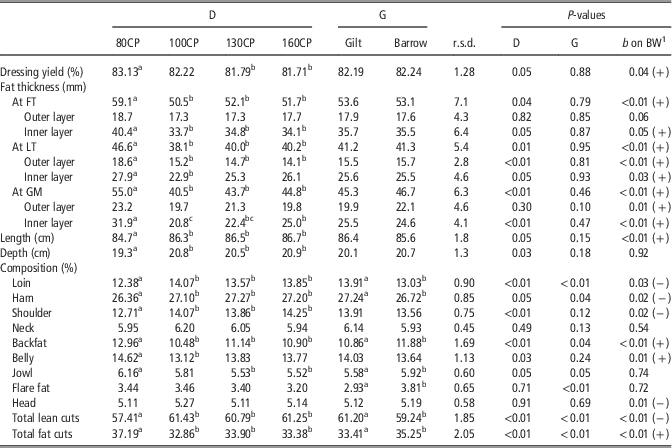
D=diet; G=gender; FT=first thoracic vertebra; LT=last thoracic vertebra; GM=m. gluteus medius.
Least squares means estimated at the BW of 147.1 kg.
1 (+,−) sign of linear regression coefficient on BW, when significant (P<0.05).
a,bValues within criterion with different superscripts differ significantly at P<0.05.
Gender had no effect on the carcass measurements; however, evaluating the side compositions revealed that the gilts had a larger loin and ham content and a lower content of backfat, jowl and kidney fat, and thus were leaner than the barrows.
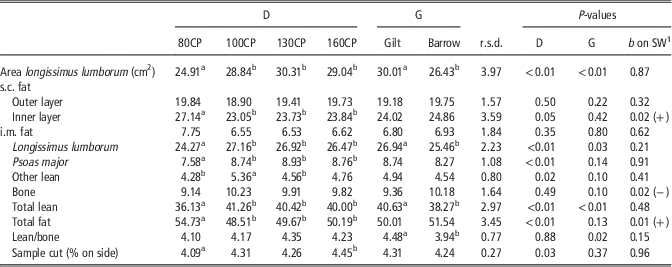
The sample cut composition analyses (Table 4) confirmed that the highest fatness and the lowest meatiness occurred in the pigs fed the 80CP diet. Specifically, among the fat deposits examined, only the inner layer of the s.c. fat was significantly (P<0.05) more developed in the animals from the 80CP group, which, in contrast, exhibited the lowest percentage of leanness of both the LL and the PM muscles. The minimal development of the LL in the 80CP group is consistent with its relatively smaller cross-sectional area, while the lowest incidence of the sample cut on side of the 80CP pigs (at least in absolute value) is consistent with the lowest percentage of their loin (Table 3), the region from which the LL derives. However, it should be noted that the four diets did not affect the lean/bone ratio.
Effect of dietary protein content and gender on sample cut composition (%) of Cinta Senese pig
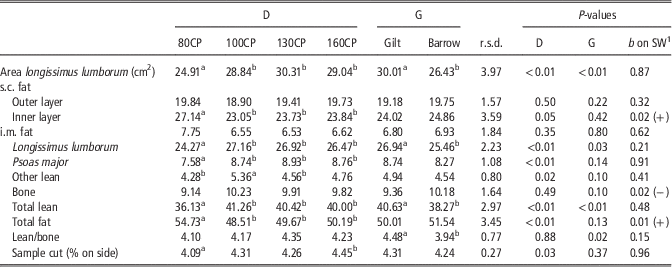
D=diet; G=gender.
Least squares means estimated at the side weight of 62.3 kg.
1 (+,−) sign of linear regression coefficient on side weight, when significant (P<0.05).
a,bValues within criterion with different superscripts differ significantly at P<0.05.
Gender, on the contrary, affected only the muscular development, with the gilts exhibiting a higher percentage of total lean and LL muscle (with larger cross-sectional area) and, consequently, a more favourable lean/bone ratio (P<0.05).
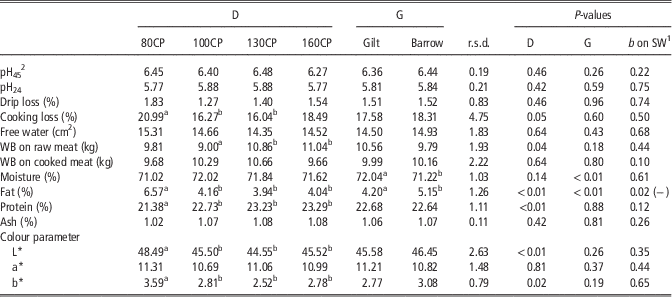
Table 5 shows the chemical and physical traits of the LL muscle. The diet did not influence the pH45 and pH24, whereas the 80CP diet resulted in (in absolute values) the poorest WHC, as determined by drip loss, cooking loss and free water, although a significant difference (P<0.05) emerged only for cooking loss in respect to 100CP and 130CP diets. The 100CP diet resulted in a more tender raw meat than did the 130CP or 160CP diets, but the differences in the WB shear force values disappeared when the meat was cooked. No dietary effects were observed for the moisture content of the LL, although the 80CP diet produced meat that was richer in fat and poorer in protein (P<0.05) than did the other three diets, which demonstrated analogous reciprocal behaviour. Finally, the meat of the animals in the 80CP group displayed higher values of the L* and b* parameters than did the counterparts. The influence of gender on the meat traits was evident only in the chemical composition, with the gilts possessing meat with a higher water content and a lower fat content (P<0.05) than those of the barrows.
Effect of dietary protein content and gender on chemical and physical traits of m. Longissimus lumborum of Cinta Senese pig
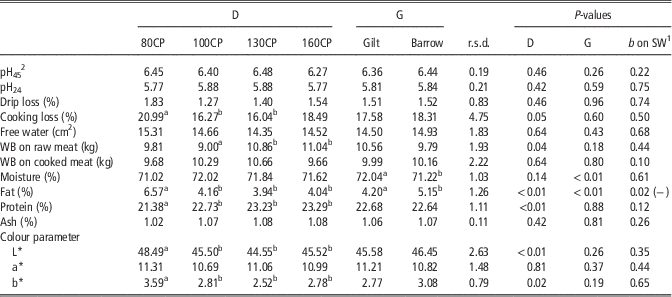
D=diet; G=gender; WB=Warner-Bratzler shear force; L*=lightness; a*=redness; b*=yellowness.
LS means estimated at the side weight of 62.3 kg. pH45, pH24=pH at 45 min and 24 h after slaughter.
1 (+,−) sign of linear regression coefficient on side weight, when significant (P<0.05).
2 41 observations.
a,bValues within criterion with different superscripts differ significantly at P<0.05.
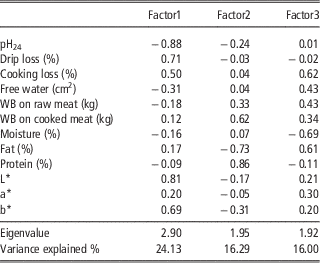
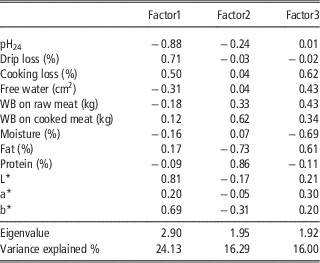
Table 6 shows the loading coefficients of the physical–chemical traits on the first three factors, which account for the overall >56% total variance. Considering 0.5 as the minimal threshold for a significant contribution of each variable of the factor, the analysis revealed that Factor1 combined the decrease in the pH24 value and the increase in the drip loss, the cooking loss, the lightness and the yellowness; Factor2 linked the tougher meat (primarily when it was cooked), the higher protein content and the lower fat content; and Factor3 described the connection between the higher cooking loss, the reduced moisture content and the higher fat content.
Loading vectors and eigenvalues for the first three principal component factors, taking as variables the chemical and physical traits of longissimus lumborum of Cinta Senese pig
WB=Warner-Bratzler shear force; L*=lightness; a*=redness; b*=yellowness.
pH24=pH at 24 h after slaughter.
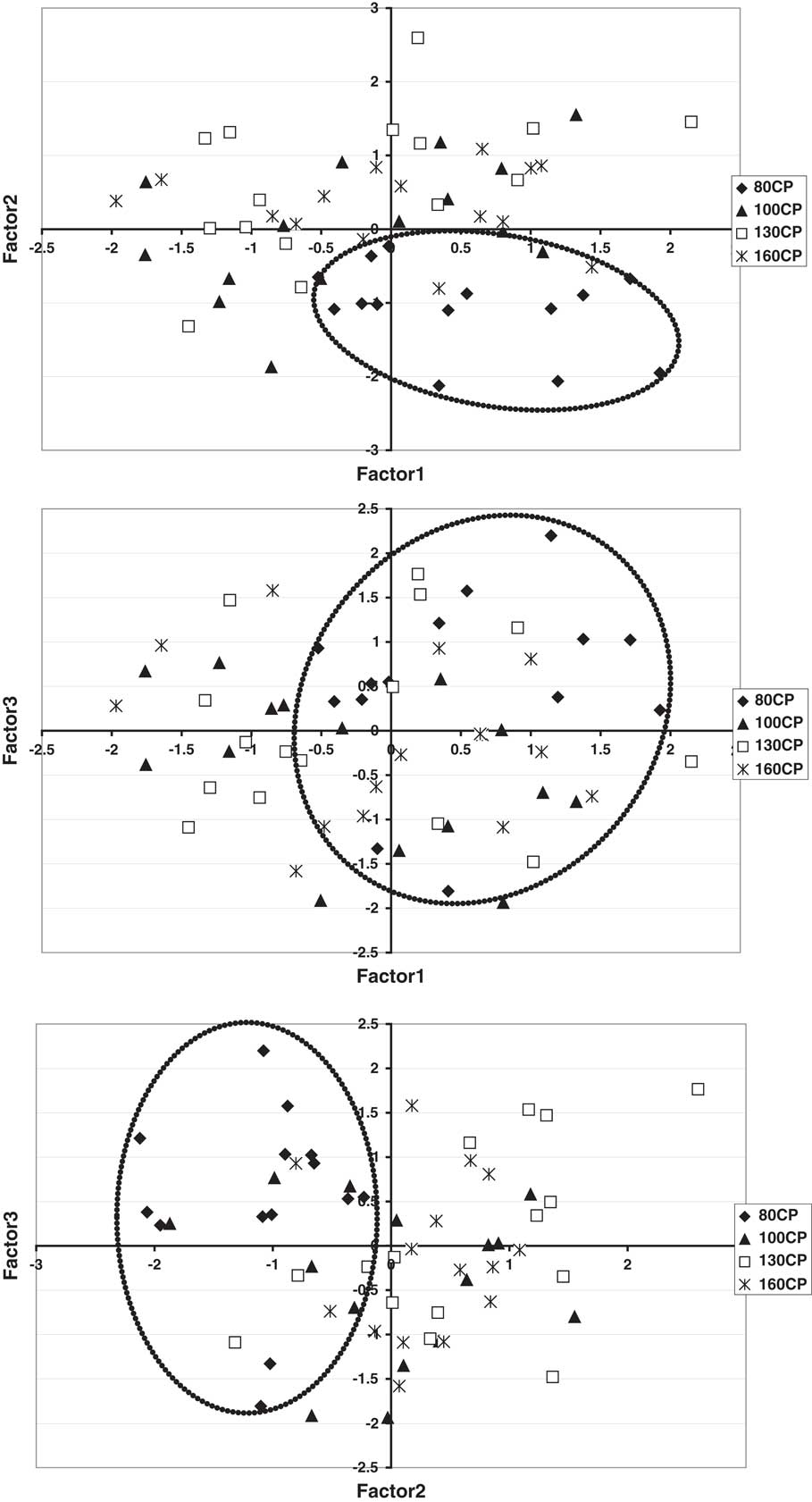
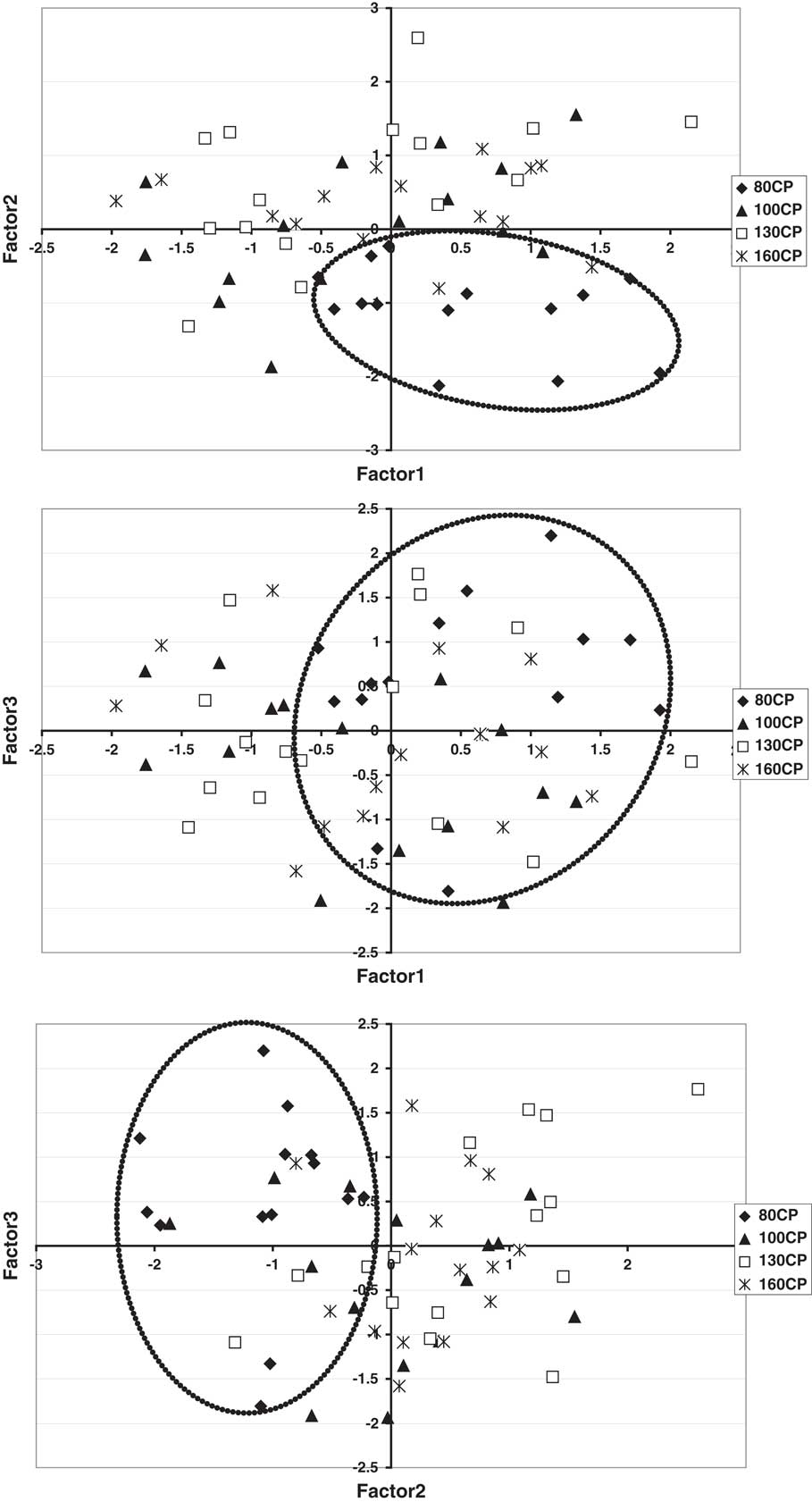
Plotting the three factors on a Cartesian axis (Figure 1) revealed that, on the whole, the meat produced by the 80CP diet could be discriminated from that of the other three diets, which, in turn, were nearly equivalent. In particular, the combination of Factor1 and Factor2 appeared to be the best discriminator, confining the samples from the 80CP diet group substantially in the fourth quadrant, with the Factor1 values being generally positive and the Factor2 values always being negative. Only sporadic observations from the other diets are represented in that quadrant. On the contrary, the other two combinations of the factors show a more confuse picture of spatial distribution of samples from the four diets.
Plot of the scores of Factor1 and Factor2; Factor1 and Factor3; Factor2 and Factor3 for Cinta Senese pigs belonging to the four dietary groups. The oval shape delimits all the values of 80CP diet.
Discussion
Cinta Senese pigs are usually reared in free-range system that exploits natural resources (grass, acorn, chestnut and root), but their diet is also supplemented with feed of commercial or farm origin (such as feed mixtures and cereals). However, the effective protein requirement for this breed has not been determined even though it is expected to be lower than that of the improved pig, such as that reported for the Iberian pig, another breed with a low potential for lean tissue development (Nieto et al., Reference Nieto, Lara, Garcia, Vilchez and Aguilera2003; Barea et al., Reference Barea, Nieto and Aguilera2007). The present study is part of a larger experiment designed to provide indications of the growth performance, carcass composition and meat characteristics of this breed, as determined by different protein levels in the diets. As in similar experiments on improved or unimproved pigs (Campbell et al., Reference Campbell, Taverner and Curic1984; Hansen and Lewis, Reference Hansen and Lewis1993; Barea et al., Reference Barea, Nieto, Lara, Garcia, Vìlchez and Aguilera2006), this trial tested a wide range of protein contents, starting with a value (80 g/kg) that is lower than that of cereals. This diet composition was attained by using straw meal, instead of the maize starch that has been utilised in the other trials (Campbell et al., Reference Campbell, Taverner and Curic1984; Le Bellego et al., Reference Le Bellego, van Milgen, Dubois and Noblet2001; Barea et al., Reference Barea, Nieto, Lara, Garcia, Vìlchez and Aguilera2006), to simulate the feeding of this breed that often eats fibre-rich natural resources (such as grass and roots).
The 80CP diet provided the least desirable outcomes, as was previously observed for the associated growth rate and feed efficiency values (Sirtori et al., Reference Sirtori, Acciaioli, Pugliese, Bozzi, Campodoni and Franci2010). The carcasses of the 80CP pigs were shorter and fatter than those of animals fed the diets with higher protein content, producing 7% less lean cuts than the average of the other three diets, mainly dependent on the loin (−11%), ham (−3%) and shoulder (−10%); moreover, their sample cuts were likewise deficient in the lean proportion because of the lesser development of the LL and PM muscles.
The greater fatness resulting from the 80CP diet was also evident in the composition of the meat (LL). The value of 6.5% IMF (50% greater than the values obtained from the other diets) is rather high also for Cinta Senese pigs compared with the results for the same muscle obtained in other experiments using this breed (Franci et al., Reference Franci, Bozzi, Pugliese, Acciaioli, Campodoni and Gandini2005; Pugliese et al., Reference Pugliese, Pianaccioli, Sirtori, Acciaioli, Bozzi and Franci2007; Sirtori et al., Reference Sirtori, Crovetti, Meo Zilio, Pugliese, Acciaioli, Campodoni, Bozzi and Franci2011), although it is consistent with the results obtained for other local Mediterranean pigs (Pugliese and Sirtori, Reference Pugliese and Sirtori2012). Notably, the dietary effect on the IMF content was compensated by an opposing trend for the protein content, whereas gender exerted its effect by balancing the level of fatness with the moisture content. A similar parallelism was also evident by examining the composition of the sample cuts.
Diets with similar low protein level have not been tested in analogous trials with the improved pig breeds, at least according to the available literature (Campbell et al., Reference Campbell, Taverner and Curic1984; Hansen and Lewis, Reference Hansen and Lewis1993; Critser et al., Reference Critser, Miller and Lewis1995; Tuitoek et al., Reference Tuitoek, Young, de Lange and Kerr1997; Chen et al., Reference Chen, Lewis, Miller and Yen1999), but such diets were used in experiments involving local pigs that are characterised by low muscle growth, such as the Iberian pigs (Barea et al., Reference Barea, Nieto, Lara, Garcia, Vìlchez and Aguilera2006 and Reference Barea, Nieto and Aguilera2007). In a study on Iberian pigs fed 12.8%, 10.6%, 8.4% and 6.2% ideal protein content from 50 kg of live weight (l.w.) until it reached 100 kg of l.w., Barea et al. (Reference Barea, Nieto, Lara, Garcia, Vìlchez and Aguilera2006) observed that only the 6.2% protein diet resulted in a lower lean content of the carcass and a higher percentage of dissectible fat in the ham and shoulder compared with those obtained from the other three diets. That result is in general agreement with the present findings but collocates the critical protein content at a lower value because ideal protein was employed in that trial. In contrast, in the present experiment, crystalline AAs were not integrated into the diet with the aim to simulate the current feeding system for the Cinta Senese pig that generally respects the rules of an organic system (EC, 2008) or of the ‘Cinta Senese’ PDO label (EC, 2012). On the other hand, diets at the lowest protein content, tested in the trial of Barea et al. (Reference Barea, Nieto, Lara, Garcia, Vìlchez and Aguilera2006) and in the present one, are peculiar in a sylvo-pastoral feeding system usual for the local pig, as Rodriguez-Estevez et al. (Reference Rodriguez-Estevez, Garcia, Pena and Gomez2009) demonstrated that Iberian pig, reared in the Dehesa, has a daily intake of about 3.6 kg of acorn endocarp and 0.4 kg of grass (as dry matter (DM)) with a dietary protein content of 6.5% (on DM basis).
The results of the present paper do not allow to discuss on the requirements for essential AA in the Cinta Senese, as the trial was not programmed for this aim. On the other hand, nospecific knowledge is available on essential AA requirement for local breeds and the studies, who used the ideal protein (i.e. Barea et al., Reference Barea, Nieto, Lara, Garcia, Vìlchez and Aguilera2006), calibrated the protein composition taking into account the requirements defined for the improved breeds. However, considering the lysine, the main limiting AA for pigs, the present research shows that a level of 2.1 g/kg is too low and detrimental for growth rate and lean development but levels from 3.7 up to 7.9 g/kg would provide analogous performances, when inserted in the amount of protein here tested (from 100 to 160 g/kg). It should be noted that in Iberian pig, Barea et al., (Reference Barea, Nieto, Lara, Garcia, Vìlchez and Aguilera2006) found that 0.42% of lysine was insufficient when placed in a 6.2% protein diet.
The differences in the carcass and meat composition among the three other diets that had a higher content of protein were not significant, thus confirming the results obtained with the Iberian pig in the aforementioned trial (Barea et al., Reference Barea, Nieto, Lara, Garcia, Vìlchez and Aguilera2006). Moreover, for improved pigs slaughtered at a weight of ~100 kg, Critser et al. (Reference Critser, Miller and Lewis1995), Tuitoek et al. (Reference Tuitoek, Young, de Lange and Kerr1997) and Dannenberger et al. (Reference Dannenberger, Nuernberg, Nuernberg and Priepke2012) found no significant effect on carcass traits of dietary protein levels ranging from 11.0% to 14.2%, 13.1% to 18.4%, or 15% to 19.6%, respectively. Only by using a wider range of dietary protein content (from 13% to 25%, and from 11% to 23%, respectively) Chen et al. (Reference Chen, Lewis, Miller and Yen1999) observed a linear effect on backfat thickness, and Hansen and Lewis (Reference Hansen and Lewis1993) a quadratic effect on percentage of lean of the carcass.
On the contrary, the reduction of dietary protein generally increased the IMF content (Doran et al., Reference Doran, Moule, Teye, Whittington, Hallett and Wood2006; Alonso et al., Reference Alonso, Campo, Provincial, Roncales and Beltran2010) but the effect seems to be determined more to lysine than protein restriction (Madeira et al., Reference Madeira, Costa, Alfaia, Lopes, Bessa, Lemos and Prates2013); moreover, the same protein and lysine reduction increased the IMF content in conventional crossbred pigs but not in Alentejano genotype, an autochthonous pig similar to Iberian strain (Madeira et al., Reference Madeira, Costa, Alfaia, Lopes, Bessa, Lemos and Prates2013).
As regards the other chemical–physical traits of the meat, in addition to the IMF content, the differences, if any, were significant only for the 80CP diet in relation to the other diets, and they involved the cooking loss and the L* and b* parameters of colour, all of which had the highest values for the meat produced by this diet. The other diets with higher protein content differed only in the toughness of the raw meat and thus appeared to produce meat with analogous qualities. This latter result is consistent with the literature that reports no influence of dietary protein restriction on L*, a*, b* colour values, pH, shear force and cooking loss of meat (Alonso et al., Reference Alonso, Campo, Provincial, Roncales and Beltran2010; Dannenberger et al., Reference Dannenberger, Nuernberg, Nuernberg and Priepke2012; Madeira et al., Reference Madeira, Costa, Alfaia, Lopes, Bessa, Lemos and Prates2013; Tous et al., Reference Tous, Lizardo, Vilà, Gispert, Font-I-Furnols and Esteve-Garcia2014).
The physical traits of meat generated by the diet with the lowest protein content (more loss after cooking, higher lightness and yellowness values) might be partially owing to the highest fat content which agrees with the report of Latorre et al. (Reference Latorre, Làzaro, Gracia, Nieto and Mateos2003), who showed that increased IMF content was associated with more intense colour of meat.
In order to thoroughly study the relationships among the physical and chemical characteristics, a PCA was performed using the varimax method, which optimises and balances the variance partitioning among the defined factors (SAS, 2007). PCA was often utilised to study the reciprocal relationships among quality traits of meat both in the swine (Alonso et al., Reference Alonso, Najes, Provincial, Guillén, Gil, Roncalés and Beltrán2012; Ros-Freixedes et al., Reference Ros-Freixedes, Sadler, Onteru, Smith, Young, Johnson, Lonergan, Huff-Lonergan, Dekkers and Rothschild2014), and in other species (Destefanis et al., Reference Destefanis, Barge, Brugiapaglia and Tassone2000; Santos et al., Reference Santos, Silva, Silvestre, Silva and Azevedo2008).
Among the first three factors, that explained >56% of the total variance, Factor1 provided connections among the WHC, the colour and the pH24 but not with the chemical composition, which, in turn, influenced the second and the third factors. Factor2 connected a low fatness to a high protein content and to the toughness of the cooked meat, while Factor3 linked a high fatness to a low moisture content and a high cooking loss. The associations found in Factor1 are consistent with the literature: Otto et al. (Reference Otto, Roehe, Looft, Thoelking and Kalm2004) and Ros-Freixedes et al. (Reference Ros-Freixedes, Sadler, Onteru, Smith, Young, Johnson, Lonergan, Huff-Lonergan, Dekkers and Rothschild2014) found that the drip loss was negatively correlated with the pH24 and positively correlated with L* and b*; Lee et al. (Reference Lee, Norman, Gunasekaran, van Laack, Kim and Kauffman2000) and D’Alessandro et al. (Reference D’Alessandro, Marrocco, Zolla, D’Andrea and Zolla2011) reported a correlation between the increase in the ultimate pH and the decrease of the drip loss and the L* value; Van der Wal et al. (Reference Van der Wal, de Vries and Eikelenboom1995) observed a negative relationship between the pH20 and the drip loss, cooking loss and L* value. No confirmation was found in the literature for the associations expressed by the other two factors, at least in a multivariate analysis system, but it is notable that the high IMF content was associated separately with the low content of the other principal chemical components (moisture and protein). However, the use of the factors (PCA) that are able to describe the associations among the different traits, contributed also to disclosing the diet effect and reinforced the differences between the 80CP diet and the other diets, as the plotting of the first two factors visually highlighted.
In conclusion, combining the present results with the previous ones regarding the growth rate and feed efficiency (Sirtori et al., Reference Sirtori, Acciaioli, Pugliese, Bozzi, Campodoni and Franci2010) and considering the cost of protein feed as well as the need to reduce the N pollution in the environment, the 100CP diet, at least in the tested formulation, may be the optimal compromise for the growth–fattening of the Cinta Senese pig.
Acknowledgements
This study was supported by a grant of Toscana Region. The authors thank the managerial and technical staff of the Corpo Forestale dello Stato (ex-ASFD administration of Siena, Italy) and the Cassa di Risparmio of Firenze for providing financial support for the SAS licence.