Introduction/Purpose of the Study
Shambhala Music Festival (Canada) is a mass gathering with an annual attendance in excess of 15,000 people. It is held in a rural setting in the West Kootenays of British Columbia, Canada. This 5-day festival began in 1998 with 500 attendees and now incorporates thousands of staff and volunteers who converge to transform a working farm into a multi-stage site for world-class performers.Reference Munn, Lund, Golby and Turris 1 The festival has been recognized publicly in the media for its approach to festival safety. 2 - Reference Euringer 4
Large-scale electronic dance music events (EDMEs) are a subset of mass gatherings that have become increasingly common and have a unique risk profile for attendees and organizers.Reference Penner 5 There has been an increase in the number of EDME-associated deaths reported in the media with many of these linked to illicit drug use.Reference Lund and Turris 6 - Reference Leger 9 The identification of EDMEs as high-risk events has generated growing interest in both preventive and medical response services to improve health outcomes and minimize the impacts on host community health services.Reference MacPherson 10 - Reference Memish, Zumla and McCloskey 12
Dedicated on-site medical care has been recommended as an essential service at EDMEs for several decades.Reference Lund, Turris and Bowles 13 , Reference Sanders, Criss, Steckl, Meislin, Raife and Allen 14 Increasingly, basic first aid services are being supplemented with experienced emergency providers in an attempt to increase on-site safety while decreasing impact on local community resources. This has been described recently using a “higher level of care” model.Reference Penner 5
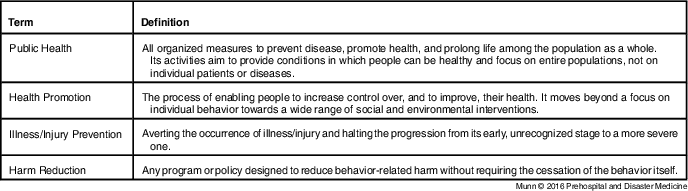
There has also been a push for additional non-medical initiatives aimed at ensuring the continued health of attendees. Thus, medical services increasingly are being considered but one component of an organized public health response. Distinct approaches and ideological underpinnings can shape the way in which non-medical initiatives are undertaken. Health promotion, illness prevention, and harm reduction (HR) are three approaches to increasing safety at music festivals. Definitions of these terms are provided in Table 1.Reference Meites and Brown 15 - Reference Breslow 18
Definition of Terms

In the context of music festivals, HR approaches are developed as a practical response to the failure of abstinence alone to effectively manage the harms associated with drugs. 19 The HR approach is well suited to this environment, with interventions focusing less on abstinence and more on responsible use and reducing any potential harms associated with the behaviors themselves.
Increasingly, HR services are being considered an acceptable component of EDMEs.Reference Single 20 - Reference Frei 23 Several reviews have examined the utilization of HR strategies at music festivals and the authors note an overall lack of research and conclusive evidence regarding their efficacy.Reference Peters, Kok and Schaalma 24 - Reference Akbar, Baldacchino, Cecil, Riglietta, Sommer and Humphris 26 In the European context, the concept of HR is so embedded that medical care at recreational events is often described under the HR umbrella.Reference Calafat, Juan and Duch 27 - Reference Van Havere, Vanderplasschen, Lammertyn, Broekaert and Bellis 28 From the perspective of attendees, one small published survey has shown attendees at EDMEs to be supportive of both HR measures and medical presence. 29 Thus, at this type of event, an interaction between HR and medical services has been inferred but not described explicitly.
The primary goal of this research was to describe the health outcomes experienced by medical services at an EDME with embedded HR infrastructure. Also presented are descriptions of the HR services, the observed collaborations with medical personnel, and the potential benefits of utilizing both approaches together to minimize negative health outcomes for attendees.
Methods
This study was a descriptive case report. Event-related data, including number of attendees, event site hazards, and conditions for 2014 were provided by event organizers and on-site medical team leaders. Meteorological data were gathered from Environment Canada (Fredericton, New Brunswick, Canada).Reference Chinet, Stéphan, Zobel and Halfon 30 Head counts were calculated for each 24-hour period, from 8:00 am to 7:59 am the following day.
Patients’ acuity was determined according to a triage acuity scale (TAS) developed for use during mass gatherings. 31 Patient-related data were collected via the Mass Gathering Medicine Online Registry Project (New Westminster, British Columbia, Canada).Reference Turris and Lund 32 Patient encounters were documented prospectively using one of two standardized forms: minor treatment logs for dispensary requests and minor complaints (ie, band-aids, water, and ibuprofen), or patient encounter forms for all others (ie, collapse and chest pain).Reference Lund, Turris, Amiri, Lewis and Carson 33 Documentation and event-related data were transcribed by trained volunteers into the Registry. Patient data were de-identified prior to analysis.
Ethics approval was received for this minimum-risk project from the University of British Columbia Behavioral Research Ethics Board (Vancouver, British Columbia, Canada).
In addition, HR encounter data for 2014 were obtained via reports from HR services organizers. These data are collected annually and used internally for self-evaluation, quality assurance, and planning purposes.
Results
Event-related Variables
Location
The festival took place on a 300-acre, private farm where the event has been hosted for 17 consecutive years. Natural hazards included a river, vehicles, dust, noise, wooded and uneven areas, livestock, and farm equipment. The farm was located in a rural setting with the nearest town of 1,139 inhabitants located 11 kilometers (seven miles) away. Local provincial ambulance was based in town and had a response time of approximately 20 minutes. The local referral hospital, located 52 kilometers (33 miles) from the event site, was approximately 60 minutes away by dirt road egress and provincial highway.
Duration
The event took place over a period of five days. Medical and HR services were in place from one day before until one day after the event, providing services to arriving and departing campers as well as event staff and volunteers.
Attendance
Over the entire 7-day period, the cumulative daily attendance was 67,120. Attendance peaked at 15,380 people (range 2,859-15,380) on the third event day.
Special Hazards
No alcohol was sold or permitted on the event grounds, and this policy was publicized during advance ticket sales via the event website. 34 Although this was officially a “dry” event, it was possible for alcohol to be consumed clandestinely on site. Open drug use was not permitted, but recreational drugs were recognized to be present. The majority of attendees camped in tents for the duration of the festival. Food vendors were permitted, and portable toilets and free potable water were available in compliance with regulations. Weather conditions for the duration of the festival were dry, hot, and sunny. Daily 24-hour temperatures ranged from 13-36 degrees Celsius with an average 23.8 degrees.
On-site Public Health Services
Medical and HR services were located in the “Health and Wellbeing Zone,” a high-traffic, high-visibility area immediately adjacent to stages, as well as to food and merchandise vendors.
Medical Services
Due to the distance from definitive medical care, the medical team was assembled to provide both first aid and higher level of care on site. The team consisted of 161 credentialed multi-disciplinary personnel covering a total of 188 shifts. Each 12-hour shift had at least one physician and three registered nurses (each with experience in emergency and critical care medicine), three paramedics, three occupational first aiders, and a medical office assistant. A one-hour, on-site training orientation was offered at the beginning of each shift, and a total of 20 personnel were present on shift at peak times.
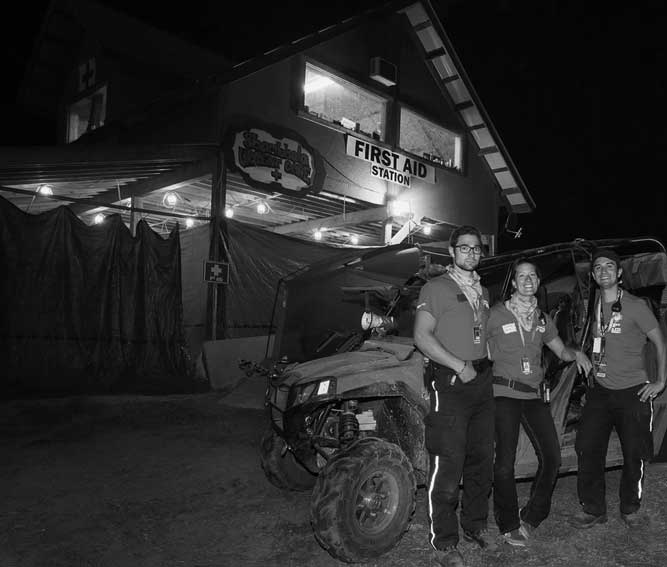
Medical services were provided in a purpose-built, permanent structure (Figure 1). Fourteen beds were available, with two for resuscitation, four for monitored care, and eight for treatment and observation. Minor encounters were managed in chairs in two four-by-four meter tents adjacent to the main medical building. Equipment included monitors and defibrillators, intravenous (IV) fluids, oral and IV medications, advanced airway equipment, wound care materials, spinal immobilization devices, glucometers, and an iSTAT (Abbott Laboratories; Abbott Park, Illinois USA) with electrolyte testing capability. Three all-terrain vehicles were available for scene response and patient transport. Two-way radios were used for communication between medical team members as well as with HR, security, and event staff via a dedicated medical dispatcher. Ambulance transfers were undertaken in circumstances where an urgent or anticipated need for hospital care was identified.
Medical Services.

Harm Reduction Services
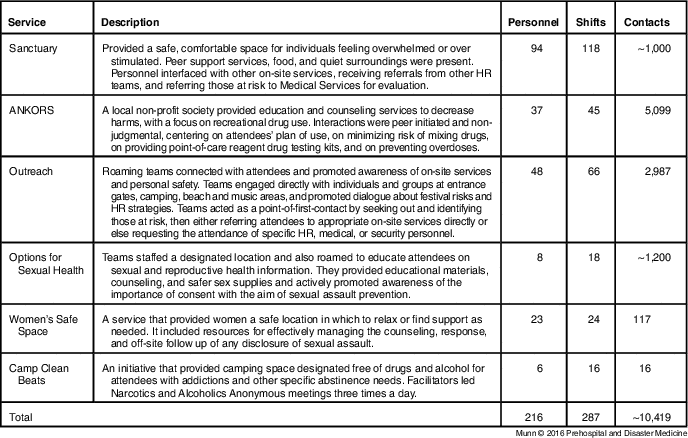
Harm reduction services were active on site for the duration of the event. Several distinct HR services were staffed by a total of 216 HR volunteers with experience in peer support, addictions, mental health, and social and youth work. A description of these on-site HR services has been included in Table 2. Harm reduction volunteers worked 12-hour shifts, with a peak of 34 personnel on shift on the third event night.
Harm Reduction Services

Abbreviations: ANKORS, AIDS Network Kootenay Outreach and Support Services; HR, harm reduction.
Public Health Response
Medical Encounters
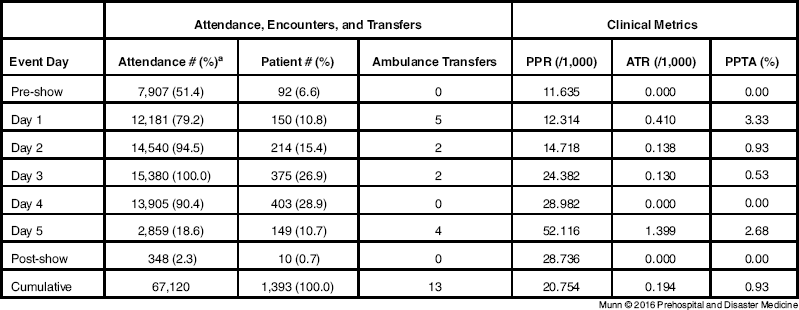
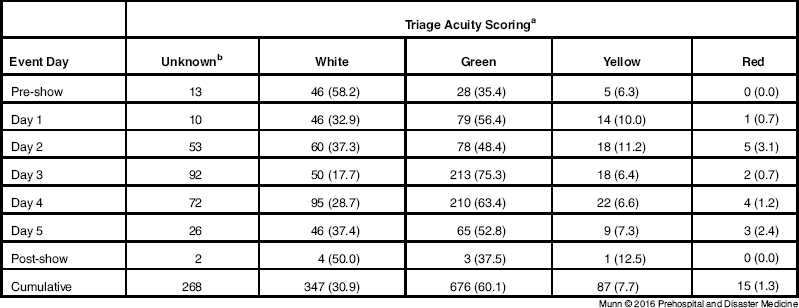
A total of 1,393 patient encounters were documented over a period of seven days for a cumulative patient presentation rate (PPR) of 20.8 patients per one thousand cumulative attendees (range 11.6-52.1; Table 3). The majority of encounters occurred during the five main event days (N=1,291; 92.7%) with a mean of 258 encounters per day. Encounters peaked on the fourth event day at 403 (range 149-403). Males accounted for 53% of encounters, and 81.4% of all patients encountered were age 30 or less. Acuity was documented with a TAS in 80.8% of encounters (Table 4). Ninety-one percent of encounters were for lower acuity (TAS White and Green). Six common presenting complaints (decreased level of consciousness, agitation, syncope, nausea and vomiting, allergic reaction, and dehydration) accounted for 67 of the 102 higher acuity (TAS Red and Yellow) encounters. No patients required intubation and there were no fatalities.
Attendance, Patient Encounters, Transfers, and Clinical Metrics by Day

Abbreviations: ATR, ambulance transfer rate; PPR, patient presentation rate; PPTA, percent of patients transferred by ambulance.
a Percentages reported as percentages of peak attendance (Day 3, Saturday).
Patient Acuity by Day

Abbreviation: TAS, triage acuity scale.
a There were no deaths; no “black” TAS category patients.
b 268 (19.2%) encounters did not have a TAS documented.
Whenever possible and safe, patients were managed on site and then returned to the event. A total of 13 patients (two TAS Green, six TAS Yellow, and five TAS Red) were transported off site by ambulance. The cumulative ambulance transfer rate (ATR) for the event was 0.194 transfers per one thousand cumulative attendees. The cumulative percentage of patients transported by ambulance (PPTA) was 0.93%. Of the 102 highest acuity (TAS Red and Yellow) encounters, 53 were deemed by providers to have received care on site that prevented a visit to hospital, reducing ambulance transfers and emergency department impact.
Harm Reduction Encounters
As the focus of this report is on a blended medical and HR response, anecdotal data on HR encounters are reported also (Table 2). For the 2014 festival, more than 10,000 encounters were documented by HR services. 35 The “Sanctuary” space had approximately 1,000 total encounters over seven days, peaking at 195 encounters on the fourth event day. The outreach team documented 2,987 contacts. Sexual health services had approximately 1,200 contacts and distributed 10,000 condoms. The women’s safe space saw 117 visits; no sexual assaults were reported in 2014. Abstinence meeting services were utilized by 16 attendees.
The local non-profit AIDS Network Kootenay Outreach and Support Services (ANKORS; Nelson, British Columbia, Canada) had 5,099 contacts and performed 2,786 point-of-care pill checks. 36 A number of checks (n=318) were performed on “ground scores” (ie, identified tablets found on the ground by attendees). Nearly 30% of all substances checked were negative for the expected constituent. There were 191 substances discarded after being checked (seven percent discard rate). Reasons for discard were not obtained, and all discarded substances were turned over to local authorities for disposal and potential toxicological review.
Discussion
Medical Response
Medical encounter volume, acuity, and transfer rates were consistent with previously published results for dance music events worldwide. 37 , Reference Krul, Blankers and Girbes 38 The majority of encounters (91%) were for minor problems and a large proportion were for dispensary requests, as described previously (30.8% TAS White). Patient presentation rates and ATRs are commonly used metrics of interest for mass gatherings and the PPTA has been proposed as a measure of the ability to provide medical care for patients on site. The range of daily metrics over the duration of the festival may reflect natural fluctuations in demand for medical attention but are highly dependent on accurate attendance data. Cumulatively, the high PPR (20.8%), low ATR (0.194), low PPTA (0.93%), and high acuity transfers prevented (53) suggest that dedicated on-site HR and medical services help to minimize the effects of a more than 13-fold increase in population on local health infrastructure.
Just over nine percent (n=102; 9.1%) of medical presentations were for major, higher acuity issues and 11 of 13 transfers came from this group. It is unclear to what extent HR services can prevent or inform the need for a “higher level of care” for these high-risk EDME attendees; however, this subset of patient encounters is of specific interest for future study.
Interaction between Harm Reduction and Medical Services
As mentioned previously, the effect of HR services on medical acuity and patient volume has not been described explicitly in the literature for EDMEs. Nevertheless, at this festival, several potential benefits of HR presence with respect to the medical experience were observed.
Redistributed Volume
The “Sanctuary” played a major role in decongesting limited medical treatment space. The total encounters in this space (approximately 1,000) approached the total number of medical encounters (1,393) and had the capacity to overwhelm medical services. The “Sanctuary” space not only diverted crowds from the medical tent, but also addressed challenges better served by non-medical interventions such as peer support and quiet space. It also provided an intermediate space in which to discharge medically cleared patients requiring support prior to event return. Finally, the large total number of HR volunteers (216, substantially more than the 161 medical personnel) and total number of contacts by HR services (approximately 10,419) had the potential to decrease medical volume.
Increased Safety and Reduced Risk
A dedicated space like the “Sanctuary” allowed attendees to take a break from dancing while receiving recognized health interventions like cooling and hydration.Reference Krul, Sanou, Swart and Girbes 39 Additionally, other services, such as pill checking, allowed attendees the opportunity to evaluate the reliability and safety of their choices in a prosecution-free environment. Advocates for pill checking emphasize that the substance testing itself is the least important component of the HR intervention. Rather, checking is the “hook” that engages users in conversations that promote health and prevent injury and illness. Nevertheless, 2,986 checks resulted in 191 voluntarily discarded substances. These tablets, which were discarded voluntarily, may have represented higher risk exposures, as results identified contaminants, unknown substances, or different substances than expected.
The high number of substances (30%) that were negative for an expected active ingredient underlines the potential for harm due to ingestion of an unknown substance. The fact that 318 found tablets were checked highlights an additional risk in that many attendees may consider ingesting unidentified substances.
Whether or not there is benefit or harm in checking found substances remains unclear. The impact of pill checking has been questioned previously due to limitations in assay accuracy and the potential for a false sense of security.Reference Weir 40 Additionally, pill checking remains particularly controversial. In the United States, any acknowledgment of drug presence by event organizers may be interpreted as the promotion of drug use, prosecutable under an anti-drug bill commonly known as the “RAVE Act.”Reference Winstock, Wolff and Ramsey 41 Nonetheless, outside of the United States, pill checking has been proposed to reduce negative outcomes when integrated with medical and prevention interventions.Reference Akbar, Baldacchino, Cecil, Riglietta, Sommer and Humphris 26
Information Sharing
Harm reduction, security, and medical services worked together closely in planning the health response pre-event, by referring between services as needed on-event, and in debriefing post-event. Information was shared between these three services in twice daily meetings in order to respond dynamically to observed drug use and medical presentations. Incident response was multidisciplinary, including members of HR, security, and medical teams.
Pill checking results were disseminated in real-time to the individual attendee and then displayed for the public on a chart describing each tablet and its composition. Mobile HR teams and medical services were also supplied information regarding high-risk substances on site. This act aimed to decrease drug-associated harms by alerting attendees to the physical appearance of any substances identified as adulterated or falsely described. This information also aided management of toxicological presentations by providing advance notice of substances in circulation, and point-of-care tests provided the ability to evaluate substances found on attendees presenting for medical care immediately.
Educational resources and orientation information used in HR services were shared with medical volunteers, using EDME-specific content to improve clinical practice and patient education. Education of prehospital personnel in specific HR encounter interaction methods and event-specific protocols for common medical presentations has been successful in the dance club environment. 42 , Reference Wood, Greene and Alldus 43 Medical personnel at EDMEs are likely to benefit similarly.
Increased Approachability and Acceptance
Medical teams, and by extension festival attendees, may have much to gain from the integration of a HR approach. Health care professionals previously have been shown to display stereotyped and judgmental attitudes in the care provided to patients demonstrating drug use and mental health issues.Reference Dutch and Austin 44 - Reference Van Boekel, Brouwers, van Weeghel and Garretsen 46 These providers are sometimes seen as unapproachable, intimidating, or authoritative to users at dance events.Reference Akram and Galt 21 Focused training of medical personnel in the non-judgmental and supportive care methods employed by HR services has the potential to improve approachability, utilization, patient satisfaction, and outcomes when compared to a traditional first aid or medical model.
Research Limitations/Future Considerations
A review of the efficacy of HR interventions found that most studies do not test effectiveness directly.Reference Giandinoto and Edward 47
The services at Shambhala Music Festival have evolved over more than a decade, relying on a substantial, legacy-driven, volunteer base. As such, replication of these HR services at other events may be difficult in year one.
The impact of HR services on medical acuity and volume at EDMEs is not yet well understood. The current paucity of research on this subject is due to several factors. First, negative press and conservative public and government perception oblige EDME organizers to avoid incorporating or publicizing interventions aimed at reducing harm for fear of prosecution or event shutdown. Second, studying the effects of HR methods requires prospective data that are difficult and labor-intensive to obtain. The very same limitations have plagued research in the field of mass-gathering medicine, as medical outcomes are known to differ between events and even between iterations of the same event in successive years. The limited availability of alcohol for sale, for example, is just one of many factors that prevent generalizations from the results drawn from this festival. Third, the fields of HR and mass-gathering medicine have been studied largely in isolation, and few HR efforts that look at medical outcomes have been published to date.
Further collaborative research is needed in order to characterize and quantify the potential benefits of HR interventions on medical outcomes in this unique and remote out-of-hospital environment. A baseline set of comprehensive encounter data collected simultaneously from HR and medical services would provide a platform on which to conduct prospective, broad-based, public health research evaluating the efficacy of specific HR interventions. Additionally, an exploration of the extent to which other on-site services (eg, security and sanitation) affect medical volume and acuity also would be informative. A cost-benefit analysis also may help to better understand the relative weight of each non-medical intervention on health outcomes.
The potential also exists for incorporating HR approaches when designing clinical management guidelines for common medical issues requiring medical services at EDMEs. The implementation of validated, evidence-based protocols to direct higher level of care encounters (eg, decreased level of consciousness, agitation, and others) might aid directly in tailoring care to the EDME environment.
Conclusions
Shambhala Music Festival effectively combines HR and medical services to mitigate the risk profile of a multi-day EDME. These two services represent complementary health strategies and can be considered essential services in planning for this type of event. When preparing on-site medical protocols at EDMEs, the inclusion of HR services and approaches can inform patient care, reduce presentation rates and acuity, and decrease impact on the host community’s local health services. The specific extent to which HR strategies reduce the medical care needs is not well understood. Further collaborative research is needed in order to characterize and quantify these health benefits.
Acknowledgements
Many thanks to Kerrie Lewis, Michael Camporese, Michael Carson, Hadi Rezaei, Pedram Laghaei, Alain Denis, Ivan Hoffman, and Erik Spence who helped with data entry; Michael Carson who provided registry reports; Chloe Sage and Stacey Lock who shared HR data; Mark Galloway for providing the photo; and to Warren Michelow who commented on the manuscript. Appreciation is also extended to the many people who worked in previous years to develop a strong foundation of core services at this festival.
Author Contributions
AL, BM, and ST were responsible for the research conception and design. AL and BM were involved in the implementation of this research project. BM undertook the analysis of data and AL and ST contributed to the method section of the draft manuscript, which was based on a pre-existing Event and Patient Registry (https://www.ubcmgm.ca/registry). All authors contributed to the interpretation of the research findings. BM, AL, RG, and ST co-authored multiple drafts of the manuscript. All authors reviewed the made critical revisions for important intellectual content and approved the final manuscript.