INTRODUCTION
Polymorphism has been selected in many animal taxa (West-Eberhard, Reference West-Eberhard2003), allowing individuals to efficiently use a wider array of habitats (Van Valen, Reference Van Valen1965; Galeotti & Rubolini, Reference Galeotti and Rubolini2004; Forsman et al., Reference Forsman, Ahnesjö, Caesar and Karlsson2008). Morphotypes tend to become specialists within the species distribution range, leading to an optimized use of resources by individuals which can exploit vacant niches (Sinervo & Lively, Reference Sinervo and Lively1996; Hurtado-González & Uy, Reference Hurtado-Gonzales and Uy2009). For species colonizing habitats of variable background, colour and shape, polymorphisms may be particularly important because effective camouflage over most of their habitat may critically reduce predation pressure (Kettlewell, Reference Kettlewell1955; Forsman & Appelqvist, Reference Forsman and Appelqvist1998).
Species colour polymorphism can vary according to individual life-stage and sex, implying in most cases ecological differences among population categories, which lead to maximized foraging efficiency and reproductive output (Jormalainen & Tuomi, Reference Jormalainen and Tuomi1989; Booth, Reference Booth1990; Jormalainen et al., Reference Jormalainen, Merilaita and Tuomi1995). In some species, colour polymorphism in juveniles allows concealment in a heterogeneous physical background, when individuals are more vulnerable to predation (Palma & Steneck, Reference Palma and Steneck2001). In other cases, individuals can change their colour based on habitat shifts that occur through ontogenesis (Booth, Reference Booth1990), resulting in size differences between colour morphs (Hultgren & Stachowicz, Reference Hultgren and Stachowicz2010). Sexual colour dimorphism is also common in many animal groups (Forsman, Reference Forsman1995; Forsman & Shine, Reference Forsman and Shine1995; Merilaita & Jormalainen, Reference Merilaita and Jormalainen1997; Forsman & Appelqvist, Reference Forsman and Appelqvist1999; Magurran & Garcia, Reference Magurran and Garcia2000; Joron, Reference Joron2005) and their maintenance in a population may be driven by different independent or interacting ecological processes, such as sex-dependent habitat use (Jormalainen & Tuomi, Reference Jormalainen and Tuomi1989; Merilaita & Jormalainen, Reference Merilaita and Jormalainen1997), differential predation pressure (Gotmark et al., Reference Gotmark, Post, Olsson and Himmelmann1997; Forsman & Appelqvist, Reference Forsman and Appelqvist1999) or sexual selection (Chunco et al., Reference Chunco, Mckinnon and Servedio2007).
Caridean shrimps have successfully colonized a variety of habitat types, from bare benthic grounds (Beukema, Reference Beukema1992) and uniform vegetated canopy (Howard, Reference Howard1984) to very specific biogenic microhabitats (Duffy, Reference Duffy1996). Specialization to particular habitats can promote subsequent selection of several adaptive traits, such as camouflage involving remarkable changes of shape and colour (Bauer, Reference Bauer1981; Hacker & Madin, Reference Hacker and Madin1991), allowing an optimized use of the available resources and a reduction of predation pressure (Cournoyer & Cohen, Reference Cournoyer and Cohen2011). Several shallow-water species of the genus Hippolyte display a remarkable intraspecific variation in colour pattern (e.g. Hippolyte varians – Gamble & Keeble, Reference Gamble and Keeble1900; H. coerulescens – Hacker & Madin, Reference Hacker and Madin1991; H. inermis – Bedini et al., Reference Bedini, Canali, Bertuccelli, Pessani, Tirelli and Froglia2011), with individuals resembling the colours of different habitats in which they live (e.g. algae, sessile invertebrates, shell gravel and other substrates). The shrimp Hippolyte obliquimanus Dana, 1852, is a very common small gonochoric species (Terossi et al., Reference Terossi, Greco and Mantelatto2008), associated to macroalgal canopy over shallow rocky reefs along the northern coast of São Paulo State, Brazil. Similar to other species of the genus, populations of H. obliquimanus are composed of individuals with contrasting colour patterns, which belong to the same species (Terossi & Mantelatto, Reference Terossi and Mantelatto2010). Some studies have described the population structure and sexual system of this species (Terossi et al., Reference Terossi, Greco and Mantelatto2008, Reference Terossi, Wehrtmann and Mantelatto2010; Terossi & Mantelatto, Reference Terossi and Mantelatto2010), but there is no information available on the distribution of colour morphotypes across population categories, or their natural occurrence over different algal habitats. Such information is mostly needed to frame further experimental work testing the evolutionary and ecological significance of colour polymorphism in this species.
Based on previous observations, we could divide the populations of H. obliquimanus in our study area into two main colour morphs; homogeneous shrimps (H) of different colours, most of them greenish-brown (HGB) or pink (HP), and striped translucent shrimps (ST), with either longitudinal or transversal colour bands (Online Supplementary Material). Homogeneous shrimps are capable of remarkable concealment in both the greenish-brown Sargassum spp. (HGB) and the reddish-pink G. marginata (HP), while ST individuals, although found in these same habitats, exhibit a more neutral colouration. In this study, we examined morph-specific distribution patterns, population structure and female reproductive output, as an initial step to understand the polymorphic condition in H. obliquimanus. We first investigated whether shrimp colour morphs are distributed between algal habitats to maximize concealment, which would support the selection of crypsis (Edmunds, Reference Edmunds1974; Stevens & Merilaita, Reference Stevens and Merilaita2009). Then, we investigated the population structure and reproductive ecology of colour morphs in each habitat, in order to obtain basic information on overall population dynamics and reproductive output. Possible differences in size or sex proportions between morphs may indicate ontogenetic or sex-dependent polymorphism. Also, differential reproductive parameters of individuals may be a result of potential trade-offs between habitat, or morph-specific adaptations, and reproductive investment.
MATERIALS AND METHODS
Density of colour morphs in algal habitats
Along the São Sebastião Channel (São Sebastião, SP, Brazil), Sargassum furcatum Kützing, 1843, is the most abundant macroalga, and, together with the red weed Galaxaura marginata, constitutes the bulk of available habitat for the obligate algal-dwelling shrimp Hippolyte obliquimanus. Algal samples of the two species were collected in the summer of 2010 by skin diving at rocky bottoms in three different sites along a 5 km stretch within the Channel; Barequeçaba (23°49′54″S 45°26′39″W), Zimbro (23°49′28″S 45°25′10″W) and Grande Beach (23°49′28″S 45°24′50″W), at a maximum depth of 2 m during low-tide periods. Sixteen replicate samples of both Sargassum and Galaxaura clumps, separated by a minimum distance of 5 m, were obtained on six sampling dates, over 2 months (January–February 2010). For each sampled clump, entire algal fronds, including the holdfast, were carefully removed by hand and placed underwater in a 5-L meshed bag (250 µm). In the laboratory, algal fronds were agitated in large containers filled with seawater and all suspended materials were sieved (500 µm) and examined in white plastic trays (Tanaka & Leite, Reference Tanaka and Leite1998). Shrimps were sorted out while still alive, and maintaining their original colour, counted and assigned to a colour pattern before being individually stored in 70% ethanol for further analyses. After removing excess water with a salad dryer, the weight (±1 g) of algal samples was recorded to calculate shrimp densities, defined as the number of individuals per canopy wet weight (ind. kg−1), a common metric to indicate density for canopy-dwelling species (Poore & Steinberg, Reference Poore and Steinberg1999; Flores et al., Reference Flores, Gomes and Villano2009). The average weight of our samples was relatively constant (450 g ± 25).
Densities of HGB and ST shrimps, but not HP, were positively correlated in both Sargassum (df = 1, r = 0.59, P = 0.015) and Galaxaura (df = 1, r = 0.55, P = 0.028), suggesting these morphs co-occur to some extent within algal clumps (i.e. the densities of HGB and ST shrimps are interdependent). In order to ensure the independence of observations, we separated samples of each alga into two random groups and counted either HGB or ST in each sample. This procedure reduced sampling size to eight replicate observations. Eight random samples from the whole pool were also separated to count HP individuals. Data were ln (x + 1) transformed to achieve homoscedasticity and then analysed using a two-way ANOVA, in which shrimp density (ind. kg−1) was compared between algal substrates (Sargassum and Galaxaura) and colour morphs (HGB, HP and ST). The Student–Newman–Keuls (SNK) method was used for a posteriori comparisons.
Habitat and morph-specific population structure
Since individuals of some related species can change colour very rapidly upon contact with an unmatched background (e.g. Hippolyte varians – Gamble & Keeble, Reference Gamble and Keeble1900), we made some observations on the capacity of colour change in H. obliquimanus morphotypes. We observed around 10 individuals of each morph (HGB, HP and ST) kept individually in plastic aquaria (800 mL) containing seawater and pieces of the natural algae Galaxaura or Sargassum. H shrimps were kept in contact with colour unmatched habitat, while ST individuals were haphazardly placed in contact with one of these algal habitats, since their colouration did not match any of the substrates. Aquaria were maintained in the laboratory at constant temperature (25°C) and water was renewed every day. Shrimps were observed daily to assess colour change capabilities over a period of 2 weeks. In only 5 days, HGB and HP shrimps changed their colour when in contact with an unmatched substrate, while none of the ST individuals change their colour. Moreover, repeated observations on around 30 ST individuals maintained in the same conditions specified above, over 2 months, evidenced these shrimps cannot change their colour. Therefore, HGB and HP individuals were pooled to a single category, the homogeneous colour morph (H), for subsequent analyses.
The size and sex of all individuals were determined under a dissecting microscope provided with a ruled ocular. The carapace length (CL) was measured as the maximum distance between the posterior margin of the ocular orbit to the posterior margin of the carapace (Terossi & Mantelatto, Reference Terossi and Mantelatto2010). Sex was determined under a dissecting microscope set at maximum magnification of 111.5×, based on the morphology of second abdominal appendages. Animals bearing an appendix masculina were classified as males, and those without this appendix considered females. Small individuals without a developed appendix interna were considered juveniles (Terossi et al., Reference Terossi, Greco and Mantelatto2008).
Shrimp size was compared across combinations of the factors: sex (males, females), morph (H, ST) and algal habitat (Sargassum, Galaxaura), using a three-way analysis of variance. Since data were heteroscedastic and transformation [log (x)] did not solve the problem, we randomly excluded size data for all factor combinations, except for ST females in Galaxaura, to achieve a balanced design (N = 33), robust to variance heterogeneity (Underwood, Reference Underwood1997). The SNK procedure was used for a posteriori comparisons.
The overall adult sex-ratio was calculated based on sizes at first maturation estimated by Terossi et al. (2008) and our own data. The size of the smallest ovigerous females matched in both studies (CL = 1.6 mm) and was considered as the size at the onset of maturity. Terossi et al. (2008) also observed that the smallest males bearing the appendix masculina (CL = 0.7 mm) had already developed convoluted tests, indicating that the presence of that pleopod structure is a reliable indicator of sexual maturity. Thus, we calculated separate adult sex-ratios for the Sargassum and Galaxaura populations by dividing the frequency of females above 1.6 mm CL and the frequency of males above 0.7 mm CL. Comparisons of sex-ratios between algal substrates and colour morphs were carried out using z-tests for proportions, and departures from the 1:1 expected ratio were assessed by chi-square tests. Also, juvenile proportions were compared separately between colour morphs and habitats using z-tests.
Reproductive output
Breeding success may vary between colour morphs because they occupy habitats with contrasting supply of food resources, or because they require different metabolic costs restraining reproductive activity to a variable extent. We compared the reproductive output of colour morphs in both Sargassum and Galaxaura by measuring (i) the proportion of ovigerous females, as a proxy of brooding frequency, (ii) their size and (iii) their fecundity.
The relative frequency of ovigerous individuals within the adult female population (individuals larger than 1.6 mm CL, according to Terossi et al., Reference Terossi, Greco and Mantelatto2008) was compared across colour morphs and algal habitats using a log-linear model (Sokal & Rohlf, Reference Sokal and Rohlf1995). Size (CL) was compared using the equivalent two-way ANOVA procedure, but using a random sample of 11 ovigerous females for each combination of morph and algal habitat, in order to achieve a balanced design.
Embryos of brooding females were removed, counted and a sample of 5 eggs per individual was separated for measurements and embryo staging (with and without eyes as early and late embryos, respectively, adapted from Wehrtmann, Reference Wehrtmann1990). The volume of embryos (V) was calculated assuming they are oblate spheroids (Turner & Lawrence, Reference Turner, Lawrence and Stancyk1979):
 $$V = \displaystyle{{\pi Xa_1^2 X{a_2}} \over 6}$$
Where a 1 and a 2 are the smallest and largest axes, respectively. The average embryo volume was used to calculate brood size (mm3) for each ovigerous female. Size-specific fecundity relationships, using the allometric model (Somers, Reference Somers, Wenner and Kuris1991), were fit to each of the colour morphs and habitats, using both fecundity (number of embryos) and brood size. To achieve a balanced design, we randomly selected 31 ovigerous females for each colour morph, for comparisons between colour morphs, and 77 individuals for each macroalga, for comparisons between habitats. Student's t-tests were used to test differences among intercept and slope values, and therefore reproductive output per batch. Student's t-tests were also used to test departures from isometry (β 0 = 3) for breeding females of each morph and in each habitat. There is no evidence of egg loss during incubation, since neither slope (number of eggs: t = 0.80, P = 0.43; brood size: t = 0.09, P = 0.93) or intercept (fecundity: t = 0.30, P = 0.78; brood size: t = 0.92, P = 0.36) differed for size-fecundity relationships fitted to females carrying early and late embryos. Whole ovigerous populations were thus used in these analyses.
RESULTS
Density of colour morphs in algal habitats
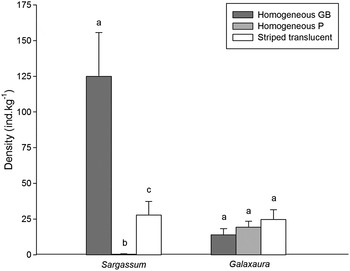
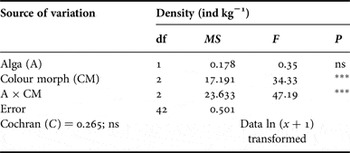
Shrimp density can be very high in algal substrates, exceeding 100 individuals per kg of algal habitat. Such very high densities, however, were only observed in Sargassum because HGB shrimps concentrate in great numbers in this algal habitat (Figure 1). In fact, the distribution of colour morphs differed between Sargassum and Galaxaura (Table 1). While density differed between morphs in Sargassum, with HGB individuals being five times more abundant than ST shrimps and the HP morph near absent, no such differences were observed in Galaxaura, where the density of all three shrimp morphs was fairly similar, around a baseline range of 15–25 ind kg−1 (Figure 1).
Hippolyte obliquimanus. Average density of colour morphs in main macroalgal habitats Sargassum furcatum and Galaxaura marginata. Colour morph abbreviations: GB, Greenish-brown; P, Pink. Mean values represented by bars with a different letter are statistically different (P < 0.05). Whiskers stand for +1 SE.

Summary results of the two-way analysis of variance testing the overall distribution of individuals of different colour morphs (CM) in the two algal substrates (A), Sargassum furcatum and Galaxaura marginata in São Sebastião, SP.

C: Cochran statistics; ns: not significant; ***P < 0.001.
Habitat and morph-specific population structure
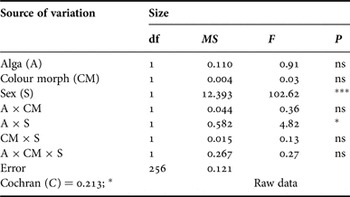
There were no morph-related differences of size (Table 2). Females were much larger than males (X
females = 1.84 mm,
 ${\bar X_{males}} = 1.40\,{\rm mm}$
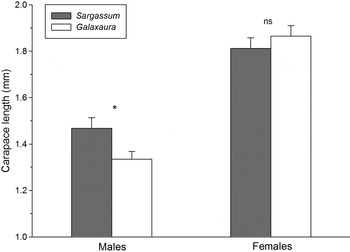
, P < 0.0001), which is the expected pattern for most caridean shrimp species (Bauer, Reference Bauer2004), including H. obliquimanus (Terossi et al., Reference Terossi, Greco and Mantelatto2008). Males in Sargassum were larger than those at Galaxaura but no such trend was observed for females (Figure 2), which explains the significant double interaction between factors ‘alga’ and ‘sex’ (Table 2).
Hippolyte obliquimanus. Variation of size, expressed as carapace length (mm), according to sex and algal habitat (Sargassum furcatum vs. Galaxaura maginata). Data are means + 1 SE. ns: not significant; *P < 0.05.

Summary results of the three-way analysis of variance testing differences in individual size according to sex (S), colour morph (CM) and algal habitats (A).

C: Cochran statistics; ns: not significant; *P < 0.05; ***P < 0.001.
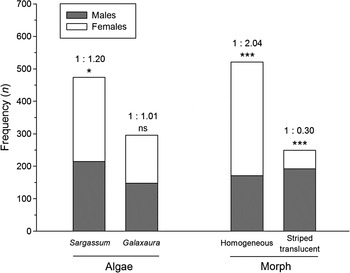
The sex-ratio in Sargassum differed from the 1:1 proportion (χ2 = 4.08, P = 0.04), while it did not in Galaxaura (χ2 = 0.003, P = 0.95; Figure 3). The male to female proportion clearly differed between the H and ST colour morphs (z = 11.44, P < 0.001), departing from evenness in both cases (χ2 H = 60.36, χ2 ST = 71.62, P < 0.001). H shrimps were mostly females (sex-ratio 1:2.04), while more than 70% of ST shrimps were males (sex-ratio 1:0.30; Figure 3).
Hippolyte obliquimanus. Frequency of adult males and females according to their habitat and colour morph. The sex-ratio (males:females) is presented over each bar. Departures from evenness (1:1) are indicate as *(P < 0.05) or ***(P < 0.001). ns: not significant.

Juvenile ratios did not differ significantly between morphotypes in both algal habitats. The share of juvenile shrimps was 0.12 (H) and 0.13 (ST) in Sargassum (z = 0.19, P = 0.39), and 0.21 (H) and 0.19 (ST) in Galaxaura (z = 0.28, P = 0.38). However, the overall juvenile proportion was higher at Galaxaura (0.20) when compared with Sargassum (0.12) (z = 3.53, P = 0.001).
Reproductive output
There were no detectable differences of reproductive effort between H. obliquimanus colour morphs or algal habitats based on any tested traits. None of the components of the log-linear model testing for frequency contrasts of ovigerous females were significant (P > 0.05 for all components). The ovigerous ratio varied very little around 0.51. The size of ovigerous individuals (2.18 ± 0.24 mm CL) was also not different between morphs (df = 1, F = 0.03, P = 0.86) and algae (df = 1, F = 1.08, P = 0.30), and the interaction between these factors was not significant (df = 1, F = 0.63, P = 0.43).
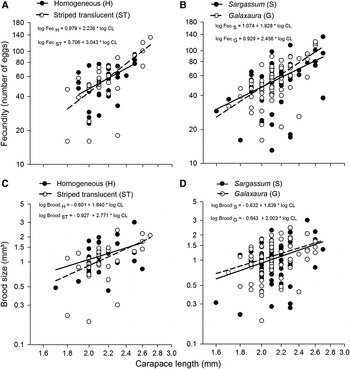
Habitat and morph-specific scatterplots for size vs. fecundity and size vs. brood size relationships are shown in Figure 4. The estimated slope for the overall size-specific fecundity relationship, using all H. obliquimanus ovigerous females, indicated negative allometry, significantly below the expected isometric value (b = 1.997, t = 3.24, P < 0.01). The same allometric pattern was observed using brood size in the regression model (b = 2.081, t = 2.17, P < 0.05). Differences of intercept (t = 0.11, P = 0.91) and slope (t = 0.76, P = 0.145) were not detected between colour morphs for fecundity data. Similar results were obtained using brood size as the independent variable (intercept: t = 1.14, P = 0.26; slope: t = 0.57, P = 0.57). Differences were also not significant for between-habitat comparisons, including analyses for the number of eggs (intercept: t = 1.08, P = 0.30; slope: t = 0.85, P = 0.40) or brood size (intercept: t = 1.25, P = 0.21; slope: t = 0.18, P = 0.86).
Hippolyte obliquimanus. Size-specific fecundity relationships, using either the number of eggs or brood size, according to colour morphs (A, B) and algal habitat (C, D).

DISCUSSION
We report in this study that both the distribution of individuals in macroalgal habitats and population structure vary between colour morphs of Hippolyte obliquimanus. Because the capacity of colour change differs so markedly between morphs, and given that shrimps cannot shift between them, colour polymorphism is likely to be under genetic control, as reported for isopods (Shuster & Wade, Reference Shuster and Wade1991) or grasshoppers (Forsman & Appelqvist, Reference Forsman and Appelqvist1999). The distribution of individuals between algal habitats is clearly morph-specific, with H individuals occupying colour-matching substrates and ST shrimps being more evenly distributed between macroalgae. While we did not observe any sign of reproductive trade-offs in females of different morphs or inhabiting different habitats, sex ratio was noticeably morph-dependent, with most H individuals being females and most ST shrimps males. Together, these results suggest that selection for sex-specific traits favours the maintenance of different morphotypes in H. obliquimanus, which probably differ in several other ways than colour. The female-biased H morph clusters at Sargassum and bears a colour-matching colour pattern, consistent with a cryptic behaviour reducing predation pressure. On the other hand, a more generalist use of algal fronds in the male-biased ST morph is consistent with a less sedentary lifestyle, allowing individuals to search for resources and potential mates.
Preferential selection for a specific habitat, allowing efficient camouflage, is a known process for cryptic shrimp species in macroalgal and seagrass banks (Hacker & Madin, Reference Hacker and Madin1991; Cournoyer & Cohen, Reference Cournoyer and Cohen2011) that could explain the large densities of the H morphotype in Sargassum. Both visual and chemical cues (Barry, Reference Barry1974; Hacker & Madin, Reference Hacker and Madin1991; Christie et al., Reference Christie, Nina Mari Jørgensen and Norderhaug2007; Lecchini et al., Reference Lecchini, Mills, Brié, Maurin and Banaigs2010; Huijbers et al., Reference Huijbers, Nagelkerken, Lössbroek, Schulten, Siegenthaler, Holderied and Simpson2012) can be used to locate and mediate substrate fidelity while approaching a specific algal habitat. Selection for Sargassum could be advantageous because the more intricate architecture of its blades, together with the physical complexity of commonly associated epiphytic algae Hypnea spp. (Leite & Turra, Reference Leite and Turra2003; Tanaka & Leite, Reference Tanaka and Leite2003), could provide abundant shelter and food to individuals. Alternatively, larger numbers of H shrimps in Sargassum may be a result of lower predation rates owing to superior camouflage in this habitat (Stevens & Merilaita, Reference Stevens and Merilaita2009). These two processes, habitat selection and habitat-specific camouflage efficiency, could explain the heterogeneous distribution of H shrimps and should be experimentally tested.
Sex proportions are not the same in H and ST morphs, suggesting that morph-specific selective pressures may be acting on males and females. Sexual differences in animal colouration are commonly related to sex-dependent behaviours, mainly in terms of activity patterns or microhabitat use derived to reproductive strategies (Andersson, Reference Andersson1994; Merilaita & Jormalainen, Reference Merilaita and Jormalainen1997). Changes in behaviour and habitat use can affect differently the survival of males and females when subjected to predation by visual consumers (Jormalainen et al., Reference Jormalainen, Merilaita and Tuomi1995; Forsman & Appelqvist, Reference Forsman and Appelqvist1999). At this stage, it is very difficult to speculate if behavioural divergences between sexes are driving different population structures in H. obliquimanus morphs, but some results at least suggest future lines of research. The more even distribution of the male-biased ST morph over algal habitats may be a result of higher mobility of individuals, which could be expected given the natural history of these hippolytids. Males are much smaller than females and lack dimorphic sexual characters related to mate guarding or territorial defence, suggesting that the prevailing mating system in H. obliquimanus is a pure search strategy (as defined by Wickler & Seibt, Reference Wickler and Seibt1981), very common in other non-territorialist caridean species attaining high population densities (Correa & Thiel, Reference Correa and Thiel2003). In this mating system, male investment is directed to find and mate with the maximum possible number of females (Emlen & Oring, Reference Emlen and Oring1977; Andersson, Reference Andersson1994), which in H. obliquimanus would require intense swimming across algal clumps. In contrast, the female-biased H morph concentrates in Sargassum, where population density and, possibly, carrying capacity is higher. Shrimp density in this algal habitat is among the highest found for other similar algal-dwelling carideans (Howard, Reference Howard1984; Hacker & Madin, Reference Hacker and Madin1991), suggesting that female fidelity to the algal habitat, besides effective crypsis with reduction in predation pressure, may also be responsible for shrimp aggregations.
In contrast to females, males in Sargassum are larger than those in Galaxaura. Small juveniles, around 1 mm CL, are also more abundant in the red weed habitat. In spite of their apparent unaggressive behaviour, these results suggest that competition may take place, mostly affecting smaller males and juveniles that may be displaced to the likely marginal Galaxaura habitat, possibly working as a sink in a metapopulational context (Pulliam, Reference Pulliam1988; Diffendorfer, Reference Diffendorfer1998). These competitive interactions may underlie habitat-specific sex-ratios. Given a pure-search strategy, a female-biased sex ratio would be beneficial for this species since males may copulate with several females. Therefore, the male per capita reproductive output in Sargassum may be substantially higher than in Galaxaura because it holds 20% more females than males. However, there were no apparent signs of competition among females. As mostly H shrimps, females may otherwise benefit from increased crypsis and specialize on the use of local feeding resources on the probably favoured Sargassum habitat. Together with habitat-specific sex-ratios or crypsis costs, any differences in the quality of feeding resources between the Sargassum and the Galaxaura habitat could possibly eventually translate into differences in female per capita reproductive output. However, this was not the case. Both the number of broods, as inferred from the proportion of ovigerous females, and size-specific fecundity were remarkably similar between habitats, suggesting these are relatively fixed traits in the population. Differences were also absent when ST and H females were compared, indicating that eventual divergent life-histories do not result in reproductive trade-offs.
Together, the results presented here provide original information on the polymorphic nature of H. obliquimanus populations. Morph-specific sex proportions and distribution between algal habitats suggest that H and ST shrimps are characterized by distinct lifestyles, allowing individuals a more efficient use of algal habitats. Given the expected mating system in this species, H individuals (mostly females) would benefit from a lifestyle characterized by a more cryptic behaviour and a specialized use of habitat-specific resources, while ST individuals (mostly males) would follow a more neutral camouflage strategy, independent of background matching (Schaefer & Stobbe, Reference Schaefer and Stobbe2006), and probably invest in a more generalized habitat use, enabling males to find more mates in a pure-search strategy. Therefore, colour polymorphism within populations of H. obliquimanus may be maintained by sex-specific selective mechanisms. Further experimental research is needed for a better understanding of the ecological processes underlying morph-specific distributions patterns.
SUPPLEMENTARY MATERIAL
To view supplementary material for this article, please visit http://dx.doi.org/10.1017/S0025315416000230
ACKNOWLEDGEMENTS
We are grateful to Alvaro Migotto for his advice in image acquisition and analysis. We especially thank the technical staff at the Centre for Marine Biology for helping in field surveys, and Glauco Machado, Fosca Leite and two anonymous reviewers for suggestions on an early manuscript draft. This is a contribution of the Research Centre for Marine Biodiversity of the University of São Paulo (NP-Biomar/USP).
FINANCIAL SUPPORT
This work was supported by the Fundação de Amparo à Pesquisa do Estado de São Paulo – FAPESP (2009/06675-4 and 2012/17003-0), which granted a master and a PhD fellowship to RCD.