We commend Leech et al.'s attempt to draw together diverse and apparently contradictory accounts of analogy within a single connectionist model. From our standpoint, the particular strengths of this model are that it makes developmental processes paramount, embeds higher level processes in lower level ones, and captures the way in which analogising can take place through sub-symbolic relational priming. Yet their model neglects the possibility that the transfer from lower- to higher-level cognition might occur through explicit, self-reflective processes. To the extent that connectionist approaches fail to embody such processes, then, Leech et al.'s model needs to be enhanced to accommodate mechanisms that can interleave self-reflective thinking with activation-based priming and pattern completion. In particular, evidence from microgenetic studies – short term investigations designed to chart or manipulate the process of developmental change – identifies two factors associated with explicit, self-reflective thought that are important to any comprehensive model of the development of children's reasoning skills: the child's explanation of strategy use and feedback provided on task performance. These factors, which derive from the child's interactions with the broader task and social environments, are not given serious consideration in Leech et al.'s model.
Asking children to provide retrospective explanations of their answers during analogical problem solving tasks has been shown to aid the development of their analogical reasoning skills in several recent studies (e.g., Cheshire et al. Reference Cheshire, Ball, Lewis, Bara, Barsalou and Bucciarelli2005; Siegler & Svetina Reference Siegler and Svetina2002). Leech et al. simulated how the provision of verbal labels for relational terms benefits subsequent analogical reasoning behaviour, but there are key differences between providing such verbal cues and asking children to explain why they chose a particular answer. Verbal labels may augment the representation of spatial or transitive relations and thus facilitate performance, but self-explanation prompts children to be reflective in order to verbalise explicitly why they have selected a response. What seems to be needed is an account of how the explicit process of self-explanation can impact beneficially on analogical reasoning. It may be, for example, that self-explanation somehow increases the likelihood of an appropriate relational item being selected in the future. Such an account, however, is complicated by the finding that improvements in relational mapping that derive from self-explanation are transitory, with children reverting to a preference for superficial object similarity when no longer asked to explain (Cheshire et al. Reference Cheshire, Ball, Lewis, Bara, Barsalou and Bucciarelli2005). The inherent fragility of benefits deriving from self-explanation seems especially difficult to model via activation-based priming and pattern completion.
Children also benefit from feedback during analogical reasoning and other cognitive tasks (e.g., Cheshire et al. Reference Cheshire, Ball, Lewis, Bara, Barsalou and Bucciarelli2005; Muldoon et al. Reference Muldoon, Lewis and Berridge2007; Siegler Reference Siegler, Kuhn and Siegler2006; Siegler & Svetina Reference Siegler and Svetina2002). Again, however, such interaction with the social environment associated with learning is not considered in Leech et al.'s proposals. Our microgenetic data indicate that there is a rapid phase of learning when explicit feedback is given, with such feedback promoting long term improvements in analogical reasoning. A connectionist model could no doubt simulate the rapidity and permanence of such feedback-based learning. But exactly how positive and negative feedback strengthens the connections between the nodes in the network is a complex issue and one that seems unlikely to be addressed simply through an appeal to relational priming and pattern completion mechanisms.
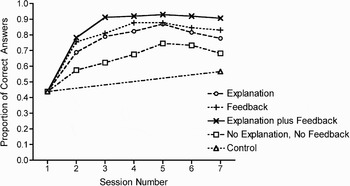
Furthermore, our microgenetic data suggest different trajectories of change for children in different conditions dependent upon the presence or absence of feedback and explanation. Figure 1 compares the effects over seven sessions of repeated testing without feedback or explanation (i.e., simple priming), providing feedback, asking children to explain their decision, and a combination of the two (see Cheshire et al. Reference Cheshire, Muldoon, Francis, Lewis and Ball2007). Asking children to provide explanations enhances performance in terms of a preference for relational mappings over superficial object matches, but, as noted above, this improvement is transitory, and children subsequently revert to a preference for object similarity when no longer asked to explain (Cheshire et al. Reference Cheshire, Ball, Lewis, Bara, Barsalou and Bucciarelli2005). Although the effects of explanation versus feedback on analogising are qualitatively different to each other (i.e., explanation leads to more transitory effects; feedback produces more enduring changes), the combination of the two leads to greater accuracy and more permanent learning. The varied developmental pathways depicted in Figure 1 attest to the subtle and complex influences of self-reflective processes on the development of analogical reasoning. We contend that such subtleties and complexities need to be matched by equally sophisticated mechanisms within a connectionist framework of the type proposed by Leech et al.
Different paths of change in a microgenetic study of the development of analogical reasoning (Cheshire et al. Reference Cheshire, Muldoon, Francis, Lewis and Ball2007). Sessions involved 22 matrix-completion trials (essentially involving analogies of the a:b::c:d form) whose solutions entail relational mapping processes. Sessions 1, 6, and 7 were not associated with any experimental manipulation. Session 7 occurred approximately 8 weeks after Session 6.

In conclusion, Leech et al.'s model falls foul of a long-standing problem that in concentrating on the development of internal structures such models are solipsistic (Frawley Reference Frawley1997). The development of analogical problem solving is not just due to repeated, passive exposure to a problem and general knowledge accretion. Through their active commitment to learning children partly train their own networks by strengthening different connections based on their individual experiences (which may include explanation and feedback). Can the interplay between implicit networks and explicit, self-reflective thought be modelled in a detailed, psychologically plausible, and testable manner?