Introduction
The genus Polymeridium is a typical member of the Trypetheliaceae, characterized by black perithecioid ascomata, anastomosing interthecial filaments and lichenization with trentepohlioid algae. Within the family, it is characterized by the rounded ascospore lumina and the thin whitish thallus. Harris (Reference Harris1993) recognized 19 species in the genus. He applied a wide species concept, accepting variation in chemistry and hamathecium inspersion within the species. Since that time, only two species have been added to the genus (Aptroot et al. Reference Aptroot, Diederich, Sérusiaux and Sipman1995; Aptroot & Ferraro Reference Aptroot and Ferraro2001).
Species of Polymeridium are generally rare and not locally abundant, but it had already been noted by Harris (Reference Harris1993) that at least some regions of Brazil are rich in species. Our observations confirm this and we can add that Polymeridium is even abundant on trees in at least some areas with Caatinga vegetation in Brazil. During our various ecological studies and expeditions in Brazil (Cáceres Reference Cáceres2007), Venezuela and the Guianas, we collected several additional undescribed species of the genus. The purpose of this paper is to describe the new species found recently in Brazil. Including these new species, 21 of the 27 species currently accepted in Polymeridium are now known from Brazil.
Material and Methods
Identification and descriptive work was carried out in Itabaiana, Universidade Federal de Sergipe, using a Leica EZ4 stereomicroscope and a Leica DM500 compound microscope, and also in Soest using an Olympus SZX7 stereomicroscope and an Olympus BX50 compound microscope with interference contrast, connected to a Nikon Coolpix digital camera. Sections were mounted in tap water, on which all measurements were taken, and also the reaction of ascospores to IKI (Lugol's solution) was observed. The specimens from this study are preserved in ISE. The chemistry of the type specimens was investigated by spot reactions (KOH 10%), under long-wave UV light, and by thin-layer chromatography (TLC) using solvent A (Orange et al. Reference Orange, James and White2001).
The Species
Polymeridium corticatum A. A. Menezes, M. Cáceres & Aptroot sp. nov.
MycoBank No.: MB 801913
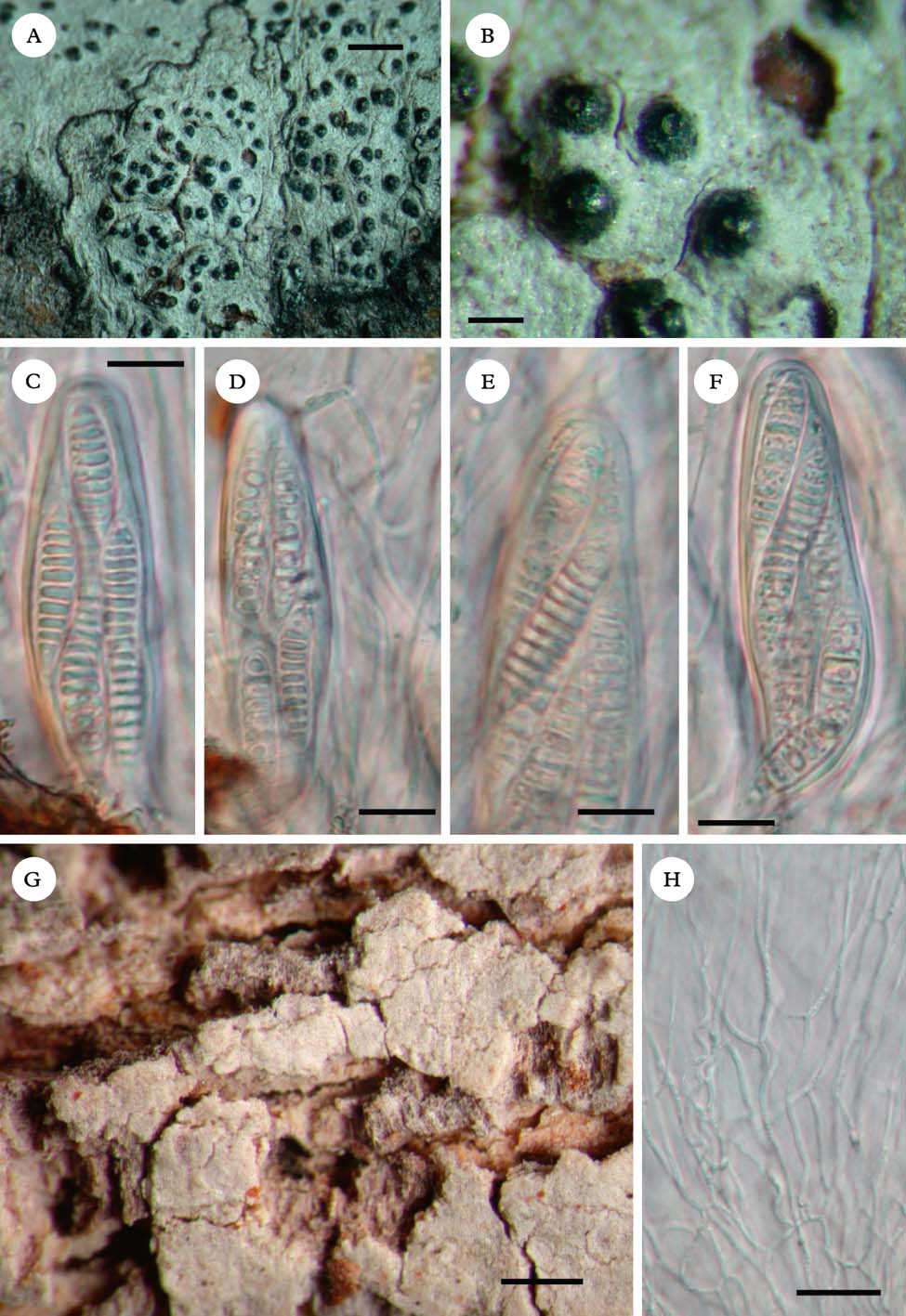
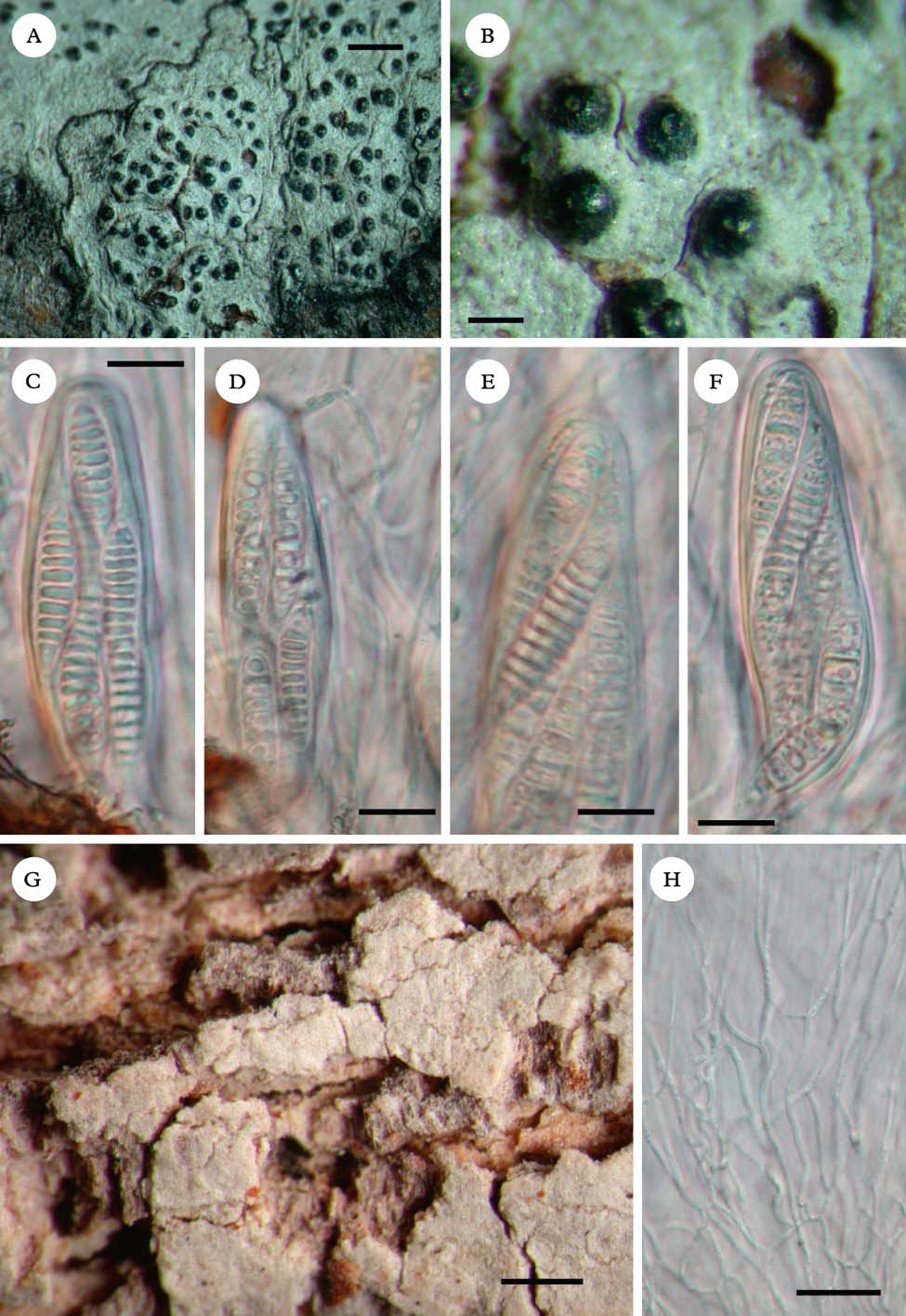
Polymeridium with a corticate thallus and 9–13-septate ascospores, 32–36×6–7 µm.
Type: Brazil, Ceará, Chapada do Araripe, on bark of tree, 15 May 2012, A. A. Menezes (ISE 15888—holotype).
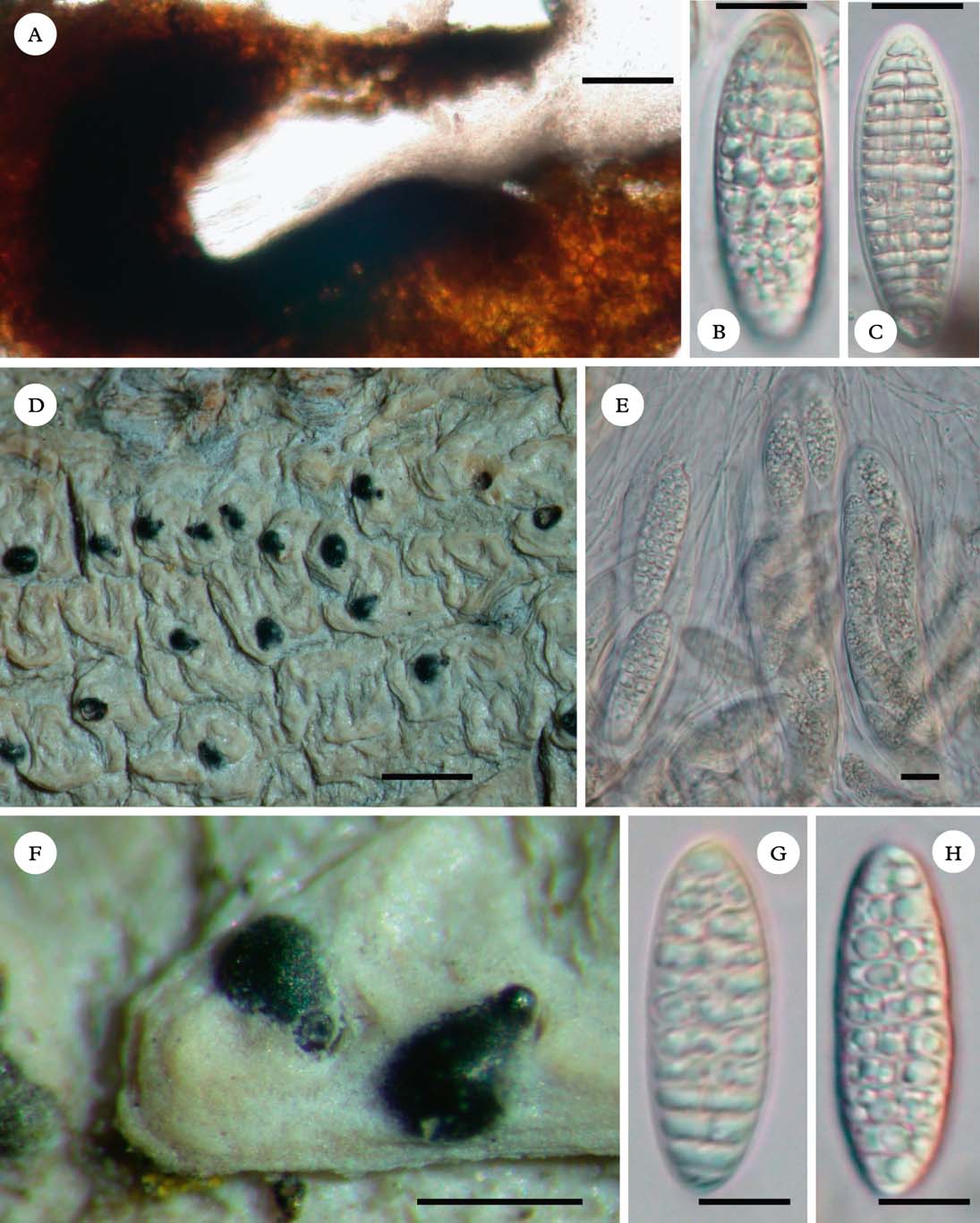
A–F, Polymeridium corticatum (holotype); A & B, habitus; C–F, asci with ascospores. G & H, Polymeridium immersum (holotype); G, habitus; H, hamathecium. Scales: A & G=1 mm; B=0·2 mm; C–F & H=10 µm. In colour online.
Thallus crustose, continuous, corticate, dull, pale creamish white, very thin and closely following the bark surface, surrounded by a thin black prothallus line. Algae trentepohlioid.
Ascomata conical, erumpent, somewhat glossy, 0·2–0·4 mm wide, black. Ostiole black, apical, depressed. Hamathecium not inspersed. Ascospores 8 per ascus, hyaline, IKI−, 9–13-septate, 32–36×6–7 µm, not constricted.
Pycnidia not observed.
Chemistry
UV+ yellow, KOH−; lichexanthone present in thallus (TLC).
Ecology and distribution
On smooth bark of trees in Caatinga forest. Known only from Brazil.
Discussion
This species differs from all other known Polymeridium species by the corticate thallus. In all other characters it is a typical Polymeridium. A cortex in the thallus is usually a valid and stable species character, but is rarely regarded as a generic character. Also, many tropical crustose genera with trentepohlioid algae (e.g. Acanthothecis, Anisomeridium, Chapsa, Diorygma, Fissurina, Graphis, Ocellularia, Pyrenula, Stirtonia, Thelotrema) include corticate and non-corticate species.
Polymeridium immersum Aptroot, A. A. Menezes & M. Cáceres sp. nov.
MycoBank No.: MB 801914
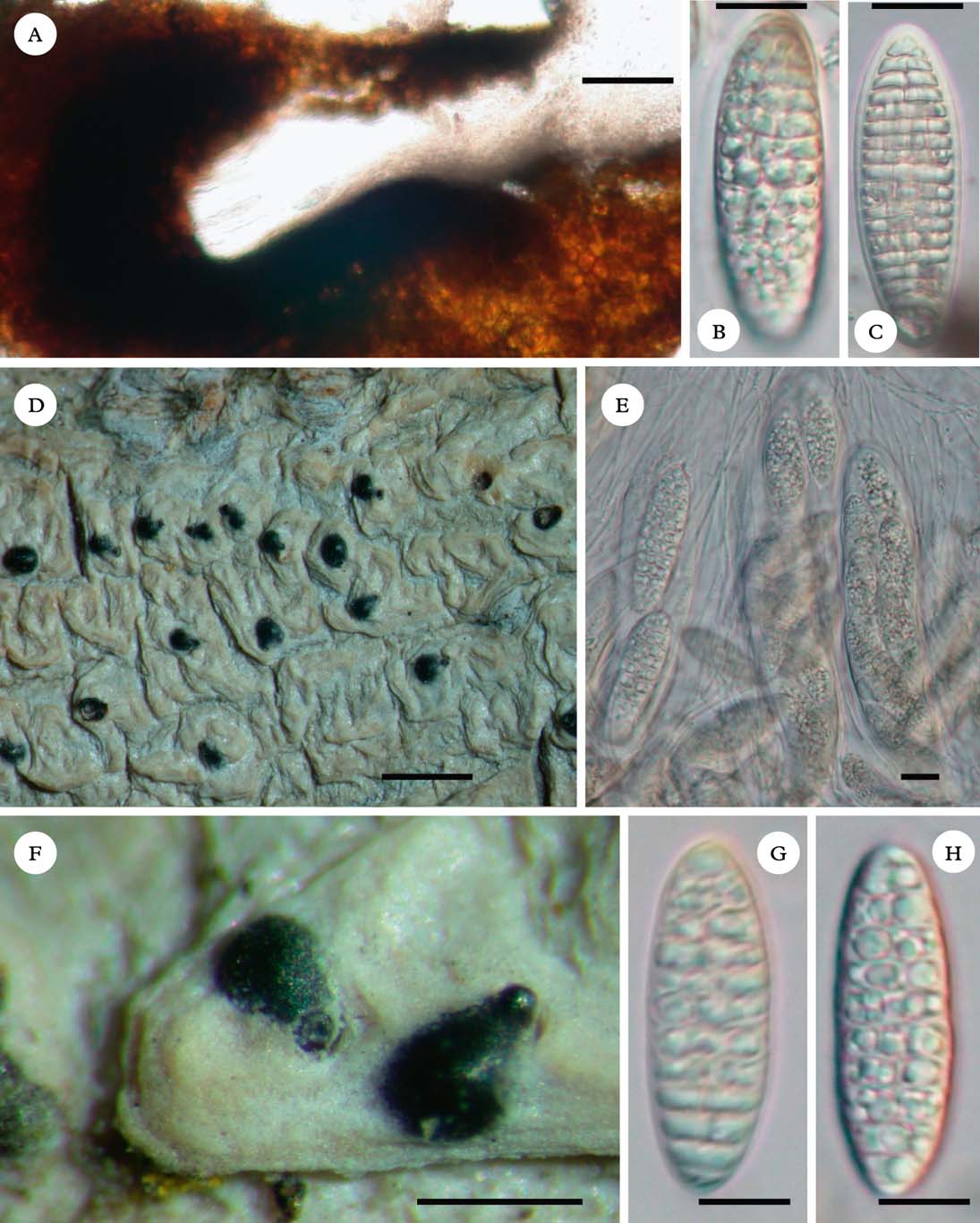
Polymeridium with the ascomata deeply immersed in the bark below the thallus, lateral, single or fused ostioles, asci with 2 muriform ascospores of (45–)60–70×17–25 µm.
Type: Brazil, Rondônia, Porto Velho, UNIR Federal University campus S of city, on bark of tree, c. 100 m alt., 8 March 2012, M. Cáceres & A. Aptroot 11138 (ISE—holotype; ABL—isotype).
(Figs 1G & H, 2A–C)
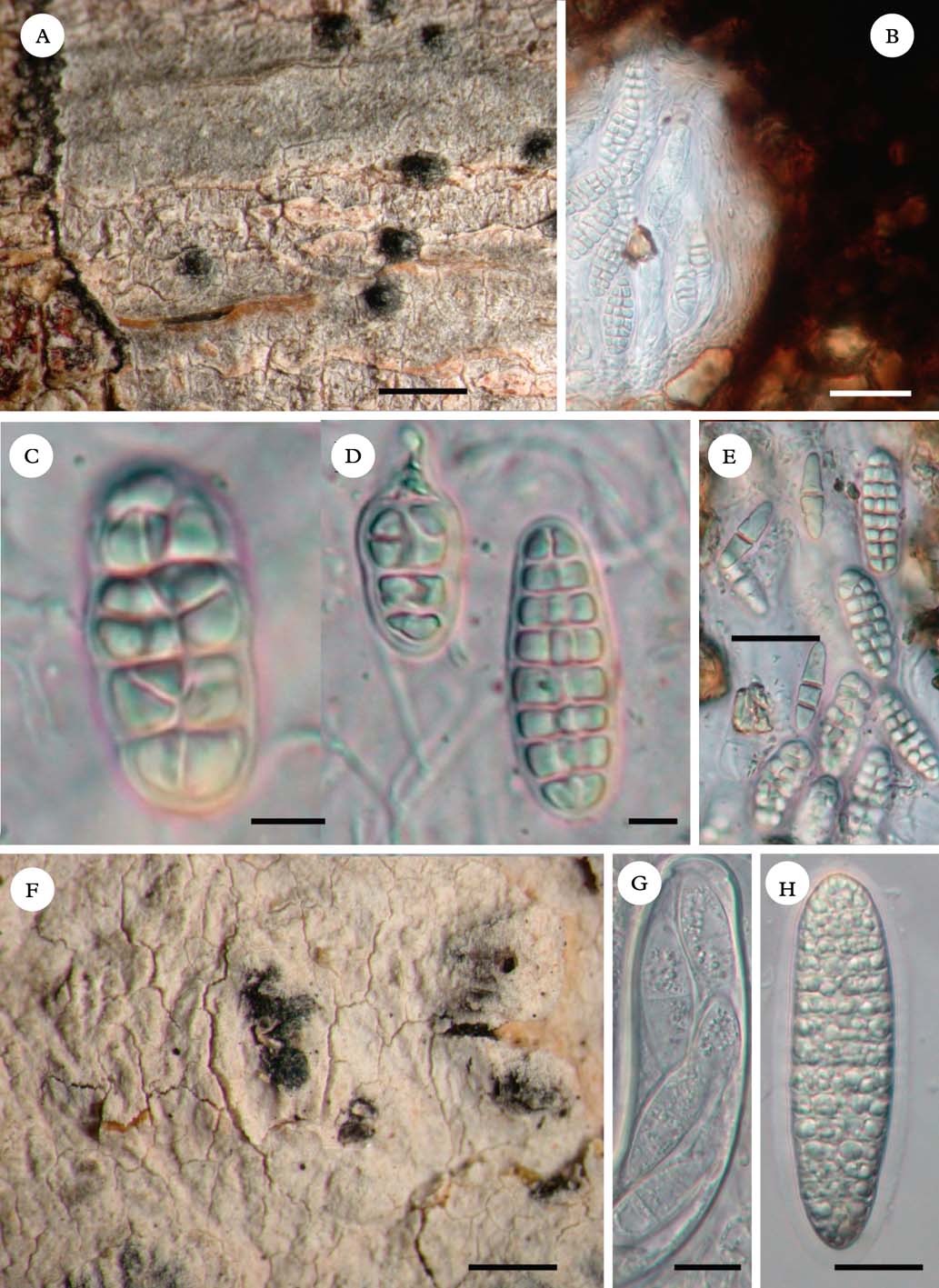
A–C, Polymeridium immersum (holotype); A, section through ascoma; B & C, ascospores. D–H, Polymeridium isohypocrellinum (holotype); D, habitus; E, asci with ascospores; F, habitus; G & H, ascospores. Scales: A=0·1 mm; B & C=20 µm; D=2 mm; E, G & H=10 µm; F=0·5 mm. In colour online.
Thallus crustose, continuous, not corticate, dull, pale pinkish white, very thin and closely following the bark surface, surrounded by a brown prothallus line. Algae trentepohlioid.
Ascomata pyriform, deeply (up to 3 mm) immersed in the bark below the thallus, 0·3–0·5 mm wide, wall black, only visible from above by the pale ostioles. Ostioles pale, lateral, single or 2 fused, connected with long and often curved necks with the ascomal chamber. Hamathecium not inspersed. Ascospores muriform, 2 per ascus, hyaline, IKI−, 9–15(–19)×1–4-septate, ellipsoidal to fusiform, (45–)60–70×17–25 µm, outer wall generally constricted at the median septum.
Pycnidia not observed.
Chemistry
UV+ yellow, KOH−; lichexanthone present in thallus (TLC).
Ecology and distribution
On smooth bark of trees in rainforest remnants and primary tropical rainforest. Known only from Brazil.
Discussion
This species differs from all other known Polymeridium species by the ascomata that are deeply immersed in the bark below the thallus. The species is easily mistaken for a sterile crust because the ascomata are below the thallus in the bark, and would escape notice when only a superficial section is made through the thallus at the ostiole. Species with a somewhat similar habitus are known only in the related genus Pseudopyrenula (Komposch et al. Reference Komposch, Aptroot and Hafellner2002). It is also the only species of Polymeridium known with just two ascospores per ascus; all others have eight per ascus.
Additional specimen examined. Brazil: Amazonas: Fazenda São Francisco off BR319, 30 km N of Porto Velho, on bark of tree, c. 100 m alt., 2012, M. Cáceres & A. Aptroot 11943 (ABL, ISE). Ceará: Chapada do Araripe, on bark of tree, 2012, A. A. Menezes (ISE 15889).
Polymeridium isohypocrellinum A. B. Xavier-Leite, M. Cáceres & Aptroot sp. nov.
MycoBank No.: MB 801915
Polymeridium with ostiole with red, KOH+ green pigment (iso-hypocrellin) and muriform ascospores 33–47(–55)×11–15 µm.
Type: Brazil, Paraíba, Reserve Muralha, on bark of tree, 16 July 2012, A. B. X. Leite (ISE 15890—holotype).
Thallus crustose, continuous, not corticate, dull, pale pinkish cream-coloured, very thin and closely following the bark surface, surrounded by a black prothallus line. Algae trentepohlioid.
Ascomata ovoid to triangular, occasionally 2 with fused ostioles, superficial, somewhat glossy, 0·3–0·5 mm wide, black. Ostioles lateral, black, with red pigment inside. Hamathecium not inspersed. Ascospores muriform, 8 per ascus, hyaline, IKI−, 9–15×1–3-septate, ellipsoidal, 33–47(–55)×11–15 µm, not constricted.
Pycnidia not observed.
Chemistry
UV−, red pigment in ostiole KOH+ green; iso-hypocrellin present in ostiole.
Ecology and distribution
On smooth bark of trees in Caatinga forest. Known only from Brazil.
Discussion
This species differs from all other known Polymeridium species by the red, KOH+ green pigment in the ostiole. It is the first time that iso-hypocrellin has been found in the genus. This substance is known within the family only from Laurera purpurina (Nyl. ex Leight.) Zahlbr. and in lichenized fungi from the Graphidaceae, viz. in Graphis (Lücking et al. Reference Lücking, Archer and Aptroot2009) and Thecaria (Cáceres et al. Reference Cáceres, Rivas Plata and Lücking2012), and the Pyrenulaceae (Aptroot et al. Reference Aptroot, Sipman and Cáceres2013).
Polymeridium julelloides E. L. Lima, M. Cáceres & Aptroot sp. nov.
MycoBank No.: MB 801916
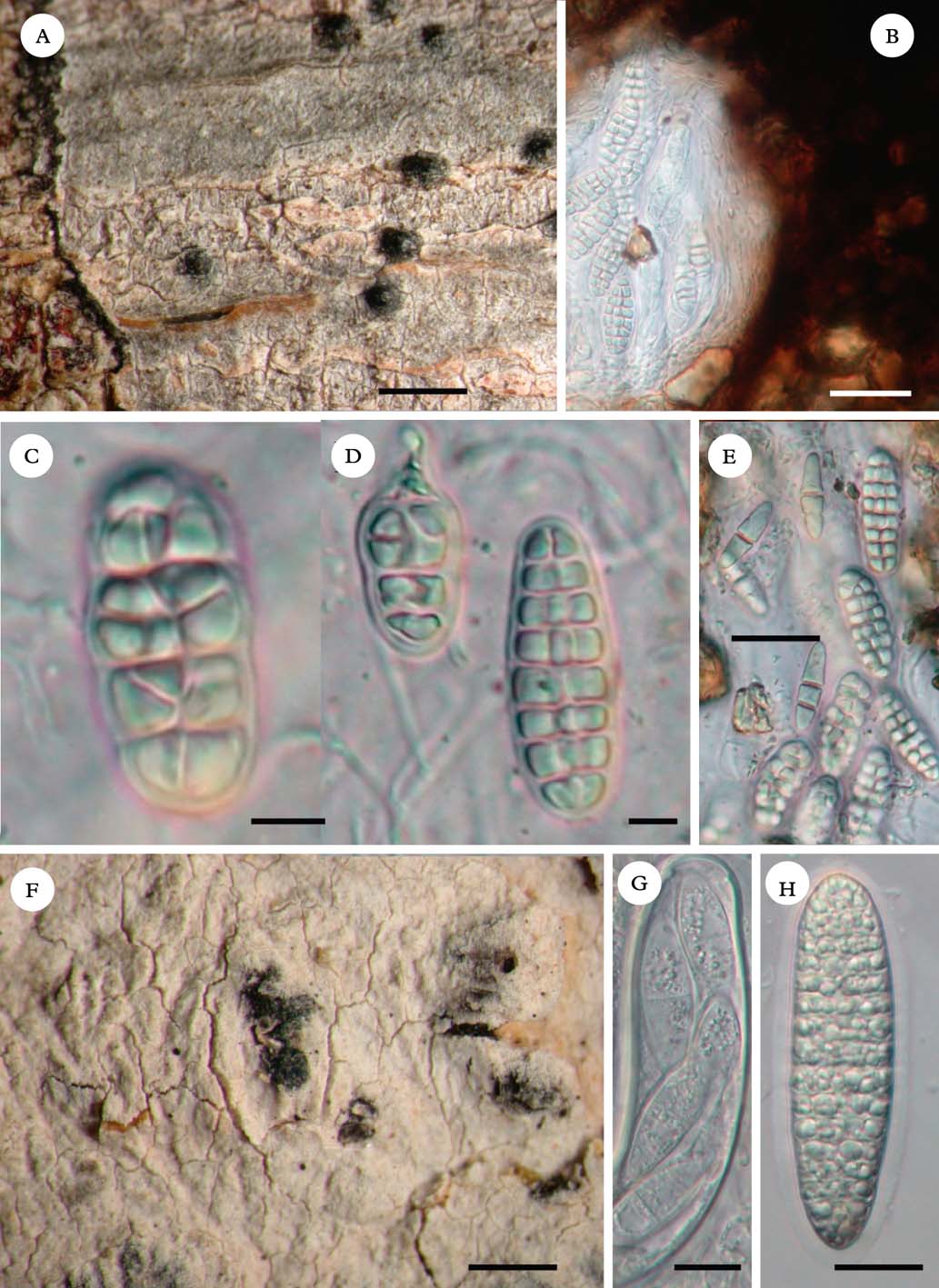
Polymeridium with short and broad muriform ascospores 25–29×11–13 µm.
Type: Brazil, Pernambuco, Buíque, Vale do Catimbau National Park, on bark of tree, c. 900 m alt., 3 October 2011, E. L. Lima 145 (ISE—holotype).
A–E, Polymeridium julelloides (holotype); A, habitus; B, section through ascoma; C–E, ascospores. F–H, Polymeridium paraproponens (holotype); F, habitus; G, ascus with young ascospores; H, ascospore. Scales: A=1 mm; B, E, G & H=20 µm; C & D=5 µm; F=0·5 mm. In colour online.
Thallus crustose, continuous, not corticate, dull, pale pinkish brown, very thin and closely following the bark surface, surrounded by a brown prothallus line. Algae trentepohlioid.
Ascomata conical, superficial, somewhat glossy, 0·3–0·5 mm wide, black. Ostioles brown, apical. Hamathecium not inspersed. Ascospores muriform, 8 per ascus, hyaline, IKI−, 6–9×0–2-septate, ellipsoidal to slightly clavate, 25–29×11–13 µm, septa often partly oblique, outer wall generally constricted at a few septa.
Pycnidia not observed.
Chemistry
UV−, KOH−; no substances detected by TLC.
Ecology and distribution
On smooth bark of trees in Caatinga forest. Known only from Brazil.
Discussion
This species differs from all other known Polymeridium species by the relatively short and broad muriform ascospores. These ascospores are reminiscent of those in the few common species in the genus Julella (Aptroot & van den Boom Reference Aptroot and van den Boom1995). This genus differs mainly by the mostly unbranched interascal filaments. The genus Julella was recently found to belong, like Polymeridium, to the Trypetheliaceae (Nelson et al. Reference Nelsen, Lücking, Aptroot, Andrew, Lumbsch and Ree2012).
Polymeridium paraproponens Aptroot, M. Cáceres & E. L. Lima sp. nov.
MycoBank No.: MB 801917
Polymeridium with ascomata grouped by 2 or 3, with lateral, fused ostioles and muriform ascospores 55–75×19–21 µm.
Type: Brazil, Rondônia, Porto Velho, UNIR Federal University campus S of city, on bark of tree, c. 100 m alt., 8 March 2012, M. Cáceres & A. Aptroot 11162 (ISE—holotype; ABL—isotype).
Thallus crustose, continuous, not corticate, dull, pale pinkish white, very thin and closely following the bark surface, sometimes flaking off, surrounded by a broad brown prothallus line. Algae trentepohlioid.
Ascomata grouped together by 2 or 3, elliptical to hemispherical but mostly covered by thallus, not glossy, 0·3–0·5 mm wide, black. Ostioles black, lateral, 2–3 fused. Hamathecium not inspersed. Ascospores muriform, 8 per ascus, hyaline, IKI−, 15–25×1–3-septate, long ellipsoidal, 55–75×19–21 µm, not constricted, surrounded by a 3 µm wide gelatinous sheath.
Pycnidia not observed.
Chemistry
UV+ yellow, KOH−; lichexanthone present in thallus (TLC).
Ecology and distribution
On smooth bark of trees in rainforest remnant and in Caatinga forest. Known only from Brazil.
Discussion
This species differs from all other known Polymeridium species by the grouped ascomata and the combination of lateral fused ostioles and muriform ascospores. It clearly belongs to the Polymeridium proponens group, which in recent phylogenetic studies (Nelsen et al. Reference Nelsen, Lücking, Aptroot, Andrew, Lumbsch and Ree2012) was found outside the clade with the other species of Polymeridium. For the moment they are still classified in the same genus.
Additional specimens examined. Brazil: Pernambuco: Buíque, Vale do Catimbau National Park, on bark of tree, c. 900 m alt., 2011, E. L. Lima 313; 395 (ISE). Rondônia: Porto Velho, UNIR Federal University campus S of city, on bark of tree, c. 100 m alt., 2012, M. Cáceres & A. Aptroot 11109 (ABL, ISE).
Discussion
Interestingly, these new species not only confirm that Brazil is the centre of diversity for Polymerdium, but that many species exhibit at least one character that was so far unknown in the genus, thus expanding its total morphological diversity.
With the numerous (over 200) collections of species of the genus now available, it became evident to us that the species concept applied by Harris (Reference Harris1993) is untenable. He argued that the character absence/presence of lichexanthone and absence/presence of hamathecium inspersion were not worth using as distinguishing characters for species because in some cases all four possible combinations were known for a morphologically characterized species. However, within a certain geographical area, we generally found only one combination of these characters present within each morphological species, showing that these characters are not random variation. Application of this stricter species concept would lead to the recognition of more species, which will be published elsewhere. It is remarkable that the vast majority of the Polymeridium specimens present in NE Brazil (and even most of the species described here) have lichexanthone in the thallus and lack inspersion. It is unclear whether this could be an adaptation or (and this seems more likely) that they at least partly share ancestors that are not shared with the inspersed specimens and/or specimens without lichexanthone that are currently partly classified in the same species. For example, all lichexanthone-containing species with muriform ascospores seem also to share other characters, such as a lateral ostiole. The matter is currently under scrutiny by means of phylogenetic research (Nelsen et al. Reference Nelsen, Lücking, Aptroot, Andrew, Lumbsch and Ree2012).
The Conselho Nacional de Desenvolvimento Científico e Tecnológico (CNPq) is thanked for a research grant to MESC (Processo 501633/2009-0) and for financial support for the collecting trips (CNPq-Protax Processo 562.330/2010-0 and INCT-Herbário Virtual Processo 573.883/2008-4). The Fundação de Amparo à Ciência e Tecnologia do Estado de Pernambuco (FACEPE) is thanked for a Master's scholarship to ELL. Coordenação de Aperfeiçoamento de Pessoal de Nível Superior (CAPES) is thanked for Master's scholarships to AAM and ABXL. AA is grateful to the Stichting Hugo de Vries-fonds for travel support. Leo Spier is thanked for performing thin-layer chromatography.