Introduction
The importance of personal practice for instrumentalists and vocalists is well established among researchers, and axiomatic for practitioners. For musical performers at all levels, practice normally represents the bulk of time spent and effort made; feeds and reflects motivation, and other affective aspects of learning; entails the independent continuation of learning acquired in social settings, including individual lessons; and affects the success of performance outcomes, which in turn feed into the cyclic nature of skill-based learning. As we have argued elsewhere, however, personal practice is the musical activity perhaps least accessible to the scrutiny of either teachers or researchers (Burwell & Shipton Reference BURWELL and SHIPTON2011, p. 255).
At Canterbury Christ Church University, student approaches to personal practice have been explored over the last several years, as part of a long-term project intended to enhance student development, and the institution's capacity to support it. A preliminary questionnaire study completed by 94 student respondents provided us with a good deal of information about their approaches to performance studies, often suggesting relationships between aspects of personal practice and their success in the undergraduate course (Burwell & Shipton Reference BURWELL and SHIPTON2011). Although many of the findings were perhaps of more academic interest than statistical significance, the study left us with some broad impressions that called for further investigation.
One of these was that, while students generally expressed confidence in their teachers, their lessons and their own progress, it was by no means clear that strategic approaches to practice were being systematically taught and learned. This impression was reinforced by our experience in the Department of Music and Performing Arts, overhearing the student practice coming from imperfectly soundproofed studios over a period of many years. Often, for example, we would hear students repeatedly rehearsing their repertoire, with no clear goal in evidence. At other times, we would hear clever practice strategies being used by energetic and committed students, who, however, would switch from one activity to another apparently at random, and sometimes surprisingly quickly, leaving us wondering what had been achieved before the student moved on. Increasingly, we suspected that many of our students might be practising ineffectively: that their work might be taking longer than it should, or lacking in precision and focus, or proving unreliable in performance situations.
On the whole, we could not know what had passed between most of the students and their teachers, in individual lessons, regarding the issue of personal practice. As piano teachers as well as course leaders of performance studies, however, we found that even in our own studios, addressing practice strategies in lessons did not seem to be enough to prepare students to proceed entirely effectively, on their own. With critical reflection, we could see that our management of the issue, in individual lessons, was not consistent; and yet the notion of consistency seemed to contradict our conviction that instrumental teachers should be responsive to what each student brings to the lesson.
We wanted to learn more about how individual students were approaching personal practice: how they organised their time, set goals, selected strategies and monitored their own progress. We also wanted to find out whether there might be some generic approaches to performance studies, which could be offered to students outside the setting of individual lessons, enabling them to optimise their time and energies in their independent practice.
Existing research
In recent years, research exploring the nature and role of students’ personal practice has been buttressed by two authoritative literature reviews. In the first, Hallam (Reference HALLAM, Jorgensen and Lehmann1997) proposes a model representing the constituent components of practice, divided chiefly among learner characteristics, the learning environment, and the processes of practice itself. A concluding summary identifies ten under-researched aspects of practice: these include ‘metacognitive activities’, relating to the planning, monitoring and evaluation of outcomes; the variety among learners and practice tasks; and practice strategies, along with the methods adopted in teaching practice skills (Hallam Reference HALLAM, Jorgensen and Lehmann1997, p. 217).
Twelve years on, Jørgensen included a shorter review of research focused on practising alone, in an appraisal of music education research from the perspective of quality improvement (Jørgensen Reference JØRGENSEN2009, pp. 81–91). This reports an expansion of research on the subject, focused in the main on two broad issues: the amount of time allotted to practising, which Jørgensen labels quantitative aspects; and the use of practice strategies, or qualitative aspects of practising. Musicians engaged in either research or performance activities are, of course, interested in both; but it seems significant that there has not been more attention given to an aspect of practice that should link the two: strategic time-use, or time-use as a strategic means of supporting the structure, content and regulation of personal practice.
Time management is discussed in the broader context of academic learning by Zimmerman et al. (Reference ZIMMERMAN, GREENBERG, WEINSTEIN, Schunk and Zimmerman1994), who note that it has often been regarded as a manifestation of personal traits such as aptitude or motivation (p. 182), rather than something that can be learned and controlled. They illustrate its pivotal importance, however, in reporting findings from a diagnostic measure of strategic, goal-directed learning among college students. Time management was found to be related to all other scales measured: attitude, motivation, anxiety, concentration, information processing, selecting main ideas, study aids, self-testing, and test strategies (pp. 190–191).
For the specialist field of music, this aspect of practice is by no means unrepresented in the literature. Hallam (Reference HALLAM2001) seems to touch on time-use, for example, in describing common features in the independent work of 22 professional musicians, in terms of metacognitive skill:
They demonstrated acute self-awareness of their strengths and weaknesses, extensive knowledge regarding the nature of different tasks and what would be required to complete them satisfactorily. They also had a range of strategies that could be adopted in response to their needs. This not only encompassed technical matters, interpretation and performance but also questions relating to learning itself, for example concentration, planning, monitoring and evaluation. (Hallam Reference HALLAM2001, p. 30)
Perhaps surprisingly, the ‘acute self-awareness’ of these musicians is evident in some being quite critical of their own organising skills, and Hallam suggests that scheduled time-use in their practice might represent compensation for their self-perceived ‘natural disorganisation’ (p. 32).
Zimmerman asserts that constructs such as metacognition tend to overlap with others, such as volition and planning; he seems to position metacognition as one of several cross-currents through self-regulation, which refers to ‘the degree that individuals are metacognitively, motivationally, and behaviourally active participants in their own learning process’ (1994, p. 3). Boekaerts et al. (Reference BOEKAERTS, PINTRICH, ZEIDNER, Boekaerts, Pintrich and Zeidner2000), in turn, explain that ‘self regulation is a very difficult construct to define theoretically as well as operationalize empirically’ (p. 4); and although an ‘atheoretical conceptual framework’ has been proposed by Zimmerman (Reference ZIMMERMAN, Schunk and Zimmerman1994, p. 7), Schunk and Zimmerman acknowledge that self-regulated learning can be understood from a range of theoretical perspectives, with common features (Reference SCHUNK and ZIMMERMAN2001).
In practical terms, self-regulated learning encompasses three key features: goals, actions and assessment (Vancouver, Reference VANCOUVER, Boekaerts, Pintrich and Zeidner2000, p. 306). Pintrich & De Groot, in a study of junior high-school students, identified links among self regulation, motivation and performance; self regulation was also correlated with cognitive strategy use, but it appeared that ‘cognitive strategy use without the concomitant use of self-regulatory strategies is not conducive to academic performance’ (Reference PINTRICH and DE GROOT1990, p. 38).
In the context of higher education music Nielsen (Reference NIELSEN2001) explored the role of self-regulation in practice by making video observations of two advanced organ students, inviting them to comment on their own personal practice and noting whether they identified specific learning outcomes for each session, whether they included self-evaluation, and what criteria they used for this. In a further study, she used a questionnaire to investigate the approaches taken by 130 music students in higher education, finding that – consistent with Hallam (Reference HALLAM2001) – advanced musicians employed a full range of cognitive, metacognitive and resource-management strategies. Of these however it seemed that those related to resource management, including efforts to organise and control time use, the study environment, and effort regulation, were the least used strategies.
Given the recognition of the importance of self-regulation in developing effective approaches to practice, it might be expected that self-regulating activity would be addressed in individual lessons, particularly in higher education. However, in an interview study with 20 conservatoire teachers, Gaunt found that teachers tended to assess the quality of their students’ practice by the results achieved in performance, and appeared to have little knowledge of what was actually taking place during student practice sessions. Gaunt reported, in addition, that only a minority of these teachers prescribed practice activity for their students, with one asserting that students should be allowed to find their own way (Reference PINTRICH and DE GROOT2008, p. 237).
Koopman et al. (Reference KOOPMAN, SMIT, DE VUGT, DENEER and OUDEN2007) investigated the relationship between lessons and practice in a conservatoire setting and found little evidence of explicit reference to practice, in the individual lessons of six students. There was a clear link between the content of the lessons and the methods that students adopted in their practice, which suggests perhaps that students model their practice on lesson activity, whether the model is discussed with their teacher or not. Most of the students demonstrated a knowledge of certain strategies, without demonstrating a confident grasp of self-regulation: often they did not seem to know when to apply the strategies, nor for how long. Students appeared to be relying on their weekly lessons to drive their practice, rather than steadily acquiring strategies – and the ability to monitor and evaluate their use – that might equip them for independent learning in the future.
The notion of cultivating student independence in lessons and practice does not appear to be an essential component of the traditional master-apprentice model as characterised by Jørgensen:
the master usually is looked at as a role model and a source of identification for the student, [and] the dominating mode of student learning is imitation. For me, a key question in this relationship is: is the student given opportunity to develop his independence and active initiative in learning, or is he restricted to develop his ability to receive, absorb and transform teacher influences? (Jørgensen Reference JØRGENSEN2000, p. 68)
Many ‘masters’ might wish to argue that their role is to teach the student to be a good instrumentalist or singer, and that the student's development as a learner is her own responsibility; conversely, many students might feel that the traditions of studio-based instruction ‘restrict’ their ability to develop independence. The argument would be enriched by the fact that some students, even in higher education, do not want such responsibility (Jørgensen, Reference JØRGENSEN2000, pp. 70–71); indeed, it has been reported that many advanced students both seek and maintain their teacher's authority (Nerland & Hanken, Reference NERLAND, HANKEN, Hanken, Nielsen and Nerland2002, p. 172). These issues tend perhaps to divert attention from the institution's responsibility to ensure that students are equipped with lifelong learning skills such as resource management, which would seem to be generic in nature. In this particular case, it seemed worth exploring the possibility that these might be supported in a setting complementary to individual lessons.
Methodology
This was action research, characterised as ‘a form of self-reflective enquiry undertaken by participants in social situations in order to improve the rationality and justice of their own practices, their understanding of these practices, and the situations in which the practices are carried out’ (Carr & Kemmis, Reference CARR and KEMMIS1986, p. 162). This is normally carried out by professionals who identify issues that are relevant to them in practical terms, in an effort to improve local practice; it is distinct from reflective practice to the degree in which the rigour of the research process is brought to bear on professional work, and distinct from many other methodological approaches to the degree in which participant concerns are incorporated. Although it may be manifested in a variety of approaches, action research brings together research and practice as ‘forms of knowing’, favouring what Gergen & Gergen describe as ‘a pluralist and instrumentalist view of knowledge’ (Reference GERGEN, GERGEN, Reason and Bradbury2008, p. 166). Thus the ‘particularly significant’ concerns of action research are, according to Wicks et al. (Reference WICKS, REASON, BRADBURY, Reason and Bradbury2008), likely to emphasise:
• the importance of practice and life experiences and these as integrated with – and often preceding – philosophical, political, and intellectual underpinnings; [and]
• the web of relationships, events, influences, role models, and experiences which underpins action researchers’ practice (and which has done so over time). (Wicks et al., Reference WICKS, REASON, BRADBURY, Reason and Bradbury2008, p. 15)
Previous instances of action research in music education have been reviewed by Cain (Reference CAIN2008) who carefully distinguishes a range of characteristics that are shared to varying degrees. Several of these characteristics may be identified in the current case study. First, the study integrates research and action, in a cyclic process through which innovations are being introduced, monitored and evaluated within the Performance Studies course at CCCU: this report refers to a phase of research following a preliminary questionnaire study (Burwell & Shipton Reference BURWELL and SHIPTON2011), and the residential clinic described here has already been followed by further steps toward integrating the innovations into the formal curriculum. The ongoing study is being conducted in a ‘natural’ setting by practitioner-researchers, with experience in leading Performance Studies modules and in conducting qualitative research. Drawing on both kinds of knowledge, one of the underlying aims of the project is to challenge assumptions about instrumental teaching and learning, specifically acting on the notion that practice skills might not be systematically acquired within the traditional format of one-to-one lessons, and seeking to identify generic approaches to practice that might be more reliably disseminated in other ways or settings. Not least, the project is aimed at empowering students to develop their potential performing skills more independently and effectively, as part of the university's published aim to foster lifelong learning (Internet 1, pp.11–12).
Procedure
This phase of action research was supported by funding from the Performing Arts Learning and Teaching Innovation Network (PALATINE). It was focused on a residential practice clinic, for eight student participants who were initially identified through a call for volunteers from the Performance Studies classes at CCCU. Most of these students had previously participated in a questionnaire study exploring their approaches to practice and other aspects of their course (Burwell & Shipton, Reference BURWELL and SHIPTON2011); several had told us that even completing the questionnaire had provoked reflection and raised concerns about the efficiency of their individual approaches, and seminar-based discussion of early findings further inspired them to put themselves forward for clinic participation.
The practice clinic occupied a whole building of practice facilities over a two-week period during the Easter vacation preceding the final, examination term. The facilities included a concert room and individual studios for practice, with two reception rooms used for refreshments, group meetings and interviews. One practice studio was equipped with a digital camera for making regular recordings of each student's personal practice, and another designated for regular rehearsals with a repetiteur, while the interview room was equipped with a computer and television so that recordings could be reviewed and discussed.
Three seminar sessions were held during the clinic, each introducing specific guidelines for aspects of performance studies: these outlined strategic approaches to practice, rehearsal and performance respectively. The participating students accepted from the outset that they had volunteered for the clinic in order to be challenged, and agreed with some enthusiasm that they would try these approaches as suggested, all the while feeding back to researchers with their impressions, questions and reflections.
A questionnaire, based on the earlier phase of research within Performance Studies, was used before and after the clinic, to collect and monitor information about participant characteristics and individual approaches to aspects of the course. The results from students’ performance examinations were also noted, before and after participation in the clinic. A preliminary interview was conducted with each student, collecting further information particularly about current approaches to practice. The opportunity was taken here to ask students who did not already have one, to discuss with their individual teachers a warm-up routine that they might use during the clinic; we checked whether students had had any previous health problems related to their work, and we provided written information setting out the nature of the study, obtaining informed consent in compliance with the university's research ethics procedures.
During the clinic each student participated in two further, formal interviews, watching their filmed practice sessions back with an interviewer-researcher. These interviews served several purposes: the interviewer as researcher sought information about the students’ intentions and reflections on reviewing their own practice; the suggested strategies that were being implemented were discussed and clarified; and the interviewer as tutor questioned aspects of the students’ practice and made further, more specific suggestions to assist with identifying and addressing problems. Toward the end of the clinic, a group interview was recorded, reflecting on the nature of the clinic in the context of Performance Studies, with respect to individual student trajectories and with a view to wider implementation in the future. A final concert was the focus of strategic approaches to both rehearsal and performance: this was filmed, and at the end of the clinic each student received a DVD including this and their individual practice sessions, for further reflection.
During the clinic students kept practice schedules, indicating items for practice and the time spent on each, each day; they also entered weekly reflections on a weblog, from the beginning of the clinic through to their performance examinations about a month later. Finally, semi-structured interviews were conducted with each student before and after the examinations, tracing the effect of clinic participation on the independent work that followed. Thus, each student participated in a total of five interviews.
Perhaps typically of action research, the project generated an enormous amount of data (Cain, Reference CAIN2008, p. 310) which provided much valuable and interesting food for thought, though only a portion of it can be addressed within the scope of this paper. The findings and discussion below will be focused on strategic approaches to practice.
Strategic approaches to practice
On the first day of the clinic, after a preliminary discussion about healthy practice, students were introduced to the approach to be taken to individual practice. This was explained in terms of three phases – before, during and after. With practice viewed as self-teaching, the ‘before’ phase would represent planning and preparation; ‘during’ would represent the execution; and ‘after’ would represent observation and reflection. Viewed as self-regulated learning, the three phases were also explained in terms of forethought, performance and self-reflection (Jørgensen, Reference JØRGENSEN and Williamon2004, pp. 85–86). In the clinic, ‘before’ would involve the use of structured practice schedules; ‘during’ would be supported by the use of a video camera, to record individual practice so that it could be reviewed with a tutor; and ‘after’ involved keeping weekly weblogs reflecting on the use of the prescribed approaches to practice, as they evolved.
Further attention was now given to the notion of structured practice schedules. This was to be based on the use of 15-minute cells or building-blocks within each student's schedule – a notion that quickly became known as ‘the 15-minute rule’. It was asserted that anything worth practising, would be worth practising for 15 minutes. The student would decide the content, which might consist in a selection of related tasks such as a ‘warm-up routine’; or technical work; or a section of a piece; or an extracted problem from a piece; a performed run-through; or an accompanied rehearsal. The chosen content must be practised for a full 15 minutes, and so had to be gauged to fill that time. After 15 minutes, the same unit might be repeated, or the student might decide to move on to something else. Although they were expected to attend from 9.00 am each day, students were free to decide the total duration of their practice sessions, and to take breaks as appropriate.
The 15-minute rule was taken from Ronald Smith, the eminent English pianist and teacher who was artist in residence at CCCU during the 1990s. Smith had taught one of the researchers, and the teacher of the other, and both had become acquainted with the approach through familiarity with Smith's own practice methods. Interestingly, however, it seemed that Smith did not teach this approach systematically in individual lessons: although he described it to some, and offered it as a tool that he had found reliable himself, he did not raise it with all, and to our knowledge, did not prescribe its use for any student. This suggested a different attitude to the organisation of practice, than to technique, for example, which Smith taught in a highly specific and systematic way.
Perhaps as a consequence of this perceived attitude, the researchers had not prescribed this approach to individual students either, prior to the clinic. Now, however, it was offered to clinic participants as the starting point for their practice regime.
Participant characteristics
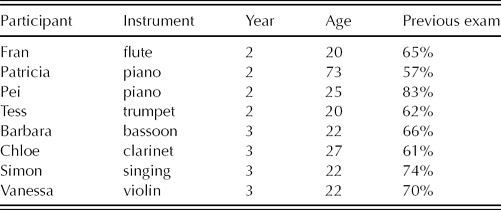
The range of volunteers was limited somewhat by the commitment required: participants were expected to attend a ‘residential’ clinic each morning for two weeks during the university holidays. Of the eight participants, four were engaged in their second year of the undergraduate Performance Studies course and four came from the third year. The students specialised on six different instruments altogether, and one was a specialist singer. Three of the students were ‘mature-aged’, meaning that they had had at least one gap year before entering university; one outlying student had begun her degree course only after reaching retirement age. The abilities of student participants, as indicated by their previous examination results, ranged from average to outstanding within the Performance Studies course. The characteristics of participants, who are represented by pseudonyms, are summarised in Table 1.
Participant characteristics

Findings
In interviews, the student participants were invited to reflect on their experience with the clinic and on their approaches to practice before joining it. Asked what advice they had had about practice before coming to university, Barbara, Fran and Simon asserted that they had had none; Patricia reported ‘virtually zero’, and Vanessa ‘very little’. Students had been told that they should practice, or that they should practice more, or that they should practice a particular amount; but only Pei reported that she had been ‘told how’, and this amounted to the suggestion that she should practice slowly.
Asked what advice they had had about practice since coming to university, but before participating in the clinic, the students gave a wider range of responses. Vanessa felt that her violin lessons referred to practice skills, ‘all the time: from the minute we get in there’. Such consistency was exceptional, however. Tess had had advice from one trumpet teacher, but not another. For several other students, advice had been sporadic: for Barbara, ‘only in phases’, for Pei ‘more at the beginning’ and for Patricia ‘as issues arose, rather than systematically’. Simon reported that he had not been given advice on practice in his singing lessons; and yet, later in the same interview, he was able to explain some explicit strategies that he had been taught, for mastering coloratura passages.
The students reflected frankly and critically on their approaches to practice, prior to the clinic. Chloe felt that she had been ‘head bashing’, Patricia described her approach as ‘ad hoc’, and Tess ‘higgledy-piggledy’. Barbara reported that she would spend a long time practising without necessarily achieving tangible results:
I'd quite often spend a whole two hour practice session on maybe ten bars, if that . . . Every now and then I'd do something, and I'd get it to the stage where I could play it, [but] the next day I'd come back to it and [find that] I couldn't play it again.
Simon described his previous approach in terms of organisation, reporting practice that had been ‘lacking in structure, [with] no systematic ways of getting through pieces’. Chloe described an approach that relied on stumbling across problems, rather than trying to identify them first:
Well, if I did set aside time to practice, I would have something specific in mind to work on . . . But it would be – oh, I spent a lot of time faffing around, so it wasn't a productive time. And then, it would be more [like], run through till I find the problem, and then stop and focus on the problem.
For many of the students, focusing on a problem had often meant extracting it from its context, and repeating it: Fran reported playing difficult passages ‘a million times’, Barbara playing ‘over and over’, and Chloe remarking that she did not know what else she could do, ‘other than repeating’. Pei too had repeated material ‘so many times’, and seemed to have no alternative but to rely on the only piece of advice that she had received before coming to university: ‘I need to practice slower’.
All of the participants seized on the 15-minute rule promptly and with enthusiasm, and in their individual weblogs, this was the salient topic for reflection, particularly in the early stages of the clinic. Almost immediately, the participants began to report that the rule was supporting improvements in their work. Simon was energetically positive, expressing early confidence in the system:
At the end of the first week I have learnt how to systematically organise my practice, thanks to the helpful practice schedule provided. This structure is of great advantage and definitely something that I will use in my private practice.
The other participants were more specific in their reflections. Barbara asserted in her first weblog that ‘this has made my practice more focused and efficient’; Vanessa felt that the approach put more pressure on her concentration, but compared this favourably with her previous routine, which often resulted in little progress. Pei wrote that it was ‘more effective’ to move on after 15 minutes whether she was satisfied or not, suggesting that this might be because ‘my brain does not feel tired if I change items each 15 minutes’. Chloe explained:
Before starting this practice clinic I was not aware of using short term targets during practice sessions, so having an object for 15 minutes focuses and condenses my practice from [having been] dilatory to enable me to achieve much more.
The concise written record generated by the 15-minute rule was itself found useful. Fran, for example, wrote that ‘writing down exactly what I'm practising is helping me to focus more and be more productive’, and Pei recorded that ‘another thing that I felt useful was writing items down so I knew what I [had] practised and [what] I need to work on’. Vanessa had tried keeping written records of her practice before the clinic, and in her second interview reflected on that in the light of the new system:
Well actually I did try a lot of different things. When I recorded it though it wasn't really with a tick [for each 15 minutes], it was something that became an essay on what I'd done, and that was quite demanding. You eventually, you couldn't keep it up. So I didn't [continue to] do that. But then I wrote out maps of intonation and things like that. And I didn't keep that up, and I thought, basically it was quite inconsistent. That's what I'm like most of the time, really, inconsistent.
Although all of the participants seized on the 15-minute rule readily, the first sessions of filmed practice, viewed back with a researcher, revealed that only Tess had firmly grasped the principle immediately. Barbara, Fran, Patricia and Vanessa thought that they had been keeping to schedule, but realised watching the films that they had not; Chloe was unable to identify the start of a new 15-minute slot, in her first film, while Simon was unable to say what specific item he had been filmed practising, for 30 minutes of rather indecisive activity. In contrast, Pei was filmed practising purposefully, and was able to specify an aim – to memorise a certain passage; but watching her film, she admitted that she had lost her awareness of time as she became determined to pursue the aim indefinitely, even though she could articulate no particular plan for achieving it, and could see now that no clear progress was being made.
By the following week, confidence in using the 15-minute rule had clearly increased. Barbara addressed this in her weblog:
I found that the second week flowed more naturally. Being more used to working in 15 minute sections, I was at least by the end of the [first week], able to judge what could be done in that time, and about how long a task would need if it was more than 15 minutes. It also meant I was able to plan ahead more, because being able to look back and pinpoint exactly what I had done, and what still needed doing, meant that I was spending less time going over the same ground again and again, and able to give attention to everything that needed it.
By this time, most of the students were exercising a more commanding approach to the 15-minute rule. Students who were found pursuing 30-minute ‘items’ were planning to do so deliberately and were confident in justifying that, while Vanessa had devised some 15-minute items that consisted of three 5-minute tasks. Tess reported that she was scheduling her series of 15-minute items to include periods of mental rehearsal and listening to recordings, which allowed her to extend her trumpet practice and to manage her memorising more successfully. In contrast, and exceptionally, Patricia's practice schedules and weblogs suggested that for her, the use of the 15-minute rule gradually disintegrated; in her second weblog she suggested that 12 minutes might be sufficient for some items, and eventually she recorded a 5-minute item in her practice schedule. Patricia continued to reflect on the difficulty of identifying workable items, regretting that this had not been decisively defined for her in the introductory session, and a week after the clinic had ended she lamented in a weblog, ‘learning is a messy business’.
The participants were also enthusiastic about the value of watching films of their practice back. Often, watching the film allowed them to evaluate their work objectively, without prompting; Barbara for example remarked that ‘it highlights things that you don't notice so much while you're playing’, and observed a lack of attention to dynamic detail and a tendency to play high notes loudly. Fran, similarly, noticed her own tendency to rush, while Pei remarked that her playing had a lack of ‘musical interest’ in places.
More than this, the students remarked on the value of being able to watch their practice back with a researcher. Often, attention was drawn to issues that were apparently being overlooked by the student in the moment of practice, including generic issues such as posture, accuracy, and musicianship. In the group interview at the end of the clinic, Simon remarked ‘I think on our own we wouldn't have asked ourselves the questions that you've been asking’. This was reinforced by Barbara, who touched on the more specific advice that had been made available, about practice strategies for particular problems:
We wouldn't even have thought of asking the questions, if that makes sense. If we hit a problem, at the moment, and we think ‘is there a better way of doing this?’ [if] I can't think of anything, I can go and ask about it. If there was no one here, we'd have just carried on because it wouldn't have occurred to us that someone else might have another point of view.
Barbara was able to articulate several strategies that she had learned before attending the clinic, but seized on new ideas with enthusiasm, and explained in some detail:
Before, I generally varied rhythm and articulation in different ways to get my fingers round the passage. Now I've added in looping a short passage and varying the rhythm, so that the notes are a different length each time. I've also started working from the end of a passage backwards so that I get more confident as I play through the passage. Using these methods, I've found that passages stick better, so that they don't need the same amount of work when I next come to them.
It seemed clear that the researchers’ active input was valued; at the same time, it seemed that the mere fact that researchers were present, in an organised and semi-formal setting, helped the students in their work. In the group interview, Chloe referred to ‘the discipline of being expected here’, while Vanessa likened the researchers to ‘parents or something’, with an anecdote that provoked sympathetic laughter from her peers:
On the first day I went upstairs to do Bach and it really didn't work so I came downstairs, and there was no one downstairs apart from you and I thought, ‘I'd better go upstairs again and do some more practice!’
Similarly perhaps, several students commented on the value of peer support within the clinic. Both Barbara and Chloe reported having taken ideas from others, through either conversations among students or overhearing the way others were experimenting with the 15-minute rule. Tess remarked on the value of having colleagues to talk to, ‘rather than feeling alone, practising all the time, for the day’; this was echoed by Patricia, who in an interview after the clinic, recalled that ‘it was also useful that it was a social clinic and that one could pick up vibes from others’.
With the end of the clinic, these aspects of social support fell away, as the final term of the year began and the students were drawn back into a flurry of activity, generated by their formal courses, an annual music festival based within the university, and the examination period. In weekly weblogs, Fran reported that it was difficult to maintain her level of motivation after the clinic, while Pei felt that her practice was challenged by other demands on her time and attention:
I haven't done much practice since I've returned to term work. It [has] affected my practice very very badly. I reduce my practice a lot during the day when I decide to do assignments. I sometimes don't practice at all during that time. This is one of my bad habits. Also, it is difficult for me to concentrate on practice when assignments are in my mind.
The weblogs showed that seven of the eight students faced reduced practice time from the moment term resumed; the eighth, Simon, recorded no weblogs beyond the end of the clinic. Weblogs continued to show reference to the 15-minute rule, which perhaps assumed a particular importance as practice time became scarce. Barbara for example wrote that,
Again, I found this week that I was not able to spend as much time practising as I would have liked, which means I had to find ways to be more efficient with my practice. At this stage, I can mostly play my pieces, so I was able to just focus on the small problem bits that still need work, but several of them within a 15 minute slot. By taking a whole movement, for one slot, then focusing on a couple of sections instead of just one, I was better able to cover the things I wanted to in the limited time I had.
Vanessa too reported that she was able to adapt her approach, as her final performance examination drew near, so that work on small sections or components of her repertoire gradually gave way to timed rehearsal. Of the function of the 15-minute rule, she wrote:
I just think it changes, the nature of the thing changes, and so it has to evolve into what you need, rather than staying at that one particular point. We didn't talk about that idea of evolution, but I think it was implied.
What each participant took from the clinic presumably varied with their individual aims and circumstances. In individual interviews during the second week of the clinic, students were asked why they had volunteered to participate. Barbara, Simon and Tess were frank about the timing: with the final term to follow immediately, they assumed that attending a practice clinic would help with their exam preparation. Similarly, Fran and Tess assumed that it would help them to ensure that a certain quantity of practice was accumulated. Barbara, Vanessa and Pei, who had been familiar with more specific practice strategies than their peers, hoped that they would pick up more of these in the clinic; Patricia, Pei and Simon referred to a previous want of efficiency and organisation. Chloe however found it difficult to articulate reasons for attending the clinic, hesitantly remarking, ‘I know I'm not great with any practice; I wasn't getting anywhere’. Vanessa too reported general dissatisfaction with her practice, perhaps surprising since she had already asserted that her violin lessons almost consisted in practice techniques. Now, she reflected that ‘technique had taken over’: ‘I realised that I wasn't really making much progress in my practice . . . I lost my way a bit; I didn't really know what I was doing; I really needed some help’.
Ideally, the outcomes of clinic participation would be felt in the long term, beyond the scope of this project; the data in hand only provides access to short-term outcomes, which may however be of interest. Of the eight participants, seven took performance examinations in the following term; the class of Simon's result fell from his previous examination, but the other six clinic participants maintained or improved the class of their results, with Barbara, Patricia, Tess and Vanessa achieving marks that represented a ‘personal best’.
Discussion
It is striking that so much of what the clinic offered – in terms of the planning, execution and evaluation of practice – was embraced so readily by the students: there appeared to be no tension between the approaches introduced in the clinic and the work that students had been pursuing in either personal practice or individual lessons. To some extent this reflects a deliberate decision on the part of the practitioner-researchers, to emphasise generic approaches to practice rather than specialist instrumental or vocal technique. However, it seemed clear that the participants had received very little explicit advice about practice prior to attending university, and although most of them were now able to discuss aspects of practice that had been addressed in their individual lessons, none of these referred to self-regulation, metacognition, or management issues. In short, the 15-minute rule offered participants a flexible supportive framework for the development of diagnostic skills, target-setting, monitoring and evaluation: where before they had had none.
The successful implementation of that framework varied with participants. For those whose reason for joining the clinic was to accumulate a quantity of practice, the 15-minute rule proved a serviceable building-block, and because its use required some clarification of content, aims and evaluation, the felt benefits often gave students the motivation to practice more. The achievement of quantity was also supported by the external discipline of clinic attendance, and the social support and expectations it represented. When quantity of practice was threatened by term-time activity, the 15-minute rule proved a reliable contingency plan for surviving drought, with weblogs referring to units of 15 minutes as a matter of course now, and students confident that they could make even short periods useful.
The written practice schedules, in which students ticked off 15-minute items, gave them a visual representation of their work: the listed items represented their intentions, identified in advance now rather than incidentally, while the ticks recorded their activity, apportioned now among focused items rather than at random. The value of the 15-minute tool arguably lay in making these aspects of practice explicit. Similarly, perhaps, the underlying value of discussion within the clinic – in group settings, in watching practice films back with researchers, and informally among all participants – was to develop an explicit vocabulary for strategic approaches to practice. The clinic participants were limited at first, and to varying degrees, in their ability to discuss aspects of practice, which might indicate that for most of them there had been a lack of explicit reference to it, in their instrumental lessons. It will be recalled that Simon denied having received advice about practice from his singing teacher, but was later able to describe strategies he had learned in his lessons: perhaps he had been left to ‘pick up’ strategies in his lessons, without reference to how they might be employed in personal practice. This might be associated with the apparent contradiction between findings from the questionnaire study at CCCU, in which respondents agreed that in general they were equipped by their teachers to practice effectively (Burwell & Shipton Reference BURWELL and SHIPTON2011, p. 260), and findings from the current study, in which students had so little to report on the particulars of their teachers’ advice. The notion would also seem to be supported by Koopman et al., who in a study of six conservatoire students, found that approaches to practice tended to mirror what happened in lessons, whether clear instruction had been given or not (2007, p. 391).
The clinic offered students a range of explicit practice strategies, in response to problems that were identified while reflecting on films of their work, with the help of a practitioner-researcher. Vanessa had asserted that her lessons consisted almost entirely in practice activity, and Barbara was able to describe several practice strategies that she had used in the past; all of the clinic participants were able, to some degree, to articulate technical procedures that were employed in both lessons and practice sessions. On the whole however the knowledge of specific practice strategies was patchy; evidence of prior knowledge of strategies tended to be limited to technical development, and this rarely included effective self-evaluation, and the knowledge of strategies for addressing issues that arose in repertoire was generally poor. Of course, the researchers could not simply hand over solutions, because the problems themselves, in musical performance, are not ready-made; in the film-watching sessions with individual students, some ideas about identifying problems, suggesting alternative approaches and encouraging evaluation, were made explicit, but in the long term the students will need to enter into such procedures independently – such aspects of artistry, as described by Schön (Reference Schön1983, Reference Schön1987) – if they are to fulfil their own potential as reflective practitioners.
The disposition to solve problems cannot be cultivated without tools, and although the tools were arguably made available in the clinic, the participants showed varying capacities to exercise command over them. Indeed, the participants showed varying capacities to adapt their attitudes during the clinic. Patricia did not seem to gain full confidence in the 15-minute rule during the project, and perhaps her attitude might be associated with her initial – and ongoing – discomfort at being left to define an ‘item’ for herself; this recalls Jørgensen's assertion that even in higher education, not all students want responsibility (2000, p. 70). Simon, in contrast, seemed to feel that he had mastered the art of organisation, at the end of the first week, but he did not seem to develop his ideas further during the clinic, and abandoned his weblogs immediately afterward. Had his early enthusiasm been what Dewey calls ‘lazy acquiescence’? A genuinely responsible attitude would seem to call for much more:
By responsibility as an element in intellectual attitude is meant the disposition to consider in advance the probable consequences of any projected step and deliberately to accept them; to accept them in the sense of taking them into account, acknowledging them in action, not yielding a mere verbal assent. (Dewey Reference DEWEY1916, p. 178)
Several of the clinic participants did acknowledge challenges to their prevailing attitudes. Both Vanessa and Pei described previous practice behaviour that seemed almost obsessive in nature; it was common among participants to admit to having used repetition as the dominant practice strategy, but for these students, persistence without progress had often become a source of frustration. The 15-minute rule gave them a mechanism for taking regular decisions about persistence, on the basis of self-evaluation.
More broadly, the participants’ attitude toward seeking help was brought into question: as Barbara commented, ‘it wouldn't have occurred to us that someone else might have another point of view’. This comment was made with reference to the researchers, but several of the participants also found that their peers might represent a useful source of ideas and of support. In the CCCU questionnaire study, one of the most strongly agreed responses among performance students showed that they were unlikely to ask other students for help with practice difficulties (Burwell & Shipton Reference BURWELL and SHIPTON2011, p. 260); any little changes to this culture might lead to a fruitful exploration of an under-valued resource.
Conclusion
While student feedback was strongly positive, the clinic was by no means a cure-all, not least because the personal context must have been different for each participant. A flexible framework and a range of specific tools were offered to eight distinct individuals, who each made something different of them. For better or worse, this was associated with student responsibility and adaptability. Dewey writes of the learner in terms of immaturity, positively designating the power to grow; the ability to learn from experience, and to modify actions on the basis of the results of prior experiences, is described as ‘the power to develop dispositions’, which however may be curtailed by the routine of habits (1916, pp. 43–49).
The research project described here was developed in the conviction that it is not enough to attribute responsibility for learning to the student alone. Similarly, it is argued that it is not enough to attribute responsibility to individual studio lessons. Participant reports suggest that approaches to practice are not addressed systematically in individual lessons, which are structured responsively rather than systematically, dealing with issues as they arise. In some ways this is well suited to the creative nature of the processes involved in instrumental and vocal performance. The potential flaw with such an ad hoc approach is that ineffective practice might not present itself as a specific problem during a lesson, and yet might curb the long-term success of all but the most exceptional (Burwell, Reference BURWELL2012, p. 125).
The practice clinic set out to help students develop self-regulatory skills, firstly by offering them a range of tools. The application of tools included specific practice strategies, but perhaps more importantly, strategies for the management of resources, with the 15-minute rule placing particular emphasis on time. The second main offering consisted in an induction into good habits, presented not as a fixed routine but as components of a flexible approach to practice, prompts-to-self that might encourage the development of dispositions to monitor, evaluate and respond to experience. These offerings did not interfere with the students’ specialist work with their individual teachers, and indeed seemed to address a gap in their broader education.
Although the conduct of the clinic gave us some confidence in what we might be able to offer performance students beyond their individual lessons, it constituted a small-scale case study within an ongoing cycle of action research. We had some success in assisting eight enthusiastic participants. This was generated by the students’ dissatisfaction with their personal practice, through an intensive and well-funded programme of support. How might a programme of assistance be administered to larger numbers of students, with more economy of means?
The monitoring and evaluation of the clinic helped to identify strategic approaches to practice that would seem to be most readily useful; it also helped to identify aspects of these approaches that were most prone to individual variance, or least generalisable. Even the variety of attitude among the clinic participants suggested that in order to engage effectively with new approaches, student motivation would need to be considered. These participants joined the clinic because they were, for various reasons and to varying degrees, dissatisfied with their practice. Among larger numbers of students, it seems likely that many will not have questioned their approaches; indeed, the fact that they have gained admission to a university degree in music might endorse an impression that their approaches have already led to considerable success.
The incentive to ask ‘what more?’ or ‘what next?’ might come from research, and might be delivered by the institution. Through class-based work in Performance Studies, in modules based on music education, and through staff-development programmes for visiting instrumental and vocal teachers, research findings suggesting that there are significant relationships between success in performance and strategic approaches to practice must further suggest that musicians at any level could improve the efficacy of their work. For lifelong learners, immaturity in the best sense can empower continual growth.
Kim Burwell lectures in the School of Arts & Media of the University of New South Wales, where she is developing modules related to performance pedagogy. Her research interests are focused on student approaches to performance studies in higher education, and the behaviour of teachers and students in individual instrumental lessons.
Matthew Shipton lectures in the Music Department of Canterbury Christ Church University, where he leads the International Foundation in Music. Current teaching responsibilities include modules in performance studies, and music arts and health. He also teaches piano and organ, and performs regularly as an accompanist and chamber musician.