Lucy Arbell played an important role in Massenet's compositional process and output. From 1901 he composed several mélodies for her, including the celebrated cycle Expressions lyriques (1909–1911); then, beginning with Ariane in 1906, he wrote principal or secondary roles for the singer in all of his operas. Massenet's collaboration with Arbell was much longer than his better-known partnerships with Sibyl Sanderson (1887–1894) and Emma Calvé (1894–1897).Footnote 1
Massenet's final muse allowed him to explore a vocal register that had not received much attention from nineteenth-century composers of French opera, apart from Meyerbeer (Fidès in Le Prophète), Donizetti (Léonor in La Favorite) and Saint-Saëns (Dalila in Samson et Dalila). The boundary between roles for mezzo-sopranos and contraltos is often unclear:Footnote 2 many performers, such as Rosine Stoltz (1815–1903), Pauline Viardot (1821–1910), Marie Delna (1875–1932) and Ketty Lapeyrette (1884–1960), who created the title role in Roussel's Padmâvati, possessed a wide vocal range that allowed them to take on roles demanding not only solid low notes but also agility in the higher register. Massenet's turn towards the contralto register was motivated primarily by particular circumstances and emotional considerations rather than by a conscious move to explore a new vocal range. Although Arbell's selection of roles placed her within this singerly tradition, her performances were received more ambivalently than those of her more famous predecessors. Whereas Viardot, Delna and the soprano Sanderson were acclaimed enthusiastically by their contemporaries for their vocal prowess and dramatic qualities, the French contralto, who appeared almost exclusively in Massenet's works, fell into oblivion soon after the composer's death. For some, her talents as an actress could not make up for the mediocre quality of her voice. Camille Saint-Saëns felt so strongly that, in a letter to Charles Lecocq, he decried ‘the ineffable Arbell, soprano in the low register, contralto in the upper, she sings like a blind clarinet, like a needle, like a pig. I will never understand how love could blind the author to the point of finding admirable something so hideous. There must be something there that we don't know about.’Footnote 3
Drawing on several unpublished and hitherto unknown archival documents, including some of the correspondence between Massenet and Arbell, this article explores the professional and sentimental relationship between the composer and the singer. Arbell's dramatic capabilities and voice influenced Massenet's vocal writing for several roles, notably in the prevalent use of spoken and accompanied declamation, which sets them apart in the history of opera.
Lucy Arbell: an unusual career path
The real name of the singer, born in Vésinet on 8 June 1878, was Georgette Wallace.Footnote 4 And yet that was her second surname, for her birth certificate notes that she was born ‘of an unknown father and Suzanne-Amélie Gall, thirty-one years old, unemployed, single, living in Vésinet’.Footnote 5 She did not use her mother's name for very long. A note written in the margin indicated that Edmond-Richard Wallace, the adopted son of the famous English art collector Sir Richard Wallace, had recognised his daughter in a notarised agreement on 7 July 1884, just as he had done with his first three children with Suzanne-Amélie: Marie Richard Georges Wallace, Richard Henry Wallace and Edmond George Wallace.Footnote 6 With his son's sudden death three years later, however, Sir Richard refused to act as executor and thus to recognise the children born of a relationship of which he disapproved.Footnote 7 His wife, Lady Wallace, was more generous, bequeathing them property in Paris on the boulevard des Italiens at her death in 1897.Footnote 8
Amidst a rather precarious family situation, the twelve-year-old Protestant Georgette was discovered while singing psalms: ‘a family friend, a noble and perceptive musician, was struck by the accuracy and strength of the young girl's accents’.Footnote 9 She began learning the principles of the art of tragedy from the wife of the composer and critic Victor Roger. The young actress performed Phèdre and Andromaque in private, and studied singing relentlessly, wanting ‘to know and understand everything’.Footnote 10 Could Massenet have been the ‘noble and perceptive musician’ who supervised her training and her first steps as a singer? It is unfortunately impossible to confirm. Wallace's name, in any case, appeared often in the press during this period. In 1896, Le Ménestrel reported on a recital by the students in Rosine Laborde's singing class; among the young women who sought a career in the theatre, she was singled out for doing justice to the celebrated pedagogue's excellent method.Footnote 11 In 1899, Gil Blas praised the vocal ensemble class of Louise-Thérèse Vincent-Carol and noted one particular singer at the most recent performance: ‘Mlle G. Wallau [sic], whose admirable voice and almost perfect talent were marvellous in the grand air from Le Prophète.’Footnote 12 The following year, she also performed at the marriage of her new instructor's daughter.Footnote 13
In spring 1900, Vincent-Carol introduced the singer to Massenet, an encounter that likely helped to launch Wallace's professional career.Footnote 14 Shortly after, Massenet composed the mélodie ‘On dit!’ and offered the manuscript to Wallace in January 1901.Footnote 15 The following June, Massenet accompanied Wallace at the piano for the closing session of Vincent-Carol's class. Le Figaro reported that the ‘second part of the programme was devoted to the works of Massenet, who performed the piano accompaniment himself. Mlle Georgette [Wallace?] was highly acclaimed in the [Air des larmes] from Werther and in the Noël païen.’Footnote 16 That same day, Massenet dedicated a copy of Werther ‘to Madame Vincent-Carol, to a teacher who has trained such brilliant artists’.Footnote 17 Without a doubt, that event sealed the meeting between Massenet and his new muse.Footnote 18 The following November, Massenet wrote to Vincent-Carol, ‘I would very much like to see you again, and your charming and interesting student.’Footnote 19
From that moment, the singer's career took off. Her first public appearance under the aegis of Massenet seemed imminent in June 1902, according to a letter from her brother to the composer: ‘Dear Master … I would be very happy to speak with you because I am afraid that G's debut is fast approaching.’Footnote 20 Her debut at the Palais Garnier, however, did not take place until the following year, on 23 October 1903. She appeared under the stage name Lucy Arbell, which the Opéra's director, Pedro Gailhard, had advised her to adopt.Footnote 21 Her performance of Dalila (Samson et Dalila) charmed the press and the public: ‘She has a warm and appealing voice and, in addition to her qualities as a singer, Mlle Lucy Arbell possesses physical qualities that immediately captured the sympathy of the entire audience.’Footnote 22 Arbell performed the roles of Amneris (Aida) and Maddalena (Rigoletto) in March and September 1904 respectively, followed later by Uta in Reyer's Sigurd in June 1905; these roles attest to her ability to sing high notes and agile passages. She even rubbed shoulders with Enrico Caruso, who performed the Duc to her Maddalena in Monte-Carlo in March 1904.Footnote 23 Soon after, Massenet wrote and dedicated the mélodie ‘Les Yeux clos’ to her. The manuscript, dated May 1904,Footnote 24 contains a simple message: ‘I present this manuscript to Mlle Georgette Wallace, and beg her to give it to Mlle Lucy Arbell for me, with my admiration.’Footnote 25
The year 1905 marked a turning point in their artistic collaboration.Footnote 26 Massenet added a new tableau (Act IV, ‘Aux Enfers – Le Tartare’) to Ariane explicitly for the young singer, even though he had supposedly completed the score the previous year. In late July, he interrupted his work on the orchestration to relocate to Saint-Aubin-sur-Mer, taking up residence at the singer's summer house in Normandy where he created the role of Perséphone, goddess of Hell, specifically for Arbell. A few months later, Massenet gave her the piano-vocal manuscript of the opera with the following inscription: ‘In tender and appreciative memory of the dear house in St. Aubin I give to Mademoiselle Georgette Wallace this manuscript in which an entire act was composed for Lucy Arbell of the Opéra. J. Massenet, Christmas 1905.’Footnote 27 The stay was creatively stimulating, as in addition to this new act, the singer's influence could also be felt in the instrumental passage, ‘La douleur d'Ariane’, which illustrates Ariane's thoughts in Act III (‘Elle est seule dans les ténèbres. Elle rêve. / Elle considère la place où elle fut trahie’; ‘She is alone in the darkness. She dreams. She examines the place where she had been betrayed’). At this precise spot, the composer wrote in his manuscript: ‘Oct. 1905. This page was suggested to me by Mlle Georgette Wallace and I wrote it according to her thoughts.’Footnote 28 Massenet was completely captivated by his muse, dedicating a new mélodie, ‘En chantant’, to her in November 1905. The manuscript reveals a growing artistic passion: ‘to Mademoiselle Lucy Arbell of the Opéra. A pure voice is like a weapon with a gentle and radiant power; you know full well how to charm with your singing’.Footnote 29 The piece might have been first performed at the Salle des agriculteurs de France, on 11 November 1905, during a ‘soirée Massenet’, a benefit for the charitable association Les Trente-Ans de théâtre. Lucy Arbell sang a series of Massenet's mélodies with her ‘supple and generous voice’, Mme Segond-Weber performed a scene from Phèdre, and Mlle Pierrat declaimed the ‘Invocation d'Electra’ from Érinnyes.Footnote 30
Early the following year, Arbell found herself in Monaco with Massenet, who used his influence to get his new muse an invitation. He wrote to Camille Blanc:
It is not a recommendation that I am sending – it's a personal solicitation.
I have asked you to be favourable to a contract (for a classical concert) for Mlle Lucy Arbell of the Opéra.
This remarkable artist will sing the air of Orphée and an air from Samson & Dalila for the King of Portugal again tomorrow.
This is of the highest importance.Footnote 31
Massenet repeated his request with insistence the next day, specifying: ‘I would like to reiterate – following my letter – the importance of the engagement of Mlle Lucy Arbell (of the Opéra)…. I would also like it to be from 9 to 15 February 1906, the period when Le Roi de Lahore will be performed. It will be an unforgettable experience for me to have His Serene Highness hear this artist.’Footnote 32 Massenet got his wish. In February, Arbell sang two of his mélodies with orchestra, conducted by Léon Jehin. A few days later, she performed a series of his mélodies in the salons of the International Sporting Club, accompanied by Massenet at the piano and in the presence of Albert I, who wished to congratulate her himself according to Le Ménestrel.Footnote 33
This initiative was connected to the composition of Thérèse, which Massenet had recently begun in the hopes of proposing it to the Opéra de Monte-Carlo with Arbell in the title role. The premiere of Thérèse in Monaco on 7 February 1907 was accompanied by another avalanche of gifts. In addition to the décor for the first act, which at the composer's request recalled the Bagatelle pavilion on the Wallace property,Footnote 34 the score bore a dedication from Massenet and the librettist: ‘to Mademoiselle Georgette Wallace: to whom “Thérèse” is dedicated by the authors. These pages were written under your inspiration; you should possess them in fond memory of these minutes, these hours, these months that were yours. To Mademoiselle Lucy Arbell of the Opéra our beautiful and vibrant collaborator.’Footnote 35 Massenet wrote a hitherto unknown mélodie, ‘Mélancolie’, for the singer, to poetry by Raymond d'Aurevillis. The song was published in Le Figaro illustrée on 9 February 1907 to accompany the premiere of Thérèse.Footnote 36 The journalist René Lara, who had commissioned it, indicated that Arbell was to premiere the song in a concert organised by the journal, but I have not yet found any trace of the event.Footnote 37 The mélodie was not widely circulated, likely because its thematic material can also be found in the piano piece Papillon noirs, composed and published during the same period, as well as in the fourth song from Expressions lyriques, written in 1909 on the same poem and with the same title of ‘Mélancolie’ (I will return to this below).
In the meantime, Massenet gave Arbell the role of Queen Amahelli in his new opera Bacchus, which was premiered at the Palais Garnier in May 1909. On the cover of the piano-vocal manuscript, he inscribed majestically in black ink these dithyrambic words: ‘I offer this manuscript to Lucy Arbell who combines voice, charm and drama in the passionate expression of a unique and admirable personality – and which make her a “new” artist; a rare accolade!’Footnote 38 The next year, Massenet also offered her the piano-vocal manuscript of Don Quichotte even though Arbell did not have a lead role: ‘to Lucy Arbell, of the Opéra, tragédienne in “Thérèse”, actress in “Dulcinée”, moving singer in “Expressions lyriques”, in gratitude, in admiration!’Footnote 39
Indeed, Expressions lyriques, a cycle of mélodies combining song and spoken declamation, also dates from this period: it was composed between 1909 and 1911.Footnote 40 And yet Massenet would progressively surround this work – published posthumously – with a halo of mysteries, often on account of the romantic relationship that he allegedly maintained with Arbell, as Saint-Saëns implied in his letter to Lecocq cited at the opening of this article.
Expressions lyriques: between intimate confession and society life
As Massenet's letter to the singer from June 1909 indicates, the Expressions lyriques were clearly conceived for Arbell, who performed them initially in a private setting, likely with the composer at the piano:
I have written for you a new number (‘Expression lyriques’) with rhythmic declamation. 1. Nocturne, 2. Comme autrefois. 3. Battements d'ailes. 4. Lied.Footnote 41 Then: with free declamation in the same style as ‘La Berceuse’ (les marins…)Footnote 42 1. Les Nuages. 2. Rose de mai. This last piece: poem by Madame Poirson – this will be recited at her home… one day?.Footnote 43 Affectionately to your mother and to you. J. Massenet.Footnote 44
And yet, in Mes Souvenirs, which he wrote a few months prior to his death in August 1912, Massenet briefly mentions that the work was conceived for a singer, but refuses to name the individual:
In the meantime, an idea of real interest was proposed by the artist who would later endeavour to make it a success. Having put this idea to good use, I wrote a set of compositions with the title proposed by the singer, Expressions lyriques. This combination of two expressive forces, singing and speaking, interested me greatly, especially in making them resound within the same voice.
Besides, the Greeks did the same thing with the performance of their hymns, alternating song with recitation.
And as there is nothing new under the sun, what we deemed a modern invention was but ‘revived from the Greeks’, something in which we can, nevertheless, take pride.
Since then and even now I have seen audiences greatly captivated by these compositions and deeply affected by the admirable personal expression of the singer.Footnote 45
The artist is not hard to identify, because the contemporary press and the dedication of the posthumous edition confirm that it was none other than Lucy Arbell. Just before the public premiere of the first three mélodies (‘Les Nuages’, ‘Battements d'ailes’ and ‘Dialogue’) on 6 May 1910, the Journal de l'université des annales announced a ‘Massenet festival’ during which the composer was to accompany his own mélodies. The musical programme, part of a conference organised by his biographer, Louis Schneider, entitled ‘Les Mélodies dans ma vie’, included a third segment, ‘Au soir: la Mélodie pour moi (Expressions lyriques)’ with three new songs sung by Mlle Lucy Arbell.Footnote 46 However, while the omission of the singer's name in Mes Souvenirs might signal an open secret or the kind of complicity Massenet liked to establish with his public, it also betrays a deliberate desire to encode hidden meaning in the cycle – particularly given that the composer did not wish to publish it. In his talk, Schneider explains: ‘These Expressions lyriques were not meant to be heard in public … these works are not published and therefore will not be sung elsewhere. The master wrote them only for his personal satisfaction.’Footnote 47
Nevertheless, certain mélodies from the cycle were soon performed fairly regularly, either in public or in private, although it is difficult to determine which pieces.Footnote 48 Some were performed at the Théâtre Femina on 31 March 1911, again with Arbell and Massenet at the piano, for a concert-reading given by Georges Ricou, the secretary of the Opéra-Comique. Following this occasion, the composer wrote to his publisher, heaping praise on the contralto:
if you speak of Femina in Le Ménestrel, could you write in large characters Expressions lyriques as the title of the work. I will remind you that it was a sensation; here are a few lines written by Moret about it. Mlle Lucy Arbell was encored enthusiastically; one could sense that there was a new feeling in the public.Footnote 49
His faithful student and friend Ernest Moret did in fact discuss the impressions of two women who attended the concert:
The response was very lively, very profound, very enthusiastic, for the work and for the superb performance that produced something unique. We had the impression that a beautiful work of art was being created by new means, and spoken with remarkable mastery, true and intense feeling, and an unknown art.Footnote 50
A few months later, on 2 December 1911, Massenet accompanied Arbell for another Annales conference, called ‘Massenet intime’, organised this time by his librettist Henri Cain. There were ‘two new mélodies (first hearing)’, Chanson désespérée and Rêverie sentimentale, on the programme, as well as ‘two new expressions lyriques (first hearing)’.Footnote 51 Three weeks later, the cycle was programmed again for a new concert-reading by Ricou; before the performance, Massenet explained his motivations for composing these works ‘where [recitation] and music were combined so well’.Footnote 52 The following year, on 26 February 1912, Arbell sang Expressions lyriques at the Prince's Palace of Monaco with Maurice Yvain at the piano, likely with Massenet in attendance despite his fragile state of health.Footnote 53 He had travelled to the principality for the premiere of Roma, in which Arbell performed the secondary role of the old Posthumia.Footnote 54 Massenet did not therefore restrict the circulation of the cycle, despite its hidden meaning, and despite its inclusion of a wide variety of poets, many of whom were amateurs or socialites and often selected following random encounters.Footnote 55
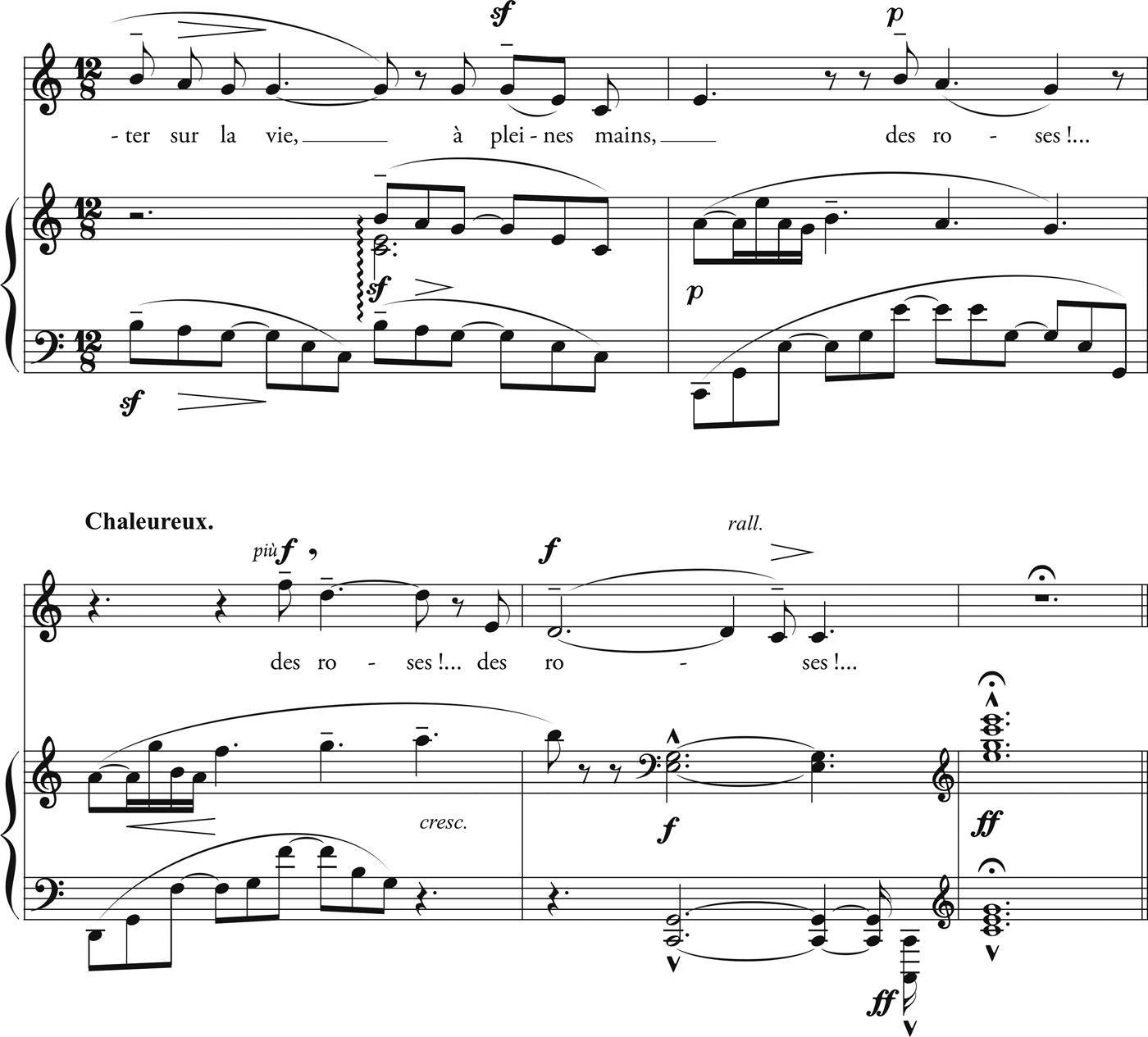
All the same, as Jacqueline Waeber and Sylvie Douche have argued, Expressions lyriques can be understood as a semantic network – poetic and musical – that implicitly evoked the passionate love Massenet felt for Arbell.Footnote 56 Waeber has described the cycle as ‘miniature scenes of a secret opera’, and underscored its ‘eminently theatrical leanings’ derived, notably, from the specific alternation between song and speech.Footnote 57 The poems form a coherent cycle by suggesting, in a kind of bitter commentary, the various phases of love from its beginnings (‘En Voyage’) to its twilight (‘Dialogue’, ‘Les Nuages’, ‘Comme Autrefois’), passing through its most brilliant moments (‘Battements d'ailes’, ‘Nocturne’, ‘Rose de mai’) and alluding to unrequited or painful love (‘La Dernière lettre de Werther à Charlotte’ and ‘Mélancolie’). It is difficult to imagine how the cycle could be anything other than a discreet evocation of the impossible love that Massenet felt, perhaps regretfully, given the myriad ways the score seems to corroborate such a hypothesis. Massenet filled the cycle with self-borrowings, some fairly predictable such as those in ‘La Dernière lettre de Werther’, but others subtler. In ‘Battements d'ailes’, the motive from the ‘Air des roses’ that Arbell sang so successfully in Ariane appears under the last words of the phrase ‘jeter sur la vie à pleines mains des roses’ (see Ex. 1).Footnote 58 Along similar lines, Douche has discussed the possibility of a secret and complex play of keys and notes, devised using Lucy Arbell's first and last names.Footnote 59
Massenet, ‘Battements d'ailes’, Expressions lyriques (Paris, 1913), 15.

Other elements support this interpretation. Besides the deliberate absence of explicit references to Arbell and her involvement with the song cycle in Mes Souvenirs (even though Massenet talks freely about her in reference to other moments in his career), autograph notes made in 1905 in the piano-vocal manuscript of Ariane raise more questions. How should we interpret this ambivalent phrase, written on the bottom of the last folio: ‘This act was written in joy… and pain. J.M.’?Footnote 60 Or this one: ‘While orchestrating the phrase of the roses – at the last note, I receive a telegram: Roses, Roses! … Égreville 8 Oct. [1905] 3 o'clock’?Footnote 61 How might we explain the correction of another comment written on a sheet slipped inside the manuscript: ‘Monday 9 Oct. [1905], 7½ morning[.] two admirable letters W’?Footnote 62 The W was extended in red ink to form the incongruous name of ‘Werther’, likely by Massenet, even though in all likelihood it was originally a reference to the name ‘Wallace’, hidden beneath a simple uppercase letter.
Similarly, in a letter to Heugel written in August 1906, Ernest Moret hints wryly at the irresistible attraction Massenet felt for Arbell. Moret expresses his disappointment at not being able to meet the composer at Dinard, the publisher's summerhouse, as Massenet would soon be occupied by the rehearsals for Ariane: ‘I imagine that his passage to Dinard will be quick – for reasons his heart cannot deny, he will be dragged towards Pedro [Gailhard]’s Hell to bow at the feet of Perséphone.’Footnote 63
All the same, this growing passion was likely quickly restrained and transformed into a friendly – even filial – relationship, profound and durable, although it was still perceived as overly invasive by the composer's family. Massenet found in Arbell not only a source of inspiration, but perhaps also, as Sylviane Falcinelli has suggested, a source of comfort to fill the emotional solitude prompted by his wife's recurrent absences, often for travel or for cures, particularly in the last few years of his life, even as Massenet became gravely ill and his death was clearly imminent.Footnote 64 As for Arbell, she likely found in Massenet a substitute father and steadfast support. In December 1911, she provided a rare description of her work with the composer who, she felt, acted like a father, at once excessive, demanding and generous:
Ah! It was not always pleasant, because as he brought out the new pages of a work, the master wanted the singer to immediately render the feeling, the character, the nuances … that is, everything. He did not accept a single hesitation, he felt as though it was the eve of the dress rehearsal. … From the artist's first contact with a new role, he demanded … perfection!
But once he felt understood, what a change! He was joyful, grateful; he spoke with generosity and would shower you with praise. Exaggeration at the beginning … exaggeration at the end.
Everything would work out, however, and the master loved artists so much that he gave them a place of honour among the most cherished in his family.Footnote 65
Letters only recently discovered from Massenet to Arbell reveal the portrait not only of an ill man seeking a compassionate ear, but also of a composer grateful for the work of a singer in the service of his music. As Arbell triumphed in Thérèse in Vichy in July 1907, Massenet wrote to her: ‘What a pleasure to be able to count on a solid artist like you; success is always certain – assured –… News from you – letters – would be wonderful… tenderly – joyfully. J. Massenet.’Footnote 66
A month later, having returned from a visit to the singer during which he had worked on Bacchus, he confided:
Dear friend,
My telegram is sent & I write to you – sitting somehow… – this word!
My state [of health] is not any worse – I was able to move about in my room…
Now I see everything again… I see St. Aubin again… to the most insignificant details…
I am touched… and I cry with tenderness.
I thank you for your unique care, I thank you for these days in the dear house & I bless you.
To you, my heart is filled with emotion.Footnote 67
And, on 24 September, Massenet paid tribute to her rentrée in Ariane:
How good it is to know that you have been so rightly rewarded for your talent, for your artistic integrity, and for your kindness [génialité].
For you give everything to your art – you live it completely – and this is the only way, especially in the theatre, that we can translate the emotion of a moving work… What a beautiful stroll among the roses of Bagatelle! Shall we do it again?!Footnote 68
Finally, the next year, in a very fragile state, he confided to her:
I have the pleasure to write to you at my table – I have risen… For the day, I hope – like yesterday!
My stomach hurts… I have taken so much salicylate… To heal myself before your arrival I resigned to take – in 3 days – 18 grams… my knee is better, too… much better than my stomach, sadly.
The most important thing for me is to be upright – to walk – to be able to pick you up at Souppes & &!… I will be able to now.Footnote 69
The will written by the composer on 29 August 1909, just as he finished a considerable portion of Expressions lyriques, corroborates the hypothesis of a man having found in the young woman at once a muse devoted to his cause and an emotional support: he bequeathed the singer a sum of ten thousand francs for the purchase of ‘a pearl or a jewel that Mlle Georgette Wallace will procure as soon as possible herself… This is in memory of her devotion to me and of my admiration for the artist.’Footnote 70 Then, on 18 January 1912, as Massenet went through a particularly intense period of suffering that made him fear the worst, he indicated clearly, in a new codicil, that the singer would create the roles of Amadis and Cléopâtre, the latter having been written for her.Footnote 71
Following Massenet's death a few months later, on 13 August 1912, his wife Louise Massenet informed Ernest Moret of the composer's generosity from which he and Arbell alone benefitted.Footnote 72 Moret revealed his indignant surprise in a newly discovered, eloquent letter addressed to Henri Heugel's wife. He clearly took Louise Massenet's side, hinting at the marital tension and Jules's multiple infidelities:
Mme Massenet, without telling me anything else, added: ‘He made only two bequests, and yours pleases me greatly.’ I believe the other, sadly, was just a new source of tears for this woman, to whom I send my affectionate and sorrowful sympathy, and that this new grief is the cruellest of them all, as it brings up in her mind all the others, buried long ago and perhaps almost forgotten, and makes her relive a life that was beautiful only through the devotion, the abnegation of all that could bring her happiness and pride, and these painful sufferings. Oh, what pain can we inflict as individuals in wanting to create useless and unmerited joy! … And when it involves the being with whom we have gone through our whole life – and with whom we have experienced difficult and hard hours, how much more and better must we think!Footnote 73
Supported by the director of the Opéra de Monte-Carlo, Raoul Gunsbourg, and the publisher Heugel, the composer's wife and daughter overstepped their roles as beneficiaries to oppose Massenet's final artistic wishes, signed with dark vengeance. After participating in the premiere of Panurge at the Théâtre de la Gaîté in April 1913, singing the role of Colombe, Arbell was unceremoniously pushed aside from the premieres of Cléopâtre and Amadis. Cléopâtre was premiered in Monte-Carlo, on 23 February 1914, following much revision to adapt the vocal line of the title character for the soprano Maria Kousnezoff.Footnote 74 Just prior to this, Arbell had filed a suit against Gunsbourg, Heugel and the composer's heirs; the affair was widely covered in the press, which focused mostly on the position of the librettist Henri Cain. Knowing Massenet's predilection for Arbell, Cain did not wish to take a potentially hurtful position, and therefore renounced his right to sign the libretto for Cléopâtre as well as his right to the royalties.Footnote 75
Arbell won the lawsuit. But the Massenet family made an appeal, and a new verdict (delayed by the war) was given in March 1920: the singer could not assume that she had exclusive rights to the roles of Cléopâtre or Amadis because, in his lifetime, the composer was not in a position to ‘impose his will’ legally on his collaborators.Footnote 76
Arbell seemed to slow down and even abandon her career in Paris altogether, even though during the war she had taken up the role of Thérèse at the Opéra-Comique (February 1915) and then performed, for the first time at that theatre, the role of Charlotte in Werther (February 1916). She sang a larger variety of roles in the provinces and made an impression in Bordeaux just after the armistice as Thérèse, as Charlotte ‘whom she performs in such a nuanced manner’ and as Carmen ‘where her talents as a singer and an actress were outstanding in her completely personal interpretation, [she] has also brought the most brilliant sparkle to this wonderful series of performances’.Footnote 77
After singing the role of Dulcinée once again in Monaco in February 1920, she overcame the failure of her lawsuit to premiere the original version of Cléopâtre the following year. Comœdia announced that Arbell left ‘the magnificent retreat where she lives for a few days to lend her talent to this sensational event’ with ‘the firm satisfaction of fulfilling a duty’.Footnote 78 Le Ménestrel, Heugel's media outlet, did not report on the event, even though Louise Massenet and her daughter had likely approved the production. The Massenet family's consent was a sign of warmer relations with Arbell and was perhaps given in the hope of galvanising the circulation of the composer's lesser-known works, since his fame had begun to fade considerably after the war. The success was such that the singer gave the work again on 15 March 1921 at the Théâtre des Bouffes in Bordeaux,Footnote 79 where she also premiered Roma the following December, and then sang in Don Quichotte in January 1922.Footnote 80 The latter success might have encouraged the Opéra-Comique to invite Arbell in 1924 to celebrate the inclusion of Don Quichotte in the theatre's repertoire, together with the same soloists who had sung the Parisian premiere, including Vanni-Marcoux and Lucien Fugère.
Although Arbell's career subsequently seems to have lost momentum, the contralto continued to circulate Massenet's works, albeit more discretely and often simply in concert form. She performed Expressions lyriques in 1927.Footnote 81 Arbell then returned to the stage in Deauville to sing Don Quichotte in August 1929, with Vanni-Marcoux in the title role, in a production conducted by Reynaldo Hahn,Footnote 82 and with the same performers the following year in March in Cannes, where she had been contracted for the season.Footnote 83 She sang in the premiere of Plus que reine, by Marcel Bertrand and Henri Cain, in March 1929 in Nice and in December in Rouen, in the role of Laetitia, which included an old song in Corsican dialect.Footnote 84 According to Le Ménestrel, Arbell condescended to perform a minor role out of goodwill for the composer's wife, although she undoubtedly also wanted to show her gratitude to Cain.Footnote 85 Then, in December 1930, Arbell gave nine performances of Godard's La Vivandière at the Bataclan in Paris.Footnote 86 She also participated the following year in a Massenet festival at the same theatre, singing Thérèse, which had been recently handed over to Suzanne Brohly for the reprise at the Opéra-Comique in January 1930.Footnote 87 And she returned to the Opéra-Comique stage – probably for the last time – in January 1931 in the role of Dulcinée, performing alongside André Pernet's Don Quichotte.
In the final years of her life, she became heavily involved with the Orphelinat des Arts, which she directed from 1935.Footnote 88 Her work at the orphanage earned her a decoration from the Légion d'honneur, and she bequeathed a portion of her assets to the institution at her death, on 21 May 1947.Footnote 89
From song to speech: Lucy Arbell, singer and tragédienne
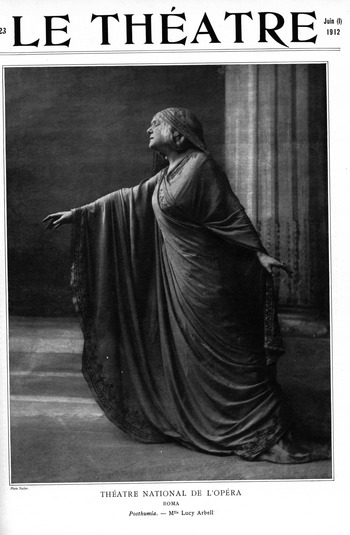
From 1901 until his death in 1912, Massenet composed constantly for Lucy Arbell, despite the reservations about her voice that were expressed regularly in the press. Although some people appreciated her unique timbre, their close links with Massenet cast doubt on their objectivity. Édouard Noël, librettist and friend of the composer, praised Arbell for her ‘powerful and superb voice’,Footnote 90 while Louis Schneider, author of Massenet's biography in 1908, refrained from commenting on Arbell's vocal qualities – in striking contrast to his discussion of other singers – for the premiere of Bacchus in 1909, simply stating: ‘Mlle Lucy Arbell (Amahelli) has dramatic expression of exceptional truth, with superb gestures; she is an excellent tragédienne lyrique.’Footnote 91 In 1909, Gabriel Fauré wrote a generous evaluation of her performance in the same role, stating that her ‘dramatic qualities have already drawn much attention and … we can now compliment her vocal progress’.Footnote 92 In 1912, however, his praise centred entirely on her acting (Fig. 1):
Mlle Lucy Arbell performs the character of Posthumia, the blind grandmother, with the admirable talents of a tragédienne: nothing could be nobler than her appearance, nothing more moving than her gait, than her uncertain gestures, nothing more poignant than her accents. Mlle Arbell's success was as brilliant as it was merited.Footnote 93
Others were less diplomatic. Alfred Bruneau described Arbell as ‘the serious and pale contralto who suits the funereal lamentations of Perséphone’, a comment that provoked Massenet's anger.Footnote 94 Louis Vuillemin felt Arbell was an ‘intelligent but quite imperfect singer’,Footnote 95 while Gauthier-Villars referred to the ‘guttural voice [of this] hoarse contralto [with] ventriloquist effects’, for her performance of Amahelli in Bacchus.Footnote 96 Arthur Coquard's verdict is also uncompromising: ‘Lucy Arbell, who carries the weight of a principal role, Queen Amahelli, cannot escape serious criticism: her voice, fine in the low register, is harsh in the upper register and unequal throughout; her diction is weak.’Footnote 97
Lucy Arbell in the role of Posthumia (Roma), photograph by Nadar, Le Théâtre, June 1912 (1), no. 323 © Médiathèque du département de musicologie, Université de Lorraine (Metz).

Some of the negative commentary might have been motivated by the critics’ antipathy to Massenet; they did not hesitate to pour venom on the unfortunate singer who was publicly supported by her mentor. Adolphe Jullien, a fierce opponent of Massenet's music, had already referred to Arbell's ‘cottony voice’ in 1905 in Sigurd,Footnote 98 and at the premiere of Thérèse at the Opéra-Comique, he wrote:
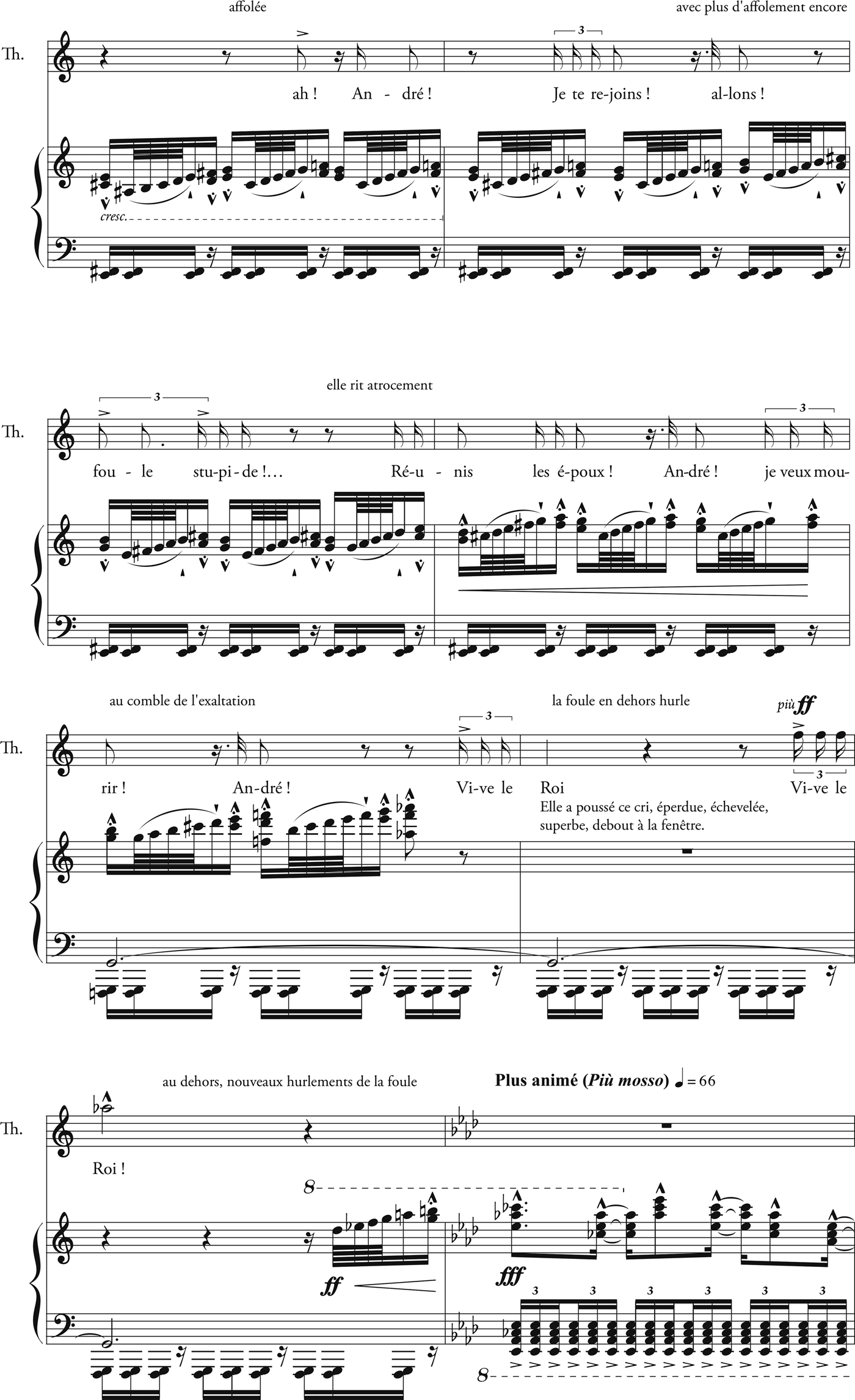
‘She is not just a singer’, M. Massenet said of Mlle Lucy Arbell, ‘but an artist in the purest, the most elevated sense of the word.’ So be it, but even if this ‘artist’ pours all the warmth and emotion she possesses into her performance of the score dedicated to her, nothing can change the fact that she has a deaf voice and vague diction, such that we lose everything that she says. As for the merit attributed to the author for having discovered that she should not sing, but declaim, or rather scream in the scene where she must put Thorel in prison, it is negligible, especially because, even here, she remains quite lifeless and her final cry of ‘vive le roi’ lacks brilliance entirely.Footnote 99
The critiques against Arbell seemed to soften or disappear entirely after the composer's death, and were even transformed into praise for her timbre. Witnessing her performance of Charlotte in 1916, a critic from Le Figaro was struck by ‘her dramatic personality, her deep, very pliable voice, her rare talent as an actress that earned her much success’.Footnote 100 Similarly, her performance was unanimously applauded when she re-established the original version of Cléopâtre in Nantes:
Possessing a voice with an impeccable production, blessed with a rare talent as a tragédienne, she was the most impressive of the Cléopâtres.Footnote 101
Mlle Lucy Arbell embodies with great truth all the nuances of this complex character, from the most suave gentleness to cold and depraved cruelty. Grand, elegant, voluptuous, carrying the royal diadem majestically, she performs the queen of Egypt divinely. Her supple and bold voice rises easily from the lowest notes of the mezzo to the most metallic and ringing of the soprano. Mlle Lucy Arbell brought the enthusiasm of the hall to a climax during the death scene where she acted and mimed as an exceptional tragédienne.Footnote 102
Somewhat surprisingly, the same laudatory commentary also appeared at the end of her career, for her performance of La Vivandière at the Bataclan in 1930: ‘The beauty of the timbre of her voice was highlighted by an impeccable singing technique and by her poignant and forthright acting.’Footnote 103 In 1913, Henri Quittard, who was unquestionably competent in such matters, offers perhaps more objective commentary in his appreciation of her creation of Colombe in Panurge: ‘She performs with excellent physical means this role that, vocally, fits her perfectly and she knows how to render the various nuances with remarkable musical intelligence.’Footnote 104
But what should we make of Arbell's voice, given that she did not leave behind a single recording? Might she have been making continual progress by following the advice of Vincent-Carol, with whom she maintained a correspondence?Footnote 105 While her talents as an actress, and especially as a tragédienne, were unanimously acclaimed, her voice did not have the beauty, breadth and soundness displayed by Viardot or Delna, although it was likely not as disastrous as some critics supposed it to be.
Massenet appears to have been conscious of his muse's vocal limits. In a letter to Arbell, he reassures her shortly before he composes Cléopâtre: ‘This piece is truly excellent. Your role surpasses all expectations. But I must spare the artist to make it to the fifth act. It is an incredible role. Trust me to compose a unique creation for you!’Footnote 106 His affection for Arbell might have encouraged him to compose roles that were less developed, with tailor-made vocal lines. However, Massenet included some difficult passages that not only attest to Arbell's abilities, but also reveal the models that he was thinking about during the compositional process (see Ex. 2). In a passage from his memoirs pertaining to the role of Dulcinée from Don Quichotte, he claimed that ‘A contralto must know how to vocalise like a soprano. Le Prophète and Le Barbier de Séville demonstrate this.’Footnote 107
Massenet, Don Quichotte (Paris, 1910), Act I, 22.

Above all, Massenet was sensitive to Arbell's talents on the stage (she accompanied herself on the guitar in Don Quichotte) as well as in her performance of Expressions lyriques. The vocal style used in the song cycle was also utilised in the operatic roles Massenet wrote for Arbell – not to cover her vocal faults, but because the composer had found in his muse the interpreter of his dreams. Massenet had a genuine and sustained interest in the expressive power of the spoken voice, writing scenes that are often labelled as melodrama.Footnote 108 Shortly before the premiere of Thérèse, he discussed his approach in an interview with Le Figaro, explaining that he had conceived the final scene of his ‘music drama’ entirely in this form on account of Arbell's talent; the singer had performed admirably a similar episode in Ariane (also written specifically for her). Massenet praised the procedure and the dramatic power that can be elicited in certain cases.Footnote 109 In another interview, Massenet emphasised how Arbell was able to ‘speak’ (dire) verse correctly, which was certainly not true of all singers.Footnote 110 In one of her rare personal accounts published shortly before the premiere of Ariane, Arbell delighted in highlighting the two facets of her talent: ‘To sing the role of Perséphone in the fourth act of this admirable work is a touching joy for me; To speak in the same act verses so beautiful, so powerful, of our great poet Catulle Mendès, is a source of pride.’Footnote 111
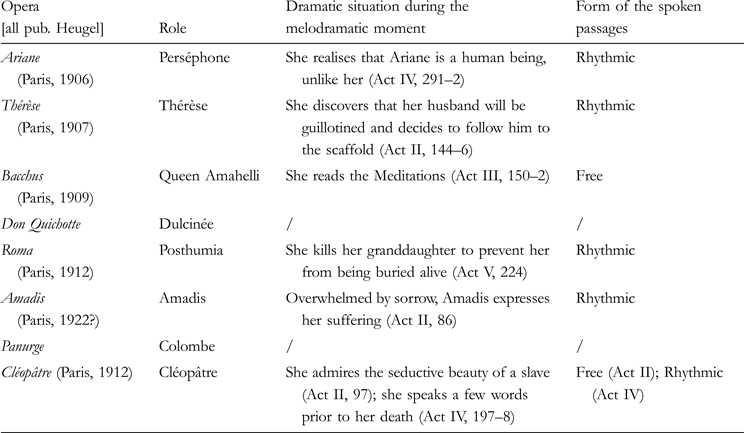
These qualities place Arbell unmistakably in the line of diseuses, embodied by Yvette Guilbert, whom Massenet admired. Moreover, fascinated by her facility for drama, notably, her clear diction and ability to colour words, whether spoken or sung, Massenet wrote several roles for Arbell with episodes of melodrama. These tended to be associated with a tragic situation (see Table 1); the roles of Dulcinée and Colombe, which are closer to comedy, have no such episodes.Footnote 112
Spoken episodes in roles composed for Lucy Arbell

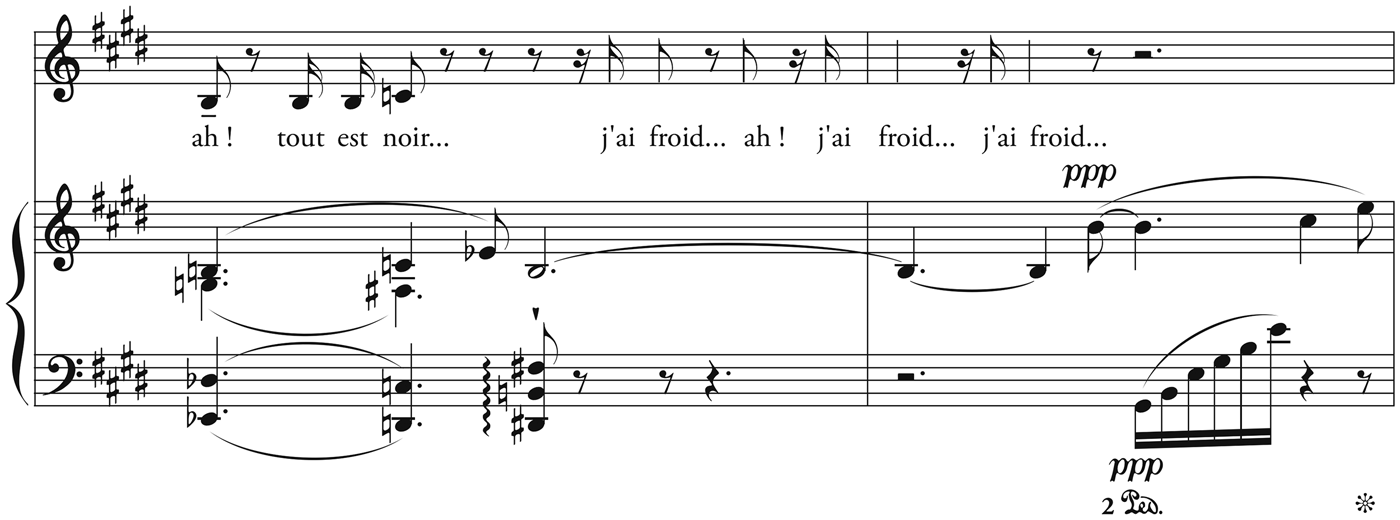
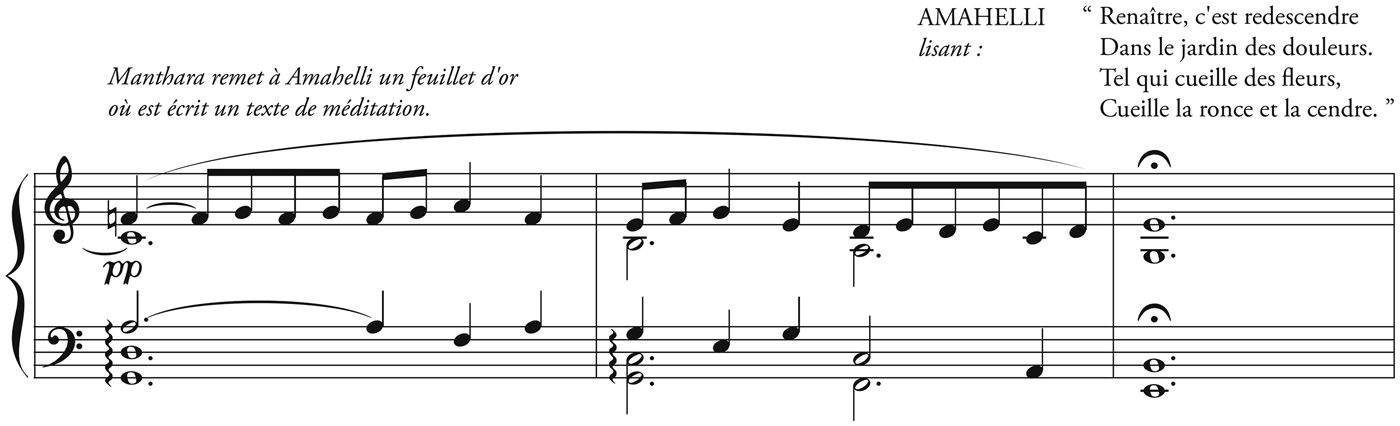
The compositional approach to the vocal line and accompaniment in these episodes differs from one opera to the next. Sometimes they are brief (Roma, Cléopâtre; see Ex. 3) and at other times more developed (Ariane, Thérèse, Bacchus, Amadis), without ever exceeding ten bars or so. As in Expressions lyriques, the spoken text is sometimes notated rhythmically (Ariane, Thérèse, Amadis, Roma, Cléopâtre) or, more rarely, notated freely above the stave (Bacchus, Cléopâtre; see Ex. 4).
Massenet, Cléopâtre (Paris, 1914), Act IV, 198.

Massenet, Bacchus (Paris, 1909), Act III, 150.

In each case, the melodramatic episode highlights a unique atmosphere, with the voice at the edge of singing, or accompanies growing tension – as it does in all occurrences in Massenet's works.Footnote 113 For example, Thérèse's anguish is expressed by the progressive passage from speech to song: the effect is particularly striking as speech, becoming ‘melodified’,Footnote 114 transforms imperceptibly into sung notes, in a very high range approaching a scream (see Ex. 5).
Massenet, Thérèse (Paris, 1907), Act II, 146.

According to the critic Adolphe Boschot, the intensely tragic vocal moments in the role of Posthumia in Roma were generally declaimed rather than sung. Such an approach could recall the art of Mounet-Sully or Sarah Bernhardt and might today pass as a kind of verismo interpretation. However, at the turn of the century, it more often reflected how contemporaries imagined the declamation of ancient Greek tragedy, as articulated in this response to Arbell's performance of Expressions lyriques:
Lucy Arbell, in the very dramatic role of the blind mother, performed with the most moving sincerity. Her dramatic voice, full of sobs, combined sung declamation and speech with the most secure art; her behaviour and gestures, perfectly correlated with the music, powerfully realised all the intimate scenic intentions.Footnote 115
This kind of performance, in which singing alternates with spoken declamation and speech over music, was not only linked with Arbell. Massenet included actors in his operas, such as the celebrated Édouard de Max (in Bacchus Footnote 116), and sometimes wrote music to accompany spoken declamation in stage works inspired by Antiquity, including Les Érinnyes and Phèdre, performed by Sarah Bernhardt (her several recordings testify to her lyrical and emphatic declamation).Footnote 117 At the same time, Massenet was part of a more general sweep of composers who, like Fauré (in Prométhée), sought new relationships between words and sounds, foreshadowing works by Debussy (Le Martyre de Saint-Sébastien) and Stravinsky (Perséphone).
Nevertheless, Lucy Arbell occupies a particular place in the history of French singing and in Massenet's works. As muse to a composer to whom she sacrificed her brief but intense career, the singer found in Massenet a kind of protector on an emotional and professional level. She inspired him to write many works, from simple mélodies to operas with demanding roles, often with extraordinary dramatic investment. Massenet knew how to bring out her best qualities, as he had done previously with Sanderson and Calvé, with roles that allowed her to fully assume her position as a ‘tragédienne lyrique’ and included the musical and dramatic use of the spoken voice. Conversely, Arbell gave Massenet the opportunity to develop an approach that he had already tested (in Manon, for example), despite the reservations of both critics and singers at the time. Indeed, exploration of the spoken voice would become an important feature of opera on account of its manifest expressive power, stemming in part from the sudden intrusion of spoken declamation into a sung work.
During the Monacan ceremonies in February 1913 that paid homage to the recently deceased composer, Arbell performed in two works requiring the qualities of a diseuse. After the performance of four pieces from Expressions lyriques with piano accompaniment, she participated in the premiere of the Suite théâtrale, for orchestra, voice and recitation, in which she featured as the singing and reciting soloist. The comments from the journalist in Comœdia reveal her undeniable talent in a unique genre at the border between song and theatre, to which she remained permanently attached:
In the middle of a religious contemplation … Mlle Arbell, this artist about whom Massenet wrote ‘that she possesses to a supreme degree the art of declamation as well as vocal art’, sang the Expressions lyriques. …
The text of Suite théâtrale … has three parts: La Tragédie, La Comédie and La Danse. … La Tragédie begins with a short introduction in a slow, accented tempo. Then comes the declamation, supported by simple and discreet chords. The song begins next, first ‘piano’ and then increasing little by little in a crescendo to the most impressive brilliance. In this steady rise so well led, Mlle Lucy Arbell passionately asserted all of her talent as a singer, expert in the art of nuances. …
This is a unique genre in which Massenet revealed the immensity and powerful diversity of his imaginative resources. The work was applauded for a long time. The effects are admirably arranged, and the master, with surprising tact, knew how to maintain growing interest right to the end.
Closely associated with his success, the talented singer, Mlle Lucy Arbell, knows how to imbue her manner of singing with the subtlety born of rare understanding.
The pure and crystalline waves of her warm voice ravished the listeners and it was with several call-backs that the concert ended.Footnote 118
Translated by Kimberly White.