Milk and dairy products are consumed worldwide daily and represent a vital source for human nutrition, with great economic importance for industrialized as well as developing countries, such as Brazil. The safety of dairies depends highly on the knowledge of food and in-house microbiota to avoid contamination by detrimental microorganisms, and the advent of metagenomics has greatly impacted this area of investigation (Ercolini, Reference Ercolini2013). It is hypothesized that additional knowledge on microbial communities of Brazilian dairy samples may provide insights on previously overlooked bacterial taxa and contribute to improved food safety. In this study, the microbiota of 90 selected dairy samples was analyzed, based on a previous work by Dittmann et al. (Reference Dittmann, Chaul, Lee, Corassin, Oliveira, De Martinis, Alves, Gram and Oxaran2017).
Materials and methods
High Throughput DNA Sequencing was carried out for 90 dairy-related samples (frozen, 5 ml-aliquots) from a single Brazilian dairy that were pooled into four categories (raw material, final products, food-contact surfaces and non-food contact surfaces, described fully in online Supplementary Table S1). DNA extraction was done with PowerLyzer® PowerSoil® DNA isolation kit (MoBio Laboratories, Qiagen, USA), to obtain at least 5 ng/l, according to the protocol recommended by the manufacturer. The extract obtained was used for Metagenomic Sequencing Library Preparation (V3-V4 regions of 16S rRNA genes), following the guide from Illumina®.(San Diego, USA). Sequencing was done at the facility for nucleic acid sequencing of the Faculdade de Ciências Farmacêuticas de Ribeirão Preto – Universidade de São Paulo, Brazil, using a MiSeq® system, with the reagent kit V3, 600 cycles, added 5% of PhiX control.
For bioinformatics and statistical analysis, the raw reads generated from sequencing with Illumina® MiSeq platform were quality-assessed, trimmed and taxonomically annotated using the BaseSpace Illumina® cloud bioinformatics pipeline. The downstream analyses were performed in R platform using as input the OTU table with reads counts by sample (see online Supplementary Table S2). To draw a rarefaction curve, the Vegan R package was used to plot the number of reads vs. the sequencing coverage (Oksanen et al., Reference Oksanen, Blanchet, Friendly, Kindt, Legendre, McGlinn, Minchin, O'Hara, Simpson, Solymos, Stevens, Szoecs and Wagner2018). The Shannon's and Chao1 indexes were calculated using the archive of OTUs counts. The Top10 OTUs heatmap was plotted based on Bray-Curtis dissimilarity distance. The microbiome R package was used to determine the core microbiota composition (Lahti et al., Reference Lahti, Shetty, Blake and Salojarvi2018).
Results and discussion
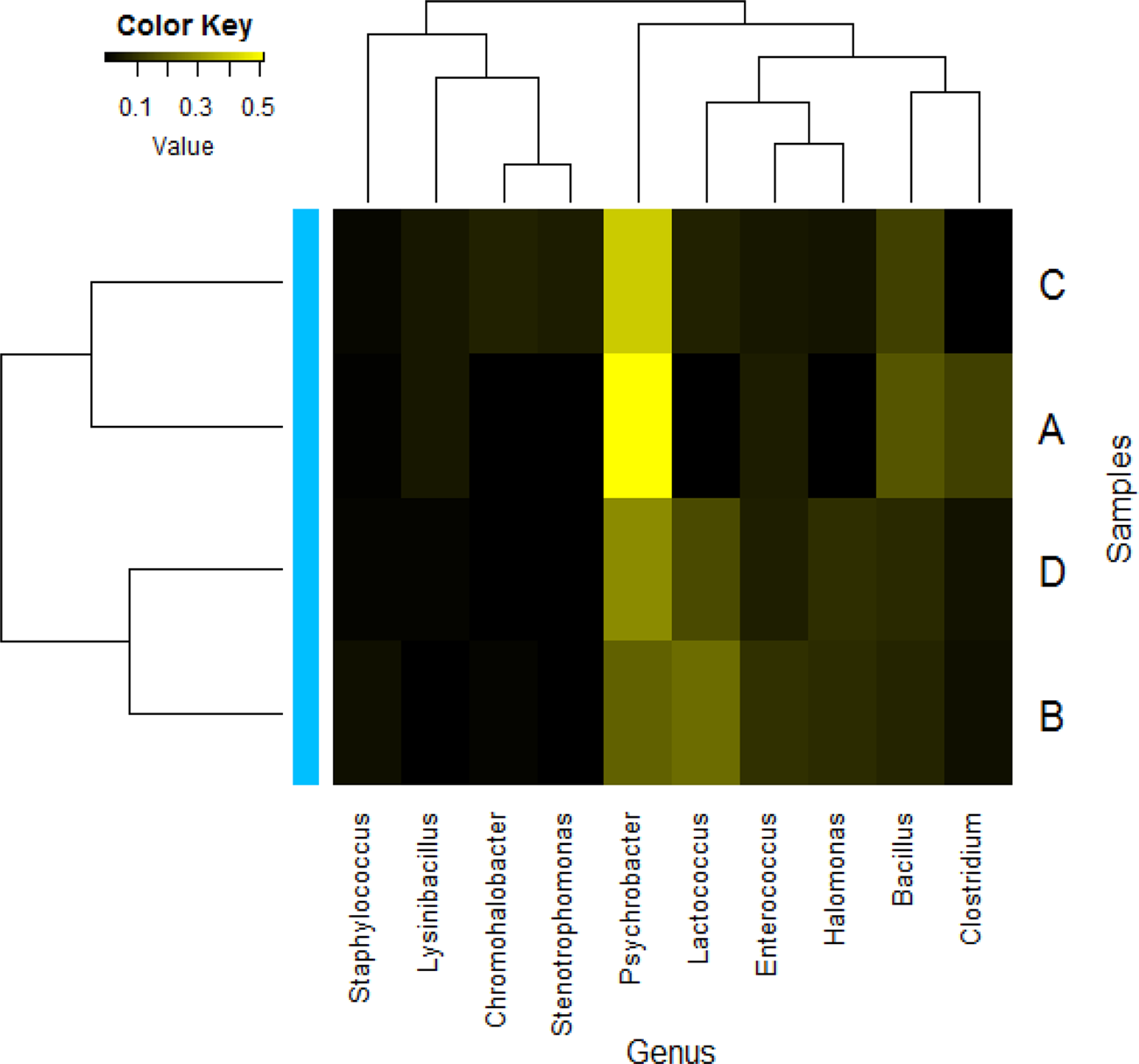
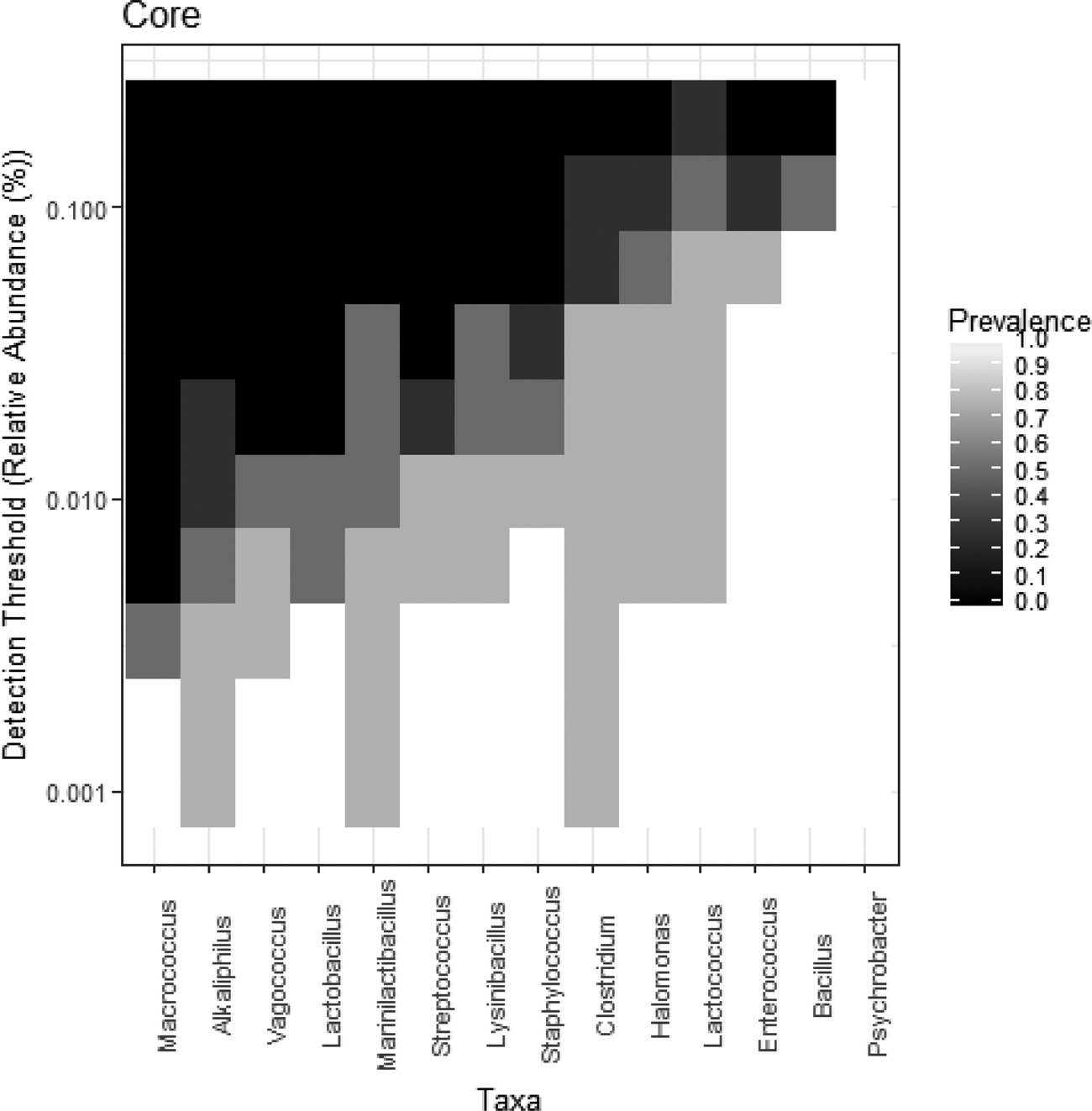
The rarefaction curve indicated a suitable depth of sequencing (online Supplementary Fig. S1). Alpha-diversity indexes (Shannon and Chao1) indicated the groups of samples B (final product) and D (non-food contact surface) were the richest and most diverse ones (online Supplementary Fig. S2). Beta-diversity indexes were compared by clustering studies (Fig. 1), considering only taxa with relative abundance >1%, since irrespective of read abundance per sample, the majority of OTUs were not key representations of the bacterial diversity (online Supplementary Fig. S3). It was shown that there were two main clusters: one formed by the group of A-C samples (respectively, raw material and food contact surface) and the other by the group of B-D samples (respectively, final product and non-food contact surface). The abundance of reads from the genera Psychrobacter and Bacillus were common to groups A and C, which were separated respectively by Clostridium and Lactococcus. The groups B and D both exhibited members of the genera Psychrobacter and Lactococcus but they diverged by high levels of Enterococcus reads only in the final product. The core microbiota (Fig. 2) was dominated, in a crescent order, by Macrococcus, Alkaliphilus, Vagococcus, Lactobacillus, Marinilactibacillus, Streptococcus, Lysinibacillus, Staphylococcus, Clostridium, Halomonas, Lactococcus, Enterococcus, Bacillus and Psychrobacter.
The Top10 OTUs clustered according to their abundances, obtained with Illumina® MiSeq 16S rDNA sequencing for samples of raw material (a), final product (b), food-contact surfaces (c) and non-food contact surfaces (d) from a Brazilian dairy.

The Core Microbiome for samples analyzed with Illumina® MiSeq system for 16S rDNA, according to groups of raw material (a), final product (b), food-contact surfaces (c) and non-food contact surfaces (d) from a Brazilian dairy.

Overall, the results of this study contribute to a description of the microbial communities of Brazilian dairies, using a pooling of samples that allowed for a broad overview of the genera represented. A similar approach was used to describe a clinical environment by Olm et al. (Reference Olm, West, Brooks, Firek, Baker, Morowitz and Banfield2019). Quality control of DNA sequencing can be assured by plateaus obtained in rarefaction curves (online Supplementary Fig. S1), which indicated the majority of theoretical bacterial diversity was assessed. The Shannon's index was used to measure richness and abundance, combined with the calculation of the minimal theoretical number of OTUs present in the sample (Chao1). These indexes (online Supplementary Fig. S2) indicated the highest bacterial diversity in final product and non-food contact surfaces, likely due to multiple points of cross contamination in several processing steps from raw to final products.
Clustering studies showed Psychrobacter and Bacillus were very abundant in raw material and food contact surfaces (Fig. 1). The relevance of Psychrobacter sp. is not completely known for cheeses, but it potentially produces cheesy aroma notes (Deetae et al., Reference Deetae, Bonnarme, Spinnler and Helinck2007). The Bacillus genus may also contribute to the flavor of cheeses, although it is of main concern as a sporulated thermoduric bacterium with ability to form biofilms on abiotic surfaces (Gopal et al., Reference Gopal, Hill, Ross, Beresford, Fenelon and Cotter2015). Figure 1 also shows Clostridium sp. was highly abundant in raw material whilst food contact surfaces were rich in reads from Lactococcus sp. Taking into account that Clostridium sp. is a potential spoiler in raw milk, this indicated the need of controlling its contamination from farm to final product. To the contrary, the detection of Lactococcus sp. does not raise concern, due to its positive association with dairies. In the other cluster (Fig. 1), Psychrobacter and Lactococcus were common to final product and non-food contact surfaces, but only the final product presented high levels of Enterococcus reads. Enterococci are controversial members of food microbiota, since they have been linked to either good (bioprotective or probiotic cultures) or bad aspects of food safety (carrier of virulence/resistance genes).
The core microbiota analysis indicated the central composition of the OTUs, which is key to estimate the functional activity of a microbial community (Shade and Handelsman, Reference Shade and Handelsman2012). In this study, the bacterial community was dominated in a crescent order by: Macrococcus, Alkaliphilus, Vagococcus, Lactobacillus, Marinilactibacillus, Streptococcus, Lysinibacillus, Staphylococcus, Clostridium, Halomonas, Lactococcus, Enterococcus, Bacillus and Psychrobacter. According to Li et al. (Reference Li, Wang, You, Ren, Chen, Zheng and Liu2018), for Chinese milk samples, Bacillus sp. had a straight correlation with Alkaliphilus sp. – a Clostridiaceae family member that supports high salinity and pH. This finding supports the hypothesis that culture-independent methods are important to detect extremophile microbes not previously documented in food processing plants. The halotolerant Halomonas was allocated in the core microbiota of this Brazilian dairy, which is in agreement with a previous study on cheeses done by Delcenserie et al. (Reference Delcenserie, Taminiau, Delhale, Nezer, Doyen, Crevecoeur, Roussey, Korsak and Daube2014). Moreover, it is worth noting the presence of spore-formers (Clostridium, Bacillus Lysinibacillus) as members of the core microbiota, along with Staphylococcus and Macrococcus, besides lactic acid bacteria commonly associated with dairy food (Vagococcus, Lactobacillus, Streptococcus, Lactococcus) and the uncommon Marinilactibacillus, from marine organisms (Ishikawa et al., Reference Ishikawa, Nakajima, Yanagi, Yamamoto and Yamasato2003).
In conclusion, we have provided a comprehensive description of the microbiota of a Brazilian dairy. Our results are in agreement with the literature reports on high abundance of OTUs from Lactococcus, Lactobacillus and Streptococcus genus (Kamimura et al., Reference Kamimura, De Filippis, Sant'Ana and Ercolini2019) but the findings regarding halo and psychrotolerant bacteria are novel, indicating metataxonomics contributes to reveal previously overlooked microbiota members, with a functional role yet to be investigated.
Supplementary material
The supplementary material for this article can be found at https://doi.org/10.1017/S0022029920000837.
Acknowledgements
The authors thank the technical assistance of Vanessa M. Souza and Émerson Santos, from Faculdade de Ciências Farmacêuticas de Ribeirão Preto, Universidade de São Paulo, Brazil. To comply with Brazilian environmental law (13.123/2015), this research was registered at Sisgen (A1D6ECC).
Financial support
This work was supported by the São Paulo Research Foundation – FAPESP (2012/50507-1), Brazil. O.G.G.A is grateful to FAPESP for a Ph.D. fellowship (2017/13759-6). This study was financed in part by the Coordenação de Aperfeiçoamento de Pessoal de Nível Superior – Brazil (CAPES) – Finance Code 001. D.A.F. was a Ph.D. fellow from CAPES.