Healthcare-associated infections (HAIs) are costly and they cause much morbidity and mortality.Reference Zimlichman, Henderson and Tamir 1 The use of antiseptic agents such chlorhexidine, povidone-iodine, and alcohol for hand hygiene and decolonization of the skin before invasive procedures has been paramount in preventing HAIs.Reference Horner, Mawer and Wilcox 2 , Reference Milstone, Passaretti and Perl 3 Due to its qualities such as tolerability and a good safety record, chlorhexidine gluconate (CHG) is one of the most frequently used agents.Reference Horner, Mawer and Wilcox 2 CHG is a broad spectrum antiseptic, active against gram-positive bacteria, gram-negative bacteria, and fungi.Reference Horner, Mawer and Wilcox 2 Daily bathing with CHG has been associated with a reduction in bloodstream infections and reduced colonization by multidrug-resistant organisms (MDROs).Reference Climo, Yokoe and Warren 4 Consequently, many hospitals in the United States have implemented CHG bathing in their intensive care units (ICUs) and non-ICU units.Reference Shuman, Harpe and Calfee 5 This increased use raises the potential of selection for reduced bacterial susceptibility to CHG, which could ultimately limit the utility of CHG.
Studies that have examined bacterial susceptibility or resistance to CHG have produced varying results.Reference Edmiston, Krepel, Seabrook, Lewis, Brown and Towne 6 , Reference Suwantarat, Carroll and Tekle 7 Given the inconclusiveness in the literature, there is need to monitor the development of resistance to CHG over time, particularly when CHG is used for daily bathing. Through assessment of susceptibility to CHG by methicillin-resistant Staphylococcus aureus (MRSA) and fluoroquinolone-resistant gram-negative bacilli (FQRGNB), this study examined the potential of resistance to CHG following CHG implementation in an ICU setting.
METHODS
Setting, Data, and Intervention
We conducted this study at a 24-bed critical care inpatient unit of a large academic medical center in Wisconsin. The intervention was conducted over 9.5 months and involved the use of no-rinse, prepackaged, 2% chlorhexidine (CHG)–impregnated washcloths (Sage, Cary, IL) with no compliance monitoring except documentation of the bath in the electronic health record. Using standard collection procedures, we collected nasal, skin, oral, and stool samples at admission and discharge during pre- and postimplementation periods. All patients were eligible for surveillance cultures. We identified the FQRGNB class of organisms by testing gram-negative organisms for susceptibility to ciprofloxacin with no particular organism characterized. We stored and later tested isolates to determine their minimum inhibitory concentration (MIC) to CHG. In the absence of established thresholds, we defined reduced susceptibility to CHG based on the findings of previous studies. We used a threshold median MIC of ≥4 μg/mL for MRSA and ≥10 μg/mL for FQGRNB.Reference Sheng, Wang, Lauderdale, Weng, Chen and Chang 8 , Reference Higgins, Murtough and Williamson 9 MIC testing was performed on isolates in duplicate using the broth microdilution method according to the Clinical and Laboratory Standards Institute guidelines. The University of Wisconsin Institutional Review Board exempted this work as a quality improvement project.
Statistical Analysis
We calculated frequencies of isolates for each site. We used the Wilcoxon–Mann–Whitney test to compare the median MICs for the pre- and postimplementation isolates, separately comparing admission and discharge cultures. We also compared the median MIC for admission and discharge isolates in the postintervention period for patients who had paired samples. We defined paired samples as admission–discharge samples from the same patient and collected from the same anatomic site.
RESULTS
We tested 137 bacterial isolates. Among them, 86 isolates (62.8%) were identified from the post–CHG implementation period. Of these 137 total isolates, 73 (53.3%) were nasal and 6 were stool isolates. MRSA was identified mainly from the nares (66 of 80 nares isolates, 82.5%), whereas most of the FQRGNB isolates were identified from the oral cavity (22 of 57 oral isolates, 38.6%) and the skin (22 of 57 skin isolates, 38.6%).
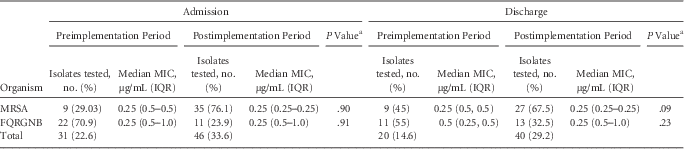
Both admission and discharge median MICs for MRSA and FQRGNB did not differ between the pre- and postimplementation periods (Table 1). For paired samples, the median MIC for MRSA did not significantly change between admission and discharge (Table 2). The highest overall MIC was 0.5 µg/mL, and none of the MICs reached the threshold that defines reduced susceptibility to CHG.
Comparison of Admission and Discharge Median MICs Before and After Implementation of CHG Bathing

NOTE. MIC, minimum inhibitory concentration (median, mg/mL); CHG, chlorhexidine gluconate; IQR, interquartile range; MRSA, methicillin-resistant Staphylococcus aureus; FQRGNB, fluoroquinolone-resistant gram-negative bacilli.
a Wilcoxon rank-sum test was used to compare admission and discharge median MICs for the pre- and post-implementation periods.
Comparison of MICs for Admission and Discharge Isolates in the Post–CHG Bathing Implementation Period for Patients with Paired Samples

NOTE. MIC, minimum inhibitory concentration (median, mg/mL); CHG, chlorhexidine gluconate; IQR, interquartile range; MRSA, methicillin-resistant Staphylococcus aureus; FQRGNB, fluoroquinolone-resistant gram-negative bacilli.
a Wilcoxon signed-rank test was used to compare paired admission and discharge MICs for the postimplementation period.
DISCUSSION
These data did not show reduced susceptibility to CHG by MRSA and FQRGNB surveillance isolates following CHG bathing in the ICU. The highest median MIC for both MRSA and FQRGNB was 0.5 µg/mL.
Our results are consistent with other studies that did not show reduced susceptibility of bacteria to CHG. A cluster-randomized crossover trial by Climo et al,Reference Climo, Yokoe and Warren 4 which examined susceptibility to CHG (2% CHG-impregnated cloths) by clinical isolates over 1 year, did not show resistance to CHG by MRSA isolates. Edmiston et alReference Edmiston, Krepel, Seabrook, Lewis, Brown and Towne 6 examined resistance to CHG when 2% CHG cloths and 4% CHG soap were used preoperatively, but they did not observe resistance to CHG by Staphylococcus aureus.
In contrast, some studies have demonstrated reduced susceptibility or resistance to CHG following its implementation. Using no-rinse, 2% CHG-impregnated cloths, Suwantarat et alReference Suwantarat, Carroll and Tekle 7 examined CHG susceptibility by both gram-negative and gram-positive isolates. CHG bathing that had occurred for at least 1 year prior to resistance assessment was associated with reduced susceptibility to CHG.Reference Suwantarat, Carroll and Tekle 7 Wang et alReference Wang, Sheng and Wang 10 examined resistance to CHG after >20 years of its use for hand hygiene and showed an increasing trend of MRSA isolates with high MICs. Both studies suggest that long-term use of CHG can lead to reduced susceptibility and eventual resistance to CHG.
The observation of no resistance in our project may be a valid phenomenon indicating the absence of resistance to CHG at this time. Our finding can also be explained by the fact that we examined resistance after a duration of only 9.5 months of CHG use. Currently, no literature has reported the optimal time needed for CHG resistance to occur following implementation of CHG bathing.
We conducted this study under real-world conditions that are more representative of day-to-day clinical practice; this is a major strength of our study.
Readers should interpret findings of this study in the context of limitations. We tested samples for 9.5 months of CHG bathing implementation. Studies conducted over a longer duration may be better suited to examine the question of CHG resistance. We did not have data on certain factors that may influence development of resistance to antimicrobials for the pre– and post–CHG implementation periods. We had no data on patient factors such as immunosuppression and comorbidities that might affect normal body defenses. However, this factor was less likely to have affected our results because an absence of reduced susceptibility to CHG was observed in both the pre– and post–CHG implementation periods. We did not collect samples from sites of chlorhexidine-impregnated dressings; we focused on CHG bathing. For gram-negative organisms, we tested only for fluoroquinolone resistance, generally using susceptibility to ciprofloxacin. Also, we did not identify specific organisms. Finally, our isolates were identified vis surveillance rather clinically, and we did not conduct genotypic analyses.
In conclusion, no reduced susceptibility or resistance to CHG by MRSA and FQRGNB was observed following 9.5 months of implementation of daily CHG bathing. Healthcare facilities should conduct continued surveillance of clinical isolates for early identification of potentially resistant bacterial strains and to detection of any trends in CHG resistance.
ACKNOWLEDGMENTS
This research is part of the first author’s PhD dissertation on the sustainability of daily chlorhexidine bathing. Thanks to Megan D. for conducting the susceptibility tests.
Financial support: J.S.M. was supported by the Agency for Healthcare Research and Quality (grant no. R18HS024039). The content of this article is solely the responsibility of the authors and does not necessarily represent the official views of the Agency for Healthcare Research and Quality.
Potential conflicts of interest: All authors report no conflicts of interest relevant to this article.