Messages and meta-musical fermatas
The true language [Sprache] of art is mute [sprachlos], and its muteness takes priority over poetry's significative element, which in music too is not altogether lacking.Footnote 1
Vocal works appear sporadically in Helmut Lachenmann's compositional output. As he acknowledges, ‘the human voice has always posed a problem for me’.Footnote 2 Not only does the conventional singing voice tend to recall the aesthetic traditions that the composer has consistently sought to eschew but it is also difficult to integrate with his technique of ‘musique concrète instrumentale’, a label from which he has distanced himself but which nevertheless highlights his focus on sound as the result of kinetic-mechanical production. Yet despite the primacy of instrumental writing in his practice, two relatively short pieces for voices, Consolation I and II of 1967 and 1968, played an important role in the development of compositional principles – including techniques for large-scale formal planning and localized sound-gestural organization – that would occupy Lachenmann throughout his subsequent career. As they look back to works by Nono and Stockhausen for conceptual topics and formal ideas about how to develop the relationship between music and text, the Consolation pieces are an important step in Lachenmann's development of a distinct post-serial idiom and for engaging ideas that would come to define his aesthetic and political positions in his many writings on music and composition.
Consolation I (1967), which set a passage from Ernst Toller's play Masse-Mensch, and Consolation II (1968), which set the medieval German Wessobrun Prayer, initially arose from a commission by conductor Clytus Gottwald and his vocal ensemble Schola Cantorum in Lachenmann's native Stuttgart. Formed in 1960, this ensemble of professional singers premiered many vocal works by contemporary composers and Lachenmann's Consolation pieces may be heard as part of a wave of avant-garde works from the 1960s that explored extended vocal techniques. But in a number of ways, these pieces reveal the influence of important vocal and electronic works from the previous decade by Lachenmann's teachers, Karlheinz Stockhausen and Luigi Nono (Lachenmann studied and worked with Nono in Venice between 1958 and 1960, and participated in Stockhausen's courses at Cologne in 1963 and 1964). These connections are rarely noted, however, nor have they been pursued in depth. Since Lachenmann was Nono's most famous student, certain thematic or technical similarities are perhaps taken for granted.Footnote 3 As I will discuss, preliminary notes and sketches held at the Paul Sacher Stiftung suggest further connections to vocal works by these two other composers. Beyond technical concerns, the Consolation pieces raise further issues surrounding text setting in modernist idioms, the challenges of communication through an aesthetic medium, and the political and spiritual themes of consolation and dis-consolation.
One of the primary ways in which Lachenmann seeks to manifest the existential themes of the Consolation texts is by developing a formal element that he would go on to employ in most of his subsequent compositions: what I describe as a ‘meta-musical fermata’. In this way, Lachenmann may join the likes of Paul Dukas (and one could surely add Gustav Mahler, particularly the scherzi of his later symphonies) as a composer who mobilizes the dramatic standstill and conjures the fantasy of music attaining a sort of self-awareness. In her famous analysis of Dukas's L'apprenti sorcier (The Sorcerer's Apprentice), Carolyn Abbate responded to a now centuries-old tradition which read musical works not only hermeneutically but also narratively – long before or after the actual vogue for programmatic compositions – and set out to explain just when and how a narrative ‘voice’ (an imaginary subject position from ‘within the music itself’ and not merely that of the composer) could emerge in an instrumental composition. Employing Paul Ricoeur's notion of the narrative survivor of fiction, Abbate asks ‘can music establish a discursive distance, a strong signal constructing the subject's voice, and can it endow that voice with a narrative color (such as that generated in literary narrative, for instance, by the past tense)?’Footnote 4 Abbate finds just one instance of a subjectivity breaking through the surface of the work – this is, of course, the memorable moment half-way through the piece when, if we follow the programme supplied in part by Goethe's poem, the bouncy broom theme seemingly regenerates ex nihilo after its destruction at the hands of the apprentice: ‘This broom that rises, doubled, to resume its task is a nightmarish figure that draws on fears of organic repetition and self-replication; observing exact duplication of a pseudo-human, we turn the process on ourselves, and the doubled broom suggests our own unimaginable Doppelgänger.’Footnote 5 With this compelling image, Abbate suggests that this strange moment of suspension that hints at a subjectivity both outside yet inscribed within the piece also works to suture our own subjectivity to it – even if it is a form of life that we would rather not confront or cohabit.
Lachenmann's own use of a mid-piece standstill and a call for self-recognition are closely related components of his wider compositional practice and extend well beyond his two Consolation pieces, although it is here where this formal element and philosophical outlook are first explicitly combined and articulated in part through their musically set texts. One of his favourite dicta is ‘to compose means to build an instrument’ and despite the vast and varied labours undertaken by the performers of his scores, one senses that he means an instrument that plays itself. His comments also suggest that he is not only building a sonic vessel but also making us privy to its process of construction. Indeed, once his pieces get underway, the collective efforts of the musicians produce what might be thought of as an imaginary and fantastic instrument that plays according to the ‘syntactical blueprint’ – another designation Lachenmann uses for his compositions – almost like a player piano or a hurdy-gurdy. Like Dukas, Lachenmann also uses fear as an aesthetic category but not for its own ends. When fear is invoked by Lachenmann it is usually in the service of a larger process of self-awareness that the composer attempts to create through compositional means. As my analysis of these pieces will show, in a typically dialectical manner, Lachenmann strategically deploys ‘silence’ in order to ‘voice’ the central existential messages within the Consolation texts.
Lachenmann has offered a few words that address, specifically, his proclivity for grand pauses during the course of his compositions. He describes the role and prominence of
stationary moments that dis- or interrupt the dynamically conceived tendencies of my structures time and time again. In almost all of my compositions there is a moment of repose – in the manner of a fermata – in which the music glances around like a mountain climber who only becomes aware of his new surroundings upon standing still, and only now experiences the characteristic stillness of the plateau he has reached.Footnote 6
By ‘structures’ Lachenmann refers to the coordination of two characteristic features of his music: ‘structure-nets’ (Strukturnetze), serially derived temporal schemes that govern the commencement and termination of stretches of different ‘sound-families’ (Klangfamilien), groupings of instrumental actions according to a similar sound profile.Footnote 7 Lachenmann characterizes this interruption as a ‘repose’ and personifies the work or its performance: ‘the music glances around’. He thus attempts another incarnation of the supposedly self-aware musical work – like Abbate's Apprentice – moreover, one that encourages the listener to engage in self-reflection as well (whether or not he is successful in this is of course debatable). Lachenmann also invokes a simile – ‘like a mountain climber’ – and gives us additional clues as to the sensations and significance these mid-piece fermatas hold in store. As he has stated in more recent comments on his compositional approach,
the dialectic of reception and repose in the terrain thus reached, thus conquered, thus crept up on, i.e. the overcoming of resistances forms, in my music, a vital part of the work-experience. Where the path is in fact the goal, I would rather not be brought to the summit of a mountain by helicopter; such quick service should be reserved for Sunday walkers.Footnote 8
This comment is notable for its allusions to both Nono and Stockhausen. The idea of the ‘path as goal’ was one of the central aesthetic tenets of Nono's late period, having been inspired by an inscription attributed to Antonio Machado that Nono found on a monastery in Toledo: ‘Traveller, there is no pathway, there is only traveling itself.’Footnote 9 Lachenmann's walkers and Nono's travellers both indicate that musical experience will not involve the passive reception of a musical ‘narration’ but will instead be a journey that the listener is invited and even required to participate in fully. Although this idea is characteristic of Nono's later period, in other ways Lachenmann's Consolation I may also be heard as a sort of homage to the composer with whom he studied during the 1950s. Consolation II in turn takes many cues from Stockhausen's early masterwork of 1950s serialism and electronic composition, Gesang der Jünglinge. But if these pieces are to be heard as hommages, they may also be considered attempts to re-evaluate the relationship between the political (or non-political) and compositional positions represented by the two older composers. Writing of music and politics in the 1960s, Robert Adlington notes that a fundamental question became ‘how could avant-garde musicians make a meaningful contribution to social change if their music remained the preserve of a tiny, initiated clique?’Footnote 10 After all, the subversion of musical systems risked an experimentalism that was wholly acceptable to the bourgeoisie while at the same time the fetishization of technology was consistent with capitalist ideology.Footnote 11 As his comments above indicate, he deliberately distances himself from what we might characterize as Stockhausen's later tendency towards spiritual as well as music-technological super-humanism. Indeed, Lachenmann's allusion to helicopters above is surely a dig at Stockhausen's Helicopter String Quartet (1992–95), a spectacle that the composer dedicated ‘to all astronauts’.
The following sections of this article will focus on the particulars of Lachenmann's large-scale fermatas and the treatment of text and voice in his Consolation pieces, on their connections to Nono and Stockhausen, and on the ways in which Lachenmann came to articulate a compositional outlook centred around the theme of self-recognition.Footnote 12 Despite their different origins, both texts express existential sentiments and are thus ideal cases through which to examine the ways in which Lachenmann tries to create ‘music as an existential experience’.Footnote 13 As my discussion of each piece will show in more detail, they attempt this by staging both a journey in which the listener must ‘overcome resistences’ (in this case, the challenges to the comprehension of the message as well as its ambivalence between consolation and dis-consolation) and a more restricted moment or period during which the work participates – or at least stages within itself – an act of introspection to be mirrored by the listener. I conclude by examining how the additions, adaptations, and new directions that Lachenmann undertook with the early Consolation project eventually led to his 1995 magnum opus, the ‘Musik mit Bildern’ (music with images), Das Mädchen mit den Schwefelhölzern (The Little Matchstick Girl).
‘Erkenn dich doch’ (Consolation I)
Consolation I (1967) for percussion and SATB choir can be heard as standing between the serial and electronic vocal masterworks of the 1950s and a new generation of works beginning in the late 1950s and 1960s by a number of composers including Dieter Schnebel, Sylvano Busotti, and Luciano Berio who sought to cultivate ‘ambiguity, chaos, and sensuality’ through less rigid compositional systems.Footnote 14 Whereas Nono and Stockhausen defended the occasional unintelligibility of the text in their vocal works of the 1950s, Lachenmann not only deliberately pulls apart language to create musical material from its constituent parts but also makes the deliberate obscuring of meaning and intelligibility the technical and expressive basis of this piece. In this he seems to respond to the then-recent call from Adorno for the necessity of a critical reformulation of the relationship between music and language. In the essay ‘Music and Language’ (1963), published a few years before Lachenmann's Consolation pieces, Adorno wrote that ‘If tonality does not quite generate concepts, it may at least be able to create lexical items.’Footnote 15 However, this too becomes threatened by the unchanging identity of functional harmonies, well-established sequences, and stock figures which have become ossified, ‘sedimented like a second nature’, according to Adorno.Footnote 16 As he continues,
This is why consciousness finds it so hard to bid farewell to tonality. But the new music rises up in rebellion against the illusion implicit in such a second nature. It dismisses as mechanical these congealed formulae and their function. However, it does not dissociate itself entirely from the analogy with language, but only from its reified version which degrades the particular into a token, into the superannuated signifier of fossilized subjective meanings. Subjectivism and reification go together in the sphere of music as elsewhere. But their correlation does not define music's similarity to language once and for all. In our day the relationship between music and language has become critical.Footnote 17
In his choice and setting of text in Consolation I, Lachenmann attempts to resist semiotic reification and subjectivism by establishing a new type of musical syntax based on gestural morphology and by forcing the listener to perform the work of decoding a message and by having that message itself be a call for self-reflection on the part of the listener.
The text for Consolation I is taken from the play Masse-Mensch (Masses and Man, 1919–20), by the German Expressionist and socialist playwright Ernst Toller.Footnote 18 The excerpt is spoken by the main character, Sonja, a bourgeois housewife who becomes caught between her marriage to a state official and her leadership of a revolution opposed to an ongoing war and general social oppression. Though she urges the masses to engage in passive resistance in the form of a strike, a ‘nameless one’ usurps the movement and calls for violent revolution. Sonja's brief monologue stems from the fourth act dream scene in which she comes to comprehend the moral deadlock that the revolution has now reached. In order to achieve their humanist goals, the masses must surrender individual choice, freedom, and morality in the act of revolution and therefore forfeit their original goal of personal liberty. As Cecil Davies suggests, the play demonstrates ‘the antithesis between human beings considered collectively “in the mass”, and individually as persons’.Footnote 19 In a certain sense the dramatic kernel of the play is somewhat hackneyed political existentialism (though Lachenmann's interest in Toller in 1967 would prove prescient by the following year). The wall becomes a symbol for impasse and having seen the masses escape her control, Sonja can now only urge contemplation of the paradox in the hopes of some form of resolution.
The penultimate line of this text – ‘Erkenn dich doch’ – is crucial to the understanding of Consolation I. Erkennung is one translation of the literary trope of anagnorisis.Footnote 20 In the Poetics, Aristotle defines anagnorisis (discovery, or recognition) as a change from ignorance to knowledge. This can be in relation to one's self or to external circumstances. According to the philosopher, the finest form of anagnorisis is that which is accompanied by perepeteia – a change in fortune for a character or, more generally, a change from one state of things within a place to its opposite – such as occurs within Sophocles’ Oedipus the King.
Lachenmann was initially reticent regarding the specific interpretation of the text, choosing instead to direct the listener's attention to its sonic qualities. As he suggests in his 1968 commentary, the text is treated in a ‘purely phonetic way’ (though that is something of an exaggeration); the words are split up into syllables and smaller elements and distributed among the different choral parts.
The text itself is of such phonetic economy that its relative meaning does not get completely lost, even when reduced to its vowels and consonants. For example, the letter ‘M’ stands for Mensch and also Mauer, both words contained in the original text. This treatment of the phonetic units of the text makes it possible to create an interaction of effects with the percussion instruments, which seem at times to be uttering fragments of spoken language themselves.Footnote 21
Lachenmann suggests that the text does not provide an easy path to meaning, nor does it offer a pre-existent structure to direct the musical form. Instead, it becomes sonic material. He notes, for example, that the ‘dich doch’ of the text has the quality of two different cymbal strikes. This corresponds to the voiceless palatal fricative (IPA: ç) found in the word dich, and the voiceless velar fricative (IPA: x) found in the word doch. But Lachenmann's commentary proposes a series of impressive claims: can a ‘purely phonetic’ treatment communicate a relative meaning despite the extreme fragmentation of the phrases and individual words? In turn, can percussion instruments utter a spoken language?
Lachenmann has stated that Consolation I can be understood as an early example of conceiving a work as a ‘syntactical blueprint’ in which a combination of instruments creates new sound possibilities. The syntactical blueprint of Consolation I is formed through what Lachenmann calls ‘sound-families’ (Klangfamilien). This notion of ‘sound-families’ itself may have derived from Stockhausen's own experiments with text and electronic music. In his famous 1959 essay, ‘Music and Speech’, Stockhausen describes seeking similarities between speech and electronic sounds in his Gesang der Jünglinge:
It would not have been possible to achieve the desired fusion with discontinuous sound sources such as, for example, with instruments (especially with respect to the ‘timbre’). In order to employ the most complex phonetic structure of speech in terms of serial composition, many different steps are necessary between the individual examples of a given phonetic system (in this case, German) so that regular timbre-scales can be chosen from a continuum … this is only, if at all, possible with electronically-produced sounds. We only have a homogenous sound-family if sung sounds sound at a certain places like electronic sounds, electronic sounds like sung ones.Footnote 22
In dealing as he does with only physically produced sound, Lachenmann seems to take up Stockhausen's challenge to establish a continuum between instrumental timbres and gestures and speech patterns and phonemes. In this case, the sound family has to be composed from the ensemble at hand, and similarities need to be sought out rather than generated electronically.
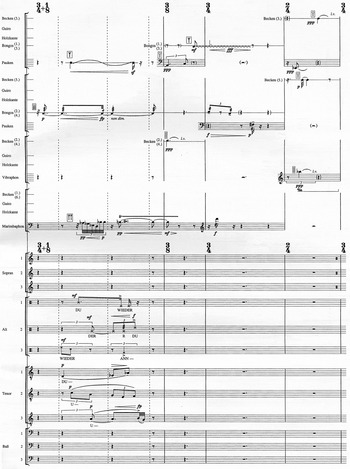
As Lachenmann explains, his concept of sound families was further derived from the serialist notion of a ‘polyphony of ordered juxtapositions’.Footnote 23 However, as the composer realized, the ‘clearly measurable acoustic characteristics and their quantified gradations’ of serial and post-serial music were ‘at best only the most primitive variant of what was available in conjunction with superordinate structures in terms of musical sense units, types of experience and related sound constellations’.Footnote 24 Thus Lachenmann considered serialism to be a tool in the service of other musical processes and, in the case here, of semantic articulation even if it is highly obscured. In Consolation I, the purely musical syntactic blueprint enters into a relationship with the text and the text in turn becomes part of the individual sound families that the composer organizes. When combined with language, these sound-families indeed create ‘types of experience’, though this may initially be states of confusion, inscrutability, and anxiety. This tension is apparent in the opening bars in which the tenors and altos sing the word ‘Du’ (you). The music seems to speak to us, yet its message comes in and out of focus (Example 1).
Lachenmann, Consolation I, bb. 1–7.

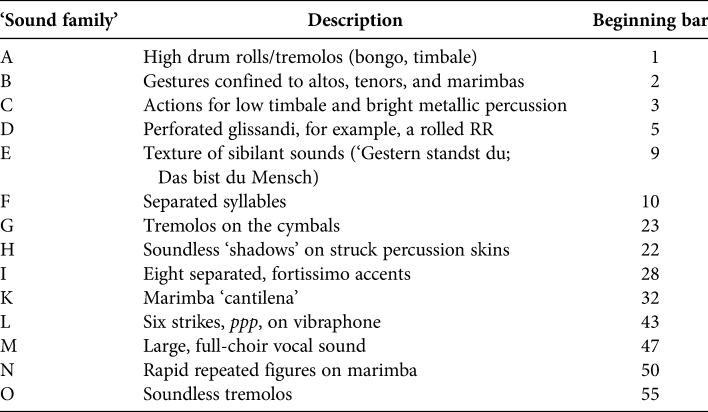
Clarifying the organization of Consolation I somewhat is a partial diagram that Lachenmann produced in his published writings – the only, in fact, that he has provided in print for any of his pieces. As an early example of his employment of sound-families, he provides a schematic outline of the first fifty bars of the work, which comprises fourteen families. Lachenmann provides only the list of families and a visualization of their approximate duration and layering; I have provided a translation and the beginning bar numbers for each family (Table 1).Footnote 25
Initial sound-families in Consolation I

Lachenmann's setting transforms Toller's monologue into a dialogue between voices and instruments that in turn speaks less directly to the audience. Piotr Grella-Mozejko suggests that Consolation I presents an ‘ideal equilibrium between the textual and the instrumental. This the composer achieves by introducing two complementary compositional techniques: instrumental vocalisations and vocal instrumentalisation’.Footnote 26 Yet this convergence can just as easily result in cancellation. The difficulty of communication expressed through the richness of percussion and vocal interactions are just as crucial to the understanding of the work. Lachenmann's structure of successive and recurring sound-families helps to minimize the suggestions of collage-like organization or automatism. The text is presented neither as a free rambling, surrealist stream of subconsciousness, nor as a completely serialized construction (which may well prove impossible) with phonetic units. Rather, there is the suggestion of a relatively closed and complete message, which, through an enumeration of all possible forms of vocalization, struggles to find means to make itself comprehensible. And as the text struggles to reveal itself clearly, it urges us to reflect on ourselves. How is this achieved?
Consolation I opens with the sound of a single bongo roll, a sound that may initially seem opposed to any conceivable traditional vocalization. Against this rhythmic texture, Lachenmann sets the altos against the tenors, each employing different forms of vocalization. The altos treat the text rhythmically: the phrases ‘du wieder’, ‘der du’ and ‘wieder an’ are split between three parts and set to short, interlocking rhythmic bursts. The tenors, on the other hand, treat the single word ‘du’ with its long vowel in a manner reminiscent of Nono's text settings of the 1950s: the vowel sound is isolated in certain voices and sung in counterpoint just as Nono had described his approach in La terra e la campagna (1958) where the vowel sound is presented isolated in certain voices and sung in counterpoint. Above the voices, the marimba offers a diminution and condensation of the rhythmic and melodic materials of the vocal groups as a sort of terse and accented echo. Rather than presenting the text in its original form, Lachenmann begins with the familiar second person subject pronoun: the music literally addresses us, draws us in, though soon leads us into vague terrain.
In Nono's 1960 lecture and article, ‘Text-Musik-Gesang’ – a text which Lachenmann helped him draft in German – Nono demonstrates how in applying serialization to text, and in anticipating and following sung words with their constituent vowels, the semantic and phonetic are put into a new relationship and create a new type of musical fabric. The possible relationship between pieces such as Nono's La terra e la campagna or Coro di Didone (also 1958) and Lachenmann's Consolation I extends beyond the ‘rapport between the two forces which constitute the armature of a text: the phonetic and the semantic’, as Nono describes his approach. The composer also suggests an existential theme with Coro di Didone, ‘the tension of a life, whose extreme intensity favors the human and creative force in order to explode suddenly in tragedy or to brush against the explosion: suicide or death of society – to speak like Camus’.Footnote 27 However, the different treatment of the ‘existential question’ by Nono and Lachenmann in these earlier works by both composers can be distinguished through Adorno's description of the differences between the more ‘didactic’ existentialists such as Sartre and Camus, and those such as Beckett, who made the experience of their art an existential experience in itself.Footnote 28 It is the latter who seems to provide the model for Lachenmann.
The ‘perforated’ sound family, D (bb. 5–7), brings a real sense of the sound and energy relationships that would come to determine the construction of Lachenmann's later works. The rolled ‘r’ of ‘der’ and ‘wieder’ combine in the vocal parts and set off similar sounds by the guiro and bongos. This unpitched gesture is even attempted by the pitched percussion, notably a glissando across the pipes of the vibraphone. These perforated and sibilant sound-families seek to create musical gestures from consonants and to minimize the lyricism that remained in Nono's vocal works and of which Lachenmann was suspicious.Footnote 29 As the vibraphone's non-pitched glissando slows, it becomes a pitched glissando in the marimba. The vocalists then exchange their ‘r’ for ‘s’ phonemes (b. 9) in a whispered recitation of the words of the chosen text which contain this consonant. This ‘Flüstertext’ is one of the most intelligible sound-families (E). This particular sound family also recurs throughout the piece. The feverish text (‘GE-S-TERN SCH-TAN-Z-DU JE-Z-T- SCH-TEH-S-DU MEN-SCH DA-S-BI-S-DU’), while organized based on particular timbral and sound qualities, suggests a repressed speech rising to the surface only to find itself babbling incoherently.
Though largely concerned with fragments of speech, Consolation I ventures once briefly into song. However, when a ‘cantilena’ – the term used by Lachenmann in his diagram and sketches – first occurs in the piece, it is performed by the marimba rather than by the choir. This sort of defamiliarization of instrumental (and vocal) conventions and roles has since become a staple of Lachenmann's compositional approach. The marimba, which functioned as a textless echo at the beginning of the piece, supplements the largely absent melodic singing of the choir with its own angular and pointillistic melody (b. 27). The voices respond, but fluency falters; unable to sing melodic lines and clear text, their garbled text erects an acoustic ‘wall’ before the listener. Following this, the vocalists fixate upon the word ‘heute’ (‘today’) perhaps a hint at the difficulty of musical communication in the present but also another deictic gesture directing the listener to the here and now.Footnote 30
The voices and percussion continue to give the impression of an obscured back-and-forth exchange as sound families pile upon one another: bits of isolated speech, sung vowels, rhythmic consonants in the vocal parts and melodic fragments, outbursts, and neurotic rhythmic ostinati in the percussion. ‘Toneless whisks’ at bar 55 (sound-family O) whisper a speechless echo to the text ‘wieder’ and ‘du’ heard in the tenor and bass parts, both of which remain intelligible. The echo is at times heard as unintelligible, frenzied voice. Yet the percussion cannot truly speak, and through them, the music suggests a more troubling absence of speech. In this way, by attempting to make speech pure music, Lachenmann creates a dialogic situation between voices and instruments but one absent of actual dialogue. One such place is a lengthy and dramatic passage beginning after bar 55 where the voices, after various manic and garbled recitations, fall into a full, suspended yet textless chorus (sound-family M). They sing a thickly layered ‘chorale’ on the vowel sound ‘a’, one of the few passages with traditional vocal techniques. Their turn to traditional singing brings an ironic muteness as they communicate essentially nothing. At b. 74, the climax of the piece, the vibraphone and marimba enter into a loquacious, quasi improvisando duet above the vocal parts, which seem to struggle to form complete words, confined as they are to ‘a’ and ‘m’ sounds. The speechless and gaping mouths of the vocalists are filled by the incessant contrapuntal chatter of the mallet percussion, and the staggered counterpoint of the vocalists now creates an augmented shadow to the hysterical mallet dialogue. Lachenmann forces us to ask who speaks, who echoes, and ultimately, what is being said? The music cannot say anything but only direct our intention to its own place of difficulty between language and sound.
In Masse-Mensch, Sonja desires to transform speech into lived experience: ‘How I have longed and waited for this hour / When heart's blood turns to words / And words to action!’Footnote 31 Yet as her husband tries to tell her, Sonja is not really free to act as an individual if she becomes part of the masses. Lachenmann's speechless dialogue seems to convey the lost voices of both the individual and the mass as they negotiate the exigencies of personal expression and human solidarity. Just as Toller's play does not offer an easy answer to this existential situation, Lachenmann's vocal setting forces us to struggle between recognition and alienation. As his earlier remarks indicate, overcoming the initial sense of incomprehension that his compositions present before the uninitiated listener is a crucial step on the path towards self-recognition. But it must also be noted that this sets a considerable task for the listener and to this end, the conveyance of any message may be a success or a failure.
An unsettling climax comes early in Consolation I. At bar 129 the words are broken down further in single phonemes and echoed by a variety of isolated percussion gestures which seem to belong to no one particular sound-family. This apparent disintegration leads to the first moment of extended silence in the piece (b. 133) – Lachenmann's trademark ‘mid’-piece fermata. The piece then seems to start over again, recalling the immediately preceding gestures (marimba runs, vibraphone dyads, guiro rolls, timbale strikes all against suspended choral vowels) as well as suggesting the opening bars of the piece. The ensemble attempts to coalesce once again, to try to carry on. The remainder of Consolation I introduces new sound-families such as a highly complex rhythmic hockets in the choir (b. 141), and shimmering metallic and fricative sound textures (b. 149).
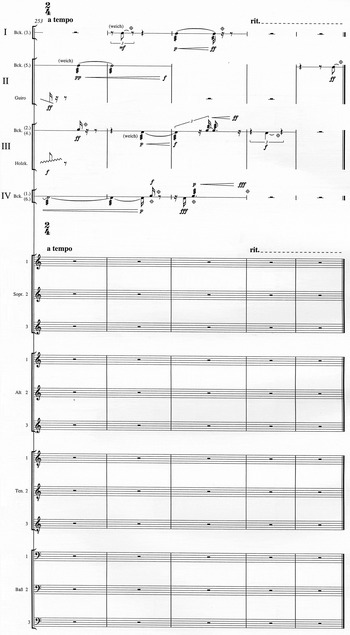
At this point, the listener may have given up trying to align the progression of Toller's text with the patterns of phonemes heard throughout Consolation I. But a pause can direct the listener to its message in other ways; that is, after all, the benefit of the printed programme. The final message can resonate before being sounded by the ensemble, which seems to be precisely what Lachenmann intends in saving one final ‘Erkenn dich doch’ for the very closing of the piece. From around bar 190 to the conclusion of Consolation I, few fragments of speech remain. Instead, we hear a suspended and tense texture out of which only a few voices ever manage to make themselves heard. The final vocal sound recalls the ‘perforated’ sound-family: a rolled ‘RR’ in the sopranos is immediately heard by the marimba and then transferred to the vibraphone and to the guiro in the form of glissandi. Finally a chorus of cymbal strikes emphatically silences the ensemble and brings the work to a close (Example 2). Recalling the ‘dich doch’ cymbal strikes of which Lachenmann spoke, this moment is thus surely a reference to the final words of the text, ‘Erkenn dich doch’ – ‘recognize yourself’. We are urged to look within ourselves but through a faint voiceless echo. It is both a direct appeal and, as an acoustic shadow of an absent text, a reminder of the inability of music (even vocal music) to speak directly. The experience of new sound combinations and defamiliarized vocal techniques comes with the price of potential muteness with regards to a linguistic message. Lachenmann suggests, ‘all of those who set themselves a genuine challenge … all those who expose themselves to whichever existential outer limits, who drive themselves into the unknown, who “had to overleap their own shadow” – they know what it means to discover oneself’.Footnote 32 The final line of text, ‘Das bist du’ (‘That is you’), is given no instrumental approximation in these closing bars. It is as if Lachenmann withholds an ultimate sign of unity between the individual listener and the work. The command to recognition is signalled but it is left to the listener to continue the journey towards self-recognition.
Lachenmann, Consolation I, conclusion.

‘Da noch nirgends nichts war’ (Consolation II)
Consolation II is scored for sixteen vocalists (SATB) with no instrumental accompaniment, thus it is the only purely vocal work by Lachenmann and explores slightly different approaches to text and to the voice than those heard in Consolation I. The preliminary sketches suggest that Lachenmann had intended this work for the same ensemble as its predecessor but the plan was soon abandoned. Lachenmann has written that his original intention was to have been a four-part cycle of works for voice and percussion which would treat texts dealing with existential themes but that plan was abandoned at some point.Footnote 33 As I discuss in the final section of this article, the result was instead the beginnings of a much larger conceptual and compositional project eventually leading to Das Mädchen mit den Schwefelhölzern.
In contrast to the modern social context of the Toller excerpt in Consolation I, Lachenmann chose in Consolation II to work with the Wessobrunner Gebet (Wessobrunn Prayer), a creation prayer believed to date from the late eighth century and one of the earliest known poetic texts in Old High German. The prayer is divided into two sections: the first is a praise of creation in nine lines of alliterative verse and the second is the actual prayer written in free prose. Lachenmann chose only the first, more poetic part of the prayer. The prayer shares the language and idiom of Old German oral epics, and it has been speculated that the first five lines may once have formed a part of an independent cosmogony.Footnote 34 The Wessobrunner Gebet thus integrates elements of pagan mysticism with the Christian creation story and sets the evocations of natural forces and elements alongside the omnipresent transcendence of God. Despite this rich imagery of a creation-to-be, the text also speaks of a state of nothingness.Footnote 35 Formlessness and chaos may be what many listeners hear in this work and Lachenmann's setting also frequently evokes states of absence and emptiness. Yet this original text, if not the resulting piece, is ultimately a prayer: a divine presence reassures the subject facing the sublimity of the void.
Song is a notable absence in Lachenmann's setting in the previous piece as well as here. Whereas Consolation I uses extended passages of textless singing to create tension, Consolation II contains some passages of pitched singing, but never in a sustained and consistent matter. The choice of vocal ensemble and the allusion to a cappella religious settings seems intentional in conjunction with the chosen text: we experience the lack of a traditionally interpersonal and spiritual musical idiom and we are left stranded in a seemingly bleak aural landscape. In his treatment of the Wessobrunn Prayer, Lachenmann recalls a frequently quoted passage from Adorno, again from his fragment on music and language:
The language of music is quite different from the language of intentionality. It contains a theological dimension. What it has to say is simultaneously revealed and concealed. Its idea is the divine Name which has been given shape. It is demythologized prayer, rid of efficacious magic. It is the human attempt, doomed as ever, to name the Name, not to communicate meanings.Footnote 36
As in Consolation I, listening is intended by the composer to be an existential experience as the apparently comforting text is ‘revealed and concealed’, and becomes open to new, less consoling interpretations. Lachenmann concedes that the work may be considered as containing a spiritual dimension, though he seems to want it to move from consolation to a different sensation altogether, ‘[an] experience which underpins any thinking: the amazement of mortals’.Footnote 37 In other words, he is interested in pausing on the feeling that emerges in moving from the ‘Da noch nirgends nichts war an Enden und Wenden’ (‘When there was nothing anywhere, no ending and no limits’) to the revelation of the Almighty.
How does Lachenmann transform this textual underpinning into musical experience, especially considering the voices of Consolation II struggle to form intelligible communication as words are obscured and moments of silence engulf? The composer writes that
In Consolation II the text is no longer comprehensible. Such incomprehensibility [Unverständlichkeit] seems to me legitimate and hardly avoidable, where music and musical form have traded in their old language-like laws for others, for laws that resist any surface-structure linkage to linguistic discourse based on traditional notions of syntax and semantics. ‘Composing’ a text, beyond ‘setting’ it to music, must mean intervening in the arrangement of the text and reacting to it.Footnote 38
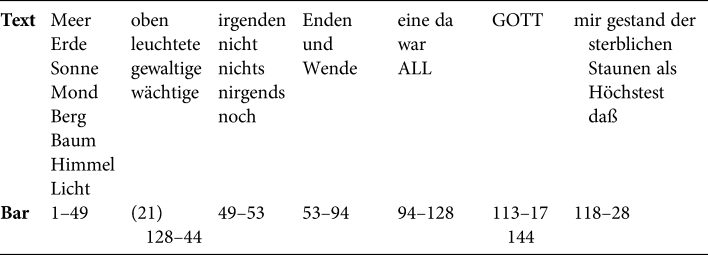
Unlike Consolation I, this piece never offers clearly comprehensible complete passages of text, nor even moments of Flüstertext recitation. Yet when Lachenmann writes that the text of Consolation II is ‘incomprehensible’, he means the text in its original form; the lines are broken up but individual words – mostly one or two syllables – are understood by the listener to a certain degree at various places in the work, much more so than in the preceding piece. Lachenmann may have been able to obscure the linguistic material further beyond that of this previous composition since the prayer would be familiar to at least some members of his German audience, just as Stockhausen had chosen a well-known biblical passage for the manipulation of text in Gesang der Jünglinge.Footnote 39 As Stockhausen described it in 1955: ‘Single syllables and words are taken from the Song of the Youths in the Fiery Furnace (3rd Book of Daniel) and whenever language emerges momentarily from the sound signals of the music, it praises God.’Footnote 40 Although it seems far removed from the vocal purity and electronic manipulation of Stockhausen's Gesang, preliminary sketches for Consolation II suggest that Lachenmann used a remarkably similar approach to fragmenting and reconstituting the text. The composer drew up a chart with groupings of words taken from the prayer which form different sections of the work (Table 2).Footnote 41 These sections are not heard in the order that the words appear in the prayer and Lachenmann gives no indication of the exact span or duration of the sections. I have provided approximate bar numbers for the beginning of each complete or partial collection as well as passages where they recur.
Text distribution in Consolation II

In Consolation I, Lachenmann pulled the text apart in as many different ways as possible based on sound similarities; the sketches of that work reveal Lachenmann's struggle to settle on a phonetic classification, which was organized by single phonemes, words and whole passages of text. In the sketches for Consolation II, Lachenmann first drew up a chart with groupings of words taken from the prayer which form different sections of the work just as Stockhausen had built his piece around larger sections relating to sound morphologies and text divisions. Additionally, we find in the notes for the piece pages with the eight key, symbolic, primordial words of the prayer and the twenty-eight permutations derived by combining each word with one of the remaining seven. The words Berg, Baum, Himmel, Licht, Sonne, Mond, Erde, and Meer thus yield neologisms in a manner similar to Stockhausen's approach in Gesang, which he also described in Die Reihe:
Parallel to the timbre-continuum (phonetic continuum), the composition is based on a speech-continuum (semantic continuum): at certain moments in the composition, groups of sung sounds become intelligible speech-symbols (words); at other moments they remain as pure timbre-qualities (sound-symbols). Between these extremes lie different degrees of linguistic comprehensibility, which arise either from the degree of permutation of words in a sentence, syllables in a word, or phonemes in a syllable, or else from the mixing of one speech-unit with speech- or sound-elements foreign to the context … Of course various new word combinations result from this process, which are not to be found in the text: Schneewind, Eisglut, Feuerreif among others.Footnote 42
In the sketches for Consolation II, we similarly find new words such as Bergbaum or Baumhimmel, as well as more established German compound words. However, not all of these words are easily isolated in the finished score and they appear mainly confined to the first section of the work – perhaps appropriate as it deals with the chaos of creation – although some neologisms such as Himmelsonne (b. 37) or Sonnemond (b. 39) are clearly perceived. At times, Lachenmann indicates a word in a box beneath the vocal parts, particularly when the phonetic structure of the word is distributed among the different parts and is not immediately recognizable to the performer.
These words are combined with three main types of vocal production: sung tones, inhaled and gasping tones, and exhaled susurrant sounds. In the performance directions for the final score, the sound types are further expanded. Vowel sounds are created with speech-tones, head voice, forcefully exhaled and squeezed exhaling, snoring, and voiced and squeaky ‘perforated’ inhaling. Consonants are given over to a more thorough exploration than in Consolation I; here Lachenmann specifies various mouth positions and rhythmic treatments for individual and combined consonants. Lastly, Lachenmann calls for a variety of mouth, tongue, and lip sounds including fluttered lips, explosive and delicate mouth-popping, and several types of tongue-clicking.
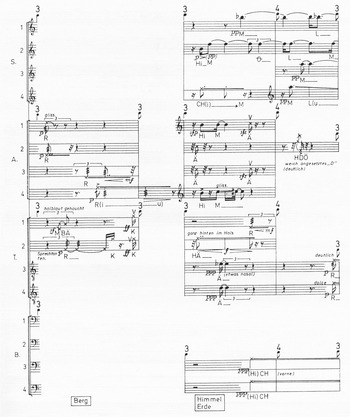
The interaction of the various vocal techniques further delineates the different regions of the work noted above and provides various means of expressing a state of absence or the void. Whereas Consolation I sustains a frantic dialogue between and within numerous sound-families, Consolation II forms sound-families from larger expressive fields. For example, the opening moments of Consolation II create a sense of solitude and isolation as single words coalesce from out of near silence. Lachenmann refers to the opening as a tutti. This section constitutes almost half of the piece and involves elements and forces of nature. For example, in the first bar we hear several layers of rolled ‘r's, among the altos with the tenors supplying the breathy ‘bä’ and clipped ‘k’. The hard and unpitched sound seems appropriate for the word ‘Berg’. Following a bar rest, we hear the staggered entry of the entire ensemble with the voices divided between pitched closed consonants and open vowels, bringing the word ‘Himmel’ into focus. The successive voices reach higher in pitch, raising the texture upwards before dissipating. The setting suggests a sort of word-painting in which Lachenmann emphasizes both the semantic and the phonetic elements of each word (Example 3). Words emerge and recede; they are cut short with bated breath and cut across by fragments of other words. Appropriately for a passage drawing on an ancient cosmogony, Hartmut Lück writes that language is treated as if it were meant to ‘convey something of the chaos before the creation of the world’.Footnote 43 This chaos can certainly be heard in the various passages where sung vowels, extended techniques, and phonemes come together out of a seeming disarray to form flashes of intelligible words.
Lachenmann, Consolation II, opening.

But these are really the rare moments of semantic clarity. More frequently, the text is largely incomprehensible. Following the tranquillity of the opening bars, the interaction of phonetic elements, extended vocal techniques, singing, and speaking overwhelm the listener who struggles to decipher and reconstitute the fragments of text. Despite the fragmentation of the text beyond recognition through much of the piece, Lachenmann nevertheless writes that, ‘Consolation II – as earlier in Consolation I – proceeds from a text treatment in which, thanks to the characteristic economy of the phonetic material – also despite the complete isolation, alienation and rearrangement of the particles of the text – the semantic meaning still remains “signaled as if from afar”.’Footnote 44 Lachenmann does not only convey the meaning of individual words ‘from afar’, but creates a more ambivalent evocation of the isolation and nothingness that exists despite and perhaps due to the prayer's assurance of the Eternal. Though the text is generally divided into the groupings noted above, fragments of the words ‘noch’, ‘nichts’, and ‘nirgends’ reccur frequently throughout the entire work, constant reminders of the potential void out of which the ensemble attempts to create meaning and the endpoint it perhaps signals. Nothingness resists articulation which is perhaps why these words can only be ‘telegraphed from afar’ through the palatal and velar fricative ‘CH's and rolled ‘r's that are found throughout the score. In Consolation I, the voices and instruments struggle to create channels of communication towards conveying the necessity of self-reflection; here, acting as a single instrument and as an orchestra, the ensemble materializes words before us all the while hinting at the emptiness and sense of isolation behind them. While the work never quite succeeds at communicating the entire text, we constantly glean a hint of one possible message of nothingness concealed within the prayer.
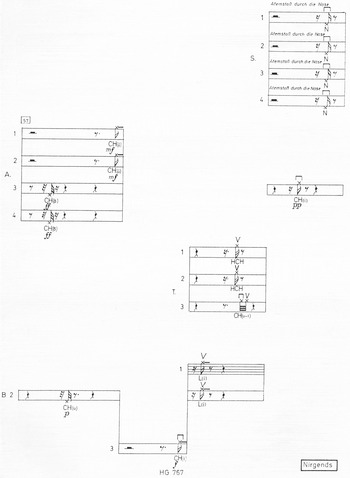
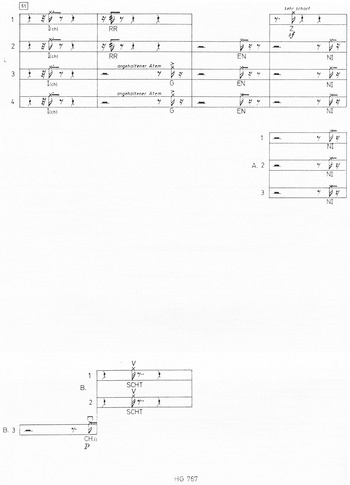
About midway into Consolation II, the music begins to ‘speak’ of this nothingness in a more direct manner. The dense layering of voices around bar 45 brings together different phonemes in each vocal group. In bar 49 there are repeated ‘ND’ tremolos in the sopranos, sustained fricative sounds in the altos, a rhythmic ‘TSCHIKE-TSCHIKE’ in the tenors, and ‘MD’ tremolos with a quasi-suppressed speaking voice in the tenors and basses. Lachenmann indicates the word ‘Nichts’ below the vocal parts even though actual sonic emptiness is nowhere apparent. In the following bar, however, the ensemble dissipates, the built-up density and tension disappear, and we hear the dispersed phonemes of words sounded earlier along with other seemingly less important ones such as ‘war’, ‘oben’, or ‘Noch irgend’. We are again in the midst of one of Lachenmann's introspective ‘fermatas’. At bar 55, the alto part specifies a spoken ‘nichz’, initiating a passage full of intermittent silences lasting until an actual fermata in bar 72. This suspended passage is punctuated by the palatal fricative suggesting the word ‘nichts’ and, in bar 61, the phonemes I, G, EN, and D indicate the word ‘nirgends’, which Lachenmann also specifies at the bottom of the page (Examples 4a and 4b).
Consolation II, midpoint ‘fermata’, bb. 57–60.

Consolation II, midpoint ‘fermata’, bb. 61–4.

Lachenmann's illustrative description of his ‘fermatas’ – the still plateau of the mountain climber – suggests an optional, though perhaps obligatory opportunity for reflection, a chance to assess the situation thus far. The physical ‘new surroundings’ of Consolation II consist of vistas of defamiliarized vocal techniques. Following the ‘repose’, voiced tones other than the fricative signs of nothingness once again emerge; however, the meagre phonetic guideposts we had been provided earlier are no longer present. Even the circled words below the score are gone. When sung tones reappear, the voices once again are able to speak, though their message is both profound and ambiguous. At bar 92, the sopranos and altos come together to sing a suspended ‘W-AH’ ending with a rolled ‘RR’ amid interjected sounds in the tenors and basses. They haunt us with the past, singing ‘war’ (‘was’) as if their suspended song was a distant memory. Or are they saying ‘wahr’ (‘true’) or even ‘Nicht wahr’ (‘isn't it’)?
The singing voices, though, do not last, and they quickly fall back into isolated vowels and consonants (b. 96) and, finally, shrieks, fluttered lips, and tongue flicks and clicks (b. 104). If these non-verbal sounds are at the outmost border of speech, then the sound of the breath signals the threshold of complete vocal silence. In the sketches for Consolation II, Lachenmann writes at the top of a page, ‘Was läßt sich mit angehaltenem Atem machen?’ (‘What can be made with bated breath?)’.Footnote 45 The score offers plenty of answers. The composer's growing interest in laying bear the mechanics of sound production is evident in the increased presence of breathing. In this piece, Lachenmann equally considers the expressive role of the breath. At bar 112, we encounter another suspension in the frenetic flow which had resumed after the last cessation. Following a grand pause – an indication of a second but shorter ‘fermata’ – the ensemble struggles to speak the word ‘Gott’. Each phoneme is distinct, voiced with ‘bated breath’ and separated by silence. While the voices had previously expressed difficulty in voicing the text, they are now rendered almost completely speechless – whether due to the ‘amazement of mortals’ that Lachenmann mentions, some unspeakable realization, or some other hindrance to communication. Rheinhard Febel, in discussing Lachenmann's later, revised work, Les Consolations, suggests that the semantic ‘chaos’ of Consolation II confirms the transcendence of ‘music as meta-language [Über-Sprache] for the expression of the non-verbalizable’.Footnote 46 This would seem to suggest another possible interpretation for the tension between semantic clarity and obfuscation that runs though out the piece. In Febel's interpretation, pure music – whatever that is – transforms into a superior medium through which to express the ineffable, thus recalling a privileging of instrumental music as a more accurate representation of both metaphysical concepts and human emotions expounded in nineteenth-century musical and philosophical thought. Instead, however, my analysis shows that Lachenmann moves between direct linguistic communication, words recomposed or signalled ‘from afar’, and an ‘absolute’ (but necessarily incomplete) musicalization of text. And even though the void is unrepresentable, Lachenmann's dialectic approach both speaks of nothingness and depicts it in actual silence, particularly around the central ‘fermata’ of the work. In this manner he also inverts, as it were, the Urform of all music: sound surrounded by silence becomes here silence surrounded by sound.
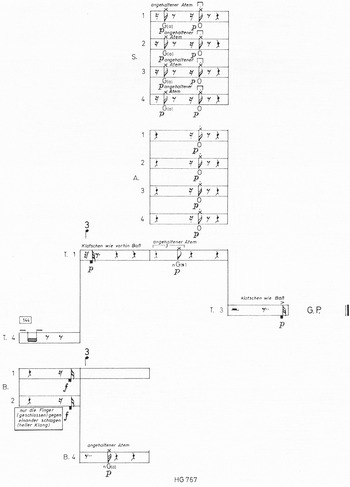
At the culmination of Consolation II, the ensemble struggles once more to voice the word Gott (Example 5). In bar 145 the fourth bass utters a single ‘G’ marked piano followed by two mere crotchet rests. This is nevertheless the longest pure silence yet heard in the piece and suggests endless silence before we hear the vowel that follows in the sopranos. The women echo in a stutter and add a short ‘O’ followed by longer silence. The final ‘T’ is unspoken. We hear only a faint percussive handclap which silences the ensemble for the last time. In Consolation I, the percussion blocked out the voices at the conclusion while here the voices silence themselves. We are left far from the realm of the Lobgesang; Lachenmann, in a note on a page of the sketches for Consolation II, provides his own interpretation: ‘G-O-T-T ist eine Form des “Nichts” “Nirgends” [G-O-D is a form of “Nothing” “Nowhere”].’
Consolation II, bb. 144–8.

This does not necessarily suggest a vocal setting of a Nietzschean Gottestod; far from it. The ‘amazement’ of the vocalists, signalled by the silence surrounding each forced wisp of the word Gott, also registers the foreboding eternity suggested in the text. Nothingness, though it may suggest solace, may easily register desolation. It can account for the frantic search in Consolation I and II to speak even when confined to the most obliterated remains of language and the struggling sounds of speechless bodies. It can also account for the anxious attempt to find a consoling message. The text of Consolation I and II may initially seem to offer two apparent forms of consolation: confirmation of our individual humanity and the comfort of God's presence, respectively. Even if negated or undermined in the course of each piece, the solace of silence and the confirmation of no consolation has its own paradoxical consolation. But when it comes to the truly downtrodden, Lachenmann concedes that this is ‘not really a consolation for those whose existence is oppressed’.Footnote 47 His response is, ultimately, a turn to classic existential acerbity: if there is to be a message in the work it is ‘that we are unimportant’,Footnote 48 as he has later commented.
Subsequent self-reflection
Lachenmann's more recent interpretation should be considered in light of the subsequent history of the Consolation project. The fact that Lachenmann seems to have begun revising his thoughts about these pieces in 1968 is significant. The earlier optimism of effective communication found among Nono and Stockhausen seemed increasingly untenable – if it indeed ever was – within Lachenmann's developing technique as well as within the political atmosphere of the late 1960s. As Beate Kutschke has documented, during the ‘period of “1968”’, which in fact lasted from the end of the 1950s to the middle of the 1970s, student and protest movements with an anti-authoritarian impetus stimulated composers, performers, and music students to contribute to New Leftist goals by counteracting authoritarian institutions involved in music production and management.Footnote 49 Yet in reflecting on the period of the late 1960s, he would later describe being troubled by what he described as a new,
pseudo-radicalism, which puts the concept of the musical work in question in a mannerist, iconoclastic manner … This charlatanism, in its most dilettantish form, entered into an embarrassing alliance with the cultural-critical demands of our student protesters at the time, who, as part of the struggle against what was very correctly judged to be ideological restoration, against US imperialism, against the war in Vietnam, and Third World exploitation, among other issues, were demanding a politically engaged music.Footnote 50
In the face of both the contested outcomes of the May 1968 student and political revolts across the world, particularly in France and Germany, as well as what Lachenmann saw as certain post-1968 regressions, the composer's shift away from offering a message of consolation in 1967 would seem to offer a particularly poignant index of this historical juncture. As Maurice Blanchot suggested, the real stakes of ‘68 were not institutions of power’ – ‘objectifs sans importance’ – but a manifestation ‘outside of all practical interests, [of] a possibility of being-together which bestowed equal rights to all in the fraternity by the freedom of speech that aroused each person’.Footnote 51 Although Lachenmann identified with aspects of the student protests, he recounts ‘suffering from the inquisitorial self-mutilation with which the protest constantly crippled itself’.Footnote 52 Indeed, May 1968 proved to be not only crippled but also mute despite its apparent readiness to speak, moreover, to shout. As Blanchot notes, ‘[l]e Dire primait le dit’Footnote 53 –the act of saying was more important than what was being said. Overwhelmed by the freedom to express anything, to claim an ‘immediately realized utopia’ through spontaneous ‘explosive communication’, the participants confused their utopian goals of communication with their insufficient practices of the moment.Footnote 54
Based on the commentaries that Lachenmann wrote in 1968 and 1969 for his Consolation pieces, it becomes apparent that the composer reconceived the message he wished to articulate – even if part of that message was the very difficulty of communicating in the first place. In his 1969 commentary for Consolation II, Lachenmann mentions the original idea for a series of ‘reflective’ pieces for choir and percussion that would deal with existential themes.Footnote 55 The series would appear to have been abandoned after Consolation II, although we find in the sketches of Accanto for clarinet and orchestra (1975) a tentative plan for a third Consolation piece.Footnote 56 The original project seems to have hit an impasse and it is also around the time of writing Accanto that Lachenmann struck upon the idea for an ‘opera’ of sorts. This reconceived project seems to have crystallized in the mid-1970s during the trial of the Red Army Faction, otherwise known as the Baader-Meinhof gang, a far-left militant group who had engaged in bombings, assassinations, kidnappings, and bank robberies in West Germany.Footnote 57 In the eventual work, Das Mädchen mit den Schwefelhölzern, not completed until the 1990s, Lachenmann famously and notoriously compared the gang member Gudrun Ennslin (a childhood acquaintance of the composer) to Andersen's Mädchen in the ways both were alienated from an indifferent society.
Les Consolations (1976–78) was the result of Lachenmann's abandoned project for a series of individual consolation pieces. During the intervening years between Consolation II and Les Consolations, Lachenmann completed several important solo compositions such as Pression for Cello (1969–70), Guero for piano (1970), and works for large orchestra which further developed his ideas around instrumental sound production in ‘absolute’ musical contexts. In the commentary he wrote for Les Consolations a decade after the two individual Consolation works, the composer singles out fear as a necessary condition for fully connecting with the message of the texts:
Both texts, when interpreted as forms of ‘consolation’ in the face of human helplessness and existential fear [Daseinangst], are contemplative in completely different ways: ‘… It is you who stands at the wall today, recognize yourself’ – ‘When nowhere was there nothing at the ends, there was still the one God almighty’. It seems to me today that – via Franz Liszt – the undisguised disconsolateness of both texts made me come up with the title at the time. ‘Dis-consolation’ [De-consolation], if such a thing exists, is the basic concept.Footnote 58
It is not just that the message of musical consolation is treated ironically; the experience of the piece leads to a cold consolation, or, as Lachenmann might have it, dis-consolation.
When it came to further developing the themes of Consolation I and II – including the composition of a process of self-reflective subjectivation through the cultivation of existential fear – Les Consolations was thus both an end and a beginning for another project. Rather than compiling different reflective stances, perhaps Lachenmann realized he could speak through them by placing them in dialogue with yet another text. In Les Consolations, Lachenmann composed new, brief instrumental pieces around the two earlier pieces and added instrumental parts to Consolation II. To a large degree, Les Consolations is simply a reworking of the two initial pieces with the addition of a ‘Praeludium’, ‘Interludium’, and ‘Postludium’ which frame the two originally independent works. The original pieces remained relatively unchanged except for another important addition: Lachenmann interweaves a new text, a portion of Hans Christian Andersen's The Little Matchstick Girl, and in so doing first gives voice to a literary figure who would occupy Das Mädchen mit den Schwefelhölzern nearly two decades later.
In creating the new Les Consolations work, Lachenmann adds the Andersen text throughout the existing Consolation I and II scores. Given the already extreme fragmentation of the text in the original pieces, the incorporation of additional and lengthier prose has an arguably limited effect in these movements. In one particularly clever compositional move, however, Lachenmann aligns the three texts so that the mention of a wall (Mauer) and of God (Gott) in the Andersen text coincides with the occurrence of these words in the earlier Consolation pieces. If the Andersen text lies comfortably, though somewhat in the background, of the Consolation project, it also begins to press the limits of what the pre-existing pieces can offer in terms of a dramatic vehicle. This is the long process that Lachenmann undertook from his Consolation pieces to Das Mädchen. Several years before the completion of the ‘opera’, Lachenmann sent Nono a book by journalist Pieter Bakker Schut called Stammheim: der Prozess gegen die Rote Armee Faktion (1986) that detailed the trial, imprisonment, and mysterious suicides of members of the Red Army Faction.Footnote 59 By this point, the conceptual combination of the sentimental fable with the politically sensitive allusion to a domestic terrorist must have been clear to the composer. As he would later write, ‘Not only did [Ensslin] play with matches, she went beyond that and made use of violence thereby disfiguring her own humaneness.’Footnote 60 Nevertheless, Lachenmann also treats her as a sympathetic and tragic figure much like the match-seller. Les Consolations, however, underwent no further revisions or additions. When Das Mädchen was completed in 1996, none of the material from Les Consolations remained.
The issues surrounding communication in the Consolation project foreshadow Lachenmann's adoption of an Adornian notion of speechlessness, or Sprachlosigkeit which begins to appear in his writings in the years immediately following the composition of Les Consolations. This can be seen as part of his broader attempt to rhetorically position himself as an inheritor of an Adornian aesthetic position through his writings. In his essay, ‘Composing in the Shadow of Darmstadt’ (‘Komponieren im Schatten von Darmstadt’), Lachenmann looks back on the legacy bequeathed by the figures and experiences of the 1950s and 1960s and incorporates part of an earlier essay from 1982:
The ego, in acknowledging its broken state, its loss of speech [Sprachlosigkeit], confronting its old ties and its inability to shake them off … the ego, not communicating affectively, through gestures that speak emotionally, but through the act of seeking, via the aspect that imposes itself through reformatory dealings with the prevailing aesthetic apparatus, and the concept of material that it communicates. This is how composers of my generation have understood their situation, accepting it as a challenge.Footnote 61
We might read the Consolation pieces as homages to the composer's teachers or as youthful experiments carried out under the ‘anxiety of influence’. But in revisiting techniques and themes that had been taken up by Nono and Stockhausen, those composers’ themes of political engagement and spiritual praise are reconsidered and placed in a more discomforting light. It is these very questions of the ego's self-awareness and of ‘humaneness’ – or simply humanness – found in Das Mädchen that Lachenmann's earlier Consolation pieces also pose in their own way. Yet it would seem that both May 1968 and the terrorist events of the 1970s rendered their call for introspective self-discovery in need of recasting against changing socio-political conditions and the actions of successive waves of political radicalism. Rather than relying on models of past or present utopias, Lachenmann settled on a theme of critical reflection that itself was subject to critical reappraisal – something that was both necessary and, as it turns out, convenient.
What remains remarkable in the development of this project is that the original ‘texts’ – the two Consolation compositions – remain largely intact and unaltered. Indeed, aspects of the messages and means provided by Nono and Stockhausen persist as refracted, speechless echoes not unlike the shadowy percussive sounds that ‘telegraph’ the unreconstituted text of Consolation I and II. The centrality of these messages may account for why they were the vehicle for subsequent projects and why these relatively short vocal pieces, which may appear as one-offs in the composer's oeuvre, magnify key compositional and conceptual concerns of the composer's larger practice. As they enact the difficulty of communication and as revealed by the ways in which the composer himself reframed the pieces in subsequent commentaries, Lachenmann's Consolation pieces are also metaphoric and metonymic of some of the challenges facing the composer's ‘voice’.