INTRODUCTION
Wildlife is commonly thought of as ferae naturae or res nullius, owned by all or by no one. Footnote 1 But the received view in the literature also shows that wildlife may come to be owned by humans in one of three ways: through our care and assistance; Footnote 2 through capture where the wild animal, for example, becomes the possession of the hunter who shoots it, Footnote 3 or through confinement, where wildlife is enclosed within private or communal property boundaries. Footnote 4 We suggest a fourth dimension has gone unacknowledged by the literature on property theory and on wildlife management; wildlife may come to be symbolically owned through the class that legislates the species. Such appropriation of wildlife results in a phenomenon where responsibility for the species—parsed in terms of conservation, care, and management—comes to align squarely with property rights. Those who do not, in any capacity, identify as co-owners of the species consequently default on responsibility taking. Footnote 5 Moreover, they may become resentful of wildlife being other people’s property, Footnote 6 often seen as encroaching on “their” game stocks, private property, or, in extreme cases, on cultural heritage rights, as in the case where now protected predators infringe on traditional livelihoods and lifestyles pertaining to livestock grazing or hunting.
In this article, we scrutinize the entanglement of property and responsibility where wildlife is concerned. We do so to highlight a growing, but historically prefigured, phenomenon of hunters experiencing such protection of wildlife that confers ownership of the species to the state, “causing the animal to become entangled with notions of public authority and with resentment toward public institutions.” Footnote 7 Our aim is to show that this is a fourth and neglected form of shadow ownership that the literature has failed to engage in the property debate. This “ideological and legal sequestration” of wildlife is less material appropriation, akin to capture and confinement, and more symbolic appropriation. Footnote 8 In the case of wolves (Canis lupus) restored to their historical habitats under current policy, this requires the investment of resources in wildlife conservation to the point where hunters take the state’s coercive and legislative power to have been co-opted by a growing middle class with a bio-conservation agenda. Footnote 9 At the same time, these “conservationists” are accused by hunters of behaving as irresponsible and neglectful owners by not following up on the consequences of their pet conservation projects. Footnote 10 In practice, hunters see themselves as having to become the actual responsibility takers for wildlife. Indeed, they complain that wolves should be “kept in line” by their urban-based “handlers,” so as to not encroach on, and attack, hunters’ game animals or livestock. But more than attacks on their private property, the presence of wolves can also to be said to pose a profound threat toward the cultural heritage of Swedish hunters to hunt with free-roaming dogs as before. Footnote 11
Hunters thus reinforce the perception that animals can be demarcated into “yours” and “mine” categories and that responsibility taking should rightly correspond to such ownership. They also exhibit considerable possessiveness toward their game animals, on the one hand, which they see as their property—as “our moose” and “my deer population” Footnote 12 —and, on the other hand, toward the sorts of immaterial cultural heritage that they see as being under threat by urban pet wolves, including the prized tradition of loose dog hunting. Footnote 13 To this extent, they assert themselves as the class that owns wildlife by virtue of their superiority as its rightful stewards. Footnote 14 But, to their chagrin, this role fails to be recognized or appreciated by conservationists and the state. The hunters respond by emulating the old nobility, evoking quasi-aristocratic virtues around the sanctity of property rights, as a basis for owning wildlife. In doing so, however, they reproduce a partitioning of wildlife across classes. We argue that this fragmentation of responsibility for wildlife above all signals a crisis of state legitimacy. This crisis persists as long as the state can be co-opted by social classes so that it is unable to serve as a neutral arbiter where wildlife policy is concerned.
A historical-materialist analysis can elucidate the continuity of state co-optation where wolves are concerned from the perspectives of hunters—from the nobility of old to the urban-based middle-class conservationists today. Indeed, exposing the historicity and continuity of this dialectic opens a way to a better appreciation of the normative dimensions of the present conflict over ownership and responsibility of wildlife and the potential for its mediation. Not only is this urgently needed to de-fragment the common so that all may feel co-ownership of common fauna and ready to invest in, or comply with, its conservation law. But it is also a crucial exercise in civic responsibility taking, where the right democratic process can mediate class antagonisms and expose hunters’ quasi-aristocratic claims as false consciousness.
In what follows, we first offer brief statements of our methodology and theoretical framework. We then set out to remedy the deficit in the literature and open the way for mediation of such conflict in three closely interconnected ways. First, drawing from a Marxian approach, we develop a descriptive historical-materialist analysis of class-based antagonisms between hunters and social elites in Sweden to show the original fragmentation of the common. Second, from here, we present the findings of a three-year contemporary empirical study of semi-structured interviews with Swedish hunters, revealing in their own words their resentments concerning the arrangements of the present-day state in which wildlife management policies are effectively controlled by conservation elites. Finally, building on the descriptive insights of historical materialism, we offer a prescriptive analysis of the findings of this study, in which we appeal to deliberative democracy to mediate ongoing antagonisms over wildlife between hunters and conservationists.
METHOD
Interviews with Swedish hunters across multiple demographic axes and geographical locations were conducted as part of the research project entitled Confronting Challenges to Political Legitimacy of the Natural Resource Management Regulatory Regime in Sweden: The Case of Illegal Hunting. A total of 39 semi-structured interviews lasting between 1.5 and 2.5 hours were conducted in 2014–16 at the height of the wolf conservation conflict in Sweden in terms of illegal hunting, litigation battles, and protests. Footnote 15 These interviews concerned hunters’ reflections on property rights; ownership of, and responsibility for, wolves; and their protected status under Swedish and European Union (EU) law. Because of the delicate nature of questions asked pertaining to law-breaking or aggressive attitudes toward certain wildlife, policy, or institutions, indirect interview techniques of hypothetical scenarios, speculations about peer behavior and attitudes, and other forms of anonymization were used based on prior successes in this context. Footnote 16
Although the interview battery was developed from the broad themes of the perceived legitimacy of institutions pertaining to wildlife management, all respondents reflected in some detail about the wolf, whose protection has famously become a symbol of the influence of conservationists and the simultaneous marginalization of hunters and rural lifestyles. Footnote 17 Hence, the wolf was continuously approached from multiple thematic openings by the respondents, which resulted in phenomenological accounts of the place of this species in contemporary Sweden. It can be noted that given its controversy, the occasional fatigue associated with discussing it, and its propensity to put hunters in a defensive mood, interviews were neither presented nor opened as investigations into attitudes on the wolf. Footnote 18 Rather, we allowed respondents to autonomously broach the wolf issue under the several open-ended themes.
THEORETICAL FRAMEWORK
Our framework is designed to address the twin needs of descriptive and prescriptive analysis. The first need is met through a limited and selective appeal to the theory of historical materialism. Broadly conceived, this aims to explain ideas about legitimacy and right as resulting from historical class struggles. Footnote 19 Class struggles originate with the enclosure, or privatization, of the common and the subsequent inequalities that emerge between those who lay claim to natural resources and those denied access to what was previously accessible to all. Classes struggle for control of the coercive powers of the state, according to which ownership may be legally assigned and re-assigned, promoting the interests of one class over another, capitalist over landed nobility, proletarian over capitalist. As conceived by Karl Marx and Friedrich Engels, historical materialism operated with a monolithic conception of class—landowners, capitalists, proletarians—overlooking the nuances of intra-class, as opposed to inter-class, conflicts. Nonetheless, it sought to offer a descriptive analysis of how ownership changes over time as ascendant social classes establish enclosures of common resources—be it through privatization, patenting, or other means of moving control away from those concerned, Footnote 20 like that of appropriation of local wildlife as global resources for a conservation and sustainability agenda. We contend that the present confluence of class interests between hunters and conservationists involves many nuances and internal class tensions insofar as both groups exhibit increasing socio-economic diversity, not least the case of “new” affluent hunters coming from cities and homes with urban-based values around nature conservation. However, the conflict between them still fits the historical materialist model of a competition for control of the state to advance their particular agendas concerning the assignment of ownership.
That said, historical materialism is also associated with claims that are prescriptive as well as descriptive. In regard to property rights, these prescriptive claims concern the desirability of some future restoration of the common, such as in eco-socialism. Footnote 21 Here, a Marxian approach appeals to virtues of the common, quite distinct from those of ownership and possession, such as spontaneity and cooperativeness in a class-less, property-less society. Nonetheless, such prescriptive claims as may be derived from this approach are of questionable value. Our empirical study shows hunters do not truly aspire to any such restoration of the common. Instead, they express a strong desire for recognition and respect from the state for decidedly non-Marxist virtues of possession and pride. Footnote 22
To this extent, we turn to deliberative democracy to address the second of the twin needs—for a prescriptive analysis of a way forward beyond ongoing conflict over who controls the state. Deliberative democracy is concerned with improving collective decision making, emphasizing the right, opportunity, and capacity of anyone who is subject to a collective decision to participate in consequential deliberation influencing the decision outcome. Footnote 23 From the point of view of this study, its relevance lies on its very different attitude toward class conflict and the state. Contrary to historical materialism, classes do not simply vie for control of the state and its coercive powers to advance their interests. Instead, deliberative democrats see a positive role for the state in providing neutral deliberative fora in which competing class interests may be mediated and adjudicated. Deliberative democracy thus also rejects the eco-socialist ideal of a restored common, seeking instead a standpoint of state neutrality with respect to questions of common interest for hunters and conservationists across class lines. Footnote 24
It does so by creating the kind of deliberative spaces that shift the focus of class antagonism from narrow questions of ownership—game of hunters or pets of state—to complex, overlapping relations of shared political responsibility for nature and wildlife. Here, the deliberative virtues of taking the perspective of others, critically assessing their positions against contrary points of view and the best available scientific information, are prescriptions that replace the quasi-aristocratic virtues of possession and pride claimed by hunters, which are inevitably tied to their partisan class interests and may or may not reflect the actual interests of wildlife. Likewise, such deliberative virtues may enable hunters to more effectively challenge the positions of the new conservation elites, which they believe to be merely sentimental and ill-informed urban biases at odds with the realities of rural life. Footnote 25
Regarding our use of the concept of class, we understand this primarily in terms of political, rather than economic, subordination, although the two frequently interact. Here, we stipulate that a class privilege—or superior positionality within the extant social order—is achieved when one social faction succeeds in effectively co-opting the coercive powers of the state to advance its particular interests and agenda, at the expense of other factions with conflicting interests and agendas. But the subordination of one class by another is not always reducible to economics, as typically stressed in the Marxian approach. It might also be a function of the elite class gaining discursive control over deliberative processes for evaluating competing claims to justice and validating competing claims to knowledge. Footnote 26 Indeed, hunters cannot easily be parsed as a class in the economic sense, given that contemporary hunters are diverse and many are reasonably affluent members of society. Footnote 27 As noted, class tensions are manifest within the hunting community itself (as between “meat” hunters and sportsmen and between urban hunting “clients” and rural “lifers”), but for two reasons these are of secondary importance in the current political debate on wolves. First, this class division is simply less pronounced than in many other countries. Second, hunters arguably transcend internal economically configured class tensions to form a coalition mobilized against what they perceive as the far greater threat of external class struggles. These struggles operate on the basis of politically—as discursively disadvantaging in the debate—rather than economically subordinating hunters, even if hunters also contend that wildlife conservation involves the simultaneous economic disenfranchisement of the countryside.
Still, given that their subordination turns primarily on the principle of political disempowerment of an economically diverse demographic, this weakens any claim they might have that they are a heterogeneously economically subordinate class unto themselves or a discriminated against minority whose livelihoods and lifestyles are fundamentally at stake with protective legislation, as Sarah Fenstemaker supports in arguing for the Hopi’s rights to continue to hunt eagles. Footnote 28 Although their livelihoods are (most of the time) not at stake, then, hunters often position wolf conservation as a direct attack on property rights and the right of hunters to cultural self-preservation and maintenance of cultural heritage more indirectly. Footnote 29 Cultural heritage, as we will see, comprises culturally shaped landscapes and traditional ways of hunting rather than the typical physical property categories listed in the 1970 UNESCO Convention. Footnote 30 It can be noted, however, that in the context of the ongoing legal debate whether hunting prohibitions violate the Convention for the Safeguarding of the Intangible Cultural Heritage or the cultural rights to lifestyle stipulated by the European Court of Human Rights, recreational Western hunters rarely successfully qualify as a distinct subculture in danger of cultural extinction analogous to an indigenous community that can make these appeals. Footnote 31
Finally, as a point of clarification, we stress that our approach is based in social and political theory and not in legal theory. Our concern is not with legality—who has legal rights of ownership—but with achieving legitimacy in the process of deliberating rival class claims to ownership of common fauna. To this extent, it is not our intention in this article to pioneer a new legal category of ownership, as much as to begin laying out the conditions for achieving legitimacy in the complex democratic process of giving voice to conflicting interests regarding such ownership, without privileging the voices of conservationists over hunters, or vice versa, and using the power of the state to reinforce any one or other positionality in this process. Legitimacy is achieved when the powers of the state are employed to ensure processual neutrality with respect to class positionalities in the deliberation of collective decision outcomes.
DESCRIPTIVE ANALYSIS: HISTORICAL MATERIALISM
The purpose of this brief section is to establish that the subsequent empirical reflections of contemporary Swedish hunters are best understood as the most recent iteration in an ongoing historical dialectic between a subaltern and dominant or elite class. Indeed, hunters’ reflections on the importance of virtue in wildlife stewardship, their resentments toward the state and their class antagonists who co-opt its power to advance narrow elite interests, and their attempts to reconcile private and common are all historically prefigured phenomena. The class antagonists have changed, but the role of the state in promoting some class interests over others, and the aspiration of hunters for state recognition and respect, remain largely the same.
The importance of the appeal to virtue in justifying claims to ownership and exclusive access to wildlife is prefigured in hunting in early modern Sweden having become a royal recreation associated with elite prerogative of masculinity and adventure, reflecting parallel trends in Europe. Footnote 32 Hunting thus detached from subsistence was increasingly justified as promoting these paradigmatically aristocratic virtues. To commoners, the reframing of some forms of hunting as recreational caused deep resentment about the state’s narrowly self-interested appropriations of the common as extending legal protection to “things of pleasure.” Footnote 33 Clearly, commoners were not profiting from these hunting pursuits of the privileged few, while believing they had the right to enjoy access to the common on a basis of equality with their peers.
Commoners resented the statutes of the 1600s that consolidated the attractive and valuable game, such as the esteemed moose hunting, Footnote 34 with social elites, while leaving more arduous predator control practices to the lower classes. The burden of wolf culling, for example, was left as a legally stipulated duty to commoners when it was the nobility who most benefited from such hunts in keeping high game numbers up. Wolf battues, in Roger Bergström, Karin Dirke, and Kjell Dannell’s words, “were a useful way of controlling, and subordinating commoners.” Footnote 35 Resentful of their subordination through wolf battues, commoners voiced their dissatisfaction by misbehaving, for example, by showing up late or ill-equipped. Footnote 36 Their conduct was a testament to the unpopularity of the state hunting administrators (jägaristaten) who initiated and oversaw the raids, as Ulf Nyrén contends: “The same state servants who routinely called the public before courts over various poaching and tree felling offenses demanded that this same public would obey orders by participating in wolf hunts in all kinds of weather and across all kinds of untraversable landscapes.” Footnote 37
Class antagonism over wildlife became most pronounced during the Nordic War in the early 1700s. Never more reliant on the public’s acceptance of taxes for the purpose of waging war, the state saw an increase in objections and dissent. Poaching of wildlife became less sporadic and individual and more organized, particularly with respect to moose hunts. Footnote 38 Indeed, the state failed to deliver on its martial promises, while exacting harsh tolls on the subordinate classes. In addition to poaching, commoners refused to pay taxes, circulated rumors, and deserted military ranks. Footnote 39 In this respect, they were critical of what they saw as administrative infringements of various kinds, facilitating radical appropriations of their goods and resources, such as horses, monies, or manpower. Footnote 40 Parallel to the more familiar cases of protest among the English, Footnote 41 state regulation of wildlife in Sweden was unpopular both because of its toll on the lower classes and because of their increasing suspicion of the class who administered them. Footnote 42 Both legal and illegal measures were now sought by the peasantry to regain the right to hunt, and they were gradually more successful under the Age of Liberty (1718–72), during which Swedish commoners sought progressive social change on multiple fronts.
Limited concessions were granted to commoners to hunt in the coming years, even though these were primarily motivated by the rationale of getting commoners to agree to an upcoming war tax. In 1789, however, the right to hunt was unequivocally granted to all those who owned land. This meant that only a small class of landless tenants were without access to game. Predictably, the public’s right to hunt led to rapidly deteriorating wildlife stocks, necessitating new prohibitions on hunting practices in the decades that followed—1808, 1825, and 1864. With the formation of the Swedish Hunting Association in 1830, however, Swedish hunters gradually came to self-style themselves as the owners of common wildlife in a manner not dissimilar to the Vermont hunters, described by Marc Boglioli, who exhibited excessive possessiveness toward deer as “their” game, which they had stewarded and saved from near extinction. Footnote 43
Nonetheless, we stress here that these Swedish hunters did not properly reclaim their customary rights of the poor to access the common—or, in Marx’s memorable phrase, the “alms of nature”—as antecedent to law. Footnote 44 Instead, they asserted a legal right of ownership and control over wildlife more akin to those mandates of the modern state that had once reserved access to common Swedish game for nobility and crown. The Swedish Hunting Association is in fact often criticized for privileging the landed elite among hunters. We shall later argue that this historical supererogation of ownership duties from their class antagonists manifests itself in the “quasi-aristocratic virtues” that Swedish hunters claim for themselves. These are not virtues of the common, as espoused by Marx, such as sharing, spontaneity, and cooperation but, rather, virtues of pride: freedom with responsibility, independent judgment, and personal initiative. They are above all celebrations of property rights, forming a defensive shield around hunting as a sovereign jurisdiction into which new laws about public goods like wildlife should not penetrate. Footnote 45
We argue this dialectic of supererogation with respect to the ownership of Swedish wildlife goes some considerable way towards explaining the current form that class antagonism has taken among hunters, as revealed in our interview study. This is class antagonism not toward the old elite of Swedish nobles but, rather, toward what is seen as a new urban-rooted elite of conservationists and environmental non-governmental organizations (ENGOs), co-opting the powers of the state to impose a conservation agenda on hunters. Footnote 46 Indeed, such a top-down agenda of the new elite is experienced by the hunters as wresting from them the unequivocal right of hunting and stewardship transferred to them from the old elite of nobility and crown by the nineteenth-century Swedish state. The focal point is above all the sudden criminalization of wolf culling in the countryside.
EMPIRICAL FINDINGS OF THE INTERVIEW STUDY
We now proceed to the empirical findings of our interview study, presenting (1) the hunters’ reflections on the virtues of hunting; (2) their resentments toward the state; (3) their present-day class antagonists; as well as (4) their attempts to reconcile the private and common where the property of wildlife and, in particular, wolves, are concerned. All quotations below are from our hunter respondents, unless otherwise stated.
Virtues of Hunters
To the respondents, the hunting institution placed a premium on the following virtues: local autonomy, property rights, and responsibility by the landowner. This was elucidated in the hunting virtue of “freedom with responsibility,” which grants the landowner autonomy over his land and his animals. Footnote 47 Freedom with responsibility has been strongly codified in recent years against detail regulation from top-down conservation directives. As one hunter argued, “[t]o counteract this need for detail regulation you have to ensure that those who are given freedom with responsibility behave properly. Or else it won’t work.”
Freedom with responsibility was particularly important in light of hunters’ observation of an increased tendency of the state to appropriate increasingly trivial natural resources that were bound to the localities, simply because of a conservation agenda: “It’s almost like the mushroom is also regulated [by authorities] today. I mean I think the ownership has been displaced to the state and away from the praxis of landowners, where it should be.” Freedom with responsibility meant that most respondents endorsed the decentralization of decision making to what they saw as the lowest common denominator—the landowner. Where hunters did not personally own land, but were tenants or guests on other people’s hunting grounds, they were surprisingly equally emphatic about local autonomy over wildlife, arguing that decision making ought to be the responsibility of local communities comprised by the users of hunting land:
“I’d wish decision-making power would be delegated as far as possible to that person who wants to [use it], that is to say, hunters and landowners.”
“I think these things have to be made more local. I think those that don’t hunt or aren’t landowners need to respect the fact that decisions are taken locally and not blame anyone else.”
Respondents connected the justification for local autonomy to two virtues of hunting in particular. The first virtue, and what they saw as perhaps the principal virtue of hunting, was embodied knowledge on how to best manage wildlife stocks. This is similar, interestingly, to the old nobility’s justification for their decision-making authority—namely, their possession of superior knowledge about hunting and forestry. Footnote 48 Here, hunters positioned themselves in David Butz’s words as “historically sanctioned stewards of a meaningful landscape.” Footnote 49 Hunters saw that the stewardship of wildlife could only proceed if they themselves undertook it without the oversight of detail regulation, not only because it was an inalienable right with historical precedence (“the landowner has a right to harvest from his or her property” or a typically “old-fashioned ideal,” as one respondent conceded) but also because hunters’ expertise was grounded in “the geographical conditions, climate and natural premises” of the land. It meant any outside ruling by conservation agencies were sure to produce “suboptimal results … you’ll get inefficiency.”
The second virtue to delegating authority over wildlife to hunters was that they were also seen as uniquely positioned to manage wildlife because of their built-in stewarding dimension. Footnote 50 Here, the landowner simply had the greatest imperative to steward its wildlife populations, as testified by the following respondents’ reflections:
“The most sustainable and managing principle is that which is realized by those who have direct responsibility.”
“If you look at the portal paragraph it says the hunter and the landowner are responsible for the hunt and the management of the wildlife so it will be cared for in a sustainable way.”
Through such stewarding, hunters may be said to partly appropriate ferae naturae into cultural property. As imparted by direct ownership or user rights, responsibility meant that hunters saw observable effects of the care they invested in wildlife stocks and maintaining their habitats, whether through supplementary feeding or trimming hedges.
“Your deer, you trim hedges for them to get through … then when you get what you harvest. When you see that your pheasants are becoming numerous. That your deer are thriving, that you have wild boar. That’s a reward in itself. It gives you great satisfaction.”
“Individual acts of stewardship undertaken by hunters, like throwing out an extra bucket of seed for pheasants for example, means we still have pheasants.”
When undertaken with freedom with responsibility, hunting was hence thought to have an enriching effect on wildlife. It was said that: “If we didn’t have hunting today, we wouldn’t have nearly as much wildlife as we do.” This reflects an argument popularly presented by hunters that hunting is an inextricable part of therapeutic wildlife management. Footnote 51 The phrasing of “us having wildlife” as opposed to “there being wildlife” may be a similarly significant reflection of hunters’ sequestration of ferae naturae into cultural property. The same respondent connected the diversity of wildlife directly to hunters’ interest in maintaining it: “The second that interest goes away, so do the animals. That’s how I see it.” This parallels the refrain adopted by the United Kingdom’s pro-hunting movement in 2004, which claimed that the hunting act bereaved the fox of its prized cultural status—conferred through it by generations of hunting—and thereby turned it into a pest for whom no one cared. Footnote 52 The implication was clear: its survival was contingent on its approximation of a cultural category of property of hunters.
While respondents did make references to “our moose stocks,” they generally showed greater ownership of, and attachment to, particular parcels of land than to particular species, let alone individual animals. This reflects previous findings by Katinka Waelberts, Frans Stafleu, and Frans Brom and by Jonathan Finch that hunters come to revere landscapes as cultural property shaped by hunting practices. Footnote 53 The hunting territory was a sacred space to many of the individual’s interviewed. One respondent jokingly characterized this by appeal to American frontier mentality associated with independence and self-sufficiency, contending: “My ranch is my castle.” This landscape had a particular quality; it was pastoral and managed, where the nightmare scenario for hunters was that wolf depredation of herbivores would result in a rewilded, overgrown forest: “You’ll see the stretches of forest of 50–60 km without any sort of people living there, no houses, no nothing, basically no moose left.”
Another hunting respondent even contended that he derived little joy in hunting elsewhere than on his own land because of the memories and personal game stocks that he had stewarded over generations. Footnote 54 Another respondent similarly criticized tourism hunts, or invited hunts, for ultimately being “on someone else’s terms” by being on someone else’s land, highlighting the importance of the freedom and autonomy associated with one’s own property. It was not surprising, therefore, that many critical reflections by respondents centered on violations to property rights in a particular territory. There were fears the state would seize one’s land for conservation purposes, on the one hand:
“So I can’t decide over my own territory anymore?”
“One is all too quick to take the right away from the landowner.”
The criminalization of property rights raised such questions as: “where does the boundary go and where does it end?” as one respondent asked critically of state interference. Hunters also had difficulty reconciling the public’s freedom to roam with encroachments on their land. Footnote 55 Specifically, prohibitions on hobby wildlife surveillance cameras raised by hunters on their land, citing the risk of capturing humans on tape, meant stretching the commons too far. They questioned treating their hunting grounds as suddenly “public places” in which the state could issue prohibitions that protected the integrity of visitors on this land rather than of the owners of it. Hunting was a “very personal thing.” It was at times so private that several respondents could not see why game was “any of [the state’s] business” or “why other parties need to interfere with it.”
Attitudes toward the State
Because this research explicitly set out from an observed crisis of legitimacy on the part of the regulatory regime, there was no shortage of regime-critical opinions by the hunters interviewed. These centered on the limits of actual participation by hunters over wolf conservation policy, prompting the sober reflection that “the state has decided how it’s to be managed,” without input from those affected by its policy. They also centered on the state’s incompetence before administrating hunting issues and on the state’s lack of recognition of hunters’ contributions. First, respondents presented criticisms that centered on the state’s fundamental lack of recognition—indeed, ingratitude—for hunters’ contributions to society. Instead of having their customary vehicular-injured tracking and euthanization duties duly acknowledged as a public service to traffic safety, the state failed to appreciate the full significance of this contribution. This was manifested when Dalarna hunters embarked on several consecutive strikes of this practice to leverage the state to change wolf conservation policy. Moreover, because the wildlife that suffered from this activity were run-of-the-mill game stocks, such as deer, and not the charismatic, state-sponsored wolves, the strikes were unsuccessful in compelling change from the state.
Second, hunters showcased an often profound mistrust of the state and its agenda where wildlife was concerned. Mistrust toward the regulatory regime increased the further away from the hunter the authority was located: “The further away you get the less confidence you have in these institutions, especially the Swedish Environmental Protection Agency.” The EU, in particular, was seen as a supranational regulatory actor who encroached not only on national sovereignty but also on local resources, intangible cultural property, and landscapes:
“In my opinion the EU interferes a bit much in local affairs.”
“No one really understands why the EU has to meddle with what we hunt here.”
“I imagine most people are bothered by [the] EU’s interfering in their hunting.”
When respondents were asked about their relationship to, and trust in, state administrative bodies that managed wildlife, regionally and nationally, it became clear that a principal source of resentment toward civil servants and state managers was their armchair-based alienation from the repercussions of wildlife conservation. The “theoretical backgrounds” and “practically speaking no experience” of civil servants was an affront when such people micro-managed hunting matters. The Swedish Environmental Protection Agency (SEPA), in particular, was said to comprise everyone from “a lot of ‘nature-lovers’ … who are perhaps a bit biased on certain issues” to “ideologies” that were working to put a spanner in the works, operating, in one respondent’s words, from the dubious point of departure of restricting hunters’ freedom: “How should we infringe on the rest of society’s liberties to undertake protective measures for this species?” As an institution, the SEPA was much criticized for effecting a political mess and for showing “time and again they can’t handle” wildlife management by veering into straight conservation.
While regional authorities tasked with wildlife management were on the whole better regarded than the administrators at SEPA, especially where such individuals had hunting backgrounds themselves, respondents still emphasized a gap between “polished” civil servants and the common hunter or farmer. These civil servants were jokingly said to have “sold their soul” in working for the state. Echoing the role of the unpopular regional wildlife and hunting administration at the time—the jägeristaten in historical times—a new breed of zealous state-employed nature inspectors now counteracted the hunters’ freedom in the woods, making them feel monitored and policed, especially in the wolf-dense county of Dalarna. Footnote 56 Sometimes this was overt in the administrative authority’s positioning of wildlife monitoring cameras that seemed, to two respondents interviewed in this study, to be more about capturing hunters’ misconduct on tape than about the wildlife.
Third, hunters accused the state of prioritizing the agenda of conservation over rural economic investment and social welfare. Several hunters presented a near-apocalyptic vision of the state’s “systematic devastation of the countryside,” where factories were closed down or workers were let go to make room for wolf conservation or livestock producers were forced to give up because of repeated carnivore attacks on their herds, causing the prized open pastoral landscape to regrow into a forest full of wolves where “no more moose [were] left”: Footnote 57
“They’ve let go 500 people. I’m not one of them, but I’m still affected … it’s the largest company here so it’s really difficult.”
The state’s co-optation by conservationists was seen not merely on the level of granting them disproportionate uptake in the debate, or affirming the legitimacy of their discourse above that of hunters,’ Footnote 7 but it was also economic to many of the hunters interviewed in this study. Respondents were critical of the substantial state grants that animal rights ENGOs received annually, often to the point of being more or less fully subsidized (as one observed, albeit only partly correctly, of the Swedish Association for Nature Protection and the Anti-Poaching Unit). Footnote 58 Hunters, meanwhile, pay a fee that goes into a wildlife management research stipend. As such, some respondents complained that grants from this stipend often go directly toward funding wolf-promoting projects by SEPA:
“So this money is taken from hunters … why are hunters a unique group forced to pay for this?”
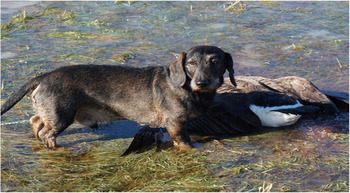
There was the sense among a majority of respondents that, while the government had turned its back on the countryside, “these wolves can cost just about however much they want.” Not only did wolves divert resources from the needs and interests of hunters, but their conservation represented the erosion of a unique cultural heritage on the part of Nordic hunters—that of free-roaming coursing by hunting dogs. In fact, one of the principal grievances of hunters in this study, as elsewhere, was that their cherished custom of hunting with dogs is no longer possible in wolf-dense regions. Footnote 59 As one individual argued, “[o]f course there’ll be confrontation [with the wolf] when our hunting today is some 90 percent dog-based.” Hunters are deeply attached to their hounds, which they view as family members more so than property: “Take your dog away from you and I think the hatred is pretty much comparable as someone taking your wife away from you.” Wolf territoriality means attacks on dogs are a common occurrence where only about one in every four dog survives. Footnote 60 In this sense, the pets of conservationists could not co-exist with the dogs of hunters and, by extension, the rich tradition of loose dog hunting (fig. 1).
Hounds like dachshunds, for example, hunt game over large stretches rather than course, flush, or put the game to bay, making them vulnerable to attacks in wolf territories. Courtesy of Nils von Essen.

Fourth and finally, hunters’ resentment toward the state was also grounded in its perceived persecution of hunters over various misdemeanors, not unlike the old jägeristaten—a wildlife agency that was seen as a military institution in civil disguise. Footnote 61 Today, the agenda of nature inspectors, environmental prosecutors, and militant animal rights and ENGOs has steered law enforcement in the direction of prioritizing wildlife crimes. One clear point of injustice was in the state’s unduly harsh punishment for illegal hunting—often over forms that were simply the continuity of customary lifestyle practices:
“Seems like there’s very severe punishments for [illegal hunting]. Surprisingly hard compared to a lot of other stuff.”
“The large carnivores is where the big punishments are.”
Such enforcement and punishment were speculated to be employed in large part to send a message to hunters to stay in line. For example, the fact that any investigations into a hunter’s conduct in relation to wolves took so long sent a message to hunters that their licenses and weapons could be seized almost indefinitely, effectively precluding them from pursuing their hunting lifestyle for as long as the attorney deemed appropriate. There was a disproportionate emphasis on enforcing wildlife regulation, to the point where otherwise police-neglected areas saw “CIA style criminal investigation … as soon as a wolf’s in the picture.” Resentment over the state shifting its police force to diligently enforce green laws in a community where most police contact was otherwise initiated by citizens is now commonly documented in outport communities of hunters. Footnote 62 It suggests legal systems never dispense a neutral justice but carry out arrests, investigations, and sentences as part of a political struggle. Footnote 63
Attitudes toward Conservationists
The idea that an urban-based public with a minimal stake in wildlife conservation could exert relatively profound influence over conservation policy, through state channels, though media, and in public debate over wolves, was cause for concern among a majority of hunters in this study. Not all respondents categorically objected to including multiple societal voices on common issues, but they criticized the state for giving so much uptake to a vocal minority of animal rights activists. These individuals were readily invited into issues that hunters considered exclusively the domain of hunters and became an unquestioned part of the epistemic elite that went on to legislate increasing restrictions for customary hunting practices. These were often enacted at their behest, as some hunters contended, over purely emotional attachment to particular species.
In Finland, these people have been described by hunters as “watermelons,” denoting a person with green and red (left wing) values whose values clash with the praxis-based agrarian values of rural communities. Footnote 64 These “wolf-huggers,” “balcony biologists,” “large carnivore mafia,” or “wolf talibans,” as hunters referred to them, were alienated from actual repercussions of their conservation policies for wolves:
“Where are the biggest and most numerous wolf-huggers?” asked a hunter in the south. “Malmö. It’s easy for them to sit in Malmö and go “of course we should have wolves.”
“Of those 10 representatives, 8 live in Stockholm City. And they push an agenda for 5,000 wolves. Of course you might think that’d be nice. I might like for there to be 10,000 wolves in France. It’s easy to wish it unto someone else.”
Respondents also accused conservationists of being hypocritical in their love for wolves. They happily endorsed biodiversity conservation in the countryside as a means of personal nature reconciliation, but their lifestyles continued to reflect the comforts of city life:
“I’m weary … I mean, have all these opinions about hunting and then you buy mass-produced pork. Fine, just go ahead and do that.”
Their alienation did not, however, preclude them from experiencing a significant moral proximity to the wolf, deriving benefits from the wildlife’s well-being from afar. Because such benefits were consolidated with urban conservationists, moreover, hunters viewed the wolf as the pet of ENGOs and animal rights activists. These wolves were hopelessly indulged with specific diets and accommodating lifestyles: “It’s just incredible, it’s their little pets.”
In the hunters’ words, conservationists’ ownership of wolves extended, at best, to a passive and neglectful sense of responsibility in practice. Indeed, respondents were strongly critical toward ENGO and state handling of wolves, contending it was an armchair-based enterprise where the primarily urban conservationists were insulated from the costs of such conservations schemes: “I don’t think a person from a non-hunting home could ever expect to understand it all.” Their charges were that wolf proponents were ultimately irresponsible owners, neglecting their “pets” and delegating actual responsibility to the countryside population:
“It would be nice to see the public venture out into the countryside to face these problems that take place every day.”
Public Dimensions to Local Wildlife
In this final theme, we feature reflections by hunters that testify to potential concessions that common ownership might be possible, if the more intractable virtues of private ownership and freedom with responsibility can somehow be transcended in the right deliberative spaces. First, hunters acknowledged “the democratic merit with not letting the hunting collective just operate from its own sense of ethic where things concern stuff beyond that which affect the hunting collective.” This respondent went on to note that while he disagreed with wolf protection, he also saw that “the fauna is shared somehow. If the hunting community has its own … that’s not fair to those who are also co-owners of the fauna.” This sentiment was sounded in more reflections, particularly toward the end of the interviews: “It’s not just my land. It’s Sweden’s wolf in a way,” referring to the difficulty of confining a transient, boundary-crossing wild animal to a parcel of land. Another respondent argued: “[The wolf] is part of our common fauna, or our shared opportunity to have such a fauna in the future in case the animal goes extinct.”
For all of their frontier mentality around the sanctity of property rights, some respondents also expressed ambivalence when it came to the idea that landowners could unilaterally decide what wildlife crossed their property. Although they were adamant that “[the landowner] should be involved in the process of deciding things,” some respondents also cautioned over the tragedy of the commons. They noted that the landowner must not “override these others.” Another respondent who was emphatic about sovereignty for hunting also conceded that a different and heightened form of responsibility was entailed by protected wildlife. The latter necessitated some form of supranational oversight beyond the landowner. As such, about a third of hunters in this study openly conceded that such wildlife should be a public good in a different way to local rabbits and foxes, over which the landowners’ discretion could be exercised.
As to how such commoning of wildlife was to take place, hunters disagreed. However, while decentralization at the level of the landowner was endorsed by some, there was also an almost desperate desire on the part of many respondents to elevate the discussion from a mud-slinging war across isolated trenches. “Meeting in the middle” was cautiously suggested by about a third of the respondents, and a new wildlife management agency was discussed as one potential route to such reconciliation. Here, it was “the utmost importance to cultivate a shared view” across all users of wildlife. This exercise was not only seen as the only plausible way out of a conflict over wolves, but it was also seen to provide a forum in which hunters and conservationists could transcend their preordained roles and rationalities, toward relating to each other in multiple categories and as having multiple rationalities. For example, most hunters were averse to their current misrepresentation by conservationist media outlets as backward animal killers and wanted arenas in which they could showcase the full spectrum of their rationality, including their roles as part-time “nature-lovers” and stewards.
PRESCRIPTIVE ANALYSIS: FROM HISTORICAL MATERIALISM TO DELIBERATIVE DEMOCRACY
Our descriptive analysis clearly shows that hunters—at least rhetorically—construct themselves as the underdog in the economic sense, in addition to emphasizing their discursive and criminal justice disempowerment as well as a broader political disenfranchisement aimed at devastating the countryside. Indeed, they construct themselves as the victims of rural disinvestment and the prioritization by elites of the needs of wolves over rural residents for hospital beds. In rallying these grievances, hunters effectively collapse the socio-economic diversity within the hunting community (as between tenants and landowners). They do so, in part, because such tensions are clearly secondary to the threat of an external class struggle over wildlife. With this in mind, we now build upon the descriptive framework of historical materialism by considering prescriptive responses to the present-day resentments of hunters toward the state for promoting the conservationist agenda of new elites of ENGOs, which have effectively replaced the old elite of nobility and crown as class antagonists of Swedish hunters.
What are the ways forward in such a prescriptive analysis? We believe it requires moving beyond the Marxian paradigm insofar as this fails to capture the normative aspirations of contemporary Swedish hunters. Indeed, it presupposes what we consider to be a false dichotomy. Responsible stewardship is either thought to require private ownership and possessiveness by a particular class, exemplifying virtues of pride and independence, or it requires common ownership without social distinction, exemplifying virtues of spontaneity and cooperation. Both poles of this dichotomy are problematic. On the one hand, private ownership and possessiveness are deeply tied to the defense of class privilege. This means that the question of what is best for common fauna is inexorably subsumed by the question of what is best for the class claiming rightful possession based upon its purported virtues of pride. This is strongly manifested, for example, in the attempt by English upper-class fox hunters to appropriate the fox as its cultural property. Footnote 65 On the other hand, common ownership raises concerns about a potential tragedy of the commons in which the ascription of responsibility to all risks the outcome in which responsibility is taken by none. Footnote 66
To this extent, we advocate turning from the deep historical tie between responsibility and ownership exposed by historical materialism to the relationship between responsibility and democratic process. This diverts attention from class struggles between hunters and conservationists toward focusing on the role of the state as mediator. Class antagonism in regard to wildlife (and, indeed, generally) is a function of one social class co-opting the powers of the state to advance its interests over those of rival classes. But such antagonism should be seen as a failure of democratic legitimacy—that is, a failure to achieve agreement across class lines on the rightful use of state coercion in order to achieve a purpose of common interest of society. Based on the findings here, the state has been unable to facilitate a neutral resolution of class antagonism over common Swedish fauna through any of its existing decision-making arrangements. Indeed, the 2009 innovation of the Game Management Delegations in Sweden ostensibly answered hunters’ calls for more decentralized wolf management. Footnote 67 However, this has also fallen victim to the same degree of co-optation and “mud-slinging” to the point where it is reproducing the fragmentation of the common. Footnote 68 Some critics suggest that in delegating decision-making power to the local level, wildlife management has been co-opted by hunters, who are over-represented on these delegations, even though the hunters also appear unsatisfied with the delegation because decisions are overruled by ENGOs at later stages. Footnote 69 This development shows that attempts at accommodating hunters’ desire for political recognition as rightful owners and stewards of the unmanufactured common risk becoming little more than a wistful desire for hunters to co-opt the process for themselves and their agenda.
Such a tug-of-war between classes begs the question: how and in what forms may a resolution of class antagonism over common Swedish fauna be approximated? What exactly should the role of the state and the role of hunters be in securing a standpoint of class neutrality that can emphasize the creation of unbiased processes and procedures of arbitration? Leaving this in the hands of the state, even in a new wildlife management agency, as suggested by some of our respondents, is clearly insufficient. It would appeal to what contemporary Marxists often denounce as the social democratic compromise of the twentieth century. Footnote 70 Here, the social democratic state took on the role of umpire, mediating between the rival class interests of capital and labor. Because of the record of failure on the part of the Swedish state to create such neutral processes, we believe there may be time for a more radical alternative to level the playing field.
One such alternative for neutral mediation may be found in deliberative democracy. In particular, critical, emancipatory, deliberative mini-publics may be initiated by particular stakeholders who believe their position has not been fairly represented before the mass public. Rather than the state issuing a judgment that could be construed as biased toward either of the interested factions at any given time, responsibility for adjudication is turned over to a random selection of citizens who consider the perspective of the disaffected faction that initiated the deliberation process. Neutrality is thus achieved through the random selection of disinterested citizens presenting to the mass public a deliberative judgment not only reached in light of their critical assessment of competing stakeholder perspectives but also critically tested against the common values and consideration of best practice scientific information considered relevant by the citizens. Facilitators of the process must be external persons, actors tied neither to the state nor to any competing class.
In the case of a mini-public initiated by disaffected Swedish hunters, this would mean that the latter could no longer claim justification for exercising their independent judgment and initiative on the basis of their purported virtues. Indeed, their virtue-based claims to superior judgment as stewards would be critically tested against best practice scientific information concerning the interests and welfare of protected wildlife. In other words, the common good of wildlife would have to be considered independently of the (class) interests of competing social factions. The hunters’ own reflections elucidated some potential for cultivating such class-transcending deliberative processes about the common, although hunters primarily phrased this in terms of calling for fora in which the full spectrum of rationality could be brought forth, including hunters’ simultaneous positions as nature lovers, academics, and stewards.
Nonetheless, important questions remain concerning the best institutional design for mini-publics in order to guarantee their neutrality with respect to particular factions and the proper scope of mini-public judgments. While the hunters saw the potential for transcending domains in the commoning of wildlife, their protectionist quasi-aristocratic virtues present a challenge to the establishment of any such processes. This could be seen, for example, in the Swedish Hunting Association’s rejection of the proposal for “community agoras” for wildlife management in 2010, on the basis that it was dangerous for hunters to relinquish any sort of “control” to those who did not own land. Footnote 71 Rejecting this proposal, an opportunity was prematurely lost to try out a deliberative approach where state institutions played a backseat supportive role to make room for the substantive deliberation of issues, rather than promoting certain preordained positions of participants.
The key point here is that the optimal design for impartial arbitration between opposing factions is one that is sufficiently emancipated from the state and yet receives some sort of constitutional protection and uptake. We see two principal reasons from our findings as to why this deliberative space needs to be appropriately balanced in terms of emancipation from, and protection by, the state. First, hunters are not likely to come to the table for anything that is too far from “freedom with responsibility.” Second, the Swedish immemorial “freedom to roam” may be said to provide a uniquely promising basis for building upon public access and responsibility taking for the commons. Indeed, this establishes the ideal access to, and responsibility for, the common already valorized as a public right controlled by no class interests, which the state must protect. Inasmuch as the ideal of common responsibility embodied in freedom to roam is allowed to undergird deliberation, it could provide an element of autonomy that is much sought after, motivating hunters’ participation.
In meeting the challenges to our proposal for critical mini-publics, it could still be asked whether the judgments provided by mini-publics are to be merely recommendations to the mass public on whether or not to issue hunting licenses or should they instead result in legally binding decisions that permit or prohibit, for example, protective wolf culling in particular municipalities. Should mini-public judgments be restricted to meta-questions about the legitimacy of hunting generally and its impact on common European fauna, which are questions that might engage the citizens of other EU countries as well as Swedes? However, it is not our intention to address these questions here.
Instead, our purpose is only to point toward mini-publics as a plausible deliberative democratic alternative to ongoing class warfare in wildlife management controversies. It is an alternative that could disentangle ownership of wildlife from class privilege, demonstrating to hunters that rather than evoke their quasi-aristocratic virtues of property, they too would be better served by a commoning of public resources. Mini-publics could provide the foundational element for an ongoing democratic exercise to cultivate a civic virtue of responsibility taking, even when there are not immediate benefits in terms of economic self-interest and private ownership of the kind purported above. Indeed, they do so by addressing the central problem of class conflict in the present context of discussion—that is, not just the economic but also the discursive disadvantage and political disempowerment of rural hunters as the new subordinate, or “lower,” class.
CONCLUSION
We have presented both a descriptive and prescriptive analysis of class antagonism over ownership of, and responsibility for, common fauna in Sweden, using a case study of wolves. As pets of the state, wolves pose a direct threat to the game stocks, livestock, hounds, and cultural heritage of hunters to hunt and lead their lives in a certain way. In our descriptive analysis, we appealed to historical materialism to expose the otherwise hidden basis for such antagonism in social class and political subordination, linking this to our empirical interviews study with Swedish hunters. Our prescriptive analysis then turned to deliberative democracy for a way forward. This takes into account both the deep-seated aspiration of the hunters for state recognition and the need for them to adjust to an egalitarian, as opposed to quasi-aristocratic, outlook on the stewardship of common fauna. It also takes into account all other perspectives from Swedish society, in addition to the interests of wildlife as determined by best practice standards of science against with these perspectives are critically tested in neutral fora.