Introduction
Nematodes of the genus Trichinella are important foodborne parasites that cause serious disease in humans throughout the world, and infect a broad range of hosts, including mammals, birds and reptiles. At present, the Trichinella genus was classified into nine species and three genotypes. The primary route of transmission from animals to humans is through the consumption of infected meat. In some countries, pork is the most commonly consumed meat, and some ethnic groups consume raw pork; thus, pigs are considered to be the primary source of human infection with Trichinella. In Western Europe, wild boar meat is also identified as a predominant source of infection. In addition, trichinellosis is a source of significant economic losses for swine farmers (Gottstein et al., Reference Gottstein, Pozio and Nöckler2009).Therefore, there is an urgent need for the development of effective diagnostic reagents or vaccines for controlling parasite infection. In recent years, multi-epitope antigen-based vaccines have received more attention for controlling helminthic infections such as schistosomiasis and malaria. It is widely believed that any such vaccines will need to incorporate multiple antigens from the various stages of the parasite's complex life cycle. Attempts to develop a peptide-based vaccine for Trichinella have been encouraging because they have demonstrated the development of significant protection in a murine model (Wei et al., Reference Wei, Gu, Yang, Yang, Wang, Cui and Zhu2011). In addition, using B-cell epitopes for the serodiagnosis of trichinellosis also presents several advantages, such as precise knowledge of the composition of the diagnostic antigen, the ability to use more than one identified B-cell epitope, and easy standardization of the method. The newly synthesized multi-epitope antigen is one of the most promising antigens for the development of diagnostic kits for routine parasite disease screening. Therefore, the identification of protein epitopes would be useful for diagnostic tests and the development of subunit vaccines.
In our previous studies, an immunodominant Trichinella spiralis serine protease, named NBL1, was isolated by suppression subtractive hybridization of a cDNA library of T. spiralis newborn larvae (NBL) (Liu et al., Reference Liu, Wang, Fu, Li, Wu, Le Rhun, Chen and Boireau2007). Immunolocalization of NBL1 showed a specific expression in NBL, embryos and larvae before birth within the gravid females. The specific distribution of NBL1 to embryos and newborn larvae indicated that this serine protease could be involved in the invasion stage of Trichinella for migration of NBL within tissues. Epitope mapping showed that the antigenic domain is contained in the NBL1 C-terminal region (NBL1-C). Experimental studies in pigs to detect the humoral response against Trichinella by indirect enzyme-linked immunosorbent assay (ELISA) presented encouraging results, and NBL1 had the potential to make a substantial contribution to the prevention of human infection by early stage diagnosis of Trichinella infection in pigs and other animals intended for human consumption (Boireau et al., Reference Boireau, Liu, Fu, Le Rhun, Bahuon, Vallee, Le Guerhier, Hernandez and Wu2007). Furthermore, we have also found that immunization of pigs with recombinant NBL1-C protein significantly inhibited the installation of the parasites in muscles (Vallée, pers. comm., 2011). All these data indicate that NBL1 behaves as a crucial antigen of Trichinella.
To expand the current knowledge regarding the antigenicity of this protein, we attempted to identify immunodominant linear epitopes of NBL1–C by screening a set of overlapping peptides that cover the whole NBL1-C sequence, using serum samples from three kinds of hosts (pig, wild boar and mice) experimentally infected with T. spiralis and Trichinella britovi, and pigs immunized with recombinant NBL1-C (rNBL1-C). The data presented here will provide valuable information for the development of novel diagnostic methods for serological detection of Trichinella infection and the rational design of more effective multivalent combination vaccines.
Materials and methods
Preparation of serum samples
Blood samples were collected from 60 days post-infection (dpi) from six 10-week-old conventional pigs (Iberian) and six wild boars infected orally with 20,000 T. spiralis muscle larvae (ML) (ISS004) or T. britovi ML (ISS1575). In addition, six female OF1 mice (Charles River Laboratories, l′Arbresle, France) were infected orally with 300 T. spiralis ML (ISS004) or T. britovi ML (ISS1575). Blood samples were collected from OF1 mice at 30 dpi. In another experiment, three conventional pigs were immunized by intramuscular injection at days 0 and 28 with 200 μg purified recombinant NBL1-C protein (rNBL1-C) in MontanideTM ISA206 VG adjuvant (SEPPIC, Puteaux, France). At day 56, each pig was infected orally with 1000 T. spiralis ML. Blood samples were collected at 28 and 90 days post-immunization. Blood samples collected before infection or immunization were used as negative controls. Sera were extracted by centrifugation at 2000 g for 30 min at 4°C, divided into aliquots and stored at − 80°C until use.
Identification of linear epitopes by Western blot
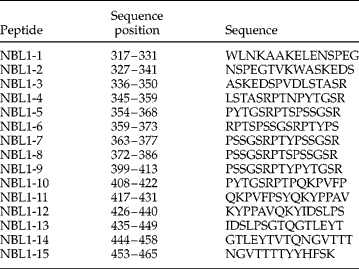
Fifteen overlapping peptides (NBL1-1 to NBL1-15) covering the C-terminal part of NBL1 (NBL1-C) were expressed as fusion proteins with glutathione S-transferase (GST) from Schistosoma. Each peptide was 15 amino acids in length (except for NBL1-15, which contained 13 amino acids) and overlapped with adjacent 6 or 10 amino acids (table 1). GST-fused peptides (0.5 μg, NBL1-1 to NBL1-15) were separated by 15% sodium dodecyl sulphate-polyacrylamide gel electrophoresis (SDS-PAGE) and transferred on to a nitrocellulose membrane (Hybond-C Nitrocellulose, Amersham Pharmacia Biotech, Waukesha, Wisconsin, USA). After blocking with 5% (wt/vol.) skimmed milk in TBS-T (20 mm Tris base,150 mm NaCl (pH 7.5), 0.1% Tween-20) at 37°C for 1.5 h, membranes were incubated for 2 h with the serum samples described above diluted at 1:300 in 5% (wt/vol.) skimmed milk in TBS. After five washes with TBS-T, membranes were incubated with alkaline phosphatase-conjugated rabbit anti-mouse IgG or alkaline phosphatase-conjugated goat anti-pig IgG (Sigma, Santa Clara, California, USA) diluted at 1:10,000 and 1:30,000, respectively, in TBS containing 5% skimmed milk for 1 h at room temperature. Finally, membranes were washed five times with TBS-T and incubated with bromo-chloro-indolyl phosphate/nitroblue tetrazolium (BCIP/NBT) substrate (Invitrogen, Camarillo, California, USA). After 10 min in the dark at room temperature, the reaction was stopped with distilled water. Purified recombinant GST and NBL-C were used as negative and positive control respectively.
Sequences of overlapping peptides from the NBL1-C of Trichinella spiralis.

Results and discussion
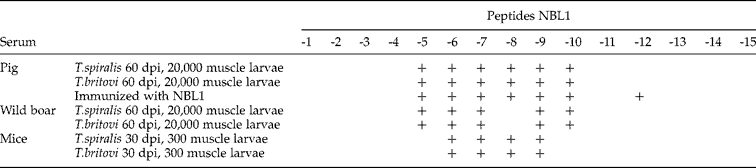
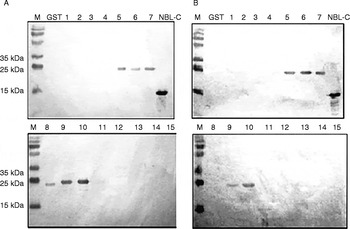
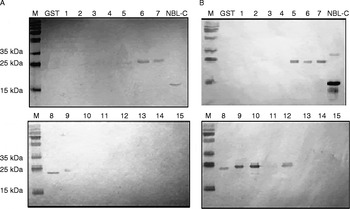
The precise mapping of epitopes is important for understanding the antigenic composition of parasite proteins and parasite–antibody interactions at a molecular level. Further, defined epitopes provide a foundation for epitope-based vaccine design and clinical application, and also provide a powerful research tool to study protein function and to diagnose or control a variety of infectious agents. In this study, 15 overlapping peptides covering the whole NBL1-C protein of T. spiralis were expressed as GST-fused peptides. Using these GST-fused peptides, we first thoroughly mapped and compared the immunodominant linear epitopes within NBL1-C that were recognized by sera obtained from three kinds of hosts infected with two Trichinella species by Western blot analysis. Following infection with T. spiralis or T. britovi, each kind of host generated antibodies against some NBL1-derived peptides. As shown in table 2, serum samples from pigs experimentally infected with both Trichinella species recognized six peptides (NBL1-5, -6, -7, -8, -9, -10) (fig. 1A), serum samples from infected wild boars recognized five peptides (NBL1-5, -6, -7, -9, -10) (fig. 1B), and serum samples from infected mice recognized four peptides (NBL1-6, -7, -8, -9) (fig. 2A).
Identification of linear epitopes of NBL1-C using antisera from different host species against Trichinella or rNBL1-C;+, recognition of overlapping peptides using Western blot analysis.

Identification of linear epitopes of NBL1-C in hosts infected with 20,000 muscle larvae of Trichinella, (A) sera of pigs infected with T. spiralis and (B) sera of wild boar infected with T. britovi, on day 60 post-infection. Lanes: 1–15, individual peptides covering the entirety of NBL1-C, expressed as fusion proteins with GST; M, protein molecular weight marker. GST, glutathione S-transferase from Schistosoma. GST and NBL-C only were used as protein controls.

Identification of linear epitopes of NBL1-C in infected hosts: (A) sera of mice infected with 300 muscle larvae of T. spiralis on day 30 post-infection; and (B) sera of pigs immunized with rNBL1-C. Lanes: 1–15, individual peptides covering the entirety of NBL1-C, expressed as fusion proteins with GST; M, protein molecular weight marker; GST, glutathione S-transferase from Schistosoma.

The peptides NBL1-6, NBL1-7 and NBL1-9 were commonly recognized by serum samples from all animal species. These three peptides share a common sequence PSSGSRPTYP that is repeated four times in NBL1-C. Antigens carrying repetitive amino-acid sequences have been identified in some parasites, such as the Plasmodium vivax merozoite surface protein-2 (MSP-2), Trypanosma cruzi surface antigen B13 and cytoplasmic repetitive antigen (CRA). These repetitive sequences were usually the targets of the host humoral immune response during parasite infection, some of which were employed for improving sensitivity and specificity of serological tests (Kemp et al., Reference Kemp, Coppel and Anders1987; Gruber & Zingales, Reference Gruber and Zingales1993). Serine proteases play a variety of roles during the parasite life cycle, such as invasion of host cells, penetration of tissues, parasite development and immune evasion. NBL1 is a NBL stage-specific serine protease and this protein comprises two clearly defined regions: a catalytic domain and a C-terminal domain containing four repetitive ten-amino-acid units. The trans-sialidase of T. cruzi involved in invasion of host cells also includes a catalytic domain and a C-terminal domain with an immunodominant repetitive sequence (Parodi et al., Reference Parodi, Pollevick, Mautner, Buschiazzo, Sanchez and Frasch1992). The immunodominant repetitive sequence induces a strong antibody response at an early stage of infection, thus antibodies directed against the repetitive sequence cannot inhibit trans-sialidase activity. It has been speculated that immunodominant repetitive sequences may be used as a smokescreen by parasites to divert the host immune response away from functional sites of the molecule (Leguizamón et al., Reference Leguizamón, Campetella, González Cappa and Frasch1994). Thus it can be speculated that the immunodominant repetitive sequence within NBL1 might play an important role in protecting enzymatic activity of the catalytic domain from a neutralizing humoral response. Consequently, NBL can invade muscle cells successfully. More research is needed to identify the roles of the immunodominant repetitive sequence during Trichinella infection, which will increase our knowledge of Trichinella immune evasion and provide an important target for the possible control of Trichinella.
We also showed that the sequence PYTGSRPT, shared by the peptides NBL1-5 and NBL1-10, was recognized by swine species but not by mice. Moreover, the peptide NBL1-8 was well recognized by serum samples from infected mice, but weakly recognized by pig serum samples. This may be due to a major histocompatibility complex (MHC) restriction of the B-cell epitopes of NBL1-C, and each animal species does not process the antigen in the same way. This may also be associated with the infective capabilities of Trichinella in different hosts. These results provided a valuable reference for further study on the immunity stimulated by parasites in the murine model and natural pig hosts of Trichinella. Unfortunately, during epitope mapping, we did not find the Trichinella species-specific epitope, which was only recognized in serum from hosts infected with only T. spiralis or T. britovi.
Our previous studies have shown that NBL1-based ELISA is superior to excretory-secretory (ES) antigen-based ELISA in early detection of pig trichinellosis. However, a decrease in anti-NBL1 antibody titres was observed after the peak of detection (60 days post-infection). This indicated that this antigen was not a suitable candidate for detection of antibodies in pigs infected with Trichinella at a later stage. Alternatively, ELISA based on recombinant protein containing antigens from different development stages of Trichinella could be employed to detect antibodies against Trichinella at a later stage. Thus, immunodominant linear epitopes identified in this study will provide valuable antigenic components for multi-epitope-based serological tools.
Active immunization with NBL-C protein confers protection from challenge T. spiralis, suggesting that immune responses targeted against NBL1 play important roles in conferring immunity. To gain an insight into the immunological properties of NBL1 antigen as a vaccine, we additionally generated polyclonal antibodies (pAbs) from pigs immunized with recombinant NBL-C, and used the pAbs to screen an NBL-C peptide series for linear epitopes. There was a notable difference, and one peptide (NBL1-12) located at the extremity of the C-terminal region was only recognized by pAbs from pigs immunized with recombinant NBL-C (table 2 and fig. 2B). This approach identified one additional NBL-C epitope, and also confirmed the identity of the epitopes identified using sera from pigs infected with live parasites. The difference observed between sera obtained from infected or immunized pigs could be due to a number of reasons. One possible explanation is that the variation in recognition pattern is due to the differences in the way that antigens are exposed to the immune system. During a natural infection, total Trichinella antigens, including a small fraction of NBL1, are exposed simultaneously to the host immune system and induce a specific anti-Trichinella immune response. This immune response, including humoral and cellular immunity, likely differs from the immune response induced by vaccine. During vaccination, the larger quantity of NBL1-C, in conjunction with the adjuvant, is exposed to the host immune system and induces a specific anti-NBL1 immune response.
Although immunization with rNBL1-C protein in pigs significantly inhibited the installation of the parasites in muscles, it is unclear whether specific antibodies induced by these immunodominant epitopes are correlated with significantly high protection. Previous studies have indicated that specific antibodies against parasite antigens play an important role in host development of protective immunity against helminth infection (Bungiro et al., Reference Bungiro, Sun, Harrison, Shoemaker and Cappello2008; McCoy et al., Reference McCoy, Stoel, Stettler, Merky, Fink, Senn, Schaer, Massacand, Odermatt and Oettgen2008; Cho-Ngwa et al., Reference Cho-Ngwa, Liu and Lustigman2010). Buscaglia et al. (Reference Buscaglia, Campetella, Leguizamón and Frasch1998) showed that trans-sialidase generated a faster humoral response against the catalytic domain when mice were previously immunized with the recombinant immunodominant repetitive sequence. The results suggested that the generation of the faster humoral response inhibiting the trans-sialidase activity was associated with prior induction of antibodies against the non-catalytic domain. It could be interesting to investigate the role of specific antibodies elicited by these immunodominant epitopes in a vaccine trial of NBL1-C.
In summary, we characterized the antigenic characteristics of NBL1 by epitope mapping. The identification of epitopes could be important for understanding antigen structure and parasite–antibody interactions at the molecular level, and may assist in the design of vaccines and diagnostic reagents.
Acknowledgements
We are grateful to our colleagues Pauline Mace, Nicolas Versille, Virginie Jazede, Aurelie Grasset-Chevillot and Aurelie Heckmann for their technical assistance and advice.
Financial support
This work was supported by Med-Vet-Net project (WP 27TrichiMED), Chinese Academy of Agricultural Sciences engineering innovation fund (20140204066NY) and the scholarship council of China.
Conflict of interest
None.
Ethical standards
Animals (pig, wild boar and mice) were handled in strict accordance with good animal practice as defined by the European standards of welfare for animals in research. Animal work performed at the Ecole Nationale Vétérinaire d'Alfort (ENVA/ANSES) was approved by the institute's ethics committee in September 2005.