Introduction
Professionals in charge of caring for the injured and ill in acute conditions and transporting them to and from hospitals are known as emergency medical technicians (EMTs) and paramedics. Both EMTs and paramedics work longer hours as compared to many others. They are at risk for serious injuries during work hours. Both EMTs and paramedics have higher work-related injury (WRI) rates, according to the literature data.Reference Yilmaz, Serinken, Dal, Yaylacı and Karcioglu 1
Among all kinds of frequently encountered WRIs, motor vehicle accidents (MVAs) comprise a special category for their potentially fatal outcomes. Motor vehicle accident rates have been noted to increase by 40% in Turkey, while the share of ambulances increased by 83% in the meantime.Reference Reichard, Marsh and Moore 2 However, it is difficult to obtain reliable information on WRIs affecting EMTs and paramedics in Turkey, similar to many other countries. 3 Only a minority of the WRIs are public and recorded properly.
There are a total of 2,395 ground ambulances and 17 air ambulances cruising legally in Turkish Emergency Medical Services (EMS; data elicited in February 2016). The majority of the ground ambulances are staffed with three personnel (EMTs and paramedics). Drivers also can be added to the crew, if necessary. These vehicles are used to transfer the patient to the hospitals as well as for emergency care. 3 , Reference Yılmaz, Dal, Yaylacı and Uyanık 4
Chaotic working environment, unpredictability of the nature of “the next case,” anxiety regarding difficulties in communication with patients and families, and extended stressful working hours lead to burnout and lower job satisfaction of health care personnel in EMS. This study was designed to investigate causes and characteristics of WRIs involving EMTs and paramedics staffed in a big city in Western Turkey.
Methods
Study Design
The study was approved by the ethics committee of Pamukkale University School of Medicine in Denizli, Turkey. The present study was conducted in the developed city of Denizli in Western Turkey, populated by approximately one million people. Thirty EMS bases with 36 ambulances staffed by 379 personnel (238 EMTs and 65 paramedics) comprise EMS in the city.
The approval for the study was issued by the Denizli local health authority. All health care personnel staffed in EMS in the city were interviewed face-to-face in their off-duty hours to inform them about the study. The personnel were told not to write their names on the sheets and were notified that data which would be collected from the study are not to be used anywhere apart from the scientific analyses. Excluded from the study were those who declined to participate in the study, those who were not on duty during the two-month study period, and those who had been working in the EMS for less than one year.
The subjects were asked to answer 23 multiple-choice questions, mostly involved in WRIs which can be encountered in the EMS work environment. For the study purposes, “needlestick injury” refers to penetrating injury to the personnel by a needle, while “sharps injury” describes the injury by sharp material other than needles.
Statistical Analysis
All data obtained in the study were recorded in and analyzed using the Statistical Package for Social Sciences (SPSS; IBM Corp.; Armonk, New York USA) for Windows (Microsoft Corp.; Redmond, Washington USA), Version 17. Numerical variables were given as mean and standard deviation, while categorical variables were given as frequencies (n) and percentages.
Results
A total of 303 EMS personnel were identified (238 EMTs and 65 paramedics). Of these, 93 (30.6%) were excluded for having work experience in the EMS for less than one year, 37 (12.2%) for being on vacation or out of duty in the study period, and 10 (3.3%) for declining from the study. Finally, a total of 163 personnel (117 EMTs and 46 paramedics) comprised the study sample. It took an average of seven to 10 minutes to fill out the answer sheet by the respondents.
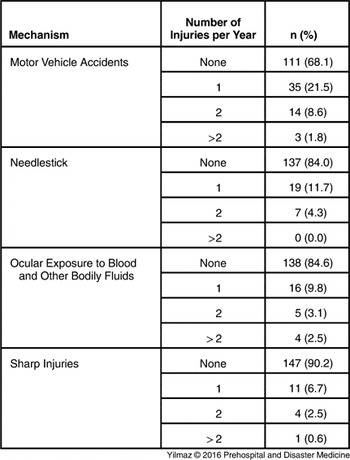
Eighty-three personnel (50.9%) were female and mean age was 29.7 years (SD=8.4 years). The most common causes of WRIs, as reported by the personnel, were MVAs (31.9%), needlestick injuries (16.0%), ocular exposure to blood and other bodily fluids (15.4%), and sharp injuries (ie, injuries by sharps other than needlestick; 9.8%), respectively. Table 1 demonstrates the incidences of different mechanisms of WRIs as reported by EMTs and paramedics during the last year. Only 11.9% (n=8) of the personnel subjected to WRIs such as needlestick injuries, penetrating injuries, and eye contact with bodily fluids (n=67) had reported the WRI to the authorities following the event.
Frequencies of WRIs as Reported by EMTs and Paramedics during the Last Year

Abbreviations: EMT, emergency medical technician; WRI, work-related injury.
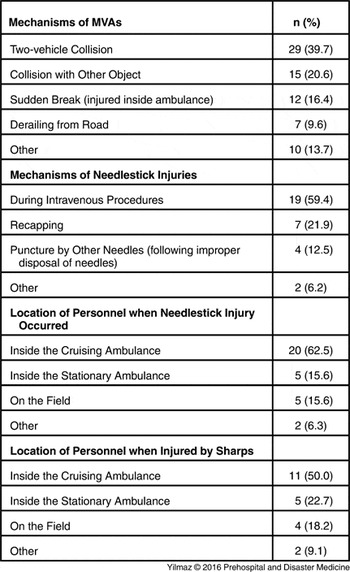
Data regarding the detailed mechanisms and location of the injuries are depicted in Table 2. Motor vehicle accidents mostly occurred as collisions with other vehicle and with other object (39.7% and 20.6%), respectively. Needlestick injuries commonly occurred during intravenous line procedures (59.4%) and inside the cruising ambulance (62.5%). Similarly, sharp injuries mostly occurred during the ambulance cruises (50.0%).
Data Regarding the Mechanisms and the Location of InjuriesFootnote a

Abbreviation: MVA, motor vehicle accident.
a Some subjects reported more than one choice.
In case of MVA, the subjects were asked if they were injured individually or witnessed a member of the crew or third parties in the accident. Six persons (one health care personnel and five others) died and 18 were injured (eight personnel and 10 others) in these accidents.
Personnel who reported to have needlestick injuries (n=32) were asked if the needle had been used previously or not. Thirteen (40.6%) answered positively. Follow-up investigations revealed there was no blood-borne infections on the personnel after the event. None of the respondents noted a flu-like syndrome or other airborne infections in the last year.
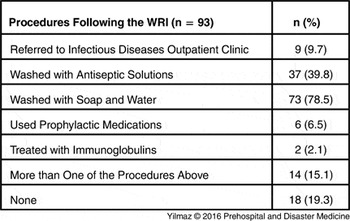
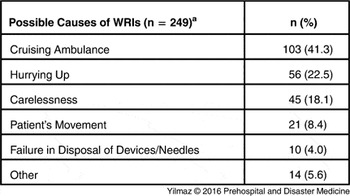
Personnel were inquired on their procedures following the WRIs such as needlestick injuries, penetrating injuries, and eye contact with bodily fluids (n=93; Table 3). Washing with soap and water was the most common measure taken by the personnel (78.5%) and working inside the cruising ambulance was the most commonly accused cause of the WRI (41.3%). Possible causes of the WRI also were asked to the personnel and responses are depicted in Table 4.
Procedures Reported by Personnel Following WRIs such as Needlestick Injuries, Penetrating Injuries, and Ocular Exposure to Bodily Fluids

Abbreviation: WRI, work-related injury.
Possible Causes of WRIs (in their point of view)

Abbreviation: WRI, work-related injury.
a Some subjects reported more than one choice.
Only 11.9% (n=8) of the personnel subjected to WRIs such as needlestick injuries, penetrating injuries, and eye contact with bodily fluids (n=67) had reported the WRI to the authorities following the event. Of note, 104 (63.8%) of the respondents reported that they had undergone a training program specially designed to cover possible WRIs related to the EMS working environment before or after they started working on the field.
Discussion
The results of this descriptive study showed that EMTs and paramedics are exposed to substantial risk in regard to WRIs and MVAs inherent to the EMS work environment. The incidence of injuries was 10.9% and mortality rate was 1.4% in the 73 MVAs reported within the one-year study period.
Motor vehicle accidents are known to constitute the most fatal cause of WRI for the personnel staffed in EMS.Reference Eksi, Celikli and Kıyan 5 Ambulance MVAs cause a death toll four times greater than that of other occupations.Reference Maguire, Hunting, Smith and Levick 6 Many researches have been focused on the drive safety of ambulances in the last four decades. Studnek et al found the incidence of MVAs for EMS personnel as 8.6% in a broad-based study in the US. They also reported that sleep deprivation and inexperienced drivers had a major impact in these events.Reference Levick and Swanson 7 The corresponding figure found in the present study is nearly four times greater than this result, which also supports the hypothesis that the EMS personnel in this region are under substantially higher risk when compared to developed countries. The total number of vehicles in Turkey have doubled in the last decade. The number of registered vehicles in the city was 315,000 in 2013 and has been increasing by 5.0% to 7.0% every year.Reference Reichard, Marsh and Moore 2 The soaring inner-city traffic deliberately renders it difficult to operate as EMS personnel.
Nearly two-fifths of the MVAs were found to occur as two-vehicle collisions in this study. Studies published on the ambulance crashes so far have agreed that most MVAs occur in the crossroads as two-vehicle collisions whose outcomes are commonly mortal.Reference Eksi, Celikli and Kıyan 5 , Reference Studnek and Fernandez 8 They suggested that traffic signals be strictly heeded at crossroads and speed limits in urban settings be obeyed.
Of note, although many studies indulged in improvement of occupant protection in passenger vehicles by the industry, the occupant safety of ambulance vehicles has never been addressed adequately.Reference Kahn, Pirrallo and Kuhn 9
Needlestick injuries were found to occur commonly in the cruising ambulances during vascular procedures in this study. El Sayed et al studied on the risks of contagious diseases in ambulance workers and showed that needlestick injuries decline following protective measures while exposures to viral airborne diseases prevail within this group of labor.Reference Fournier, Chenaitia, Masson, Michelet, Behr and Auffray 10 The results of this study did not reveal any patient with airborne diseases and therefore do not support the relevant literature data. This result may be attributed to lack of safety needle devices while gloves and masks are used prevalently in the EMS which hosted the project. Safety needle devices are known to alleviate the incidences of this kind of WRI remarkably in ambulances.Reference El Sayed, Kue, McNeil and Dyer 11 Broad and population-based studies need to be designed and necessary measures be taken to prevent needlestick injuries in the country, regardless of the cost of the measures.
Ocular exposures to blood and other bodily fluids were reported to have an incidence of 5.9% to 10.3% in EMS personnel.Reference Fournier, Chenaitia, Masson, Michelet, Behr and Auffray 10 , Reference Ford and Phillips 12 This figure was found to be 15.4%, which is much higher than literature findings.
The findings showed that only approximately two-fifths of the personnel who were subjected to WRIs such as needlestick injuries, ocular exposures to bodily fluids, or injuries with sharps had washed the contamination site with antiseptic solutions and only approximately one-tenth had referred to the infectious diseases clinic. More interestingly, one-fifth did virtually nothing after these exposures. Personnel reported only approximately 12.0% of the WRIs properly, a more dramatic finding shown in the study.
The results indicate that only a small part of the WRI tolls are reported to the authorities and thus the reported injuries do not represent the whole picture. The percentage of reported injuries may have been reduced by the fact that paramedic and EMTs blame themselves about the injuries. The personnel reported factors defined as “hurrying up” and “carelessness” were the most common causes for the injuries.
Ground ambulances are, as a rule, monobloc panel-van type minibuses in Turkey. Length, width, and height of the patient cabin are 3,000 mm, 1,400 mm, and 1,600 mm, respectively. All vehicles are subject to thorough technical examination and licensure procedure every two years. Maximum expiry date of an ambulance is 15 years after manufacturing. Two or three outstanding trademarks are preferred for purchasing. The vehicles have high-quality suspension systems in order to enable transport of the patients without discomfort. Vehicle vibrations can be remarkable due to poor-quality roads in some parts of the region. Another factor paving the way to WRI can be that organization of the interior design of the vehicles after purchasing procedures are completed.
Limitations
This was a descriptive study with a limited size, thus the findings cannot be extrapolated to the population as a whole. In addition, this study lacks an investigation of data related to the scene of the WRI and the use of protective measures. Studies using surveys are prone to validation and selection bias.Reference Reed, Daya, Jui, Grellman, Gerber and Loveless 13 The survey used in the present study was not validated in a pre-test group before study. There were 210 paramedics eligible for the study during the study period, however only 163 paramedics filled the survey, which may lead a selection bias. The study also was limited by combining EMTs and paramedics as participants in the same pot, despite that the training levels and experiences of the groups differ significantly from each other.
Conclusions
Paramedic personnel and EMTs apparently are under high risk of WRI. The mobile nature of the work environment poses a substantial risk in EMS. Given the fact that ambulances should be mobile, strict measures need to be taken to restructure the interior design to protect personnel from all kinds of WRIs.