

Introduction
Gardenia J.Ellis (Rubiaceae) is a genus of shrubs and trees found in tropical and warm temperate regions from Africa, through East and Southeast Asia, to the western Pacific and Hawaiian islands. Currently, there are some 140 species names applied in this genus (Govaerts et al., Reference Govaerts, Ruhsam, Andersson, Robbrecht, Bridson, Davis, Schanzer and Sonké2010), although the number of accepted species sanctioned by modern revisions is likely to decrease. Revisions in the last 50 years have included those for the Fijian region (Smith, Reference Smith1974), South and Southeast Asia (Tirvengadum, Reference Tirvengadum1978, Reference Tirvengadum1983; Wong, Reference Wong1982; Low & Wong, Reference Low and Wong2007, Reference Low and Wong2009) and Australia (Puttock, Reference Puttock1988, Reference Puttock1997).
The Gardenieae (Gardenia and traditional allies), in subfamily Ixoroideae, appear from molecular analyses to be paraphyletic or polyphyletic (Persson, Reference Persson2000; Bremer, Reference Bremer2009). The analysis by Persson (Reference Persson2000) showed no support for a monophyletic tetrad-pollen grouping, or a palaeotropical grouping with monad pollen (‘Aidia’ group) earlier suggested from morphological and anatomical considerations (Robbrecht & Puff, Reference Robbrecht and Puff1986; Persson, Reference Persson1996).
As represented by an alliance of species closely related to the type Gardenia jasminoides J.Ellis (Low & Wong, Reference Low and Wong2007, Reference Low and Wong2009), Gardenia is reliably distinguished by a number of characters, including usually having conspicuous, cream-turning-yellow, fragrant flowers with a hypocrateriform corolla, frequently more than 5 (6–8 or more) corolla lobes, a 1-loculate ovary with 2–9 parietal placentas, a glabrous style and exserted, knob-like and variously lobed stigma. The flowers are typically solitary and terminal, usually developing at the end of leafy branches, sometimes between a pair of axillary branches developing from the ultimate node of the flowering branch. The pollen grains are issued as tetrads, never singly. The fruits are of conspicuous size, often several centimetres across and (in many Southeast Asian species, but apparently not the African species) split irregularly when ripe, exposing seeds in a bright orange-red placental pulp that is attractive to birds. The stipules develop into tubular structures that are rather tightly ensheathing at the nodes; their colleters (modified glandular hairs scattered on the inner surfaces of the stipule and calyx) produce the exudate that often forms a resinous covering of both vegetative and floral buds. Numerous seeds are produced, usually at least several millimetres across, typically lens-shaped to angular and compressed, with a conspicuously areolate testa. The tertiary veins of the leaf typically form a scalariform (ladder-like) pattern, linking as cross-veins between the secondary veins, rather than being reticulate (net-like).
As also demonstrated elsewhere (Keay, Reference Keay1958; Tirvengadum, Reference Tirvengadum1978, Reference Tirvengadum1983; Wong, Reference Wong1982), Gardenia in the Philippines was previously morphologically heterogeneous and many species placed in Gardenia in the past are better accommodated in other genera. As a result of segregating taxa aberrant from the type alliance of Gardenia, only five Gardenia species occur in the Philippines, two of which are described as new. This is a much smaller number of species compared with the last botanical enumeration of the genus for the Philippines (Merrill, Reference Merrill1923). Species removed from Gardenia are listed at the end of this contribution under ‘Excluded and Unplaced Names’ with accompanying notes.
Materials and Methods
This study was based on herbarium specimens held at A, BO, K, KEP, KLU, L, NY, SAN, SING and US (herbarium acronyms follow Holmgren et al., Reference Holmgren, Holmgren and Barnett1990). Throughout, we have used measurements based only on dried specimens. It is difficult to generalise the degree of shrinkage associated with the drying of different parts, such as corollas and younger (less woody) fruits, without specific knowledge, and a consistent use of measurements for comparing or defining entities is required. As such, it needs to be borne in mind that the present distinctions are for clarifying the taxonomy and that dimensions of parts seen in fresh or living material (such as in the sometimes cultivated Gardenia mutabilis Reinw. ex Blume) may vary slightly from those given here.
As many species in the Southeast Asian and Pacific regions (St. John & Kuykendall, Reference St. John and Kuykendall1949; Smith, Reference Smith1974; Tirvengadum, Reference Tirvengadum1983; Low & Wong, Reference Low and Wong2007, Reference Low and Wong2009) have been described with rather unique calyx morphology, a sorting of the Philippine material based primarily on calyx differences was carried out. Taxa were eventually defined by suites of characters, including flower and other (including fruit and vegetative) characters. The calyx is firm and leathery, smooth and obconic-cupular with a subtruncate margin in Gardenia elata Ridl., or with an irregularly lobed margin in G. vulcanica K.M.Wong. Likewise, the calyx is also smooth with a subtruncate margin in Gardenia mutabilis, but forms a cup that tightly ensheaths the corolla tube. Narrow keels occur on the surface of an obconic-cupular calyx in Gardenia ornata K.M.Wong. In Gardenia barnesii Merr., which has a sheathing calyx with an oblique mouth, the keels develop into conspicuous slender apical spurs.
Abbreviations used in specimen citations include BS (Bureau of Science, Manila), FB (Forestry Bureau, Manila), PNH (Philippine National Herbarium) and PPI (Philippine Plant Inventory); the material included with the specimens is indicated by fb (flower buds), fl (open flowers), fr (fruits), or st (without reproductive parts present). Conservation status was assigned for the species based on documented distribution as set out in IUCN (2001).
Key to species and varieties of Philippine Gardenia
1a. Calyx tube smooth, without any keels 2
1b. Calyx tube otherwise, provided with distinct keels 5
2a. Calyx margin with irregular lobes or invagination and slightly recurved, including 1–2 narrow lobes 4–10 mm long (Sorsogon Province in south Luzon) 5. G. vulcanica
2b. Calyx margin subtruncate, without distinct lobes or appendages 3
3a. Calyx cupular-obconical, tightly sheathing the corolla, not flared upwards in the open flower, 2.5–3 mm wide; corolla tube slender, 2–2.5 mm wide at the middle; mature fruit 2–2.5 cm in diameter; leaves 2–5 cm wide, with 8–12 pairs of secondary veins, drying dark brown to black (Bohol and Samar) 3. G. mutabilis
3b. Calyx cupular-obconical, slightly flared upwards in the open flower, typically over 8 mm wide; corolla tube 2.5–4.5 mm wide at the middle; mature fruit 3.5–5 cm or more in diameter; leaves (2–)4.5–10.8 cm wide, with 8–22 pairs of secondary veins, drying pale to medium brown 4
4a. Pedicels of open flowers ≤ 5 mm long (Luzon and elsewhere) 2a. G. elata var. elata
4b. Pedicels of open flowers ≥ 7 mm long (restricted to the Cagayan, Isabela and Rizal Provinces in Luzon) 2b. G. elata var. longipedicellata
5a. Calyx with 5 narrow keels (1–1.5 mm wide) along the tube continuing (and departing from the calyx surface 0.4–1 cm below the mouth) as conspicuous linear, bilaterally flattened spurs to more than 1 cm long (widespread from Luzon to Palawan and Mindanao) 1. G. barnesii
5b. Calyx with 8–9 narrow keels (1.5–2.5 mm wide) gradually broadening towards the mouth (known only on Samar) 4. G. ornata
Enumeration of Taxa
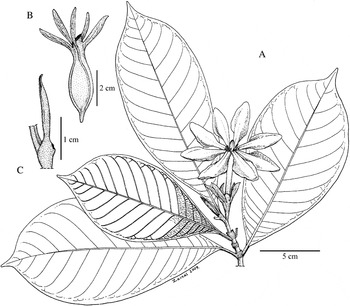
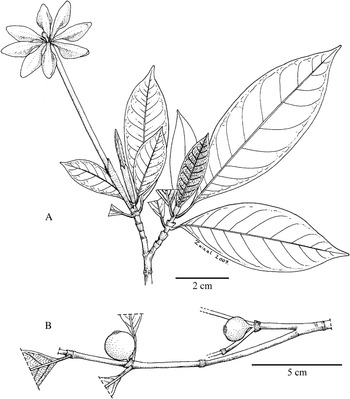
1. Gardenia barnesii Merr., Philipp. Gov. Lab. Bur. Bull. 17: 47 (1904); Merr., Philipp. J. Sci. 1: Suppl. 131 (1906); Elmer, Leafl. Philipp. Bot. 1: 5 (1906). – Type: Philippines, Luzon, Bataan Province, Lamao River, i 1904, Barnes FB 163 (lecto NY (fl, fb), designated here; isolecto K (st), SING (fb), US (fl)). Fig. 1.
Fig. 1.Gardenia barnesii Merr. A, flowering leafy branch; B, immature fruit showing intact calyx tube (with oblique margin) and protruding spurs; C, puberulent sheathing stipule at shoot tip. A from McGregor BS 32445 (K); B from Williams 2942 (K); C from Celestino & Ramos PNH 23092 (K).

Gardenia segmenta Elmer, Leafl. Philipp. Bot. 4: 1331 (1912). – Type: Philippines, Palawan, Puerto Princesa, Mt Pulgar, 500 ft [167 m], v 1911 (fl), Elmer 13153 (lecto NY, designated here; isolecto A, BO, K, L, US).
Gardenia megalocarpa Merr., Philipp. J. Sci. 20: 463 (1922). – Type: Philippines, Mindoro, Paluan, iv 1921 (fr), Ramos BS 39819 (lecto A, designated here; isolecto K, US). Type number wrongly listed as 38919 in Merrill (Reference Merrill1922).

Tree, to 9 m high, trunk to 15 cm diameter. Bark smooth to slightly scaly to lightly fissured, pale yellowish grey-brown. Stipules connate into a cylindrical tube, often 1–2 cm long, apex weakly 2-lobed to subtruncate or (rarely) slightly cleft on one side, outside scantily puberulent and sometimes coated with resin. Petiole 3–12 mm long, 1–1.5 mm thick. Leaf lamina obovate to elliptic, 5.5–22 × 2.5–8.3 cm; base cuneate; apex acute to obtuse, tip pointed to short-cuspidate; subcoriaceous; midrib flat to sunken and glabrous on upper side, prominent and puberulent on lower side; secondary veins 11–22 pairs, flat and glabrous on upper side, prominent and puberulent on lower side, vein axils on the lower side pubescent; tertiary venation scalariform. Flowers solitary. Pedicels 3–14 mm long and 1–1.5 mm thick in open flowers, reaching 8–18 mm long and 2–3 mm thick at fruit maturity. Calyx subfusiform to tubular, tightly sheathing the corolla tube, the margin oblique, apex acute or torn into two acute portions by corolla emergence; 8–15 mm long, 2.5–4 mm wide at the base, 5–7 mm wide at the apex; outside puberulent to subglabrous; inside puberulent to long-hairy; with 5 ridges or very narrow keels 1–1.5 mm wide along the tube, these continuing (and departing from the calyx surface 0.4–1 cm below the mouth) as linear, bilaterally flattened spurs 10–16 × 1.5–2 mm, these often slightly curved upwards. Corolla hypocrateriform, cream turning light yellow, then deeper yellow; tube 2.6–6 cm long, 1.5–3.5 mm wide at the mid-portion, 3.5–8 mm wide at the throat, outside puberulent to subglabrous; lobes 6–9, oblanceolate to obovate, (1.2–)3.7–4.6 × 0.7–2.1 cm, contorted to the left in bud, glabrous on both sides. Stamens 6–9, inserted between corolla lobes just below the throat, dorsifixed; filaments very short to inconspicuous; anthers 4.5–13 mm long, around half or more of its length exserted. Style glabrous; stigma club-like with 3–5 lobes, these initially coherent, 1.5–5 mm long, 1–2.5 mm wide, wholly exserted. Fruits mostly broad-ellipsoid, occasionally obovoid to subglobose, 3.5–6 × 3–4.7 cm, when mature often developing 5 conspicuous longitudinal ridges or low keels on the external surface especially in the upper half of the fruit; portions of the calyx often persistent at fruit apex; green ripening orange-red. Seeds many, embedded in a pulp-like placenta, irregularly angular-rounded to elliptic, flattened, 3–4.5 × 2.5–3.5 mm, testa surface fine-areolate.
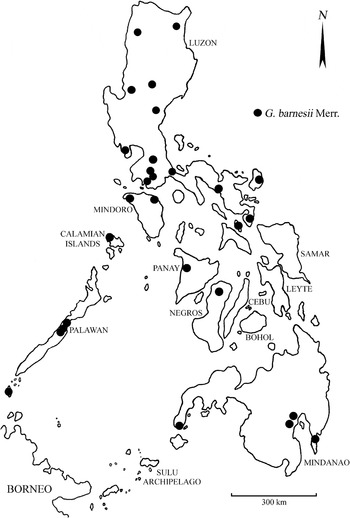
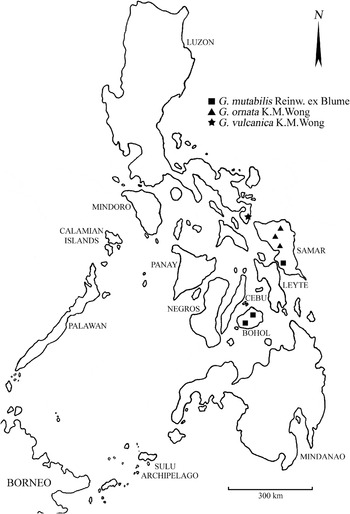
Distribution. Endemic to the Philippines: Balabac, Busuanga, Catanduanes, Luzon, Masbate, Mindanao, Mindoro, Negros, Palawan, Panay and Ticao (Fig. 2).
Distribution of Gardenia barnesii in the Philippines.

Habitat and ecology. Primary and logged-over (regenerating) lowland forests.
Proposed IUCN conservation status. Least Concern (LC). This species has been collected at many sites, including logged-over forests, in the Philippines. However, with the forest conversion rates increasing steadily in the region, the status needs periodic reassessment.
Additional specimens examined. Balabac. Palawan Province: Danglis [7°59′N, 117°2′E], 90–150 m, 30 vi 1994 (fr), Soejarto et al. 8632 (L). Busuanga. Palawan Province: 1901 (fl), Ahern s.n. (US). Catanduanes. Catanduanes Province: Mt Nagpakdit, 14 ix 1928 (fr), Ramos & Edano BS 75389 (NY, SING). Luzon. No date (fb, fl), Lobb s.n. (K). Abra Province: Sallapadan, Poblacion Gangal [17°28′N, 120°49.6′E], 250 m, 18 xi 1996 (fr), Fuentes & de la Rosa PPI 38651 (K, PNH). Bataan Province: Lamoa River, Mt Mariveles, v 1905, Whitford 1235 (K, st; US, fr); Lamas Forest Reserve, x 1906 (fr), Foxworthy BS 1587 (NY); Mt Mariveles, xi 1904 (fr), Elmer 6714 (NY); Mt Mariveles, Lamao River, iii 1905, Borden FB 2916 (K, st; NY, fr), ii 1905, Meyer FB 2788 (K, st; NY, fr), 18 i 1904 (fr), Williams 487 (A, NY). Batangas Province: vii–viii 1914 (fr), Ramos BS 22406 (A, K, L). Benguet Province: Sablang, xi–xii 1910 (fr), Fenix BS 12722 (US); Twin Peaks, v 1904, Elmer 6354 (NY, fb, fl; K, US, fl). Cagayan Province: vi–ix 1914 (fl), Barros FB 23253 (A), vii–viii 1915 (fl), Bernardo FB 24265 (US); vicinity of Penablanca, 5 v 1917 (fr), Adduru 32 (A, US). Camarines Sur Province: Pasacao, v 1904 (fr), van Wickle FB 699 (US). Laguna Province: Mt Maquiling, xi 1914 (fr), Foxworthy s.n. (US), no date (fl), Sulit PNH 7086 (A), xi 1932 (fl), Sulit PNH 7254 (A), 10 xii 1949 (fl), Sulit PNH 12186 (A); Mt Maquiling, Los Banos, vi–vii 1917, Elmer 18320 (A, K, NY, fl; L, fb); San Antonio, vi 1912 (fb), Ramos BS 14990 (L). Nueva Vizcaya Province: Vicinity of Dupax, iii–iv 1912 (fr), McGregor BS 11422 (US). Quezon Province: Quezon National Park, 29 xi 1991 (fr), Reynoso et al. PPI 3886 (L); Quezon National Park, Atimonan [14°4′N, 121°55.2′E], 17 iii 1996 (fb), Castro, Barbon & Garcia PPI 22254 (K); Tayabas, iii 1908 (st), Curran FB 10278 (NY); Tayabas, Guinayangan, i 1884, Vidal 833 (K, fb; L, fl), iii–iv 1913 (fr), Escritor BS 20838 (US). Rizal Province: viii 1911 (fr), Ramos 1088 (US); Antipolo, x 1883 (fl), Vidal 383 (L), xii 1914 (st), Merrill Sp. Blancoanae 655 (A, K, L, NY); Bosoboso, vi 1903, Merrill 2631 (NY, fb; US, fl), vii 1903 (fl), Merrill 2817 (NY, US); Montalban, 11 viii 1935 (fr), Bartlett 14441 (A), 1906 (fl), Loher 6386 (K), vi 1909 (fl), Loher 12466 (A); Morong, xi 1884 (fr), Vidal 1452 (K). Sorsogon Province: Irosin, Mt Bulusan, ix 1916 (fr), Elmer 17189 (A, L, NY). Zambales Province: Mt Marayep, xii 1924 (fr), Ramos & Edano BS 44809 (NY). Masbate. Masbate Province: v–vi 1904 (fr), Clark FB 1702 (US), vi 1903, Merrill 2771 (K, fb; NY, US, fl), ix–x 1915 (fr), Valencia FB 24635 (US). Mindanao. Davao Province, iii 1917, Ceballos FB 26598 (K, fb; US, fl); Zamboanga Province, 1901 (fl), Ahern s.n. (US). Davao City: Tibunco, viii 1933 (st), Kanehira 2599 (NY); Todaya, Mt Apo, 457 m, vi 1909 (fr), Elmer 10964 (A, K, L, NY, US). Davao del Sur Province: Santa Cruz, 10 vi 1905, Williams 2942 (A, NY, fl, fr; K, US, fr). Davao Oriental Province: Mati, iii–iv 1927, Ramos & Edano BS 49150 (BO, L, st; NY, SING, fr). Zamboanga City: Tetuan, no date (fl), Quadras 287 (NY, US). Mindoro. i 1907 (fr), Merritt FB 6141 (NY). Oriental Mindoro Province: Pola, v 1903, Merrill 2217 (NY, fb; US, fl). Negros. Negros Occidental Province: Murcia, Mambucal Resort Area, 350 m, 23 iii 1992 (fr), Stone et al. PPI 6332 (KEP, PNH). Palawan. Palawan Province: v 1906, Curran FB 4147 (BO, L, fb, fl; US, fb), v 1906, Foxworthy BS 838 (NY, fl; US, fb), ‘Paragua’, iii 1886 (st), Vidal 2995 (K); Puerto Princesa, ii 1923 (fl), Cenabre FB 29122 (US); Puerto Princesa, Irawan R. Valley, east side, 24 iii 1984, Ridsdale SMHI 202 (L, 2 sheets, fb, fr); Puerto Princesa City, Irawan, Impapay, 23 ix 1993 (fl), Madulid & Majaducon 8053 (A), 17 ix 1993 (fr), Madulid & Majaducon 8008 (A); Sagpangan, Aborlan, 28 v 1955 (fb, fl, fr), Celestino & Ramos PNH 23092 (K, L). Panay. Antique Province: v–viii 1918, McGregor BS 32445 (K, L, fb, fl; A, NY, fl). Ticao. Masbate Province: v–vi 1904 (fl), Clark FB 1023 (K, NY, US).
Gardenia barnesii (Philippines) and G. jasminoides (S China) may be a vicariant pair occupying different geographical or ecological areas. Both develop protruding spurs on their calyces, but differ in their plant height, very different leaf sizes, number of leaf veins, corolla tube thickness and fruit size. Gardenia barnesii is a tree to 9 m tall, with leaves reaching 22 cm long with 11–22 pairs of secondary veins and globose fruits often more than 3–4 cm across. In contrast, Gardenia jasminoides is a shrub barely several metres high, with small leaves (generally less than 6 cm long) with fewer than 8 pairs of secondary veins and ellipsoid fruits around 3 cm long.
2. Gardenia elata Ridl., J. Straits Branch Roy. Asiat. Soc. 79: 81 (1918); Low & Wong, Gard. Bull. Singapore 61: 107 (2009). – Gardenia tubifera var. tubifera forma elata (Ridl.) K.M.Wong, Gard. Bull. Singapore 35: 22 (1982); K.M.Wong, Tree Fl. Malaya 4: 349 (1989); Coode et al., Checkl. Fl. Pl. Gymnosperms Brunei Darussalam 270 (1996), pro parte. – Type: Singapore, Bukit Timah, 1898 (fl), Ridley 11332 (lecto K, designated by Low & Wong (Reference Low and Wong2009); isolecto SING).
Randia speciosa Hook., Icon. Pl. 5: t. 824 (1852), nom. illeg., non DC. (1830). – Gardenia speciosa Hook.f., Fl. Brit. Ind. 3: 117 (1880); King & Gamble, J. Asiat. Soc. Bengal, Pt. 2, Nat. Hist. 72, 2(4): 220 (1903), non Salisb. (1796) nec Roxb. ex Wight & Arn. (1834). – Gardenia lobbii Craib, Fl. Siam. 2: 120 (1932). – Type: Hook., Icon. Pl. 5: t. 824 (1852).
Gardenia longiflora S.Vidal, Revis. Pl. Vasc. Filip. 153 (1886); Merrill, Enum. Philipp. Fl. Pl. 530 (1923), nom. illeg., non Ruiz & Pav. (1799), nec (Salisb.) Dryander ex Aiton (1810). – Type: Philippines, Luzon, i 1884 (fl, fr), Vidal 832 (lecto K, designated here).
Gardenia longituba Ridl., J. Bot. 72: 274 (1934). – Type: British North Borneo, Kudat, vii 1885 (fb), Fraser 164 (holo K).
Gardenia glutinosa auct. non Teijsm. & Binn.: Elmer, Leafl. Philipp. Bot. 4: 1331 (1912), pro parte.
Gardenia tubifera auct. non Wall. ex Roxb.: Corner, Gard. Bull. Straits Settlem. 10: 46 (1939), pro parte; Corner, Wayside Trees of Malaya 1: 541 (1952), pro parte; Anderson, Checkl. Trees Sarawak 297 (1980); Kessler et al., Secondary Forest Trees of Kalimantan, Indonesia 135 (2000).
Tree, to 12–20 m high or more, trunk diameter 50 cm or more. Bark smooth to flaky, pale yellowish grey-brown. Stipules connate into a cylindrical tube, often to 1–2 cm long, apex weakly 2-lobed to subtruncate or (rarely) slightly cleft on one side, outside scantily puberulent and sometimes coated with resin. Petiole (3–)11–20 mm long, 1–2.5 mm thick. Leaf lamina obovate to elliptic, (5.2–)10.5–22 × (2–)4.5–10.8 cm; base cuneate; apex obtuse, tip pointed to short-cuspidate; subcoriaceous; midrib flat to grooved or sunken and minutely puberulent to subglabrous on upper side, prominent and puberulent on lower side; secondary veins 8–22 pairs, flat and sparsely puberulent to glabrous on upper side, prominent and puberulent on lower side, vein axils on the lower side pubescent; tertiary venation scalariform. Flowers solitary. Pedicels up to 10 mm long and 1.5–3 mm thick in open flowers, reaching 1–2 cm long and 3.5–9 mm thick at fruit maturity. Calyx cupular-tubular to slightly flared upwards, the margin subtruncate; 8–20 mm long, 4–6.5 mm wide at the base, 8–11 mm wide at the apex; outside minutely puberulent at the base and sparsely puberulent to subglabrous at the upper part; without marginal lobes, ribs or keels. Corolla hypocrateriform, cream turning light yellow, then orange-yellow; tube 5.7–11.6 cm long, 2.5–4.5 mm wide at the mid-portion, 5.5–10 mm wide at the throat, outside sparsely puberulent to glabrous; lobes 8–10, oblanceolate to obovate, (1.9–)3.2–4.1 × 1.1–1.9 cm, contorted to the left in bud, glabrous on both sides. Stamens 8–10, inserted between corolla lobes just below the throat, dorsifixed; filaments very short to inconspicuous; anthers 8–11 mm long, around a third to half of its length exserted. Style glabrous; stigma club-like with 5–7 lobes, these initially coherent, 5–8 mm long, (2.5–)4.5–5.5 mm wide, wholly exserted. Fruits mostly subglobose, occasionally obovoid, (3.5–)4.3–5 cm or more across, surface smooth; portions of the calyx often persistent at fruit apex; when ripe splitting irregularly to expose dirty white seeds embedded in a bright yellow to orange-red pulp. Seeds many, irregularly angular-elliptic, flattened, 5–9 × 3–5 mm wide, testa surface fine-areolate.
Distribution. Widespread from the Nicobars, Sumatra, Malay Peninsula, Borneo, to the Philippines: Busuanga, Culion, Luzon, Mindanao, Palawan, Panay, Sibuyan and Tawi-Tawi. A map showing the species range is given in Low & Wong (Reference Low and Wong2009).
Habitat and ecology. Primary and logged-over lowland forests, including on ultramafic soils.
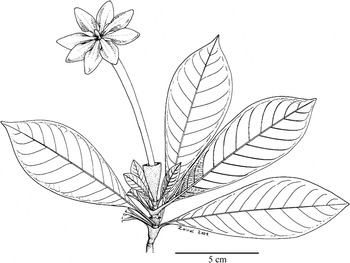
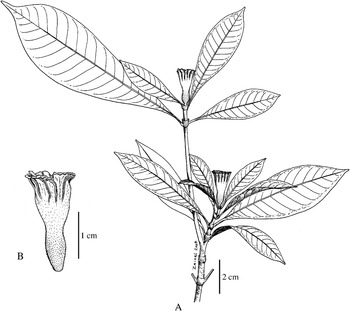
2a. Gardenia elata var. elata.Fig. 3.
Leafy branch terminated by a solitary flower of Gardenia elata var. elata, from Ridsdale SMHI 291 (K).

The typical variety has flower pedicels only (1–)3–5 mm long, compared with Gardenia elata var. longipedicellata K.M.Wong, in which they are longer (7–10 mm long).
Distribution. As for the species.
Proposed IUCN conservation status. Gardenia elata var. elata is a widespread taxon, and so the status Least Concern (LC) is appropriate. However, as regional forest conversion rates steadily increase, the status needs periodic reassessment.
Additional specimens examined. Busuanga. Palawan Province: ix 1922 (fr), Ramos BS 41218 (K, L); NE of Coron, 2 km north of San Nicolas, along Wayan Creek, 29 xi 1984 (fr), Bourell 2439 (A). Culion. Palawan Province: 29 iv 1931, Herre 1085 (A, fl; NY, fb, fl), iv 1931, Herre 1088 (A, st; NY, fr). Luzon. Camarines Norte Province: Paracale, xi–xii 1918 (fr), Ramos BS 33747 (A, NY, SING). Laguna Province: Dahican River, ix 1912 (fr), Ramos 1325 (A, L, NY, SING); San Antonio, ii 1913 (fr), Ramos BS 20508 (US). Tayabas Province: v–vi 1916 (fr), Cailipan FB 25640 (K, US), v–vi 1916 (fr), Cailipan FB 25658 (A, NY); Lucban, v 1907 (fr), Elmer 7732 (A). Mindanao. Zamboanga, ii 1908 (fl), Whitford & Hutchinson FB 9492 (K, NY, US). Palawan. Palawan Province: ii–iii 1920 (fr), Cenabre, Baldemor & Aduviso FB 27899 (A), ii 1920 (st), Cenabre, Paras & Gellidon FB 27923 (A), viii 1913 (fr), Escritor BS 21566 (US), v 1913 (fb, fr), Merrill 1360 (A, NY, SING); St. Paul’s Bay Cabayngan village, 7 v 1984 (st), Ridsdale SMHI 1615A (L). Bataraza municipality: Sumbiling, Sitio Gamayon, Bulanjao Range [8°33′N, 117°24′E], 50 m, 21 iii 1995 (fr), Soejarto & Madulid 9030 (A, PNH). Puerto Princesa municipality: Irawan, Impapai hills above BFD Field Station [9°51′N, 118°37′E], 300 m, 26 vi 1992 (fb, fl), Soejarto & Fernando 7750 (K, NY); Irawan River valley head, 150 m, 19 iii 1984 (fb), Ridsdale SMHI 145 (A, BO, K, KEP, L); Irawan River valley head, lower slopes of Mt Beaufort, 150 m, 30 iii 1984 (fb, fl), Ridsdale SMHI 291 (A, BO, K, L, SAN); Irawan River Valley, Tatanarom, road to Benguet mine, Mt Beaufort [9°50′N, 118°40′E], 150 m, 16 vii 1988 (fr), Soejarto & Madulid 6066 (NY, SING, US); Mt Bonton, 6 ix 1994 (st), Majaducon 8499 (L); Mt Pulgar, iv 1911, Elmer 13064 (K, fb, fr; A, L, fl, fr; NY, US, fl). Sofronio Espanola municipality: Pulot, Massin River, 12 km N. Brooks Point, lowland forest on ultrabasic, Gymnostoma-dominated, 23 x 1985 (fr), Ridsdale 998 (A, L). Taytay municipality: v 1913 (fl), Merrill 1279 (A, NY, SING); Bambanan, Mt Capoas, 90 m, 14 vi 1993 (fr), Reynoso, Alvarez & Fuentes PPI 11269 (L); Lake Manguao (Danao), valley of stream leading into NNW bay of lake, 60–80 m, 7 iv 1984 (fr), Ridsdale SMHI 357 (A, BO, KEP, L, SAN), 7 iv 1984 (fb, fr), Podzorski SMHI 767 (A, L, SAN); island on Lake Manguao, c.10 km SE of Taytay town [10°50′N, 119°33′E], 20–100 m, 30 i 1991 (fr), Soejarto & Fernando 7419 (A, PNH). Panay. Capiz Province: x–xi 1925 (fr), Edano BS 46123 (A, BO, NY, SING). Sibuyan. Romblon Province: Magallanes, Mt Giting-Giting, iii 1910, Elmer 12103 (K, fb; A, fb, fl; BO, NY, US, fl). Tawi-Tawi. Tawi-Tawi Province: vii–viii 1924 (fr), Ramos & Edano BS 44127 (A, NY, SING, US).
Flowering material from Palawan and south Mindanao appears to have corollas with shorter lobes (1.9–2.6 cm long) and also a tendency towards shorter tubes (5.7–8.5 cm long); elsewhere in the Philippines, the flowering material available has longer corolla lobes (3.2–4.1 cm) and longer corolla tubes (6.8–11.6 cm). The significance of this cannot be ascertained without further specimens, preferably in conjunction with field studies.
Elmer (Reference Elmer1912) has used the name ‘G. glutinosa’ which is problematic. Gardenia glutinosa Teijsm. & Binn., Cat. Hort. Bot. Bogor 119 (1866), is an invalid name as it was listed without a description, diagnosis or illustration (nomen nudum) (see Article 32.1 of the Vienna Code: McNeill et al., Reference McNeill, Barrie, Burdet, Demoulin, Hawksworth and Marhold2006). It does not seem to refer to Gardenia elata. In the original publication, this name was simply listed as ‘G. glutinosa T. et B. ---- 5 ---- Bima’. ‘Bima’ almost certainly stands for Burma. Although there is a locality on Sumbawa island named Bima, Teysmann did not go to Sumbawa until 1873 (van Steenis-Kruseman, Reference van Steenis-Kruseman1950) and in his catalogue he used names of islands and countries to indicate origin, not smaller localities. The following specimens that Teysmann had attributed to G. glutinosa are instead identifiable as G. tubifera Wall. ex Roxb.: Maingay 838, Malaya (A, L), Teysmann s.n., Birma, ‘Herb. Miquel’ (K), Teysmann, 1868, Java (NY), sine coll., ‘Herbarium of the late East India Company No. 2816’ (A, L), sine coll., ‘Herb. Hort. Bot. Calcuttensis, HK. 1747’ (K), sine coll., ‘H. Zollinger inter javanicum secundum, No. 3647.1. ex Bima’ (K), sine coll., ‘Zollinger Iter javanicum secundum II No. 3647’ (A).
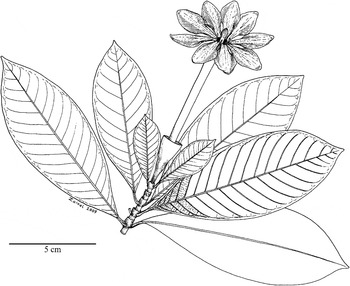
2b. Gardenia elata var. longipedicellata K.M.Wong, Gard. Bull. Singapore 61: 115 (2009). – Type: Philippines, Luzon, Cagayan Province, v 1921 (fl), Ponce FB 28435 (holo A, 2 sheets; iso US). Fig. 4.
Flowering leafy branch of Gardenia elata var. longipedicellata K.M.Wong, from Bernardo FB 15478 (L).

Gardenia elata var. longipedicellata is recorded as a tree about 15 m high. It shares much similarity with the typical variety, differing only by its longer (7–10 mm) flower pedicel compared with those of Gardenia elata var. elata (only (1–)3–5 mm).
Distribution. Endemic to the Philippines, known only from Luzon.
Habitat and ecology. Primary lowland forests, including on ultramafic soils.
Proposed IUCN conservation status. Vulnerable due to very few documented, small or restricted populations (VU D2).
Additional specimens examined. Luzon. Cagayan Province: i–v 1915 (fl, fr), Velasco FB 24116 (US). Isabela Province: iii 1910 (fl), Bernardo FB 15478 (L); Kapuntian, San Jose, San Mariano [16°59.7′N, 122°2.3′E], 400 m, 12 vii 1994 (fr), Barbon, Romero & Fuentes PPI 13137 (L); Palanan, Digallorin, Divinisa camp site, forest on ultrabasic [16°30′N, 122°26′E], 50 m, 10 iv 1992 (fb), Ridsdale, Baquiran et al. ISU 479 (A, BO, K, L). Rizal Province: ii 1905 (fr), Ahern’s Collector FB 2673 (NY, SING, US); v 1907 (fl), Ramos BS 2689 (US).
3. Gardenia mutabilis Reinw. ex Blume, Bijdr. Fl. Ned. Ind. 16: 1016 (1827); Koorders, Versl. Minahasa 494 (1898); Koorders-Schumacher, Syst. Verz. III Abteilung 120 (1914); Koorders, Suppl. Fl. Celebes 3: 59, pl. 124 (1922). – Type: Celebes, Reinwardt 1567 (holo L). Fig. 5.
Gardenia ramosii Merr., Philipp. J. Sci. 29: 489 (1926). – Type: Philippines, Bohol, Kalingohan, viii–x 1923, Ramos BS 43323 (lecto A, designated here, fl; isolecto US, fb, fr).
Gardenia mutabilis Reinw. ex Blume. A, leafy branch terminated by a solitary flower, and a side shoot with sheathing stipule enveloping emerging leaves; B, fruits terminating two orders of leafy branches. A from Madulid et al. PPI 7705 (KEP); B from Barbon et al. PPI 5922 (K).

Tree, to 5 m high. Bark smooth to scaly, very pale yellowish brown. Stipules connate into a cylindrical tube, often to 1–1.5 cm long, apex weakly 2-lobed to subtruncate or (rarely) slightly cleft on one side, outside puberulent and often coated with resin. Petiole 7–15 mm long, 1–1.5 mm thick. Leaf lamina obovate to elliptic, (5–)9–15 × (2–)2.5–5 cm; base cuneate; apex acute to obtuse, tip pointed to short-cuspidate; subcoriaceous; midrib flat and minutely puberulent on upper side, prominent and puberulent on lower side; secondary veins 8–12 pairs, flat and sparsely minutely puberulent on upper side, prominent and sparsely puberulent on lower side, vein axils on the lower side pubescent; tertiary venation scalariform. Flowers solitary. Pedicels 1.5–2 mm long and c.1 mm thick in open flowers, 1.5–2 mm long and c.2.5 mm thick at fruit maturity. Calyx obconic-cupular to tubular, tightly sheathing the corolla tube, the margin subtruncate, 10–17 mm long, 1.5–2 mm wide at the base, 2.5–3 mm wide at the apex; outside puberulent; without marginal lobes or ribs or keels. Corolla hypocrateriform; tube to 6.5–7.5 cm long, 2–2.5 mm wide at the mid-portion, 3.5–4.5 mm wide at the throat, outside minutely puberulent; lobes 7–8, oblanceolate to obovate, (2.5–)2.9–3.2 × 0.7–1 cm, contorted to the left in bud, glabrous on both sides. Stamens 7–8, inserted between corolla lobes just below the throat, dorsifixed; filaments very short to inconspicuous; anthers 7–10 mm long, only 1–2 mm exserted. Style glabrous; stigma club-like, 3.5–4 mm long, c.3 mm wide, wholly exserted. Fruits subglobose, 2.3–2.7 × 2–2.5 cm, when mature with a rugose surface and the epidermis flaking off as a thin, pale grey-brown layer. Seeds many, embedded in a pulp-like placenta, irregularly angular-rounded, flattened, 2–2.5 mm across, testa surface fine-areolate.
Distribution. South Philippines to Sulawesi. In the Philippines, so far recorded only from Bohol and Samar (Fig. 6).
Distribution of Gardenia mutabilis, G. ornata and G. vulcanica in the Philippines.

Habitat and ecology. Primary lowland forests and vegetation on limestone.
Proposed IUCN conservation status. Vulnerable due to very few known, small or restricted populations (VU D2).
Additional specimens examined. Bohol. Bohol Province: viii 1923 (fr), Ramos BS 43283 (A, US); Logarita, Bilar, limestone [9°42.5′N, 124°6.4′E], 22 v 1993, Madulid, Reynoso et al. PPI 7705 (BO, fl, fr; K, PNH, fb, fr; KEP, fl). Samar. Samar Province: Wispal, Basey, 5 ii 1992 (fr), Barbon, Garcia & Sagcal PPI 5922 (K).
The leaves characteristically dry a dark colour with its fine secondary and higher-order veins submersed in the blade tissue, features that are rare in other species. A pencil tracing of a specimen (kept at A) made from a cultivated plant (V.D.60 acc. 11 xi 1912) in the Hortus Bogoriensis (Bogor Botanical Garden), obtained by Merrill from the Berlin Herbarium and correctly identified as Gardenia mutabilis, shows a corolla tube 12.8 cm long. This is longer than in Philippine material known so far, but such tube lengths are known in cultivated specimens in Southeast Asia, for example Low s.n., 13 vi 2005, Peninsular Malaysia, cult. Rimba Ilmu Botanic Garden (KLU). In the Philippine and Sulawesi material, as well as cultivated material, the open flowers have styles protruding conspicuously from the corolla mouth, by as much as 1 cm, so that the stigma is more noticeably exserted than in other west Malesian or Philippine species.
4. Gardenia ornata K.M.Wong, sp. nov.Fig. 7.
Gardeniae subcarinatae (Corner) Y.W.Low similis sed tubis calycis supra 10–12 mm in diam. et marginibus recurvatis nervisque secundariis foliorum paribus 14–21 differt. – Type: Philippines, Samar, Central Samar, Paranas, Campo Uno, rolling mountain/limestone, primary forest [11°58.2′N, 124°43′E], 400 m, 1 v 1996 (fr), Reynoso & Majaducon PPI 24052 (holo A; iso K, PNH).
Gardenia ornata K.M.Wong. A, leafy branches terminated by immature fruits; B, close-up of immature fruit crowned by its flared, keeled calyx tube with recurved margin. Both from Reynoso & Majaducon PPI 24052 (K).

Tree, to 10 m high or more, trunk diameter to 35 cm or more. Bark smooth, yellowish grey to pale brown. Stipules connate into a cylindrical tube, often 1–1.5 cm long, apex weakly 2-lobed to subtruncate or (rarely) slightly cleft on one side, outside puberulent and sometimes coated with resin. Petiole 3.5–9 mm long, 1–1.5 mm thick. Leaf lamina elliptic to slightly obovate, 6.3–12 × 2.1–5 cm; base cuneate; apex acute to obtuse, tip pointed to short-cuspidate; subcoriaceous; midrib flat to sunken and glabrous on upper side, prominent and puberulent on lower side; secondary veins 14–21 pairs, flat and glabrous on upper side, prominent and puberulent on lower side, vein axils on the lower side pubescent; tertiary venation scalariform. Flowers solitary. Pedicels c.1.5 mm long and 1.5–2 mm thick in very young fruits, c.2 mm long and 3.5 mm thick in the older woody fruit. Calyx obconical, much flared upwards; 11–12 mm long, 3–3.5 mm wide at the base, 10–12 mm wide at the apex; outside minutely puberulent at the base, upper part glabrous; margin subtruncate with 8–9 lobes, triangular to rounded, 1–1.5 mm high, slightly folded and recurved; with 8–9 narrow keels 1.5–2.5 mm wide, broadening upwards from base to apex. Corolla not known. Fruit subglobose, to c.3.5 cm across, surface smooth.
Distribution. Endemic to the Philippines: known only from Samar (Fig. 6).
Habitat and ecology. Primary lowland forests, in areas with limestone.
Proposed IUCN conservation status. Vulnerable due to very few known, small or restricted populations (VU D2).
Additional specimens examined. Samar. Northern Samar Province: Catubig River, ii–iii 1916 (fr), Ramos BS 24401 (US); Mt Capotoan, Catubig River, 89 m, 20 ii 1916 (fr), Sablaya 109 (A).
This new species most closely resembles Gardenia subcarinata (Corner) Y.W.Low (Sumatra and Malay Peninsula) in its short, slightly flared calyx tubes with low keels. Gardenia ornata differs from the above species by its wider calyx tube (10–12 mm wide at the mouth), which has a recurved margin, and leaves with 14–21 pairs of secondary veins. Gardenia subcarinata has calyx tubes just 4–8 mm wide without a recurved margin and leaves with 7–12 pairs of secondary veins.
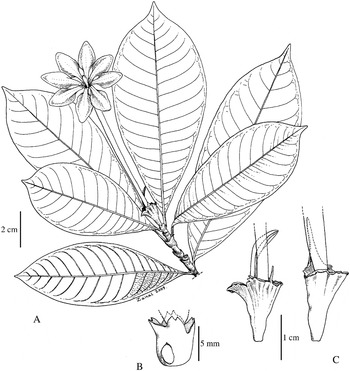
5. Gardenia vulcanica K.M.Wong, sp. nov.Fig. 8.
Gardeniae tubiferae Wall. similis, foliis infra nervis puberulis, calycis tubo margine parum recurvato lobis 1 vel 2 angustis 4–10 mm longis differt. – Type: Philippines, Luzon, Sorsogon, near Irosin, south side of Mt Bulasan, near lake [12°45′N, 124°5′E], 400 m, 9 iv 1987, Burley 120 (holo A, 2 sheets, fb, fl, fr; iso K, fl, fr; iso NY, fr).
Gardenia vulcanica K.M.Wong. A, flowering leafy branch; B, close-up of cupuliform stipule from a leafy node (petiolar scar shown at bottom left); C, close-up of two cupular-obconical calyces (note irregularly recurved tube margin and 1–2 narrowly prolonged lobes). A & B from Burley 120 (K); C from Burley 120 (K) (left) and Stone et al. 15900 (KEP).

Tree, to 5–6 m high or more. Bark smooth to slightly scaly, pale grey-brown. Stipules connate into a cylindrical tube, often to c.1 cm long, apex weakly 4-lobed to subtruncate or (rarely) slightly cleft on one side, outside puberulent and often coated with resin. Petiole 2–4 mm long, 1–1.5 mm thick. Leaf lamina obovate to elliptic, (5.5–)9–17.5 × (2.6–)3–5.4 cm; base cuneate; apex acute to obtuse, tip pointed to short-cuspidate; subcoriaceous; midrib slightly raised but grooved and glabrous on upper side, prominent and puberulent on lower side; secondary veins 11–23 pairs, flat and glabrous on upper side, prominent and puberulent on lower side, vein axils on the lower side pubescent; tertiary venation scalariform. Flowers solitary. Pedicels 2–3 mm long and 1.5–2 mm thick in open flowers, reaching 3–5 mm long and 3–3.5 mm thick at fruit maturity. Calyx obconical, 8–9 mm long, 2–2.5 mm wide at the base, 8–9 mm wide at the apex; outside minutely puberulent; margin with irregular lobes or invagination and slightly recurved, including 1–2 narrowly prolonged lobes 4–10 mm long, without ribs or keels. Corolla hypocrateriform, cream turning light yellow-orange; tube 10–11 cm long, c.2.5 mm wide at the mid-portion, 7–8 mm wide at the throat, outside slightly puberulent to glabrous; lobes 8–9, oblanceolate to obovate, 2.4–2.6 × 1.2–1.4 cm, contorted to the left in bud, glabrous on both sides. Stamens 8–9, inserted between corolla lobes just below the throat, dorsifixed; filaments very short to inconspicuous; anthers 5–6 mm long, around half of its length exserted. Style glabrous; stigma club-like with 7–9 lobes, these initially coherent, c.3.5 mm long, 2.5–3.5 mm wide, wholly exserted. Fruits subglobose, to 3.8 cm across, surface smooth; portions of the calyx often persistent at fruit apex. Seeds many, embedded in a pulp-like placenta, irregularly angular-elliptic, flattened, 5–8 × 4.5–5.5 mm, testa surface fine-areolate.
Distribution. Endemic to the Philippines: known only from Luzon, in forest around the base of the volcanic Mt Bulusan (Fig. 6).
Habitat and ecology. Primary lowland forests.
Proposed IUCN conservation status. Vulnerable due to very few known, small or restricted populations (VU D2).
Additional specimens examined. Luzon. Sorsogon Province: Bulusan Volcano, ix 1915 (fr), Ramos BS 23682 (A, L, US); Mt Bulusan, Lake Bulusan, 400 m, 9 iv 1987 (fl), Stone et al. 15900 (KEP).
This species resembles Gardenia tubifera (Thailand, Malay Peninsula, Sumatra, Borneo) (Low & Wong, Reference Low and Wong2009) in its smooth calyx tube, but differs in its puberulent veins on the lower leaf surface and the slightly recurved calyx tube margin, which has one or two narrow, 4–10 mm long lobes. In contrast, Gardenia tubifera has glabrous lower leaf surfaces and the calyx margin is plane and entire.
Doubtful Name
Gardenia pseudopsidium (Blanco) Fern.-Vill., Novis. App. 109 (1880); Merrill, Bull. Bur. Forest. Philipp. Islands 1: 54 (1903); Elmer, Leafl. Philipp. Bot. 1: 5 (1906); Merrill, Sp. Blancoanae 363 (1918); Merrill, Enum. Philipp. Fl. Pl. 531 (1923). – Sulipa pseudopsidium Blanco, Fl. Filip. 497 (1837).
Blanco (Reference Blanco1837) did not cite specimens in his description. Blanco’s original (Spanish) description did not provide measurements of parts or an illustration and is very general, stating only:
Cor. cuatro veces mas larga que el caliz, bilabiada: el tubo delgado, la gargantua abierta, y el limbo grande con cinco lacinias; las dos mayores á un lado, y las tres menores al′otro.
[Corolla four times longer than the calyx, two-lipped: the tube slender, the throat widened, and the limb expanded with five lobes; these (with) two larger to one side, the other three smaller than the others.]
Merrill (Reference Merrill1918) stated that ‘There is no doubt as to the correctness of referring Sulipa pseudopsidium Blanco to Gardenia in spite of a few discrepancies in Blanco’s description which were apparently due to faulty observations’ and favoured associating this name with G. barnesii. These discrepancies are not minor and would include ‘two-lipped’ (which could be interpreted as the pressed open corolla appearing somewhat asymmetric) and the corolla ‘limb with five lobes’ (in contrast, Gardenia barnesii has 6–9 corolla lobes). Merrill could have been led to associate the Tagalog name given by Blanco (Malabayabas) with Gardenia but he did not explain how else he identified Blanco’s taxon. Malabayabas is also applied to Tristaniopsis (Myrtaceae) (e.g. Eala, Reference Eala1975) and Merrill (Reference Merrill1903) himself documented this name being applied to Dysoxylum (Meliaceae), Eugenia (Myrtaceae) and two different genera in the Rubiaceae.
As the Blanco description of Sulipa pseudopsidium does not fully correspond to the corolla structure of Gardenia barnesii, and no other specific evidence links it with certainty to that species, it should be considered a nomen dubium. The specimens selected by Merrill (Species Blancoanae No. 655: A, NY, US: all leafy twigs with neither flower nor fruit material) to represent what he thought Blanco’s name referred to cannot be considered evidence in view of his interpretation being suspect.
Excluded and Unplaced Names
Gardenia acutifolia Elmer, Leafl. Philipp. Bot. 1: 6 (1906), is Villaria acutifolia (Elmer) Merr., Philipp. J. Sci. C. 5: 248 (1910); Merrill, Enum. Philipp. Fl. Pl. 532 (1923).
Gardenia curranii Merr., Sp. Blancoanae 363 (1918); Merrill, Enum. Philipp. Fl. Pl. 530 (1923), is Ceriscoides curranii (Merr.) Tirveng., Nordic J. Bot. 3: 456 (1983).
Gardenia elliptica Elmer, Leafl. Philipp. Bot. 1: 6 (1906), is Villaria philippinensis Rolfe, J. Linn. Soc., Bot. 21: 311 (1884). According to Alejandro et al. (Reference Alejandro, Arlegui, Detabali, Espino, Layson and Rosales2008), Villaria philippinensis is the correct name for both V. littoralis Vidal and V. odorata (Blanco) Merr.
Gardenia lagunensis Merr., Philipp. J. Sci. C. 10: 110 (1915); Merrill, Enum. Philipp. Fl. Pl. 530 (1923), is a member of the Rothmannia complex, requiring further elucidation (Pereira, pers. comm.).
Gardenia merrillii Elmer, Leafl. Philipp. Bot. 1: 5 (1906); Merrill, Enum. Philipp. Fl. Pl. 530 (1923), is a member of the Rothmannia complex, requiring further elucidation (Pereira, pers. comm.).
Gardenia morindifolia Elmer, Leafl. Philipp. Bot. 1: 67 (1906); Merrill, Enum. Philipp. Fl. Pl. 530 (1923), is Vidalasia morindifolia (Elmer) Tirveng., Biogeographica (The Hague) 74: 166 (1998).
Gardenia negrosensis Merr., Philipp. J. Sci. C. 10: 111 (1915); Merrill, Enum. Philipp. Fl. Pl. 530 (1923), is a member of the Rothmannia complex, requiring further elucidation (Pereira, pers. comm.).
Gardenia obscura (Blanco) S.Vidal, Phan. Cuming. Philipp. 18, 119 (1885), based on Remijia obscura Blanco, Fl. Filip., ed. 2: 116 (1845), ed. 3, 1: 207 (1877), is Villaria glomerata (Bartl. ex DC.) Mulyan. & Ridsdale, Reinwardtia 12: 195 (2004).
Gardenia obscurinervia Merr., Philipp. J. Sci. C. 11: 32 (1916); Merrill, Enum. Philipp. Fl. Pl. 531 (1923), is Sulitia obscurinervia (Merr.) Ridsdale, Blumea 25: 301 (1979). Wong (Reference Wong2004) has explained why Sulitia should not be congeneric with Atractocarpus Schltr. & K.Krause, resulting in Atractocarpus obscurinervius (Merr.) Puttock, Austral. Syst. Bot. 12: 304 (1999) also being a synonym.
Gardenia pinnata (Blanco) Merr., Philipp. Gov. Lab. Bur. Bull. 27: 53 (1905), based on Serissa pinnata Blanco, Fl. Filip. 163 (1837), is Villaria glomerata (Bartl. ex DC.) Mulyan. & Ridsdale, Reinwardtia 12: 195 (2004).
Gardenia pubifolia Merr., Philipp. J. Sci. C. 10: 112 (1915); Merrill, Enum. Philipp. Fl. Pl. 531 (1923), described as having ‘cymes in the uppermost axils among the crowded leaves’ and ‘corolla tube 6 mm long’ cannot refer to a Gardenia, which would have terminal and typically solitary flowers much larger than this. The type, Wester BS 19343, Mindanao, Davao, Mati, 10 viii 1912, is at US and has only leafy twigs; the ovate stipules that are connate to less than halfway and non-resinous buds are clearly not of Gardenia.
Gardenia whitfordii Elmer, Leafl. Philipp. Bot. 1: 4 (1906) and Randia whitfordii (Elmer) Merr., Philipp. J. Sci. 1: Suppl. 130 (1906); Merrill, Philipp. J. Sci. C. 3: 437 (1908); Elmer, Leafl. Philipp. Bot. 3: 1004 (1911), 5: 1895 (1913); Merrill, Enum. Philipp. Fl. Pl. 529 (1923), are Discospermum whitfordii (Elmer) S.J.Ali & Robbrecht, Blumea 35: 301 (1991).
Gardenia carinata sensu Fern.-Vill., Novis. App. 109 (1880), non Wall. ex Roxb., Fl. Ind. ed. Carey & Wall. 2: 560 (1824), has not been traced to any specimen, although the locality was stated as ‘in oppido Talisay, provinc. Batangas (Luzon)’. This could well refer to Gardenia barnesii, which is the only Philippine species with well-developed calyx keels.
Gardenia thunbergia sensu Fern.-Vill., Novis. App. 109 (1880), non L.f. (1781), is probably Voacanga globosa (Blanco) Merr., Sp. Blancoanae 384 (1918).
Acknowledgements
This research was made possible by a Mercer Fellowship from the Arnold Arboretum, Harvard University, July–November 2007 to K.M.W. We are grateful to the keepers and curators of various herbaria for facilitating the study of specimens in their care: A, BO, K, KEP, KLU, L, NY, SAN, SING, US. Robert Cook (Director, Arnold Arboretum and Harvard University Herbaria, HUH), David Boufford (HUH), Stuart Davies (Center for Tropical Forest Science), Richard Primack (Center for Ecology & Conservation Biology, Boston University) and John Beaman (previously Royal Botanic Gardens, Kew) supported K.M.W.’s programme of study. We thank the Royal Botanic Gardens, Kew; Datuk C. L. Chan (Natural History Publications, Kota Kinabalu); Judie Warnement, Gretchen Wade, William Tootle and Lisa DeCesare of the Botany Libraries, HUH; and Chuck Davis and Wenheng Zhang (A), for help with research literature. Kanchi Gandhi (HUH) and David Middleton (E) gave advice on nomenclature and typification. Christian Puff (University of Vienna) and J.-F. Veldkamp (L) kindly helped with Latin diagnoses. Aaron Davis (Kew) and Claes Persson (University of Gothenburg) provided very useful comments which improved our account. Curatorial staff members of various herbaria have been especially helpful: James Macklin, Emily Wood, Henry Kesner (A); K. T. Yong (KLU); Stella Sylva (NY); Joan T. Pereira (SAN); Serena Lee (SING); Rusty Russell and Debbie Bell (US). Zainal Mustafa prepared the line drawings.