Viewing an exhibition of civil war paintings in 1886, Lea Barakat wrote that her “country came to mind: the splendor of its ruins, the wonders of their form like the fortress of Baalbek, the ruins of Palmyra, and the scenes of Lebanon …” Native women should paint like this, she states, and “not leave a scene [of Lebanon] unpainted … They can decorate the rooms of their homes and sitting rooms with these pictures …” She concludes that “since the ladies of our country are smarter and more industrious in their handcrafts than [American] ladies,” they too can obtain a similar level of “wealth, honorable work, admiration of the masses, and praise for the virtue of their [arts and crafts].”1
Lea Barakat, “al-Taswir wa-l-tazwiq,” al-Muqtataf 11 (1886–87): 178–79.
Polemics against Arab “civil society” have intensified after 11 September 2001 by ideological hacks such as Bernard Lewis, Fouad Ajami, Daniel Pipes, and Charles Krauthammer. For an example of similar neoliberal pedantry written by Arab pundits in English, see Hazim Saghieh, ed., The Predicament of the Individual in the Middle East (London: Saqi, 2001).
OTTOMAN TANZIMAT, ARAB REFORM, AND SECONDARY LITERATURE
In the Ottoman Empire, photography acted forcefully in creating class and national identities because of the scientific nature of the apparatus. If the “fever for reality was running high” in Europe with the invention of photography, the Comptean compulsion for rationality and objectivity was the dominant current of thought among Arab intellectuals during al-nahḍa al-ʿArabiyya (the Arab renaissance).3
Beaumont Newhall, The History of Photography, 4th ed. (New York: MOMA, 1964), 12. For an examination of positivist paradigms within Arab subjectivity, see Stephen Sheehi,Foundation of Modern Arab Identity (Gainesville, Fla.: University Press of Florida, 2004).
The following are some examples. For how to fix an image on paper, see “al-Taswir al-fotografi” in “Masaءil wa-ajwiba,” al-Muqtataf 19 (1895): 303; for Egyptian-based Lebanese photographer Louis Badwar's instructions on developing a photograph, see “al-Fotografiyya” in “Bab al-sina'a,” al-Muqtataf 19 (1895): 291–93; for treating paper for different tones, see “Taswid al-suwar al-fotografiyya” in al-Muqtataf 24 (1899): 366.
Formally, native-produced photographic portraiture differed little from Western photographs. In her study of women and photography of the Middle East, Sarah Graham-Brown states, “Styles of photography remained largely derivative, taking the norms of composition and styles of portraiture almost entirely from European models.”5
Sarah Graham-Brown, Images of Women: The Portrayal of Women in Photography of the Middle East, 1860–1950 (London: Quartet, 1988), 59.
For a discussion of these “patterns,” see Julia Hirsh, Family Photographs: Content, Meaning and Effect (New York: Oxford University Press, 1981), 99.
Christopher Pinney, Camera Indica: The Social Life of Indian Photographs (Chicago: University of Chicago Press, 1997), 72, 95–96.
In contrast, in her study on popular culture in the Ottoman Empire, Suraiya Faroqhi reminds us that “the literary figures and politicians of the Tanzimat isolated themselves from the lower classes by their acceptance of a foreign culture.”8
Suraiya Faroqhi, Subjects of the Sultan: Culture and Daily Life in the Ottoman Empire (London: I. B. Tauris, 2000), 251.
The relationship between photography, modernity, and the East appeared almost simultaneously with the apparatus' debut in Europe. Egypt and Palestine were among the first destinations for French-government daguerreotype missions to visually document antiquities.9
Noel Paymal Lerebours, Prix-courant des daguerréotypes (n.p., 1843); idem, Excursions daguerriennes: Vues et monuments les plus remarquables de globe (Paris: n.p., 1842), pl. no. 57.
For a study of the Bonfils, see Carney Gavin, The Image of the East: Photographs by Bonfils (Chicago: University of Chicago Press, 1982).
See Malek Alloula, The Colonial Harem (Minneapolis, Minn.: University of Minnesota, 1986) and David Prochaska, “Archive of l'Algerie Imaginaire,” History and Anthropology 4 (1990): 373–420.
For some examples, see Paul Chevedden, The Photographic Heritage of the Near East (Malibu: Undena, 1981); Fouad Debbas, Romantic Lebanon: The European View 1700–1900 (London: British Lebanese Association, 1986); idem, Our Memory (Beirut: Naufal, 1986); Michel Fani, Liban 1848–1914: L'Atelier photographique de Ghazir (Paris: Editions de l'Escalier, 1995); Carney Gavin, Legacy of Light: Photographs from the Last Century (Araya, Liban: Impieties Catholique, 1983); Nancy Micklewright, A Victorian Traveler in the Middle East (London: Ashgate, 2003); and Nissan Perez, Focus East: Early Photography in the Near East (1839–1885) (New York: Abrams, 1988).
Graham-Brown, Images of Women. For the relationship between anthropology and photography, see Elizabeth Edwards, ed., Anthropology and Photography 1860–1920 (New Haven, Ct.: Yale University Press, 1994).
In his compendium of Palestinian photography, Walid Khalidi maps the dominant themes of the photographic archive in Palestine before 1948 as created by foreigners and Arab and Armenian indigenes, including Khalil Rʿad and his partners and in-laws, Garabed and Johannes Krikorian.14
Walid Khalidi, Before Their Diaspora: A Photographic History of the Palestinians 1876–1948 (Washington, D.C.: Institute for Palestine Studies, 1984).
Annelies Moors, “Presenting Palestine's Population Premonitions of the Nakba,” MIT Electronic Journal of Middle East Studies 1 (2001): 1–12, http://web.mit.edu/cis/www.mitejmes.
Ibid., 5.
Graham-Brown, Images of Women, 56.
Although reform priorities informed photography, few written sources exist regarding indigenous studios, photographers, and the reception of their product. Despite this lacuna, few scholars have studied the Arab–Ottoman context of photographic images. Nancy Micklewright argues that photographs in the Ottoman–Turkish press pushed a nationalist-based agenda of consumerism.18
Nancy Micklewright, “Personal, Public, and Political (Re)Constructions: Photographs and Consumption,” in Consumption Studies and the History of the Ottoman Empire, 1550–1922, ed. Donald Quataert (Albany, N.Y.: State University of New York Press, 2000), 261–88.
Wolf-Deiter Lemke, “Ottoman Photography: Recording and Contributing to Modernity,” in The Empire in the City: Arab Provincial Capitals in the Late Ottoman Empire (Beirut: Ergon Verlag Wurzburg, 2002), 237–38.
Faroqhi, Subjects of the Sultan, 258–59.
AL-NAHḌA AL-ʿARABIYYA, NATIVE INDIVIDUAL, AND THE ROOTS OF LEBANESE PHOTOGRAPHY
A handful of the most famous Ottoman photographers were able to capitalize on the West's desire for landscapes, townscapes, images of ruins, and character types, because these photographic entrepreneurs maintained a prestigious association with the sultan and Ottoman officials. Concurrently, native studios cultivated a growing local market, concerning themselves largely but not exclusively with portraiture. Graham-Brown confirms that, along with the strong presence of expatriate studios, local services were marketed toward a local clientele. In regard to Lebanon, she writes that “it became very fashionable among well-to-do Christian families to have cabinet portraits or photographic cartes de visite made,” but she also specifies that the demand was cross-confessional.21
Graham-Brown, Images of Women, 57.
The French prohibited Arabs and Berbers in North Africa from many professions, including those in the visual arts. For the change in this policy toward Lyautey's “nativist” approach regarding indigenes and the beaux arts, see Roger Benjamin, Orientalist Aesthetics (Berkeley, Calif.: University of California Press, 2003), 200–203.
Miller provides important information from Armenian sources about Arab-Armenian photographers. See Dickenson Jenkins Miller, “The Craftman's Art: Armenians and the Growth of Photography in the Near East (1856–1981)” (master's thesis, American University of Beirut, 1981). Muhsin al-Yamin researches many unknown Lebanese photographers; see Muhsin al-Yamin, “Yawmiyyat Wadiء Nawfal 1854–74,” al-Mustaqbal, 27 April 2000. Badr el-Hage provides scattered information regarding Damascus; see Des Photographes a Damas 1840–1918 (Paris: Marval, 2000).
Some sources say that Sabunji opened his studio in Beirut in 1862, only two years after Trancrede Dumas, the first European to do so.24
Phillippe Tarrazi, Tarikh al-sahafa al-ʿArabiyya, vol. 3 (Beirut: al-Matbaʿa al-Adabiyya, 1913), 214. For information about Dumas, see Gavin, Legacy of Light, 4.
See Leon Zolondek, “Sabunji in England,” Middle East Studies 14 (1978): 102–15. For his activity supporting Egyptian independence, see Wilfred Blunt, Secret History of the English Occupation of Egypt (London: Unwin, 1907).
Tarrazi, Tarikh al-sahafa, 72.
Ibid., 72.
Engin Cizgen, Photography in the Ottoman Empire (Istanbul: Haset Kitabevi A. S., 1987), 116.
See Muhsin Yammin, “David kharaj min al-adraj wa-Louis khala thawb al-kahnut,” Mulhaq al-nahar, 10 May 1997.
See “ʿAmal al-Maraya,” al-Muqtataf 18 (1983-84): 208, and “Talmiʿ al-suwar,” al-Muqtataf 8 (1883–84): 684–85, for explanations of the processes and techniques for developing and polishing photographs.
Sabunji's photographs are classic 19th-century portraiture. It is not coincidental that he photographed leading Ottoman officials and Beirut intellectuals, including Ibrahim al-Yaziji and Butrus al-Bustani. Of the most prominence, he was the official photographer for Midhat Pasha while the famous Ottoman reformer was governor of Syria. Sabunji invented a method and received commendation for printing photographs on silk, reproducing Midhat's image on thirty-six foulards.31
Cizgen, Photography in the Ottoman Empire, 116–17.
His intimate association with the new bourgeoisie, nahḍa intellectuals, and the reform-minded ruling class gave him a central role in popularizing the visual semiotics of nahḍa ideology. His mostly male subjects are often standing relaxed, exuding confidence and ease. Wearing native attire, subjects of studio portraits (Figure 1) project learnedness, control, and culture. They resemble countless portraits of “pioneers of the renaissance,” such as Salim al-Bustani and al-Yaziji, who wear shirwāl, vest, and fez, the latter a sign of the Ottoman reform that began with Sultan Mahmud II (d. 1839).32
See Salim's portrait on the cover of Salim al-Bustani, ed. Michel Juha (London: Riad al-Rayyes, 1989). Zaydan remarked how Ibrahim al-Yaziji always wore shirwāl and a fez. Jurji Zaydan, Mudhakkirat Jurji Zaydan (Beirut: Dar al-Kitab al-Jadid, 1968), 40. Jirousek comments on how the fez and shirwāl were the uniform for a reformed bureaucracy. Charlotte Jirousek, “The Transition of Mass Fashion System Dress in the Late Ottoman Empire,” in Consumption Studies, 224. Brummett shows how fashion was a dynamic site of ideological contention where traditional clothes symbolized both nationalism and backwardness, just as European dress signified progress and immorality. Palmira Brummett, Image and Imperialism in the Ottoman Revolutionary Press 1908–1911 (Albany, N.Y.: State University of New York Press, 2000), 221– 58.
For examples, see Salim al-Bustani's romantic novel al-Huyam fi jinan al-sham in al-Jinan 1 (1870), and Niqula Bistrus' short story, “Riwayat Fuءad” in al-Muqtataf 12 (1887): 127–28. For a discussion of the Salim al-Bustani and romance novels, see Sheehi, Foundations of Modern Arab Identity, 76–106.
For his memories about the emerging bourgeoisie of Beirut, see Shakir al-Khuri, Majmaʿal-Masarrat (Beirut: Dar al-Ittihad, 1908). Khalil al-Khuri wrote ʿAsr al-jadid (Beirut: al-Matbaʿa al-Suriyya, 1863) and al-Nashaءid al-fuءadiyya (Beirut: al-Matbaʿa al-Suriyya, n.d).

(Left) Jurjis Sabunji, Shaykh Effendi al-Khuri, n.d., and (right) Jirjis Sabunji, n.d. Reprinted with permission of the Foundation for the Arab Image.
If the traditionally attired subjects project a mastery of knowledge emblematic of al-nahḍa, the image in Figure 2 emanates a sense of mastery of means. Regaled in Western garb, his coat draped over his arm, and relaxed on his walking cane, the subject is clearly confident in his surroundings. Although these images are just a few in Sabunji's large oeuvre, they articulate an orthodox visual iconography of the native subject: young, successful, “progressive,” and male; gazing forward, out of the frame; learned and personally if not also financially secure in the modern age. The iconography became the visual standard for the reform intellectual and modern comprador. Tarrazi's landmark Tarikh al-sahafa al-ʿArabiyya provides portraits of journalists, intellectuals, publishers, and educators, celebrating them as the heroes of al-nahḍa. The biographical encyclopedia is an unambiguous, if not overdetermined, ideological anthology of the modern Arab imago. Many of Sabunji's portraits, in fact, appear in Tarrazi's magnum opus. For example, the portrait of Edgar Mashaqa expresses the same airs as seen in Figure 2. A well-groomed schoolboy with leather shoes, a suit, a bow tie, and meticulously combed hair, the young Mashaqa stands next to a high table with his hand on a large, open book.35
Tarrazi, Tarikh al-sahafa, 61.

Jirjis Sabunji, anon., n.d. Reprinted with permission of the Foundation for the Arab Image
Sabunji did not originate the iconography of this portraiture, just as Tarrazi did not codify it. He was a pioneer among others within the larger practice of Ottoman photography. The dissemination of the representation of a confident, worldly, and cultured Ottoman citizen was “relatively inconspicuous but all the more effective as a factor contributing to the process of secularization” as well as modernization and social reform.36
Faroqhi, Subjects of the Sultan, 258. Faroqhi asserts that visual culture in the Balkans and Asia Minor was linked to the development of secularism in Turkey.
For some of their works, see Gilbert Beauge and Engin Cizgen, Images d'empire: Aux origins de la photographie en Turquie: Collection of Pierre de Gigord (Istanbul: Institut d'etudes francaises d'Istanbul, [1993?]). The Gigord Collection is housed at Getty Research Institute. Numbering more than 6,000 images, it contains albums of photographs by the Abdallah Frères, Pascal Sébah, Legekian, and European photographers, many patronized by the sultan.
Muhsin al-Yamin, “Thalatha imtahanu al-shughal bi-l-shamas wa zhalaliha,” Mulhaq al-nahar,30 August 1999, 14–15.
“Al-Fotografiyya al-Suriyya,” al-Muqtataf 1 (1876–77): 685.
The regularity of nahḍa portraiture (Figure 3) is its very strength. Again, each model's clothes are stylized, as are his body language and surroundings. His tarboosh signals his education; his Western clothes relate his success, progress, and/or affluence; and the absence of sectarian markers signifies his nationalism. The composition is hardly distinguishable from Sabunji's portraits. The project of the photographer and photographed—the very veracity of the image—is found within this field of sameness. This repetition forces the viewer to recognize and identify with the model as a representative of a national class. Indeed, the al-Muqtataf article entitled “Syrian Photography” lauds these two photographers as “sons of the nation” and representative of the progress of Syria itself. The subjects of the Kovas' photographic portraiture are represented as bourgeois individuals, exuding the heroic qualities of the modern Syro-Lebanese citizen: progressive, knowledgeable, nationalistic, and secular.

Kova Brothers, anon., n.d. Reprinted with permission of the Foundation for the Arab Image
The success of the Beirut-based Kovas resembles the career of the most eminent Ottoman photographers, Vichen (d. 1902), Hovsep (d. 1900), and Kevork (d. 1918) Abdallah, otherwise known as the Abdallah Frères. Trained in miniature painting at the Armenian Catholic seminary in Venice, the brothers bought the business of the German chemist–photographer with whom they had apprenticed around 1860.40
Miller, “The Craftman's Art,” 15. Perez, Focus East, 124.
Miller, “The Craftman's Art,” 18. Özendes' biography in Turkish reproduces many of Abdallah's photographs; see Engin Özendes, Abdullah Frères: Osmanli Sarayinin Fotografcilari (Istanbul: YKY, 1998).
Cizgen, Photography in the Ottoman Empire, 94.
The photographers' relationships to the most powerful echelons of the ruling elite in Istanbul and the empire permitted the Abdallah Frères to diversify their portfolio from portraiture to landscape to character types beyond the scope of most native studios. In Figure 4, entitled “Sufi Musician” by its archivist, the troped image of a dervish is a character type, most probably commissioned by the sultan. Wandering in a faux pastoral, the nomadic dervish has no town, no ethnicity, and no specific territory. The craft (flute player, dervish) is the subject of the image, not his personal or even local identity. Moreover, the figure's eyes do not look out but down, reinforcing the image's stasis, and garments of excessive size displace his very body.

Abdallah Frères, “Sufi Musician,” n.d. Reprinted with permission of the Foundation for the Arab Image.
A series of the photographs that the Abdallah Frères shot in Cairo exists. Having taken the portrait of the khedive, they likely opened a branch of their studio in Cairo or at least produced portraits on the side while photographing Egypt for the sultan.43
Doubtful that they relocated, the nominal converts were court employees, far from Hamidian massacres of the Armenians between 1894 and 1896. The Cairene photographs probably originate from their tours for the Sultan's albums.

Abdallah Frères, anon., n.d. Reprinted with permission of the Foundation for the Arab Image

Abdallah Frères, anon., n.d. Reprinted with permission of the Foundation for the Arab Image
The bust resembles miniatures that were popular with Europe's ascendant bourgeoisie immediately before the dawn of photography. Similar oil paintings and miniatures of figures in grand regalia or military uniform were popular among Ottoman aristocracy and state officials. John Tagg notes that, rather than being killed by “mechanical reproduction,” “the aura of the precious miniature passes over” to photographic portraiture, which was utilized by the state and industry as a disciplinary practice to control and manage citizens, workers, criminals, and the mentally ill.44
John Tagg, The Burden of Representation: Essays on the Photographies and Histories (Amherst, Mass.: University of Massachusetts Press, 1988), 37.
A catalogue of the dress of the Ottoman people was presented at the Universal Exposition at Vienna; see Osman Hamdy Bey, Les Costume Populaires de La Turquie en 1873 (Constantinople: Levant Times & Shipping Gazette, 1873). Pascal Sébah was one of the most prominent Ottoman photographers, with strong ties to the ruling elite and nascent bourgeoisie. He traveled throughout the Levant and Egypt and maintained a prolific studio in Istanbul's Pera district and in Cairo. His son, Jean, continued the studio's great success after his father's death, which seems to have been between 1886 and 1890. Like the Kovas, Pascal Sébah won several awards in exhibitions in Europe, including a medal at the Exposition Universelle in 1878. Despite the prominence of his oeuvre, his life remains enigmatic, and the few studies on him fail to provide significant source material for their assertions. See Perez, Focus East, 222, and Engin Özendes, From Sébah & Jouillier to Foto Sébah (Istanbul: YKY, 2000).
Despite their minimalism, the Abdallah Frères' images of the Cairene bourgeoisie have an aura of their own, like the Beiruti portraits. The Hellenic columns, plush drapes, baroque chairs, books, and reading tables—ubiquitously found in portraits throughout the empire and in the West—“exude a civilizing and civilized air.”46
Tagg, Burden of Representation, 68.
Hirsh, Family Photographs, 85.
Suren Lalvani, Photography, Vision, and the Production of Modern Bodies (Albany, N.Y.: State University of New York Press, 1996), 59. For additional discussions on photography's role in the representation of the body and capitalist forms of social discipline, see Gisele Freund, Photography and Society (Boston: David Godine, 1980); Alan Sekula, “The Body and Archive,” in The Contest of Meaning, ed. Richard Bolton (Cambridge, Mass.: MIT Press, 1999), 343–89.
The phenomenon of the rise of the modern individual and family was complicated by the colonial condition. In the case of Lebanon, the 19th-century political economy was transformed from a semifeudal to a capitalist economy that included a redistribution of resources and surplus capital along new class and confessional lines. These changes rearranged spatial and domestic economy as well as the economy of the self. This selfhood could be parochial or national, inclusive or exclusive. Hence, the specifically Lebanese-national subject appeared at the same time the Arab–Ottoman citizen was being formulated. Whereas in the 1850s and 1860s Butrus al-Bustani theorized the centrality of Lebanon in the political and cultural economy of Greater Syria, Bulous Nujaim wrote La Question de Liban in 1908, positing the unique economic, cultural, and geographic characteristics of Greater Lebanon.49
Al-Bustani states that Lebanon is “the link in the great global chain” connecting East and West. Butrus al-Bustani, Nafir Suriyya (Beirut: Dar Fikr li-l-Abhath wa-l-Nashr, 1990), ix, 50–51.
I borrow the term “Lebanonism” from Asʿad AbuKhalil and his blog http://www.angryarab.blogspot.com. Nujaim's book influenced many schools of Libanism; see Bulous Nujaim, La Question du Liban (Jounieh: Biban, 1961 [1908]). See also Kais Firro, “Lebanese Nationalism vs. Arabism: From Bulum Nujaym to Michel Chiha,” Middle East Studies 40, no. 5 (2004):1–27. Stressing mercantile “Phoenician” identity, Michel Chiha was the ideologue for Lebanon's “special role” in the Arab world. Unlike exclusionist Charles Corm, George Samnah, and Emile Eddeh, he saw Lebanon as minorities united by interdependence and “willing interaction.” See Michelle Hartman and Alessandro Olsaretti, “‘The First Boat and the First Oar’: Inventions of Lebanon in the Writing of Michel Chiha,” Radical History Review 86 (Spring 2003): 37–65. For a critique of Nujaim, see Ahmed Beydoun, Identité confessionelle et temps social chez les historiens libanais contemporains (Beirut: Université Libanaise, 1984).
LEBANON AND THE SOCIAL HISTORY OF THE IMAGE
Thus far, I have focused on mostly Beirut-based studios to define an iconography and ideology of the photographic portrait that was informed by the intellectual and cultural activities of al-nahḍa. I argue that the later Lebanese self-image was rooted in the 19th-century reform movement. As an outgrowth of the Ottoman tanzimat, al-nahḍa al-ʿArabiyya stressed progress, civilization, and social order, as well as interconfessional unity and good citizenry. All desires and energies should be sublimated into pursuit of these goals—national goals of economic, political, and cultural advancement.
One of the means to achieve these goals included buying domestically produced goods rather than foreign ones. In the process of modernization, the empire had accumulated a crippling debt, resulting in the Capitulations that afforded the Great Powers extraterritorial privileges.51
For an overview of various aspects of economic history of the empire, see Donald Quataert et al., An Economic History of the Ottoman Empire, vol. 2, 1600–1914 (Cambridge: Cambridge University Press, 1994). In addition, for a social history of the bourgeoisie in the empire, see Muge Gocek, Rise of the Bourgeoisie, Demise of Empire: Ottoman Westernization and Social Change (Oxford: Oxford University Press, 1996).
Salim al-Bustani, “al-Sinaʿa,” in al-Jinan 1 (1870): 49–51. For one discussion of the changing practices in consumption, see Elizabeth B. Frierson's “Cheap and Easy: The Creation of Consumer Culture in Late Ottoman Society,” in Consumption Studies, 243–87.
Carolyn Gates corroborates al-Bustani's theory, showing that Lebanon never developed a manufacturing base, because it could import cheaper finished products from the West. Consequently, the economy's service and consumer sectors flourished in place of manufacturing.53
Carolyn Gates, The Merchant Republic: The Rise of an Open Economy (London: I. B. Tauris and Centre for Lebanese Studies, 1998), 28–29.
See Akram Khater, Inventing Home: Emigration, Gender, and the Middle Class in Lebanon 1870–1920 (Berkeley, Calif.: University of California Press, 2001). For 19th-century economic history of Lebanon, see Dominique Chevallier, La Societé du Mont Liban a l'époque de la Revolution Industrielle en Europe (Paris: Paul Geunther, 1971), and Butrus Labaki, Introduction a l'histoire économique du Liban: soie et commerce extérieur en fin de période Ottomane (1840–1914) (Beirut: Université Libanaise, 1984).
Civil disturbances and the rise of sectarianism between 1840 and 1860 expressed changes in the demographic, class, and power structure within and among the Maronite, Orthodox, Sunni, and Druze communities.55
See Leila Fawaz's Merchants and Migration in 19th-Century Beirut (Cambridge, Mass.: Harvard University Press, 1983); also see Fawaz's An Occasion for War: Civil Conflict in Lebanon and Damascus in 1860 (Berkeley, Calif.: University of California Press, 1994).
See Khater, Inventing Home; Moise Berenstein, The Levant under French Mandate and Problems of the Emigration and Immigration (Geneva: International Labor Review, 1936); and Nadim Shehadi and Albert Hourani, eds., Lebanese in the World: A Century of Emigration (London: I. B. Tauris, 1993).
Elizabeth Thompson, Colonial Citizens (New York: Columbia University Press, 1999), 62; Gates, The Merchant Republic.
This broad historical overview is meant only to give an idea of Beirut's rapid growth in wealth, power, and population. In 1892, a joint Lebanese–French enterprise built Beirut's port as a modern facility, and due to the volume of traffic, the Mandate government expanded it in 1938. This secured a virtual monopoly on the agricultural and commercial imports upon which Lebanon and Syria became dependent. Thompson states that “the Lebanese bourgeoisie profited heavily from the financial and service industries” surrounding the Beirut port, especially firms involved in “import–export … banking, shipping, and tourism,” not to mention the satellite services around this economy.58
Thompson, Colonial Citizens, 80.
Ibid., 36–37.
See May Davie, Beyrouth et ses faubourgs (Beirut: CERMOC, 1997) and Beyrouth 1825–1975 (Beirut: Ordre de Ingeniuere Architects, 2001); Robert Saliba, Beirut 1920–1940: Domestic Architecture between Tradition and Modernity (Beirut: Order of Engineers and Architects, 1998). Anne Mollenhauer, “The Central Hall House: Regional Commonalities and Local Specificities,” in The Empire in the City.
Even if the growing urban middle class was demographically small, its consumption patterns and social behavior were conspicuous and influential. Although not unique in the Middle East, Lebanon was a crucible for consumptive practices that served as an ideological statement for embourgeoisement. In the 1920s, Beirut became the city that its earliest theorist divined as “the link in the great chain between East and West and the past and present success.”61
See Butrus al-Bustani, “Fi madinat Bayrut,” in Aʿmal al-jamʿiyya al-ʿilmiyya al-Suriyya li-l-funun wa-l-ʿulum 1868–1879, compiled by Yusuf Qizma Khuri (Beirut: Dar al-Hamraء, 1990), 167–73; and Salim al-Bustani, “Asbab taqaddum Bayrut wa numuha al-sariء” (Reasons for the Progress of Beirut and Its Rapid Growth), al-Jinan 60 (1884): 449–51.
Zaydan compares true progress to its superficial trappings, where debt and social ills (promiscuity, gambling, drinking, consumerism) stopped advancement and caused “the foreign intervention into the country's administration,ء” “al-Nahda al-Masriyya al-akhira,” in al-Hilal 1 (1892): 124. Prominent in the 1870s, one short story narrates the marriage of the protagonist, who is bankrupted by the ostentatious wedding. Salim al-Bustani, “Zifaf Farid,” in al-Jinan 2 (1871): 447–53.
See Butrus Labaki, Education et mobilité sociale dan la société multicommunautaire du Liban (Frankfurt: Deutsche Institute, 1988).
THE PUNCTUM'S EVIDENCE
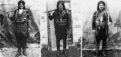
Certainly, the majority of Lebanese were not middle class or bourgeoisie by the 1920s and 1930s—to believe so would fall into the traps of Lebanese nationalist myth. The fifty dynamic years of social and economic transformations were the soil from which a native bourgeois culture sprouted and that it nourished in turn. Photography was keen to evince this culture, which became synonymous with Lebanese modernity and nationalism. Distinguishing between bourgeois portraits and “Sufi Musician” differentiates between active subjects and passive objects of photography but also between bourgeois and subaltern subjects. When we look at portraits of nonbourgeois subjects, the indexical and representational content of the images is often quite different.
Unlike the subject of “Sufi Musician,” we know the names of the 1920s montagnards in Figure 7 (left to right): Jirjis Bou Zeid, Yusuf al-Saqqi, and Elias al-Makari. Their arms, costumes, and stiff frontal postures resemble “criminal” portraiture and images of “rebels” in revolt against the French occupation.64
Photographs depicting the apprehension of “criminal leaders” and their “gangs,” such as Milham Qasim, by French Mandate authorities appear 1924–1925; see al-Maʿrid 1921–1932 (Beirut: Dar al-Nahar, 2001), for example, those dating from July through August 1925, p. 20. Note similar images, such as those of Druze leader Fawzi al-Qawuqji (January–March 1927, 20) and a bandoleer-festooned woman named Rashida al-Zaybaq (September–October 1926, 20). In the original publication, see “several pictures in the courtroom in the Justice Ministry during the trial of Mahmoud al-Rifaʿah and his gang,” al-Maʿrid, 21 Tashrin I, 1923, no. 251:1). Contrast the portraits of dignitaries, intellectuals, and politicians to those photographs of the leaders of “bandits” (i.e., warriors revolting against the French occupation) in al-Suwaida and Mount Lebanon that were published throughout the 1927 edition of al-Asrar al-musawwara (Beirut: Dar al-Nahar, 2002).
Rihani states that “the freedom of the individual is still the supreme end with the Oriental.” Ameen (Amin) Rihani, The Path of Vision: Pocket Essays of East and West (New York: White & Co., 1921), 173, 158. Sawda argued for the Maronite origins of the “Marada.” Yusuf Sawda, Fi sabil Lubnan (Beirut: Dar al-Arz, 1921). For a historiographic critique of Lammens' “mountain refuge,” see Kamal Salibi, A House of Many Mansions: The History of Lebanon Reconsidered (Berkeley, Calif.: University of California Press, 1988), 130–50.
Zaydan, Mudhakkirat, 12. Makdisi discusses how the Ottoman center constructed the ahal Jabal Lubnan as “pre-modern” savages antithetical to the civilization of the empire. Ussama Makdisi, “Rethinking Ottoman Imperialism: Modernity, Violence, and the Cultural Logic of Ottoman Reform,” in The Empire in the City.

Kamil al-Qareh: (left to right) Jirjis Bou Zeid, Yusuf al-Saqqi, Elias al-Makari, 1920–30. Reprinted with permission of the Foundation for the Arab Image.
Despite this stereotype, the subaltern subjectivity of the montagnards conveys a “punctum,” as Roland Barthes writes, that maintains a tension with the other images we have seen.67
The “punctum” is the “accident” of the photograph that divulges the image's alternative history. Roland Barthes, Camera Lucida: Reflections on Photography (New York: Hill and Wang, 1981), 27. For an example of the punctum's “alternative histories,” see Elizabeth Edwards, Raw Histories: Photographs, Anthropology, and Museums (Oxford: Berg, 2001), 101.
It has been suggested that photography liberalized the economy of visual representation, enabling those previously excluded, like the rural Lebanese peasant, to participate in self-representation. Yet, John Tagg has shown that although photography offered a more “democratic” symbolic order, it also ushered the nonbourgeoisie into a representational system that bound them securely to dominant discourses of class hierarchy and state power.68
Roland Barthes, Camera Lucida; Tagg, The Burden of Representation, 1–2. For a critique of Tagg, see Geoffrey Batchen, Burning with Desire: The Conception of Photography (Cambridge, Mass.: MIT Press, 1997), 7, and “Photography, Power, and Representation,” in Afterimage 16, no. 4 (1988): 7–9.
Buttressed by histories, journals, and fiction, some of which I have mentioned, the images served a double function for bourgeois individualism, one public and the other private. As in the West, the family in turn of the century Lebanon began to represent itself as self-contained and apart from society, even apart from church/mosque and state.69
Hirsh, Family Photographs, 35.
Ibid., 36.
FAMILY HISTORY
If this secular schema resonates too closely with the photographic history of the bourgeois family in the West, critical differences exist in Lebanon, particularly the triumph of a “culture of sectarianism.”71
For a meticulous examination of the development of the “culture of sectarianism” during the 19th century and how it cannot be separated from modernity in Lebanon, see Ussama Makdisi's rigorous The Culture of Sectarianism (Berkeley, Calif.: University of California Press, 2000). For a broader sociological study, see Samir Khalaf, Civil and Uncivil Violence in Lebanon (New York: Columbia University Press, 2002).
See Kais Firro, Inventing Lebanon: Nationalism and the State under the Mandate (London: I. B. Tauris, 2003), 98.
If religious communalism served the interests of ruling elites by displacing class antagonism, the photograph albums of families such as the Sursocks, Boustroses (Bistris), Pharaons, Eddehs, al-Hosses, Baltajis, al-Solhs, and Salams provided a normative, shared secular image through which the cross-confessional elites perceived and promoted themselves.73
Images of these families abound in the magazines, memoirs, and personal histories of the Mandate. For example, see the unscholarly local history of Raءs Beirut by its mukhtār Kamal Rebeiz, Rizq Allah ʿahidik al-ayyam … Ya Raءs Bayrut (Beirut: al-Matbaʿa al-Musawwara, 1986).
Meir Zamir, Lebanon's Quest: The Road to Statehood 1926–1939 (London: I. B. Tauris, 1997), 245.
For an article expressing the social dangers arising from new consumptive social practices, see “Shabban al-yawm,” in al-Hilal 5 (1896): 339.
Critiquing the master narratives of the modern history of the family, Beshara Doumani notes that the subject involves three interlocking “prestige zones” in Middle Eastern studies: gender, Islam, and modernity.76
Beshara Doumani, ed., Family History in the Middle East: Household, Property, and Gender (Albany, N.Y.: State University of New York Press, 2003), 2. For a gendered approach, see Suad Joseph, ed., Intimate Selving in Arab Families (Syracuse, N.Y.: Syracuse University Press, 1999).
Ibid., 5. See Philippe Fargues, “Family and Household in Mid-19th Century Cairo,” in Family History, 23–50, and Mary Ann Fay, “From Warrior-Grandees to Domesticated Bourgeoisie,” in Family History, 77– 97.
Samih Farsoun, “Family Structure and Society in Modern Lebanon,” in Peoples and Cultures of the Middle East, vol. 2, ed. Louise Sweet (New York: Natural History Press, 1970), 257–307.
Akram Khater challenges Farsoun's static family, showing that “between 1890 and 1920 the Lebanese expatriate community constructed a new set of relations that were neither modern nor traditional, neither Eastern nor Western. Rather, these new identities were peculiar to their individual, familial, and communal historical experiences.”79
Akram Khater, “‘Queen of the House?’ Making Immigrant Lebanese Families in the Mahjar,” in Family History, 293.
Ibid., 287.
The idea of romantic love between individuals with free will was propagated by Lebanese intellectuals for decades, from Salim al-Bustani and Niqula al-Haddad to Gibran and Tawfiq ʿAwad. This ideal relationship was predicated upon an a priori extracommunal individual, a self-contained subject with incumbent rights and personal desires in and of himself or herself. Adib Ishaq (1856–85), Francis Marrash (1836–73), and many of the aforementioned authors contemplated this universal, humanist subject.81
Marrash and Ishaq translated into Arabic the Enlightenment concepts of individual rights and the fraternity of “man.” See Adib Ishaq, al-Darar (Alexandria: Matbaʿat al-Mahrusa, 1886), and Francis Marrash, Ghabat al-haqq (London: Riad al-Rayyes, 1989 [1865]). Niqula al-Haddad's novels also posited the centrality of personal desires and freedom to the individual. See Thawrat al-ʿawatif ([Alexandria?]: n.p., n.d.).
Al-Bustani called upon the Syro-Lebanese citizen to put aside personal desires for national unity and concord. Al-Bustani, Nafir suriyya. See Sheehi, Foundations of Modern Arab Identity, 55–57.
Firro, Inventing Lebanon, 18.
THE LEBANESE IMAGO
Faroqhi states that by the late Ottoman Empire, Muslim upper-class family portraits “were already a part of everyday life. Women, particularly younger women, of that class, including the Sultan's daughters, liked to be photographed without veils and in European dress … pictured at the grand piano or holding a violin.”84
Faroqhi, Subjects of the Sultan, 258.
“Tadbir al-manzil,” al-Muqtataf 14 (1889–90): 484–85.
The fact that the subsection is nestled in between “Education of Children” and “A Cheerful Face Not Expensive Furniture” underscores that photography was seen as a domestic practice, one that would make visible the social aspirations of the family. The deployment of images in the salon advertised the visual hierarchy of the new family to its members and outsiders. An image by an unknown Sabunji brother (M. Saboungi) presents the ideal Lebanese comprador family. Like many Lebanese elites, Michel Fahoum had a thriving business in Cairo and commercial and political interests in Lebanon.86
See Thomas Philipp, The Syrians in Egypt 1725–1975 (Stuttgart: Steiner, 1985).

M. Saboungi: Fahoum family in Cairo, 1920. Reprinted with permission of the Foundation for the Arab Image.
In contrast, the middle-class mother as the family's reproductive base differed from the multitasking working and peasant mother. She was responsible for the family's ideological as much as their biological reproduction and her children's moral and social education, which ensured the longevity of a modern society. Her public image represented the family's private space. In this respect, the family portrait animated the internalization of the vision of the earliest proponents for the emancipation and education of Lebanese women as formulated by Lebanese intellectuals across confessions from Ahmad Faris al-Shidyaq to the Bustanis to ʿAbd al-Qadir al-Qabbani.87
Decades before Qassim Amin, women's emancipation was a centerpiece of reform in Lebanon, as expressed in editorials in al-Jinan, al-Muqtataf, Lisan al-hal, and Thamarat al-funun. As early as the 1850s, Ahmad Faris al-Shidyaq and al-Bustani championed women's education and their increased role in society. See Maqalat wa-khutub fi-l-tarbiyya: ʿAsr al-nahda al-haditha (Beirut: Dar al-Hamraء, 1990).
This domestic space defined the bourgeois family's immediate identity, setting lines of inclusion and exclusion. In Figure 9, the children of Sʿad al-ʿAlam form a wall behind the family patriarch that demarcates him as central to knowledge, order, reproduction, and capital. Sʿad founded a school in northern Lebanon, al-ʿAlamiyya, where his son, Najib, taught and which he later ran. His sisters flanking him, Najib stands at the center as his father's legacy. The wall of siblings blocks out those who are peripheral to the modern vision of self and family—whether they are the extended family or the lower classes.

Hanna al-ʿAlam, Sʿad al-ʿAlam with his children (Zeina, Najib, and Wise), 1920. Reprinted with permission of the Foundation for the Arab Image.
This exclusion divulges the bourgeoisie's need to distance itself from “tradition.” The need arose from middle- and ruling-class anxieties about the rural and urban underclass, which Jens Hanssen adeptly draws out.88
Jens Hanssen, Fin de Siècle Beirut: The Making of an Ottoman Provincial Capital (Oxford: Oxford University Press, 2005).
Sheehi, Foundations of Modern Arab Identity, 15–45.
In this historical vein, Graham-Brown warns that “it would be rash to assume that the families in these portraits automatically fit into the mould of the Western bourgeois family.”90
Graham-Brown, Images of Women, 95.
Faroqhi, Subjects of the Sultan, 95 (my italics), 97.
The nuclear family was not the mark of modernity in Lebanon. Rather, the native bourgeois family, whether it was the affluent Fahoums or the educated al-ʿAlams, portended to possess the qualities of capitalist modernity (family unity, decency, success, education, capital). The individuals of the family strove to match the imago of the bourgeois family (the father as productive head and mother as reproductive base) as represented by photography. For Lacan, the imago is the mirror image of the self, reflecting back to the infant a complete ontological presence. Simultaneously, the ego finds itself as the other in the mirror image, forming the “imaginary” basis for the ideal ego and thereby allowing the self-entry into the symbolic social.92
Jacques Lacan, “The Mirror Stage as Formative in the Function of the I,” in Ecrits (New York: Norton, 1977), 2–3.
The photographic imago during al-nahḍa was inspiration for and justification of bourgeois subjectivity, its desires, and socioeconomic trajectory. The young Edgar Mishaqa assumed editorship of his father's journal, Najib became the principal of al-ʿAlamiyya, and the teen Fahoum returned to Beirut to associate with the elite families responsible for establishing an independent Lebanon. Therefore, the photographic imago not only expressed what it meant to be a modern family and individual but also defined the role of each member and what he/she should desire to be.
THE KODAK CAMERA AND PERSONAL EXPERIENCE
Although studio portraiture remained important throughout the 20th century in Beirut, Kodak and Brownie cameras were the choice of many serious amateur photographers in Lebanon, such as Hanna and Najib al-ʿAlam, Marie el-Khazen, and Salim Abu ʿIzz al-din. A technological wonder of the age, Eastman's Kodak was the perfect mechanism to commute seamlessly between private and public spaces. Imported into the Ottoman Empire in 1888 by Onig Diradorian, the Brownie ensured mass access to photography, or at least middle-class access to it. Its accessibility, ease, and mobility tightly fastened the new bourgeois individual to the commodity culture that represented him/her. Along with the image it produced, the Kodak itself was a commodity that reproduced and signified a personal identity and experience that was uniquely modern.
One advertisement makes this correlation between consumerism, personal identity, and photography unequivocal. Along with a picture of the Kodak, the advertisement's headlines read, “Do you remember your first ride in a car? Do you remember the first time you rode a bicycle [darrāja]?”93
Misr al-haditha al-musawwara (March 1928), inside front cover.
Iskander Makarius, “al-Film aw al-ruqq,” al-Muqtataf 30 (1905): 224–25.
Kayfiyat al-husul ʿala suwar mutaqina: Dalil li-hiwayat al-taswir al-shamsi (Cairo: Kodak Co., 1927), 6.
Likewise, the Kodak advertisement related the camera to the automobile, the increased popularity and availability of which coincided with the first decade of the Mandate. The two are experiential prostheses, status symbols, and technological hallmarks of the mechanical age. Images of automobiles abound in the personal and public albums of Lebanese, produced by ordinary middle-class citizens like the al-ʿAlams (Figure 10) as well as elites like the affluent, photophilic Pharaons (Figure 11), who seemed to define style in Mandate Lebanon as much as they enjoyed taking photographs of themselves.96
The Pharaons (Far ʿawn) were a wealthy family, intermarried with President Beshara al-Khuri and Michel Chiha, ideological architect of the Lebanese state and co-owner of the Chiha-Pharaon Bank.
Akram Zaatari, ed., The Vehicle (Beirut: Foundation for the Arab Image, 1999). Iskander Marakius' journal highlights how class, gender, and consumption were intertwined with photography, representing bourgeois, personal experience. A Studebaker advertisement states, “Winter has come upon you and the best automobile to protect your health from sickness, cold and the harshness of wind and guarantee your comfort is Studebaker. It will protect you from the tortuous elements of winter, leaving you in comfort.” The driver, a woman, is driving away from a sketchy image of men pushing a mining car. Al-Lataءif al-musawwara (1923): 2.

Najib al-ʿAlam: al-Mazraʿa [view of al-Manara in Raءs Beirut], 1927. Reprinted with permission of the Foundation for the Arab Image.

Yvette Pharaon, Home in Aley, anon., 1936. Reprinted with permission of the Foundation for the Arab Image.

Marie el-Khazen, anon., 1920–30. Reprinted with permission of the Foundation for the Arab Image.
THE INDIVIDUAL, COMMODITIES, AND BEYOND
The Kodak represented the family as one, albeit central, defining element in the totality of the individual. Another term particular to the gestalt of the Lebanese individual was a person's relationship to commodity consumption. Lauded by nationalists and decried by romantics like Rihani and Gibran, the proliferation of commodities in Beirut defined it as an entrepôt but also as a capital of consumption. Photography documented this inventory of the things that could not be separated from Lebanese bourgeoisie identity, things that located it within modernity.
The image of Marie el-Khazen's nephew in Beirut (Figure 13) articulates how photography promulgated the signs of modern consumption and its role in social order but also individual and class identity. The image exemplifies the lessons of modern child rearing that regularly appeared in the print media of the day, intended to elevate a new generation of mothers, fathers, and children. For example, Rose Yusuf, born Fatimah Yusuf in Lebanon (1858–1958), who became the consummate middle-class critic, argues in her al-Marءa al-jadida that the negative effects of consumerism on men, women, and particularly children can be counterbalanced through the correct combination of “nationalistic activities, music, sports, and various kinds of beneficial play and leisure.”98
Rose Yusuf, al-Marءa al-jadida (1926), 107.
Histoires intimes (Beirut: Actes Sud, n.d.), 3.

Marie el-Khazen, anon., 1920–30. Reprinted with permission of the Foundation for the Arab Image.
El-Khazen's class status comes through clearly in her images and is closely associated with the consumerist compulsion of the 1920s. A comic in al-Musawwar, a journal run by Zaydan's sons Emile and Shakib, illustrates the collapse of the commodity with bourgeois identity as well as the gendered bourgeois body. In the comic, the head and limbs of a woman are drawn as dismembered from her jacket, skirt, and shoes; only together do they make a complete composite picture. The caption reads, “Woman as a woman sees her [the clothes]. Woman as man sees her [the body].”100
Comic in al-Musawwir 1, no. 5 (1925): 11 (my parentheses).
The folding of the commodity into the subject made it constitutive of bourgeois selfhood as much as the family. The consumption of commodities—house, automobile, camera, clothes, mass-produced toys, instruments, and so on—signified that the owner was a modern desiring individual. This took on an added ideological tenor in the Lebanese context as the Mandate government institutionalized the “open economy” of the republic. Nationalist ideologues such as Chiha, Samné, Corm, and Malek helped the French and Lebanese theorize how capitalist commerce and consumption were national traits that distinguished Lebanese from their backward Arab brethren. The photograph condensed commodities with these national, class, and familial elements of the individual self. For example, although residents of the rural North, Najib and his brother, Hanna, a Paris-educated physician, frequented Beirut and represented themselves in their photography as urban, cosmopolitan men. Therefore, by photographing themselves and their family in front of Beirut landmarks such as al-Manara (Figure 10) and el-Rawcheh (Figure 14), they are clearly expressing an ideological position regarding their own personal identities, their social and special mobility, and their representational and class differences from their Zghortawi concitoyen. Therefore, the brothers' album presents a group of educated, well-dressed, “modern” Lebanese siblings, each with shared but individual identities.

Hanna al-ʿAlam, “Najib, Zeina, and Wise al-ʿAlam” at el-Rawcheh, 1928. Reprinted with permission of the Foundation for the Arab Image.
El-Khazen's portfolio extends beyond the al-ʿAlams in number and scope. Her endless images document her home, friends, relatives, and travels throughout Lebanon, from Baʿlbek to Maʿamaltain to ʿAkkar. Unmarried, independent, and reminiscent of Gertrude Bell, her photographs of peasants and bedouin display an anthropological impulse. These images are sensitive and anticipate the photographic oeuvre of photophilic bedouin scholars like Jibraءil Jabbur. Despite this, the images have the effect of representing subaltern classes as traditional and communal (Figure 15) in contrast to her own bourgeois individualism. Her ethnographic photographs are compendia to the solitary images of el-Khazen. Always well dressed, she poses alone at the Beirut port, on a rocky harbor, on a beach (Figure 16), on a nameless mountain, or at a peasant's farm. The sartorial signifiers melt into these solitary images to communicate the liberty and independence of Marie in the mode of Gertrude Bell. Like Bell, her photography commutes between classes, confessionals, and provinces without disturbing her own individual identity. If commodity consumption was an ideological statement of national identity in the much-lauded “Switzerland of the East,” the personal experience invoked by al-ʿAlam's and el-Khazen's cameras was as separate from the nation as much as it was a part of it.

Marie el-Khazen, Rural men's dabka, 1920–30. Reprinted with permission of the Foundation for the Arab Image.

Marie el-Khazen, Marie on the beach at Jounieh,1920–30. Reprinted with permission of the Foundation for the Arab Image.
Photography in the early decades of the 20th century manifested an original compulsion to first find one's being in the desire for things, not only in the things themselves. It reinforced the myth narrated in contemporaneous Lebanese romantic literature, that the subject could leave the confines of capitalist and national space and time. In this fiction, commodities that illustrate the young lovers' class identity disappear from sites where they fall in love, such as gardens, mountains, streets, or fields. Lovers—usually compradors or enlightened peasants—assert their individuality and establish lives apart from their oppressive parents, evil uncles, wicked aunts, or covetous cousins—not to mention tyrannical oligarchs and repressive tradition.101
The individual self, love, and spirit apart from materialism were the basis for the romantic novel, starting with Gibran's al-Ajnihat al-mutakassira (New York: Miraءat al-Gharb, 1912). For the relationship between the romance novel and national subjectivity in the 19th-century Arab world, see Sheehi, Foundations of Modern Arab Identity, 76–106. For a noncritical discussion of the romantic aesthetic, see Joseph Abou-Rizk, Regards sur la peinture au liban (Beirut: Dar al-Funoon, 1956), and Muhammad Abu-Zariq, Min al-taءsis ila al-hadatha f-il-fann al-tashkili al-ʿArab al-muʿasir (Beirut: al-Muءassa al-ʿArabiyya li-l-Dirasat wa-l-Nashar, 2000).
The amateur snapshot acted similarly, albeit in a less conspicuous way. Like the image of Khazen fishing on the beach, the photograph disassociated Lebanese bourgeois subjects from necessity itself and even removed them from the very property and commodities that gave them their national and class identity as modern subjects.102
Hirsh, Family Photographs, 64.
For an example taken from columns on personal style, health, and hygiene advising how to care for one's body, see “How to Extend Your Life,” al-Musawwir 1, no. 1 (1924): 15. For the body as a “zone of significance,” see Lalvani, Photography, Vision, and the Production, 66.
The photography of al-ʿAlam and el-Khazen interweaves individual experiences with overlapping national, class, and familial identities (children, wives, siblings, and friends, and homes and cars). The individual experience of the bourgeois Lebanese as embodied by their self-representation found its ontology in the things of modernity, in modes of production particular to it, and the places and spaces that are exclusive to consumer culture. At the same time, the bourgeois individual precedes this ontology, existing separately from society, just like Marie on the beach. Amateur photographs such as those displayed by Najib al-ʿAlam's image in the mirror (Figure 17) are literally the imago of the bourgeois self. His photograph is a distilled imago of his selfhood, which supersedes the commodities of his toilette, in the foreground. As in all snapshot representation, he exists as an individual, both part of and apart from his national and class identity.

Najib al-ʿAlam, self-portrait, 1930. Reprinted with permission of the Foundation for the Arab Image.
The photograph animated the disappearance of the commodity into body seamlessly. It is instrumental in an ontological–political mystification, that is, the individual—upon which national, confessional, and class affiliation transpires—rests on the naturalness of a desiring self. Amateur photography, even more than studio photography, shows how the private self—the individual—finds its signifiers in commodities. Upon their naturalization, these commodities could disappear, because the desiring subject itself became a signifier for them. In Lebanon, this gestalt of individual selfhood is codified in its constitution, adopted in 1926. The preamble, Article 8 (personal liberty), Article 13 (expression), and Article 15 (property) protected “liberty of the individual” and ensured “private initiative and the right of private property,” protecting the sanctity of the home, conscience, religious belief, assembly, representation, and education.
CONCLUSION
The 1926 Lebanese Constitution expressed the consolidation of a bourgeois identity, which begs this article to conclude on another set of images that transmitted to individualist subjectivity that its framers assumed lay at the foundation of national identity. Odalisque-like, Lutfiyya's sensuous photograph (Figure 18) occupies a place among a large photographic collection taken by her husband, Salim Abu ʿIzz al-din (1873–1943). If Khazen's photographs document her life of privilege, individuality, and independence, then Abu ʿIzz al-din weaves a narrative of earned accomplishment. A Druze born in ʿAbadieh and educated at the prestigious Brummana High School, Abu ʿIzz al-din was an official in the Maritime Company in Istanbul, an employee of the British High Commission in Cairo, an “Officer of the British Empire,” and, finally, assistant director-general of the Egyptian Ministry of Interior. His large collection presents a public and private gentleman couched in images of a well-dressed and dignified Lutfiyya and his two children (ʿAziza and Fuءad) as well as their friends, dog, houses, servants, horses, and gardens in Lebanon and Egypt. The public face puts forth the man in his official capacity as a state functionaire, dignified and commanding (Figure 19). The private is a bourgeois individual, relaxed but confident, dapper, and educated (as signaled by the tarboosh; Figure 20). As a male, the two are inevitably connected.

Salim Abu ʿIzz al-din, Lutfiyya, 1902. Reprinted with permission of the Foundation for the Arab Image.

Salim Abu ʿIzz al-din, on a boat to Istanbul from Egypt, ca. 1898. Reprinted with permission of the Foundation for the Arab Image.

Abu Izz al-ʿdin [Salim in his garden in Egypt], 1902. Reprinted with permission of the Foundation for the Arab Image.
Taken in 1902, the image of a reclining Lutfiyya contrasts with those of her properly dressed in front of her house, in her parlor, or with her children, sisters, and friends. It sharply conveys Lutfiyya's agency, which is not as sexual in nature as much as it is libidinal. Less an economy of sexual instincts, libidinal energies are projective and find satisfaction in specific object relations.104
Libidinal desire finds its expression in the availability or prohibition of objects. Simultaneously, the act of desiring is an act of individuation. For an extended definition of libido theory, see Sigmund Freud, New Introductory Lectures on Psycho-Analysis, trans. James Starkey (New York: Norton, 1989), 118–38, and Sigmund Freud, Three Essays on the Theory of Sexuality (New York: Basic Books, 1962), 60–63.
As an amateur photograph, Lutfiyya's image is rare for its age. However, by the 1920s, its narrative had become commonplace in bourgeois photography. The constitution summed up the imago of the self-contained Lebanese as represented in al-ʿAlam's self-portrait in the mirror (Figure 17) or images of individuals in nature, such as el-Khazen on the beach (Figure 16). In this way, the photograph of el-Khazen's sister is a nexus of several of the issues previously discussed (Figure 21). A wife of a Lebanese merchant living in Egypt, her direct eye contact with the camera indicates an activity upon which we accept her as a subject of leisure. This active agency is the source of object relations that define her personal identity, her identity as a desiring self. In her ancestral home, her feet rest on a crate of imported French Vegetalin, her body reclines in a wicker rocker, and one of the two mirrors that appear in several other images of the el-Khazen family forms the background. Living in Egypt, she is a member of the privileged expatriate community that could maintain residence in Lebanon and abroad. As the wife of a merchant, she represents commerce along with bourgeois domesticity. These qualities take on a further nationalistic tenor when realizing that she was a daughter of an aristocrat. The image sums up the various aforementioned tenets of the liberal constitution that undercut the normative representational field of the bourgeois individual in Lebanon. That el-Khazen's sister is an émigré to Egypt further calls attention to the Ottoman legacy of Lebanon's bourgeoisie and reminds us of the economic and cultural connections between cities like Cairo and Beirut; Lebanese compradors owned businesses and journals in Egypt and worked in schools and the government, only later to return to Lebanon and join the new, landed middle class.

Marie el-Khazen, sister Hoda, 1920–30. Reprinted with permission of the Foundation for the Arab Image.
In this less than comprehensive prolegomenon, I have regrettably ignored a nuanced unpacking of gender's role in photography, consumerism, and bourgeois subjectivity, nor have I discussed how representation of peasants, proletarians, lumpen classes, soldiers, students, and clerics played an active role in identity formation throughout Lebanon. Rather, this article scratches at how photography in Lebanon served to reify the imago of a bourgeois individual who was a composite totality of private and public identities. This article begins to explain how the photographic image naturalized the discourses of individualist, class, nationalist, and consumer desire that were germinated in the political economy and the organic intellectual culture both preceding and during the French Mandate. Indeed, the photographic practices of the Ottoman eastern Mediterranean—whether Arab, Turkish, or Armenian—similarly represented the process of embourgeoisement under way in cities such as Beirut, Cairo, Haifa, and Istanbul. Similarities aside, the socioeconomic and cultural history of Mandate Lebanon contrasts with this history of Palestine, Syria, or the more economically diverse, affluent, and powerful Egypt. Photography assisted in instituting a new process of desiring capitalist production, accumulation, and consumption in Lebanon, but beyond that, the imago of the native individual erased the socially constructed nature of such desire.
Author's note: I thank Irene Beirman, Leo Ching, Michelle Hartman, Allan Hibbard, Lareesa Isa, Samir Khalaf, Akira Mizuta Lippit, Nancy Micklewright, Walid Raad, and Eric Zakim for their generous comments regarding the content of this article and Akram Zaatari, Zeina Arida, and Tamara Suwaya at the Foundation for the Arab Image in Beirut for their active support during the research process. Dr. Judith Tucker, Sylvia Whitman, and the staff at IJMES were extremely helpful in the editing of the text, as well as hammering out the logistical challenges of publishing an article on visual culture. Likewise, anonymous readers made invaluable comments to improve this article. Although the images did not make it into this article, the Special Collections staff at the Getty Research Institute helped me search through the Pierre de Gigord Ottoman Collection, allowing me to locate early Lebanese–Arab photography in relation to its larger Ottoman context. My research was supported by grants from the Franklin Center for International Studies at Duke University, a Mellon Research Grant from the Center for Social and Behavior Studies, and a Faculty Research Grant from the Provost Office at the American University of Beirut. All images and information in this article are from the archives of the Foundation for the Arab Image (FAI) in Beirut. I add titles, dates, and/or photographers when able to approximate that information or if provided by the archives. The descriptions in brackets are mine.