Introduction
An inverse association between offspring birth weight (BW) and risk of parental cardiovascular disease (CVD) mortality and morbidity has been reported in many studies.Reference Osmond and Barker 1 – Reference Friedlander, Manor and Paltiel 5 The explanatory pathway underlying these associations is not clearly established. Several concepts have been suggested to define a specific mechanism responsible for these associations. One of the proposed concepts is the thrifty phenotype hypothesis suggested by Barker,Reference Hales and Barker 6 posing that an adverse nutritional environment during intrauterine life marks permanent changes in the growing fetus. These changes, in turn, increase the susceptibility of chronic diseases such as diabetes and coronary heart disease in adult life. Experimental studies have confirmed the importance of epigenetic modifications in the early onset of chronic diseases.Reference Godfrey, Lillycrop, Burdge, Gluckman and Hanson 7 – Reference Wang, Walker, Hong, Bartell and Wang 9 Alternatively, common genetic factors (pleiotropic effect) may be responsible for the associations.Reference Hattersley and Tooke 10 It is also possible that shared environmental factors partly explain the associations between decreased fetal growth and chronic diseases later in life.Reference Bergvall and Cnattingius 11
The explanatory role of shared familial factors (gene and environment) on reduced BW and chronic disease associations has been assessed in a number of epidemiological studies. Regarding CVD risk, some previous studies found offspring BW and mortality associations in fathers, as well as in mothers, supporting some importance of the genetic factors.Reference Davey Smith, Hypponen, Power and Lawlor 2 – Reference Davey Smith, Hart and Ferrell 4 , Reference Li, Chen and Sung 12 , Reference Manor and Koupil 13 However, some studies presented a weaker effect in fathers compared with mothers.Reference Li, Chen and Sung 12 , Reference Naess, Stoltenberg and Hoff 14 The impact of non-pathologic maternal constraint such as height and parity can be considered in this regard.Reference Elshibly and Schmalisch 15 Furthermore, a recent study investigating mother–offspring and father–offspring correlations for CVD risk factors showed similar mother/father–offspring associations for most of the risk factors. The authors suggested that shared environmental and genetic factors both are equally important for explaining the observed associations.Reference Vik, Romundstad, Carslake, Davey Smith and Nilsen 16
Parental smoking is an important shared environmental risk factor that could influence both offspring BW and own risk of CVD mortality.Reference Davey Smith, Hypponen, Power and Lawlor 2 , Reference Smith, Sterne, Tynelius, Lawlor and Rasmussen 3 , Reference Dietz, England and Shapiro-Mendoza 17 Most previous studies have reported the role of smoking and socio-economic factors in the association between offspring BW and maternal CVD mortalityReference Davey Smith, Hypponen, Power and Lawlor 2 , Reference Friedlander, Manor and Paltiel 5 , Reference Bonamy, Parikh, Cnattingius, Ludvigsson and Ingelsson 18 however; data on the role of other parental CVD risk factors in the association is sparse. Thus, in this study, we use data from the Norwegian health surveys and the Medical Birth Registry to investigate the importance of parental CVD risk factors in the association between offspring BW and CVD mortality among mothers and fathers.
Methods
Using a multigenerational database, the Medical Birth Registry of Norway (MBRN) was linked to the three health surveys [Cohort of Norway (CONOR), Age 40 Program and County Studies], the National Educational Registry and the Cause of Death Registry. All births in MBRN were linked to the health survey participants by using a unique personal identification number.
MBRN was introduced in 1967 and encloses information about demography, maternal diseases before and during pregnancy, complications during pregnancy and delivery, congenital defects and perinatal health.Reference Irgens 19 The three large health surveys were conducted in Norway for the screening of CVD risk factors in the population. In the Norwegian County Study (1974–1988), inhabitants of three different counties between 35 and 49 years were invited for CVD risk screening at three different time periods.Reference Bjartveit, Foss, Gjervig and Lund-Larsen 20 In the Age 40 Program (1985–1999), all those aged 40–42 years were invited regularly for cardiovascular health screening in all Norwegian counties except Oslo.Reference Bjartveit, Stensvold and Lund-Larsen 21 In the CONOR, cardiovascular data from the different regions of Norway was collected from 1994 onwards.Reference Naess, Sogaard and Arnesen 22 The response rate in the County Study was 86%, whereas in the Age 40 Program and CONOR it was 70 and 56%, respectively.Reference Kjollesdal, Ariansen, Mortensen, Davey Smith and Naess 23
Sample
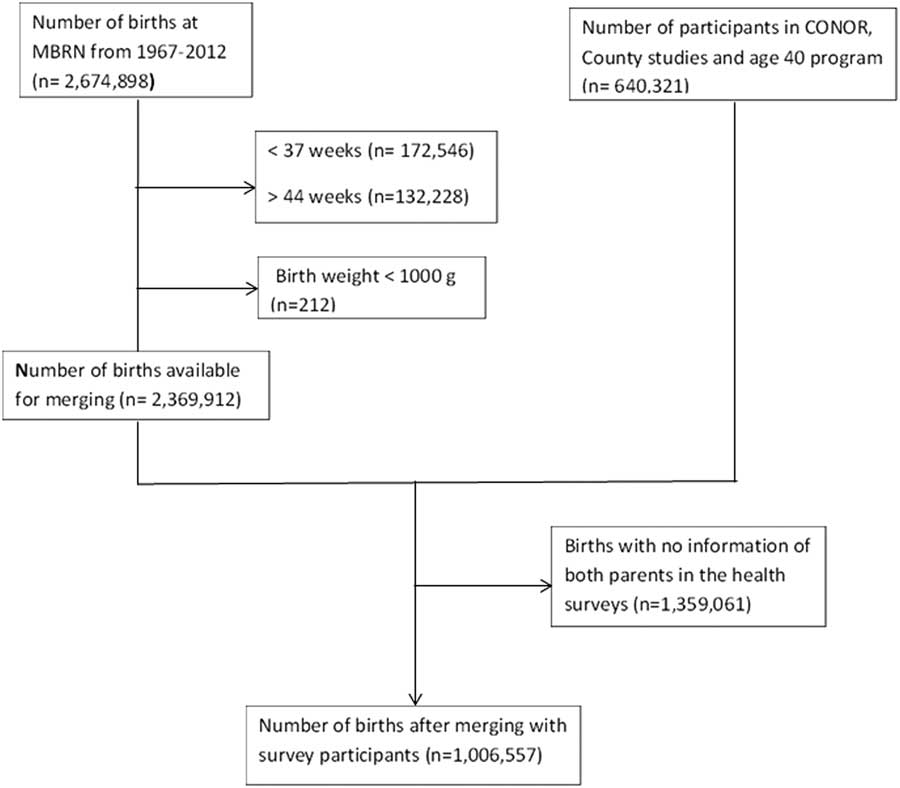
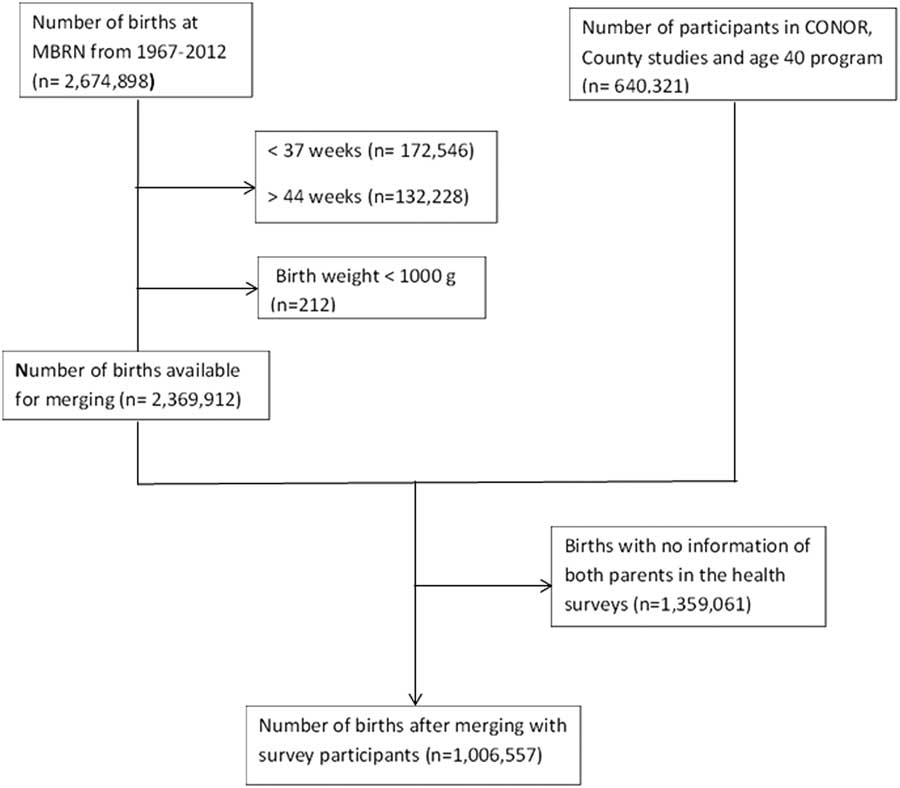
The number of births (from 1967 to 2012) with information on maternal and paternal CVD risk factors available for the analysis was 1,006,557 (520,670 for mothers and 485,887 for fathers). Births without information from both parents in the health surveys were excluded (Fig. 1). Further, pregnancies <37 weeks (n=172,546), >44 weeks (n=132,228) and offspring BW <1000 g (n=212) were excluded.
Flow chart. MBRN, Medical Birth Registry of Norway; CONOR, Cohort of Norway.
Birth data
Information about BW (in grams), sex, gestational age, birth order and year of offspring birth was taken into consideration. Congenital anomalies among the offspring were coded as ‘disease in offspring.’ Information about maternal age, parity, diseases before pregnancy (asthma, chronic hypertension, chronic renal disease, urinary tract infection, rheumatoid arthritis, heart disease, diabetes, epilepsy and thyroid diseases) and diseases during pregnancy (vaginal bleeding, glycosuria, hypertension, preeclampsia, eclampsia, gestational diabetes, anemia, thrombosis and infection) was also included in the analyses. BW was categorized and analyzed according to the percentiles. Data on smoking during pregnancy was recorded in the MBRN after 1999, and it was not mandatory for mothers to report on smoking.
Assessment of CVD risk factors in parents
In the health surveys, participants were screened for the clinical measurements including systolic (SBP) and diastolic (DBP) blood pressure, heart rate, total serum cholesterol (TC), triglycerides (TG), height and weight. In CONOR and the Age 40 Program, all biochemical measurements were done by the enzymatic methods. In the County Study, TC and TG were measured by the non-enzymatic methods and later transformed to the enzymatic method by a correction factor.Reference Stocks, Borena and Strohmaier 24 An automatic device was used to measure heart rate, SBP and DBP. Three recordings were made at 1-min intervals after resting for 2 min. The mean values of the second and third recordings were used in the analyses. Acceptable stability of BP measures over time in the population surveys has been reported.Reference Lund-Larsen 25 Height was measured to the nearest centimeter and body weight was measured to the nearest half-kilogram with participants wearing light clothing without shoes. Body mass index (BMI) was calculated as weight (kg)/height (m2). Obesity was defined as BMI⩾30 kg/m2. Hypertension was defined as SBP⩾140 mmHg and/or DBP⩾90 mmHg. Information about self-reported health such as smoking and prevalent diabetes was collected by the self-administered questionnaire. Participants were asked ‘do you have, or ever had diabetes’ and answers were taken as ‘yes’ or ‘no.’ Smoking status of the participants was categorized into ‘current smoker and non-smoker.’
A sensitivity analysis was performed to examine the effect of unmeasured confounding by smoking on the association between offspring BW and parental CVD mortality. A subgroup (n=866,348) with information on lifelong smoking was used to categorize smoking habits into ‘never smoke before’ and ‘ever smoke before.’ Cigarette consumption was also calculated in the same group as ‘number of pack-years’ by using the following formula: Number of pack-years=(number of cigarettes smoke per day/20)×number of years smoked.
Other variables
Data on parents’ education was extracted from the National Educational Registry of Statistics Norway and was categorized as ‘<9 years,’ ‘10–12 years’ and ‘>13 years.’ Parental marital status was categorized as married/cohabitant and others (including unmarried, single, divorce and registered partners).
Cardiovascular mortality
The Norwegian Cause of Death Registry used the International Classification of Diseases (ICD) 8th, 9th and 10th revision. Cardiovascular deaths were coded as ICD 9:390–459, ICD-10: 100–199. These codes refer to diseases of the circulatory system. 26
Statistical analyses
All statistical analyses were performed in STATA software version 14. Linear regressions were used to assess associations between offspring BW and all covariates. Offspring BW was analyzed by quintiles and by small for gestational age (SGA) (below the 10th percentile for gestational age) compared with non-SGA. The association between BW and CVD mortality in mothers and fathers was measured by hazard ratio (HR) estimated in Cox regression. The proportional hazards assumption was verified by plotting the Schoenfeld residuals. The CVD deaths in parents were followed from 1974 to 2012. The total person-years included in the analysis were: 16,409,176 (mothers) and 14,766,427 (fathers). Several offspring in our study were nested within the same parents. Therefore, offspring dependency within parent was taken into account by the ‘robust cluster’ command in STATA version 14. This command effectively adjusts the standard error for within-parent correlation. The offspring were clustered on two parents (520,670 for mothers and 485,887 for fathers). Reduction in HR was used to assess the extent to which CVD risk factors could explain the mortality risk associated with offspring BW. A P-value<0.05 was considered as significant.
Results
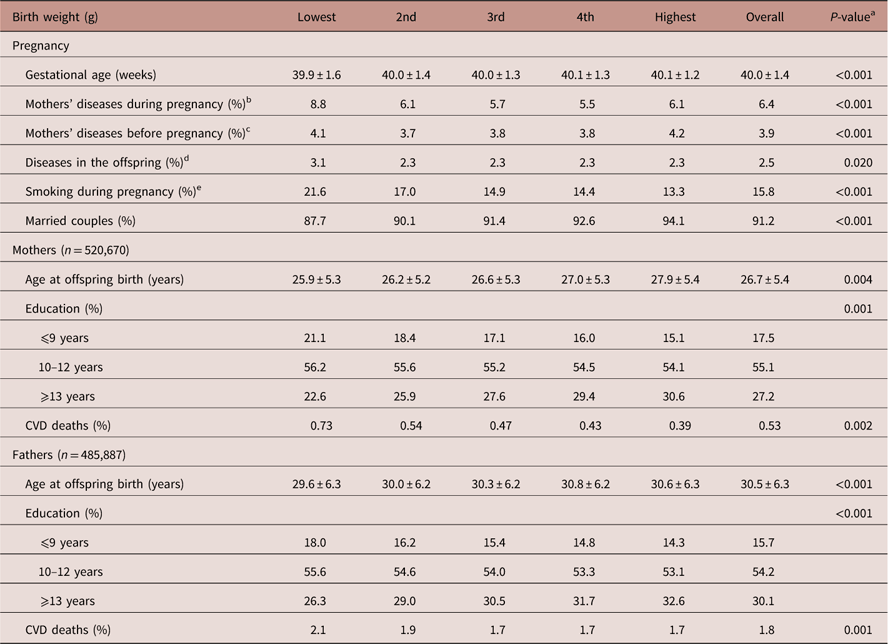
Table 1 shows characteristics of parents according to the quintiles of offspring BW. Parents of offspring in the lowest BW quintiles were comparatively younger at the time of offspring birth. They were less likely to have married and less educated than parents of offspring in the higher BW quintiles. Higher BW was related to a lower proportion of smoking during pregnancy. The number of CVD deaths in mothers and fathers were 2660 and 9160, respectively.
Characteristics of the study cohort according to quintiles of offspring birth weight born between 1967 and 2012 (n=1,006,557)

CVD, cardiovascular disease.
a P-value for difference between the groups.
b Mothers’ diseases during pregnancy: vaginal bleeding during pregnancy, glycosuria, gestational diabetes, preeclampsia, eclampsia, HELLP syndrome, anemia and infections.
c Mothers’ disease before pregnancy includes: asthma, recurrent urinary tract infection, kidney disease, hypertension, diabetes (type 1 and 2), rheumatoid arthritis and heart disease.
d Disease in offspring: congenital malformations (coded in Medical Birth Registry from C01-C45).
e Subset with smoking data available after 1999 (n=29,821).
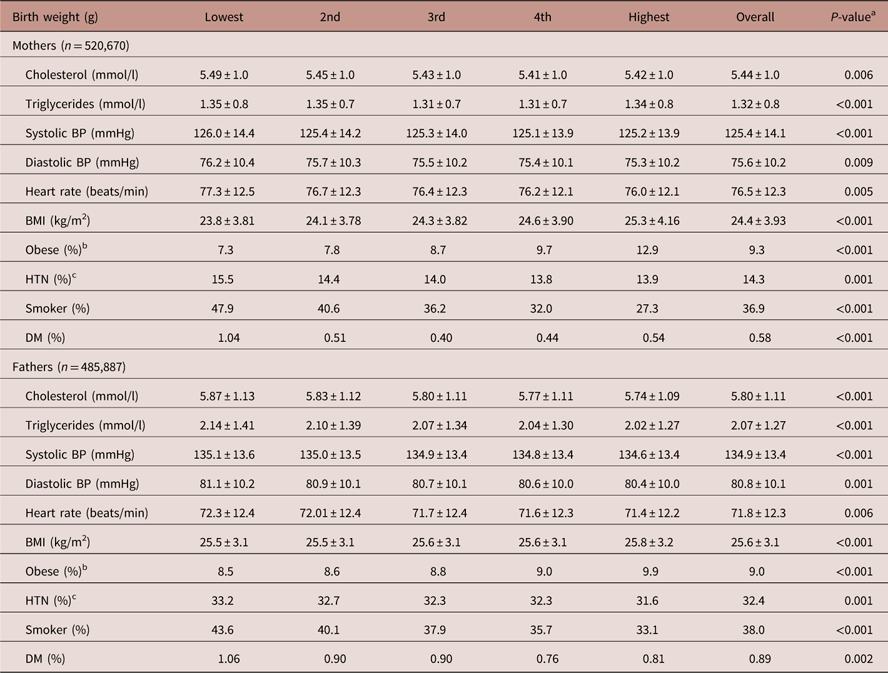
A more unfavorable pattern of CVD risk factors was observed among parents of offspring in the lowest BW quintile (Table 2). A higher proportion of smokers and hypertensive, as well as higher mean levels of TC, SBP, DBP and heart rate were observed among parents of offspring in the lowest BW quintile compared to their counterparts. A trend of higher mean TG level was detected only among fathers of offspring in the lowest BW quintile. The proportion of obese parents was higher among offspring in the highest BW quintile.
Mean values and percentages of parental cardiovascular disease risk factors according to quintiles of offspring birth weight (n=1,006,557)

BP, blood pressure; BMI, body mass index; DM, diabetes mellitus.
Some parent had multiple children, therefore number of births (n=1,006,577) were clustered on two parents (mothers: n=520,670 and fathers: n=485,887).
a P-value for difference between the groups.
b BMI⩾30 kg/m2.
c HTN, hypertension (systolic BP>140 mmHg).
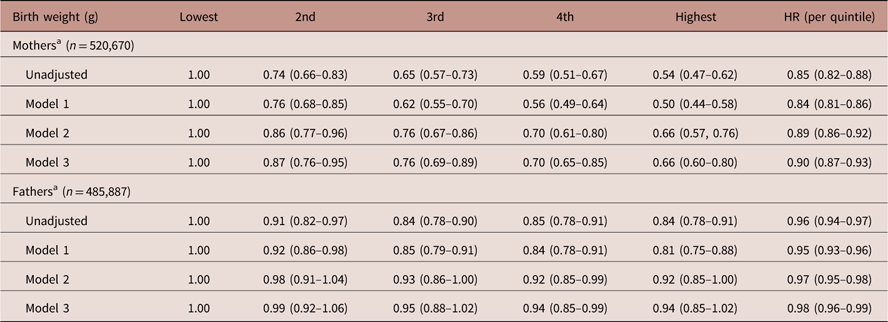
An inverse association between parental CVD mortality and offspring BW was observed among both parents (Table 3). The age-adjusted HR for per quintile increase in BW was 0.84 (0.81–0.86) for mothers and 0.95 (0.93–0.96) for fathers. Adjusted for parental CVD risk factors, the effect estimates associated with per quintile increase in BW were attenuated to 0.89 (0.86–0.92) among mothers and 0.97 (0.95–0.98) among fathers. Further adding maternal disease before and during pregnancy, parity, diseases in offspring, offspring year of birth, parental marital status and education to the model attenuated the associations a little among both parents (model 3).
Hazard ratio (HR) (95% CI) of cardiovascular disease (CVD) deaths in parents according to quintiles of offspring birth weight in different multivariate models (n=1,006,557)

Model 1: adjusted for age (father and mothers).
Model 2: plus CVD risk factors (body mass index, cholesterol, triglycerides, systolic and diastolic blood pressure and smoking).
Model 3: plus maternal diseases before and during pregnancy and diseases in offspring, education and marital status.
a Number of CVD deaths: mothers (n=2660), fathers (n=9160).
P-value for difference in effect between father and mother was <0.001.
CVD risk factors explaining the association between offspring BW and CVD mortality in parents
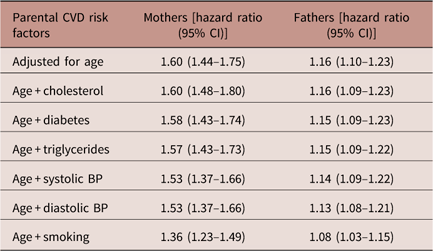
Table 4 states the HR of parental CVD mortality in SGA compared with non-SGA offspring. The CVD mortality risk in parents was first adjusted for age and then age plus TC, TG, smoking, diabetes, SBP and DBP, one at the time. Age-adjusted CVD mortality rate for mothers [1.60 (1.44–1.75)] and fathers [1.16 (1.10–1.23)] of SGA offspring was higher than among others. Among mothers, adjustment for smoking, TG and diabetes reduced the risk to 1.36 (1.25–1.52), 1.57 (1.43–1.73) and 1.58 (1.43–1.79), respectively. Adjustment for DBP and SBP both reduced the risk to 1.53 (1.37–1.66). Among fathers, adjustments for smoking, DBP, SBP reduced the risk to 1.08 (1.02–1.15), 1.13 (1.06–1.19) and 1.14 (1.08–1.22), respectively. Adjustment for TG and diabetes reduced the risk to 1.15 (1.09–1.12). Smoking was the single largest contributor to the reduction in excess CVD mortality associated with low BW risk among both parents. The second strongest contributors among mothers were SBP and DBP, followed by TG and diabetes. Among fathers, the contribution of other CVD risk factors in the association was found to be very small.
Hazard ratio (95% CI) of cardiovascular disease (CVD) deaths in parents by small for gestational age offspring after adjusting for CVD risk factors (n=1,006,557)

BP, blood pressure.
In the sensitivity analyses, parental CVD mortality risk was adjusted for ‘ever smoke before.’ Among fathers, the risk reduced from 1.16 (1.10–1.23) to 1.15 (1.09–1.22) and among mothers from 1.60 (1.48–1.79) to 1.57 (1.42–1.72). Further adjustment for ‘number of pack-years’ reduced the risk to 1.10 (1.03–1.17) in fathers and 1.51(1.35–1.68) in mothers. The impact of lifelong smoking was found to be smaller than for current smoking.
Discussion
Our study investigated the role of parental CVD risk factors in the association between offspring BW and CVD mortality among parents. An inverse association was observed between offspring BW and risk of CVD mortality among mothers, as well as among fathers. Parental CVD risk factors may account for some of this association, with smoking being by far the most important contributing risk factor.
Comparisons with other studies
Our results are in accordance with previous studies. A large cohort study found an inverse relationship between offspring BW and CVD mortality among mothers as well as among fathers.Reference Smith, Sterne, Tynelius, Lawlor and Rasmussen 3 Furthermore, several previous studies and a meta-analysis have reported an inverse association between BW and parental CVD mortality, albeit with weaker strength in fathers compared with mothers, as we observed.Reference Davey Smith, Hypponen, Power and Lawlor 2 – Reference Davey Smith, Hart and Ferrell 4 , Reference Lawlor, Davey Smith and Whincup 27 On the contrary, another cohort study showed no consistent inverse relationship between offspring BW and parental CVD and diabetes.Reference Adams, Pearce, White, Unwin and Parker 28
We were able to investigate the role of parental CVD risk factors in offspring BW and CVD mortality association among both parents. Smoking was found to be the risk factor influencing this association considerably among both parents. The impact of smoking on the association is verified by other studies.Reference Davey Smith, Hypponen, Power and Lawlor 2 , Reference Davey Smith, Hart and Ferrell 4 , Reference Friedlander, Manor and Paltiel 5 , Reference Li, Chen and Sung 12 , Reference Catov, Newman and Roberts 29 Most of the previous studies have investigated the role of smoking during pregnancy on BW and heart disease risk among mothers,Reference Davey Smith, Hypponen, Power and Lawlor 2 , Reference Friedlander, Manor and Paltiel 5 , Reference Bonamy, Parikh, Cnattingius, Ludvigsson and Ingelsson 18 , Reference Catov, Newman and Roberts 29 however only a few have investigated the role among fathers.Reference Davey Smith, Hypponen, Power and Lawlor 2 , Reference Smith, Sterne, Tynelius, Lawlor and Rasmussen 3 , Reference Li, Chen and Sung 12 Furthermore, a detrimental effect of maternal smoking on BW and CVD mortality association has also been reported in more than one generation.Reference Manor and Koupil 13 , Reference Naess, Stoltenberg and Hoff 14 The evidence regarding impact of other paternal CVD risk factors such as BP, TC and TG on the BW and CVD association is sparse.Reference Davey Smith, Hart and Ferrell 4 , Reference Vik, Romundstad and Nilsen 30
Furthermore, we observed that maternal CVD risk factors such as SBP, DBP and TG contributed to offspring BW and maternal CVD mortality association to some extent. In contrast, paternal CVD risk factors other than smoking had only a negligible impact on the association in fathers. This suggests that there are independent maternal and paternal impacts, some of which may be mediated through intrauterine factors.Reference Davey Smith, Sterne, Tynelius and Rasmussen 31 Although the reduction in excess CVD mortality risk was found to be small, the impact of other potential CVD risk factors than smoking cannot be completely excluded, as the ones we included in our study were measured only once during the life course. Our results suggest that environmental factors might be important in the relationship between offspring BW and parental CVD mortality.
An unfavorable CVD risk factor profile was observed among parents of offspring in the lowest BW quintile. These findings are consistent with other studies investigating the relationship between CVD risk factors and history of offspring BW. An elevated SBP and insulin resistance have been reported among mothers with a history of a low birth weight (LBW) child in first pregnancy.Reference Walker, McConnachie, Noon, Webb and Watt 32 , Reference Lawlor, Smith and Ebrahim 33 Similarly, another study suggested that an obstetric history of LBW delivery may be helpful in screening women with an elevated level of CVD risk factors.Reference Catov, Newman and Roberts 29
Our results reported a stronger association in mothers than fathers. Unlike our results, a previous study stated similar mother–offspring and fathers–offspring associations for most of the CVD risk factors, except height and SBP, which showed stronger mother–offspring than father–offspring associations.Reference Vik, Romundstad, Carslake, Davey Smith and Nilsen 16 The stronger association observed in mothers can be interpreted by multiple mechanisms. One could be maternal impact due to intrauterine exposure (e.g. nutritional factors). The direct effect of health-related behaviors might be another explanation for this stronger effect observed in mothers. Smoking in mothers has been shown to be associated with lower offspring BW and with their own risk of CVD.Reference Dior, Lawrence and Sitlani 34 , Reference Horta, Victora, Menezes, Halpern and Barros 35 On the other hand, it might be possible that paternal smoking may have an epigenetic effect whereas maternal smoking has the additional direct effect of fetal exposure to the anorectic properties of nicotine. Another possible factor is assortive mating, whereby partners choose a spouse with similar behaviors, creating an apparent ‘environmental’ effect and inflating the observed paternal contribution. Furthermore, studies have shown that CVD risk factors for instance blood pressure,Reference Havlik, Garrison and Feinleib 36 dyslipidemias,Reference Garrison, Castelli and Feinleib 37 type 2 diabetesReference Thomas, Balkau, Vauzelle-Kervroedan and Papoz 38 and obesity have deep roots in the influences of the previous generation.Reference Vik, Romundstad and Nilsen 30 It might be possible that parental CVD risk factors are themselves programmed in the previous generation and do not necessarily reflect a genetic predisposition.Reference Barker 39
Strengths and limitations
The strengths of our study included a large sample size and population-based design, giving a representative population. We were able to use standardized measures of parental CVD risk factors such as BMI, BP, blood lipids and smoking from survey data. These surveys had reasonable response rates. Furthermore, a high quality and comprehensive record about pregnancy and births was used in our study and we were able to calculate BW for gestational age which is a robust measure of intrauterine growth of the fetus. Moreover, use of registry data eliminates problems related to lost to follow-up. Our study has some limitations. Lipid levels of the survey participants were taken in a non-fasting state. This could increase the chances of statistical uncertainty however, previous studies have reported only a minimal difference in lipids after normal food intake and in the fasting state.Reference Langsted, Freiberg and Nordestgaard 40 It should be considered that glucose levels in parents were not assessed in the study, however information about self-reported diabetes from the health surveys was included in the analyses. Maternal diet is known to be important in providing nutrients required for robust fetal growth and paternal diet may also influence the epigenetic status of sperm. However, it is not assessed in our study. Data on smoking during pregnancy was not available in a high proportion of the mothers (97%) because smoking has been registered in the MBRN only after 1999. This provides a short period for the follow-up of CVD deaths in this subgroup. Therefore, we could not estimate an impact of ‘smoking during pregnancy’ on the studied association. However, a positive correlation (r=0.367) was observed between smoking during pregnancy and smoking habits in the survey data. The data on lifelong smoking and pack-years was available in a subgroup. Assuming that lifelong smoking is reported reliably, the observed HR after adjusting for ‘ever smoke before’ and ‘pack-years’ gives a complete control of smoking in our results.
Conclusion
Cardiovascular risk factors may have a role in explaining the association of offspring BW and parental CVD mortality, with smoking being the most important among both parents. Although smoking has declined in Norway in recent decades, 41 it’s prevalence is still high. Thus, our results can be generalized to the population at large. Our results indicate that shared environmental factors might be important in the association between offspring BW and parental CVD. Moreover, a stronger association in mothers suggest that some of the effect may be facilitated through intrauterine factors. Further research in this area may give important insight into the prevention of CVD.
Acknowledgments
Ø.N. conceptualized the idea and Ø.N. and M.K.K. provided a critical revision of the article. F.S. analyzed data and drafted the manuscript.
Financial Support
This study was supported by the University of Oslo, Norway.
Conflicts of Interest
None.
Ethical Standards
Ethical approval for the study was acquired from the Regional Ethical Committee of Norway (REK).