


Introduction
Depressive symptoms are common in schizophrenia. Whilst depressive symptomatology can accompany acute psychosis, there are estimates that around a third of people with schizophrenia may experience depression independently of psychosis during the stable phase of their illness (an der Heiden, Könnecke, Maurer, Ropeter and Häfner, Reference an der Heiden, Könnecke, Maurer, Ropeter and Häfner2005; Birchwood, Iqbal, Chadwick and Trower, Reference Birchwood, Iqbal, Chadwick and Trower2000). Such symptoms have been proposed to arise, at least in some people, as a psychological reaction to stress, in particular to the difficulties adjusting to and living with a chronic, disabling and stigmatized illness (e.g. an der Heiden et al., Reference an der Heiden, Könnecke, Maurer, Ropeter and Häfner2005; Birchwood, Reference Birchwood2003).
In understanding the emergence of depression, a number of studies have reported that depressive symptoms in schizophrenia are associated with awareness of illness, with people who lack insight tending to be less prone to depressive symptoms than those who are aware of illness. In a meta-analysis of 15 cross-sectional studies, Mintz, Dobson and Romney (Reference Mintz, Dobson and Romney2003) concluded that there was a small but significant relationship between measures of insight and depressive symptoms. In addition, there is longitudinal evidence that the development of insight (Carrol et al., Reference Carroll, Fattah, Clyde, Coffey, Owens and Johnstone1999; Crumlish et al., Reference Crumlish, Whitty, Kamali, Clarke, Browne and McTigue2005; Drake et al., Reference Drake, Pickles, Bentall, Kinderman, Haddock and Tarrier2004; Rooke and Birchwood, Reference Rooke and Birchwood1998) and other illness-related beliefs (Iqbal, Birchwood, Chadwick and Trower, Reference Iqbal, Birchwood, Chadwick and Trower2000; Rooke and Birchwood, Reference Rooke and Birchwood1998) can prospectively predict the emergence of depressive reactions. An interpretation of this is that awareness of one's mental illness, and its inherent implications for one's identity and future, may lead to patterns of thinking that increase vulnerability to depression.
One way of examining this possible role of cognition in adjustment to schizophrenia is to investigate specific illness-related appraisals associated with depressive responses. Appraisals of mental illness that have been predictive of depressive symptoms include seeing it as a loss, source of humiliation or uncontrollable stressor (Birchwood, Mason, MacMillan and Healey, Reference Birchwood, Mason, MacMillan and Healey1993; Iqbal et al., Reference Iqbal, Birchwood, Chadwick and Trower2000; Lobban, Barrowclough and Jones, Reference Lobban, Barrowclough and Jones2004, Reference Lobban, Barrowclough and Jones2005; Rooke and Birchwood, Reference Rooke and Birchwood1998; Watson et al., Reference Watson, Garety, Weinman, Dunn, Bebbington and Fowler2006). Another line of investigation is to examine cognitive processes that are implicated in depression. In the literature on affective disorders, one of the most well-established cognitive processes associated with depression is rumination (Nolen-Hoeksema, Wisco and Lyubomirsky, Reference Nolen-Hoeksema, Wisco and Lyubomirsky2008). Rumination is a thinking style that is perseverative, self-focused and negatively valenced (Nolen-Hoeksema, Reference Nolen-Hoeksema1991; Trapnell and Campbell, Reference Trapnell and Campbell1999; Watkins Reference Watkins2008). Nolen-Hoeksema (Reference Nolen-Hoeksema1991) described rumination as a response to negative feelings and events, whereby one dwells upon symptoms of distress, their causes and their consequences, e.g. asking oneself “why do I feel this way?”, “why did this happen to me?”. This interferes with effective problem solving and increases attention on negative emotion and cognition, which makes it more likely that dysphoria will persist and/or escalate into a depressive episode. Accordingly, it has been found that rumination is reliably correlated with measures of depressive symptoms in clinical and non-clinical samples, and is predictive of future depressive onset and relapse (for reviews see Nolen-Hoeksema et al., Reference Nolen-Hoeksema, Wisco and Lyubomirsky2008; Watkins, Reference Watkins2008). Rumination has been proposed to function as a self-regulatory mechanism for resolving perceived discrepancies between current and desired goal states (Martin and Tesser, Reference Martin, Tesser and Wyer1996; Pyszczynski and Greenberg, Reference Pyszczynski and Greenberg1987). As such, rumination appears to be relevant in a number of disorders (Harvey, Watkins, Mansell and Shafran, Reference Harvey, Watkins, Mansell and Shafran2004), and has been proposed as a possible factor mediating adjustment to chronic illness and its effects (Soo, Burney and Basten, Reference Soo, Burney and Basten2009). For example, in people with a chronic health problem, awareness of negative consequences of illness may trigger rumination, in turn contributing to the formation of depressive symptoms (Soo et al., Reference Soo, Burney and Basten2009).
Rumination has yet to be examined as a process that may contribute to depressive symptoms in schizophrenia. As a key mechanism that has been implicated in depression, it is proposed that rumination would also be a process associated with depressive symptoms in schizophrenia. In addition, given observations that depressive symptoms are associated with both insight and negative cognitions relating to illness, we propose that rumination in schizophrenia may involve a particular focus upon mental illness and its potential causes and consequences. A further implication of this is that the observed associations between awareness of illness and depressive symptoms might be partly mediated by rumination. In other words, awareness of illness elicits ruminative thinking, and in turn this contributes to depressive symptoms.
The present study conducts a cross-sectional examination of possible relationships between rumination, depressive symptoms and awareness of illness in a sample of participants in a subacute phase of schizophrenia. It examines the following hypotheses:
-
1. Depressive symptoms in schizophrenia will be associated with rumination;
-
2. Themes related to mental illness will feature in a significant proportion of reported examples of rumination content;
-
3. Rumination will mediate the relationship between awareness of illness and depressive symptoms.
Method
Participants
Forty participants were recruited from the continuing care team of a community mental health service in Melbourne and from a registry of people with a diagnosis of schizophrenia who had expressed an interest in taking part in research held at the Mental Health Research Institute of Victoria. Inclusion criteria were: (a) a DSM-IV diagnosis of schizophrenia; (b) during a stable phase of illness with no psychiatric inpatient admission within the past 2 months; (c) aged 18 to 65; and (d) sufficient English to complete the self-report measures. Diagnosis was confirmed by the interviewer using the Structured Clinical Interview for DSM-IV Axis I Disorders (First, Gibbon, Spitzer and Williams, Reference First, Gibbon, Spitzer and Williams1997). Twenty-nine participants (73%) were male, the average age was 43.1 (SD 9.9 years), and the average length of illness was 17.3 years. Fifteen participants (38%) were in paid or voluntary employment. All participants were taking antipsychotic medication: 32 (80%) a second generation antipsychotic, 4 (10%) a traditional antipsychotic, and 4 (10%) a combination of both types. Seven (18%) were also taking antidepressant medication. All participants gave written informed consent and the study was approved by the relevant ethics committees.
Measures
The following measures were administered during an interview with one of the researchers.
The Calgary Depression Scale for Schizophrenia (CDSS; Addington, Addington and Maticka-Tyndale, Reference Addington, Addington and Maticka-Tyndale1993). The CDSS is a nine-item structured interview and rating scale of depressive symptoms, each item rated 0–4. Being designed to assess depression independently of schizophrenic symptomatology, the CDSS shows excellent convergent validity with depression measures, whilst showing good discriminant validity from both positive and negative symptoms. It also shows good inter-rater reliability (Addington, Addington and Atkinson, Reference Addington, Addington and Atkinson1996).
The Rumination–Reflection Questionnaire Rumination Scale (RRQ; Trapnell and Campbell, Reference Trapnell and Campbell1999). The RRQ rumination scale assesses rumination as a tendency to self-focused, negative, repetitive thinking. It consists of 12 items, e.g. “Sometimes it is hard for me to shut off thoughts about myself”, with 5-point Likert scale responses. It has shown good reliability and validity (Trapnell and Campbell, Reference Trapnell and Campbell1999; Siegle, Moore and Thase, Reference Siegle, Moore and Thase2004), and internal reliability in the current study was α = .87.
Scale of Unawareness of Mental Disorder (SUMD; Amador et al., Reference Amador, Strauss, Yale, Flaum, Endicott and Gorman1993). The SUMD has been developed to assess a multi-dimensional model of insight into mental illness, comprising items for both past and present awareness of illness across the domains of awareness of the presence of mental disorder (AMD), awareness of the achieved effects of medication (AEM), and awareness of the social consequences of mental disorder (ASC), providing a six-item measure. Overall scores for each of these three domains, combining past and current awareness, were used in analyses. The additional items measuring awareness and attribution of specific symptoms were not used due to symptomatic variability within the population being studied. The SUMD shows good inter-rater reliability and convergent validity with other measures of insight (Amador et al., Reference Amador, Strauss, Yale, Flaum, Endicott and Gorman1993).
Positive and Negative Syndrome Scale (PANSS; Kay, Opler and Lindenmayer, Reference Kay, Opler and Lindenmayer1987). The PANSS was used to control for positive and negative psychotic symptoms. The PANSS comprises 30 seven-point items assessing schizophrenia-related symptomatology that are clinician-rated following a semi-structured interview. Items are scored on three scales: Positive (seven items), Negative (seven items) and General (16 items). Inter-rater reliability and validity are excellent (Bell, Milstein, Beam-Goulet, Lysaker and Cicchetti, Reference Bell, Milstein, Beam-Goulet, Lysaker and Cicchetti1992; Kay, Opler and Lindenmayer, Reference Kay, Opler and Lindenmayer1988).
Rumination Content Questionnaire. This questionnaire was designed for the study to elicit the focus of a participant's rumination. It asks “When we feel sad, we often find ourselves dwelling on things we are unhappy about. When you feel sad what things play on your mind?” and then requests the participant to list three things. The participant is then asked to rate the extent to which each example of rumination is “related to my mental illness” on a 5-point Likert scale (from strongly disagree to strongly agree). This was used to determine how often themes related to having a mental illness featured in rumination content.
Data analysis
Variables were either normally distributed or normalized using square root (CDSS, PANSS Negative, AMD, AEM), or inverse (ASC) transformations. To test the hypothesis that depressive symptoms would be associated with rumination, the relationships between variables were examined with partial correlations, controlling for the potential confounds of positive and negative symptoms. To test the hypothesis that rumination would mediate the relationship between insight and depressive symptoms, regression equations were calculated following the guidelines of Baron and Kenny (Reference Baron and Kenny1986). The statistical significance of the mediated indirect effect was determined using the bootstrapping method described by Preacher and Hayes (Reference Preacher and Hayes2004, Reference Preacher and Hayes2008). This involves developing an estimated sampling distribution from which a confidence interval for the product of coefficients for the two mediation pathways (ab) can be derived, indicating whether the effect differs from zero at a statistically significant level. The sampling distribution is constructed by redrawing a large number of samples from the obtained dataset. Compared with parametric product-of-coefficients significance testing methods, which assume a normal distribution of ab (e.g. Sobel, Reference Sobel and Leinhart1982), this method has the advantage of developing a more accurate sampling distribution that takes into account the skewing of ab, which arises unless the sample is very large. Bootstrapping analyses were conducted using the INDIRECT macro for SPSS (Preacher and Hayes, Reference Preacher and Hayes2008), bias corrected and accelerated, with 5000 redraws.
Results
Descriptive statistics
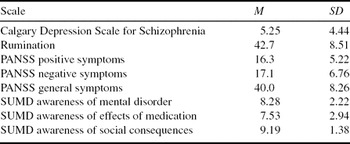
Descriptive statistics on the main measures are presented in Table 1. Using the recommended cut-off score of 7 (Addington et al., Reference Addington, Addington and Maticka-Tyndale1993), 18 (45%) of the participants had depressive symptoms significant enough to meet criteria for a depressive episode. None of the measures were related to gender, age or length of illness, with the exception of AMD, which was correlated with age (r = .36, p = .03).
Descriptive statistics

PANSS: Positive and Negative Syndrome Scales; SUMD: Scale of Unawareness of Mental Disorder.
Note: SUMD scores have been reverse-scored so that higher scores correspond to increased awareness of illness.
Association between rumination and depression
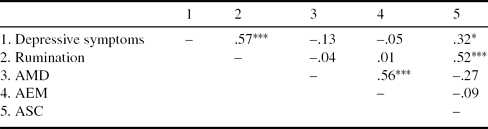
Partial correlations between the main measures controlling for positive and negative symptoms are presented in Table 2. In line with the first hypothesis, depressive symptoms showed a significant correlation with rumination.
Partial correlations between main variables, controlling for positive and negative symptoms

AMD: Awareness of mental disorder; AEM: Awareness of the achieved effects of medication; ASC: Awareness of the social consequences of illness
* p < .05, *** p < .001 (two-tailed significance)
Content of rumination
Reported content of rumination was examined in order to determine the extent to which this related to psychotic illness as predicted by the second hypothesis. Together, the 40 participants gave 105 examples of rumination content. Inspection by researchers indicated that 11 (28%) participants gave examples that referred directly to mental illness, symptoms or treatment (14 of the 105 examples, 13%, e.g. “voices”, “being forced to take meds”, “mental illness situation”). However, whilst only a minority of responses clearly appeared unconnected with illness (14/105 examples, 13%, e.g. “death of my father”, “ageing process”, “global warming”), most reported content concerned themes that involved potentially illness-related problems (77/105 examples, 73%, e.g. “life failure”, “unable to support children”, “detached from friends”). These required the participant's self-report on whether they regarded them as connected. Hence participants’ ratings on the questionnaire were used as the primary index of the extent to which rumination content meaningfully related to the person's concept of illness. On the 1–5 scale of how related items were to illness, it was noted that participants gave substantially higher ratings for content judged by researchers as clearly illness-related (mean = 4.43, SD = 0.85) than content judged by researchers as clearly unconnected (mean = 1.93, SD = 0.92; t = 7.475, p < .001), supporting the validity of the participant ratings.
Using this approach, 28 participants (70%) indicated that one or more topics they ruminated about were related to having a mental illness (response of agree or strongly agree), and 19 participants (48%) indicated that all of the content examples they identified were illness-related. Of the total 105 discrete topics identified by the 40 participants, 64 responses (61%) were endorsed as relating to mental illness. Thus the second hypothesis, that themes related to mental illness would feature in a significant proportion of rumination content, was supported.
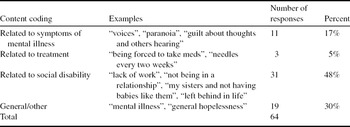
Those examples of rumination content that participants identified as related to mental illness were also sub-categorized to determine which aspect of mental illness awareness they most related to. Coding was conducted by the researchers, who classified content examples as related to (a) symptoms, (b) treatment, (c) social consequences, or (d) general or other aspects of mental illness (following the Amador et al. (Reference Amador, Strauss, Yale, Flaum, Endicott and Gorman1993) conceptualization of the domains of illness awareness). Two researchers independently coded responses, obtaining an intraclass correlation coefficient of 0.92, with subsequent discussion to resolve discrepancies and agree on the final codings. Examples of content that participants did not rate as related to mental illness were not coded. Content codings to subcategorize these 64 responses are given in Table 3. The most common response coding was content related to the social consequences of mental illness.
Categorization of rumination content identified by participants as mental illness-related

Relationship between awareness of illness, rumination and depressive symptoms
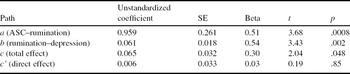
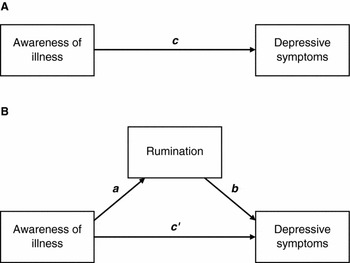
The third hypothesis was that rumination would mediate the relationship between awareness of illness and depressive symptoms. As shown in Table 2, the only dimension of insight showing a statistically significant relationship with depression was ASC, so this was used as the independent variable in the mediation analysis. The mediation analysis involved constructing regression equations according to the guidelines of Baron and Kenny (Reference Baron and Kenny1986) to derive coefficients for the paths a, b, c and c’ illustrated in Figure 1. A summary of the coefficients produced by the regression analyses for each of these paths is presented in Table 4.
Coefficients for paths between awareness of the social consequences of illness (ASC), rumination and depressive symptoms, controlling for positive and negative symptoms. Path c is the total effect of ASC on depression not controlling for rumination, and path c’ the direct effect of ASC on depression once partialling out rumination

(A) Unmediated effect of awareness of illness on depressive symptoms (B) Proposed mediation of the effect of awareness of illness on depressive symptoms by rumination

A first regression analysis was used to verify that ASC was related to rumination (path a in Figure 1). Rumination was used as the dependent variable, and after positive and negative symptoms had been entered as predictors (R 2 = .077), entering ASC improved fit of the model (R 2 = .329, F change = 13.535, p = .001). In the final model, ASC was the only variable predicting rumination (see path a in Table 4).
A second regression analysis examined predictors of depression. This was used to determine both the relationship between rumination and depression (path b), and the relationship between ASC and depression before and after controlling for rumination (paths c and c’, respectively). With depression as the dependent variable, positive symptoms and negative symptoms were first entered as predictors (R 2 = .135, F = 2.879, p = .07). In the next step, ASC was entered, increasing fit of the model (R 2 = .224, F change = 4.170, p = .048), with ASC being the only statistically significant predictor of depression at this step (path c in Table 4). Finally, rumination was entered, further increasing the fit of the model (R 2 = .420, F change = 11.775, p = .002). In the final model, rumination was a statistically significant predictor of depression (path b in Table 4), whilst the coefficient for ASC was no longer significant (path c’ in Table 4).
Baron and Kenny (Reference Baron and Kenny1986) proposed that a mediating relationship can be inferred when paths a (ASC-rumination), b (rumination-depression) and c (ASC-depression) are statistically significant, and path c’ (ASC-depression once controlling for rumination) is nonsignificant. All of these conditions were observed, a, b and c being statistically significant, and c’ being low as well as non-significant, suggesting that rumination fully mediated the effect of awareness of illness on depression. However, a more direct test is provided by the bootstrapping procedure to determine the statistical significance of the indirect effect (ab). This method provided a point estimate for ab of 0.0586 (unstandardized), with a 95% confidence interval of 0.0246 to 0.1108, indicating statistical significance at p < .05.
Discussion
This study investigated the possible role of rumination in contributing to depressive symptoms in schizophrenia. The first question addressed by this study was whether rumination would be associated with depressive symptoms in schizophrenia. As has been found in the context of affective disorders, depressive symptomatology was associated with a tendency to ruminate in people with a diagnosis of schizophrenia, suggesting it is just as relevant in this context. Within the sample, scores on the rumination measure were similar to those observed in the general population (Trapnell and Campbell, Reference Trapnell and Campbell1999), suggesting that rumination is not necessarily elevated in people with a diagnosis of schizophrenia, but individual differences in the person's tendency to ruminate are clearly associated with their proneness to depressive symptoms. Experimental rumination induction studies in other populations suggest that ruminative tendency may have a number of deleterious effects that may compound dysphoria, such as increasing recall of negative memories, increasing focus of thinking and speech on problematic issues, reducing initiation of instrumental behaviour, and impeding adaptive coping and problem solving (Nolen-Hoeksema et al., Reference Nolen-Hoeksema, Wisco and Lyubomirsky2008). It may be that these provide mechanisms for rumination contributing to the formation and/or maintenance of depressive symptoms in a population facing significant difficulties associated with a chronic mental illness.
Indeed, rumination may be of broader relevance in understanding adjustment to psychosis. Recently it has been found that rumination is also associated with distress arising from hallucinations (Badcock, Paulik and Maybery, Reference Badcock, Paulik and Maybery2011) and other studies have found that worry, another form of repetitive thinking, is predictive of delusional distress (Morrison and Wells, Reference Morrison and Wells2007; Startup, Freeman and Garety, Reference Startup, Freeman and Garety2007). Hence, perseverative thinking might be thought of as a possible factor important in the person's adaptation to psychosis, with increased levels of ruminative thought compounding possible difficulties arising in the disorder.
The other questions addressed by the study were whether rumination in schizophrenia focuses upon mental illness, and whether this may account for observed associations with insight. As anticipated, it appeared that rumination content was frequently focused on concerns related to mental illness, with participants indicating that a substantial proportion of rumination content was mental illness-related. Whilst we did not think it would be feasible to ask participants to differentiate rumination topics as primarily schizophrenia-related as opposed to mood-related, it did not appear that content regarded as “mental illness-related” was purely restricted to people dwelling upon the causes and consequences of depressed mood itself. As well as frank psychotic symptoms and aspects of treatment for severe mental illness being reported as rumination content in some people, the majority of ruminative content concerned participants’ social difficulties, which would be strongly contributed to by the person's psychotic illness rather than purely related to dysphoria. This suggests that when rumination occurs in schizophrenia, non-affective symptoms and other perceived problems are incorporated into the person's negative thinking, with social disability featuring prominently.
The third hypothesis, that the process of rumination is implicated in the observed association between insight and depressive symptoms, was also supported. Rumination was a stronger determinant of depressive symptoms than insight, and the only observed relationship between insight and depression was fully mediated by rumination. Together with the observations of reported rumination content, this supports the proposal that depressive symptoms in schizophrenia are particularly associated with a process of perseveratively dwelling on mental illness and its causes and consequences.
However, although it was anticipated that all dimensions of insight would be correlated with depressive symptoms, ASC was the only dimension for which this association was observed. Similarly, ASC was the only dimension correlated with rumination. The existing literature shows that a relationship between insight and depressive symptoms has not been consistently found in relation to psychotic disorders (e.g. Simon, Bergere, Giacomini, Ferrero and Mohr, Reference Simon, Berger, Giacomini, Ferrero and Mohr2006; Watson et al., Reference Watson, Garety, Weinman, Dunn, Bebbington and Fowler2006). However, it is difficult to interpret differences in findings between studies as there has been a lack of consistent methodology used, with studies using both acute and subacute, and both chronic and first episode samples, and a variety of different measures (Lincoln, Lüllmann and Rief, Reference Lincoln, Lüllmann and Rief2007). Of studies published, the most comparable to the present study was conducted by Moore, Cassidy, Carr and Callaghan (Reference Moore, Cassidy, Carr and Callaghan1999) in a chronic sample using the SUMD: this also found that ASC was the dimension of insight most consistently correlated with measures of depression, although correlations with other dimensions were also observed. In considering whether ASC might have a particular relationship with rumination and depression, it is also notable that subcategorizations of illness-related rumination content in the present study most frequently focused on the social consequences of illness. Hence it may be that it is not awareness of having a mental illness per se that is associated with rumination and depression, but awareness of the disability and disadvantage associated with it. This appears particularly relevant for the sample studied, who had, on average, quite longstanding illnesses: if rumination functions to resolve discrepancies between current and desired perceptions of self (Martin and Tesser, Reference Martin, Tesser and Wyer1996; Pyszczynski and Greenberg, Reference Pyszczynski and Greenberg1987), the social disability associated with chronic schizophrenia may be most salient in triggering it. It is, however, unclear whether similar findings would be obtained in people with a first episode of psychosis, or during an acute phase, when awareness of disturbed mental functioning or specific symptoms may be more salient concerns.
The particular association between depression, rumination and awareness of social disability also corresponds with some of the specific appraisals of illness proposed as important in contributing to depression in schizophrenia. Appraisals of illnesses that have been associated with depressive symptoms include illness characteristics such as uncontrollability, chronicity and entrapment in illness, but also social consequences such as loss of social role, social humiliation, and stigma (Birchwood et al., Reference Birchwood, Mason, MacMillan and Healey1993; Iqbal et al., Reference Iqbal, Birchwood, Chadwick and Trower2000; Lobban et al., Reference Lobban, Barrowclough and Jones2004, Reference Lobban, Barrowclough and Jones2005; Lysaker, Roe and Yanos, Reference Lysaker, Roe and Yanos2007; Rooke and Birchwood, Reference Rooke and Birchwood1998; Watson et al., Reference Watson, Garety, Weinman, Dunn, Bebbington and Fowler2006). It may be that rumination leads to such thoughts about illness being repeatedly activated, increasing their impact upon mood. There is evidence for such a process in major depressive disorder and non-clinical populations, where rumination has been found to mediate the relationship between depressive thought content and mood symptoms (Lo, Ho and Hollon, Reference Lo, Ho and Hollon2008; Spasojevic and Alloy, Reference Spasojevic and Alloy2001; Robinson and Alloy, Reference Robinson and Alloy2003). Further study is required to determine how these illness appraisals and rumination may interact in schizophrenia.
Limitations include the small sample size and cross sectional design of the study. As a cross-sectional study, the direction of causality cannot be determined. For example, the extent to which rumination increases vulnerability to depression versus depression leading to ruminative thinking is uncertain, and it is unclear whether insight prompts rumination or whether rumination increases awareness of the problems associated with illness. Longitudinal or experimental research would be required to clarify causal relationships between depressive symptoms, rumination and awareness of illness. Additionally, the elicitation of rumination content was reliant upon retrospective self-report, which may not have captured in-the-moment awareness of thought content as might be obtained through experimental designs in which ruminative thinking is induced. There were also no comparison data to determine possible differences between rumination in schizophrenia and depression, such as the proportion of rumination content related to illness. Future study could also clarify the processes by which illness awareness may trigger rumination, such as examining the role of discrepancies between current and desired perceptions of self, and the role of moderating factors such as metacognitive beliefs about rumination.
Clinically, the results suggest a possible direction in developing interventions for people recovering from psychosis to protect against depressive responses. Depression may be associated not solely with what understanding people form of their psychosis - as has been the traditional target of psychoeducational and cognitive behavioural interventions - but also with ruminative thinking focused on illness. Reducing rumination is a component of a number of existing therapeutic approaches, including behavioural activation (e.g. Martell, Dimidjian and Herman-Dunn, Reference Martell, Dimidjian and Herman-Dunn2010) and mindfulness-based interventions (e.g. Hayes, Strosahl and Wilson, Reference Hayes, Strosahl and Wilson1999; Segal, Williams and Teasdale, Reference Segal, Williams and Teasdale2002). In addition, emergent interventions have been described that aim to reduce rumination as the primary focus of treatment (e.g. Watkins et al., Reference Watkins, Scott, Wingrove, Rimes, Bathurst and Steiner2007; Wells and Papageorgiou, Reference Wells, Papageorgiou, Papageorgiou and Wells2003). In psychosis, at the present time, the most researched of these interventions has been the use of acceptance and mindfulness-based interventions, with some initially promising results on broad outcomes (Bach and Hayes, Reference Bach and Hayes2002; Gaudiano and Herbert, Reference Gaudiano and Herbert2006). There has also been some initial success in directly targeting worrying with cognitive behavioural therapy in people with psychotic disorders (Foster, Startup, Potts and Freeman, Reference Foster, Startup, Potts and Freeman2010). However, the development of these interventions remains at an early stage and specific impacts upon depressive symptoms have yet to be examined. Results suggest it may be useful to investigate the possible impact of such interventions on both rumination and depressive symptoms in psychosis.



Comments
No Comments have been published for this article.