INTRODUCTION
Protozoa are a primary component of the microbiota and play crucial roles in the functioning of microbial food webs by mediating the flux of carbon and energy across different trophic levels in aquatic ecosystems (Cairns et al., Reference Cairns, Lanza and Parker1972; Norf et al., Reference Norf, Arndt and Weitere2009a, Reference Norf, Arndt and Weitereb; Morin et al., Reference Morin, Pesce, Tlili, Coste and Montuelle2010; Xu et al., Reference Xu, Zhang, Jiang and Yang2014, Reference Xu, Xu and Xu2016; Zhong et al., Reference Zhong, Xu and Xu2017). Changes in their abundance and composition may significantly influence the community structure of high-trophic-level organisms (Cairns & Henebry, Reference Cairns, Henebry and Cairns1982; Morin et al., Reference Morin, Duong, Dabrin, Coynel, Herlory, Baudrimont, Delmas, Durrieu, Schäfer, Winterton, Blanc and Coste2008; Mieczan, Reference Mieczan2010; Zhang et al., Reference Zhang, Xu, Jiang, Zhu and Al-Rasheid2012, Reference Zhang, Xu, Jiang, Zhu and Al-Rasheid2013; Xu & Xu, Reference Xu and Xu2016). Due to their short life cycles and rapid response to environmental change protozoa have been used to evaluate environmental quality, including anthropogenic impacts, on temporal and spatial scales (Kathol et al., Reference Kathol, Norf, Arndt and Weitere2009; Kchaou et al., Reference Kchaou, Elloumi, Drira, Hamza, Ayadi, Bouain and Aleya2009; Jiang et al., Reference Jiang, Xu, Hu, Zhu, Al-Rasheid and Warren2011; Xu et al., Reference Xu, Zhang, Jiang and Yang2014).
A number of investigations have demonstrated the utility of community-based parameters (e.g. species richness, taxonomic/body-size distinctness and functional diversity) of biofilm-dwelling protozoa for determining marine water quality (Ismael & Dorgham, Reference Ismael and Dorgham2003; Xu et al., Reference Xu, Zhang, Jiang and Yang2014; Zhong et al., Reference Zhong, Xu, Wang and Xu2014; Xu & Xu, Reference Xu and Xu2016). These studies, however, are typically carried out at single depths, usually in the surface layers (1–3 m) of the water column (Coppellotti & Matarazzo, Reference Coppellotti and Matarazzo2000; Xu et al., Reference Xu, Zhang, Jiang, Zhu, Al-Rasheid, Warren and Song2011; Zhang et al., Reference Zhang, Xu, Jiang, Zhu and Al-Rasheid2012, Reference Zhang, Xu, Jiang, Zhu and Al-Rasheid2013). Consequently, little is known about the variability of protozoan community structure down the depth of the water column (Kralj et al., Reference Kralj, Plenković-Moraj, Gligora, Primc-Habdija and Sipoš2006; Zhong et al., Reference Zhong, Xu and Xu2017). This lack of knowledge significantly limits the use of protozoa in the bioassessment of environmental change in aquatic ecosystems on vertical scales.
In the present study, a 1-month baseline survey was conducted to evaluate vertical variations in community structure of the protozoa in northern Chinese coastal waters of the Yellow Sea from October to November 2016. The aims of the study were: (1) to document the vertical variability of species composition and distribution; (2) to reveal ecological features of the protozoan communities and the relevant biodiversity parameters at different depths; and (3) to evaluate the utility of biofilm-dwelling protozoa for community-based bioassessment of marine water quality down the water column.
MATERIALS AND METHODS
Study area and data collection
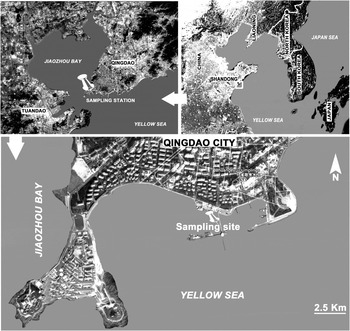
The selected sampling site was in coastal waters of the Yellow Sea, at the mouth of Jiaozhou Bay near Qingdao, northern China (Figure 1). The study area was ~9 m deep with a tidal interval of ~3 m.
Sampling stations in coastal waters of the Yellow Sea, near Qingdao, northern China.

Protozoa were collected by immersing glass microscope slides in the water for sufficient time to allow colonization by biofilm-dwelling protozoa to take place, as described by Xu et al. (Reference Xu, Zhang, Jiang, Zhu, Al-Rasheid, Warren and Song2011). A total of 80 glass slides (2.5 × 7.5 cm) was used to collect the protozoa at depths of 1, 2, 3.5 and 5 m below the water surface. For each depth, two PVC frames holding 10 slides each were immersed for a period of 14 days. Upon collection, the slides were transferred into Petri dishes containing in situ water and stored in a cool box for transport to the laboratory. Identification and enumeration of protozoa were carried out following the methods outlined by Xu et al. (Reference Xu, Zhang, Jiang, Zhu, Al-Rasheid, Warren and Song2011). The enumeration of protozoan species in vivo was conducted under an inverted microscope at a magnification of 100× within 2–4 h of sampling (Xu et al., Reference Xu, Zhang, Jiang, Zhu, Al-Rasheid, Warren and Song2011, Reference Xu, Zhang, Jiang and Yang2014). Species composition and abundances of protozoa were expressed as percentage of the total number of species recorded (%), and individuals per cm2 (ind cm–2) from two glass slides, respectively.
Data analysis
The species diversity (Shannon-Wiener, H′), species evenness (Pielou's, J′) and species richness (Margalef, D) indices were used to summarize the biodiversity of the protozoan communities. These measures were computed using PRIMER package (v7) following the equations:
 $$H{^\prime} = - \sum\limits_{i = 1}^s {P_{i}(\ln P_{i})} $$
 $$J{^\prime} = H^{\prime}/{\rm ln}S$$
 $$D = {\rm} (S-1)/{\rm ln}N$$
where P i, proportion of the total counted arising from the ith species; S, total number of species, and N, total number of individuals.
Vertical distributions of the protozoan species were analysed using clustering analysis on the matrix of ‘index of association’ from variable-standardized species presence/absence data (Clarke & Gorley, Reference Clarke and Gorley2015). Hot-plotting analysis was used to summarize the species distribution of the protozoa in terms of their relative abundances at the four depths. The contribution of each species to the average Bray–Curtis similarity among depths was analysed using similarity percentage analysis (SIMPER).Vertical variations in protozoan community structure among the four depths were ordinated using canonical analysis of principal coordination (CAP) on Bray–Curtis similarity matrices from fourth-root-transformed species abundance data (Anderson et al., Reference Anderson, Gorley and Clarke2008; Xu et al., Reference Xu, Zhang, Jiang, Zhu, Al-Rasheid, Warren and Song2011). Differences in community structure among the four depths were measured using SIMPROF test and shown using clustering and distance-based redundancy analyses (dbRDA) on Bray–Curtis similarity matrices from fourth-root-transformed species abundance data (Anderson et al., Reference Anderson, Gorley and Clarke2008; Xu et al., Reference Xu, Zhang, Jiang, Zhu, Al-Rasheid, Warren and Song2011).
RESULTS
Vertical variation in species distribution
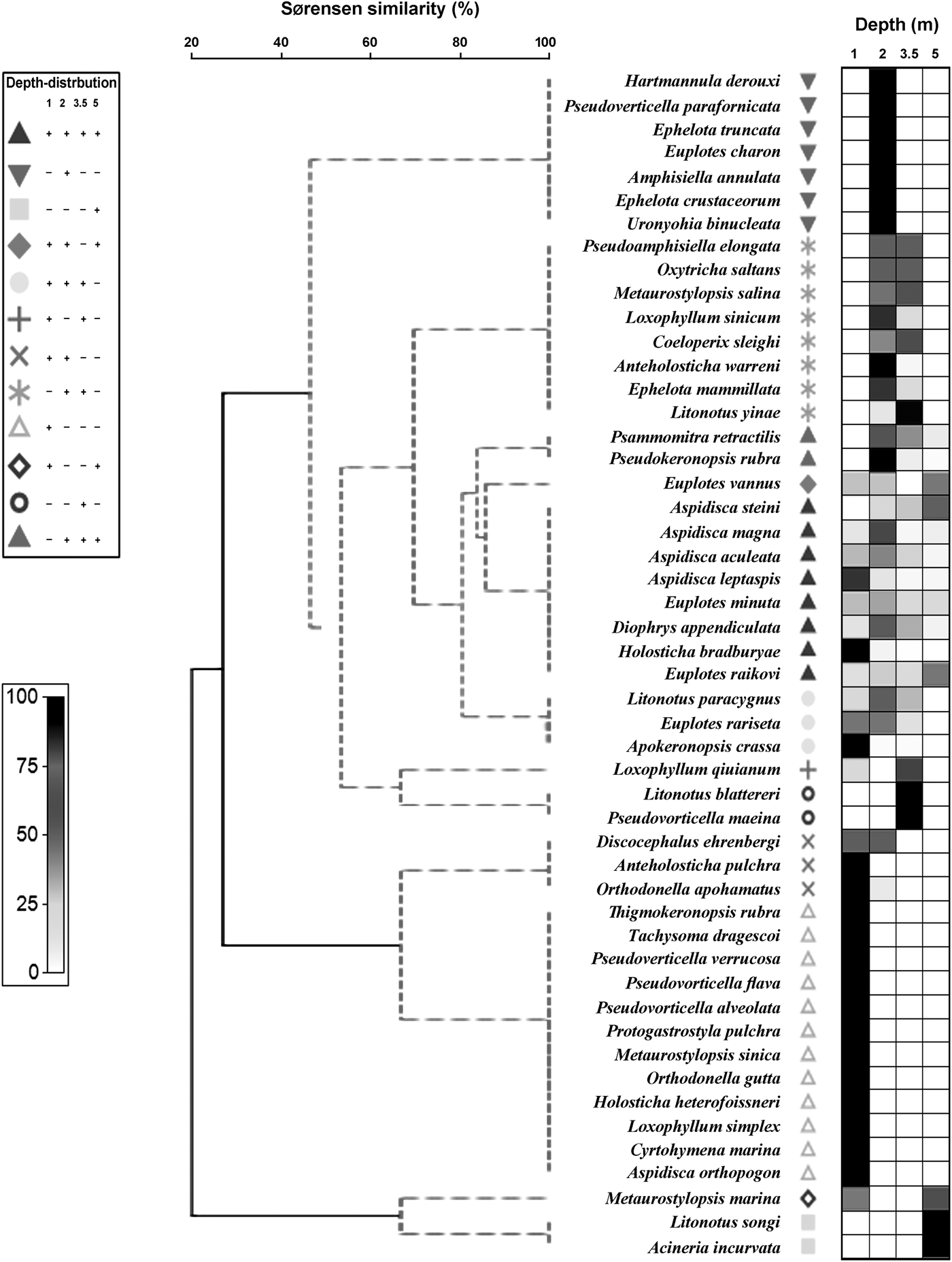
A total of 50 biofilm-dwelling ciliate species was recorded at the four depths. The average abundance and rank percentage occurrence of each species at each depth are summarized in Supplementary Table S1. Of these, seven species (Aspidisca magna, A. aculeata, A. steini, A. leptaspis, Diophrys appendiculata, Euplotes minuta and Holosticha bradburyae), each of which was among the top 12 ranked contributors at each depth, were defined as ‘dominant’. Eight species (Aspidisca magna, A. aculeata, A. steini, A. leptaspis, D. appendiculata, E. minuta, Euplotes raikovi and H. bradburyae) were present at all four depths and were defined as ‘common’.
Based on the dendrogram of clustering analysis, the 50 species were sub-divided into three groups: group I consisted of 32 species; group II, 15 species; and group III, three species. Twenty-nine species were recorded at 1 m, 25 at 2 m, 24 at 3.5 m and 12 at 5 m (Figure 2). Hot-plotting analysis revealed a clear vertical variation of biofilm-dwelling protozoan communities among the four depths. With indices of association >50%, 19 species occurred at 1 m, 18 at 2 m, eight at 3.5 m and three at 5 m (Figure 2).
A dendrogram of the species distribution among the four depths and Hot-plotting analyses, showing species contribution of biofilm-dwelling protozoa at four depths in the water column. +, presence; −, absence.

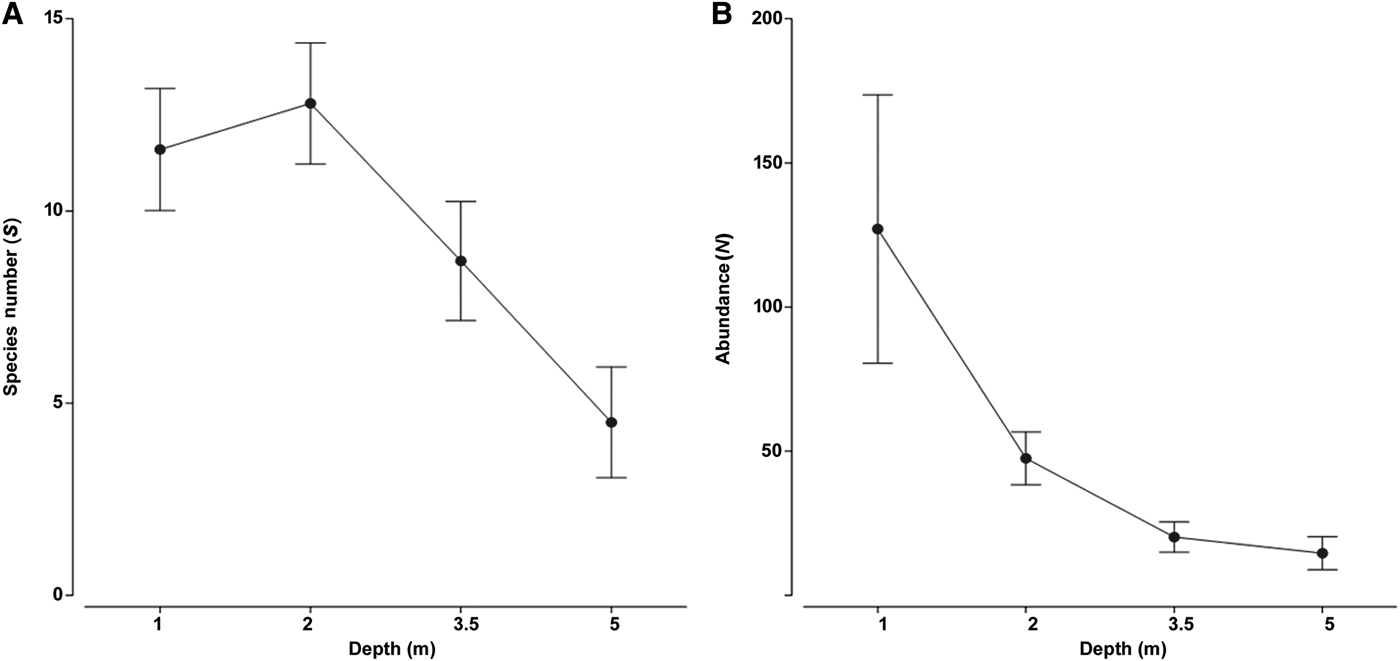
In terms of species richness, the highest average number of species was at 2 m, followed by 1 m. There were significantly fewer species at 3.5 m and lowest numbers at 5 m (Figure 3A). In terms of total abundance, there was a decreasing trend from 1 to 5 m (Figure 3B).
Vertical variations in species number (A) and abundance (B, ind cm−2) of biofilm-dwelling protozoan at four depths in the water column.

Vertical variation in community structure
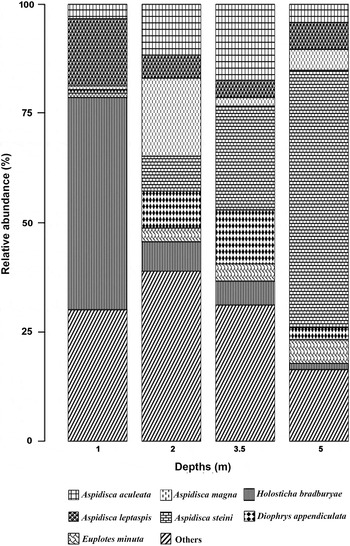
In terms of relative abundance, the protozoan community structure showed a clear variation with depth. As a proportion of total protozoan abundance, the primary contributors at each depth were: H. bradburyae (48.54%) and A. leptaspis (15.42%) at 1 m; A. magna (17.90%) and A. aculeata (11.58%) at 2 m; A. steini (23.76%) and A. aculeata (17.33%) at 3 m; and A. steini (58.90%) at 5 m (Figure 4).
Vertical variations in relative abundance (%) of biofilm-dwelling protozoa at four depths in the water column.

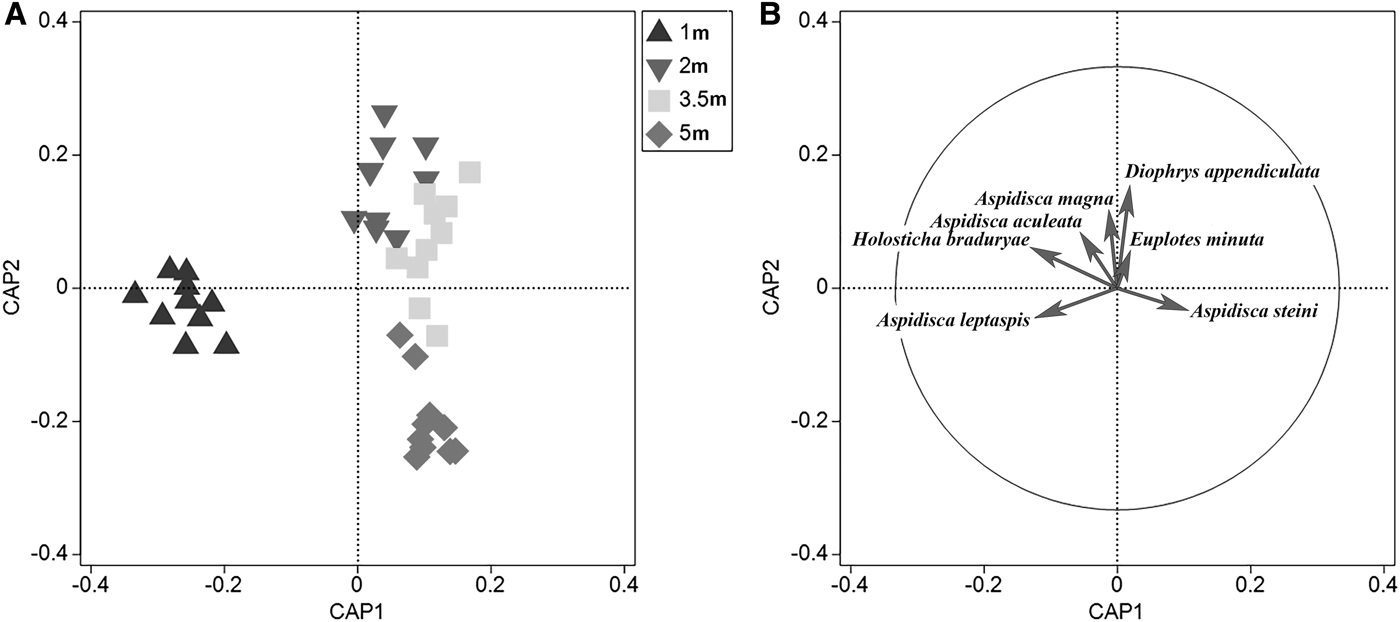
The CAP ordination plots showed that the community structure at 1 m clearly differed from those at the other three depths. The first canonical axis (CAP1) separated the clouds of samples at 1 m (left) from those at 2, 3.5 and 5 m (right) while the second canonical axis (CAP2) discriminated samples at depths of 1 and 5 m (lower) from those samples at 2 and 3.5 m (upper) (Figure 5A). Among the vectors coordination of the seven dominant species, four (A. magna, A. aculeata, A. leptaspis and H. bradburyae) point towards the sample cloud at 1 m (left), two (E. minuta and D. appendiculata) point towards those at 2, 3.5 and 5 m, and one (A. steini) points towards those at 3.5 and 5 m (Figure 5B).
Canonical analysis of principal coordinates (CAP) on Bray–Curtis similarities from four-root transformed species abundance data of biofilm-dwelling protozoan communities (A), with correlations of the seven most dominant species with the CAP axes (B), which together show the vertical patterns of protozoan community structure at four depths in the water column.

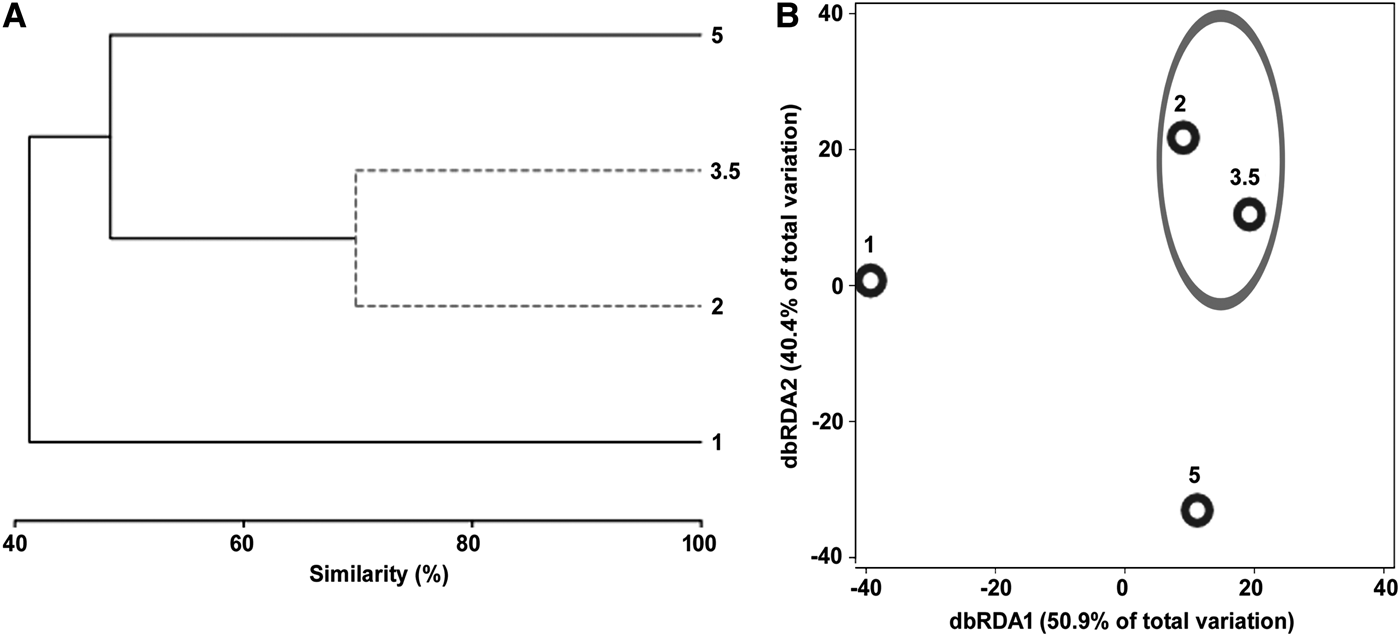
SIMPROF test and the dbRDA/clustering analysis showed that there were significant differences in the protozoan community structure among the four depths (P < 0.05), except between 2 and 3.5 m (P > 0.05) (Figure 6).
Clustering (A) and Distance-based redundancy analysis (dbRDA) (B) with SIMPROF test for species abundances data of biofilm-dwelling protozoan communities, showing vertical variations in community structure among four depths in the water column.

Vertical variation in biodiversity parameters
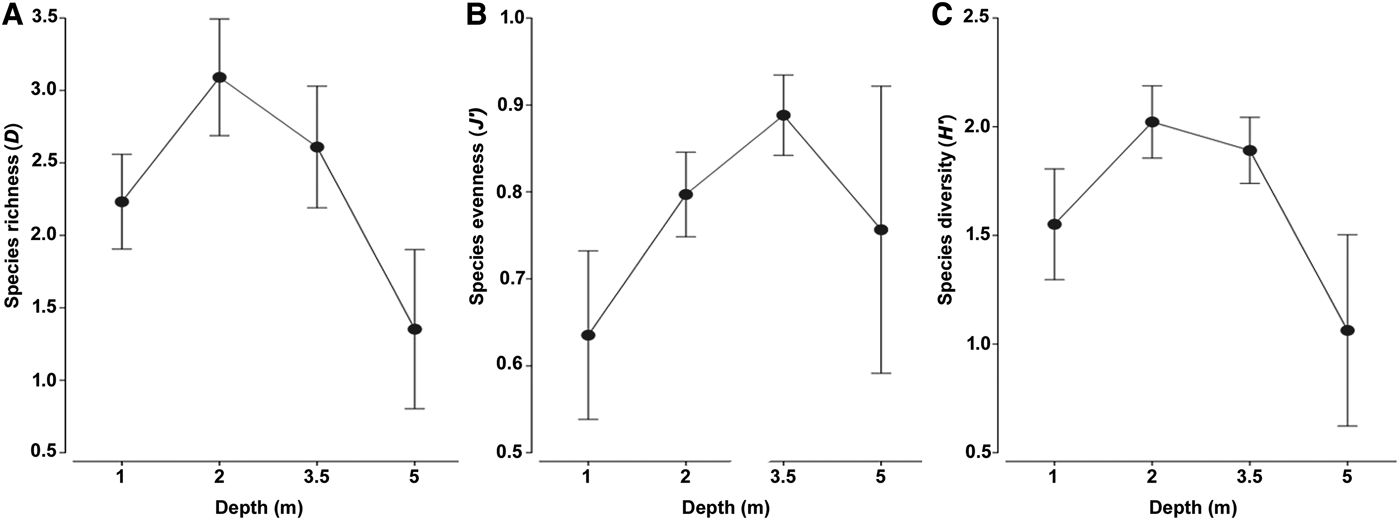
Species richness and species diversity peaked at 2 m, followed by a sharp decrease at 3.5 m and a further decrease reaching a minimum value at 5 m. By contrast, the highest value of species evenness occurred at 3.5 m and the lowest at 1 m (Figure 7).
Species richness (A), species evenness (B) and species diversity (C) of biofilm-dwelling protozoan communities at four depths in the water column.

DISCUSSION
The colonization of a substratum by heterotrophic protozoa is highly dependent on the food supply (e.g. bacteria, algae) from both the biofilm and the surrounding water (Geesey et al., Reference Geesey, Mutch, Costerton and Green1978; Risse-Buhl & Küsel, Reference Risse-Buhl and Küsel2009; Zhang et al., Reference Zhang, Xu, Jiang, Zhu and Al-Rasheid2012). Biofilm-dwelling protozoa comprise a variety of feeding types, e.g. bacterivores, algivores, predators and non-selectives (Scherwass et al., Reference Scherwass, Fischer and Arndt2005; Zhang et al., Reference Zhang, Xu, Jiang, Zhu and Al-Rasheid2012, Reference Zhang, Liu, Warren and Xu2014; Zhong et al., Reference Zhong, Xu and Xu2017). For example, the filter feeders capture food particles suspended in the water whereas gulpers actively search for prey in the biofilm (Franco et al., Reference Franco, Esteban and Téllez1998; Hausmann, Reference Hausmann2002; Norf et al., Reference Norf, Arndt and Weitere2009b; Kathol et al., Reference Kathol, Fischer and Weitere2011). Since food supplies are directly associated with environmental conditions in the water column, the community structure of biofilm-dwelling protozoa is indirectly affected by environmental parameters (Kiørboe et al., Reference Kiørboe, Grossart, Ploug, Tang and Auer2004; Norf et al., Reference Norf, Arndt and Weitere2009a; Wey et al., Reference Wey, Norf, Arndt and Weitere2009; Früh et al., Reference Früh, Norf and Weitere2011).
In the present study, the 50 species of protozoa recorded showed a clear vertical variation in distribution patterns: only 15 species occurred at all four depths while the other 35 taxa were found at one, two or three depths. In terms of the relative abundances of the seven dominant species, bacterivores and algivores were the primary contributors to the communities at 1 m, algivores and non-selectives dominated at 2 and 3.5 m, and bacterivores dominated at 5 m. Wang et al. (Reference Wang, Xu, Zhao, Gao, Abdullah Al and Xu2017) noted that protozoan communities have strong feeding efficiencies in the presence of high concentrations of microscopic algae in the water column. Furthermore, microalgal production in the water column has an empirical relationship with environmental parameters, in particular transparency and sunlight (Lind et al., Reference Lind, Doyle, Vodopich, Trotter, Limon and Davalos-Lind1992). Thus the reduced transparency/sunlight at deeper layers in the water column results in lower photosynthetic production. This is consistent with the present finding that concentrations of algivorous protozoa progressively reduce with increasing water depth. Methods of food acquisition might also explain the differences in protozoan community structure down the water column. Grazers (e.g. groups I & II) that are dominant in near-surface waters above 3 m feed on a variety of food particles (e.g. algae, bacteria, flagellates etc.). These might be acquired either by filter feeding on suspended particles or by the active search for food particles in the biofilm by gulpers (e.g. group II & III) (Scherwass et al., Reference Scherwass, Fischer and Arndt2005; Norf et al., Reference Norf, Arndt and Weitere2009b). The progressive decrease in concentrations of algivores with water depth is mirrored by a progressive increase in concentration of bacterivores, implying that the type of food supply differed at the four depths.
Based on our data, the total protozoan abundance and individual species abundances had a decreasing trend from 1 to 5 m. Furthermore, species richness peaked at 2 m and decreased with increasing depth. This might be a result of lower food supply and food availability at deeper layers in the water column due to weaker sunlight penetration along with the influence of other parameters such as temperature, pH, chlorophyll, dissolved oxygen and nutrients (Pfister et al., Reference Pfister, Auer and Arndt2002; Sonntag et al., Reference Sonntag, Posch, Klammer, Teubner and Psenner2006). Multivariate analyses revealed a clear vertical variation in the protozoan community structure in the water column. It should be noted, however, that no significant difference in these communities was found between depths of 2 and 3.5 m. This finding suggests that the food supply (microalgal production) and environmental conditions were similar at these two depths.
Species richness, species evenness and species diversity indices are traditionally used for summarizing biodiversity and for community-based bioassessment of water quality status in marine ecosystems (Ismael & Dorgham, Reference Ismael and Dorgham2003; Jiang et al., Reference Jiang, Xu, Hu, Zhu, Al-Rasheid and Warren2011; Zhang et al., Reference Zhang, Xu, Jiang, Zhu and Al-Rasheid2012; Xu et al., Reference Xu, Zhang, Jiang and Yang2014). In the present study, high species diversity and richness were observed at a depth of 2 m, whereas maximum species evenness occurred at 3.5 m. This indicates that the conditions at 2 to 3.5 m were more favourable for most contributor species, e.g. algivores and non-selectives, compared with the other three depths, probably due to higher food availability (e.g. concentrations of microscopic algae) as reported elsewhere (Wang et al., Reference Wang, Xu, Zhao, Gao, Abdullah Al and Xu2017). Liu et al. (Reference Liu, Zhang and Xu2014) noted that in coastal waters light penetration is reduced at depths below 3 m due to vertical mixing, which directly influences primary productivity by decreasing water transparency. Thus, the results presented here are consistent with those of previous studies (Liu et al., Reference Liu, Zhang and Xu2014; Yang et al., Reference Yang, Xu, Xu and Xu2016) in that the diversity of primary producers (e.g. diatoms) is higher at depths above 3 m thereby affecting the community structure of protozoan communities by supporting the growth of algivores.
In summary, biofilm-dwelling protozoan communities varied significantly among the four water depths although they were similar at depths of 2 and 3.5 m. Community structure parameters generally showed a clear decreasing trend with increasing depth, although species richness, diversity and evenness peaked at 2 or 3.5 m. These results suggest that water depth may significantly shape the community structure of biofilm-dwelling protozoa in marine ecosystems. However, further studies on the vertical distribution patterns in a range of environmental types are needed in order to verify this conclusion.
SUPPLEMENTARY MATERIAL
The supplementary material for this article can be found at https://doi.org/10.1017/S0025315417001680
ACKNOWLEDGEMENTS
This work was supported by ‘The Natural Science Foundation of China’ (project number 31672308) and a CSC Scholarship Award for Excellent Master's Student from the Chinese Ministry of Education.