INTRODUCTION
Soil microbes can have significant impacts on plant community structure and function: plant pathogens have negative effects on plant performance, whereas symbiotic micro-organisms such as mycorrhizal fungi and nitrogen-fixing bacteria have the potential to greatly increase plant survival and growth (van der Heijden et al. Reference VAN DER HEIJDEN, BARDGETT and VAN STRAALEN2008, van der Putten et al. Reference VAN DER PUTTEN, BARDGETT, BEVER, BEZEMER, CASPER, FUKAMI, KARDOL, KLIRONOMOS, KULMATISKI, SCHWEITZER, SUDING, VAN DE VOORDE and WARDLE2013). Moreover, plants must compete with free-living heterotrophic microbes for soil nutrients (Kaye & Hart Reference KAYE and HART1997). Thus, soil microbial communities play an important role in mediating relationships among plant diversity, successional dynamics and ecosystem function (Bever et al. Reference BEVER, DICKIE, FACELLI, FACELLI, KLIRONOMOS, MOORA, RILLIG, STOCK, TIBBETT and ZOBEL2010).
The net result of interactions among plants, soil pathogens, symbionts and free-living microbes is context-dependent, and may be strongly affected by variation in soil nutrient availability (Casper et al. Reference CASPER, BENTIVENGA, JI, DOHERTY, EDENBORN and GUSTAFSON2008). Resource stoichiometry affects plant allocation to arbuscular mycorrhizal fungi (AMF): the trade balance model predicts that the mutualism between arbuscular mycorrhizas and their hosts is strengthened (i.e. becomes more mutually beneficial) as P availability declines (Johnson Reference JOHNSON2010). The trade balance model also predicts that increases in C or N availability strengthen the mutualism (i.e. increase plant allocation to mycorrhizas) by inducing P limitation (Johnson Reference JOHNSON2010). Alternatively, the nutrient limitation model predicts a hump-shaped relationship between P availability and mycorrhizal abundance. This is because fungal growth is nutrient-limited in very poor soils, and plant investment in mycorrhizas declines in very P-rich soils, leading to a peak in mycorrhizal abundance at intermediate soil fertility (Treseder & Allen Reference TRESEDER and ALLEN2002).
The predictions of these conceptual models are generally validated by experimentally manipulating N and P availability with fertilizers (Camenzind et al. Reference CAMENZIND, HEMPEL, HOMEIER, HORN, VELESCU, WILCKE and RILLIG2014, Treseder Reference TRESEDER2004). However, changes in the strength of plant-mycorrhizal mutualisms along natural gradients of soil fertility are much more difficult to interpret. As nutrient availability changes, so too does the composition of free-living microbial communities (Fierer et al. Reference FIERER, STRICKLAND, LIPTZIN, BRADFORD and CLEVELAND2009), including potentially pathogenic micro-organisms; plant allocation to below-ground tissues (Poorter et al. Reference POORTER, NIKLAS, REICH, OLEKSYN, POOT and MOMMER2012); and the identity, relative abundance and functional traits of plant taxa (Lavorel & Garnier Reference LAVOREL and GARNIER2002).
In this study, we examined changes in plant–microbe interactions along a dramatic gradient of soil fertility in north-western Costa Rica using two complementary approaches. First, we evaluated whether in situ root colonization by AMF and root nodulation were correlated with soil nutrient concentration. Next, we aimed to disentangle the effects of soil microbial communities vs. soil fertility on plant growth using a manipulative shadehouse experiment. The shadehouse experiment focused on two plant species – an N-fixing legume and a non-legume – to examine how different N acquisition strategies affect responses to mycorrhizal infection.
We had two main hypotheses: (H1) root colonization by mycorrhizal fungi in the field will be influenced by soil nutrient availability; and (H2) the net effect of soil microbes (including symbiotic and free-living organisms) on plant growth will be more positive in low-fertility soils in the shadehouse experiment. By contrast, there is some evidence that mycorrhizal fungi can adapt to their resource environments; thus we anticipated that seedling responses to the presence of soil microbes could be dependent upon microbial origin (H3).
MATERIALS AND METHODS
Study system
Our study sites are regenerating lowland tropical dry forests located in north-west Costa Rica (Appendix 1). All sites are lowland (<800 m asl) and experience a similar climate, with a mean annual temperature of 25°C and mean annual precipitation ranging from 1200–1750 mm. In 2007, six 0.1-ha plots were established in each of three forests, stratified by stand age (10–65 y) within each forest type. Santa Rosa oak forests (SROAK) are located on rocky, nutrient-depleted ignimbrite soils with very low N and P content. Santa Rosa tropical dry forests (SRTDF) occur on richer soils that have intermediate nutrient availability. Finally, Palo Verde tropical dry forest (PVTDF) grows on N- and P-rich limestone- or alluvial-derived soils. The three forest types (SROAK, SRTDF and PVTDF) differ in the identity and relative abundance of dominant tree taxa, but all three forests share some tree species (Powers et al. Reference POWERS, BECKNELL, IRVING and PEREZ-AVILES2009), and basal area of legume trees ≥10 cm diameter at breast height ranges from 0 to 39.6% among plots. Total P stocks vary 50-fold across the 18 plots, from 0.03 to 1.47 Mg ha−1, and resin-extractable P can vary over 100-fold, with lowest levels in SROAK soils, highest levels in PVTDF soils, and intermediate soil P availability in SRTDF (Waring et al. Reference WARING, BECKNELL and POWERS2015). These differences in soil P availability among plots and forest types are consistent through time and across different methods for measuring P (e.g. total P, resin P, or extractable Bray P; Powers et al. unpubl. data).
Field survey
In August 2014, we installed eight root ingrowth cores in each of the 18 plots, for a total of 144 cores (15 cm depth, 2-mm nylon mesh). The cores were collected 2 mo later in October (the height of the rainy season). Upon sampling, approximately 50 g soil from each core was immediately stored at −20ºC for determination of soil acid phosphatase activity (AP), and another subsample was air-dried for determination of Bray P. AP activity typically increases as P availability declines (Allison & Vitousek Reference ALLISON and VITOUSEK2005), and is therefore a metric of plant and microbial demand for phosphorus. Then, roots were carefully washed, patted dry, weighed and root nodules were counted. Subsamples of roots were stored in 95% ethanol for staining; the remaining roots were dried at 50ºC to determine total dry root biomass in each core.
Shadehouse pot experiment
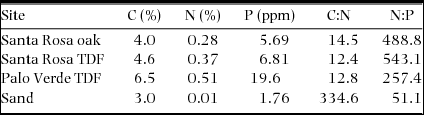
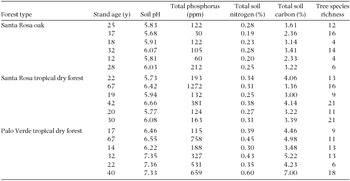
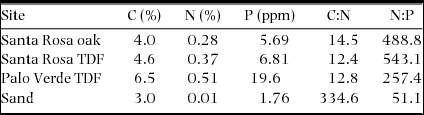
In July 2014, soils were collected from spatially random locations within each of the 18 plots. Fine roots and associated soil aggregates were separated from bulk soils and stored at 4°C. The remaining soil was bulked by forest type, homogenized and sieved to 4 mm. The soils were then sterilized by autoclaving in two 1-h cycles at 123–127°C and mixed in a 1:1 ratio with sterile sand to improve drainage. Soil chemistry information is provided in Table 1.
Nutrient concentrations (total C, N and P) of the sterilized soils used in the shadehouse experiment examining responses of Costa Rican tropical dry forest seedings (Albizia guachapele and Swietenia macrophylla) to nutrient availability. Soils were mixed in a 1:1 ratio with sand (containing carbonates).
Two plant species were chosen for the pot experiment: Swietenia macrophylla King (Meliaceae) and Albizia guachapele Kunth (Fabaceae, subfamily Mimosoideae), which naturally occur on each of the three forest types (D. Perez-Aviles, personal communication). Swietenia macrophylla seeds were collected from Estación Experimental Forestal Horizontes and Albizia guachapele seeds were purchased from the Forest Seed Bank, CATIE, Cartago, Turrialba, Costa Rica. Swietenia macrophylla seed coats were removed and both S. macrophylla and A. guachapele seeds were surface sterilized in 10% bleach (1% NaClO) and soaked in water before planting.
The shadehouse experiment was conducted from July–September 2014 (the rainy season) in a 36-m2 shadehouse covered in 70% shadecloth (i.e. shadecloth which excluded approximately 70% of PAR). Microbial inoculum from each of the three forest types was prepared on the day of planting. We used a whole-soil inoculum because we were interested in the net effect of soil communities, including AMF and the free-living microbes they compete with, on plant growth and fitness (Hypothesis 2). Root and aggregates were thoroughly homogenized in water (1:5 ratio) using a commercial blender, which was sterilized with 10% bleach in between treatments. Seeds (three per pot, approximately 10 cm diameter and 20 cm deep) were placed in sterile soil atop 1 ml of inoculum slurry. The inoculum treatment was repeated 1 wk after emergence of the seedlings, and plants were subsequently thinned to one per pot. With two plant species, three soil types, four inoculum treatments (SROAK, SRTDF, PVTDF and the control treatment), and five treatment replicates, there were 120 pots in total. We note that pots were sufficiently large that most of the soil volume was unexplored by roots at the time of harvest (i.e. plants did not become root bound). Plants were hand-watered daily to avoid cross-contamination during watering.
Shadehouse harvest
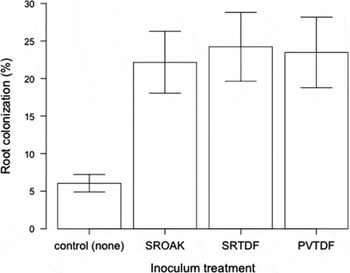
Plants in the pot experiment were all harvested on the same day, 2 mo after germination, by which time 11 of the seedlings had died. Although seedling mortality did not vary across soil types or among inoculum treatments (P > 0.05), many individuals in the non-inoculated treatment group showed substantial signs of stress (e.g. wilting and leaf curling) despite adequate water and light exposure, no apparent herbivory, and no pot size constraints on root expansion. We can only speculate as to the cause of this pattern, which could be due to root pathogens, absence of mycorrhizal symbionts in the non-inoculated treatment, or depletion of seed nutrient reserves. However, as root colonization differed dramatically among treatment groups at time of harvest (Appendix Figure 1), we suggest that the 2-mo experimental period, while short, was sufficient to detect fungal effects on plant growth and biomass allocation.
During harvest, each individual plant was carefully removed with its root system intact and rinsed completely free of soil before measuring above-ground stem length, shoot biomass and root biomass. After weighing, root systems were separated into two subsamples: one sample for root staining, stored in 95% ethanol, and one for immediate calculation of specific root length using the grid intercept method (Cornelissen et al. Reference CORNELISSEN, LAVOREL, GARNIER, DIAZ, BUCHMANN, GURVICH, REICH, TER STEEGE, MOGAN and VAN DER HEIJDEN2003). Two leaves (second and third from the terminal leaf) were also sampled from each plant and immediately scanned so that leaf area could be quantified with ImageJ. Root and leaf samples were dried at 60°C for 5 d, and dry weights were used to calculate specific leaf area (SLA) and specific root length (SRL). All statistical analyses were performed using dry weights of roots and leaves.
Mycorrhizal and biogeochemical methods
Root samples from the pot experiment and field survey were stained for mycorrhizal fungi according to Koske & Gemma (Reference KOSKE and GEMMA1989). Roots were cleared in 20% KOH for 3 d, rinsed and acidified overnight in 1% HCl. Roots were stained for up to 24 h in a 14:1:1 mixture of lactic acid, glycerol and water with 0.05% chlorozol black E, then destained in acidified glycerol. Root colonization was determined microscopically (McGonigle et al. Reference MCGONIGLE, MILLER, EVANS, FAIRCHILD and SWAN1990). Acid phosphatase (AP) activity was measured on archived soils from root ingrowth cores using p-nitrophenol conjugated substrate (Sinsabaugh et al. Reference SINSABAUGH, ANTIBUS, LINKINS, MCCLAUGHERTY, RAYBURN, REPERT and WEILAND1993). Briefly, soils were incubated at ambient laboratory temperature (25°C) with p-nitrophenol linked phosphate in a pH 5 buffer. After 1 h, enzymatic reactions were terminated with addition of 1 M NaOH, and the absorbance of the supernatant was measured at 410 nm. Bray phosphorus (Bray P) was measured by extracting 3 g of air-dried soil in 25 mL of a 0.03N NH4F and 0.025N HCL solution. Soil extracts were analysed for PO43− with spectrophotometry following Lajtha et al. (Reference LAJTHA, DRISCOLL, JARELL, ELLIOT, Robertson, Coleman, Bledsoe and Sollins1999).
Statistics
For the field survey, we conducted Spearman's correlation analyses to examine relationships among root mass, root colonization, soil phosphatase activity, Bray P and the number of nodules in each soil core. We also performed one-way nested ANOVAs to examine how root mass, colonization and AP activity varied among forest types and plots, using stand age as a covariate to control for variation in above-ground biomass (Becknell & Powers Reference BECKNELL and POWERS2014). Data were log-transformed as necessary to improve normality. Finally, we examined root colonization as a function of soil P availability with both traditional linear models and generalized additive models (to test for a unimodal hump-shaped relationship; Treseder & Allen Reference TRESEDER and ALLEN2002), using the mgcv package in R (Wood Reference WOOD2011).
For the shadehouse experiment, we conducted three-way ANOVAs to assess the impact of soil type (SROAK, SRTDF or PVTDF), inoculum source (no inoculum, SROAK, SRTDF and PVTDF), and plant species identity on total seedling biomass, root:shoot ratios, functional traits and root colonization. Response variables from the shadehouse study were non-normally distributed, and transformations did not significantly improve the shape of the distributions. All results presented here are based on log-transformed data (except in the case of colonization data, which were square-root transformed, and SRL data, which were untransformed), as these transformations produced the most normally distributed residuals. We used Tukey HSD post hoc tests to examine whether plant responses to microbial inoculum depended upon inoculum source. Finally, we performed linear regressions to quantify relationships between plant biomass and per cent root colonization.
RESULTS
Field survey
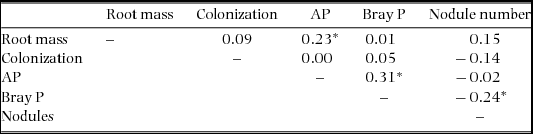
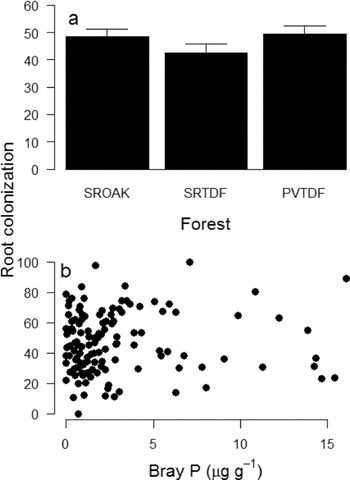
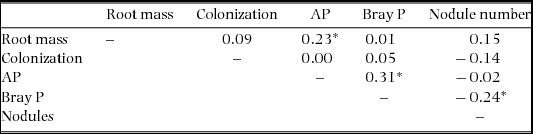
Root mass, root colonization, soil AP activity and Bray P all varied dramatically among plots, and AP and Bray P were both positively related to stand age (Table 2). However, only Bray P differed among forest types, with five-fold and three-fold higher soil P in PVTDF than in SROAK and SRTDF, respectively. AP activity was positively correlated with both root mass and Bray P (Table 3). Despite dramatic variation in P availability, average root colonization was almost identical in all three forests, ranging from an average of 42.4% in SRTDF to 49.4% in PVTDF (Figure 1a). Thus, root colonization displayed neither a linear nor a unimodal (hump-shaped) relationship with P availability (Figure 1b).
Results of one-way nested ANCOVAs examining effects of forest type (Santa Rosa oak forest, Santa Rosa tropical dry forest and Palo Verde tropical dry forest) and stand age on below-ground properties (root mass (g), percentage root colonization by arbuscular mycorrhizal fungi, acid phosphatase activity (μmol g−1 h−1), and Bray phosphorus (μg g−1)) in 0.1-ha forest inventory plots in Guanacaste, Costa Rica.

Spearman's correlations among root mass, % root colonization, acid phosphatase (AP) activity, Bray P, and root nodulation across 18 permanent plots in Área Conservación Guanacaste, Costa Rica. Significant ρ are indicated with an asterisk.
Mean % colonization (a) by arbuscular mycorrhizal fungi in roots collected in each of three forest types (Santa Rosa oak forests, Santa Rosa tropical dry forest, and Palo Verde tropical dry forest; N = 6 plots per forest type) in Guanacaste, north-west Costa Rica. Error bars are ±1 SE. Relationship between root colonization and Bray P (b) in each root ingrowth core.

Shadehouse pot experiment
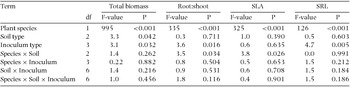
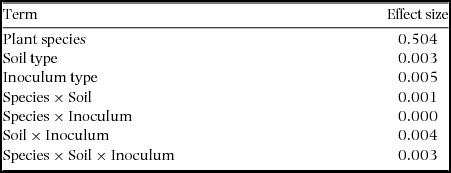
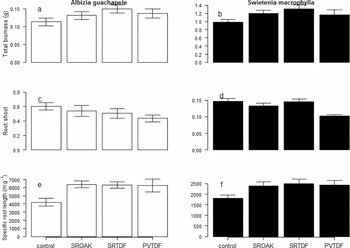
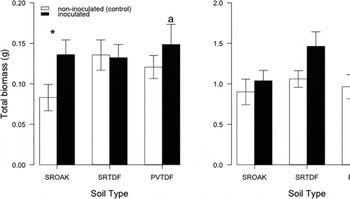
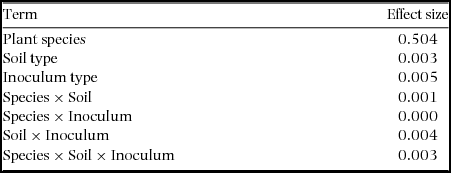
Total seedling biomass was affected independently by species, soil type and inoculum treatment (Table 4). Species identity explained about 50% of the variation in plant size. Although effect sizes for other treatments were smaller (Table 5), the effect size of inoculum type was 40% greater than the effect size of soil type. In post hoc tests, seedling biomass increased 42% with SRTDF inoculum relative to controls (P = 0.01). Addition of microbes from SROAK and PVTDF increased plant size 39% and 1%, respectively, but these differences were not significant in post hoc tests (Figure 2a,b). Plants were also 65% larger in SRTDF soil relative to SROAK soil (P = 0.04, Figure 3). Root colonization by mycorrhizal fungi was 75% lower in non-inoculated control plants (6.1% ± 1.4%) vs. inoculated plants (23.3% ± 2.0%; F3, 74 = 9.71, P < 0.001; Appendix Figure 1), but root colonization did not vary among inoculum from the three forest types. Total plant biomass was positively related to AMF colonization, regardless of inoculum source (P = 0.05).
Results of three-way ANOVAs examining effect of plant species (Albizia guachapele and Swietenia macrophylla), soil type and inoculum type on seedling biomass and morphology (root:shoot ratios, specific leaf area (SLA) and specific root length (SRL)) from a pot experiment conducted in Guanacaste, Costa Rica.

Effect size (treatment sum of squares/total sum of squares) for each factor in a three-way ANOVA on total plant biomass in the shadehouse experiment manipulating plant identity (Swietenia macrophylla vs. Albizia guachapele), soil type and microbial inoculum type.
Effect of inoculum origin (control = no inoculum) on total plant biomass (a, b), root:shoot ratios (c, d) and specific root length (e, f) in the shadehouse experiment. Results for Albizia guachapele are shown in white bars, and results for Swietenia macrophylla are shown in black bars. Acronyms: Santa Rosa oak forest (SROAK), Santa Rosa tropical dry forest (SRTDF) and Palo Verde tropical dry forest (PVTDF).

Effect of soil type on total biomass of inoculated and non-inoculated (control) Albizia guachapele (a) and Swietenia macrophylla (b) seedlings in the shadehouse experiment. Asterisk indicates a significant difference in the size of uninoculated vs. inoculated plants within a soil type in planned comparison tests.

Specific root length and plant root:shoot ratios varied among inoculum treatments, while specific leaf area was not affected (Table 4, Figure 2c–f). In post hoc tests, root:shoot ratios were 25% lower in plants that had received PVTDF inoculum vs. controls (P = 0.01). Specific root length increased 44% relative to controls in all plants that had received inoculum, regardless of source.
DISCUSSION
Soil nutrient availability is thought to mediate plant interactions with free-living microbes and symbionts such as mycorrhizal fungi and nitrogen-fixing bacteria. In this study, we used complementary approaches to investigate whether there were systematic changes in plant-mycorrrhizal interactions along soil fertility gradients, and whether seedling responses to the presence of whole soil microbial communities differed among soil types. Contrary to our first hypothesis (H1), root colonization by AMF was unrelated to soil nutrient concentrations in the field, as indexed by labile (Bray P) and total phosphorus pools. Moreover, although soil microbes had a pronounced impact on plant growth and morphology in a controlled shadehouse experiment, seedling responses to microbial communities were unrelated to soil fertility, counter to H2. Although tree seedlings in the presence of microbial inoculum tended to be larger and had greater specific root length, these responses were independent of soil type. Finally, there was no evidence of local specialization of microbial communities to edaphic conditions (H3), as plant biomass was not maximized when the source of microbial inoculum matched soil type.
Plant–fungal patterns over gradients of soil fertility
We found no evidence for a unimodal or hump-shaped relationship between root colonization and nutrient availability along a continuous gradient of P availability spanning three orders of magnitude. However, acid phosphatase activity was positively correlated with Bray P across the fertility gradient. Increased enzyme activities in P-rich soils may be linked to higher microbial biomass in the nutrient-rich soils of Palo Verde, or may reflect known variation in fungal community composition across the gradient (Waring et al. Reference WARING, ADAMS, BRANCO and POWERS2016).
Both the trade-balance model and nutrient limitation model predict that root colonization by AMF should decrease when soils are rich in P (Johnson Reference JOHNSON2010, Treseder & Allen Reference TRESEDER and ALLEN2002). This is because plants are able to sanction non-beneficial fungal symbionts by reducing below-ground C allocation (Grman Reference GRMAN2012), resulting in decreased fungal biomass. By contrast, the observed absence of a relationship between root colonization and soil P is consistent with other studies that demonstrate a decoupling between nutrient availability and mycorrhizal abundance along natural fertility gradients (Powers et al. Reference POWERS, TRESEDER and LERDAU2005). Given the high carbon cost of maintaining a mycorrhizal symbiosis, it is unclear why plants in the P-rich soils of PVTDF would exhibit such high intensities of root colonization. However, high mycorrhizal abundance in relatively P-rich tropical soils appears to be a rule rather than an exception (Camenzind et al. Reference CAMENZIND, HEMPEL, HOMEIER, HORN, VELESCU, WILCKE and RILLIG2014, Lovelock et al. Reference LOVELOCK, ANDERSEN and MORTON2003, Powers et al. Reference POWERS, TRESEDER and LERDAU2005). Therefore, we propose at least three, non-exclusive explanations for this pattern: fungal parasitism, regulation of the plant–fungal symbiosis by another resource (e.g. water), or more complex relationships among plant nutrient demand, plant–microbe competition and mycorrhizal dependency.
High root colonization by mycorrhizal fungi in the P-rich soils of Palo Verde may reflect some degree of asymmetric nutrient exchange between plants and their symbionts (i.e. fungal parasitism). Mathematical models predict a shift from plant–fungal mutualism to parasitism as soil fertility increases (Neuhauser & Fargione Reference NEUHAUSER and FARGIONE2004), and empirical data confirm that mycorrhizal fungi can behave parasitically, especially when P is not limiting (Johnson et al. Reference JOHNSON, WILSON, WILSON, MILLER and BOWKER2015). However, it is unlikely that such parasitic behaviour is pervasive throughout the entire AMF community, as the plant-mycorrhizal mutualism is stabilized by bidirectional resource exchange and sanctions (Kiers et al. Reference KIERS, DUHAMEL, BEESETTY, MENSAH, FRANKEN, VERBRUGGEN, FELLBAUM, KOWALCHUK, HART, BAGO, PALMER, WEST, VANDENKOORNHUYSE, JANSA and BUCKING2011). Moreover, in the shadehouse experiment, plant biomass was positively correlated with AMF colonization across all soil types, suggesting that AMF in P-rich Palo Verde soils were not behaving parasitically.
Another possibility is that plant–fungal dynamics in tropical dry forests are shaped by water rather than soil nutrient availability, as rainfall is a key regulator of forest growth and soil nutrient cycling in these highly seasonal ecosystems (Gei & Powers Reference GEI, POWERS, Sanchez-Azofeifa, Powers, Fernandes and Quesada2014). Mycorrhizal fungi are known to assist in water uptake and improve plant water-use efficiency (Allen Reference ALLEN2011, Ruiz-Lozano & Azcon Reference RUIZ-LOZANO and AZCON1995). The mechanisms underlying mycorrhizal effects on plant water relations are both direct (i.e. water uptake and transport by fungal hyphae) and indirect (effects on root morphology and photosynthetic efficiency, Augé Reference AUGÉ2001). In this study, we observed increases in specific root length in response to the presence of mycorrhizas, which theoretically would improve root absorption capacity in dry soils. Thus, in our study sites, where soils are dry for 6 mo of the year, patterns in root colonization may be driven by intra-annual variation in water availability, rather than soil nutrients.
Finally, it is possible that plants may benefit from their relationship with AMF even in relatively fertile soils. Across our 18 study plots, plant P-use efficiency declines with increasing soil P content (Waring et al. Reference WARING, BECKNELL and POWERS2015). Trees on Palo Verde soils do not exhibit conservative internal nutrient cycling and may have high P demand. Thus, plant mycorrhizal response (the magnitude of growth increase attributable to AMF) may be decoupled from mycorrhizal dependency (the ability to grow in the absence of AMF). For example, a species with poor foliar nutrient resorption and low nutrient uptake efficiency may experience phosphorus limitation even when the P supply rate is high, and therefore be dependent on AMF to grow. Previous studies have shown that tropical tree species exhibit dramatic variation in their mycorrhizal dependency (Siqueira & Saggin-Júnior Reference SIQUEIRA and SAGGIN-JÚNIOR2001). If fast-growing, nutrient-demanding trees also tend to be more reliant on mycorrhizas for soil P, then mycorrhizal colonization rates are likely to be high in the fertile soils where such plant species flourish.
Plant interactions with whole soil microbial communities
Plant interactions with fungal symbionts must be considered in the context of whole soil microbial communities, including pathogens and free-living microbes. In the shadehouse experiment, inoculation with soil microbes enhanced or had neutral effects on plant biomass, suggesting that the positive effects of symbionts (AMF and N-fixing bacteria in A. guachapele) outweighed or counteracted the potentially deleterious effects of soil pathogens. The net outcome of plant responses to whole microbial communities likely reflects complex interactions among plants, their symbiotic microbes and free-living heterotrophic bacteria and fungi. For example, although total P availability is high in PVTDF soils, plants and their associated symbionts can still experience strong competition with free-living heterotrophs for nutrients, which may strengthen the mutualism between plants and AMF. Moreover, increased N availability due to association with N-fixing bacteria may increase legumes’ demand for P (Johnson Reference JOHNSON2010, Scheublin et al. Reference SCHEUBLIN, RIDGWAY, YOUNG and VAN DER HEIJDEN2004). However, we did not observe an interaction between tree species identity (legume vs. non-legume) and microbial origin or soil type in our shadehouse experiment, which suggests that other components of the soil microbial community had a greater influence on the growth of A. guachapele than N-fixing bacteria.
Although our experimental design did not permit us to disentangle plant responses to symbionts vs. free-living microbes, we did find that the presence of microbes (inoculated vs. un-inoculated plants) had larger effects on plant biomass than soil nutrient concentration itself. Yet in reality the effects of both soil type and inoculum type were relatively small. This may reflect the short duration of the shadehouse experiment; however, because relative growth rate decreases with increasing plant size (Paine et al. Reference PAINE, MARTHEWS, VOGT, PURVES, REES, HECTOR and TURNBULL2012), we might expect that young seedlings should be most sensitive to variation in nutrient availability. Alternatively, the modest treatment responses may reflect plant life-history strategies: both S. macrophylla and A. guachapele are fairly shade-tolerant mid-successional species, whereas light-demanding early-successional species generally show greater gains in total biomass with increasing nutrient availability (Lawrence Reference LAWRENCE2003).
CONCLUSIONS
Our data from both pot experiments and natural fertility gradients among forests demonstrate that plant investment in mycorrhizal fungi is not necessarily predictable from soil P availability, as widely assumed. Plant responses to AMF infection must be considered in the context of whole soil microbial communities, including pathogens and free-living microbes that compete with plants for nutrients. Our work underscores the need for a better understanding of plant–microbe interactions in tropical forests, especially dry forests where water may play a more important role in regulating the plant-fungal symbiosis.
ACKNOWLEDGEMENTS
We thank the National Science Foundation for financial support (DEB-1053237), Daniel Perez-Aviles and Geohanny Hernandez for excellent help in the field, and Roger Blanco, Maria Marta Chavarria and Milena Gutierrez of the Área de Conservación Guanacaste for logistical support.
Stand age, soil chemistry (to 10 cm depth), and tree species richness for the six 0.1-ha plots within each of three forest types in Guanacaste, northwest Costa Rica.

Root colonization by arbuscular mycorrhizal fungi in each inoculum treatment (control [no inoculum], SROAK inoculum, SRTDF inoculum and PVTDF inoculum) in the shadehouse experiment in Guanacaste, Costa Rica. Data are averaged across all three soil types and plant species (Albizia guachapele and Swietenia macrophylla). Error bars are ±1 SE.