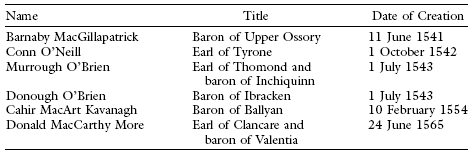
In the final decade of Henry VIII’s reign there emerged a new phenomenon in the centuries-old relationship between England and Ireland: the Gaelic peer.Footnote 1 When the king of England issued letters patent in June 1541 authorizing Barnaby MacGillapatrick’s creation as first baron of Upper Ossory, two societies’ understanding of high social position and inherited rank became intertwined.Footnote 2 At that moment, the elected head of the MacGillapatrick lineage, or clan, joined dozens of other temporal lords, in England as well as in Ireland, who were recognized as titled peers, the natural leaders of Tudor society. The crucial difference, in this case, was that the new baron was the first man who was not of English or Welsh paternal blood to hold a noble title of the king of England. The peerage of Ireland was then populated exclusively by the English of Ireland who were descended from the subjects of the king of England who had settled in Ireland in the twelfth and thirteenth centuries in the wake of conquest.Footnote 3 But there was another important aspect of MacGillapatrick’s ennoblement: he was already a nobleman in Gaelic society. He belonged to Ireland’s dominant native elite whose social distinction derived in the first instance not from a title held of any individual but from their ancient paternal ancestry and from their military strength. The ennoblement of MacGillapatrick thus touched on larger questions surrounding the constitutional relationship between the English king and the Gaelic population of Ireland, the vast majority of whom were not accounted the king’s natural subjects, and the future place of the Gaelic elite within a Tudor state that was shortly to redefine Ireland’s place within the larger polity.
The next two years saw a spate of Gaelic lords granted noble titles based in Ireland from the king of England. The creations came in conjunction with Henry VIII’s acceptance of the kingship of Ireland, which was itself part of a new Tudor political and constitutional dispensation begun in the early 1540s, meant to integrate Ireland and its inhabitants into the Tudor state.Footnote 4 From a Tudor perspective, the opening of the peerage to leading Gaelic lords was a step toward the integration of the king’s subjects in the new kingdom of Ireland into an empire headed by Henry VIII. But the Tudors’ cultivation of Gaelic peers was a largely unsuccessful exercise. Instead of incorporating the Gaelic elite into the Tudor peerage en masse in 1541 and after, successive English sovereigns chose to offer noble titles piecemeal to only a handful of Ireland’s Gaelic lords. The Henrician creations were followed by only two grants of noble title to men of Gaelic blood and surname: one, Cahir MacArt Kavanagh, in Queen Mary’s reign, and another, Donald MacCarthy More, in the reign of Queen Elizabeth. The newly made peers in Ireland, moreover, were originally intended, during the reign of Henry VIII, to be made English nobles. Though they were entitled to a seat in the House of Lords in the king’s parliament of Ireland, and thus belonged to the peerage of Ireland that was a separate body of nobility from the peerage of England, their noble titles were intended to be the last in a series of agreements that made them English subjects and English peers whose titles were attached to territories in the king’s lordship (soon to be his kingdom) of Ireland. Under Elizabeth, however, this basic (and largely artificial) binary distinction, which had developed in Ireland in the later Middle Ages between two nations, English and Gaelic, became impossible for the state to sustain.
The appearance of the Gaelic peer represents an important step in the formation of the Tudor state. The relationship between a sovereign and the nobility was a key to a successful multiple, or composite, monarchy in early modern Europe: handled properly, local elites could be a powerful tool for a monarch in the governance of his kingdoms; by contrast, a monarch’s alienation or provocation of local elites might render a kingdom ungovernable.Footnote 5 In the kingdom of Ireland, the Tudors elicited both reactions from the Gaelic peers: from the unswerving loyalty of the O’Brien earls of Thomond to the rebellions of the MacCarthy earl of Clancare and, most spectacularly, the O’Neill earl of Tyrone. Yet, the fact that the Tudor peerage extended to Ireland and that it included nobles of Gaelic ethnic extraction has been consistently overlooked in studies of the sixteenth-century English nobility.Footnote 6 Irish historians, for their part, have generally shown a reluctance to explore what were, at base, English titles of honor and social distinction. The acceptance by Irishmen of English titles of nobility was difficult to reconcile with the resistance-centered accounts of sixteenth-century Ireland later espoused by Irish nationalism.Footnote 7 Nobility—when equated with the peerage—carried with it the connotation of Englishness, for the peers of the kingdom of Ireland derived their nobility directly from the monarch of England. In a twentieth-century expression of this nationalist tradition, the possession of nobility by Irish citizens was prohibited in the constitution of Ireland. Written in 1937, Article 40 of Bunreacht na hÉireann states that “titles of nobility shall not be conferred by the state” and “no title of nobility or honour may be accepted by any citizen except with the prior approval of the government.”Footnote 8 The historian seeking to probe the subject of nobility in early modern Ireland thus must not only look beyond that distinctly modern aversion to the phenomenon of inherited privilege and rank but must also confront a nationalist tradition that has long excoriated the existence in Ireland of titles of nobility and equated their possession with foreignness.
Yet, it has been convincingly shown that the concepts of nobility and honor in early modern Europe transcended national borders; so powerful, in fact, were these notions that they may have counted for more than loyalty to one’s nation or sovereign.Footnote 9 Only recently have historians begun to separate these concepts as they existed in early modern Ireland from eighteenth- and nineteenth-century ideas about the enduring place of the nation in historical development and the supposed duty that historical figures owed to it.Footnote 10 Still, no comprehensive exploration of the peerage of Ireland has yet been attempted for the Tudor period.Footnote 11 What follows offers an explanation for the entry of Gaelic lords, after centuries of exclusion, into the peerage of Ireland. This article argues that the failure of the Tudors to cultivate a more numerous and more robust cohort of Gaelic peers was symptomatic of the exclusivist pattern of state formation pursued by the crown and government of England with relation to Ireland and its Gaelic population. Where most other composite states in early modern Europe accepted the position of local elites, the leaders of the Tudor state sought wholly to replace Gaelic concepts of nobility with English ones. A paradox lay at the heart of such an approach: by singling out some of the most influential Gaelic leaders for earldoms, and reserving lesser titles of noble distinctions for lesser lords, the state confirmed and even strengthened the existence of the native elite it sought to replace. Here the Tudor state’s efforts to Anglicize the Gaelic elite and wipe away cultural aspects that were not English came into conflict with the need, common to all early modern states, to cultivate local elites as a means of centralizing its authority.Footnote 12 An unlikely mark of English exclusivity vis-à-vis Ireland was the experiences of a handful of Gaelic lords who accepted, or were prepared to accept, noble titles from the Tudor sovereigns, but the experiences of these Gaelic peers serve to illustrate English and Gaelic attitudes to nobility and its role in the emergence of English multiple monarchy. The essay concludes by suggesting that the elite of Gaelic society, far from harboring an inherent aversion to English nobility as later historians assumed, actively sought to procure titles from the Tudor sovereigns as a means of comprehending and assimilating the rapid extension of English rule in Ireland.
The first known suggestion of raising leaders of the Gaelic polity to the peerage came early in Henry VIII’s reign.Footnote 13 In the anonymous treatise “State of Ireland and Plan for its Reformation” (1515) the author proposed that the most powerful Gaelic lords “be create and made Lord of the Kinges Parlyament and Greate Counsayll … soo that the sayd Iryshe lorde shalle inyoye all the prerogatyves of the Kinges Parlyament, as other lordes dothe, using hymselff theraftre, and shalbe nameyd and callyd lorde of the countrey wher he dwelleith, orelles lorde of nation, he and his heyres males for ever, by the Kinges graunte.”Footnote 14 The author of the treatise, who was most probably an Englishman born and bred in Ireland, was greatly influenced by fifteenth-century suggestions for the reformation of the lordship of Ireland. It is thus likely that the notion of accepting as lords in an English context the dozens of independent Gaelic lords who ruled most of the island of Ireland in the later Middle Ages was not a new one among the local English population there. While nothing like a rigidly demarcated or carefully regulated hierarchy of nobility existed between Gaelic lords, those men who were the elected leaders of their clans represented the elite of Gaelic society.Footnote 15 And within this elite only half a dozen or so lineages could lay claim to descent from those provincial kings who predominated before the English conquest. Some English observers from Ireland, such as the author of the “State of Ireland,” understood the importance of winning over the native nobility and even attempted to cast them in English terms. Of the leaders of the Gaelic polity he declared: “some callyth them selffes kynges some kynges peyres in their language some prynceis some dukes some archedukes.”Footnote 16 In this way, the legal and constitutional differences that had developed in late medieval Ireland between the king of England’s English subjects in Ireland and his “Irish enemies” would be removed through the latter’s acceptance into the lordship’s elite.
The young King Henry was initially reluctant to ennoble members of the Gaelic elite, however. Even in 1520, when he shied away from the expense of conquering the Gaelic areas of his lordship of Ireland and instructed Thomas Howard, earl of Surrey, his lieutenant there, to proceed with the native leadership by “sober ways, politic drifts and amiable persuasions founded on law and reason,” the king drew a line before making peers of Gaelic lords.Footnote 17 Henry commanded his lieutenant to “save thOrder of Knighthode” for deserving leaders of the Gaelic polity, and to this end Conn O’Neill, the most powerful of all Ireland’s Gaelic lords, received a collar of gold bearing the king’s livery as evidence of his English knighthood.Footnote 18 Yet, when in the same year, an unnamed Gaelic lord wrote to Henry offering to hold his lands of the crown by letters patent and seeking “a creacion of a name of dignitie,” the king responded favorably.Footnote 19 The earl of Surrey, too, was confronted with a lord (likely the same lord who had been in correspondence with the king) seeking a title of English nobility and to hold his lands of the king by feudal tenure. In 1521 Cormac Oge MacCarthy met the lord lieutenant and requested that he be made a baron and given the right to come to “Parliamentes and Counsailes”; in effect, to join the peerage of Ireland whose membership was then comprised exclusively of lords of English ethnic extraction.Footnote 20 Like Henry, Surrey came to see the benefit in raising men like MacCarthy to the peerage. In return for letters patent and a title, they would pledge their allegiance to the king of England and yield a rent up to him. In this way, royal influence might be extended and a cornerstone of the English social and political order introduced to a Gaelic part of Ireland at little cost to the crown.
King Henry, however, lacked both the political vision and the concentration to pursue this strategy with the Gaelic polity, and his principal advisors were shortly to have more pressing matters to occupy them. Thus, for nearly two decades, the prospect of raising Gaelic lords to the peerage receded into the background. It was only in the radically changed political atmosphere in Ireland and England following from the destruction of the Kildare power base in the wake of the Kildare rebellion and Henry VIII’s break with Rome in the mid-1530s that suggestions for ennobling Gaelic lords were again advanced. In June 1537 the king’s council in Ireland recommended that Cahir O’Connor be accepted as a subject and created baron of Offaly, so as to establish an ally for the government in the strategically important Gaelic midlands following Lord Deputy Leonard Grey’s recent military incursions there. For his acceptance of such a dignity from the king, the council believed, “Irishmen would hate him.”Footnote 21 Later that year, a group of royal commissioners sent to review Tudor government in Ireland, headed by the courtier and future lord deputy of Ireland, Sir Anthony St. Leger, accepted the submission of another midland lord, Barnaby MacGillapatrick, and suggested that he be raised to the peerage as a baron.Footnote 22 That these English commissioners, with little experience of Ireland, should also support the elevation of Gaelic lords to the peerage seems to indicate that Dublin and Whitehall were at one in their belief that the crown should engage the Gaelic polity in this way, only neither they, nor anyone in Ireland, could create a peer. This was the preserve of the king alone, and, for the rest of the decade, Henry took little interest in the lordship of Ireland.
The situation was different by 1540: the king’s break with Rome was complete; Cromwell was dead; and, for the first time since 1520, Henry VIII was personally involved in dictating the course of Tudor policy in Ireland. That year Anthony St. Leger returned to Ireland as deputy and picked up the threads of the work begun by his commission three years earlier. In early 1541, amid a flurry of Gaelic submissions to him as the king’s representative in Ireland, and as part of a new policy of integrating the Gaelic population into the Tudor state, St. Leger again recommended MacGillapatrick for a peerage.Footnote 23 In June, Henry VIII authorized the chancery to issue the letters patent that raised MacGillapatrick to the peerage as Lord of Upper Ossory—the new baron took his seat in the House of Lords in the parliament that was convened that month and at which Henry VIII was proclaimed king of Ireland.Footnote 24 While MacGillapatrick made history in the Lords, the leaders of the O’Reillys and the O’Connors, along with representatives of five other lords and clans, were in attendance to observe the Lord of Upper Ossory and the legislative organ of English government in action. It was the first time in the history of the parliament of Ireland that Gaelic lords, so often described by that same institution as “the king’s Irish enemies,” were admitted.Footnote 25
If the creation of MacGillapatrick as Lord of Upper Ossory reflected the beginning of the Tudor state’s new policy toward the Gaelic polity, then the ennoblement of two of the most powerful Gaelic lords in Ireland reflected the seriousness of that policy. Conn O’Neill and Murrough O’Brien were created earls of Tyrone and Thomond in 1542 and 1543, respectively. Kings of England might create barons by letters patent without ever having laid eyes upon the recipients, but elevation to the peerage as an earl was a much greater distinction. The king wrote to Ulick MacWilliam Burke, who sought to be advanced to the peerage as an earl but hoped to be so created without having to travel to England, that “thonor of erle is too great as hathe never been given and conferred but only by orself or by some of or most noble progenitors being p[re]sent in p[re]sence”; just two months earlier Henry made reference to the succession of James Butler to the earldom of Ormond: “and forasmuche as the creacon of therle of Ormond cannot passe but by suche investiture as must be given by ourself in p[er]son we shall differ that till suche tyme as he may at convenyent leasor repayre hether.”Footnote 26 The peerage of Ireland was separate from its English counterpart, but noble titles in both realms flowed from the same monarch. Accordingly, Henry VIII demanded the presence of O’Neill and O’Brien before him, and both creations occasioned elaborate ceremonies at the king’s palace at Greenwich.Footnote 27 There, in front of the temporal and spiritual nobility of England, O’Neill and later O’Brien were led between two earls in procession toward the king with “the Viscount Lisle [John Dudley] bearing before him his sword, the hilt upwards, Garter [King of Arms (Sir Christopher Barker)] before him.” Lisle carried the letters patent, which were the administrative mechanism whereby the creations were given legal force. Henry VIII received the letters patent of the Garter and had his secretary read them aloud. When he came to the words “cincturam gladii,” Lisle “presented unto the King the sword, and the King girt the said sword … bauldrickwise” about their left shoulders. At the dinner feast that followed, Garter read out the king’s style and then formally proclaimed the titles of the newly created earls. The earls then rewarded the officers of Henry VIII’s court “according to the old and ancient custom” by offering them a money payment. This marriage of tradition and ritual with the written word, which characterized the creation of English nobility, was now open to the elite of Gaelic society.
Yet, for all the symbolism of a Gaelic lord sitting in parliament and the spectacle of two of Gaeldom’s most powerful leaders kneeling before the king of England at Greenwich, and for all the hope that these unprecedented events would form the basis for a new relationship between the king of England and men once considered his “Irish enemies,” Henry VIII created only four Gaelic peers. After 1541, the king planned to raise O’Connor, O’Reilly, and O’Rourke to the peerage as viscounts, but they were never granted titles.Footnote 28 That King Henry showed such restraint when he had already accepted in principle the notion of ennobling Gaelic lords, and at a time when dozens of leaders of the Gaelic polity were submitting to his authority, is important. The crown’s failure to create more Gaelic peers may be attributed primarily to the Tudor state’s insistence on making English nobles of Gaelic lords. Even though the decision to grant earldoms to the strongest lords, to make barons of Gaelic lords of middling power and influence, and to grant knighthoods (or nothing at all) to minor lords showed a recognition of the existing native hierarchy, the Tudor political establishment refused to accept explicitly that the men whom the king ennobled were already nobility in Gaelic society. Every Gaelic submission accepted by the crown was designed to wipe away all traces of native nobility. O’Neill, for example, was made to admit the “errors of himself and his ancestors,” to renounce his surname—the very basis of nobility in Gaelic society—to use English habits, and, so far as he could, the English language; before O’Rourke could be put forward as a baron, he had to be accepted as “a liege and true Englishman”; O’Connor had to be made of “free state … after the manner of the English” before he could be raised to the peerage as a baron.Footnote 29 Gaelic lords thus had to pass through several stages of constitutional and cultural transformation before they could be considered for an English noble title. And if an earldom was on offer, the king insisted that the prospective earl travel to court, so as to receive his title after the fashion of English earls.Footnote 30 All of this took time. And Henry, as it turned out, did not have enough of it: by 1543 he was consumed with his war against Scotland and France, and by early 1547 he was dead.
Over the next half century Henry’s children raised just two more Gaelic lords to the peerage.Footnote 31
The Gaelic Peers
In February 1554 Mary I issued letters patent creating the Leinster lord, Cahir MacArt Kavanagh, baron of Ballyan; in June 1565 Queen Elizabeth, more than four decades after the earl of Surrey recommended a MacCarthy for an English noble title, ennobled Donald MacCarthy More as earl of Clancare and baron of Valentia.Footnote 32 Henry VIII’s attitude toward nobility was unique among the Tudors. Unlike his father, whose character was shaped by the noble feuds and dynastic struggles of the later fifteenth century, the second Tudor did not fear his nobility. Rather, Henry VIII increased the size of the peerage, if not the power of individual peers, to demonstrate the crown’s dominance of the titled aristocracy: he alone could make and unmake nobles.Footnote 33 For Henry, moreover, his was an imperial crown.Footnote 34 Nowhere was this more apparent than at Greenwich in 1543 when he ennobled Murrough O’Brien, O’Brien’s nephew, and MacWilliam Burke and knighted five others before not only the English peerage but also a proportion of the nobility of Scotland captured at the battle of Solway Moss. Here, at Henry VIII’s royal palace, representatives of the nobility of three kingdoms of the British Isles were gathered at the king of England’s court. The spectacle was not lost on the imperial ambassador in London, who reported to the queen of Hungary that “four or five of the principal lords of Ireland, accompanied by some bishops of their own nation have arrived here, and this very morning have taken the oath of fealty and homage to the king.”Footnote 35 Edward VI’s youth meant that he was not in a position of sufficient strength to dominate the nobility after the manner of his imperious father. Indeed, the elevation of so many men to the peerage in England during the boy king’s short reign underlines the fact that the relationship was then working in reverse.Footnote 36 Mary and then Elizabeth were upon their accessions handicapped in their relationship with the nobility because of their sex. They were in no way restricted from creating nobility, and both queens did create new peers in England and Ireland, but neither queen sought to dominate this exclusively male caste so as to reflect the power and majesty of the crown. Elizabeth, as is well
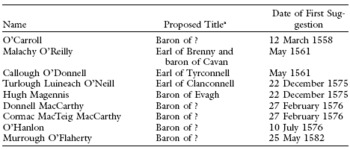
Projected Creations under Mary and Elizabeth

a Elevation to the peerage was often suggested without naming a specific title.
known, was ill disposed to the creation of new nobility: she created only twelve new peers during her long reign—ten in England and two in Ireland—and of these only Sir William Cecil, first baron Burghley, and the two new peers from Ireland, the MacCarthy earl of Clancare noted above and Sir William Burke, the first baron of Castleconnell, were neither the queen’s blood relations nor drawn from existing noble families.Footnote 37
Yet, at least nine more Gaelic lords were put forward to enter the peerage of Ireland during the reigns of the Tudor queens.Footnote 38 During a period of rapid English political and cultural expansion in Ireland, the peerage continued to represent a means whereby leaders of the Gaelic polity might be incorporated into the social and political hierarchy of Tudor society at little cost to the crown. Better to have lords paying the crown rent and sitting as peers in the House of Lords, so the reasoning went, than thundering about in their lordships outside it. The brevity of Queen Mary’s reign makes her attitude toward the creation of Gaelic peers difficult to judge, though shortly before her death in 1558 the queen wrote to the midland lord O’Carroll, promising him that she would raise him to the peerage as a baron.Footnote 39 Elizabeth, however, demonstrated a new kind of relationship with Gaelic lords over the course of her near fifty years on the throne. At one level, the queen consciously sought to emulate her father’s creations of new peers in Ireland. In 1561 she instructed her lieutenant in Ireland, Henry Radcliffe, the earl of Sussex, to raise MacCarthy and O’Donnell to the peerage as earls of Muskerry and Tyrconnell, respectively, “in like maner as our said most noble father did create therles of Thomonde & Clanricarde.”Footnote 40 Yet, in what was a remarkable departure from Tudor precedent, Elizabeth was prepared to allow Sussex to oversee the ritual of the creation of nobility, including the making of earls, in Ireland. She wrote to him in May of the “co[m]mission which we presently send to you” that empowered her lieutenant to advance men to the peerage; letters patent for the two lords had already been signed and sealed under the great seal of England and sent to Sussex, who was, in turn, to deliver them to the prospective earls.Footnote 41 But within days of instructing Sussex to make MacCarthy and O’Donnell earls, Elizabeth suddenly (and inexplicably) changed her mind: MacCarthy, she insisted, was not to be made a peer, and it was determined that Malachy O’Reilly, after years of more or less consistent loyalty to the crown, should be made earl of Brenny along with Calvagh O’Donnell, the proposed earl of Tyrconnell, who it was hoped would serve as a key ally of the government in its war against Shane O’Neill in Ulster. To this end, some of the trappings of English nobility—robes, collars, and coronets—were sent over to Ireland so that the two men would look the part of English earls.Footnote 42 Elizabeth instructed Sussex, moreover, to use her letters to him, authorized by the royal signet, to move the lord chancellor to make a grant, under the great seal of Ireland, of lands in the English Pale to O’Donnell and O’Reilly and “to the herres males of the bodyes lawfully begotten.”Footnote 43
But Sussex never availed of his power to make nobility. Why this was so is unclear. The formidable Shane O’Neill captured the would-be earl of Tyrconnell, but Secretary Cecil assured Sussex that he was sending the robes and coronets anyway, “which may be applied as youre L. seeth cause.”Footnote 44 His ambitious successor, by contrast, was convinced of the merits of ennobling Gaelic lords. Before he began his first term as lord deputy, Sir Henry Sidney sought permission to raise Gaelic lords to the peerage as barons.Footnote 45 An incomplete draft of a commission was prepared around this time authorizing “chief authorities in Ireland” to raise an unnamed man “to the state title honor and dignitie of a baron but also of an earl.” An analysis of the draft reveals that blank letters patent were prepared in England without dates or witnesses, so that the “authorities” in Ireland might raise to the peerage when they saw fit. The ceremony that Henry VIII had reserved for his court in England was, in this instance, to take place in Ireland. It was a striking reversal of Tudor practice. In 1549, Lord Deputy Edward Bellingham and the king’s council in Ireland had explored the idea of raising Gaelic lords to the peerage, but the response from Edward VI’s Privy Council was unambiguous:
you know that it hath always byn used that suche as have byn called to honor have always receyved their honors at the kinges Maties own handes; whereby & by the sight of his highnes most royall p[er]son, and other enterteynementes, the men have byn moche the more satisfied & born a more assured obedience alwayes after.Footnote 46
Yet, in 1565, the authorities were instructed:
To call before you or any of you … as many other noble p[er]sonages and men of honor of saide realme as you or any of you shall thinke mete, in whose presence our pleasure you or any of you shall cause or saide l[ett]rs patente to be rede … with all and singular such titles and tokens of honor and nobilitye and other ceremonyes and circumstances as to the creacyon state and degree of a Baron and of an Earle dothe app[er]teyne and belonge.Footnote 47
Sidney’s request, “ffor dealing wth Irishe captaines,” came to nothing in his first term as deputy: Elizabeth did not devolve this aspect of her princely powers upon Sidney, and he never acted on the letters patent issued in 1565.
Still, Sidney understood the allure of the peerage. In the following decade, he held out the prospect of a grant of an English noble title as a means to win the support of key lords for his ambitious plans to extend Tudor rule throughout Ireland. Prior to his return to Ireland for a third stint as deputy, Sidney requested that Turlough Luineach O’Neill and Sir Hugh Magennis be created earl of Clanconnell and baron of Evagh, respectively.Footnote 48 The Privy Council, as events were to show, initially had some reservations about the proposed creations, but the councillors eventually came around to Sidney’s thinking—Lord Burghley scribbled “it semeth resonable” in a “postil” beside Sidney’s request to ennoble Magennis. With the earldom of Tyrone in abeyance since the first earl’s death in 1559, it made political sense to create a new title for the powerful and still largely autonomous O’Neill, who was not a direct descendant of the first earl of Tyrone; the less powerful and consistently cooperative Ulster lord, Sir Hugh Magennis, meanwhile, was to be rewarded for his loyalty with the title of baron.Footnote 49 Sidney then suggested, in early 1576, that Sir Donnell MacCarthy and Sir Cormac MacTeige MacCarthy be made barons.Footnote 50 By summer 1576, however, there had been no movement on the creations. Sidney imputed that the delay was due to the Privy Council’s failure to answer his requests. This prompted a sharp and very revealing response from Burghley on behalf of the Privy Council:
And all be it it semeth that yor L[ordship] conceaveth that smale care is had unto yor l[ett]res sent hether … yet if you throughlie marke the l[ett]res wch we sent unto you … so will it plaineie appeare that yor self have not to those l[ett]res answered us … nor to what conclusion you are growne wth Tirlough Lynewgh uppon these Ar[ticles] & postilles sent unto you: nor yet of McGennes, in suche sorte as it is to passe for wante of such a warrante as we required to be drawne by the lerned counsell there and sente hether.
Had Sidney sent over the warrants for the grants to be made from Elizabeth to O’Neill, Magennis, O’Hanlon “& others,” Burghley continued,
it mought ere nowe have bene granted & p[er]fected. And that thereuppon suche of them mought have bene created into degree of honor as yor L[ordship] moved, the wch afore that tyme we thought not meete to be don. So as the p[ro]longing of which p[ro]cedeth of yor self & not us.Footnote 51
Nothing was done still. In an effort to expedite the process, Elizabeth empowered Lord Deputy Sidney, Sir William Drury, lord president of Connaught, and William Gerrard, the lord chancellor, “or any of them” in May 1578 to ennoble Turlough Luineach O’Neill as baron of Clogher and then earl of Clanconnell. In an echo of the method experimented with in 1565, letters patent bearing no date had been issued making O’Neill a baron and then an earl. Sidney, Drury, and Gerrard were simply to carry out the ceremony and date the letters patent—the only limitation was that O’Neill be made a baron at least a day before he was created an earl.Footnote 52 But O’Neill, like the other projected nobles, never entered into the peerage: Sidney departed Ireland in September 1578, never to return, and the kingdom was shortly to be consumed by rebellion in Munster and Leinster. Later, in 1582, Sir Nicholas Malby, the president of Connaught, with the backing of Lord Burghley, recommended that the lord of the O’Flahertys be advanced to the peerage as a baron, but nothing came of this suggestion either.Footnote 53 The lord deputy of Ireland, the queen, and the queen’s council might support the creation of Gaelic peers; the latter might authorize the dispatch to Ireland of noble accoutrement; the queen might, as in the case of O’Neill, even set the gears of Tudor government into motion to ennoble a Gaelic lord; but without the monarch’s more active involvement, the creation of a peer could not easily be brought to a conclusion.Footnote 54
In the end, MacCarthy was the sole Gaelic lord in Elizabeth’s reign to cross the social and political threshold of the peerage, and he did so by traveling to Westminster to receive his honor from the queen before her court.Footnote 55 But it is clear that where the peerage of Ireland was concerned, Elizabeth was content to dispense with the traditional ceremony that accompanied creations of earls and even to delegate her prerogative right to raise to the peerage. In 1585, during the deputyship of Sir John Perrot, Hugh O’Neill, baron of Dungannon, grandson of the first earl of Tyrone, was permitted to sit in the Lords in the parliament of Ireland as the second earl of Tyrone without any suggestion that he come before his sovereign to receive his new title.Footnote 56 Not for two years did O’Neill travel to England to receive a charter formally creating him earl of Tyrone and baron of Dungannon for life.Footnote 57
The attitude of Henry VIII and his children to their Gaelic subjects was uncommon in early modern Europe. In most European composite monarchies, the rights and privileges of the indigenous elite and nobility were preserved and respected when a dynastic union occurred. Unions of this kind in the early modern period were, as J. H. Elliott has highlighted, unions “aeque principali.”Footnote 58 When, for example, it became clear that Philip II of Spain would succeed to the kingship of Portugal, he was keen to reassure the Portuguese nobility and gentry that administrative posts throughout his sprawling empire and in his household would be open to them and that “for the good of the state, of the nobles, and the gentry … we promise to preserve the royal house and family with all its functions, maintaining its privileges and customs in its establishments and its dwellings without altering anything the kings of Portugal have done.”Footnote 59 There had, of course, been no Gaelic king of Ireland for centuries at the time Henry VIII assumed the kingship of Ireland, but there was undoubtedly a Gaelic culture of nobility in place that might easily have been approached along the lines of Philip II’s model. There were two crucial differences in the Anglo-Irish relationship, however. The first was that Henry VIII did not see the king of England’s relationship with Ireland as one borne of “union” at all. Rather, it was a connection founded on his ancestors’ conquest of Ireland. This was not some conceit of the ego of a warrior king: references to “the conquest” were a common feature in Tudor discourse on the history of England’s relationship with Ireland.Footnote 60 For Henry, to acknowledge a nobility that did not derive from the English crown would be to disavow his right to Ireland by conquest.
But there was another element at work here that made the English crown’s attitude toward the Gaelic elite, and the Gaelic population more generally, uncommon in early modern Europe. Englishmen believed the Gaelic polity to be primitive by European standards. For late medieval and early Tudor observers, the conferring of political leadership upon men “elected” by an elite, bound together by a common male ancestor, gathered beneath the open sky atop a hill at the site of some ancient stone, an elite living in dwellings made of wood and earth, and the absence of a more rigid gradation between nobles were all evidence of the primitiveness of Gaelic society.Footnote 61 In 1521 the conquistador Hernán Cortés wrote to Charles V of the wonders of Aztec civilization—of Montezuma’s palaces, he claimed, “there is not their like in all Spain.”Footnote 62 Where were the physical manifestations of the nobility and wealth of Gaelic lords for Englishmen to gaze upon in wonder? St. Leger, at least, understood that certain lords were possessed of power if not of material wealth. Prior to O’Neill’s visit to court, the lord deputy and council wrote to King Henry that O’Neill should be treated with great honor because he is a man of great power.Footnote 63 Of a minor lord, such as Turlough O’Toole, St. Leger wrote: “Although it shall appere to Your Majestie, that this Thirrologh is but a wretched person, and a man of no grete power, neither having house to put his hedd in, nor yet money in his purse to by him a garment, yet may he well make 2 or 3 hundred men.”Footnote 64 The impression of the despotism of the Gaelic elite, something that became a fixation of later Elizabethan proponents of colonization in Ireland, served only to reinforce the English belief that Ireland’s native inhabitants were brutish and uncivilized.Footnote 65 Gaelic concepts of nobility thus had to be abandoned and replaced with English titles of nobility and all that went with them.
As Tudor rule steadily expanded, however, the earlier efforts of the Henrician regime to create English subjects of the Gaelic population became unworkable. Too few of the elite of Gaelic society were granted English noble titles to effect a more rapid change in this population’s national identity, and successive Tudor governments were unable to force the adoption by Gaelic people of most aspects of English culture. In Edward’s reign the English Privy Council suggested that the lord deputy of Ireland explore the possibility of granting Gaelic lords—“some suche noble men and others”—lands in England, presumably with the view to Anglicizing this segment of the population more quickly, but this was never acted upon.Footnote 66 During Elizabeth’s reign, the Tudor insistence that “Englishness” was legally, culturally, and socially superior to “Irishness” in Ireland remained, but in practice the crown’s attempts to make Englishmen of Gaelic lords began to break down. A commission signed by the queen in 1565, for example, made reference to Elizabeth’s “Englishe and Irishe subiectes” in her kingdom of Ireland.Footnote 67 Where once O’Rourke, who submitted to a representative of the crown in 1542, was to be accepted as a “liege and true Englishman” and offered a noble title, his son, who submitted to a representative of the crown in 1577, merely pledged his allegiance to Elizabeth “as her true and obedyent subiecte for ev[er]” without so much as the promise of ennoblement.Footnote 68 Indeed, the crown’s official position was that the queen’s subjects in Ireland, regardless of their ancestry, were no different to her subjects in England. In the draft of her instructions for the establishment of a provincial presidency for Munster in 1568, Elizabeth wrote that she had “no lesse princely and naturell regarde to her saide universall realme [of Ireland], & to the people therof than even to her realme of England”; and later, when speaking before parliament in 1585, Sir John Perrot was compelled to announce that Elizabeth had equal regard for her subjects in both her kingdoms.Footnote 69 The Elizabethan regime also came closest to making an explicit acknowledgment of the inherent nobility of Gaelic lords, including in Turlough Luineach’s letters patent the admission that O’Neill, who was “born in Ireland,” was noble “by blood.”Footnote 70 Thus, the crown, by the end of the sixteenth century, had accepted that the Tudor state included Irish subjects, some of whom were peers of paternal Gaelic ancestry, but this acceptance now came with an implicit expectation that Irish subjects would conduct themselves as Englishmen.
In February 1571 Sir William Cecil, the secretary of state and Queen Elizabeth’s most trusted advisor, was raised to the peerage as Lord Burghley. Like O’Neill and O’Brien, the Garter King at Arms led Cecil, who was flanked on either side by two barons, to kneel before the sovereign. There can be little doubt that William Cecil appreciated the gravity of his ennoblement. He was careful to preserve the elaborately embellished letters patent underpinning his dignity that he received at a ceremony before Queen Elizabeth and her court—as Stephen Alford has recently shown, Cecil carefully wrote on a pouch containing the Great Seal of England affixed to his patent: “25 February 13 Elizabeth Baron of Burghley.”Footnote 71 Yet, whether the receipt of an English noble title represented the defining moment in the life of a Gaelic lord is open to question. Historians have long attempted both to explain the motivation of those Gaelic lords who accepted noble titles from the Tudors and to understand how they esteemed their titles once they had them. Traditional Irish nationalist interpretations of the submissions of the 1540s argued that the Gaelic lords who accepted English nobility had been deceived by what was a manipulative piece of Tudor statecraft designed specifically to achieve their subjugation.Footnote 72 Writing in the eighteenth century, the Abbé MacGeoghegan—the historian and chaplain of the Irish brigade in French service—dismissed the minority of lords who accepted English nobility: “The Irish nobles were possessed of too deep a sense of nobility, to submit for empty titles of honour, unknown, till then, amongst them; titles which were to be the price of their liberty, and which they considered as the seal of degrading subjection to a foreign power.”Footnote 73 Thomas D’Arcy McGee, a nineteenth-century Irish revolutionary, later wrote of the “dilemma” that the new “Chieftain-Earls” faced balancing what he described as their conflicting loyalties to native clan and English court. Yet, “the multitude,” according to McGee, “saw only the broad fact that the chief had bowed his neck to the hated Saxon yoke, and had promised, or would be by and by compelled, to introduce foreign garrisons, foreign judges, and foreign laws, amongst the sons of the Gael.”Footnote 74 Still, despite their past errors, those men who accepted English titles might be redeemed if they cast off such distinctions and returned to traditional Gaelic forms of nobility, as Hugh O’Neill, earl of Tyrone, was to do in 1595: for MacGeoghegan, when O’Neill “renounced the title of earl,” he “removed the mask, and declared against the queen.”Footnote 75
But what of contemporary Gaelic perspectives of Gaelic lords possessed of English noble titles? What motivated men like O’Neill, O’Brien, and MacCarthy to accept earldoms of the Tudor sovereigns? Only scraps of material survive, and the Gaelic elite generated the material available to us exclusively. There is the well-known sixteenth-century poem “Fúbún fúibh, a shluagh Gaoidheal” (Shame on you men of the Gaedhil), in which an anonymous poet castigated the native elite for accepting English titles of nobility: “O nobles of the island of old Art [Ireland], unworthy is your altered rank, you weak misguided crowd, henceforth say nothing but shame.”Footnote 76 These emotive words have lost little of their potency in the four and a half centuries and more since their composition. Yet, it is difficult to know how representative of wider opinion this work was among the Gaelic elite. An examination of the Gaelic annals provides precious little illumination: they recorded the flocking of Gaelic lords to Henry VIII’s court in the early 1540s and noted that the king forbade O’Neill from being called by his surname “any longer” but reveal next to nothing of how English titles were esteemed or understood in the Gaelic world.Footnote 77 Recently, however, another Gaelic source has been used to throw light on the motivation of Gaelic lords who accepted titles from the English crown. The author of an early eighteenth-century history of the O’Rourke clan explained O’Rourke’s decision in 1542 to submit to Henry VIII’s representative in Ireland: “He saw almost all the nobility of Munster and Leinster accepting vassalage and many titles of honour from the crown, being called ‘knights’, ‘lords’ ‘earls’, and furthermore, O’Neill … receiving the title or degree of the Earldom of Tyrone … therefore, on account of the frequency of such things, he set about arranging articles of peace with the Justice [Lord Deputy St. Leger].”Footnote 78 This source, though it is not contemporary, would indicate that a certain momentum had built up round Gaelic lords accepting English noble titles and that a Gaelic lord of second rank, such as O’Rourke, felt compelled to follow the lead of other lords or risk being left behind. The only clue that the annals and the historical tract on the O’Rourkes provide to the Gaelic understanding of these grants of nobility is their references to the “honour” that the Gaelic lords received from the English crown. In 1543 the Annals of Loch Cé recorded that “the majority of the nobles of Ireland went to England to meet King Henry. … All these obtained great honour from the King.”Footnote 79
For MacGeoghegan and McGee, these may very well have been “empty titles,” the reward for men who had bowed to a foreign power, but the Gaelic sources seem to indicate that the act of receiving a title from the king of England was a mark of honor befitting men who had no doubt of their own nobility. So far as we know, no Gaelic lord refused an offer of an English noble title. And, in any case, the grant of a title, despite the pretensions of the Tudors, did not instantaneously extinguish a Gaelic lord’s traditional claim to the leadership of his clan: when the newly created earls of Thomond and Clancare returned to their lordships, their authority and status there still rested on the fact that they were “the O’Brien” and “the MacCarthy,” respectively. Writing in the early seventeenth century, the Four Masters recorded the death of Murrough O’Brien, noting that he had been “styled earl of Thomond by the Gaill and the King, but styled O Briain, according to the custom of the Irish”; of MacCarthy, who died in 1596, the Four Masters wrote: “although he was usually styled MacCarthy More, he had been honourably created earl by order of the sovereign of England.”Footnote 80 This duality of noble identity, which the obituaries suggest, was not what Henry VIII had set out to achieve, but the recognition in the Gaelic world of O’Brien and MacCarthy as English-style peers is evident.
It is unlikely that Gaelic sources will reveal much additional information about the attitude of the Gaelic elite toward English nobility under the Tudors. It is necessary, therefore, to return to the written materials generated by the Tudor state if a closer understanding of Gaelic attitudes toward English titles of nobility is to be achieved. What emerges most clearly from the State Papers is that Gaelic lords often sought out English nobility and the privileges that came with it. It was, we will recall, Gaelic lords who in 1520 and 1521 suggested to Henry VIII that he grant them “a creacion of a name of dignitie.” Later, the occasion of Turlough O’Toole’s journey to London in 1541, in what was the first submission by a Gaelic lord before the king of England at his court, arose from O’Toole’s request to do so.Footnote 81 O’Donnell wrote personally to King Henry shortly thereafter requesting that he be made earl of Sligo.Footnote 82 Even that most recalcitrant of Gaelic lords, Shane O’Neill, petitioned Queen Elizabeth following the death of his father, Conn Bacach, to recognize him as the second earl of Tyrone.Footnote 83 By 1579, when it had become clear that the crown was determined to support the claim to the earldom of Tyrone of Hugh O’Neill, baron of Dungannon, and with Sidney’s efforts to have Turlough Luineach O’Neill created earl of Clanconnell having come to nothing, Turlough Luineach took it upon himself to press for his creation as earl of Armagh and Baron Benburb.Footnote 84 His request unheeded, O’Neill then returned to Sidney’s original offer and, in 1582, sought to be advanced to the peerage as earl of Clanconnell and baron of Clogher.Footnote 85 That same year, the distant Connemara lord, Murrough O’Flaherty, submitted to the crown and requested a name of honor in his letters patent.Footnote 86
It may be argued that such eagerness on the part of Gaelic lords to seek out and accept English noble titles was purely pragmatic, a sophisticated means whereby a foreign hierarchy of distinction was embraced so as to outflank their local opponents and to display outward conformity to an expanding government that would otherwise have waged war against them.Footnote 87 In this interpretation of the evidence, many Gaelic nobles sought and some few of them obtained English nobility only to preserve or to bolster their place at the local level. The nature and the paucity of the written material generated by the Gaelic polity makes this interpretation difficult to discount. But, on balance, the available evidence would suggest that Gaelic lords and Gaelic society more generally assimilated English titles of nobility. Gaelic society was intensely hierarchical—for the Tudor sovereigns to ennoble its elite was to address this society in a way its leaders understood. This was particularly true in the reign of Henry VIII. The military power and resources of the king of England dwarfed even the collective strength of the Gaelic polity, let alone that of an individual lord.Footnote 88 To witness the splendor and pageantry at Greenwich could have left O’Neill and O’Brien in no doubt of King Henry’s power relative to their own. That this new king of Ireland should honor them with gifts and grants of noble titles was hardly a mark of shame. Queen Elizabeth’s reluctance to create new peers had the effect of making nobility even more exclusive and compensated for her inability to dominate the peerage the way her father had. The changed relationship between sovereign and nobility is captured in a letter to Lord Burghley from the Ireland-born privy councillor and master of the rolls, Sir Nicholas White. He wrote that Elizabeth “abhorred the rootinge oute of anncient nobilitie … wherof hath ffollowed that she as of all her nobilitie feared for love, and not loved fore feare.”Footnote 89 When in May 1580 the queen empowered Sir William Pelham, the lord justice, to create Sir William Burke a baron before the Privy Council in Ireland, Burke—of Irish birth and English blood, but who did not speak English—reportedly “fell suddenly into a swoon” onto the council table “partly from excitement, partly from the unwonted straightness of his new robes.”Footnote 90 Burke’s “excitement” may have been extraordinary, but the possession of English nobility in Elizabeth’s reign had become all the more sought after as Tudor rule reached into every corner of the kingdom. Access to the common law, the right to sit in the upper house of parliament, and, of course, social distinction were all won with the grant of nobility. Gaelic requests for peerages increased steadily into the mid-1580s, and at the 1585 parliament in Dublin—where Hugh O’Neill sat in the Lords as earl of Tyrone—it was reported that O’Flaherty, O’Connor Sligo, O’Connor Don, and some of the leaders of the O’Kellys were in attendance “though they were of neither house.”Footnote 91
By the end of Elizabeth’s reign Tudor society had accepted in principle the existence of Gaelic peers as part of its titled aristocracy. The adoption by Donald MacCarthy More, first earl of Clancare, and later Hugh O’Neill, second earl of Tyrone, of their ancestral Gaelic titles during their rebellions against the crown (in 1569 and 1595, respectively) may have been symbolic rejections of English nobility, but their actions did little to alter the view in London that peers of Gaelic ethnic extraction could be loyal English nobles.Footnote 92 Donough O’Brien, fourth earl of Thomond, for example, remained steadfastly loyal to his queen throughout her long war against O’Neill and was considered a paragon of English nobility.Footnote 93 O’Neill, moreover, even in defeat, retained his earldom into James I’s reign and was joined in the peerage shortly thereafter by Rory O’Donnell, the new earl of Tyrconnell.Footnote 94 Gaelic society too, it would seem, had come to accept the principle of its leading lights being possessed of English noble titles.
Yet, the opportunity to incorporate a more substantial section of Ireland’s Gaelic elite into the emerging British multiple monarchy had long since passed. England’s history of conquest in Ireland and the widely held belief that Gaelic society was savage and tyrannical meant that the Tudors were unwilling to approach the Gaelic nobility the way other composite monarchs in early modern Europe approached the elites of the territories over which they ruled. For a brief few years in the early 1540s, it appeared as if the force of Henry VIII’s personality would be sufficient to surmount the cultural chasm that existed between society in Gaelic Ireland and Tudor England. Henry showed himself willing to ennoble the elite of the former if they were made English and acknowledged his authority in church and state. The Gaelic elite, at the same time, proved remarkably receptive to King Henry’s display of power and his overtures of honor and titles of nobility—these, after all, were concepts with which they were quite familiar. But the failure of Henry VIII’s children—Elizabeth especially—to support the existing Gaelic peers, and to create a sufficient number of new ones, left incomplete the process of integrating the Gaelic elite into the English composite monarchy through the medium of the peerage. The result was that the Tudors had to conquer and uproot that which might have formed a pillar for the new kingdom of Ireland.