Introduction
Ilex paraguariensis (yerba mate) is a plant species with great economic and socio-cultural importance, because of the infusions made with its leaves (mate and tereré). I. paraguariensis is a perennial subtropical tree, distributed in southern Brazil, part of Paraguay and Argentina. Uruguay represents its Southern distribution limit, where small populations are found in ravine forests (Grela, Reference Grela2004; Hernández, Reference Hernández2019).
Microsatellite markers developed for I. paraguariensis (Pereira et al., Reference Pereira, Ciampi, Inglis, Souza and Azevedo2013) detected regional differentiation but a subset of those markers showed reduced genetic variation in populations from Uruguay (Cascales et al., Reference Cascales, Bracco, Poggio and Gottlieb2014), which, being marginal populations, may show high differentiation and alleles not found in the central area of distribution (Hampe and Petit, Reference Hampe and Petit2005). Species-specific plastidic microsatellite markers were mostly monomorphic or showed very low polymorphism (Hernández, Reference Hernández2019). Therefore, microsatellite markers specifically designed to maximise the representation of diversity in marginal populations, combined with those previously reported, will be useful to evaluate genetic diversity of rear-edge populations, for paternity studies and germplasm conservation and management. In this study, we developed polymorphic species-specific microsatellite markers to implement genetic studies of marginal populations in I. paraguariensis.
Experimental
Plant material
To characterise the markers, we used a diverse panel from 12 populations of I. paraguariensis from Uruguay and Paraguay (one individual per population, Figure S1). To characterise a subset of these markers at the population level, a sample of 15 individuals from three populations was used (Figure S1). Leaves were collected and dried in silica gel. DNA extraction was performed using a standard 2X CTAB protocol (Doyle and Doyle, Reference Doyle and Doyle1987).
Sequences
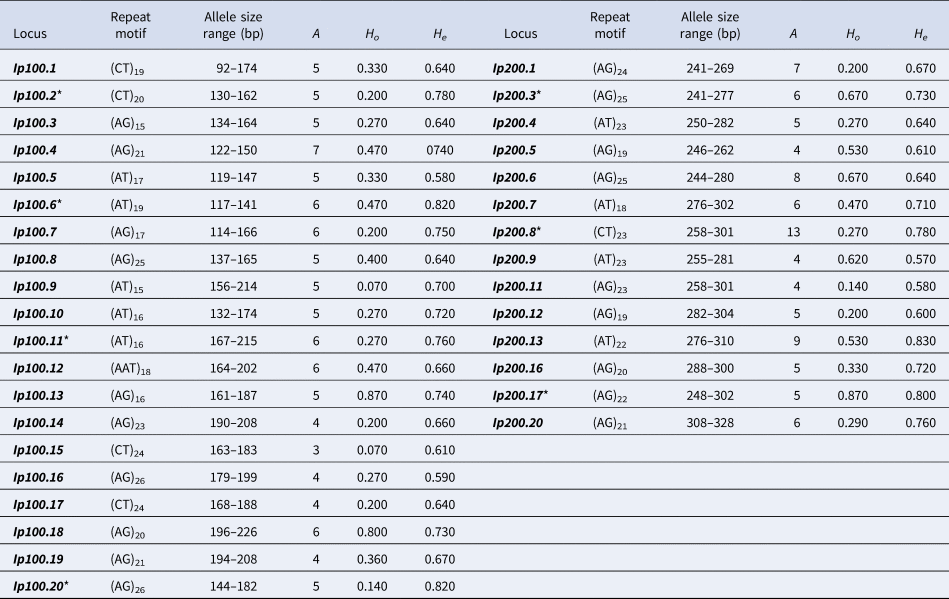
Intact genomic DNA (>1.0 μg) from one individual plant was used for library prep and low pass whole-genome sequencing (DNBseq Illumina platform, 150-bp reads, pair-end sequencing) at BGI Genomics (Hong Kong). A total of 1.41 Gbp of sequences were assembled into contigs using SOAPdenovo2 (Luo et al., Reference Luo, Liu, Xie, Li, Huang, Yuan, He, Chen, Pan, Liu, Tang, Wu, Zhang, Shi, Liu, Yu, Wang, Lu, Han, Cheung, Yiu, Peng, Xiaoqian, Liu, Liao, Li, Yang, Wang, Lam and Wang2012). From this dataset, only marker Ip100.4 (Table 1) met the selection criteria. The rest of the markers were developed from the whole-genome sequence assembly for I. paraguariensis deposited in GenBank (Sosa and Modenutti, Reference Sosa and Modenutti2021). In both cases, microsatellite-like nuclear sequences were identified with Phobos 3.3.11 and primers complementary to their flanking regions were designed using Primer3 (Rozen and Skaletsky, Reference Rozen, Skaletsky, Krawetz and Misener2000), both in Geneious 9.0 (Kearse et al., Reference Kearse, Moir, Wilson, Stones-Havas, Cheung, Sturrock, Buxton, Cooper, Markowitz, Duran, Thierer, Ashton, Meintjes and Drummond2012). Sequences containing perfect repeats of at least 15 units were selected for primer design.
Characteristics of microsatellite markers developed for Ilex paraguariensis from genomic data, including repeat motif and observed allele size range

A, number of alleles; Ho, observed heterozygosity, He, expected heterozygosity.
* Locus used in multiplex amplifications. Genbank accession number OP946888 for Ip100.4 marker contig. The rest of the markers were designed from the Genbank genome sequence GCA_905181385.1. Forward and reverse primers sequences provided in Table S1. Annealing temperature for all primer pairs was 60 °C.
Primer design
Primers were designed to obtain two sets of product sizes, 100–200 bp and 250–300 bp. The target annealing temperature was set to 60 °C for all primers. We selected primers without repetitive sequences or neighbouring microsatellites within the flanking regions. A total of 40 primer pairs (Table S1) were synthesised by the Custom DNA oligosynthesis service at Macrogen, South Korea (https://dna.macrogen.com/). Following Ge et al. (Reference Ge, Cui, Jing and Hong2014), forward primers were extended with one of the following sequences complementary to oligonucleotides labelled with FAM, VIC, NED and PET, respectively: 5’-AATACAACGCGATCGACTCC-3’; 5’-AATCCCCACACAAACACACC-3’; 5’-TCCCCTTTCAAACCTAATGG-3’; 5’-TGATCTTGAGAAGGCATCCA-3’.
Amplification
Amplifications were performed in a Vertity 96-well thermal cycler (Applied Biosystems™) and products were run in a ABI3500 XL sequencer (Applied Biosystems™). PCR cycling conditions consisted of an initial denaturation at 95 °C for 15 min; 35 cycles of denaturation at 95 °C for 30 s, annealing at 60 °C −53 °C (touchdown) for 90 s, and extension at 72 °C for 30 s; and a final extension cycle at 60 °C for 30 min. For the population analysis, the seven most informative markers were combined in a multiplex reaction (Table 1). PCR multiplex amplifications contained 10 ng of genomic DNA, 0.75 μM of each forward primer and 3 μM of each reverse primer (for product sizes 100–200 bp) or 1 μM of each forward primer and 4 μM of each reverse primer (for product sizes 250–300 bp), 1.25 μl 2X Platinum Multiplex PCR Master Mix and 0.3 mL GC Enhancer (Applied Biosystems™), 10X primer mix and ultrapure water to a final volume of 8.3 μl. Analyses were performed at Genexa (https://www.genexa.com.uy/).
Data analysis
Electropherograms were analysed individually with PeakScanner 1.0 © (Applied Biosystems, 2006). Data were analysed using GenAlEx 6.5 (Peakall and Smouse, Reference Peakall and Smouse2006).
Discussion
Almost all markers designed were dinucleotides, with only one trinucleotide (AAT). Of the 40 markers, 34 were successfully amplified and were polymorphic in the 12-plant panel (Table 1). Among the dinucleotide markers, the AG repeats were the most abundant (57.6%), followed by AT (27.3%) and CT (15.2%). Allele numbers ranged between 3 and 13 (mean 5.5). Allele sizes ranged from 92 bp (Ip100.1) to 226 bp (Ip100.18) and between 241 bp (Ip200.1 and Ip200.3) and 328 bp (Ip200.20). Non-overlapping size ranges allowed easy scoring of two loci labelled with the same fluorescent dye.
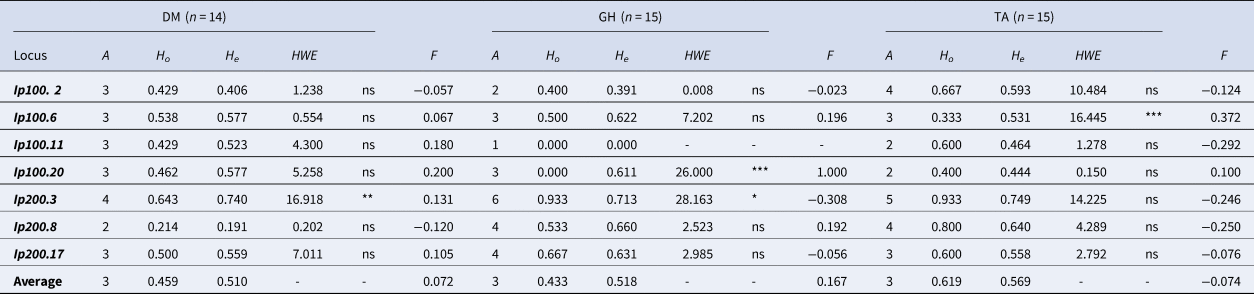
We used the seven most informative markers for the population analysis and they displayed different levels of polymorphism and frequencies in the three populations. Almost all were polymorphic, with 1 to 6 (mean 3) alleles per locus (Table 2). The level of Ho and He ranged from 0 to 0.933 (mean 0.504) and from 0 to 0.749 (mean 0.532), respectively (Table 2). Significant deviations from HWE based on Fisher's exact test (P < 0.05) were detected for one locus in population DM, two loci in population GH and one locus in population TA (Table 2). Our markers allowed comparisons among Uruguayan populations, with pairwise population Fst values of 0.325 (DM vs GH), 0.322 (GH vs TA) and 0.263 (DM vs TA) consistent with geographic distances (Figure S1). We detected levels of heterozygosity similar to those reported in two Brazilian populations (Pereira et al., Reference Pereira, Ciampi, Inglis, Souza and Azevedo2013) and to those reported within Uruguayan populations by Cascales et al. (Reference Cascales, Bracco, Poggio and Gottlieb2014), with maximum He 0.749 vs 0.742; mean 0.532 vs 0.459, respectively. High levels of fixation of genetic diversity were detected among Uruguayan populations (Table 2). Additionally, because primers had the same Tm and two size ranges, they were successfully multiplexed, substantially reducing costs. Our results show the reliability of the markers presented here and the utility of a subset of seven markers to evaluate genetic diversity and population structure in Ilex paraguariensis.
Genetic diversity properties of seven polymorphic microsatellite markers developed for Ilex paraguariensis, characterised in three populations from Uruguay: Demicheli (DM), Gruta de los Helechos (GH) and Tapera de Ayala (TA), with locations depicted in Figure S1. n, sample size for each population

Parameters detailed for each marker are: A, number of alleles; Ho, observed heterozygosity, He, expected heterozygosity; HWE, Χ2 values for the test of Hardy–Weinberg equilibrium; F, fixation index. Statistical deviation from HWE is indicated as: ns = not significant, * P < 0.05, ** P < 0.01, *** P < 0.001.
Supplementary material
The supplementary material for this article can be found at https://doi.org/10.1017/S1479262123000758.
Acknowledgements
This research was funded by Comisión Sectorial de Investigación Científica from the University of the Republic (22320200200217UD and 22320200200248UD) and by Agencia Nacional de Investigación e Innovación (ANII, grant number FCE_1_2021_1_166709). In addition, CT and RAO thank ANII and the Comisión Académica de Posgrados from the University of the Republic (CAP-Udelar) for scholarships funding. We also thank Pablo Hernández, Luis Rodriguez and the land owners for collaborating in the field collections and providing plant material.
Competing interests
None.