Implications
Cull cows are often sold and slaughtered in unfinished condition. However, it is clear that short-term feeding of a starch-based diet could improve the body condition of these cows, and depending on the cost of the diet, such a process can be profitable for the owner, while higher-quality meat can be supplied to the market. As cull cows have passed their productive growth phase, most of the weight is added when feeding cull cows are fat. In this study, we investigate whether producer could benefit from using a growth promotant normally used with young animals to gain weight more efficiently and to get higher meat yields from cull cows.
Introduction
In most countries where grain feeding of young steers and heifers is a primary industry, meat from culled cows accounts for small but often significant proportions of total beef production. In the United States, sales from culled beef cows represented 10% to 20% of the gross revenue of cow-calf operations in 2004 (Sawyer et al., Reference Sawyer, Mathis and Davis2004). In contrast, most beef sold in European countries originates from culled cows (Vestergaard et al., Reference Vestergaard, Madsen, Bligaard, Bredahl, Rasmussen and Andersen2007). A common problem in these industries is the lack of body condition and therefore lean yield of cull cows as owners mostly dispose of cows to get salvage value and do not regard them as potentially valuable meat animals. Several studies have shown that feeding of energy-dense diets over short periods to cull cows could be profitable (Sawyer et al., Reference Sawyer, Mathis and Davis2004), improve carcass characteristics (Swingle et al., Reference Swingle, Roubicek, Wooten, Marchello and Dryden1979; Matulis et al., Reference Matulis, McKeith, Faulkner, Berger and George1987; Cranwell et al., Reference Cranwell, Unruh, Brethour, Simms and Campbell1996a; Stelzleni et al., Reference Stelzleni, Patten, Johnson, Calkins and Gwartney2007) and meat quality (Cranwell et al., Reference Cranwell, Unruh, Brethour and Simms1996b; Stelzleni et al., Reference Stelzleni, Patten, Johnson, Calkins and Gwartney2007). However, Jones (Reference Jones1983) demonstrated that the improvement in carcass yield was mostly due to fat deposition with minor gains in muscle thereby decreasing the proportional yield of bone and muscle and increasing fat proportions in all major fat depots (Jones and Macleod, Reference Jones and Macleod1981). Successful attempts to further increase growth performance and meat yield of cull cows by means of growth promoters such as anabolic implants were reported by Matulis et al. (Reference Matulis, McKeith, Faulkner, Berger and George1987) and Cranwell et al. (Reference Cranwell, Unruh, Brethour and Simms1996b). Neill et al. (Reference Neill, Unruh, Marston, Jaeger, Hunt and Higgins2009) reported larger rib-eye areas and higher trimmed subprimal yields for grain-fed cull cows implanted (trenbolone acetate–estradiol) and supplemented with a beta agonist, zilpaterol hydrochloride, for the last 34 days before slaughter compared with cull cows fed a concentrate diet only (no implants and supplements). However, both the larger rib-eye areas and higher yields marked a trend (P > 0.05) towards higher carcass weights for implanted beta agonist carcasses while no proportional differences in yield (%) occurred. In addition, the beta agonist in this study did not show any additional advantage with regard to growth performance over that of the anabolic implant admitted at the start of the 70-day grain-fed period, suggesting that the effect of additional compensatory growth was facilitated by the implant only and together with the prolonged high-energy feeding, and it cancelled the potential effect of the beta agonist.
In contrast to the positive effect of beta agonists on growth performance and yield, they are commonly known to increase toughness in beef loin (Dunshea et al., Reference Dunshea, D’Souza, Pethick, Harper and Warner2005). Although it can be argued that cull cow meat is generally used in processed meats and that meat tenderness is therefore not important, cuts such as the loin and fillet could be used as fresh cuts due to their higher value (Stelzleni et al., Reference Stelzleni, Patten, Johnson, Calkins and Gwartney2007).
In this study, various durations of beta agonist supplementation are tested to find the optimum feeding period to maximize growth performance and yield and to investigate whether the meat yield was due to increased muscle deposition relative to fat (proportional gain). In addition, the effect of zilpaterol hydrochloride on meat quality of two muscles was investigated.
Material and methods
Animal material and experimental design
Three hundred and eight (n = 288 for experimental design and n = 20 as reference group) Bonsmara cull cows varying in age, number, condition of teeth (incisors), live weight and body condition were selected from a larger group of animals for this study. The animals were sourced from various farms where they had access to natural winter pastures and transferred to the feedlot facilities of the Animal Production Institute of the Agricultural Research Council of South Africa at Irene in Gauteng Province. They were placed on a maintenance ration consisting of predominantly hay and a small quantity of feedlot ration for 14 days during which weight recording, identification, vaccination, ‘teething’ and body condition score were carried out.
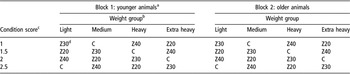
The animals were first divided into two age groups (blocks) on the basis of number and condition of permanent incisors (Table 1). Animals with 4, 6 or 8 permanent incisors in a good condition were regarded as young, whereas those with worn or no incisors left were regarded as old. Within each age group, animals were stratified into a grid according to weight and body condition score. Light, medium, heavy and extra heavy animals were distinguished, whereas body score ranged from 1 regarded as very poor with regard to fat/muscle and 2.5 as lean with fair body conformation, typical condition of animals coming from a medium-quality winter pasture. The weight by condition stratification was carried out in such a way that equal number of animals were sorted into each category combination, finally having nine (n=9) animals within each condition/weight category (n = 288). At the same time, 20 animals representing the various age, body conditioning and weight were selected as reference group to be slaughtered at commencement of the growth phase. Within each age group, one of four treatments was allocated to each weight group/condition score group of nine animals so that each of the four treatments appeared in each weight category and in each condition score category. (Table 1). The four treatments received concentrate feed (Table 2) without any beta agonist (C) or concentrate feed with zilpaterol hydrochloride (6 p.p.m.; Intervet/Schering-Plough Animal Health, Gauteng, South Africa) for the last 20 (Z20), 30 (Z30) or 40 (Z40) days of the feeding period followed by 2 days without any zilpaterol in accordance with required withdrawal time before slaughter.
Experimental design for the growth phase of cull cows (n = 288)

aAge group distinguished as animals with four, six and eight permanent incisors in ‘Younger animals’ group (incissors in good condition) and animals with eight permanent incisors, teeth worn away or no teeth left in ‘Older animals’ group.
bRanges for light, medium, heavy and extra-heavy weights stratified in such a way that equal number of animals sorted into each category.
c1 = very poor body condition with regard to fat/muscle; 2.5 = lean with fair body conformation, typical condition of animals coming from a medium quality winter pasture.
dC = control, no zilpaterol; Z20, Z30, Z40 = zilpaterol supplemented (6 p.p.m.) for the past 20, 30 and 40 days of the feeding period followed by 2 days without any zilpaterol in accordance with required withdrawal. Each small square (C, Z30 … , etc.) represents a pen with nine animals of the specific age, condition score, weight and treatment combination.
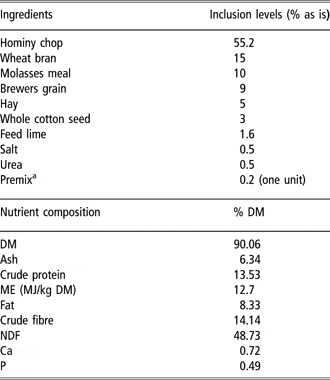
Diet and nutrient composition

DM = dry matter; ME = metabolisable energy.
aContains per unit: vitamin A (5 000 000 IU), vitamin D3 (450 000 IU), vitamin E (8000 IU), vitamin B3 (2800 IU), niacin (110 g), manganese (40 g), iron (40 g), zinc (60 g), copper (17 g), cobalt (660 mg), iodine (2200 mg), selenium (200 mg), taurotec (15% lasalocid, 220 g), albac (15% Zn bacitracin, 200 g) and aurofac (10% chlortetracycline, 350 g).
Management
Cows were housed in pens (nine cows per pen) with each cow afforded 22.2 m2 and 1.1 m of pen and bunk space, respectively, and every two pens shared a water trough. All cows were adapted to the concentrate feed for 10 days after final allotment to treatment groups and pens, by steadily increasing the percentage concentrate (Table 2) and decreasing the hay. Bunk management was performed daily to establish the amount of feed to be provided for ad libitum consumption. Weights were recorded at commencement of the 10-day adaptation and then on a weekly basis over the following 40 days to slaughter. Feed intake was recorded and bunks were cleaned on a weekly basis. Zilpaterol was mixed into the diet and inclusion started on specific days to coincide with a single slaughter day (day 52) for all animals except the reference group that was slaughter at the start of the final 52 days. Data from the reference group (Table 3) were used to calculate carcass gain and efficiency. Growth performance was compared over the last 40 days on feed.
Slaughter and carcass data
All of the animals were slaughtered at a commercial abattoir at the same time except for the reference group of 20 animals that were slaughtered at the start of the trial. Final weights were recorded the day before slaughter. Warm carcass weights were recorded at slaughter and carcasses were classified 24 h post mortem by a qualified government official according to visual appraisal of external fat cover, conformation and age (based on permanent incisors) following the Agricultural Product Standards (1999). Eight carcasses per treatment (n = 32) were selected to determine carcass and cut composition and for meat quality evaluation. Age and weight group were considered in the selection process in order to obtain representative subgroups from the larger group of animals. In addition, the average fat scores of selected carcasses reflected those of the larger group within each of the four treatment groups. Selected carcasses were processed at the Animal Production Institute of the Agricultural Research Council at Irene (Gauteng Province).
Subprimal fabrication
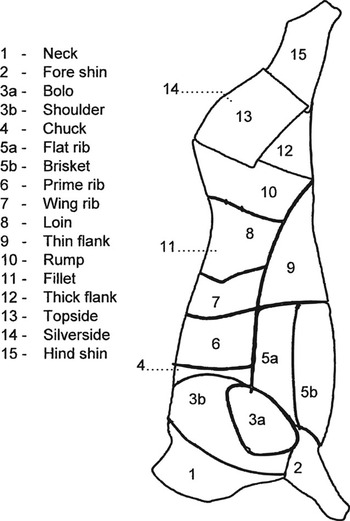
Left sides were fabricated into 15 boneless subprimals (Figure 1). Those of the hindquarter (cuts 7 to 15) were closely trimmed (∼4 mm fat) of excess subcutaneous (SCF) and intermuscular fat, whereas only the brisket in the forequarter was trimmed of SCF. Subprimal trimmed meat, bone and trimmed fat weights were recorded, and yield was expressed relative to side weight. The m. longissimus thoracis (LT) of the wing rib (between the eleventh and thirteenth rib) and the mid-portion (∼700 g) of the m. semitendinosus (ST) of the silverside cuts were recovered for sensory evaluation and shear force measurement. The samples were vacuum packed, aged for 10 days post mortem at 2°C ± 2°C and then stored at −20°C.
Wholesale cuts of the South African beef carcass.

Shear force and sensory analyses
ST and LT processing and preparation
Both ST and LT cuts were thawed over 48 h at 3°C. LT samples of each animal were standardized into four steaks of 25 mm thickness and broiled (dry-heat cooking method) in identical Mielé ovens (Mielé, model H217, Mielé&Cie, Gütersloh, Germany) at 260°C (American Meat Science Association (AMSA), 1995). Internal temperature was monitored individually by 30-gauge thermocouple placed in the geometric centre of the steak and attached to a digital monitor (Comark C9003, Comark Limited, Hertfordshire, UK). When the internal steak temperature reached 35°C, it was turned and allowed to reach a final temperature of 70°C before removal from the oven. Two steaks intended for sensory analyses were cut into cubes (1.5 cm × 1.5 cm × cooked steak thickness) from the centre of each steak (avoiding the dryer sides), wrapped in coded aluminium foil and kept warm until the panel session. ST samples were prepared as an intact cut in covered stainless steel casserole dishes (adding 100 ml of distilled water) according to a moist-heat cooking method. The intact cooked samples were cut into four 1.5-cm thick steaks. Two ST steaks were processed and presented to the sensory panel following the same procedure as for the LT.
Sensory analysis
The sensory panel consisted of 10 experienced panelists trained according to AMSA (1995) guidelines. Samples were judged during two sessions per day, each session including four randomly assigned samples (within treatment) from one of the four (Z and C) treatment groups. The sensory evaluation method used (AMSA, 1995) involved a numerical scale ranging from 1 to 8, with each number representing successive levels of aroma and flavour intensity (1 = extremely bland, 8 = extremely intense), juiciness (1 = extremely dry, 8 = extremely juicy), first bite and overall tenderness (1 = extremely tough, 8 = extremely tender) and amount of connective tissue present (1 = abundant, 8 = none).
Warner–Bratzler shear force (WBSF) analysis
LT and ST steaks intended for shear force measurement (WBSF) were cooled down at controlled room temperature (18°C) for 4 h. Eight round cores (12.7 mm diameter) were removed from the steaks parallel to the long axis of the muscle fibres (AMSA, 1995). Each core was sheared once through the centre, perpendicular to the fibre direction, by a Warner–Bratzler shear device mounted on an Universal Instron apparatus (Model 4301, Instron Ltd, Buckinghamshire, England; cross head speed = 200 mm/min).
Statistical analyses
Data were analysed using the statistical program GenStat® (VSN International Ltd, Herts, UK) (Payne et al., Reference Payne, Murray, Harding, Baird and Soutar2007). The growth performance study was analysed as two 4 × 4 Latin square designs. The cows were blocked by two factors; body condition and weight group (Table 1). The first square was on young and the second was on older cows. Differences between treatments and the age-by-treatment interaction were investigated by means of ANOVA for Latin square designs, on the two squares combined. The data were found to be normally distributed with homogeneous treatment variances. Treatment means were separated using Fishers’ protected t-test LSD at the 5% level of significance.
Results
General
No significant age × treatment interactions were found for growth performance, subprimal yield or meat quality. Therefore, only treatment (C, Z20, Z30 and Z40) effects were reported and data were pooled for both age groups.
Performance traits
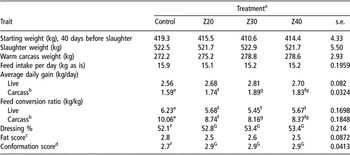
Feeding a high-energy diet to the cull cows increased carcass weight and body condition in general (Tables 3 and 4). All zilpaterol-treated cows (Z) had greater (P < 0.05) carcass weight gains, but not live body weight gains, compared with C cows. Z cows also gained live and carcass weight more efficiently (P < 0.05) than Z cows, whereas Z30 gained carcass weight more efficiently than Z20 (P < 0.05). The difference in significance between live and carcass weight gain was due to higher-dressing percentage for Z cows, although this was not reflected in significant carcass weight differences. Z carcasses had higher conformation scores (P < 0.05) than C carcasses, while fat score was not significantly affected by treatment. However, frequency distributions of carcasses in different fat score classes showed that more than 50% Z carcasses in each treatment group had fat scores of 1 and 2, compared with 43% of C carcasses (not published).
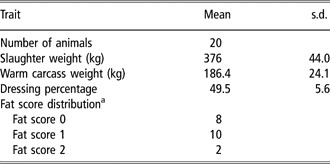
Summary of reference group (n = 20)

aFat score 0 = no subcutaneous fat (SCF); fat score 1 = 1.0% to 3.6% SCF; fat score 2 = 3.6% to 5.6% SCF (Agricultural Product Standards, 1999).
Weights, daily gain and feed efficiency for 288 cows fed for 40 days

aC = cows fed concentrate only; C20, C30, C40 = cows fed concentrate with zilpaterol (6 p.p.m.) for the past 20, 30 and 40 days, respectively, before slaughter, excluding 2 days withdrawal.
bStarting carcass weight calculated as starting live weight × dressing percentage of reference group (Table 3).
cFat score 2 = 3.6% to 5.6% SCF; fat score 3 = 5.6% to 7.6% subcutaneous fat (Agricultural Product Standards, 1999).
dConformation score 2 = ‘flat’; conformation score 3=‘medium’ (Agricultural Product Standards, 1999).
e, f, gMeans within the same row with different superscripts differ significantly at P < 0.05.
F, GMeans within the same row with different superscripts differ significantly at P < 0.01.
Subprimal yield
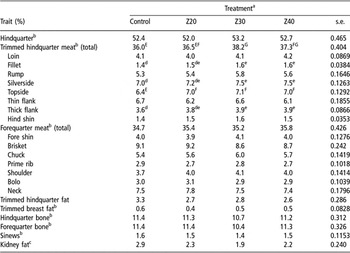
Z30 and Z40 carcasses had more (P < 0.05) hindquarter meat (%) than C carcasses, while Z30 differed significantly from Z20 (P < 0.05; Table 5). The advantage of Z over C in general was due to higher proportions (P < 0.05) of meat in the fillet, silverside, topside and thick flank cuts. No differences in forequarter meat, fat (trimmed breast fat or hindquarter fat) and bone (fore- or hindquarter) were found between C and Z.
Trimmed meat yield of hind- and forequarter cuts, bone and trimmed fat yields for 32 selected cows

aC = control, no zilpaterol; Z20, Z30, Z40 = zilpaterol supplemented (6 p.p.m.) for the past 20, 30 and 40 days before slaughter, respectively (excluding 2 days withdrawal).
bProportional yields expressed percentage of carcass weight without kidney and kidney fat.
cKidney fat expressed as percentage of carcass weight including kidney and kidney fat.
d, eMeans within the same row with different superscripts differ significantly at P < 0.05.
E, F, GMeans within the same row with different superscripts differ significantly at P < 0.01.
Meat quality
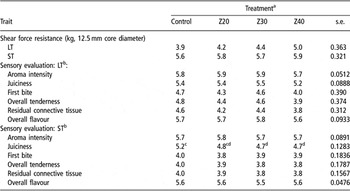
Zilpaterol had no significant effect on the WBSF or any sensory attribute of the LT (Table 6). Only ‘Juiciness’ scored significantly (P < 0.05) lower (0.5 U) for Z30 and Z40 treatments compared with C for the ST muscle.
Shear force resistance and sensory evaluation of m. longissimus thoracis and m. semitendinosus steaks for 32 selected cows

LT = longissimus thoracis; ST = m. semitendinosus.
aC = control, no zilpaterol; Z20, Z30, Z40 = zilpaterol supplemented (6 p.p.m.) for the past 20, 30 and 40 days before slaughter, respectively (excluding 2 days withdrawal).
bScore 1 = extremely bland for aroma and flavour intensity, extremely tough for first bite and overall tenderness, extremely abundant for residual connective tissue and extremely dry for juiciness; Score 8 = extremely intense for aroma and flavour intensity, extremely tender for first bite and overall tenderness, practically devoid of residual connective tissue and extremely juicy for juiciness.
c, dMeans with different superscripts in the same row differ significantly at P < 0.05.
Discussion
The large increase in body and carcass weight, and body condition of all treatment groups in a relatively short-time feeding period is consistent with various other studies on feeding (or realimentation) of cull cows (Jones and Macleod, Reference Jones and Macleod1981; Cranwell et al., Reference Cranwell, Unruh, Brethour, Simms and Campbell1996a; Sawyer et al., Reference Sawyer, Mathis and Davis2004). Most of the studies also agree that shorter (40 to 50 days), rather than longer (>70 days) feeding produce better results in terms of growth rate and feed efficiency, as older animals have a limited capacity to gain body and carcass weight. This is probably the reason why the study of Neill et al. (Reference Neill, Unruh, Marston, Jaeger, Hunt and Higgins2009) did not show significant effects of the beta agonist, zilpaterol, for growth performance and feed efficiency, as cows were fed for 70 days and received zilpaterol for the past 34 days. During the first 36 days, the cows responded positively to anabolic implants, and although the total response over the 70 days was positive, the last 34 days showed no significant effect with regard to growth performance. This study showed that the efficiency and rate of carcass gain in particular were improved by zilpaterol alone. In addition, limiting the zilpaterol to the last 30 days seemed to give the best results compared with 20 days and did not differ significantly from 40 days of supplementation.
Improvement in rate of body weight gain (average daily gain (ADG); P>0.05; ∼9%) and efficiency of gain (feed conversion ratio (FCR); P < 0.05; ∼14%) of cull cows in this study was consistent with improvements in ADG (12.5% to 36%) and FCR (15.3% to 21%) of younger animals fed zilpaterol (Avendaño-Reyes et al., Reference Avendaño-Reyes, Torres-Rodríguez, Meraz-Murillo, Pérez-Linares, Figueroa-Saavedra and Robinson2006; Vasconcelos et al., Reference Vasconcelos, Rathmann, Reuter, Leibovich, McMeniman, Hales, Covey, Miller, Nichols and Galyean2008; Montgomery et al., Reference Montgomery, Krehbiel, Cranston, Yates, Hutcheson, Nichols, Streeter, Bechtol, Johnson, TerHune and Montgomery2009). When measured on a carcass basis, ADG and FCR of 18% and 23%, respectively, between C and Z30 were recorded. The relatively larger differences between C and Z for carcass gain relative to live weight gain correspond with the increase (P < 0.05) in dressing percentage of up to 1.3 for Z30 and Z40. Similar improvements were reported by Neill et al. (Reference Neill, Unruh, Marston, Jaeger, Hunt and Higgins2009) for cull cows, whereas up to 2 increased dressing percentage were reported for young animals by Avendaño-Reyes et al. (Reference Avendaño-Reyes, Torres-Rodríguez, Meraz-Murillo, Pérez-Linares, Figueroa-Saavedra and Robinson2006), Vasconcelos et al. (Reference Vasconcelos, Rathmann, Reuter, Leibovich, McMeniman, Hales, Covey, Miller, Nichols and Galyean2008) and Montgomery et al. (Reference Montgomery, Krehbiel, Cranston, Yates, Hutcheson, Nichols, Streeter, Bechtol, Johnson, TerHune and Montgomery2009). No significant difference in carcass weight was recorded in this study, but this could have been due to large variation within cow groups combined with numerical differences in weight at the start of the 40-day growth period (Table 4). If starting carcass weights were assumed to be identical for all treatments (e.g. 186 kg; Table 3), Z30 cow carcasses would have had a 12-kg (4.8%) advantage over C cow carcasses at slaughter due to higher rate of carcass weight gain (1.89 kg/day v. 1.59 kg/day; Table 4). On this basis, the present results compares favourably with studies on young animals ranging between 3.5% and 7.5% (Avendaño-Reyes et al., Reference Avendaño-Reyes, Torres-Rodríguez, Meraz-Murillo, Pérez-Linares, Figueroa-Saavedra and Robinson2006; Montgomery et al., Reference Montgomery, Krehbiel, Cranston, Yates, Hutcheson, Nichols, Streeter, Bechtol, Johnson, TerHune and Montgomery2009; Robles-Estrada et al., Reference Robles-Estrada, Arrizon, Barreras, Calderon, Figueroa-Saavedra, Torrentera, Plascencia and Zinn2009). Vasconcelos et al. (Reference Vasconcelos, Rathmann, Reuter, Leibovich, McMeniman, Hales, Covey, Miller, Nichols and Galyean2008) showed a linear improvement in FCR and dressing percentage with increased duration of zilpaterol supplementation that agrees with this study in which Z30 seemed to give better results for carcass ADG and for FCR than Z20, whereas Z40 were in between. A similar trend was found for dressing percentage.
According to Neill et al. (Reference Neill, Unruh, Marston, Jaeger, Hunt and Higgins2009), zilpaterol had no significant effect on fat thickness measurements or chemical fat content of the three rib cut of cull cows that concur with fat measurements in this study. However, in this study, the higher proportion Z carcasses with fat score 2 (55% for Z30), compared with C carcasses (27%), suggest that zilpaterol may have had an effect on fat deposition in cull cows. Significant effects in this regard were reported by Vasconcelos et al. (Reference Vasconcelos, Rathmann, Reuter, Leibovich, McMeniman, Hales, Covey, Miller, Nichols and Galyean2008) and Robles-Estrada et al. (Reference Robles-Estrada, Arrizon, Barreras, Calderon, Figueroa-Saavedra, Torrentera, Plascencia and Zinn2009) for young animals supplemented with zilpaterol, whereas Leheska et al. (Reference Leheska, Montgomery, Krehbiel, Yates, Hutcheson, Nichols, Streeter, Blanton and Miller2009) found no differences in carcass fat percentage in treated and untreated steers and heifers. Numerically, lower values for trimmed fat (%) in the hindquarter of Z carcasses, compared with C carcasses, further suggested lower fat yields and were mirrored by significantly higher (P < 0.05) trimmed meat proportions in the hindquarter of Z carcasses. Neill et al. (Reference Neill, Unruh, Marston, Jaeger, Hunt and Higgins2009) reported a synergistic effect between anabolic implants and zilpaterol on total subprimal weight of cull cow carcasses, although this effect was mainly due to increased carcass weight, and no proportional (%) yield effects were found, which is in contrast to this study. The increased meat (muscle) proportion (P < 0.05 for hindquarter) of Z carcasses in this study corresponds with the conclusion of Mersmann (Reference Mersmann1998) that beta agonists redirect nutrients towards increased rates of muscle protein synthesis and away from adipose tissue. In further support, Gonzalez et al. (Reference Gonzalez, Carter, Johnson, Ouellette and Johnson2007) confirmed that the beta agonist, ractopamine, increased the size of type I fibres in loin of cull cows. It seemed that this effect was optimized with 30 days (or 40 days) exposure rather than 20 days in this study. Vasconcelos et al. (Reference Vasconcelos, Rathmann, Reuter, Leibovich, McMeniman, Hales, Covey, Miller, Nichols and Galyean2008) did not find any effect of duration of zilpaterol supplementation on muscle-related traits such as rib-eye area. Robles-Estrada et al. (Reference Robles-Estrada, Arrizon, Barreras, Calderon, Figueroa-Saavedra, Torrentera, Plascencia and Zinn2009) reported a positive trend (P = 0.11) towards trimmed meat proportions in zilpaterol-supplemented young feedlot steers.
No results were published on the effects of beta agonists on meat quality of cull cows. In this study, zilpaterol showed no significant effect on tenderness as reflected by WBSF and sensory attributes for the LT and ST. In general, reports on the effect of beta agonists on meat quality conclude that meat tenderness of young feedlot cattle is affected negatively (Dunshea et al., Reference Dunshea, D’Souza, Pethick, Harper and Warner2005). For zilpaterol in particular, Avendaño-Reyes et al. (2006), Hilton et al. (Reference Hilton, Montgomery, Krehbiel, Yates, Hutcheson, Nichols, Streeter, Blanton and Miller2009) and Strydom et al. (Reference Strydom, Frylinck, Montgomery and Smith2009) reported significant negative effects on LT tenderness of young feedlot cattle. According to Brooks et al. (Reference Brooks, Claus, Dikeman, Shook, Hilton, Lawrence, Mehaffey, Johnson, Allen, Streeter, Nichols, Hutcheson, Yates and Miller2009), post mortem aging reduced the effect of zilpaterol on meat tenderness, which could explain the lack of tenderness differences in this study. However, Hilton et al. (Reference Hilton, Montgomery, Krehbiel, Yates, Hutcheson, Nichols, Streeter, Blanton and Miller2009) and Strydom et al. (Reference Strydom, Frylinck, Montgomery and Smith2009) reported consistent differences between zilpaterol-treated and control meat for young animals despite of post mortem aging up to 21 days. The effect of aging was not tested, but it could be speculated that apart from aging of meat, the general effect of age of the animal on tenderness could have influenced the final tenderness in this study.
It should finally be mentioned that certain studies cited in the discussion used higher levels (8 p.p.m.; Vasconcelos et al., Reference Vasconcelos, Rathmann, Reuter, Leibovich, McMeniman, Hales, Covey, Miller, Nichols and Galyean2008; Montgomery et al., Reference Montgomery, Krehbiel, Cranston, Yates, Hutcheson, Nichols, Streeter, Bechtol, Johnson, TerHune and Montgomery2009) of zilpaterol compared with this study (6 p.p.m.), which could have expressed a more pronounced effect with regard to growth, yield and meat quality (Dunshea et al., Reference Dunshea, D’Souza, Pethick, Harper and Warner2005) than in this study.
Conclusions and recommendations
Feeding cull cows high-energy diets and supplementing zilpaterol hydrochloride for the last 30 days before slaughter will increase carcass daily gain and efficiency of gain above that of cows fed high-energy diets only. Higher carcass gain is accompanied by 2.7% increase in proportional trimmed yield with no detrimental effect on tenderness of aged LT or ST. Supplementation for 30 days tended to give better results than supplementing for 20 or 40 days.
Acknowledgements
The authors thank Mss. Ina van Heerden, Elsa Visser and Janice van Niekerk of ARC-API, Meat Quality Sensory Laboratory for sensory evaluation, and also thank Feedlot and abattoir personnel of ARC-API for assistance in the rearing and processing of experimental animals and carcasses, the Agricultural Research Council (ARC) for facilities and financial support and Intervet/Schering-Plough Animal Health for requesting and financing the project.