I. INTRODUCTION
Carbon nanotubes (CNTs) continue to attract a great deal of interest in polymer reinforcement owing to their outstanding mechanical, electrical, and thermal properties; nanoscale dimensions; low mass density; excellent physical characteristics; and high aspect ratio. Reference Moniruzzaman and Winey1–Reference Diez-Pascual, Naffakh, Gonzalez-Dominguez, Anson, Martinez-Rubi, Martinez, Simard and Gomez4 A good dispersion of CNTs in a polymer matrix is the key to improve the properties of carbon nanotube and polymer (CNT/polymer) composites. However, the preparation process of CNT/polymer composites is hindered by the poor solubility of CNTs and their strong tendency to aggregate and form bundles. Several methods for the preparation of CNT/polymer composites, such as solution mixing, Reference Pham, Mitchell, Bahr, Tour, Krishanamoorti and Green5 melt blending, Reference Kim, Park and Kim6 and in situ polymerization, Reference Barraza, Pompeo, O’Rear and Resasco7 have been proposed. Some other strategies for the distribution of CNTs through matrices have also been reported to improve the interactions between the CNTs and polymers. The mechanism of these strategies includes attaching either functional groups or polymer derivatives onto CNTs' surfaces Reference Spitalsky, Tasis, Papagelis and Galiotis8,Reference Diez-Pascual and Naffakh9 and dispersing the CNTs in compatibilizing agents. Reference Diez-Pascual, Naffakh, Gomez, Marco, Ellis, Gonzalez-Dominguez, Anson, Martinez, Martinez-Rubi, Simard and Ashrafi10 A common functionalization approach is to use an oxidation process in which CNTs are oxidized with strong acids, Reference Monthioux, Smith, Burteaux, Claye, Fischer and Luzzi11 such as nitric, sulfuric acid, or a mixture of both acids, to generate oxygen-containing surface groups (mainly hydroxyl, carbonyl, and carboxyl) that can react with functional groups or polymer derivatives subsequently.
Poly(ether ether ketone) (PEEK) is a semicrystalline thermoplastic polymer and a kind of high performance engineering material, which has been chosen as the polymer matrix for high performance composites owing to its excellent thermal stability, chemical resistance, and mechanical properties. Reference Cebe, Chung and Hong12 PEEK has been used in a wide range of commercial and industrial applications, such as medicine, electronics, and transport industries (automobile and aerospace). Reference Searle and Pfeiffer13 Many studies on the functionalization of CNTs and the synthesis of CNT/PEEK composites have been carried out over the last decade. Deng et al. studied the nanocomposites of multiwalled carbon nanotubes and PEEK (MWCNT/PEEK), Reference Deng, Ogasawara and Takada14 Song et al. worked with sandwich-like single-walled carbon nanotube (SWCNT) paper/PEEK composites, Reference Song, Zhang, Zhang and Xie15 and Diez-Pascual et al. prepared SWCNT/PEEK composites incorporating polysulfones-I, Reference Diez-Pascual, Naffakh, Gonzalez-Dominguez, Anson, Martinez-Rubi, Martinez, Simard and Gomez4 polysulfones-II, Reference Diez-Pascual, Naffakh, Gonzalez-Dominguez, Anson, Martinez-Rubi, Teresa Martinez, Simard and Gomez16 and polyetherimide Reference Diez-Pascual, Naffakh, Gomez, Marco, Ellis, Gonzalez-Dominguez, Anson, Martinez, Martinez-Rubi, Simard and Ashrafi10 as compatibilizers, separately. Some progresses in the surface modifications of CNTs and CNT/PEEK composites have also been made. However, few detailed reports on the influence of the modification methods on the dispersibility of multiwalled carbon nanotubes (MWCNTs) in different solvents and the compatibility between the MWCNTs and PEEK in composite films can be found. Furthermore, little information is available in an investigation of the composite properties with a higher percentage (more than 10 wt%) of CNTs. Reference Xie, Mai and Zhou17,Reference Sydlik, Lee, Walish, Thomas and Swager18
This article is aimed at filling the knowledge gap and has investigated the effects of different surface modifications of MWCNTs on their dispersibility in different solvents and PEEK systematically. The specimens at an identical MWCNT concentration of 20 wt% were prepared by solution blending in an organic solvent. A comprehensive characterization was carried out to study the morphology and structures of MWCNT/PEEK composite films and to explore a potential improvement in the dispersion of differently modified MWCNTs in PEEK matrix.
II. EXPERIMENTAL APPROACHES
A. Materials
Parent MWCNTs (p-MWCNTs), obtained from Chengdu Institute of Organic Chemistry, China, have an outer diameter of 30–50 nm, an inner diameter of 5–12 nm, length of 10–20 μm, and purity of greater than 95%. PEEK (450G) was provided by Jilin Zhongyan High Performance Engineering Plastic Co. Ltd with physical properties of d 25 °C = 1.26 g/cm3, T g ∼ 143 °C, and T m ∼ 343 °C. Sulfuric acid (H2SO4) of 98% purity and nitric acid (HNO3) of 65% purity were purchased from Taiyuan Chemical Reagent Factory, China. 1,6-Diaminohexane of 99% purity was supplied by Chengdu Kelong Chemical Reagent Factory, China. Hexadecyltrimethyl ammonium bromide (HTAB) of 99% purity was provided by Tianjin Damao Chemical Reagent Factory, China. Silane coupling agent 3-aminopropyltriethoxysilane (KH550; 97% purity) was obtained from Tianjin Dongliqu Tianda Chemical Reagent Factory, China. Anhydrous sulfanilic acid of 99.8% purity was purchased from Tianjin Fuchen Chemical Reagent Factory, China. N,N-Dicyclohexylcarbodiimide (DCC) of 99.5% purity was supplied from Aladdin Chemistry Co. Ltd. Ethanolamine of 99% purity was purchased from Tianjin Fuyu Chemical Co., Ltd, China. N,N-Dimethylformamide (DMF) of 99.5% purity was provided by Tianjin Bodi Chemical Co., Ltd, China.
B. Surface modifications of MWCNTs
An acidic treatment on MWCNTs in strong acids was used to explore the possibility of opening the tubes and enhancing their reactivities. The purpose was to introduce oxygen-containing groups onto the surfaces of MWCNTs for further reactions with some specific functional groups or polymer derivatives, which can eventually improve the dispersion of MWCNTs in the PEEK matrix. The following six approaches in the surface modifications of MWCNTs were carried out to study their effects on the dispersibility of MWCNTs.
1. Synthesis of acid-functionalized MWCNTs
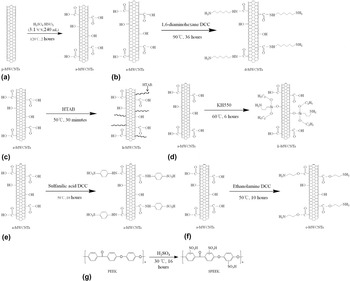
A suspension of 3.0 g of p-MWCNTs in 240 mL of H2SO4/HNO3 (3:1 v/v) was sonicated at 50 °C for 2 h. The mixture was diluted in deionized water and kept for 12 h. The supernatant was removed and the sediment was rinsed with water until neutral. The resulting solid was dried in a vacuum oven at 80 °C for 24 h, and then labeled as a-MWCNTs, as shown in Fig. 1(a).
The schematic views of principles in surface modifications: (a) a-MWCNTs, (b) d-MWCNTs, (c) h-MWCNTs, (d) k-MWCNTs, (e) s-MWCNTs, (f) e-MWCNTs, and (g) SPEEK.

2. Grafting of 1,6-diaminohexane to MWCNTs
A mixture of solution was prepared by filling 1.0 g of a-MWCNTs, 26.0 g of 1,6-diaminohexane, and 1.0 g of DCC into a 250 mL three-necked round bottom flask. The mixture was stirred in an oil bath at 90 °C for 36 h. Then, the product was washed with anhydrous ethanol for several times. Finally, the powder was dried in a vacuum oven at 80 °C for 24 h and marked as d-MWCNTs, as shown in Fig. 1(b).
3. Synthesis of MWCNTs modified by HTAB
Both a-MWCNTs (0.5 g) and HTAB (0.14 g) were added into 100 mL of deionized water and kept under stirring at 30 °C for 35 min; then the solution was sonicated at 50 °C for 30 min. The reaction product was washed by anhydrous ethanol and dried under vacuum at 80 °C for 24 h, and named as h-MWCNTs, as shown in Fig. 1(c).
4. Preparation of MWCNTs modified by KH550
Initially, 0.3 g of a-MWCNTs, 1 mL of KH550, 25 mL of deionized water, and 75 mL of anhydrous ethanol were mixed in a 250 mL three-necked round bottom flask and stirred in a water bath at 60 °C for 6 h. Then the resulting solid was washed by anhydrous ethanol, dried in a vacuum oven at 80 °C until its weight remained unchanged, and marked as k-MWCNTs, as shown in Fig. 1(d).
5. Grafting of anhydrous sulfanilic acid to MWCNTs
This grafting process was carried out in the following four steps. Firstly, 0.3 g of a-MWCNTs, 0.1 g of DCC, and 75 mL of anhydrous ethanol were added into a three-necked round bottom flask and sonicated at 50 °C for 20 min. Secondly, 0.3 g of anhydrous sulfanilic acid in 75 mL of deionized water was added into the flask. Thirdly, the mixture was stirred in a water bath at 50 °C for 10 h. Finally, the obtained product, named as s-MWCNTs [Fig. 1(e)], was washed with anhydrous ethanol and water separately and dried under vacuum at 80 °C for 24 h.
6. Grafting of ethanolamine to MWCNTs
In this grafting process, 0.3 g of a-MWCNTs and 0.1 g of DCC were added in 75 mL of anhydrous ethanol and sonicated in an ultrasound bath at 50 °C for 20 min. Subsequently, a solution of 0.3 mL of ethanolamine in 75 mL of anhydrous ethanol was added into a flask where the solution and a-MWCNTs suspension were mixed and the reaction was allowed to proceed under magnetic stirring at 50 °C for 10 h. Finally, the reaction mixture was washed with anhydrous ethanol and water separately and dried under vacuum at 80 °C for 24 h to obtain the product marked as e-MWCNTs, as shown in Fig. 1(f).
C. Preparation of MWCNT/PEEK composite films
It has been well known that the compatibility between MWCNTs and PEEK plays a key role in the properties of the MWCNT/PEEK composites. Therefore, the dispersion of p-MWCNTs and the six types of modified MWCNTs in PEEK was investigated. The sulfonic acid groups were grafted on the surfaces of MWCNTs in the preparation process of s-MWCNTs. To improve the compatibility between s-MWCNTs and PEEK, sulfonated PEEK (SPEEK) was also prepared by grafting sulfonic acid groups onto PEEK using H2SO4, as shown in Fig. 1(g).
1. Preparation of MWCNT/PEEK composite films
In the preparation process of composite films in DMF, p-MWCNTs or each of the six types of modified MWCNTs (a-, d-, h-, k-, s-, and e-MWCNTs) were mixed with PEEK separately. Each kind of MWCNTs (0.1 g) was submerged in 10 mL of DMF and sonicated in an ultrasound bath for 30 min. The pure PEEK (0.4 g) was dissolved in 10 mL of DMF and kept under stirring for 30 min. Subsequently, the polymer solution and MWCNT suspension were mixed and sonicated for 1 h. The composite films were formed on a glass slide and dried under vacuum at 60 °C for 48 h.
2. Preparation of s-MWCNT/SPEEK composite films
The preparation process of s-MWCNT/SPEEK composite films was the same as that of MWCNT/PEEK composite films. Prior to the preparation, the PEEK powder was dried in an oven at 120 °C for 12 h to remove any absorbed moisture. Then, 2.5 g of PEEK and 100 mL of H2SO4 were added into a three-necked round bottom flask and agitated with a magnetic stirrer at 30 °C for 16 h. The solution was dispersed in 500 mL of ice water, remained under magnetic stirring for 1 h, and kept for 24 h. The product was washed with deionized water until neutral and dried in the vacuum oven at 80 °C for 24 h.
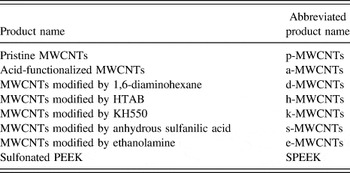
The schematic views of the principles in surface modifications are shown in Fig. 1 and the abbreviated product names obtained in the process of experiments are listed in Table I.
The abbreviated product names obtained in the process of experiments.

D. Materials characterization
1. Scanning electron microscopy
The morphology of p-MWCNTs, all modified MWCNTs obtained from six different methods shown in Table I, and the composite films was observed with a JSM-6700F scanning electron microscope (SEM, acceleration voltage: 0.5–3.0 kV, beam intensity: 10−13 to 2 × 10⁻⁹ A, operated at 10 kV). The samples were coated with gold (Au) in an evaporator to avoid charging during electron irradiation.
2. Dispersion of MWCNTs in different solvents
The dispersion of p-MWCNTs and differently modified MWCNTs in deionized water, ethanol, and DMF was studied with a Nikon D700 optical camera (Nikon Corporation, Chiyoda ward, Japan). The photographs were taken twice: first, immediately after the ultrasonic treatment maintained for 30 min, and second, after sitting for 48 h.
3. Fourier transformation infrared (FTIR) spectroscopy
The surface functional groups of p-MWCNTs and modified MWCNTs were characterized using a TENSOR27 FTIR spectrometer (Tianjin Keqi High and New Technology Corporation, Tianjin, China). The spectra were recorded at a spectral resolution of 1.5 cm−1, and two scans were collected for each sample in the range of 4000–600 cm−1.
4. Raman spectroscopy
The Raman spectra of MWCNTs were recorded using an InVia Laser Micro-Raman spectrometer (British Renishaw Company, Gloucestershire, UK), with a spectral region of 200–1000 nm and a spectral resolution of 1 cm−1. At least two different spectra for each sample were recorded in the range of 1000–2000 cm−1.
III. RESULTS AND DISCUSSION
A. Morphology of parent and modified MWCNTs
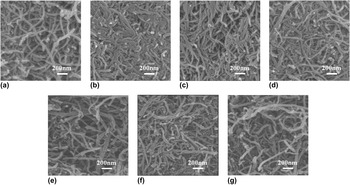
The morphology of parent and modified MWCNTs was analyzed by SEM. Figure 2 presents typical SEM micrographs of p-MWCNTs and all MWCNTs modified with six different methods. As shown in Fig. 2(a), p-MWCNTs were accumulated loosely with entangled feature and large tube gaps while each nanotube had a uniform pipe diameter. From Fig. 2(b), it can be seen that after the acid treatment, a-MWCNTs became shorter and denser. It is suggested that carboxyl groups were grafted on the surfaces of tubes. Reference Ming, Wu, Yu and Zhao19 Figures 2(c)–2(g) show that the sole dispersibility of modified MWCNTs was obviously improved to different extents with different treatments, compared with that of a-MWCNTs. In the case of d-MWCNTs as shown in Fig. 2(c), the grafting of 1,6-diaminohexane to MWCNTs improves the sole dispersibility of MWCNTs. The mechanism is probably that 1,6-diaminohexane increases the gaps among nanotubes because of the stereo-hindrance effect in 1,6-diaminohexane weakening the hydrogen bonds on MWCNTs which are created in the process of the acid treatment. Reference Sun, Wilson and Schuster20 In the case of h-MWCNTs as shown in Fig. 2(d), HTAB formed an effective electrostatic layer on the surfaces of the nanotubes. The electrostatic repulsion, steric hindrance, and Van der Waals force between the nanotubes were balanced. Reference Zhang, Zhang, Wang and Liu21 As a result, h-MWCNTs were found to be well dispersed. Figure 2(e) shows that k-MWCNTs had better sole dispersibility than a-MWCNTs as shown in Fig. 2(b). The possible reasons could be given as follows: The ethoxyl groups of KH550 were subjected to hydrolysis into hydroxyl groups, which further partly reacted with the hydroxyl groups on the surfaces of MWCNTs to form Si–O–C bonds, and partly underwent intermolecular dehydration to form Si–O–Si bonds. A flexible organic layer was introduced on the surfaces of the MWCNTs by combining Si–O–C bonds with Si–O–Si bonds. Thus, a large stereo-hindrance effect between the nanotubes was induced to prevent the aggregation of MWCNTs. Reference Kathi, Rhee and Lee22 As shown in Fig. 2(f), the surfaces of s-MWCNTs were rougher and the structures of nanotubes became wormlike, which indicates that the sulfonic acid groups were grafted on the surfaces of MWCNTs. In Fig. 2(g), e-MWCNTs showed no entanglement or agglomeration owing to the grafting of the amino groups on the surfaces of MWCNTs. Reference Sun, Wilson and Schuster20 In general, after different treatments for surface modifications, it can be seen in Fig. 2 that the sole dispersibility of k-, s-, and e-MWCNTs is superior to that of a-, d-, and h-MWCNTs.
SEM observations of MWCNTs: (a) p-MWCNTs, (b) a-MWCNTs, (c) d-MWCNTs, (d) h-MWCNTs, (e) k-MWCNTs, (f) s-MWCNTs, and (g) e-MWCNTs.

B. Dispersion of MWCNTs in different solvents
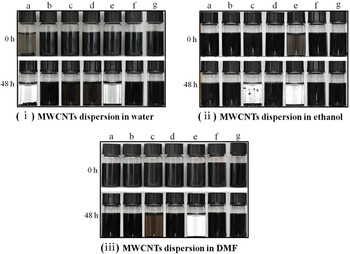
Photographs of MWCNTs' dispersion in different solvents (water, ethanol, and DMF) are shown in Fig. 3. It can be seen that the modified MWCNTs had nearly identical dispersibility in water immediately after the ultrasonic processing. After 48 h, three different scenarios were observed. Firstly, p-MWCNTs deposited obviously in water owing to the Van der Waals force among nanotubes, and the sediment at the bottom of sample bottle (e) were k-MWCNTs. Secondly, the dispersion of MWCNTs in bottles (c) and (d) changed slightly. Finally, the dispersibility of a-MWCNTs and s-MWCNTs had no change. When the used solvent was ethanol, the color of the solution in sample bottle (e) was lighter than that in the other bottles after the ultrasonic process. After 48 h, the upper solution in bottles (c) and (e) became clearer than before and the MWCNTs deposited at the bottoms of the two bottles while the color of the solution in the other bottles barely changed. The dispersibility of the seven samples in DMF was almost identical when the ultrasonic treatment was just completed. After the samples had been kept for 48 h, the dispersibility of d-MWCNTs and k-MWCNTs changed considerably while that of the others changed little. The unexpected dispersibility of p-MWCNTs in ethanol and DMF could be due to the chemical groups grafted on the surfaces of nanotubes in the preparation process of p-MWCNTs. The poor dispersion of d-MWCNTs and k-MWCNTs in all the three solvents indicates that grafting amino groups (–NH2) to MWCNTs has little effect on the MWCNTs' dispersion whether in water, ethanol, or in DMF. The h-MWCNTs had a better dispersion in all the three solvents (water, ethanol, and DMF). This is because of the electrostatic layer on the surfaces of nanotubes formed by HTAB, which may produce an electrostatic repulsion to counteract the gravitational force of the nanotubes and the Van der Waals force between them. Reference Zhang, Zhang, Wang and Liu21,Reference Szabo, Berkesi and Dekany23 It is evident that both a-MWCNTs and s-MWCNTs had a super dispersion in all the three solvents because of the organic functional groups which were grafted to MWCNTs in the modification process, such as carboxyl groups (–COOH) Reference Matarredona, Rhoads, Li, Harwell, Balzano and Resasco24 and sulfonic groups (–SO3H). The e-MWCNTs' dispersion in water showed little change after 48 h. This is probably due to the hydroxy or carboxyl groups of MWCNTs. It is suggested that the ether linkages formed by the hydroxyl groups on the surfaces of nanotubes Reference Szabo, Berkesi and Dekany23 led to the excellent dispersibility of e-MWCNTs in ethanol and DMF.
Dispersion levels of MWCNTs in different solvents: (a) p-MWCNTs, (b) a-MWCNTs, (c) d-MWCNTs, (d) h-MWCNTs, (e) k-MWCNTs, (f) s-MWCNTs, and (g) e-MWCNTs.

C. The chemical structures of parent and modified MWCNTs
An identification of the chemical groups on the MWCNT surfaces was conducted through FTIR spectroscopy. The spectra of p-, a-, h-, s-, and e-MWCNTs are compared in Fig. 4. It can be seen that p-MWCNTs show little relevant features except the band around 3430 and 1560 cm−1. It is suggested that the band around 3430 cm−1 is the O–H stretching caused by the preparation process of p-MWCNTs, and the band at 1560 cm−1 is assigned to the C=C stretching of the main structures of the MWCNTs. Reference Zhang, Zou, Qing, Yang, Li, Liu, Guo and Du26 As shown in Fig. 4, a-MWCNTs present a broad absorption at 3430 cm−1 attributed to the O–H stretching of the carboxylic groups while the band around 1640 cm−1 corresponds to the C=O stretching vibration. Reference Diez-Pascual and Naffakh9 The bands at around 2920 and 2850 cm−1 are ascribed to C–H stretching vibrations, and the C–H bending of methylene groups occurs at around 1410 cm−1. The spectra of h-MWCNTs are similar to those of a-MWCNTs. This indicates that their chemical structures are similar. The absorption around 1630 cm−1 is related to the vibration of the N–H in-plane deformation in primary amine groups, suggesting that the sulfonic acid groups of anhydrous sulfanilic acid has been grafted on the surfaces of MWCNTs. Regarding the spectra of e-MWCNTs, the new band around 3380 cm−1 can be observed, assigned to asymmetrical N–H stretching vibrations. It is suggested that ethanolamine has been grafted on the surfaces of MWCNTs.
FTIR spectra of p-MWCNTs, a-MWCNTs, h-MWCNTs, s-MWCNTs and e-MWCNTs.

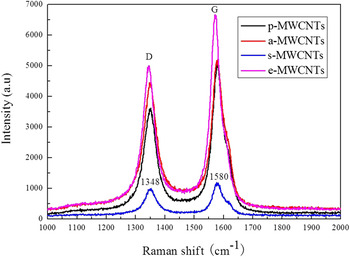
Raman spectra of the p-MWCNTs and modified MWCNTs were investigated to analyze possible changes in the bands due to the CNT disaggregation. Two features can be seen in Fig. 5: the D-band induced by dispersive disorder around 1350 cm−1 and the tangential modes or G-band near 1580 cm−1. Reference Nakamura, Fujitsuka and Kitajima27–Reference Kastner, Pichler, Kuzmany, Curran, Blau, Delamesiere, Draper and Zandbergen29 The Raman spectra of MWCNTs in Fig. 5 also show that the MWCNTs after treatments resulted in modifications in the D/G intensity ratio (I D/I G). The I D/I G value of p-MWCNTs was close to 0.72, and that of a-MWCNTs was 0.86. Such an increase of I D/I G indicates that considerable defects were produced on the surfaces of MWCNTs. As a result, it is easier to graft chemical groups on the surfaces of MWCNTs to improve the compatibility between MWCNTs and PEEK matrix. After the further treatments, the I D/I G values of s- and e-MWCNTs were reduced to 0.83 and 0.74 respectively. These decreased I D/I G values of s- and e-MWCNTs suggest that the functional groups grafted on the surfaces of MWCNTs probably increase the sole-dispersibility of MWCNTs, which correlates well with the SEM observations of MWCNTs as shown in Fig. 2.
Raman spectra of p-MWCNTs, a-MWCNTs, s-MWCNTs, and e-MWCNTs.

D. The compatibility between MWCNTs and PEEK
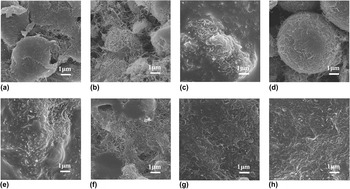
SEM was used to observe the surface morphology of composite films and qualitatively visualize the dispersion state of the CNTs in the PEEK matrix. It is well known that achieving a good distribution of the filler in polymer matrix is a rather difficult task because p-MWCNTs have a strong tendency to gather together and form bundles. Reference Diez-Pascual, Naffakh, Gonzalez-Dominguez, Anson, Martinez-Rubi, Martinez, Simard and Gomez4 Figure 6 shows typical micrographs of MWCNT/PEEK composite films with a concentration of 20 wt% MWCNTs. It can be seen that a small amount of p-MWCNTs were dispersed in PEEK while some agglomerated nanotubes were observed in the p-MWCNT/PEEK composite film as a result of the strong agglomerating tendency of the nanotubes. Figure 6(b) shows that a-MWCNTs either floated on the surface of PEEK or existed independently in the cracks of PEEK owing to the agglomerating tendency of a-MWCNTs. Figures 6(c) and 6(e) show that both d- and k-MWCNTs agglomerated distinctly in PEEK. Although grafting amino groups (–NH2) to MWCNTs can enhance the adhesive force between MWCNTs and PEEK, the dispersibility of both d- and k-MWCNTs in DMF is still poor. This poor dispersibility led to reduced compatibility between MWCNTs and PEEK when MWCNT/PEEK composite films were fabricated using solution blending method with DMF as a solvent. It can be clearly seen in Fig. 6(d) that h-MWCNTs and PEEK formed microspheres because HTAB could inhibit the growth of the product in one dimensional direction. These small particles assembled into a submicron spherical product spontaneously to reduce the surface free energy. Reference Nie, Fava, Kumacheva, Zou, Walker and Rubinstein30,Reference Fouconnier, Guerrero and Carter31 Figure 6(f) shows that in s-MWCNTs/PEEK composite films, s-MWCNTs agglomerated evidently and could not be dispersed well in PEEK while s-MWCNTs were uniformly dispersed in SPEEK as shown in Fig. 6(g). This indicates that grafting sulfonic acid groups (–SO3H) on the surfaces of MWCNTs cannot improve the compatibility between MWCNTs and PEEK matrix. By contrast, after grafting –SO3H to PEEK, s-MWCNTs have a better dispersion in SPEEK owing to the hydrogen bonding interactions between the sulfonic acid groups on the surfaces of s-MWCNTs and SPEEK. It can be seen in Fig. 6(h) that the compatibility between e-MWCNTs and PEEK was as good as that between s-MWCNTs and SPEEK. It is suggested that the ether bond formed by the reaction between the hydroxy groups on the surfaces of nanotubes Reference Matarredona, Rhoads, Li, Harwell, Balzano and Resasco24 has a similar structure with the ether bond of PEEK. While the reaction between –NH2 on the surfaces of e-MWCNTs and C=O of PEEK could produce an interaction between e-MWCNTs and PEEK, these two factors lead to a good dispersibility of the e-MWCNTs in pure PEEK.
SEM observations of different MWCNT/PEEK composite films: (a) p-MWCNT/PEEK, (b) a-MWCNT/PEEK, (c) d-MWCNT/PEEK, (d) h-MWCNT/PEEK, (e) k-MWCNT/PEEK, (f) s-MWCNT/PEEK, (g) s-MWCNT/SPEEK, and (h) e-MWCNT/PEEK.

IV. CONCLUSIONS
The effects of surface modifications of MWCNTs on their dispersibility in different solvents and PEEK matrix have been investigated. Based on the above results and discussion, the following conclusions can be drawn:
-
(1) Morphological observations of both parent and modified MWCNTs reveal that the sole dispersibility of k-, s-, and e-MWCNTs is better than that of the others.
-
(2) a-, s-, and e-MWCNTs have an excellent dispersion feature whether in water, ethanol, or in DMF, attributed to the chemical groups grafted onto the surfaces of MWCNTs.
-
(3) SEM observations of composite films reveal an excellent compatibility between s-MWCNTs and SPEEK and a super dispersion of e-MWCNTs in pure PEEK. In particular, compared with other MWCNT/PEEK composite systems, s-MWCNTs could be dispersed well in SPEEK and e-MWCNTs had an excellent dispersion in pure PEEK.
In brief, this study suggests that it is feasible to fabricate MWCNT/PEEK composites suitable for a wide range of property requirements in applications by appropriate surface modifications of MWCNTs.
ACKNOWLEDGMENTS
The authors acknowledge financial support from the National Natural Science Foundation of China (21176169), Shanxi Provincial Key Innovative Research Team in Science and Technology (2012041011), International Science & Technology Cooperation Program of China (2012DFR50460) and Research Project Supported by the Shanxi Scholarship Council of China (2012-038), and the Changjiang Scholar and Innovative Research Team in University (IRT0972).