

Introduction
Healthcare has become an increasingly complex and intricate policy area and the recent responses precipitated by the COVID-19 outbreak have strained health systems worldwide, raising concerns about the capacity of public health systems to respond to the virus. Reassuringly, we have also witnessed a wave of solidarity, mutual aid, and collaborative efforts initiated by civil society actors and grassroots innovators to generate community-based responses, such as producing locally made hand sanitizers and supporting local workers and families most affected by the virus. A global health emergency like the COVID-19 pandemic has revealed an urgent need for a profound re-examination of the ways in which health and healthcare are organised and managed, involving the public, private and third sectors to tackle health and social care issues. Under these circumstances, New Public Governance (NPG), which has highlighted the increasing involvement and engagement of civil society actors in policy and service delivery (Jenson, Reference Jenson2017; Mendell, Reference Mendell2010), has become an important lens through which the management of public services, in the era of collaborative governance, can be understood (Osborne, Reference Osborne2010; Lindsay et al., Reference Lindsay, Osborne and Bond2014).
In recent years, there has been an increasing interest in the role of social enterprisesFootnote 1 – a type of enterprise that seeks to create public benefits (e.g. Chandra and Paras, Reference Chandra and Paras2020; Defourny and Nyssens, Reference Defourny and Nyssens2010; Kerlin, Reference Kerlin2013; Mendell, Reference Mendell2010; Roy et al., Reference Roy, Donaldson, Baker and Kay2013) using business strategies. While social enterprises operate in various fields of work, they have played an increasingly significant role in the provision of healthcare services (Mazzei et al., Reference Mazzei, Teasdale, Calò and Roy2019; Miller et al., Reference Miller, Millar and Hall2012). In this article, we use the term healthcare social enterprises (HCSEs) to refer to those social enterprises that work primarily in the provision of healthcare. With an increasing emphasis on inter-organisational relations in policy delivery embedded within the NPG approach, HCSE has been framed as an ideal civil society business model that can provide alternative and effective ways to deliver healthcare services and, in places where the state has traditionally provided the majority of healthcare services, can compensate for the withdrawal of the state somewhat from direct welfare provision through community-based action (Macaulay et al., Reference Macaulay, Mazzei, Roy, Teasdale and Donaldson2018).
However, despite an increasing interest in the promise of HCSEs in engaging a collaborative approach to influence health services production and delivery under the NPG framework (Barraket and Yousefpour, Reference Barraket and Yousefpour2013), there is a dearth of understanding of what HCSEs actually do (i.e. their ‘interventions’ – see Craig et al., Reference Craig, Dieppe, Macintyre, Michie, Nazareth and Petticrew2008) and the nature of their collaborative relationships with other actors, especially the public sector, in these processes. The few articles on social enterprise in relation to health have been primarily conceptual (e.g. Ferguson, Reference Ferguson2012; Roy et al., Reference Roy, Donaldson, Baker and Kerr2014; Roy et al., Reference Roy, Macaulay, Donaldson, Teasdale, Baker, Kerr and Teasdale2018) or have used a case study approach with single or a few cases, in which the findings offer limited insights into larger number of cases or wider contexts (e.g. Macaulay et al., Reference Macaulay, Mazzei, Roy, Teasdale and Donaldson2018; Farmer et al., Reference Farmer, De Cotta, McKinnon, Barraket, Munoz, Douglas and Roy2016). Very little research has examined the contributions of HCSEs in the cross-sectoral and inter-organisational deliberations within the public sphere from the perspective of NPG. In other words: to date, we know little about the interventions, processes, and roles of HCSEs in facilitating public value creation (Moore, Reference Moore1995), and how and where HCSEs come into the picture of being involved in health service production and delivery. Therefore, in this study, we asked an important question: How do healthcare social enterprises (HCSEs) contribute to public service provision in the health sector?
New Public Governance and Healthcare Social enterprises
In the past two decades or so, public sector institutions have become more reliant on interdependent relationships with the private sector and civil society actors to address public policy problems (Elliott and Salamon, Reference Elliott and Salamon2002). New Public Management (NPM), which represented an attempt to make the public sector more business-like and to improve the efficiency of the public sector (Ferlie et al., Reference Ferlie, Fitzgerald and Pettigrew1996), has been criticised for its limitation and narrow focus in capturing and contributing to the management and governance of public services delivery (Osborne, Reference Osborne2010). Scholars argued that the intra-organisational focus of NPM could not reflect the inter-organisational and interactive nature of contemporary public services provision (Lindsay et al., Reference Lindsay, Osborne and Bond2014).
In contrast to NPM, NPG, which is rooted within organisational sociology and network theory, acknowledges the plural and pluralist worlds and the increasingly fragmented and uncertain nature of public management (Brandsen et al., Reference Brandsen, Pestoff, Verschuere, Pestoff, Brandsen and Verschuere2013). NPG captures a shift in the roles and responsibilities of bureaucracies and the engagement of private agencies, civil society organisations, and citizens which, in part, is due to demands for better-quality services, the drive for efficiency and the shrink in the budgets for some public services (Osborne, Reference Osborne2010). NPG recognises: the broad range actors involved in service delivery, including individuals and organisations; diverse processes of service delivery; and emphasises how services are increasingly ‘co-produced’ in collaboration with stakeholders (Lindsay et al., Reference Lindsay, Osborne and Bond2014; Mazzei et al., Reference Mazzei, Teasdale, Calò and Roy2019).
Co-production refers to the involvement of individuals and organisations in collaborating with government agencies in both the design and management of services as well as their delivery (Howlett et al., Reference Howlett, Kekez and Poocharoen2017). Co-production is closely linked to the concept of value co-creation (Osborne, Reference Osborne2018) where value is co-created with users. A service creates value only when users interact with the service (Osborne, Reference Osborne2018). Co-creation concerns service experience, not just its delivery.
In the past decade or so, third sector organisations (TSOs) have played more active roles as co-producers of a range of public services in many countries. These new forms of relationship represent alternative ways of harnessing the capacities of various partners, bringing about innovative responses to complex social issues (Brown et al., Reference Brown, Keast, Waterhouse, Barraket, Keast and Furneaux2013) and offering a potentially sustainable solution to public problems (Hall et al., Reference Hall, Alcock and Millar2012a). For policymakers, the involvement of TSOs in co-producing public services can ensure more specialist services shaped to the needs of users with complex issues (Teasdale and Dey, Reference Teasdale and Dey2019) and also strengthen the ‘contestability’ between possible providers in social service provision markets (Brandsen et al., Reference Brandsen, Pestoff, Verschuere, Pestoff, Brandsen and Verschuere2013).
In relation to healthcare social enterprises (HCSEs), existing literature suggests that social enterprises are symbolically legitimate in a predominately neoliberal era, given that these organisations employ business principles in the service of some form of ‘social good’ (Dart, Reference Dart2004). Social enterprise is characterised as a complex entity that has the characteristics of public, private, and non-profit sectors (Brandsen and Karré, Reference Brandsen and Karré2011; Calò et al., Reference Calò, Teasdale, Donaldson, Roy and Baglioni2018; Defourny and Nyssens, Reference Defourny and Nyssens2010; Chandra and Paras, Reference Chandra and Paras2020). The complex nature of social enterprise is further enriched by the heterogeneity of its organizational forms, operating models, fields of work, the involvement of public sectors in public and social services in different country contexts. Scholars have highlighted how historical context that drives social enterprises emergence differs across countries and regions (Chandra et al., Reference Chandra, Teasdale and Tjiptono2021; Defourny et al., Reference Defourny, Nyssens and Brolis2020; Kerlin, Reference Kerlin2013) which include welfare governance, civil society structure, legal and tax system as well as regimes of support for social enterprises which include the government, foundations, incubators, and umbrella organizations that support social enterprises including Ashoka.
From the perspective of NPG, social enterprises are conceptually interesting to study due to their ‘hybrid’ nature (Battilana and Lee, Reference Battilana and Lee2014), which allows them to bridge business and civil society functions, drawing on different ‘institutional logics’ (Battilana and Lee, Reference Battilana and Lee2014) and recognises their increasing role in policy arrangements and service delivery (Millar and Hall, Reference Millar and Hall2013). To date, some forms of social enterprise have become active agents for public service delivery, either directly on behalf of the state, or in response to the gaps produced by the shrinking of the welfare state (Roy et al., Reference Roy, Donaldson, Baker and Kerr2014). A social enterprise approach which marries public service and business models arguably improves their organisational sustainability, as well as the quality of services delivered (Powell et al., Reference Powell, Gillett and Doherty2019). Nevertheless, managing hybridity can be challenging. Scholars have cautioned against the negative aspects of hybridity, including the potential financial, cultural and political risks (Brandsen and Karré, Reference Brandsen and Karré2011) and mission drifting (Ebrahim et al., Reference Ebrahim, Battilana and Mair2014).
An Overview of Healthcare Social Enterprises
One reason for the growing interest in social enterprise is its involvement in the provision of health services in places where healthcare has traditionally been considered as the responsibility of government (and, indeed, in places where the third sector or private for-profit sector is the dominant mode). Prior research has widely discussed the potential of social enterprises to improve the health and well-being of individuals and communities (e.g. Roy et al., Reference Roy, Donaldson, Baker and Kerr2014; Farmer et al., Reference Farmer, De Cotta, McKinnon, Barraket, Munoz, Douglas and Roy2016), broaden opportunities for social connection (Farmer et al., Reference Farmer, Kamstra, Brennan-Horley, De Cotta and Roy2020), and empower disadvantaged people to make choices (i.e. Chandra and Shang, Reference Chandra and Shang2021). In particular, extant studies have uncovered that the functions of HCSEs as a socially innovative response to complex health issues are two-fold.
First, HCSEs have been regarded as an alternative mode of delivery of healthcare services in some jurisdictions, responding to gaps in mainstream service provision (Roy et al., Reference Roy, Donaldson, Baker and Kay2013). For example, in the United Kingdom, the government has facilitated the development of social enterprises to deliver health and social care and has transferred some National Health Services (NHS) to social enterprise ‘spinouts’ (Hall et al., Reference Hall, Alcock and Millar2012a, Reference Hall, Miller and Millar2012b; Roy et al., Reference Roy, Donaldson, Baker and Kay2013). NHS employees were given a ‘Right to Request’ to set up ‘social enterprises’ to deliver community health services as part of a purchaser-provider split (Miller et al., Reference Miller, Millar and Hall2012; Hall et al., Reference Hall, Miller and Millar2012b). In these cases, social enterprises have been viewed by policymakers as a vehicle within the formal healthcare system to offer higher levels of innovation, cost-efficiency and responsiveness to societal needs (Allen, Reference Allen2009). Similarly, in Italy, ‘social cooperatives’ have been increasingly involved in delivering medical and healthcare services as an innovative approach to reducing costs of public health expenditure (Borzaga and Fazzi, Reference Borzaga and Fazzi2014). However, in so-called ‘developing’ and ‘less developed’ countries – often characterized by market and the government failure in the healthcare services – the contribution and roles of healthcare social enterprises is relatively unknown.
Secondly, social enterprises also impact the health and wellbeing of individuals and communities by addressing social determinants of health: the factors in the social environment which shape how people are born, grown, live, work and age (Solar and Irwin, Reference Solar and Irwin2010). Existing studies have pointed out that social enterprises also play a role at addressing the individual and daily living conditions that will eventually create, enhance and improve the physical, mental and social well-being of individuals (Roy et al., Reference Roy, Donaldson, Baker and Kay2013; Mason et al., Reference Mason, Barraket, Friel, O’Rourke and Stenta2015). For example, through engaging disadvantaged people in meaningful employment, social enterprises that provide work-integration opportunities have been effective in improving beneficiaries’ mental health, self-reliance/esteem, health behaviors, life satisfaction, and social relations (Krupa et al., Reference Krupa, Sabetti and Lysaght2019). Importantly, research has also found that activities delivered by social enterprises can support improvements in physical activity and decrease depressive symptoms (Calò et al., Reference Calò, Roy, Donaldson, Teasdale and Baglioni2019).
Overall, prior research has pointed out the two (quite separate) functions of social enterprises in improving health and well-being of individuals: either directly engaging in service provision; or in addressing social determinants of health (Farmer et al., Reference Farmer, De Cotta, McKinnon, Barraket, Munoz, Douglas and Roy2016; Roy et al., Reference Roy, Donaldson, Baker and Kerr2014; Calò et al., Reference Calò, Roy, Donaldson, Teasdale and Baglioni2019). However, despite the growing interests on the contributions of HCSEs, research that has adopted an NPG perspective has largely focused on their role as direct service providers (i.e. Pestoff, Reference Pestoff2012), while ignoring other possible contributions of social enterprise in public service management. Moreover, extant studies in the NPG context have mainly adopted a public sector perspective by investigating how governments collaborate with different actors in the design, management, and delivery of public services (i.e. Pestoff and Brandsen, 2010; Lindsay et al., Reference Lindsay, Osborne and Bond2014). Crucially, previous research has not considered the micro-level interventions of HCSEs in a sufficiently broad context, and has also insufficiently dealt with the heterogeneity of social enterprises (Macaulay et al., Reference Macaulay, Mazzei, Roy, Teasdale and Donaldson2018). Different historical antecedents (Defourny et al., Reference Defourny, Nyssens and Brolis2020; Kerlin, Reference Kerlin2013) may result in different models and functions of HCSEs: however, we do not seek to theorize about antecedents of country or regional differences in the work of HCSEs. Rather, we seek to explore what HCSEs do, and their contributions.
Methodology
To answer the research question, we conducted a qualitative content analysis, combining a qualitative grounded theory approach (Glaser and Strauss, Reference Glaser and Strauss1967) with the Gioia methodology (Gioia et al., Reference Gioia, Corley and Hamilton2013) using open (first-order), axial (second-order), and selective (aggregate dimension) coding to analyze a sample of 172 social entrepreneurs whose organisations operate in healthcare-related sector to unpack their interventions and contributions in tackling healthcare challenges.
Sampling
Our sample came from HCSEs that have been supported by Ashoka, Schwab and Echoing Green (see Supplementary Material). These organisations are among the world’s largest platforms supporting social entrepreneurs at country, regional and global levels. As such, although they could not be said to be representative of all social entrepreneurs, nor, indeed, social enterprises everywhere, they provide an excellent cross-section and a useful repository of information for systematic analysis of this kind. The HCSEs supported by Ashoka, Schwab and Echoing Green are selected using rigorous criteria (see Supplementary Material).
From this we retrieved the organizational profiles of those Fellows and focused on their interventions to address healthcare problems. The “profiles” formed the core of the data analyzed in this article. The profiles were written and maintained by the three platform organizations respectively based on interviews with social entrepreneurs and presented in unified formats on their websites. Ashoka had more than 3,000 Fellows as of November 2016 and categorised its Fellows into six fields of work – civic engagement, economic development, environment, healthcare, human rights, and learning/education. Out of these Ashoka Fellows, there were 388 (or 12.9%) working in the healthcare field. The Schwab Foundation, by the time of data collection (November 2016), had a total of 325 Schwab Fellows in different fields of work, with 93 of them (28.6%) working in the health sector. Echoing Green had 582 Fellows by 2016, across various fields of work with 84 of them (or 14.4%) working in the health sector.
From this population of 565 (388+93+84) HCSEs, we randomly selected 60 from each platform organisation. Using a random generator in R (a programming language), we randomly selected 60 out of 388 Ashoka HCSEs. We repeated the same sampling process for Schwab and Echoing Green HCSEs. Due to some data overlap (8 cases), because some social enterprises were affiliated with more than one platform (e.g. being both an Ashoka and Schwab Fellow), we ended up with 172 unique cases in the analysis, in which 60 were from Ashoka, 55 from Schwab, and 57 from Echoing Green. The sample breakdown (see Supplementary Material) shows how the samples were spread across Africa, Asia, Europe, South, Central and North America.
Qualitative Data Analysis
The 172 randomly selected Ashoka, Schwab and Echoing Green intervention texts extracted from the websites were imported into computer-assisted qualitative data analysis software (CAQDAS) for analysis. Before the actual analysis, two research members coded five profiles on Ashoka HCSEs and manually read each of them to become familiar with the nature of these narratives. In the actual analysis, two research team members conducted qualitative “open coding” (Corbin and Strauss, Reference Corbin and Strauss1990) on these intervention texts independently. The open coding process was iterative and extensive and generated 1162 first-level (and highly detailed) codes for the HCSEs interventions (e.g. used hospital halls and waiting rooms as classrooms to educate patients and their families).
Developing the coding structure in an iterative fashion, involving eight meetings over an 18-month period, we reached a consensus with regard to the topics and themes apparent from the data. We combined all first-level codes into 10 second-order categories (e.g. enhancing social and economic competence through skills development), and finally reduced them to three aggregate dimensions (e.g. improving quality of health services). In doing so, we cycled between the codes and the literature (Gioia et al., Reference Gioia, Corley and Hamilton2013) to make sense of the findings and to better ground them in existing research. We present our findings using “power quotes” whenever necessary to highlight salient points, increase understanding, and increase the credibility of our findings.
Findings
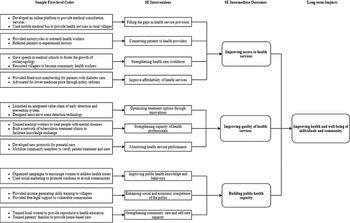
Our study revealed the HCSEs have worked on three different dimensions to improve the health and well-being of individuals and communities, which are: 1) improving access to health services; 2) improving quality of health services; and 3) building community health capacity. Each is discussed in turn.
Improving Access to Health Services
Firstly, improving access to health services includes strategies to improve availability, accessibility, and affordability of health services so that more people would have access to health resources. In doing so, HCSEs have interacted with a wide range of stakeholders including communities, health workers, governments and business sector and made efforts in four aspects: 1) filling the gaps in health service provision, 2) connecting patients to existing health providers, 3) strengthening healthcare workforce, and 4) lowering prices for health services. The findings suggested that the roles and functions of HCSEs are multi-dimensional and operate with diverse stakeholders at different levels (i.e. individual, community, public policy levels) in their interventions.
Filling the gaps in health service provision
The most common intervention employed by HCSEs to improve the accessibility of health services is providing health services directly outside public health systems to fill institutional voids. These gaps might be caused by shortages of healthcare professionals, inaccessible geographic areas of residence or strict working hours to see a doctor. Through delivering community-based health services directly to people in need, HCSEs compensate for inadequate health services provided by public institutions. Some HCSEs have developed online platforms for online health consultations (e.g. CIES by Ashoka Fellow Roberto Kiwaka, Brazil). Moreover, to address the issues of lacking availability of health services in rural areas, some HCSEs in our study provided flexible mobile clinic services for treating isolated and vulnerable groups, as noted in the profile of the Echoing Green Fellow Christopher Ategeka (Uganda), founder of Rides for Lives:
“We [Rides for Lives] manufactured locally sourced medical vehicles with the mission of improving medical access to those that are the most vulnerable… Our mobile Health unit is a refitted bus that contains three different medical stations: a pharmacy that is attended by a full-time pharmacist, a lab that has the ability to carry out different medical tests, and a medical station staffed by a full-time general health practitioner to see patients daily”
Connecting patients to health providers
Second, connecting patients to health providers operates as a form of intervention by acting as a bridge between patients and health providers. In doing this, some HCSEs have collaborated with health professionals directly by building a network that integrates health workers with different specialities, so that patients with fewer networks could find suitable doctors and seek medical advice more easily than before. One example is the Commonwealth Care Alliance (by Ashoka Fellow Robert Master, United States) that connected patients with a team of physicians and nurses to provide medical assessments, intensive medical and behavioral healthcare, and social support services in the home and community. Some HCSEs provided referral services by referring patients to health facilities to ensure that they receive the best possible care at the appropriate level. Other HCSEs recognised a lack of transportation as a key problem facing disadvantaged populations and provided transportation services using boats or modified bikes as ambulances to transport patients to health providers. An example of this was a ship ambulance provided by Friendship by Schwab Fellow Runa Khan (Bangladesh).
Strengthening the healthcare workforce
The HCSEs also engaged in strengthening the healthcare workforce by empowering community and local health workers, many of whom lack sufficient supervision and health training, through a series of training programs. They have employed multifaceted strategies to increase both the quantity and quality of community health workers through training, mobilisation and empowerment. For instance, some HCSEs trained villagers to become community health workers to provide primary care in their villages to reduce the burdens of public health institutions. As quoted from a Schwab Fellow, Sakena Yacoobi (Afghanistan), founder of Afghan Institute of Learning (AIL):
“Working with the Ministry of Health, AIL trained community health workers (CHWs) who are chosen by the villagers… CHWs refer villagers to the clinics, give first aid…and give health education… The CHWs program has been very successful in being a point of triage taking care of some things that do not need clinic care which relieves clinic numbers and…helps prevent illness in the first place”
Lowering prices for health services
Another HCSE intervention was to improve the affordability of health services by lowering prices for health services and products and improving health financing systems. This intervention typically comes in two forms: self-manufacturing and policy reform. For instance, some HCSEs in our study partnered with medical companies in developing and manufacturing health products and medicines and offered them at lower than market price. Others advocated for health policy reforms to lower healthcare costs, such as the work of Network Access to Essential Medicines by Ashoka Fellow Simon Kabore (Burkina Faso) that: “[We] built a coalition to lobby the government to provide antiretroviral drugs at zero cost, which it was receiving for free from an international donor, but selling to HIV positive citizens for 8,000 cfa (US$16.75) per month”.
In addition, we identified that some HCSEs in our study have developed pro-poor health financing schemes such as providing low-cost health insurance in partnership with insurance companies and other stakeholders to promote health coverage of poorer communities (e.g. Naya Javeen by Schwab Fellow Ansher Hasan, Pakistan).
Improving the Quality of Health Services
The HCSEs collaborated with a wide range of stakeholders such as health professionals, medical scientists, and governments to improve the quality of health service delivery. There are three major interventions to achieve this: 1) optimising treatment options through innovations, 2) strengthening the capacity of health professionals, and 3) monitoring health service performance.
Optimising treatment options through innovations
Providing more choices to existing health providers to improve the quality of their health services was also a key approach. This innovation can take place at different levels: the health product or service, the process of service delivery, and health system management method. For instance, some HCSEs focused on developing new disease detection and prevention systems such as the work of Alois (by Ashoka Fellow Bénédicte Défontaines, France) that offered integrated services of early detection, psychological support, risk prevention, medical care, and palliative care for patients. Other examples include utilising information communication technology and other advanced technologies to improve healthcare management systems particularly in organising patient-related medical or healthcare data in health institutions. For example, Koe Koe, Echoing Green Fellow Michael Lwin (Myanmar), developed a health information system for various Myanmar hospitals to track patients, and mobile apps for doctors to access patient’s information.
Strengthening the capacity of health professionals
We also found that the HCSEs developed close collaborations with health institutions and medical schools to empower in-service and future health personnel through education and training. For example, CISEPO, by Ashoka Fellow Arnold Noyek (Canada), combined education/training, research and service for medical students and professionals; and its curriculum has been used by 30 medical institutions. Moreover, some HCSEs have developed online platforms that integrate health professionals with different specialties at different levels and different geographical locations to facilitate knowledge exchange. For example, BE MORE, by Echoing Green Fellow Anurag Gupta (United States), developed an online training program to encourage the use of evidence-based medicine and improve physician-patient trust and communication.
Monitoring the performance of health services
HCSEs also acted as a third-party evaluator to monitor the performance and effectiveness of public health services. We found that some HCSEs have developed new protocols and standards for healthcare services to ensure that health services could be delivered effectively. The HCSEs also mobilised community volunteers as the watchdog in holding health providers accountable by verifying and monitoring medical treatment and care services at health institutions. This is well illustrated in Karuna Trust, by Schwab Fellow Sudarshan Hanumappa (India):
“Through the village council, the community is an active stakeholder participating in the planning and monitoring of the PHC’s functioning instead of being a passive recipient of inadequate services… Village councils hold their PHCs accountable for achieving better health outcomes and functioning as zero-corruption zones”.
Building Community Health Capacity
The last type of function performed by HCSEs we identified was in relation to building community health capacity. In doing so, the HCSEs employed three major interventions: 1) improving public health knowledge and behaviors; 2) enhancing social and economic competence; and 3) strengthening community care and self-care capacity.
Improving public health knowledge and behaviors
The HCSEs emphasised improving public health knowledge and promoting good health behaviors at both individual and community levels through collaborations with different stakeholders. For instance, some HCSEs partnered with schools and governments to deliver public education on health and hygiene. They adopted various media to disseminating health information through different media channels (e.g. documentation, social media platforms). For example, Félúton Alapítvány, by Schwab Fellow Csaba Kovács (Hungary), conducted partnerships with schools and businesses, and launched programs educating young people to address alcohol addiction. Other HCSEs employed behavioral incentives to stimulate change that enables low-income customers to purchase affordable fresh food (e.g. Wholesome Wave, by Ashoka Fellow Michel Nischan, United States).
Enhancing the social and economic competence of the public
The HCSEs implemented multiple interventions to provide skills, knowledge, and competencies that people require to become more independent and take greater control of their lives. This is a form of empowerment approach that has been used by many social enterprises. We identified that some of these interventions have focused more on social aspects, such as providing free legal services to vulnerable communities, fulfilling their basic needs by providing shelter and food or facilitating social connections within communities. For example: Heartlines, developed by Schwab Fellow Garth Japhet (South Africa), uses a mobile-phone-based social networking tool called “Forgood” to connect people based on similarity in location and interests to enhance social connectedness. Other HCSEs focused more on economic empowerment approaches to support community members via vocational training, employment opportunities, and financial support. One example is the work of Community Enterprise Solutions by Ashoka Fellow Gregory Van Kirk (Guatemala), as follows:
“[The] model creates access to healthcare-related goods and services in isolated rural communities [by empowering] local women to become entrepreneurs to sell [healthcare-related] goods and services in their communities… It gives individuals with no prior business experience the opportunity to develop entrepreneurial skills”
Strengthening community care and self-care capacity
Finally, the HCSEs implemented interventions to enable community members to provide care for themselves, their families and neighbors through a series of health skills training programs, which allows more efficient use of available human resources and quicker responses to community members’ needs for healthcare and reduces burdens of public health providers. This is well illustrated in the work of Noora Health, by Echoing Green Fellow Katy Ashe (United States):
“[The HCSE] delivers health skills training to at-risk patient families – certifying them in everything from hygiene to recognition of early warning signs. They meet users where they are by turning hospital hallways, waiting rooms and wards into classrooms. By certifying families in the conditions they face, they give community members the ability to heal and prevent disease when they return home”.
Theorizing Healthcare Social Enterprises in the Public Health Context
To ‘reach closure’ in the qualitative analysis, we cycled back and forth between the findings (Gioia et al., Reference Gioia, Corley and Hamilton2013) and the public health literature, particularly the social enterprise and NPG literature, and identified eight major activities and contributions that HCSEs played in healthcare services (see Table 1), which are: 1) policy implementer, 2) service coordinator, 3) industry watchdog or regulator, 4) performance monitor, 5) lead service providers, 6) service or process innovator, 7) policy lobbyist, and 8) institutional integrator. To provide a framework to summarise the findings, we juxtaposed our typology of HCSEs with three modes of co-production (i.e. co-production, co-management, and co-governance, following Brandsen and Pestoff, Reference Brandsen and Pestoff2006; and co-planning, co-design, co-prioritisation, co-financing, co-managing, co-delivery, and co-assessment, following Bovaird and Loeffler, Reference Bovaird and Loeffler2012) as a lens to understand how HCSEs are drawn into health service provision and to characterise their roles in the NPG framework.
Theorizing Social Enterprise Contribution in Healthcare Services

Our findings reveal that HCSEs have the capabilities and promise in engaging in various types of co-production in healthcare services that converge with and add new dimensions to those known in the NPG literature (see Table 1).
As shown in Table 1, HCSEs can act as policy implementer. This role is consistent with the co-management and co-delivery mode of NPG in which HCSEs help implement government policies to deliver health and social services directly to citizens through contractual relationships. This reflects the public-private partnerships (PPPs) model employed by social enterprises to provide public goods and services by utilising their specific expertise and skills (Nisar, Reference Nisar2013).
Second, HCSEs also play the role as service coordinators to match unmet needs or unused resources or poorly connected resources. This aligns well with the co-management mode of NPG. Examples include providing transportation services to connect patients in rural areas to existing health providers, which enables more efficient use of existing health resources. This shows that in the co-management process, the HCSEs can harness the productive capability civil society and government sectors to resolve complex health problems (Brown et al., Reference Brown, Keast, Waterhouse, Barraket, Keast and Furneaux2013).
Third, HCSEs play a critical role as industry regulators such as by taking active part in regulating the service standards in the health sector as well as influencing policy formulation and community governance at the local and national levels. Fourth, they also act as performance monitors that evaluate and monitor the service performance and accountability of public service provision, working to enhance the co-governance and co-assessment mode of NPG.
The subsequent findings below reflect some new types of contributions for HCSEs that offer new contributions beyond the typology of co-production (Brandsen and Pestoff, Reference Brandsen and Pestoff2006; Bovaird and Loeffler, Reference Bovaird and Loeffler2012) that we found in this study. That is, fifth, HCSEs can act as lead service providers to fill institutional voids through using their own hobbies and expertise to develop pioneering services not yet available in the market, such as using mobile clinics to provide healthcare services to patients in rural areas and developing e-platforms to provide online medical consultations. Sixth, HCSEs also act as service or process innovators by developing new services and products for healthcare provision. Examples include developing innovative infant incubators to protect vulnerable new-borns from hypothermia or designing more effective and sustainable mobility aids and appliances to support people with disabilities. We identify these roles as the co-innovation mode of NPG, in which HCSEs introduce innovative practices into health service provision and delivery (see Farmer et al., Reference Farmer, Kamstra, Brennan-Horley, De Cotta and Roy2020).
Seventh, HCSEs also play a role as policy lobbyist. HCSEs can influence the policy formulation and improve policy processes and outcomes by ensuring that policies are implemented and informed by local context and relevant to local needs, and at times using local wisdom. For example, HCSEs have lobbied the government to offer life-extending medications to the public and especially to the poor communities at lower prices. We call this role the co-design mode of NPG. Lastly, HCSEs can serve as institutional integrators by mobilising and coordinating public health improvement activities and bridges the interests of the government, academic, private sector and the community with new governance structures that encourage broad participation in public health issues. By doing so, different sectors and organisations become increasingly interdependent and resilient in adapting to continuous changes needed to improve health services. We call this role the co-integrator mode of NPG.
Overall, the findings reveal new empirical evidence on the distinctiveness, richness, heterogeneity of HCSEs beyond a specific setting in addressing health problems.
Discussion and Conclusion
To answer the question ‘How do healthcare social enterprises (HCSEs) contribute to public service provision in the health sector?’, we conducted a study of 172 HCSEs from three major platform organizations. As we have shown, HCSEs employ multifaceted interventions, collaborating with different stakeholders including community, health workers, health institutions, governments, and the business sector. Importantly, our findings have demonstrated that social enterprises not only diversify public service provision – as co-producers within the NPG framework – but also have the potential to take on a wide range of roles (such as coordinating health service provision or advocating for health policy reforms) in achieving the ultimate goal of improving health for all, as shown in Figure 1.
Analytical Coding Process for Social Enterprise Interventions in the Healthcare Services Provision

As we stated at the outset, there has been increasing interest in the role of civil society organisations in the provision of health services (e.g. Roy et al., Reference Roy, Donaldson, Baker and Kay2013). Building on the conceptualisation of social enterprises as an instrument to improve the health and wellbeing of individuals and communities (viz. Roy et al., Reference Roy, Donaldson, Baker and Kerr2014), we have examined the interventions of, and roles played, by 172 unique HCSEs (i.e. whose work primarily focus on the healthcare sector) across Africa, Asia, Europe, South, Central and North America that were developed as part of Ashoka, Echoing Green and Schwab fellowships. Our study reveals that social entrepreneurs could play different roles and use different interventions across different contexts of health systems. By adopting a qualitative content analytical approach using grounded theory to analyze the intervention profiles of the HCSEs, we have identified that HCSEs interventions can be categorised into three dimensions: improving access to health services; improving the quality of health services; and building public health capacity. We also found eight major roles that HCSEs play in the provision of health services that are consistent with – and offer new dimensions beyond – a narrow reading of the concept of co-production: namely, policy implementer, service coordinator, industry watchdog or regulator, performance monitor, lead service providers, service or process innovator, policy lobbyist, and institutional integrator.
Our contributions are thus twofold. Firstly, this article contributes to an enhanced understanding of the micro-level interventions of social enterprises that focus on solving complex health problems. This extends and advances prior research, which has tended to focus on the organisational or institutional aspects of social enterprises in the healthcare setting, or on the indirect outcomes of the actions of social enterprises on health and wellbeing (e.g. Hall et al., Reference Hall, Miller and Millar2016; Mason et al., Reference Mason, Barraket, Friel, O’Rourke and Stenta2015; Roy et al., Reference Roy, Macaulay, Donaldson, Teasdale, Baker, Kerr and Teasdale2018). We have shown that interventions by HCSEs (see Figure 1) are rich, diverse, yet also multi-level and multi-dimensional (e.g. connecting patients to health providers, strengthening community care and self-care capacity, optimising treatment options through innovations) to produce health services and influence the process and outcomes of health service provision. Therefore, this article deepens our understanding of the nature, process and, to some limited extent, the outcomes of HCSE interventions.
Secondly, using an NPG perspective as an initial framework to explore the interventions and roles of HCSEs, this article is the first to show that HCSEs are important co-producers of public health services (c.f. Howlett et al., Reference Howlett, Kekez and Poocharoen2017). We identified eight major roles that HCSEs play in the health services provision and delivery: policy implementer, lead service provider, service coordinator, service/ process innovator, industry regulator, performance monitor, policy lobbyist, and institutional integrator. We also showed how they corresponded with the concepts of co-management, co-delivery, co-governance and co-assessment (viz. Brandsen and Pestoff, Reference Brandsen and Pestoff2006; Bovaird and Loeffler, Reference Bovaird and Loeffler2012). Importantly, our new contribution comprises the identification of the roles of co-innovation, co-lobbying, and co-integrator as new dimensions of NPG framework by situating it in the context of healthcare.
Overall, the key contributions of this study have been to unpack the heterogeneity of the interventions of and roles played by HCSEs in addressing health problems as a means to create public value (Moore, Reference Moore1995) and providing theoretical and practical insights into how the concept of NPG can be applied to the healthcare setting. These findings could enable social enterprise and public health/management scholars to define and/or expand upon the forms of collaboration, funding, piloting, scaling, and competition that the public sector could establish with citizens and civil society organisations, particularly given the growing complexity of health problems and pressing global health challenges. For example, there is a growing trend of citizen innovators and social enterprises developing translation apps, creating face shields or other medical devices during the COVID-19 pandemic in the West and the East. This study offers new insights into how governments and businesses can work with citizens and civil society to improve health services.
Our study does, however, have several limitations. Firstly, the sample of HCSEs in this study was drawn from Ashoka, Echoing Green and Schwab platform organisations, which are not representative of social enterprises generally, particularly bottom-up, grassroots action initiated by citizens. Each of the platforms we focused upon employs strict criteria in the selection process of who they support: they seem to have selected especially prominent or impactful healthcare social enterprises. Future research could expand the study by examining social enterprises not connected to these foundations in specific regional contexts, particularly in terms of differences in interventions, collaborations and outcomes in the health service provision.
Moreover, which HCSEs interventions produce what health and social outcomes remain understudied. Future research could look into the effectiveness and efficiency of HCSEs interventions in comparison with those provided by other sectors (e.g. government, private, non-profit) and which of the eight types of HCSE roles produce better outcomes for specific regions or health problems. This opens us new avenues to conduct randomized controlled trials, quasi-experimental methods, and laboratory and field experiments to investigate which interventions produce better outcomes in comparison to a control or ‘usual’ treatment.
Acknowledgements
The authors would like to thank the organisers and attendees of the International Social Innovation Research 2020 (ISIRC) Conference, which was held on 1 – 3 September 2020, at the University of Sheffield, United Kingdom, who awarded an early draft of this article the conference’s Best Paper Award. Ethical clearance was obtained from the Hong Kong Polytechnic University (HSEARS20210120002).
Supplementary material
To view supplementary material for this article, please visit https://doi.org/10.1017/S0047279421000222