1. Introduction
Deforestation and excessive cultivation of marginal and sloped land in the upper reaches of major river basins have induced a series of environmental disasters in China. In response to these problems, in particular the severe Yellow River drought in 1997 and devastating floods in 1998 in the Yangtze River Basin and northeast China, the central government initiated a nationwide cropland set-aside program in 1999, known as the Sloping Land Conversion Program (SLCP). The program was originally designed to convert 14.67 million ha of cropland to forest and affect 40–60 million rural households, making it one of the largest land retirement programs in the world (SFA, 2003; Uchida et al., Reference Uchida, Xu and Rozelle2005; Bennett, Reference Bennett2008; Xu et al., Reference Xu, Tao, Xu and Bennett2010). Similar to other Payment for Environmental Service (PES) programs in developing countries, the SLCP adopts a fixed-payment incentive mechanism to compensate rural households that converts sloped cropland to forest- or grassland. The main objective of the program is to prevent soil erosion and thus enhance the provision of ecological services. Alleviating poverty through structural changes in households’ income-generating activities has been stated as another objective (Xu et al., Reference Xu, Tao and Xu2004b; Uchida et al., Reference Uchida, Xu, Xu and Rozelle2007). Therefore, the extent to which the program can achieve the ‘dual’ objectives has important implications for the long-term success of the SLCP.
The SLCP attempts to provide temporal compensation in exchange for long-run environmental benefits; the key determinant of the program's long-term sustainability,Footnote 1 therefore, is the incentive compatibility for participating farmers to maintain forestlands even when the program stops allocating subsidies in the future (Uchida et al., Reference Uchida, Xu and Rozelle2005; Uchida et al., Reference Uchida, Xu, Xu and Rozelle2007; Xu et al., Reference Xu, Tao, Xu and Bennett2010). Participating farmers’ post-program land use decisions have been argued to be one of the biggest concerns for the Conservation Reserve Program (CRP) in the United States (Skaggs et al., Reference Skaggs, Kirksey and Harper1994; Johnson et al., Reference Johnson, Misra and Ervin1997; Cooper and Osborn, Reference Cooper and Osborn1998; Roberts and Lubowski, Reference Roberts and Lubowski2007). Hence, one important policy concern is that farmers may return the enrolled land to cultivation if they cannot realize the benefits from the forestland or cannot find other, more profitable income-generating activities during the program period. Consequently, the environmental achievements of the program are at risk due to the likelihood of reconversion when the program terminates the compensation in the future. Therefore, it is important and pressing to examine what factors could influence participating farmers’ post-program land use decisions.
The existing literature has paid a great deal of attention to the long-term sustainability of the SLCP. However, with the exception of Grosjean and Kontoleon, (Reference Grosjean and Kontoleon2009) and Bennett et al. (Reference Bennett, Aashish and Xu2011), most of the empirical evidence is indirect and focuses on the implementation, cost effectiveness and targeting of the program (Xu et al., Reference Xu, Bennett, Tao and Xu2004a, Reference Xu, Tao and Xub, Xu et al., Reference Xu, Yin, Li and Liu2006b, Xu et al., Reference Xu, Tao, Xu and Bennett2010; Uchida et al., Reference Uchida, Xu and Rozelle2005; Uchida et al., Reference Uchida, Xu, Xu and Rozelle2007; Bennett, Reference Bennett2008; Gauvin et al., Reference Gauvin, Uchida, Rozelle, Xu and Zhan2009), as well as its impact on land and labor allocation (Uchida et al., Reference Uchida, Xu, Xu and Rozelle2007, Uchida et al., Reference Uchida, Rozelle and Xu2009; Groom et al., Reference Groom, Grosjean, Kontoleon, Swanson and Zhang2010) and on income and grain output (Xu and Cao, Reference Xu and Cao2002; Xu et al., Reference Xu, Tao and Xu2004b; Xu et al., Reference Xu, Xu, Deng, Huang, Uchida and Rozelle2006a; Xu et al., Reference Xu, Tao, Xu and Bennett2010; Feng et al., Reference Feng, Yang, Zhang, Zhang and Li2005; Uchida et al., Reference Uchida, Xu and Rozelle2005; Uchida et al., Reference Uchida, Xu, Xu and Rozelle2007; Deng et al., Reference Deng, Huang, Rozelle and Uchida2006). In particular, Uchida et al. (Reference Uchida, Rozelle and Xu2009) and Groom et al. (Reference Groom, Grosjean, Kontoleon, Swanson and Zhang2010) find a significant program impact on off-farm labor transfer for the liquidity constrained and farm output constrained households, respectively, which to a large extent supports the ‘win-win’ objectives of environmental improvement and poverty alleviation. In contrast to Bennett et al. (Reference Bennett, Aashish and Xu2011), who directly evaluate the household delivery of environmental services in terms of the survival rates of trees and grasses, the present paper investigates the determinants of participating farmers’ self-predicted post-program land use decisions. Much closer to our paper, Grosjean and Kontoleon, (Reference Grosjean and Kontoleon2009) is the first excellent study that directly assesses the program's long-term sustainability based on farmers’ contingent land and labor decisions under three hypothetical post-program scenarios: when the program is terminated, when the current program is renewed, and when a new program is introduced. Although our data only allow for investigating one of the above three scenarios under which the program subsidy will be terminated, in contrast to Grosjean and Kontoleon, (Reference Grosjean and Kontoleon2009) who investigate farmers’ preferences for both land and labor decisions at the household level, we examine farmers’ subjective perceptions for post-program land use decisions at the plot level.
To examine the determinants of farmers’ subjective post-program land use decisions, we use a household and plot-level data set that was collected in 2005 in three pilot provinces. Since the SLCP is still in the second-round subsidizing period, we lack data on participating farmers’ actual post-program land use decisions. This is in contrast to Roberts and Lubowski, (Reference Roberts and Lubowski2007), who study enduring impacts of the CRP in the US using observed land-use choices after CRP contract expiration. Of particular interest for our analysis, farmers were asked hypothetical questions about the probability of post-program conversion of forestland back to cultivation for each enrolled plot. There were five ordinal reconversion responses: definitely not reconversion, probably not reconversion, unknown, probably reconversion, and definitely reconversion. The responses could be biased to some extent since the farmers are not fully autonomous regarding land use changes under Chinese communist tradition in agricultural lands management. It is thus likely that some farmers had never thought about the reconversion issue and hence could not say whether or not they would choose reconversion. Therefore, the ‘unknown’ response in our data set could to a large extent mitigate the ‘never thought about it’ bias.
Subjective perceptions have been increasingly employed in empirical research to explain preferences and behavior (Frey and Stutzer, Reference Frey and Stutzer2002; Bellemare, Reference Bellemare2009; Delavande and Kohler, Reference Delavande and Kohler2009). Although empirical studies have improved the elicitation and measurement of subjective perceptions (Nyarko and Schotter, Reference Nyarko and Schotter2002; Manski, Reference Manski2004), there is obviously a potential bias associated with hypothetical questions. In our study it is for example possible that participants have an incentive to overstate the probability of reconversion in order to obtain subsequent subsidies, or they may want to understate the probability of reconversion in order to demonstrate their pro-social preferences in environmental protection. Similar to other studies on stated preferences, we are unable to control for subjects’ incentives in their responses regarding post-program land use choices. However, besides the relatively large sample size based on the plot-level data, we also include as many covariates in our econometric model specification as possible to minimize the potential bias in estimation parameters. In particular, in this paper we aim to investigate four sets of covariates: land targeting, household income structure, non-voluntary participation, and shortfalls in subsidy delivery, which are expected to have an influence on the probability of reconversion.
We find evidence that the targeting of steeper sloped and lower quality land can significantly decrease the probability of choosing reconversion. Second, there is a significant and robust household income structure effect on the probability of reconversion. Participating households with higher husbandry income or non-agricultural income have a lower incentive to convert the forestlands back to cultivation, whereas the share of crop income in the total household income has a significant and positive influence on the reconversion probability. Third, participating households with rights to decide what to plant on the enrolled lands have a higher probability of keeping their land forested even after the program ends. Finally, participating households that experienced the subsidy shortfall in 2003 are more likely to choose reconversion.
This paper is organized as follows. In section 2 we introduce the SLCP program and our sample data. Section 3 describes the potential determinants. We present and discuss the econometric results in section 4. Finally, section 5 concludes the paper.
2. The SLCP and data
2.1. The SLCP
In response to severe environmental degradation in the upper reaches of the Yangtze and Yellow rivers, China launched an SLCP in 1999 covering three pilot provinces: Shaanxi, Gansu and Sichuan. It was originally expected to convert around 14.67 million ha of cropland to forest and affect 40–60 million households with a budget of over US$40 billion (SFA, 2003; Uchida et al., Reference Uchida, Xu and Rozelle2005; Bennett, Reference Bennett2008). The program was originally designed for 10 years with the dual objectives of ecological restoration and poverty alleviation. The program has experienced fast expansion since its start in 1999. By the end of 2003, 15 million farmers in more than 2,000 counties in 25 provinces had enrolled in the program (Xu et al., Reference Xu, Bennett, Tao and Xu2004a; Xu et al., Reference Xu, Tao, Xu and Bennett2010). The program's main criterion is the steepness of sloped cultivated land. More specifically, the program targets cropland with slopes of 25 degrees or more in the southwest of China and with slopes of 15 degrees or more in the northwest of China.
Regarding compensation rules, initially there is a combination of three types of compensation: in-kind grain, cash and free seedlings. In-kind grain and cash compensation are delivered every year after the successful passing of a compliance inspection. The free seedlings are offered only for ‘ecological forests’ (timber crops) in the first year, and are worth 750 yuan (CNY) per hectare (ha). The cash compensation is CNY 300 per ha per year, and is delivered to the account for the forest management (guanli fei). The cash and seedlings are provided irrespective of regional differences, whereas there are two standards of in-kind grain compensation to account for the differences in regional average agricultural output. Specifically, the in-kind compensation is 1,500 kg per year in the Yellow River Basin and 2,250 kg per ha per year in the Yangtze River Basin. In 2004, the government changed the in-kind grain compensation to equivalent cash compensation. As a result, the total compensation amounts to CNY 2,400 per ha per year in the middle and upper reaches of the Yellow River, and CNY 3,450 per ha per year in the upper reaches of the Yangtze River after the first year. The compensation is paid for eight years if households plant ‘ecological forests’ (timber crops), for five years for planting ‘economic forests’ (orchard crops, or trees with medical value) and for two years for planting grasses. Hence, for farmers who participated in the program in 1999, the compensation contracts for ‘economic forests’ and ‘grasses’ had expired at the time of our survey in 2005, and the compensation contract for ‘ecological forests’ expired in 2007. Moreover, to accomplish the objective of ecological rehabilitation, the proportion of ecological forest was required to be at least 80 per cent at the regional level.
To maintain the program's ecological performance and achieve the program objective of poverty alleviation, the central government committed to continue its second-round subsidy policy in 2007. The new compensation standard was reduced by half in terms of equivalent in-kind compensation, yet additional cash compensation was left unchanged (CNY 300 per ha per year). Therefore, the new subsidy level was CNY 1,350 per ha per year in the middle and upper reaches of the Yellow River and CNY 1,850 per ha per year in the upper reaches of the Yangtze River. There was no change in subsidy duration for the different types of land converted. It remains unclear whether the payment policy is effective in promoting the long-term sustainability of the program. However, whether there exist other key determinants of the program's success with respect to both environmental gains and poverty reduction is definitely worth exploring.
2.2. The data
The data used in this paper come from a tracking household survey conducted in 2005 by the Center for Chinese Agricultural Policy, Chinese Academy of Sciences. The original survey was conducted in 2003, and covered the three pilot provinces in 1999: Shaanxi, Gansu and Sichuan. The sampling strategy followed the (stratified) random selection principle. Specifically, two counties were selected from each province. Three townships in each county and two participating villages in each township were selected based on geographical stratification. Within each village, 10 households were randomly chosen.
To reach the objectives of the present paper, we mainly use the data from the 2005 survey, which encompasses households’ socio-economic characteristics, income composition including on-farm and off-farm income-generating activities and other income sources, asset holdings, and plot characteristics including geographical characteristics and production activities. Of particular interest for the analysis, for each retired plot the farmers were asked about their perception of the probability of post-program conversion of the forestland back to cultivation. Although a hypothetical bias is unavoidable, as often discussed in contingent studies, farmers were clearly asked to choose one of five probabilities of reconversion based on their experience from program participation, plot attributes, household economic situation and other factors. The five probabilities of reconversion were stated as: definitely not reconversion, probably not reconversion, unknown, probably reconversion and definitely reconversion. After data cleaning, we have 334 effective sample households. Of the 334 households, 255 are participating households. In the end, we have 1,729 enrolled plots that are utilized to examine the determinants of reconversion probability.
Since our analysis focuses on the responses of participating farmers, the selection bias which was often assigned central importance in the program evaluation literature is not relevant in this paper. Farmers who are self-selected into the program could be less likely to convert the forestland back to cultivation than those who are targeted by the program. Thus, the top-down program design could to some extent increase farmers perception of the probability of reconversion. In addition, the probability of reconversion could be overestimated if some participating households who were working outside the village were missed by the survey. These people could have a lower propensity to reconvert the forestlands back to cultivation after the program ends.
3. Description of the potential determinants
When the subsidy program ends, the probability of reconversion depends on whether the opportunity cost of reconversion is high enough and thus outweighs the profit from converting the forestland back to cultivation. If the program targets the plots with lower expected agricultural yields, if the expected gain from enrolled land is higher than that from cropping (e.g., farmers can harvest fruits or non-timber products from the enrolled lands), or if participating households can find other more profitable income-generating activities such as livestock and off-farm employment, the cost of reconversion will increase and thus the farmers’ propensity to reconvert the forestland to cropping will be reduced. In addition, whether the program participation is voluntary and whether the subsidy delivery is short of the compensation standards have been documented as important program implementation issues that may have a negative influence on the welfare of participating households (Xu et al., Reference Xu, Tao, Xu and Bennett2010). As a result, the volunteerism and subsidy shortfalls are also expected to have a significant influence on participating farmers’ post-program reconversion behavior.Footnote 2
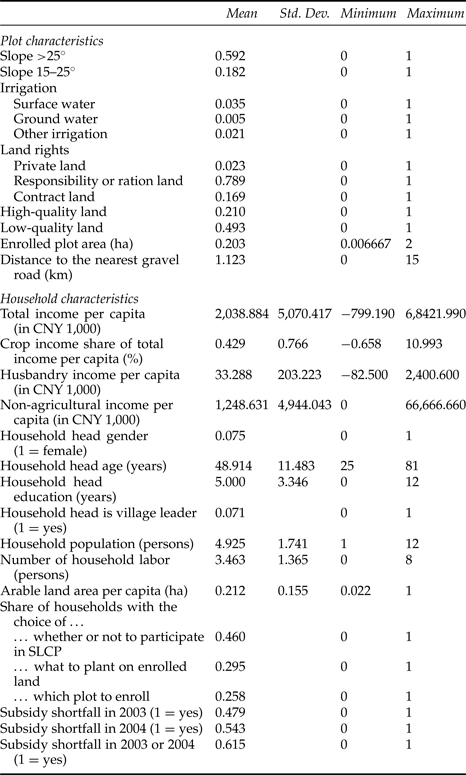
In this paper, we investigate four sets of determinants that could influence the probability of reconversion: (1) land targeting (2) household income structure (3) non-voluntary participation and (4) shortfalls in subsidies delivery. First, land targeting has been well regarded as an important criterion for evaluating the cost-effectiveness of program implementation. The general findings indicate that households are more likely to retire plots with lower opportunity cost (or forgone crop income), for example plots with steeper slope, lower quality, less secure land rights and other disadvantageous geographic conditions (Xu and Cao, Reference Xu and Cao2002; Uchida et al., Reference Uchida, Xu and Rozelle2005; Uchida et al., Reference Uchida, Xu, Xu and Rozelle2007; Xu et al., Reference Xu, Tao, Xu and Bennett2010). As summarized in table 1, in this paper we use slope, land rights, irrigation conditions, distance to the nearest gravel road and plot area as proxy variables for the opportunity cost of an enrolled plot. The descriptive results show that 59 and 49 per cent of the enrolled plots have a slope steeper than 25 degrees and low quality, respectively. However, we also find that 23 and 21 per cent of enrolled plots have a slope of less than 15 degrees and high quality, respectively. As regards land rights, land is divided into private and collective land in most Chinese villages. Collective land includes responsibility land, ration land and contract land.Footnote 3 In contrast to collective land, farmers enjoy higher security on private land, and private land is also of higher quality and has larger agricultural yields. Farmers have the least tenure security on contract land, which is auctioned off or allocated by village leaders for a fee. Two per cent of our sample plots are private land, 79 per cent are responsibility or ration land and 17 per cent are contract land. The distance to a gravel road reflects the extent to which the enrolled lands can be monitored by officials. Thus, farmers could have a lower incentive to reconvert enrolled land that is close to a gravel road.
Summary statistics of plot and household characteristics

Second, similar to the empirical studies on the determinants of land enrollment, household characteristics – in particular household income structure – are expected to play a significant role in determining the opportunity cost of reconversion. If farmers can transfer their labor to other more profitable income-earning activities during the program period, it can increase the value of labor and make the reconversion behavior worthless. Therefore, husbandry income and non-agricultural income including both self-employed and wage-earning income may have a negative effect on the probability of reconversion. However, the crop income indicates participating households’ dependence on farming, which thus could increase the probability of converting enrolled land back to cultivation. As shown in table 1, the other household characteristics that will be included in the model specification are household head's gender, age, education and political position (e.g., whether the household head is a village leader), the number of household labor, and arable land area per capita.
Third, concerning households’ autonomy to choose whether or not to participate in the program, 46 per cent of our sample have the right to choose, while 30 per cent and 26 per cent can choose what to plant on the enrolled land and which plots to retire, respectively. These descriptive results are quite comparable to Xu et al. (Reference Xu, Tao, Xu and Bennett2010) and Bennett et al. (Reference Bennett, Aashish and Xu2011), who reported their results based on data collected in 2003. Finally, in our sample we find that 48 per cent of farmers reported that they did not receive the full compensation standards in 2003 and 54 per cent experienced subsidy shortfalls in 2004.
4. The econometric analysis of determinants
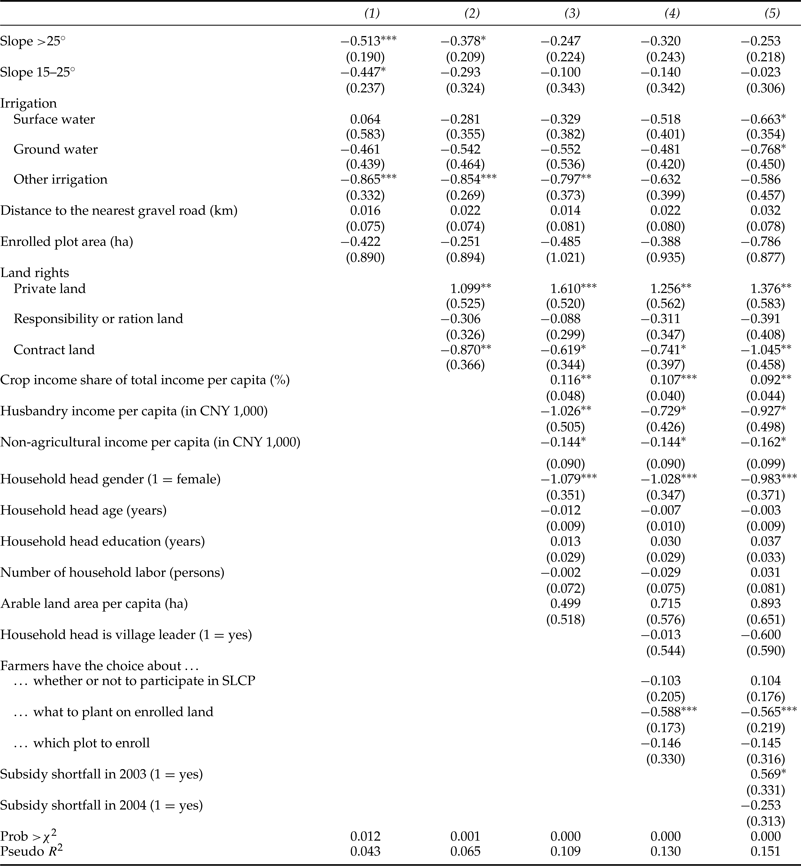
As mentioned earlier, farmers’ responses regarding their probabilities of reconversion are ordinal. Concretely, the dependent variable equals one for the definitely not reconversion, two for the probably not reconversion, three for the unknown response, four for probably reconversion and five for definitely reconversion. We therefore employ an ordered probit model to analyze the factors that could influence the probability of reconversion. In contrast to Grosjean and Kontoleon, (Reference Grosjean and Kontoleon2009) who find that 38 per cent of farmers stated that they would continue to maintain the reforested lands, our sample farmers stated that 48 per cent of the enrolled plots would definitely not be converted back to cultivation, while 26 per cent would probably not be reconverted, 9 per cent were uncertain, 11 per cent would probably be reconverted and 6 per cent would definitely be reconverted. Hence, we do find variation between the different probabilities of reconversion. In total, we estimate five model specifications with varying subsets of explanatory variables in order to check the robustness of the results. In each model regression, we control for county fixed effects and cluster the standard errors at the village level. The estimated results are summarized and reported in table 2.
Ordered probit regression results on the determinants of probabilities of reconversion

Notes: County dummies are included in all the model specifications. Figures in parentheses are robust standard errors clustered at the village level.
*Significant at 10%; **significant at 5%; ***significant at 1%.
Models (1) and (2) are used to examine how the land targeting affects the probabilities of reconversion. However, in model (1) we do not control for the land rights variables. The reason why we do not include the land quality in the model specifications is that the retired plots generally have higher slope and lower quality, and the other land attributes such as land rights and irrigation conditions are related to land quality as well. As expected, in model (1) the slope of the enrolled plots has a statistically significant and negative correlation with the reconversion probability. This indicates that if the program can effectively target the croplands with steeper slopes, participating households will have a lower incentive to convert the enrolled plots back to cultivation. In the second model where we include the land rights variables, we find that although the enrolled plots that have a slope of higher than 25 degrees are still statistically significant at the 10 per cent level, the significance of the enrolled plots that have a slope between 15 and 25 degrees disappears. This is in line with our concern that there could be a correlation between land quality (or slope) and land rights. Specifically, participating households are more likely to convert private lands back to cropping, yet the contract land has a lower probability of being reconverted. The results are in line with our expectation that the opportunity cost of retiring private land is much higher than that for collective land because private land has both higher land quality and stronger tenure security. Hence, if private land is forced to be enrolled in the program, it is expected that farmers will be more willing to convert it back to cultivation. In contrast to our results regarding crop land rights, Grosjean and Kontoleon, (Reference Grosjean and Kontoleon2009) find that strong tenure security of forestland can increase the likelihood of maintaining the reforested land. We do not find that distance to the nearest gravel road or plot area has a significant effect on the reconversion probability.
Besides the land attributes, we include household characteristics in the third model specification. The estimated results in the third column show that the slope of the enrolled plots is no longer significant at the conventional level. This is consistent with the existing literature that finds that both plot characteristics and household characteristics determine the likelihood of land enrollment. Thus, the plot having a steeper slope does not necessarily mean that it will be enrolled in the program. For example, higher income households could have more opportunities to retire their steeper slope croplands because they have advantageous social connections (Uchida et al., Reference Uchida, Xu, Xu and Rozelle2007). However, the significance of private land and contract land is kept unchanged. We indeed find significant household income structure effects on the probability of reconversion. Concretely, households with a higher share of crop income have a higher propensity to convert enrolled land back to cropping. This indicates that these types of households have a strong dependence on cropping income, and hence they have less incentive or opportunities to transfer their labor to non-agricultural productions. In contrast, as expected, higher husbandry income or non-agricultural income has a negative influence on the reconversion probability. However, the influence of household income structure should be interpreted with care since there is a potential endogeneity issue in the model estimation. For example, households that are strongly reconversion averse could have a stronger incentive to find alternative income-generating activities. In this case, the estimated results could be biased. However, on the one hand, we mostly focus on the correlation and not the causality between the potential determinants and the probabilities of reconversion in this paperFootnote 4 ; on the other hand, it is more plausible to expect a household's economic situation to influence the predicted reconversion behavior than vice versa. In addition, we find that the gender of the household head has a significant influence on the reconversion probability. A female household head has a significantly lower probability of reconverting enrolled plots. This is consistent with the findings in time preference literature that women are generally more patient in making investment decisions than are men (Bauer and Chytilova, Reference Bauer and Chytilova2009; Yang and Carlsson, Reference Yang and Carlsson2012). No other household characteristics are significantly related to the probability of reconversion.
In the fourth model, we investigate the effect of participation volunteerism on the reconversion probability. In addition to the three household autonomy variables we have discussed, i.e., whether households have the right to choose whether or not to enroll in the program, whether households have the right to choose what to plant on the enrolled land and whether households have the right to choose which plots to retire, we add a dummy variable to measure the household's political position: whether the household head is the village leader. The sign and significance of other variables are kept unchanged when we add the autonomy variables. We only find that households with a right to decide what to plant on the enrolled lands are significantly less likely to predict post-program reconversion, which is in line with Bennett et al. (Reference Bennett, Aashish and Xu2011), who find that households with a right to choose what to plant have significantly higher survival rates of program-planted trees and grasses. To some extent, the higher survival rates might imply higher expected benefits from retired land in the future, reducing the participating households’ reconversion probability (Grosjean and Kontoleon, Reference Grosjean and Kontoleon2009). As discussed by Bennett et al. (Reference Bennett, Aashish and Xu2011), the reason why we do not find a significant effect of voluntary participation on the reconversion probability could be potential measurement errors indicating that there is no significant difference between participating farmers who said they have the right to choose whether or not to enroll in the program and those who did not.
Finally, we examine how the subsidy shortfalls in the previous years impact participating farmers’ reconversion probability. Based on the model specification in column (5), we add two binary dummy variables that measure whether the subsidy delivery was short of the compensation standards in 2003 and 2004, respectively. Consistent with our expectation, households that did not receive the full subsidies in 2003 have a higher reconversion probability, but this is significant only at the 10 per cent level. Nonetheless, the subsidy shortfall in 2004 did not have a statistically significant influence on the reconversion probability. One possible interpretation of this is that the local agencies have a heavy responsibility to inspect whether the enrolled land satisfies the program requirements (e.g., tree types and survival rates) which could delay the subsidy delivery a little.
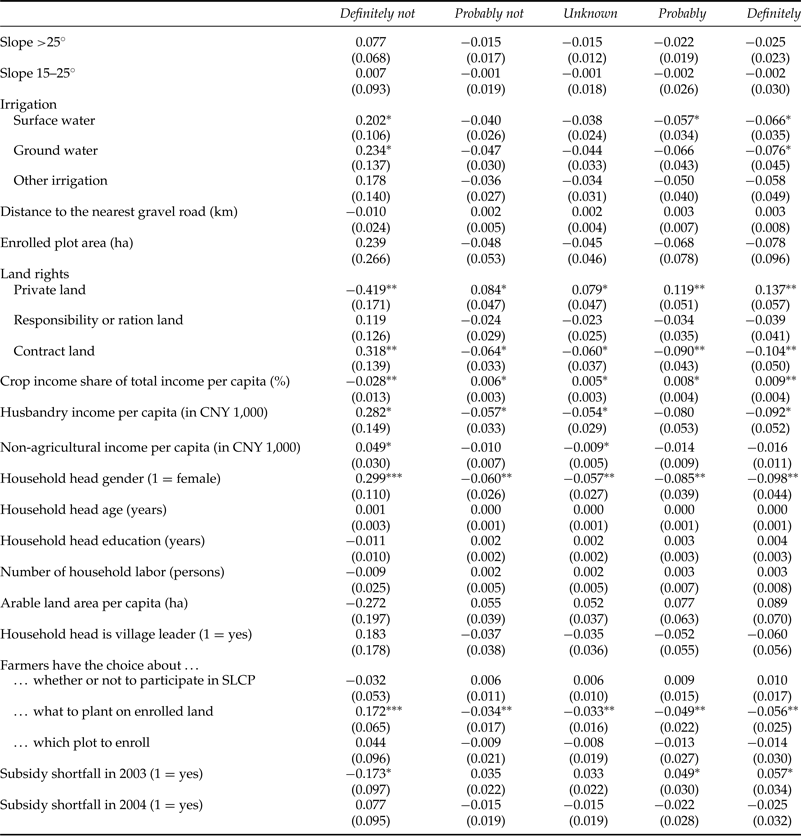
To investigate the extent to which the factors discussed above impact the probabilities of reconversion, we estimate the average marginal effects of each determinant based on the fifth model specification. The results are reported in table 3. Concerning land rights, if the enrolled plot is private land, it increases the probability of definitely reconverting by 13.7 per cent; if the enrolled plot is contract land, it decreases the probability of definitely reconverting by 10.4 per cent. Regarding household income structure, a 1 per cent increase in the crop income share of total household income implies a 0.9 per cent higher probability of definitely reconverting the enrolled plot back to cultivation. A one unit (CNY 1,000) increase in husbandry income per capita and non-agricultural income per capita increases the probability of definitely not reconverting by 28.2 per cent and 4.9 per cent, respectively. The marginal effect of non-agricultural income is much smaller than that of husbandry income, which could be due to the average husbandry income (CNY 33 per capita) being much lower than the average non-agricultural income (CNY 1,249 per capita), as shown in table 1. Hence, a one-unit (CNY 1,000) increase in husbandry income could have a larger marginal effect on the reconversion probability. Considering volunteerism, households with a right to choose what to plant have a 17.2 per cent higher probability of definitely not reconverting compared with those without such a right. Finally, if a household experienced a subsidy shortfall in 2003, it is 5.7 per cent more likely to expect post-program reconversion.
The average marginal effects of the determinants of probabilities of reconversion

Notes: County dummies are included in all the model specifications. Figures in parentheses are robust standard errors clustered at the village level.
*Significant at 10%; **significant at 5%; ***significant at 1%.
5. Conclusions
Environmental degradation and rural poverty are two major issues induced by inefficient production choices, especially in developing countries. PES programs such as the SLCP in China are designed to achieve ‘win-win’ objectives of environmental improvement and poverty alleviation (Pagiola et al., Reference Pagiola, Arcenas and Platais2005; Zilberman et al., Reference Zilberman, Lipper and McCarthy2008). Characterized by limited budgets and a finite compensation duration, the program's long-term sustainability is determined by the incentive compatibility for participating farmers to keep the enrolled land out of cultivation after the program ends. If the participating households cannot expect future benefits from enrolled land or they do not transfer their labor to other more profitable use, it is rational for them to reconvert the enrolled land back to cultivation. Based on household- and plot-level data collected in 2005, this paper investigates what determinants could influence participating farmers’ self-predicted post-program land use decisions.
In general, the results are consistent with our expectation that the opportunity cost of reconversion has played a crucial role in determining the probability of reconversion. First, the targeting of steeper sloped and lower quality plots can significantly decrease the reconversion probability. Second, we find that the share of crop income has a significantly positive correlation with reconversion probability. Concerning the fact that the grain price has been increasing after 2005, our results indicate that participating households would be more likely to convert the forestland back to cropping in order to increase their agricultural profits. Participating households that can transfer their labor to livestock or non-agricultural income-earning activities are less likely to make reconversion decisions. Third, participating households with a right to decide what to plant on the enrolled lands have a higher probability of maintaining the reforested lands after the program ends. Finally, subsidy shortfalls have a positive influence on the reconversion probability, which is in line with Grosjean and Kontoleon, (Reference Grosjean and Kontoleon2009), who find that the likelihood of re-enrollment in the new program is affected by both the subsidy amount and the assurance of subsidy delivery.
Consequently, by addressing participating farmers’ subjective perceptions of post-program land use decisions, our findings confirm the importance of future benefits from reforested land and alternative income-generating activities in promoting long-term success of the SLCP. Thus, follow-up policy will be improved if governments can, for example, enhance the training and technical support for the management of reforested land, ensure tenure security on forestland and provide non-agricultural employment services, thus motivating rural migration.