Clostridium difficile is the leading cause of healthcare-associated diarrhea; it is responsible for 15%–25% of antibiotic-associated diarrhea.Reference Martin, Zingg, Knoll, Wilson and Dettenkofer 1 , Reference Cohen, Gerding and Johnson 2 In the United States, the number of hospitalizations due to Clostridium difficile infection (CDI) increased almost 4-fold from 1993 to 2009; most cases affected individuals 65 and older.Reference Lucado, Gould and Elixhauser 3 , Reference Lessa, Mu and Bamberg 4 Hospital costs of CDI in the United States were estimated at $4.7 billion annually, and in 2013, Clostridium difficile infections were declared an urgent threat by the US Centers for Disease Control and Prevention.Reference Desai, Gupta, Dubberke, Prabhu, Browne and Mast 5 , 6
The burden of healthcare-associated CDIs in acute-care hospitals in the European Union/European Economic Area has been estimated to be 123,997 cases annually. 7 A 2003 study estimated that CDI conferred a total direct cost of approximately €3 billion (US $3.3 billion) per year to EU healthcare systems, and this burden is expected to double over the next 40 years.Reference Kuijper, Coignard and Tüll 8
In France, the surveillance of Clostridium difficile infections was reinforced after the emergence of PCR-ribotype 027 epidemic strains in 2006. An incidence study was conducted in 2009 in hospitals that voluntarily participated.Reference Eckert, Coignard and Hebert 9 However, since then, no further initiatives have been implemented. CDIs remain under recognized by public health policymakers, healthcare professionals, and the public.Reference Le Monnier, Duburcq and Zahar 10 A recent study extrapolated the national cost of CDIs from local data as €163.1 million (US $178.9 million), suggesting a high economic burden in France that would need to be further assessed with data collected at the national level.Reference Le Monnier, Duburcq and Zahar 10 More detailed estimates of the burden of CDI would highlight the need for preventive strategies against CDI and measure the potential economic benefit that would enhance the clinical benefits they could eventually bring. Our objectives were to describe hospital stays caused by or complicated by Clostridium difficile infections and to measure the costs attributable to CDI in French hospitals from the national health insurance perspective.
METHODS
Data Sources
Data were extracted from the 2014 Programme de Médicalisation des Systèmes d’Information (PMSI), an exhaustive national hospital discharge database maintained by the governmental agency Agence Technique de l’Information sur l’Hospitalisation (ATIH). Because there is no national surveillance system for C. difficile in France, the best estimates available were obtained from the PMSI, which contains information on all stays which occurred in all French public and private acute-care hospitals in 2014: (1) demographic information such as gender or age, (2) medical information on the primary or related diagnosis that led to hospital admission (related diagnosis describes a symptom instead of a disease) and underlying comorbidities/complications (associated or secondary diagnosis) coded using the International Classification of Diseases, 10th revision (ICD-10), (3) the list of procedures carried out, and (4) the list of expensive treatments administered to the patient (financed on top of DRGs-data only available for public hospitals). The data are released upon request by the ATIH for epidemiologic studies.Reference Buisson 11 – 13 The reliability of PMSI to estimate the incidence of a disease has been confirmed for tuberculosis, an infection with mandatory notification,Reference Girard, Antoine and Che 14 and also for cancers; these diseases are often followed through registries.Reference Pierron, Revert and Goueslard 15 – Reference Boudemaghe and Belhadj 17 Overall, PMSI has proven to be increasingly reliable in tracking the incidence of a disease, and it is a suitable data source for this study.
Since the introduction of a diagnosis-related group (DRG)-based prospective payment system in 2005, payments by the French national health insurer to hospitals are mainly based on fixed costs per DRG (tariff), which are nationally set and regularly updated based on a cost survey performed annually using a national representative sample of voluntary public and private hospitals (the ‘Etude Nationale de Coûts à méthodologie Commune, ENCC). 13 In this context, the PMSI database is an exhaustive resource used for prospective payment, and it is the key tool used to calculate and justify the payments to hospitals for healthcare services provided. This database is recommended as an epidemiological and economic tool by French guidelines for health economic evaluation. 18 , 19 Therefore, the economic burden of hospitalized cases is expected to be adequately described in this study.
In the database, each patient’s stay is classified in a DRG with a severity level expressed as an integer between 1 and 4 according to the information documented by the physicians. The severity level associated with each DRG depends mainly on comorbidities, length of stay (LOS), discharge status (ie, death), and patient age. Notably, the occurrence of health-acquired infections, especially CDI, triggers an upgrade to the highest severity level, which then leads to the highest level of payment to the hospital by the French national health insurer. Each patient is identified by a unique and anonymized code that allows tracking of patients across French acute-care hospitals and over time. 13 , Reference Or 20
Data Collection
All hospital stays with a diagnosis of CDI were extracted from the 2014 PMSI database using the ICD-10 code A04.7, “Enterocolitis due to Clostridium difficile.” Hospital diagnoses were segmented in 3 categories: (1) primary diagnosis that led to hospital admission, (2) related diagnosis describing a symptom instead of a disease, which also led to hospital admission, and (3) associated diagnosis or comorbidity that depicts underlying comorbidities or possible complications occurring during the hospital stay and inducing additional care. We then performed 2 different analyses.
The first descriptive analysis was performed only on hospital stays with a primary or related diagnosis of CDI, that is, patients hospitalized for a CDI. Gender, age, LOS, mortality, and costs were collected and analyzed.
In the second analysis, all hospital stays with an associated diagnosis of CDI (ie, CDI as comorbidity) were selected. To evaluate the impact of comorbidity CDI on hospitalization length and cost, a retrospective case-control analysis was performed. The cases were defined as hospitalizations with an associated diagnosis of CDI, and controls were defined as hospitalizations without any diagnosis of CDI (neither primary, associated, nor related). Each case was matched with 1 control (1:1 matching) based on age, sex, DRG (not matched on severity level), and year of hospitalization. The mean LOS and the mean cost were then calculated for cases and controls and compared using statistical nonparametric analyses (ie, Wilcoxon or Mann-Whitney).
Economic Assessment
Hospital costs attributable to CDI were assessed from the French national health insurer perspective. They were estimated from national insurer payments to hospitals that are mainly based on DRG tariffs as discussed above. DRG tariffs encompass medical care (including examinations and procedures), nursing care, treatments (excepting expensive therapies), food, and accommodation. Conventional adjustments of DRG tariffs according to LOS and additional costs per day of hospitalization in emergency or an intensive care unit or for permanent monitoring were considered when appropriate. For stays in private hospitals, as physician fees are not included into the DRG tariffs, physician fees for services (obtained from 2014 ENCC data) were also added. Costs for ambulatory care, expensive treatments (ie, drugs or medical devices usually reimbursed on a case by case basis on top of DRG tariffs, not homogeneously described in the PMSI at the time of the study), and indirect costs of productivity losses or premature mortality were not taken into account. All costs were measured and expressed in 2014 euros.
We used 2 distinct methods to estimate hospital costs and LOS associated with CDI, depending on whether CDI was recorded (1) as the reason for hospitalization (primary and related diagnosis) or (2) as a comorbidity (associated diagnosis-patients hospitalized for another cause with concurrent CDI) in the PMSI. For hospital stays with a primary or related diagnosis of CDI, the full cost and the full LOS were deemed to be attributable to CDI because it was the reason for admission. For stays with CDI as a comorbidity, CDI-associated costs and LOS were calculated as the differences between cases and controls. Additionally, costs and LOS were described by age group.
Ethics and Consent
The study was conducted in accordance with International Society for Pharmacoepidemiology (ISPE) Guidelines for Good Pharmacoepidemiology Practices (GPP). Because this study was a non-interventional retrospective study of anonymized data, it does not fall under the scope of the law and does not require any ethics committee submission (Law 88–1138 relative to Biomedical Research of December 20, 1988, modified on August 9, 2004). Approval was obtained from the Commission Nationale de l’Informatique et des Libertés (CNIL) to confirm that the confidentiality of individual patient data was insured.
RESULTS
Patient and Stay Characteristics
A total of 16,099 stays (13,516 patients) involving CDI were identified in the database, representing 0.059% of all hospital stays in 2014 in France and an incidence of 2.61 cases per 10,000 patient days. These results are in line with the last national study on CDI incidence.Reference Eckert, Coignard and Hebert 21 Of these 16,099 stays, 5,834 stays were identified with a primary diagnosis of CDI corresponding to 4,968 patients, and 10,265 stays were observed with a CDI as comorbidity representing 9,156 patients (Table 1). Distribution of age differed between women and men (P<.0001). Patients >50 years old accounted for the vast majority of patients (84%). Overall, the crude mortality rate was 14.5%. In patients with a CDI as primary diagnosis, crude mortality rates did not differ between men and women (8.2% vs 7.1%; P=.1558). In patients with a CDI as comorbidity, crude mortality rate was higher in men than women (19.3% vs 15.5%; P<.0001). Overall, crude mortality rate was higher in men than women (16.7% vs 12.7%; P<.0001).
Patient Characteristics

NOTE. CDI, Clostridium difficile infection; SD, standard deviation.
Burden of CDI as the Primary Diagnosis
Overall, we identified 5,834 stays with a primary diagnosis of CDI. The mean cost per hospital stay was €5,267 (SD, €3,645; US $5,777; SD, $3,998), ranging from €2,790 (SD, €1,586; US $3,060; SD, $1,739) in patients 31–40 years old to €6,989 (SD, €2,226; US $7,666; SD, $2,441) in patients 11–20 years old. The median cost per stay was €5,433 (US $5,959). Mean cost per stay increased with age. The mean cost per stay was higher than €4,500 (US $4,936) for patients over 60 years old.
The mean LOS was 12 days (SD, 11 days), ranging from 4 days (SD, 4 days) in patients 0–10 years old to 16 days (SD, 8 days) in patients 11–20 years old. The median LOS was 9 days. The mean LOS increased with age. The average LOS for patients >60 years old was >10 days in healthcare facilities.
Total hospitalizations costs for CDI (when a primary diagnosis) from the French national health insurance perspective were €30.73 million (US $33,710,349) in 2014. Patients >55 years old accounted for 88.5% of total costs or €27.19 million (US $29,827,022). The cumulative cost of patients 81–105 years old was €18.46 million (US $20,250,343; 60.1%).
Impact of CDI as Comorbidity on Hospitalizations Costs and Lengths of Stay
A total number of 10,265 stays with CDI as a comorbidity were identified. Moreover, 10 stays with CDI as a comorbidity could not be matched because no control with similar age, sex, and DRG could be found; these cases were discarded from the study. The distribution of DRGs for patients with a CDI as a comorbidity was very heterogeneous: patients were distributed among 735 DRGs of the ~2,500 available DRGs. The top 50 DRGs accounting for 58% of the cases are listed in Supplementary Table 1.
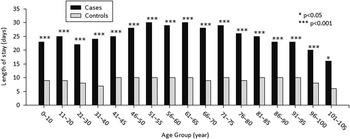
Cases had a mean LOS of 26 days (SD, 29 days); the median LOS was 19 days. Cases with patients 51–55 years old or 61–65 years old had the longest LOS (mean, 30 days). Controls had a mean LOS of 10 days (SD, 13 days) with a median of 6 days.
Wilcoxon or Mann-Whitney tests showed that CDI was linked to increased LOS (P<.0001) in the overall population and in every age group (Figure 1). CDI was associated with an average increased LOS of 17 days (SD, 30 days) ranging from +11 days (SD, 11 days) in patients >100 years old to +20 days in patients 51–55 years old (SD, 46 days) or patients 61–65 years old (SD, 32 days). The median LOS increase was 11 days.
Mean individual length of stay for cases (hospitalizations with Clostridium difficile infection [CDI] as a comorbidity) and controls (hospitalizations without CDI) per age group.

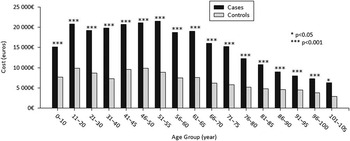
The mean cost per stay for cases was €14,512 (SD, €19,648; US $15,919; SD, $21,553), and the median cost per stay was €8,631 (US $9,468). The most expensive patient group reached €21,482 (US $23,565) per stay for patients 51–55 years old. Controls had a mean cost per stay of €6,217 (SD, €10,651; US $6,819; SD, $11,684), and the median cost per stay was €3,673 (US $4,029). Nonparametric tests showed that mean costs per stay for cases were significantly superior to controls in the overall population (P<.0001) and for each age group (Fig. 2). The mean cost difference was €8,295 (SD, €17,163; US $9,099; SD, $18,827) and the median was €4,797 ($5,262). The highest difference €12,655 (SD, €31,081; US $13,882; SD, $34,095) was observed in patients 51–55 years old.
Mean individual costs for cases (hospitalizations with Clostridium difficile infection [CDI] as comorbidity) and controls (hospitalizations without CDI) per age group.

Costs attributable to CDI were defined as the cost difference between cases and controls. Thus, from the French national health insurance perspective, total costs attributable to CDI as a comorbidity were estimated to be €84.98 million (US $93,221,785) in 2014. The cumulative cost for patients 51–90 years old was estimated to be €65.46 million (US $71,808,638; 77%). The biggest share of total costs occurred among elderly patients because they represented the highest number of patients.
Finally, the total costs attributable to CDI in patients hospitalized with a primary or associated diagnosis of CDI were estimated at €115.70 million (US $126,921,164).
DISCUSSION
In the present study, we identified 13,516 patients hospitalized with CDI in 2014 in France. Advanced age is associated with an increased incidence of CDI. The mean cost per stay with a primary diagnosis of CDI was €5,267 (US $5,777), and the mean CDI-attributable cost per stay with an associated diagnosis of CDI was estimated to be €8,295 ($9,099). This cost highlights the significant economic burden of €115.70 million (US $126,921,164) for Clostridium difficile infections in hospitals borne by the French national health insurance system. Preventive measures to avoid CDI would be expected to reduce the total amounts spent by national health insurance. When present as a comorbidity in hospitalizations for other reasons, CDI was significantly associated with increased LOS in hospital and increased economic burden for the French health system.
In this study, we identified all hospital CDI cases that were declared at discharge and billed accordingly to French national health insurance. These results should be interpreted with caution because we did not determine whether CDI diagnoses were confirmed with lab results as recommended by the guidelines.Reference Crobach, Planche and Eckert 22 Notably, Le Monnier et alReference Le Monnier, Duburcq and Zahar 10 have reported that a large proportion of CDI cases are not reported by the physician and are not billed to the national health insurer in France, which is consistent with a high rate of nondiagnosis of CDI in Europe as reported by the European, multicenter, prospective, biannual, point-prevalence study of Clostridium difficile infection in hospitalized patients with diarrhea (EUCLID).Reference Davies, Longshaw and Davis 23 More precisely, Le Monnier et al found that 38.2% of stays with bacteriological evidence of CDI were not recorded in the discharge database and thus are not billed, leading to €71 million (US $77,885,935) of CDI-attributable costs borne by hospitals directly and not reimbursed by national health insurance. This highlights the need for physician education regarding CDI burden.
Using the ICD-10 code to identify cases within the PMSI was the only available proxy even though underreporting was mentioned in previous studies using this proxy.Reference Le Monnier, Duburcq and Zahar 10 , Reference Jones, Taright and Boelle 24 However, our results showed an incidence similar to the last national study; hence, we hypothesize that coding was appropriate.Reference Eckert, Coignard and Hebert 21 Additionally, this method was used and considered reliable in overseas studies.Reference Dubberke, Reske, McDonald and Fraser 25 – Reference Lyytikäinen, Turunen and Sund 28
The cost estimation in this study was conservative in different aspects: we considered the full cost borne by national health insurance (except add-on costs for the most expensive treatments that are paid on top of DRGs), we did not integrate indirect costs linked with productivity losses or premature mortality or costs incurred outside of hospitals. Also, in Miller et al,Reference Miller, Polgreen, Cavanaugh and Polgreen 29 the length of stay of non-CDI patients was correlated with CDI incidence, which may indicate that CDI incidence is a proxy for hospital efficiency and/or quality. This finding would not have impacted our results because controls were not specifically selected in the same hospital. Moreover, €116 million (US $127,250,260) is a low estimate of CDI burden in France. Compared to all payments to acute-care hospitals, CDI cases represent 0.23% of total expenses.
This study has some limitations. The PMSI is not per se an epidemiology database because it is used to support hospital funding. Also, DRG codes are attributed to each stay based on criteria that physicians make an entry in the system for every patient stay. Misclassification or diagnosis errors, underreporting, and inadvertent omissions may occur, as noted in a previous study.Reference Le Monnier, Duburcq and Zahar 10 However, due to its exhaustiveness (all stays included in the database), robust countrywide studies can be carried out.
The total hospital cost of CDI in the US healthcare setting was recently reported to be $4.7 billion.Reference Desai, Gupta, Dubberke, Prabhu, Browne and Mast 5 Adjusted to population size, the US economic burden of CDI is 7-fold higher than the French burden reported in this paper. Aside from US studies, our results are in line with European estimates: a recent Italian study estimated that CDI acquired during hospitalization added on average €14,000 (US $15,357) per patient on top of the cost of hospitalisationReference Magalini, Pepe, Panunzi, Spada, De Gaetano and Gui 30 ; studies in the United Kingdom and Germany estimated costs (2014 values) to be £8,207 (US $10,582) and €7,993 (US $8,768), respectively.Reference Wilcox, Cunniffe, Trundle and Redpath 31 , Reference Vonberg, Reichardt, Behnke, Schwab, Zindler and Gastmeier 32 Lastly, in a publication from Le Monnier et al,Reference Le Monnier, Duburcq and Zahar 10 the societal economic burden of CDI in France is estimated to be €163.1 million (US $179,075,645), with a mean cost per stay with a primary diagnosis of CDI of €6,056 (US $6,649) and attributable costs of €11,251 (US $12,353) when CDI is an associated diagnosis. Our results differed because of the methods employed. In Le Monnier et al,Reference Le Monnier, Duburcq and Zahar 10 a different economic perspective was chosen and a sample of colocalized public hospitals was included to extrapolate the national costs where we worked from a national sample captured in the PMSI.
This study highlights the significant expenses due to CDI cases. Preventive treatments, as mentioned by Ivarsson et alReference Ivarsson, Leroux and Castagner 33 or by McFarlandReference McFarland 34 or by Leal et al,Reference Leal, Heitman, Conly, Henderson and Manns 35 would decrease the substantial economic burden supported by the national health insurer, especially when CDI occurs as a comorbidity.
Further investigations are required to study the overall economic burden of CDI taking into account, for example, the impact of CDI on readmissions, CDI recurrences, and consumption of healthcare services in the hospital setting and beyond. Such studies will support decision making, notably regarding of strategies aiming to prevent Clostridium difficile infections.
ACKNOWLEDGMENT
Financial support: Heva company (Lyon, France) received funding from Da Volterra to perform the study.
Potential conflicts of interest: Thibaut Galvain and Pierre-Alain Bandinelli are employed by Da Volterra. Antoine Andremont is a scientific adviser of Da Volterra within the framework of the French law on innovation and research.
SUPPLEMENTARY MATERIAL
To view supplementary material for this article, please visit https://doi.org/10.1017/ice.2017.114.