Significant outcomes
Previous genetic studies of bipolar disorder (BD) and schizophrenia (SCZ) have identified multiple shared susceptibility genes, neurometabolites, proteins, and brain morphology changes.
Linkage disequilibrium score regression identified one neurological protein, NEP, which shows suggestive genetic correlation for both BD and SCZ. Two-sample bidirectional Mendelian randomisation analysis suggested an association between genetically predicted levels of NEP protein (exposure), BD (outcome) and SCZ (outcome).
The findings may provide new ideas for future research on the pathogenesis of BD and SCZ and understanding the genetic effects of neurological proteins on BD and SCZ.
Limitations
Firstly, we observed suggestive genetic correlation between NEP, BD and SCZ. In addition, the instrumental variable used for MR analysis is a trans single nucleotide polymorphisms (SNP) of NEP protein, which may have weaker effect size and less direct effect. Further functional experiment is warranted to confirm our findings and clarify the underlying biological effects of neurological proteins on BD and SCZ.
Secondly, the GWAS summary statistics all derived from European populations; thus, the results should be applied to other ethnic groups with caution.
Introduction
Bipolar disorder (BD) and Schizophrenia (SCZ) are two common psychiatry disorders shared certain symptoms, such as hallucinations, delusions, and mood symptoms (Yuji et al., Reference Yuji, Madoka, Kazuki and Tomiki2020). According to the report of The Global Burden of Diseases (GBD), Injuries, and Risk Factors Study 2017, the estimated prevalence around the globe is about 45 million for BD and 19 million for SCZ (James et al., Reference James, Abate, Abate, Abay, Abbafati, Abbasi, Abbastabar, Abd-Allah, Abdela, Abdelalim, Abdollahpour, Abdulkader, Abebe, Abera, Abil, Abraha, Abu-Raddad, Abu-Rmeileh, Accrombessi, Acharya, Acharya, Ackerman, Adamu, Adebayo, Adekanmbi, Adetokunboh, Adib, Adsuar, Afanvi, Afarideh, Afshin, Agarwal, Agesa, Aggarwal, Aghayan, Agrawal, Ahmadi, Ahmadi, Ahmadieh, Ahmed, Aichour, Aichour, Aichour, Akinyemiju, Akseer, Al-Aly, Al-Eyadhy, Al-Mekhlafi, Al-Raddadi, Alahdab, Alam, Alam, Alashi, Alavian, Alene, Alijanzadeh, Alizadeh-Navaei, Aljunid, Alkerwi, Alla, Allebeck, Alouani, Altirkawi, Alvis-Guzman, Amare, Aminde, Ammar, Amoako, Anber, Andrei, Androudi, Animut, Anjomshoa, Ansha, Antonio, Anwari, Arabloo, Arauz, Aremu, Ariani, Armoon, Ärnlöv, Arora, Artaman, Aryal, Asayesh, Asghar, Ataro, Atre, Ausloos, Avila-Burgos, Avokpaho, Awasthi, Ayala Quintanilla, Ayer, Azzopardi, Babazadeh, Badali, Badawi and Bali2018). Both disorders may cause damage to the lives of patients, such as marital instability, low level of education, high social costs, as well as occupational status. With the increasing burden of both disorders (James et al., Reference James, Abate, Abate, Abay, Abbafati, Abbasi, Abbastabar, Abd-Allah, Abdela, Abdelalim, Abdollahpour, Abdulkader, Abebe, Abera, Abil, Abraha, Abu-Raddad, Abu-Rmeileh, Accrombessi, Acharya, Acharya, Ackerman, Adamu, Adebayo, Adekanmbi, Adetokunboh, Adib, Adsuar, Afanvi, Afarideh, Afshin, Agarwal, Agesa, Aggarwal, Aghayan, Agrawal, Ahmadi, Ahmadi, Ahmadieh, Ahmed, Aichour, Aichour, Aichour, Akinyemiju, Akseer, Al-Aly, Al-Eyadhy, Al-Mekhlafi, Al-Raddadi, Alahdab, Alam, Alam, Alashi, Alavian, Alene, Alijanzadeh, Alizadeh-Navaei, Aljunid, Alkerwi, Alla, Allebeck, Alouani, Altirkawi, Alvis-Guzman, Amare, Aminde, Ammar, Amoako, Anber, Andrei, Androudi, Animut, Anjomshoa, Ansha, Antonio, Anwari, Arabloo, Arauz, Aremu, Ariani, Armoon, Ärnlöv, Arora, Artaman, Aryal, Asayesh, Asghar, Ataro, Atre, Ausloos, Avila-Burgos, Avokpaho, Awasthi, Ayala Quintanilla, Ayer, Azzopardi, Babazadeh, Badali, Badawi and Bali2018), its prevention and treatment have become an urgent public health issue.
It has been demonstrated that the combination of both environmental and genetic factors all exert their effect on the development of common psychiatry disorders (Arango et al., Reference Arango, Diazcaneja, Mcgorry, Rapoport, Sommer, Vorstman, Mcdaid, Marin, Serranodrozdowskyj and Freedman2018). Multiple epidemiological (Lichtenstein et al., Reference Lichtenstein, Yip, Björk, Pawitan, Cannon, Sullivan and Hultman2009) and molecular biological (Ripke et al., Reference Ripke, O’dushlaine, Chambert, Moran, Kähler, Akterin, Bergen, Collins, Crowley, Fromer, Kim, Lee, Magnusson, Sanchez, Stahl, Williams, Wray, Xia, Bettella, Borglum, Bulik-Sullivan, Cormican, Craddock, De Leeuw, Durmishi, Gill, Golimbet, Hamshere, Holmans, Hougaard, Kendler, Lin, Morris, Mors, Mortensen, Neale, O’neill, Owen, Milovancevic, Posthuma, Powell, Richards, Riley, Ruderfer, Rujescu, Sigurdsson, Silagadze, Smit, Stefansson, Steinberg, Suvisaari, Tosato, Verhage, Walters, Levinson, Gejman, Kendler, Laurent, Mowry, O’donovan, Owen, Pulver, Riley, Schwab, Wildenauer, Dudbridge, Alexander, Holmans, Shi, Albus, Campion, Cohen, Dikeos, Duan, Eichhammer, Godard, Lerer, Hansen, Liang, Maier, Mallet, Nertney, Nestadt, Nestadt, Norton, O’neill, Papadimitriou, Ribble, Sanders, Silverman, Walsh, Williams, Wormley, Arranz, Bakker, Bender, Bramon, Collier, Crespo-Facorro, Hall and Iyegbe2013) studies have observed shared risk components among BD and SCZ. Recently, the underlying effects of genetic factors in the progression of common psychiatric disorders have been documented in detail. For example, multiple studies focus on the genetic mechanisms of the BD and SCZ have identified multiple shared susceptibility genes, neurometabolites, proteins, and brain morphology changes (Gratacòs et al., Reference Gratacòs, Costas, de Cid, Bayés, González, Baca-García, de Diego, Fernández-Aranda, Fernández-Piqueras, Guitart, Martín-Santos, Martorell, Menchón, Roca, Sáiz-Ruiz, Sanjuán, Torrens, Urretavizcaya, Valero, Vilella, Estivill and Carracedo2009). However, the aetiology of the two disorders is still elusive now.
Neurological proteins are a mixture of proteins which involves in the neurobiological processes (such as synaptic function and axon guidance) and neurological-related diseases, as well as potential proteins which play roles in cellular immunology, regulation, and development (Hillary et al., Reference Hillary, Mccartney, Harris, Stevenson, Seeboth, Zhang, Liewald, Evans, Ritchie, Tucker-Drob, Wray, Mcrae, Visscher, Deary and Marioni2019). Previous studies have discovered the relationships between neurological proteins and common psychiatric disorders. For instance, autism spectrum disorders are characterized by defects in axon guidance proteins which will induce a reduction in axonal connections between specific brain regions and an increase in connectivity within specific brain regions (Van Battum et al., Reference van Battum, Brignani and Pasterkamp2015). However, there are no systematic studies focus on the role of neurological proteins in common psychiatric disorders.
Linkage disequilibrium score regression (LDSC) has been widely used to evaluate the genetic correlations between different complex traits (Bulik-Sullivan et al., Reference Bulik-Sullivan, Finucane, Anttila, Gusev, Day, Duncan, Perry, Patterson, Robinson, Daly, Price and Neale2015). Mendelian randomisation (MR) analyses enable an assessment of potential causal association between complex traits by using genetic variants as instrumental variables (Smith & Ebrahim, Reference Smith and Ebrahim2005). These two methods are often combined together to explore the association between two traits and the direction of their association. For instance, Kappelmann et al. recently applied a combination of the two methods to evaluate the association between inflammation (as indicated by C-reactive protein (CRP) level and IL-6 signalling or activity), BMI (as an index of metabolic dysregulation), and nine specific depressive symptoms (Kappelmann et al., Reference Kappelmann, Arloth, Georgakis, Czamara, Rost, Ligthart, Khandaker and Binder2021). They reported coheritability between CRP levels and individual depressive symptoms and found that IL-6 signalling is associated with suicidality (Kappelmann et al., Reference Kappelmann, Arloth, Georgakis, Czamara, Rost, Ligthart, Khandaker and Binder2021).
In this study, we first conducted a LDSC analysis to systematically evaluate the genetic correlations between two common psychiatric disorders and plasma neurological proteins by utilising the latest genome-wide association study (GWAS) summary statistics of neurological proteins and two psychiatric disorders. Two-sample MR analysis was then applied to assess the bidirectional causal relationship between the neurological proteins identified by LDSC and BD, and SCZ.
Materials and methods
GWAS datasets of BD and SCZ
The latest GWAS summary statistics of BD (41,917 cases and 371,549 controls) and SCZ (11,260 cases and 24,542 controls) were derived from the Psychiatric GWAS Consortium (PGC) website (https://www.med.unc.edu/pgc/download-results/) (Mullins et al., Reference Mullins, Forstner, O’connell, Coombes, Coleman, Qiao, Als, Bigdeli, Børte, Bryois, Charney, Drange, Gandal, Hagenaars, Ikeda, Kamitaki, Kim, Krebs, Panagiotaropoulou, Schilder, Sloofman, Steinberg, Trubetskoy, Winsvold, Won, Abramova, Adorjan, Agerbo, Al Eissa, Albani, Alliey-Rodriguez, Anjorin, Antilla, Antoniou, Awasthi, Baek, Bækvad-Hansen, Bass, Bauer, Beins, Bergen, Birner, BØCKER Pedersen, Bøen, Boks, Bosch, Brum, Brumpton, Brunkhorst-Kanaan, Budde, Bybjerg-Grauholm, Byerley, Cairns, Casas, Cervantes, Clarke, Cruceanu, Cuellar-Barboza, Cunningham, Curtis, Czerski, Dale, Dalkner, David, Degenhardt, Djurovic, Dobbyn, Douzenis, Elvsåshagen, Escott-Price, Ferrier, Fiorentino, Foroud, Forty, Frank, Frei, Freimer, Frisén, Gade, Garnham, Gelernter, Giørtz Pedersen, Gizer, Gordon, Gordon-Smith, Greenwood, Grove, Guzman-Parra, Ha, Haraldsson, Hautzinger, Heilbronner, Hellgren, Herms, Hoffmann, Holmans, Huckins, Jamain, Johnson and Kalman2021, Pardiñas et al., Reference Pardiñas, Holmans, Pocklington, Escott-Price, Ripke, Carrera, Legge, Bishop, Cameron, Hamshere, Han, Hubbard, Lynham, Mantripragada, Rees, Maccabe, Mccarroll, Baune, Breen, Byrne, Dannlowski, Eley, Hayward, Martin, Mcintosh, Plomin, Porteous, Wray, Caballero, Geschwind, Huckins, Ruderfer, Santiago, Sklar, Stahl, Won, Agerbo, Als, Andreassen, Bækvad-Hansen, Mortensen, Pedersen, Børglum, Bybjerg-Grauholm, Djurovic, Durmishi, Pedersen, Golimbet, Grove, Hougaard, Mattheisen, Molden, Mors, Nordentoft, Pejovic-Milovancevic, Sigurdsson, Silagadze, Hansen, Stefansson, Stefansson, Steinberg, Tosato, Werge, Harold, Sims, Gerrish, Chapman, Escott-Price, Abraham, Hollingworth, Pahwa, Denning, Thomas, Taylor, Powell, Proitsi, Lupton, Lovestone, Passmore, Craig, Mcguinness, Johnston, Todd, Maier, Jessen, Heun, Schurmann, Ramirez, Becker, Herold, Lacour, Drichel, Nothen, Goate, Cruchaga, Nowotny, Morris, Mayo, Holmans and O’donovan2018). In short, all study individuals are European populations and diagnosed using research standard diagnoses and expert clinical consensus diagnosis. The genotyping was conducted by multiple platforms, such as Affymetrix SNP 6.0, UK Biobank Axiom Array, Illumina PsychChip, and Illumina 610K chips. Imputation was performed using IMPUTE2 against public reference panels, including the 1000 Genomes Project Phase 2 and Phase 3. Logistic regression model was applied for association analysis. The detail of the experimental design, sample composition, and statistical analysis can be found in the previous studies and supplementary tables 1 and 2 (Mullins et al., Reference Mullins, Forstner, O’connell, Coombes, Coleman, Qiao, Als, Bigdeli, Børte, Bryois, Charney, Drange, Gandal, Hagenaars, Ikeda, Kamitaki, Kim, Krebs, Panagiotaropoulou, Schilder, Sloofman, Steinberg, Trubetskoy, Winsvold, Won, Abramova, Adorjan, Agerbo, Al Eissa, Albani, Alliey-Rodriguez, Anjorin, Antilla, Antoniou, Awasthi, Baek, Bækvad-Hansen, Bass, Bauer, Beins, Bergen, Birner, BØCKER Pedersen, Bøen, Boks, Bosch, Brum, Brumpton, Brunkhorst-Kanaan, Budde, Bybjerg-Grauholm, Byerley, Cairns, Casas, Cervantes, Clarke, Cruceanu, Cuellar-Barboza, Cunningham, Curtis, Czerski, Dale, Dalkner, David, Degenhardt, Djurovic, Dobbyn, Douzenis, Elvsåshagen, Escott-Price, Ferrier, Fiorentino, Foroud, Forty, Frank, Frei, Freimer, Frisén, Gade, Garnham, Gelernter, Giørtz Pedersen, Gizer, Gordon, Gordon-Smith, Greenwood, Grove, Guzman-Parra, Ha, Haraldsson, Hautzinger, Heilbronner, Hellgren, Herms, Hoffmann, Holmans, Huckins, Jamain, Johnson and Kalman2021, Pardiñas et al., Reference Pardiñas, Holmans, Pocklington, Escott-Price, Ripke, Carrera, Legge, Bishop, Cameron, Hamshere, Han, Hubbard, Lynham, Mantripragada, Rees, Maccabe, Mccarroll, Baune, Breen, Byrne, Dannlowski, Eley, Hayward, Martin, Mcintosh, Plomin, Porteous, Wray, Caballero, Geschwind, Huckins, Ruderfer, Santiago, Sklar, Stahl, Won, Agerbo, Als, Andreassen, Bækvad-Hansen, Mortensen, Pedersen, Børglum, Bybjerg-Grauholm, Djurovic, Durmishi, Pedersen, Golimbet, Grove, Hougaard, Mattheisen, Molden, Mors, Nordentoft, Pejovic-Milovancevic, Sigurdsson, Silagadze, Hansen, Stefansson, Stefansson, Steinberg, Tosato, Werge, Harold, Sims, Gerrish, Chapman, Escott-Price, Abraham, Hollingworth, Pahwa, Denning, Thomas, Taylor, Powell, Proitsi, Lupton, Lovestone, Passmore, Craig, Mcguinness, Johnston, Todd, Maier, Jessen, Heun, Schurmann, Ramirez, Becker, Herold, Lacour, Drichel, Nothen, Goate, Cruchaga, Nowotny, Morris, Mayo, Holmans and O’donovan2018).
GWAS dataset of plasma neurological proteins
The GWAS summary statistics of plasma neurological proteins were downloaded from a recent study (Hillary et al., Reference Hillary, Mccartney, Harris, Stevenson, Seeboth, Zhang, Liewald, Evans, Ritchie, Tucker-Drob, Wray, Mcrae, Visscher, Deary and Marioni2019). Briefly, by using a 92-plex proximity extension assay, Hillary et al. carried out a GWAS of the plasma levels of 92 neurological proteins in 750 relatively healthy older adults from the Lothian Birth Cohort 1936 study (Hillary et al., Reference Hillary, Mccartney, Harris, Stevenson, Seeboth, Zhang, Liewald, Evans, Ritchie, Tucker-Drob, Wray, Mcrae, Visscher, Deary and Marioni2019). The proteins assayed constitute the Olink® neurology biomarker panel, including proteins with established evidence in neuropathology and potential proteins which underlie in processing cellular immunology and communication (Hillary et al., Reference Hillary, Mccartney, Harris, Stevenson, Seeboth, Zhang, Liewald, Evans, Ritchie, Tucker-Drob, Wray, Mcrae, Visscher, Deary and Marioni2019). Briefly, the genotyping was conducted by using the Illumina 610-Quadv1 array. The imputation was conducted against the 1000G (phase 1, version 3) reference panel. Linear regression model was applied to evaluate the effect of each genetic variant on the protein residuals using mach2qtl (Hillary et al., Reference Hillary, Mccartney, Harris, Stevenson, Seeboth, Zhang, Liewald, Evans, Ritchie, Tucker-Drob, Wray, Mcrae, Visscher, Deary and Marioni2019). Detailed description of sample composition, quality control, and study design can be found in the previous study (Hillary et al., Reference Hillary, Mccartney, Harris, Stevenson, Seeboth, Zhang, Liewald, Evans, Ritchie, Tucker-Drob, Wray, Mcrae, Visscher, Deary and Marioni2019).
Genetic correlation scanning
Following the standard recommendation from the developers and previous study (Bulik-Sullivan et al., Reference Bulik-Sullivan, Finucane, Anttila, Gusev, Day, Duncan, Perry, Patterson, Robinson, Daly, Price and Neale2015), LDSC software was used for scanning the genetic correlations between BD, SCZ, and each of the 92 neurological proteins. The fundamental of LDSC method is to use the observed χ2 test statistic to estimate the deviation from the expected value of the SNP directly from the GWAS summary data under the null hypothesis of no correlation (Shi et al., Reference Shi, Kichaev and Pasaniuc2016). For a SNP marking more it’s neighbours having a higher LD Score, it will be more possible to mark one or more causal loci affecting the trait (Shi et al., Reference Shi, Kichaev and Pasaniuc2016). If the detected genetic correlation is statistically significant, then we can be sure that observed correlations cannot be entirely attributable to environmental confounding factors (Lee & Chow, Reference Lee and Chow2017). In addition, Bulik-Sullivan et al. have suggested that LDSC can identify genuine pleiotropy from the bias caused by relatedness and population stratification. The LD scores of Europeans were precalculated from the 1000G and used in the current study (Bulik-Sullivan et al., Reference Bulik-Sullivan, Finucane, Anttila, Gusev, Day, Duncan, Perry, Patterson, Robinson, Daly, Price and Neale2015). In this study, we compared the relationships between BD, SCZ, and each of the 92 neurological proteins. The significant association thresholds should be P < 2.72 × 10⁻⁴ (0.05/184) after strict Bonferroni correction. p-Values between 2.72 × 10⁻⁴ and 0.05 were considered to be suggestive of significance.
Assessing bidirectional causal relationships between neurological proteins, BD and SCZ
Two-sample MR analysis was then conducted to assess the bidirectional causal relationship between the significant neurological proteins identified by LDSC, BD and SCZ. We first assessed the causal relationship between NEP protein (exposure), BD (Stahl et al., Reference Stahl, Breen, Forstner, Mcquillin, Ripke, Trubetskoy, Mattheisen, Wang, Coleman, Gaspar, de Leeuw, Steinberg, Pavlides, Trzaskowski, Byrne, Pers, Holmans, Richards, Abbott, Agerbo, Akil, Albani, Alliey-Rodriguez, T.D., Anjorin, Antilla, Awasthi, Badner, Bækvad-Hansen, Barchas, Bass, Bauer, Belliveau, Bergen, Pedersen, Bøen, Boks, Boocock, Budde, Bunney, Burmeister, Bybjerg-Grauholm, Byerley, Casas, Cerrato, Cervantes, Chambert, Charney, Chen, Churchhouse, Clarke, Coryell, Craig, Cruceanu, Curtis, Czerski, Dale, de Jong, Degenhardt, Del-Favero, Depaulo, Djurovic, Dobbyn, Dumont, Elvsåshagen, Escott-Price, Fan, Fischer, Flickinger, Foroud, Forty, Frank, Fraser, Freimer, Frisén, Gade, Gage, Garnham, Giambartolomei, Pedersen, Goldstein, Gordon, Gordon-Smith, Green, Green, Greenwood, Grove, Guan, Guzman-Parra, Hamshere, Hautzinger, Heilbronner, Herms, Hipolito, Hoffmann, Holland, Huckins, Jamain, Johnson and Juréus2019) (id: ieu-b-41) (outcome) and SCZ (Consortium, Reference Consortium2014) (id: ieu-b-42) (outcome) by utilising the two-sample MR analysis implemented in “TwoSampleMR” R package. Briefly, a total of 374 SNPs with p-value < 5 × 10⁻⁸ of NEP GWAS summary statistics were selected for MR analysis and 1 SNP was remained after filtering out SNPs whose distance within 10,000 KB and r2 > 0.001. The ratio of coefficients method, or the Wald method, is the simplest way of estimating the causal effect of the exposure on the outcome by using a single instrument variable (Burgess et al., Reference Burgess, Small and Thompson2015). Wald ratio method with SNP rs35004449 as the genetic instrument was used in the subsequent MR analysis.
Then the opposite causal effects of BD (exposure) and SCZ (exposure) on NEP (outcome) protein were estimated by using the same method. Briefly, a total of 16 SNPs for BD and 81 for SCZ with p-value < 5 × 10⁻⁸ were selected for MR analysis, and 9 SNPs for BD and 61 for SCZ were remained, respectively, after filtering out SNPs whose distance within 10,000 KB and r2 > 0.001. We employed the inverse-variance-weighted (IVW) method as primary MR analysis approach in the subsequent MR analysis which estimates causal effects of genetically predicted exposure on outcome through weighted regression of SNP-specific Wald ratios (Burgess et al., Reference Burgess, Butterworth and Thompson2013).
The causal effect size was reported in beta when the outcome was continuous (i.e. levels of NEP protein) and converted to odds ratio (ORs) when the outcome was binary (i.e. BD and SCZ status). An F statistic was estimated to evaluate the strength of these selected instrumental variables for NEP protein, BD, and SCZ (Pierce et al., Reference Pierce, Ahsan and Vanderweele2011). Generally, an F statistic > 10 was considered as a typical threshold for the selection of strong instrumental variables (Brion et al., Reference Brion, Shakhbazov and Visscher2013).
Results
Genetic correlation between neurological proteins, BD and SCZ
Among the 92 analyzed neurological proteins, we identified NEP, which shows suggestive genetic correlation signals for both BD (coefficient = −0.165, p value = 0.035) and SCZ (coefficient = −0.235, p value = 0.020) (Table 1). The overall results of LDSC analysis were summarised in supplementary tables 3 and 4.
Genetic correlations analysis results between the two common psychiatric disorders and plasma neurological protein (p value < 0.05)

BD, bipolar disorder; SCZ, schizophrenia.
Bidirectional causal relationships between neurological proteins, BD and SCZ
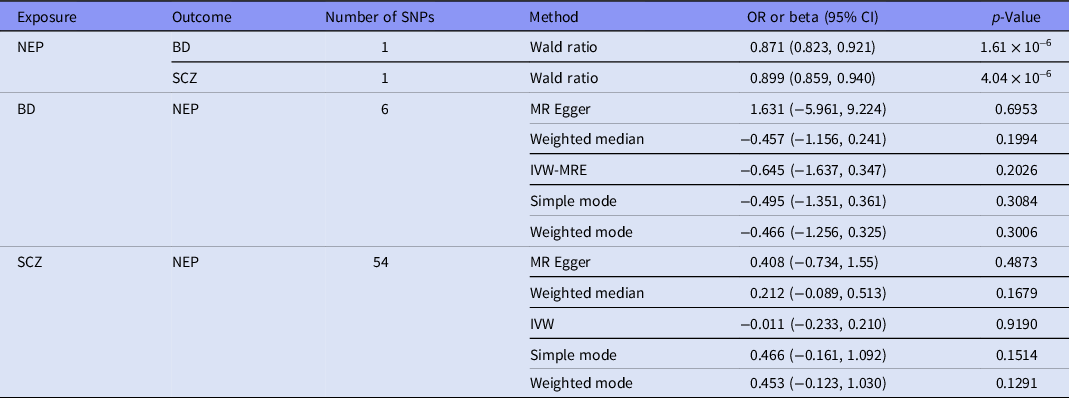
All instrumental variables for NEP protein, BD, and SCZ were sufficiently informative (F statistic > 10) for MR analyses. For the causal effects of NEP protein on BD and SCZ, due to only one instrument variable remains after filtering, we only conducted the two-sample MR analysis by using the Wald ratio method. Based on the Wald ratio method of MR analysis, we found an association between genetically predicted levels of NEP protein (exposure), BD (outcome) (OR = 0.87, 95% confidence interval (CI) = 0.82, 0.92, p value = 1.61 × 10⁻⁶) and SCZ (outcome) (OR = 0.90, 95% CI = 0.86, 0.94, p value = 4.04 × 10⁻⁶) (Table 2). However, we did not observe associations between genetically predicted levels of BD, SCZ (exposure), and NEP protein (outcome) (Table 2). The overall results of the two-sample bidirectional MR analysis were summarised in Table 2.
The two-sample bidirectional MR analysis results for the association between BD, SCZ, and NEP protein

MR, Mendelian randomization; BD, bipolar disorder; SCZ, schizophrenia; OR, odd ratio; CI, confidence interval; IVW, Inverse variance weighted; MRE, multiplicative random effects.
The heterogeneity test for BD suggested that p Cochran’s Q of MR Egger and IVW < 0.05. Therefore, we used IVW method in a MRE model to evaluate the causal effect of BD on NEP protein.
Discussion
We conducted a systematic genetic correlation scan between BD, SCZ, and each of the 92 plasma neurological proteins. We identified one plasma neurological protein, NEP, showing suggestive genetic correlation evidence with BD and SCZ after strict Bonferroni correction. The two-sample MR analysis also found that NEP protein had a causal relationship with BD and SCZ. Those findings may provide novel insights into the pathogenesis and biomarkers studies of BD and SCZ.
It is interesting that NEP was identified as a candidate neurological protein for both BD and SCZ by LDSC analysis. Hillary et al. identified a sole independent trans pQTL (rs4687657) for NEP annotated to the ITIH4 gene, as well as two trans genome-wide significant CpG sites (cg11645453 and cg18404041 annotated to ITIH4 and ITIH1, respectively) (Hillary et al., Reference Hillary, Mccartney, Harris, Stevenson, Seeboth, Zhang, Liewald, Evans, Ritchie, Tucker-Drob, Wray, Mcrae, Visscher, Deary and Marioni2019). It has been reported by a previous study that the SNP rs4687657 has been involving with lower methylation levels of cg18404041 (ITIH4) and higher DNA methylation levels of cg11645453 (ITIH1) (Gaunt et al., Reference Gaunt, Shihab, Hemani, Min, Woodward, Lyttleton, Zheng, Duggirala, Mcardle, Ho, Ring, Evans, Davey Smith and Relton2016). Previous studies have suggested that epigenetic mechanisms such as gene-specific DNA methylation and posttranslational histone modifications may play an important role in the emergence of major psychosis, such as BD and SCZ, and identified some common epigenetic modification patterns among the two diseases (Gürel et al., Reference Gürel, Kuşçu, Yavaşoğlu and Biray Avcı2020). For example, Nohesara et al. have summarised a great number of DNA methylation alterations in SZ and BD which involved in the regulation of brain functions such as neurogenesis, synaptic plasticity, and neurotransmitter delivery (Nohesara et al., Reference Nohesara, Ghadirivasfi, Mostafavi, Eskandari, Ahmadkhaniha, Thiagalingam and Abdolmaleky2011, Pai et al., Reference Pai, P., Killinger, Marshall, Jia, Liao, Petronis, Szabó and Labrie2019). Those evidence indicated that the expression of NEP, ITIH1, and ITIH4 may be co-regulated, involving the inverse effects between NEP and ITIH1 with ITIH4 (Sun et al., Reference Sun, Maranville, Peters, Stacey, Staley, Blackshaw, Burgess, Jiang, Paige, Surendran, Oliver-Williams, Kamat, Prins, Wilcox, Zimmerman, Chi, Bansal, Spain, Wood, Morrell, Bradley, Janjic, Roberts, Ouwehand, Todd, Soranzo, Suhre, Paul, Fox, Plenge, Danesh, Runz and Butterworth2018). A combined GWAS analysis of SCZ and BD have yielded strong evidence for SNPs in the region of NEK4-ITIH1-ITIH3-ITIH4 associated with the two diseases (Sklar et al., Reference Sklar, Ripke, Scott, Andreassen, Cichon, Craddock, Edenberg, Nurnberger, Rietschel, Blackwood, Corvin, Flickinger, Guan, Mattingsdal, Mcquillin, Kwan, Wienker, Daly, Dudbridge, Holmans, Lin, Burmeister, Greenwood, Hamshere, Muglia, Smith, Zandi, Nievergelt, Mckinney, Shilling, Schork, Bloss, Foroud, Koller, Gershon, Liu, Badner, Scheftner, Lawson, Nwulia, Hipolito, Coryell, Rice, Byerley, Mcmahon, Schulze, Berrettini, Lohoff, Potash, Mahon, Mcinnis, Zöllner, Zhang, Craig, Szelinger, Barrett, Breuer, Meier, Strohmaier, Witt, Tozzi, Farmer, Mcguffin, Strauss, W., Kennedy, Vincent, Matthews, Day, Ferreira, O’dushlaine, Perlis, Raychaudhuri, Ruderfer, Lee, Smoller, Li, Absher, Bunney, Barchas, Schatzberg, Jones, Meng, Thompson, Watson, Myers, Akil, Boehnke, Chambert, Moran, Scolnick, Djurovic, Melle, Morken, Gill, Morris, Quinn, Mühleisen, Degenhardt and Mattheisen2011, Witt et al., Reference Witt, Juraeva, Sticht, Strohmaier, Meier, Treutlein, Dukal, Frank, Lang, Deuschle, Schulze, Degenhardt, Mattheisen, Brors, Cichon, Nöthen, Witt and Rietschel2014). Finseth et al. observed a new association between ITIH3/4 region and suicide attempt in a group of patients combined with SCZ and BD (Finseth et al., Reference Finseth, Sønderby, Djurovic, Agartz, Malt, Melle, Morken, Andreassen, Vaaler and Tesli2014). By using a transmission disequilibrium test in 65 Han Chinese families, the researchers have confirmed a SCZ susceptibility locus on 3p21.1 which encompass the multigenetic region NEK4-ITIH1-ITIH3-ITIH4 (Li et al., Reference Li, Shen, Chen, Huai, Huang, Wu, Yang, Ma, Zhou, Du, Fan, He, Wan and Qin2020). Given that variants in NEP are related to DNA methylation of the susceptibility gene in BD and SCZ, further functional studies are needed to explore its role in the pathogenesis of BD and SCZ.
Two-sample bidirectional MR analysis was conducted to evaluate the genetic correlation direction between NEP protein, BD and SCZ identified by LDSC. It is worth noting that the instrumental variable (rs35004449) selected for estimating causal effects of NEP protein on BD and SCZ is a ‘trans’ SNP for NEP. Although it is GWAS significant for NEP protein and independent of other SNPs, it is not located in the known coding region for NEP, but in the ITIH4 coding region, whereas NEP is coded by the MME gene. According to the previous study, MR results from analysis of trans SNPS are at particular risk of pleiotropy (e.g. genetic confounding) and typically have weaker effect size and less direct effect, hence are more prone to violate MR assumptions (Porcu et al., Reference Porcu, Rüeger, Lepik, Agbessi, Ahsan, Alves, Andiappan, Arindrarto, Awadalla, Battle, Beutner, Jan Bonder, Boomsma, Christiansen, Claringbould, Deelen, Esko, Favé, Franke, Frayling, Gharib, Gibson, Heijmans, Hemani, Jansen, Kähönen, Kalnapenkis, Kasela, Kettunen, Kim, Kirsten, Kovacs, Krohn, Kronberg-Guzman, Kukushkina, Lee, Lehtimäki, Loeffler, Marigorta, Mei, Milani, Montgomery, Müller-Nurasyid, Nauck, Nivard, Penninx, Perola, Pervjakova, Pierce, Powell, Prokisch, Psaty, Raitakari, Ripatti, Rotzschke, Saha, Scholz, Schramm, Seppälä, Slagboom, Stehouwer, Stumvoll, Sullivan, ‘t Hoen, Teumer, Thiery, Tong, Tönjes, van Dongen, van Iterson, van Meurs, Veldink, Verlouw, Visscher, Völker, Võsa, Westra, Wijmenga, Yaghootkar, Yang, Zeng, Zhang, Arindrarto, Beekman, Boomsma, Bot, Deelen, Deelen, Franke, Heijmans, ’t Hoen, Hofman, Hottenga, Isaacs, Bonder, Jhamai, Jansen, Kielbasa, Lakenberg and Luijk2019). Our results might indicate that perhaps it is not genetically predicted NEP itself that influence the risk of BD and SCZ, rather something else related to ITIH4 that also influences NEP. Thus, the findings of this study should be applied with much greater caution. It has been reported that some regulatory SNPs, such as transcription factor binding regions and chromatin interactive regions of ITIH4, were involving the genetic mechanism of BD (Qi et al., Reference Qi, Wen, P., Liang, Cheng, Ma, Cheng, Zhang, Liu, Kafle and Zhang2020). Combining with the results of LDSC, NEP may be targeted for early diagnosis and treatment of BD and SCZ. However, due to other significant cis-SNPs located within the MME gene is not available, further researches are needed to verify this direct or indirect causal association.
NEP, also known as MME, is a neutral endopeptidase that cleaves peptides at the amino side of hydrophobic residues and inactivates several peptide hormones including enkephalins, glucagon, neurotensin, bradykinin, and oxytocin. We observed suggestive genetic correlation and causal relationship between NEP protein with both BD and SCZ, which is consistent with previous studies that BD and SCZ shared common genetic mechanism (Ripke et al., Reference Ripke, O’dushlaine, Chambert, Moran, Kähler, Akterin, Bergen, Collins, Crowley, Fromer, Kim, Lee, Magnusson, Sanchez, Stahl, Williams, Wray, Xia, Bettella, Borglum, Bulik-Sullivan, Cormican, Craddock, De Leeuw, Durmishi, Gill, Golimbet, Hamshere, Holmans, Hougaard, Kendler, Lin, Morris, Mors, Mortensen, Neale, O’neill, Owen, Milovancevic, Posthuma, Powell, Richards, Riley, Ruderfer, Rujescu, Sigurdsson, Silagadze, Smit, Stefansson, Steinberg, Suvisaari, Tosato, Verhage, Walters, Levinson, Gejman, Kendler, Laurent, Mowry, O’donovan, Owen, Pulver, Riley, Schwab, Wildenauer, Dudbridge, Alexander, Holmans, Shi, Albus, Campion, Cohen, Dikeos, Duan, Eichhammer, Godard, Lerer, Hansen, Liang, Maier, Mallet, Nertney, Nestadt, Nestadt, Norton, O’neill, Papadimitriou, Ribble, Sanders, Silverman, Walsh, Williams, Wormley, Arranz, Bakker, Bender, Bramon, Collier, Crespo-Facorro, Hall and Iyegbe2013, Lichtenstein et al., Reference Lichtenstein, Yip, Björk, Pawitan, Cannon, Sullivan and Hultman2009). Neurotensin is a neuropeptide that has been implicated in the biology of SCZ by modulating dopaminergic and other neurotransmitter systems (Perreault et al., Reference Perreault, Hasbi, Alijaniaram, Fan, Varghese, Fletcher, Seeman, O’dowd and George2010, Wolf et al., Reference Wolf, Hyde, Saunders, Herman, Weinberger and Kleinman1995). It has been reported that neurotensin receptor agonists have the capacity to be used as novel therapeutic strategy for the treatment of SCZ (Boules et al., Reference Boules, Shaw, Fredrickson and Richelson2007).
The advantages of current study are that because of using GWAS summary statistics, the findings should not be easily affected by environmental confounding factors. In addition, some limitations of our study should be noted. First, the main objective of current study is to detect the genetic correlations between plasma neurological proteins, BD and SCZ, and to discover novel candidate neurological proteins related to BD and SCZ. Further functional experimental researchers are warranted to validate the results and clarify the potential genetic mechanisms of NEP protein in the development of BD and SCZ. Secondly, the GWAS summary statistics used in the current study are all from European populations; thus, the study results should be applied to other ethnic groups with caution. In addition, the sample size for the GWAS used for neurological proteins is extremely small and so highly likely to be underpowered to detect all but the genetic variants with the strongest signals, it may at present preclude an informative LDSC and MR study examining genetic similarity between neurological proteins and mental disorders. Thirdly, after strict multiple testing correction, the significant threshold should be P < 2.72 × 10⁻⁴ (0.05/184). Unfortunately, according to our results, the NEP protein identified in this study shows suggestive association with the BD and SCZ. So, our results should be interpreted carefully.
In summary, by applying the widely used genetic approach, we conducted a combination of LDSC and two-sample bidirectional MR analysis to explore the genetic correlations and causal associations between neurological proteins, BD and SCZ. Our study identified one candidate neurological proteins showing suggestive association signal and potential causal relationship with both BD and SCZ. The findings may provide new ideas for future research on the pathogenesis of BD and SCZ and understanding the genetic effects of neurological proteins on BD and SCZ.
Supplementary material
For supplementary material accompanying this paper visit https://doi.org/10.1017/neu.2022.10
Data availability statement
All of the data analyzed in this study were downloaded from the Internet.
Acknowledgements
None.
Author contributions
HM, SC and FZ conceived and designed the study and wrote the manuscript; HM, SC and FZ collected the data and carried out the statistical analyses; CL, BC, LL, XL, PM, YY, CP, JZ, HZ, YC, ZZ, YW and YJ made preparations for the manuscript at first.
Financial support
This study is supported by the National Natural Scientific Foundation of China (81922059) and the Fundamental Research Funds for the Central Universities.
Conflict of interest
None.
Ethical statement
There is no ethical statement here because of all the data downloaded from the Internet.