Coronavirus disease 2019 (COVID-19) is an ongoing global pandemic caused by severe acute respiratory syndrome coronavirus-2 (SARS-CoV-2), and more than 200 countries or territories around the world have been facing with COVID-19 pandemic. The disease was reported on December 31, 2019, with a report of 27 cases of pneumonia of unknown etiology in Wuhan, China. Reference Sharma, Tiwari and Deb1 Due to the COVID-19 outbreak, health-care systems in the most countries faced critical situations and unique challenges in controlling the outbreaks and providing care to patients with COVID-19. However, COVID-19 as an emerging disease is not yet fully understood by physicians, nurses, and scientists. There are also many unknown dimensions of SARS-CoV-2 and its pathogenicity, incidence, and resistance to existing drugs. Reference Araf, Faruqui and Anwar2
Global crises, especially ongoing viral pandemics, require rigorous response at different levels of global, national, regional, and local. Given that the distribution of resources, per capita income, and countries’ approach to health care are not the same, countries may take different measures to combat a crisis. In low-income countries, minimal resources when the COVID-19 pandemic occurred led to a more catastrophic situation. However, the global experience showed that high-income countries may also encounter a catastrophic situation in the pandemic such as COVID-19. Reference Di Gennaro, Pizzol and Marotta3 It must be admitted that crises are mainly unpredictable, and each one is unique in nature. Despite this fact, when a crisis occurs, the prior experience from other similar events can be useful for crisis management. Reference Hetu, Gupta and Vu4
Management of health-care systems is usually based on normal structures and conditions. The occurrence of a health crisis challenges the routine activities and decision-making of the health-care organization. Reference Jakovljevic, Bjedov and Jaksic5 However, in response to crises and threats to public health, the demands of society are rapidly increasing. Reference Krausz, Westenberg and Vigo6 The COVID-19 pandemic has imposed difficult conditions for governments in making proper decisions and controlling the crisis. Accordingly, even large-scale decisions at the national level were changed periodically. Reference Djalante, Lassa and Setiamarga7 The most common health-care deficiencies in responding to the COVID-19 pandemic are the lack of centralized, intelligent, and reliable screening, weakness in the referral system, inadequate monitoring, lack of capacity to provide integrated care and lack of planning based on situation analysis. Reference Krausz, Westenberg and Vigo6 Moreover, confusion, delay in practical intervention, lack of effective response, poor coordination, and lack of integrated management have been reported as the common managerial challenges in fighting the COVID-19 pandemic. Reference Tekola, Myers and Lubroth8,Reference Razu, Yasmin and Arif9
According to the official report of the World Health Organization (WHO), Iran was one of the first countries after China affected by the COVID-19 pandemic. Reference Nikpouraghdam, Jalali Farahani and Alishiri10 The COVID-19 pandemic requires managing the crisis and controlling the spread of the SARS-CoV-2 in the community. The first outbreak of COVID-19 in Iran was reported February 19, 2019, from Qom city and gradually spread to other cities such as Tehran, Arak, Rasht, Gorgan, Ardabil, and other provinces. Reference Ghadir, Ebrazeh and Khodadadi11 According to the latest official statistics dated February 21, 2021, of the population of 84 million people in Iran, 1,574,012 people have been diagnosed with COVID-19 and 59,483 people have lost their lives. In Iran, health system, treatment, and medical education are managed by the medical universities in each province, which are under the supervision of the Ministry of Health and Medical Education. Reference Rahmanian, Bokaie and Haghdoost12 Ardabil province is located in the northwestern of Iran, and according to the latest National Statistical Center, Ardabil province has a population of 1,270,420 people. 13
There is currently no single effective way to prevent the spread of SARS-CoV-2 in the world, but confirmed data suggest that effective crisis management, disease prevention, and home-based quarantine and immediate vaccination can decrease the number of incidences. 14 The present study was conducted with the aim of explaining crisis management strategies during the COVID-19 pandemic in Ardabil province.
Methods
This research used a qualitative method to explain the management strategies to control COVID-19 pandemic crisis in Ardabil Province, Iran. Through purposive sampling, 12 managers and officials working in the hospitals and health-care centers were recruited to the study. The province high level health-care managers were invited by telephone to participate in the interview. After the initial agreement, the interviews were conducted at the workplace of the participants. Inclusion criteria were having direct responsibility or experience in organizations working to control the COVID-19 crisis, expressing informed consent to participate in the interview, and the ability to narrate the experiences.
In-depth semi-structured interviews were used to collect data. The first and opening question was an open-ended question: “Please tell me about the management of COVID-19.” Then, more structured questions were used to collect purposive data such as: “Tell me about your experiences in planning to fight the Coronavirus pandemic.” The interviews continued until data saturation and the formation of a comprehensive image of the experiences of dealing with the COVID-19 crisis management. Moreover, participants’ answers to the primary questions were used as a guide for the next questions. The subsequent questions were used for more details and further explanation of the initial themes.
Inductive qualitative content analysis introduced by Elo and Kyngäs was used for data analysis. This method has 3 stages, including preparation, organization, and reporting. Reference Elo and Kyngäs15 Data analysis was performed using MAXQDA-10 software. The audio-taped data were immediately transcribed into plain texts verbatim. Researchers reviewed the texts several times and reflected on each word, phrase, and sentence. At first phase, open coding was performed to extract the primary meanings or messages of the interviews. Progressively, the initial codes were identified and through the subsequent reflective process condensed to the primary categories. After the emergence of the primary categories, the similar or related categories were grouped under higher order or generic categories. Ultimately, the main categories emerged through the process of abstraction. Reference Elo and Kyngäs15 Table 1 represents more description of the phases of this study and the researchers’ activities during each phase.
Phases of the study and the researchers’ activities during each phase

Trustworthiness
The Guba and Lincoln’s criteria were used to improve and ensure the trustworthiness or validity of this study. For this purpose, some activities were used. First, key informant participants were selected for data collection. Furthermore, long-term engagement with participants, data collection triangulation through recording interviews, taking field notes, simultaneous data collection and analysis, detailed descriptions, audit trial, rich documentation, and member check of the extracted themes with the participants were strategies that promoted trustworthiness in the current study. Reference Merriam and Tisdell16,Reference Polit and Beck17
Results
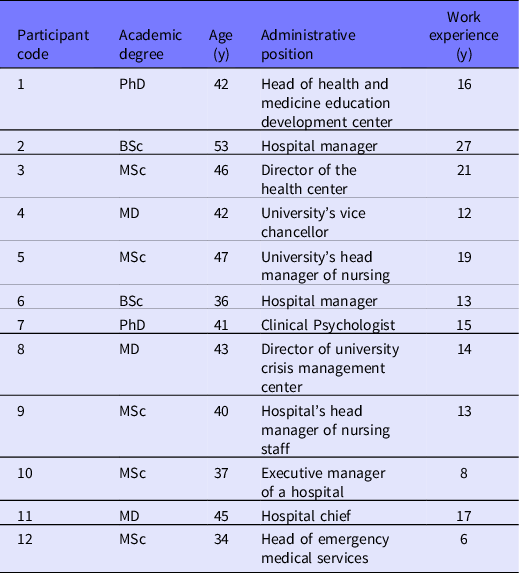
The average age of the participants was 42.2 y. Two-thirds of the participants were males; 33.30% were females (Table 2). The results of qualitative content analysis led to the emergence of 9 categories, including prior preparation for the COVID-19 crisis; challenges and management of workforce shortages; benefiting from the participation of volunteer staff; challenges and strategies for physical space, supplies, and personal protective equipment (PPE); designation of referral centers for COVID-19 patients; protocolized patient transport; benefiting from donations and charity support; management of information about COVID-19 disease and learning from early stages of crisis.
Demographic characteristics of the participants

Prior Preparation for the COVID-19 Crisis
The establishment and conducting of the COVID-19 management center has been introduced by the participants as the cornerstone of the health-care system to respond the COVID-19 crisis. Participant 4 said: “Following the news of the coronavirus outbreak in China and before its spread in Iran, we health managers came together to make some crucial decisions to be prepared for the pandemic.” With the official confirmation of the COVID-19 outbreak, decision-making policies have shifted toward coordination and organized activities in the health centers. Participant 3: “In the early days of the COVID-19 pandemic, the immediate priorities were determined, including social distancing, early detection, isolation and treatment, and community education through the media.” Moreover, the majority of the participants emphasized on solidarity as a main principle of coordination and preparation against the COVID-19. Participant 8 said: “One of our greatest achievements was our solidarity in all parts of the health system, which led to excellent coordination.” Participant 12 said: “Based on the last evidences, guidelines were developed and communicated for use in homes, offices, and public spaces.”
Challenges and Management of Workforce Shortages
Data analysis showed that workforce shortage was a vital demand during the COVID-19 pandemic following the increase in referrals to medical centers. Participant 10: “The biggest challenge was personnel shortages, when patients rushed to the medical centers at once.” One of the challenging issues regarding workforce management was the staff’s fear of getting the disease from patients. Participant 5: “The biggest problem for our staff was fear of COVID-19, which exacerbated the staff shortage crisis.” Participant 9 said in an interview: “Due to the nature of the crisis, the staff families often tried to avoid the staff from going to work.” Participant 7: “In the conflict between managers and staff families, convincing them has been a difficult process.”
In addition, the incidence of COVID-19 among staff was another barrier for managing staff that profoundly influenced patient care process. Participant 5: “Staff with positive test needed long-term quarantine, for at least two weeks, which kept them out of work.” Another major factor in terms of workforce shortage was the prolongation of the crisis. Participant 6: “Due to the staff shortages, a large number of nurses were kept at the hospital for two months because of consecutive work shifts that led to fatigue and exhaustion among them.” Managers emphasized that their first strategy for managing the shortage of workforce was to overcome the pervasive fear through novel strategies. “Along with the general fear of Corona, we have selected and identified volunteers and encouraged them, which has greatly diminished the feeling of resistance,” said the university’s director of nursing workforce. In addition, “we first tried to convince the experienced nurses to work in COVID-19 settings. When they got to work, the others came.” Another strategy was to consider financial incentives. Participant 12: “Financial incentives were also considered to make it attractive.” Participant 3: “Incentives include: financial incentives, written incentives, and special payments.”
Benefiting From the Participation of Volunteer Staff
Recruiting of volunteers and recalling inactive health workers were effective methods used to compensate staff shortages. For example, Participant 10: “After an excessive workforce shortage, complementary personnel were allowed to be recruited.” Participant 2 said: “A number of students and faculty members came to the medical centers as volunteers and they were very helpful in feeding and accompanying the patients,” said the director of a hospital. Participant 9: “We had a group of 25 clergymen at our center who helped feed patients and their general needs.” Participant 5: “The presence of clergymen who were very helpful both mentally and in helping patients and reducing staff workload.” Participant 5: “We transported clinical personnel from small towns in the province that had fewer workloads to bigger cities.”
Challenges and Strategies for Physical Space, Supplies, and PPE
One of the main challenging areas in the management of the COVID-19 crisis was related to the provision of space, supplies, and PPE. Participants acknowledged that the lack of physical space, equipment, and PPE was a major logistical challenge in the fight against COVID-19.
In terms of providing the physical space and capacity for patients with COVID-19, managers pointed to these challenges. Participant 6: “A new hospital was set up and had to be equipped and supplied within 24 hours.” Participant 2: “In our center, 12 intensive care beds with ventilators were prepared and set up in a short time, which is really difficult.” Another challenge in this area was the evacuation of the hospital, which required the discharge of elective and nonemergency patients to create sufficient capacity. Participant 5: “We had to evacuate the hospital and it had to be done within 2 hours.”
“We have had tremendous challenges in providing PPE,” said the director of the University Crisis Management Center. In addition, ensuring the proper and standard operation of PPE was another major challenge raised by the participants. Participant 3: “What criteria did we have to check the proper functioning of PPE?” Participant 5: “Non-standard masks could easily cause the disease to the personnel.” Opinions differ on the cause of the initial shortage of PPE and devices; “If we had been more aware and informed faster, we could have insured ourselves by providing equipment,” said Participant 10. On the other hand, some have another opinion. Participant 12: “The forecast was made, but because we did not have much liquidity, we had difficulty preparing it.” Other than the reasons given, the other participants stated that the reason for the initial surprise was: “We do not have anything to save for emergencies,” said Participant 9, and Participant 12 added: “The biggest problem is that we do not have the ability to store or back up financial resources and equipment.”
Participants stated that special planning and flexibility were provided to overcome the challenges associated with physical space, equipment, and PPE. “First of all, we monitored the number of daily visits and hospitalizations and predicted future events. For example, what should we have done if 300 patients needed hospitalization? What should we have done if there were 400 patients?” said Participant 11. Participant 2: “Planning was done in the province in such a way that we always had an unused ward ready to receive or transfer patients. And this was usually the closest ward to the last active ward in the same hospital.” “If the capacity of one hospital was completed, it would be ready for admission according to the next hospital plan,” said the deputy director of treatment. Some measures were taken on a large scale at the university in province, “In addition to the physical space of the hospitals, we have equipped sheds that can be used if the hospitals are full. However, due to the lack of need, it was only used as a convalescent home,” said the provincial director of crisis and emergency services.
An important strategy was to rebuild used tools and equipment, which had positive effects in this critical situation. “We already had permission for all the university’s demolition equipment to be given to the emergency services. In this way, the equipment was repaired and ready for use on a low budget. We prepared a hundred beds in this way,” said Participant 12.
One of the most effective ways to deal with the COVID-19 pandemic was cross-sectoral coordination and cooperation with other institutions. One of the auxiliary institutions was the police force, which was emphasized by participant 4: “For the quarantine of patients, the police force provided us with a hall and we took care of its equipment and personnel.” Elsewhere, they said, “We prepared the Azad University dining hall with 100 beds due to its close proximity to the COVOD-19 referral hospital, and connected it to the main building of the hospital through a corridor.”
As the results show, various strategies have been used in the field of supply and management of PPE and devices. “As soon as the coronavirus outbreak was announced, accurate statistics were provided through the consumption curve with analysis by the Nursing Office and the Quality Improvement Office,” participant 1 told me about consumption management in educational and medical centers. In the distribution dimension, the centralized management method was used, participant 5: “The responsibility of delivering and distributing PPE was transferred to the province emergency center. This center distributed the equipment based on the level of exposure in the medical centers.”
Participants emphasized that preparedness to deal with known health crises similar to the crisis of COVID-19 was an important factor in equipment management in the current crisis. “Our previous preparation for the flu helped us a lot to get the equipment we needed for the initial response,” said participant 6.
Due to the increase in consumption and the severe shortage of equipment and consumables in the early phase of the crisis, a basic strategy has been to empower managers to supply equipment in unusual ways. “One of the positive decisions was that all centers and units were empowered to use all possible means to provide PPE, even outside of administrative principles and procedures,” said participant 11. The next step was to guide donors to provide the equipment needed for the corona crisis. “People’s contributions and donations, and even previously available resources, have been diverted to control of SARS-CoV-2,” said one of the city’s crisis managers. Another measure was to divert the products of some factories, especially textile factories, to equipment needed for the corona crisis, such as masks. “The necessary coordination was done through the governor’s office, and the textile factory started to produce masks and special protective clothing,” said participant 3.
To provide physical space, one of the strategies has been to create a convalescent home. Accordingly, participant 9 said “Two observatories were prepared for patients”; participant 10said “Patients were transferred to the observation post after discharge and in the absence of managed care at home to be monitored and monitored.”
Designation of Referral Centers for COVID-19 Patients
The experience of managers involved in coronavirus crisis management showed that the allocation of special hospitals was a vital strategy in response to COVID-19 disease. Participant 8: “In large cities, referral hospitals were identified and isolated very early to prevent contamination of other health care departments.” In small towns, the separation plan is implemented differently. Participant 4: “For cities that had only one hospital, the separation of the COVID-19 department took place within the hospital,” said the director of a city hospital. Measures were also taken to separate patients before admission to the emergency department. Participant 11: “Initial additional triage was deployed before the patient entered the emergency department and triage so that patients with COVID-19 could not come into contact with other patients.” One strategy was to conduct new inpatient wards based on newly emerging needs due to Covid-19. “For pregnant cases with COVID-19 who needed Normal Vaginal Delivery or Cesarean section, a special ward was set up at the Coronavirus Referral Center with the NICU for newborns,” said participant 5.
From the participants’ point of view, restrictions were used on the entrance of patients’ families to the coronavirus ward. “Accompanies were not allowed to enter, and the equipment brought by the patients’ families was delivered, packaged, and disinfected by a specific person and then transported to the ward,” said participant 2. In addition to these standards, space and equipment disinfection have also been considered. “The hospital environment was completely disinfected three times a day,” one participant said.
Given the direct exposure of clinical staff, the need to isolate them was also critical. For this purpose, accommodation conditions were provided for the personnel who were working in the inpatient wards of COVID-19. It was necessary to provide isolated accommodation, both to prevent further outbreaks and to reassure staff. Participant 3: “One of the requests of the clinical staff of the boarding house was that, with the coordination of the governorate, a boarding house with suitable facilities for the use of the clinical staff be determined.”
Protocolized Patient Transport
Based on the participants’ experiences, one of the helpful strategies in management of COVID-19 crisis has been to learn from other leading provinces involved in the COVID-19 epidemics. One of the members of the Coronavirus Crisis Committee emphasized on the important role of learning from the experiences of other cities and provinces, participant 8: “The situation in neighboring provinces was monitored in person and reported to the university and the governor’s office. The data was used in crisis management planning.” One area in which the experiences of others were used was the transfer of patients with COVID-19. “At the beginning of the outbreak, patient transport was not principled,” said participant 12: “Therefore, the personnel of the emergency centers, after the training course, professionally took the responsibility of transporting the infected patients in each city.” According to this, “The establishment of a special center for COVID-19 in medical emergencies was done before the national instructions in Ardabil.”
In times of crisis, people need guidance. “The 190-telephone system, which was under the control of the Ministry of Health, was handed over to the provincial capitals during the crisis,” said the director of the Emergency Medical Center. To guide the people, participant 7: “Faculty members and experienced personnel were used as volunteers.” “Faculties, nurses, midwives, environmental health, etc. were professionally answering the questions of the people of the province.” said participant 1
Benefiting From Donations and Charity Support
Another way to deal with the COVID-19 crisis was to attract the support of health donors and charity institutions. This strategy was recognized as really helpful, while the budget was limited. “The involvement of the donors has been very effective. Both in providing the equipment and in motivating the staff,” said one hospital manager. The donors’ participation has been both financially and in the field. Participant 6 said: “They would take a list of supplies from us and then bought equipment such as: ventilator, CPAP, and PPE. They acted really smart and purposeful.” Sometimes, “donors sent gifts to staff at medical centers to make them motivated,” said a hospital manager. In addition, the staff themselves conducted charitable work, participant 9: “The staff themselves also performed actions to boost confidence, for example, spontaneously and sincerely accepting the cost of a meal for their co-workers.” For the participants, these behaviors created a good atmosphere and were very effective in boosting morale.
Management of Information About COVID-19
The participants emphasized on the important role of the Internet in facilitating communication and coordination between managers. Participant 1: “The possibilities of the Internet were used to coordinate with managers and provide quick instructions.” This feature also facilitated the conditions at the implementation levels. Participant 11: “Formal instructions and guidelines received and followed through the Internet.” Participant 10: “We were receiving reports of the preparations continuously,” said the director of the provincial nursing office. Cyberspace has facilitated the necessary conditions for communication in these special circumstances. Participant 11: “Virtual communication of managers with officials and clinical staff continued.”
Learning From the Prior Stages of Crisis
Managers highlighted that the intensification and recurrence of the COVID-19 crisis outbreaks was a common concern that required prospective decision-making in the early stages. “We have to be prepared for the next phases of crisis and the lessons we learned are so important for the next phases of crisis” said participant 4. In addition, participant 7 stated: “My view is that the crisis will not finish and will continue, with only a difference in the sensitivity of the people, so we need to work with the public to keep them active against the Coronavirus.”
Participants stated that they had been thinking about planning since the early stages of the crisis. “From early phases of crisis, an epidemic management training program was held to identify the needs of the future to provide greater efficiency for operational managers,” said participant 10. Regarding the quality of care for patients in need of intensive respiratory care, the relevant director stated: “In the scientific committees of the crisis, maneuvers are carried out to review scientific experiences and findings.”
Discussion
This qualitative study explored the experiences of health managers to reveal the strategies or policies that have been used to respond to the outbreak of COVID-19. Data analysis showed that the initial reaction of WHO to COVID-19 as a global public health emergency, was a turning point in response to COVID-19 crisis management. Reference Advincula, Dizon and Chen18,Reference Dhawan19 Health managers had been assumed the rapid outbreak of the coronavirus to be a public health emergency, describing it in terms such as emergency, surprise, shock, or general fear for people and even medical personnel. The findings showed that health managers have considered the primary epidemics as global health crises when the first warning was issued by the World Health Organization (WHO). Reference Advincula, Dizon and Chen18 Previous studies have similarly highlighted that the right understanding of COVID-19 as a severe contagious disease is central to adopt proper response and protective behaviors by the public and health system. Reference Boin, Lodge and Luesink20,Reference Poortaghi, Shahmari and Ghobadi21
Based on the current study, workforce management has been one of the main challenges in provision of clinical care for patients with COVID-19. In this regard, the fundamental strategies have been used to deal with the workforce shortage were recruiting, training, development, and retention of personnel. These findings are consistent with the results of previous studies. Reference Khalid and Ali22,23 The most important challenges of workforce management were workforce shortage, fear of getting COVID-19 and getting out of service, and exhaustion of staff due to prolonged crisis. Strategies such as using a volunteer workforce, considering physical and spiritual incentives, and transferring forces from less involved areas, and most importantly, creating an atmosphere of solidarity among staff have been effective solutions to combat crisis-related workforce shortages. Similarly, a study from Iran has reported similar strategies which had been effective in workforce management including recruitment of volunteer workforces, flexible work schedule, rearrangement of workforce, motivational measures, and psychological support. Reference Poortaghi, Shahmari and Ghobadi21,Reference Li, Hou and Kang24 Moreover, in the United States, the employment of retired physician volunteers and nurses, as well as undergraduate medical students, have been cited as strategies for workforce compensation. Reference Dey, Cheng and Tan25 Another study highlighted financial and psychological support during prolonged crises. Reference Iqbal and Chaudhuri26 Numerous studies have mentioned managerial characteristics such as charisma and ability to influence, effective communication skills, and building trusting relationship with staff. Reference Al Eid and Arnout27 Moreover, management of negative emotions of personnel during the early stages of the COVID-19 outbreak has been reported as a crucial activity that would be accomplished by the health managers. Reference Sun, Wei and Shi28
Use of nursing students, volunteer workforces, and recalling inactive health workers were extra strategies related to the workforce management. Due to the fact that a large number of new workforces were recruited and rushed to the aid of hospital staff, they needed special training to provide appropriate care for COVID-19 patients. Therefore, personnel training, especially for new ancillary workforces, was of special importance. Similarly, Bourgeault and et al. emphasized on recruitment of volunteer health professionals particularly retired workers, last-year nursing students, and inactive health workers as strategies for workforce shortage compensation. Reference Bourgeault, Maier and Dieleman29 Given that COVID-19 is a new phenomenon with unknown aspects, Reference Brinks and Ibert30 hospital staff also needed to acquire updated and evidence-based knowledge. Reference Khalid and Ali22
One of the challenges of the health system during COVID-19 was the lack of medical equipment, particularly PPE, mechanical ventilator, surgical gown, gloves, and masks. According to a study by Iqbal and Chaudhuri in the United Kingdom, two-thirds of health professionals believed that insufficient PPE was a serious challenge during the early stages of COVID-19 pandemic. Reference Iqbal and Chaudhuri26 Due to the fact that the lack of medical equipment, especially PPE, can endanger public health and hospital staff during health-care service provision, it requires special resource management. Reference Advincula, Dizon and Chen18 Despite the initial shortage, the current study revealed that centralized management of available resources, resource allocation by consumption analysis, staff training on how to properly use PPE, supporting of producers to deliver PPE, and cooperation with the governmental agencies have been very effective in management of medical supplies and equipment during COVID-19 pandemic.
Findings of the present study emphasized on designating of referral and specialized centers both at primary level of health-care provision and at the hospital. Allocation and designation of special referral hospitals was an effective approach to manage COVID-19 patients during the early phases of the COVID-19. Reference Jamaati, Dastan and Esmaeili Dolabi31 Based on a survey in Jakarta, in addition to the deployment of primary interventions, such as handwashing, public education, patient screening, use of PPE, distancing and etc., referral specialized hospitals played a crucial role in the management of patients with COVID-19. Reference Silalahi, Hidayat and Dewi32 Adherence to infection control guidelines, employee movement control, immediate screening, patient isolation, and patient management have been highlighted as the main measures to control contagious diseases such as COVID-19 in hospital. Reference Pham, Tahir and van de Wijgert33,Reference Shamshiri, Fuh Suh and Mohammadi34 Comprehensive Hospital Preparedness Checklist for COVID-19 can also be used for hospitals’ readiness to provide an effective care for COVID-19. 35
As the results showed, the field activity of managers and activating the capacity of societies were effective strategies for overcoming the COVID-19 crisis. In the present study, the capabilities of charity institutions and health volunteers were reported as financial resources to combat with COVID-19. The National Institutes of Health has assigned more than 300 roles to health volunteers as they make a significant contribution to the health and well-being of the community by using their time, skills, and expertise to support health promotion programs. 36 In crisis events, when the need for workforce and financial assistance increases, it is necessary to use the capacity of volunteers and health charities. It is important to note that volunteers are not a substitute for skilled professionals and should be used under supervision. Reference Peyravi, Soltani and Ahmadi37
The results revealed that information management and data sharing is a crucial aspect of crisis management during COVID-19 pandemic. In the current study, managers emphasized on the capacity of Internet-based media as well as mobile phone applications for sharing and delivery of updated information regarding COVID-19. Studies recommend that the use of the Internet and technology is identical in crisis management. Delivery of daily updated instructions, training of personnel, following up the measures taken to prevent and control the crisis, establishing direct communication between managers, and creating a chain of communication between officials and personnel are examples of fundamental usefulness of cyberspace in management of COVID-19. Reference Duan, Zhang and Xie38 Other studies highlighted the role of the Internet in various functions such as self-management of symptoms, contact tracing, test results reporting, online consultation, and access to information and support. Reference Kondylakis, Katehakis and Kouroubali39 In addition to the ample advantages and opportunities of cyberspace, the spread of false information on social media also should be considered by health administrators. Reference Malecki, Keating and Safdar40
Another strategy for managing the COVID-19 crisis was to visit and learn about neighboring provinces that were previously affected by the SARS-CoV-2. This benchmarking activity was reported as a necessary strategy to benefit from positive experiences and avoid repeating ineffective actions against COVID-19. Reference Timmis and Brüssow41
The present study had some limitations. Given that this study was a qualitative research project, the findings of our context may not be fully generalizable to other backgrounds, and it is necessary for readers to use the findings with special considerations of qualitative studies. Another limitation was due to the fact that the national COVID-19 vaccination had not begun during our data collection, so the management strategies related to the immunization program have not been explored.
Conclusions
This study, which explained the lived crisis management strategies of managers involved in COVID-19, showed that, in a crisis situation, managers adopt multiple and unique methods. However, crises can always happen, but it is important to learn from experiences from the crisis that can be helpful to better manage the subsequent crises. Therefore, according to the results of this study, the most important COVID-19 crisis management strategies were including the forming of crisis management teams, workforce management, management of resource and essential supplies, designation of COVID-19 referral hospitals, screening and isolating patients and staff, learning from pandemic-stricken provinces, benefiting from donors and charities, recruiting volunteer personnel, use of cyberspace capabilities, and learning from the prior steps of crisis to overcome the subsequent challenges. These actions of managers may follow a special model that needs to be explained by further studies in the future. It is necessary for health system to maintain the organizational and managerial preparedness created to manage the COVID-19 crisis to be active quickly in similar future crises.
Acknowledgments
This study is the result of a research project registered at Ardabil University of Medical Sciences with the ethics code of IR.ARUMS.REC.1399.011. We thank the participants as well as the staff working in the research deputy of Ardabil University of Medical Sciences.