INTRODUCTION
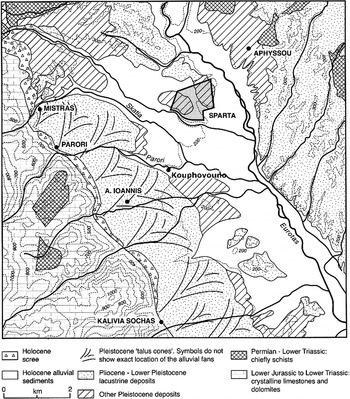
Kouphovouno is a low mound approximately 1.5 km south of modern Sparta (Fig. 1) and may have been the source of a group of finds from the ‘vicinity of Sparta’, acquired by the Archaeological Society in 1878 and now on display in the National Museum in Athens (Wolters Reference Wolters1891, 52–3). Subsequently in 1941, O-W. von Vacano undertook excavations at Kouphovouno. He exposed undisturbed strata, in places up to 2.50 m deep, which indicated that the site had been occupied between the Middle Neolithic and Early Helladic II periods. The publication of von Vacano's work, by Josette Renard (Reference Renard1989), confirmed the importance of the site and contributed to the establishment of the current project.
Location of Kouphovouno and the geology of the Eurotas valley.

In the first phase of the project, in 1999–2000, a grid of 5 m by 5 m squares was laid out across the whole of the site (Cavanagh, Mee and Renard Reference Cavanagh, Mee and Renard2004). All of the surface artefacts were collected, mainly pottery, tile and chipped stone tools, but also stone axes, querns and fragments of figurines. Geophysical survey indicated that there were a number of burnt structures. In addition the geomorphology of the tell was examined. Cores were drilled which revealed that the depth of sediment was over 4 m in places. The survey established the broad outlines of the occupational history of the settlement. The earliest pottery found was Middle Neolithic over the whole of the 4–5 ha covered by the tell. The settlement does not seem to have been established at the start of the period, however, but in the equivalent of the third of five Middle Neolithic phases at Franchthi, that is in Franchthi Ceramic Phase 2.3. The distribution of the pottery suggests that the site remained much the same size in the Late Neolithic period and there were also some Final Neolithic sherds. In the Early Bronze Age the settlement may have expanded and was occupied in the Middle and Late Bronze Age, as well as the Roman period (Cavanagh, Mee and Renard Reference Cavanagh, Mee and Renard2004, 126–8).
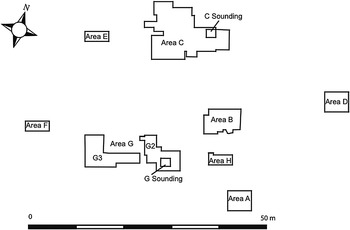
In 2001 trial trenches were opened in four locations, A–D, on the west side of the tell (Fig. 2) where cores had been taken (Cavanagh, Mee and Renard Reference Cavanagh, Mee and Renard2007). Subsequently it was decided to concentrate on Areas B and C, and a 4250 m2 plot of land was purchased. In 2002, B and C were extended and three new Areas – E, F and G – were started. Because of the considerable overlay of Roman material in E and F there was no further excavation on the western side of the plot. 2003 saw the continuation of excavation in B, C and G and the addition of Area H. After a study season in 2004, the need to expose more of the Middle Neolithic and Late Neolithic architecture led us to extend Areas C and G in 2005 and again in 2006, the final excavation season.
Plan of the excavation areas at Kouphovouno.

Pottery classification
We have defined the Middle Neolithic and Late Neolithic period pottery as follows:
Urfirnis Pottery
As Phelps (Reference Phelps2004, 44) points out, the decoration on Middle Neolithic pottery has been classified in various ways but is most conveniently described as Urfirnis. The first appearance of true Urfirnis marks the start of Phelps' Period II and it is the dominant ware at Franchthi (Vitelli Reference Vitelli1993, 135). The decoration takes three main forms. Often the outside and, in the case of bowls but not jars, the inside was monochrome painted. Sometimes lines were scribble burnished on the painted surface and these fired a darker colour because the clay had been compacted (Vitelli Reference Vitelli1993, 139; Phelps Reference Phelps2004, 47). Finally there is pattern painted decoration which can be difficult to identify if the sherds are very worn or encrusted. Vitelli (Reference Vitelli1993, 199–204; Reference Vitelli and Rice1997, 30–8) has studied the way that Urfirnis pottery was fired and concludes that it must have been a three-stage process, of oxidisation, reduction and then reoxidisation, so that the dark paint would contrast with the lighter surface colour. Typical surface colours are light red, pink and especially reddish yellow. The core is often light red, pink or reddish yellow but can be bluish grey.
Black Ware
We have classified Black Ware on the basis of the surface colour, which is usually black but can be dark grey or reddish black. Sometimes the surface is worn and the colour of the core shows through in streaks. Phelps (Reference Phelps2004, 70) noted a brush-marked slip on a few Black Ware sherds. However, he points out that it can be difficult to differentiate a slip from a good burnish unless it is thick or has flaked off. At Franchthi there was a slip on the black Andesite Burnished ware (Vitelli Reference Vitelli1999, 39) but this does not seem to have been the practice at Kouphovouno. Some vessels were smoothed or polished but most had been well burnished. Often there are darker lines or patches, evidently where the tool used to burnish the vessel was applied more heavily to remove irregularities and has compacted the surface. The burnish marks are usually horizontal but sometimes vertical, especially on shallow bowl rims and jar necks. The core colour is variable and can be red, reddish brown, reddish grey or reddish yellow, dark greyish brown and sometimes bluish grey.
Grey Ware
Grey Ware is not as easily defined as Black Ware. As Phelps (Reference Phelps2004, 77) points out, it can be various shades of grey; he also includes a variety of Grey Ware which is khaki or tan in colour, since the shapes are the same. The Grey Ware in Kouveleiki Cave Αʹ is a range of colours (Koumouzeli Reference Koumouzeli1989, 146–50). At Aria the Black and Grey Wares are treated as a single category (Douzougli Reference Douzougli1998, 65–6). This is because dark or medium grey is the predominant colour and only a few sherds are actually black. Some were fired reddish brown or buff. Vitelli (Reference Vitelli1999, 42–3 and 52) suspects that the Grey Burnished pottery at Franchthi was imported, possibly from Corinth or Thessaly. It is most common in Franchthi Ceramic Phase 4.1 contexts, less so in Franchthi Ceramic Phase 4.2. The surface colour of the Grey Ware sherds at Kouphovouno is grey, bluish grey or reddish grey, less often brown, reddish brown or red. The core colour is typically grey or bluish grey, sometimes red, yellow or pale brown. None of the Grey Ware sherds was obviously slipped but most had been burnished and there are often dark patches or lines, particularly where the surface is slightly raised and had evidently been smoothed down. Where there is decoration in white paint, this had clearly been added after the surface was burnished.
Matt Painted/White Slipped
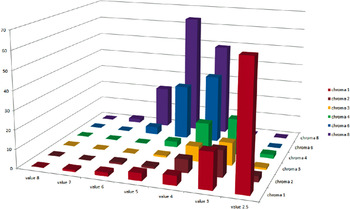
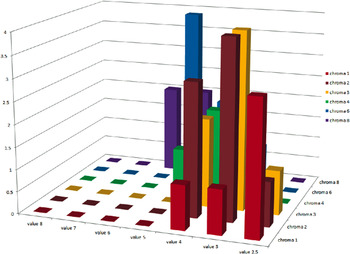
Sherds classified as Matt Painted have decoration in matt paint or a white slip. Sometimes a white slip is all that is left but we believe that these sherds were originally Matt Painted. As Vitelli (Reference Vitelli1999, 32 and 41) points out, an advantage of manganese-based paints is that the colour remains the same however they are fired, but they do not adhere well and flake off. The surface of the Matt Painted pottery is often brown, light brown or reddish brown. It can be various shades of red, reddish yellow or white, especially when slipped. Phelps (Reference Phelps2004, 87–8) gives approximate proportions for red, buff and cream colour groups at other sites in the Peloponnese. We calculate that around 33% of our Matt Painted is buff and this is fairly typical. However, 27% is high for red and 39% rather low for cream. The colour of the core can be bluish grey, light grey, reddish brown, reddish yellow, pink or white. Generally the Matt Painted pottery was carefully smoothed or polished, though some of the brown- or buff-coloured sherds were burnished. At Franchthi this was done after the vessel had been decorated so that the paint would adhere better (Vitelli Reference Vitelli1999, 31–2), but not at Kouphovouno. The paint covers a range of colours: dark grey, dark brown, reddish black, reddish grey, reddish brown or red. There is no obvious division between a red and a dark group (Phelps Reference Phelps2004, 88). Even though the red paint is presumably iron oxide rather than manganese based, it is not lustrous. We have recorded the Munsell values for the paint of both Urfirnis and Matt Painted pottery at Kouphovouno; the Urfirnis paint varies from greenish black (GLEY2 2.5/10G) to pinkish white (7.5YR8/2) but clusters around black and red (Fig. 3). Note the peaks for black at 10R2.5/1–2.5YR2.5/1 (i.e. value 2.5 and chroma 1) and for red at 10R5/8–2.5YR5/8 (i.e. value 5 and chroma 6–8) (for brevity and simplicity the graphs in Figs. 3 and 4 show the values for hues 10R and 2.5YR combined, as these convey the main values while omitting those which occur infrequently). For the Matt Painted pottery we have a smaller sample, but again a wide range of colours from dark reddish grey (10R3/1) to reddish yellow (5YR7/6). If we plot the same range of hues as that illustrated for the Urfirnis pottery above (10R–2.5YR; Fig. 4) it is clear that similar colours occur (note there are still peaks at value 2.5 and chroma 1 for black and value 5 chroma 6–8 for red), but that black and red merge into each other more gradually than is the case for Urfirnis, and the middling ‘dusky reds’ and ‘dark reddish browns’ (i.e. in the ranges values 2.5–4 and chroma 2–3) are more common. We would conclude from this comparison that iron oxide paint continued to be used on Matt Painted pottery at Kouphovouno, perhaps fired following a different procedure, and that manganese paint may also have been used, though only chemical analysis can confirm these conclusions.
Histogram of Urfirnis paint colours in hues 10R–2.5YR from Kouphovouno. The readings cluster around peaks at black (value 2.5/chroma 1) and red (value 5/chroma 6–8).

Histogram of Matt Painted paint colours in hues 10R–2.5YR from Kouphovouno. There are peaks at black (value 2.5/chroma 1) and red (value 5/chroma 6–8), but more intermediate values (values 2.5–4/chroma 2–3) than in Fig. 3.

Polychrome
There is decoration in two colours on sherds classified as Polychrome. They are not very numerous and rarely constitute a significant percentage of the pottery in any of the Late Neolithic contexts at Kouphovouno. They are concentrated in the middle of the Late Neolithic seriation sequence and do not appear in the later contexts. The surface colours are light brown, yellow, pink and red. The paint is generally a shade of red and black, dark grey, dark brown or reddish brown. The colour contrast was apparently achieved by the use of iron-oxide-based paints for the red and manganese for the black (Vitelli Reference Vitelli1999, 32). The red is often, though not always, more lustrous than the black. The fabric of the Polychrome pottery is mainly fine and the core colour can be bluish grey, pale brown, yellow or pink.
Overview of pottery evidence
The present article concentrates on the Middle Neolithic to Late Neolithic transition and in particular on the evidence from the soundings in Areas C and G. In the Middle Neolithic period the pottery is remarkably homogeneous. There is Urfirnis style decoration on a majority of the sherds from Kouphovouno. This uniformity contrasts with the greater diversity of the Late Neolithic period. Black Ware, Grey Ware, Matt Painted and Polychrome appear. There are more coarse sherds, which reflects the fact that pottery must have had a wider range of uses. Such an apparently abrupt change supports the views of those who argue for some population movement. However, our identification of contexts which we consider transitional suggests that Urfirnis continued to be produced after the Late Neolithic period had started. The Urfirnis sherds cannot all be considered residual, as was apparently the case at Franchthi (Vitelli Reference Vitelli1999, 9). At the same time, we find sherds which are a cross between the Middle Neolithic and Late Neolithic styles of decoration. In other words, the stratigraphy of Area G indicates that there is some continuity, at least at Kouphovouno. Of course this does not explain why the pottery changed so much and one of the aims of the article is to examine why this should have been the case.
AREA G1 SOUNDING AND OTHER RELATED CONTEXTS IN AREA G
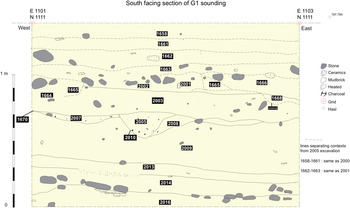
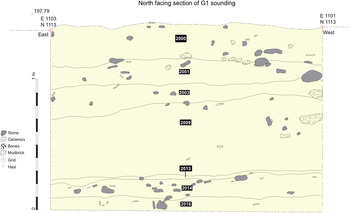
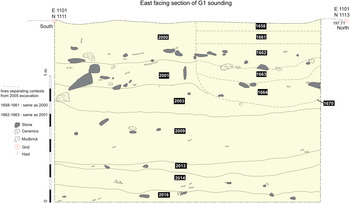
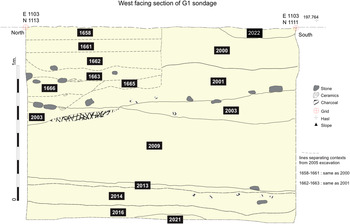
The sounding in Area G was initially opened as a test pit in the 2005 season measuring 2 × 1 m at the centre of G1 (Fig. 2). The aim was to produce a stratigraphic sequence which would partly overlap with the sequence established from the sounding in Area C. We would therefore have a series of contexts which started in the lowest strata of C, with the foundation of the settlement in the Middle Neolithic period, continuing through the Late Neolithic period. It was decided to extend the original test pit in the 2006 season by a further 2 × 1 m to the south of the area opened in 2005. Between c.196.64 and 197.71 m above sea level, the sounding provided a sequence from the Middle Neolithic to the Late Neolithic period, and several contexts represented a transitional phase between the two (Figs. 5, 6, 7, 8).
South-facing section of the G1 sounding.

North-facing section of the G1 sounding.

East-facing section of the G1 sounding.

West-facing section of the G1 sounding.

The sounding was taken to 2 m below the ground surface by the end of excavation. The cores taken in 1999 (Cavanagh, Mee and Renard Reference Cavanagh, Mee and Renard2004, 59–62) suggest there should be at least a further 0.5 m of archaeology below this. Core 3 lay 23 m to the south-east and Core 8 lay 24 m to the south-west. Both indicated a depth of about 2.5 m of archaeological deposit, but they were taken down-slope of Area G. Core 2, 17.5 m to the north-east, reached a depth of 4.36 m.
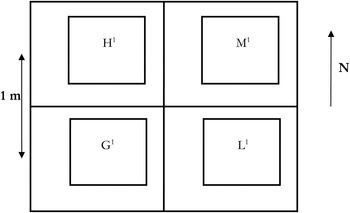
Although only a small number of features were recognised in the sounding in G, the evidence from the pottery indicates a clear stratigraphic sequence. Where contexts appeared particularly deep or were not clearly defined, a system of excavation by arbitrary 2–10 cm spits was adopted and in 2006 the sounding was divided into four 1 m2 grid squares (see Fig. 9), allowing some control on the stratigraphy.
Location of grid squares in the G1 sounding.

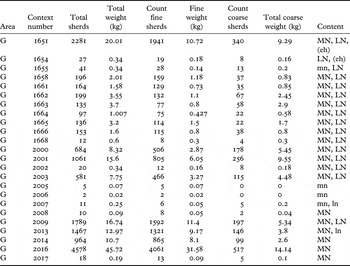
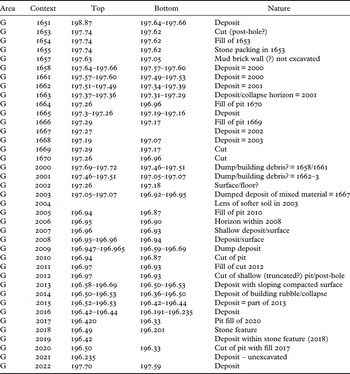
Late Neolithic pottery with an admixture of Middle Neolithic was found in the upper and middle layers of the sounding, along with some sherds which showed transitional features (Table 1). These levels also revealed indications of building activity including areas of tumble and some possible post-holes (Table 2). At 196.58–196.69 m above sea level was a surface sloping down to the south. In contrast with the material above, this surface and the deposits beneath it produced no recognisably Late Neolithic pottery and by the end of excavation, at a depth of 196.19 m above sea level, it appears that the archaeology was firmly in the Middle Neolithic period.
Pottery in the G1 sounding at Kouphovouno. In the Content column, capitals mean diagnostic sherds of the given period certainly present, lower case means possibly present, lower case in brackets means possibly present but could be intrusive. MN/mn = Middle Neolithic, LN/ln = Late Neolithic, eh = Early Helladic.

Contexts in the G1 sounding.

All contexts showed abundant evidence of human activity and were rich in charcoal. As well as pottery the sounding produced fragments of mud brick (including some within a possible layer of tumble from a wall), chipped stone artefacts, animal bones, two stone tool fragments and an anthropomorphic figurine. The figurine and polished stone axe were found very close together along with an obsidian blade in context 2013, the sloping surface separating the Middle Neolithic from the transitional contexts.
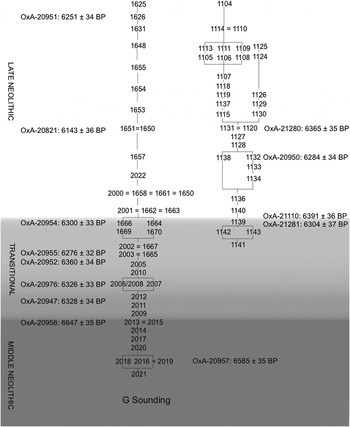
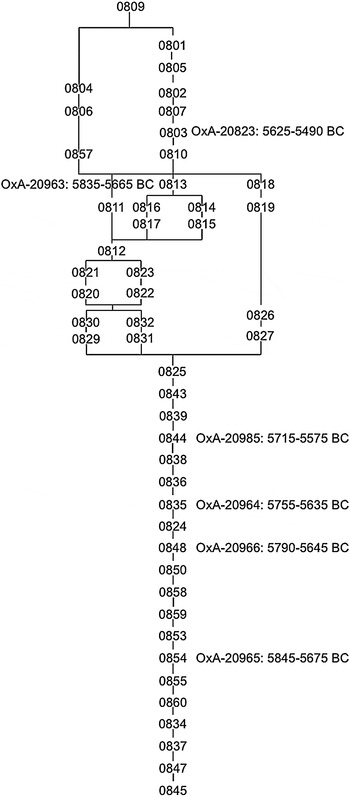
In addition to the contexts from the main sounding in Area G a number of other stratified sequences have proved useful for this study. The first of these is a series of levels in Area G2 (see plan Fig. 2) comprising the sequence G1104 to G1141, which covered a chronological span parallel with that of the deep sounding in G1; both sequences are illustrated on the Harris matrix (Fig. 10). The earliest levels in G2 (G1141–1143) were exposed but not excavated; they were stratified below G1139, whose 14C dates and pottery placed it in the Late Neolithic sequence immediately after the Middle Neolithic–Late Neolithic transitional phase. The later levels in this sequence, and the latest considered in this article, culminated in G1104, which, to judge from the seriation analysis and 14C dates, is slightly more recent than G1651 in G1 sounding.
Partial stratigraphic matrix of the sounding in Area G with uncalibrated 14C dates. The earliest levels are shown at the bottom of the diagram, the latest at the top.

SERIATION
The term seriation is sometimes used loosely to mean typological dating, but the more technical usage is intended here. The theory of seriation in this sense grew out of Petrie's original formulation (Petrie Reference Petrie1899) and both the theory and the methodology have developed (see Banning Reference Banning2000, 249–56 for a review). The basic principle is that each type will follow a unimodal distribution, that is to say over time it will be introduced in small numbers, reach a peak of popularity and then decline in numbers. This is an ideal case, and in reality there will be ‘noise’ factors which mean that rather than a simple rise and fall in popularity there will be distortions. The sorts of factors which can skew the data include residuality (the occurrence of earlier finds in a context of later date, see further the discussion below), differences of function (that the varying proportions of types can differ according to the activities which went on rather than due to change through time), the nature of the context's deposition (primary, cumulative, redeposited) and differences in sample size. For this reason, although in theory it is possible to develop a seriation solely on the evidence of the relative abundances of the various types, we have in our case based the seriation on the sequence of contexts established through stratigraphic relationships. The percentages of the various types are used as an index of the degree of similarity between one context and another.
In selecting contexts for seriation, we were guided by a number of considerations. In the first place, the contexts should have an acceptable number of sherds, as too small a number would result in unrepresentative samples; in a slightly arbitrary fashion we fixed on 200 as the lowest limit. Secondly the assemblage needed to be reasonably uncontaminated. In the case of Middle Neolithic contexts these have no sherds of later date. For the Late Neolithic samples we have selected those that have no later pottery, as all such contexts inevitably contained some, evidently residual, earlier pottery (see below). Thirdly we needed some criterion to suggest that the pottery had not been subjected to a series of redepositions before reaching its final place of discovery. The criterion we used was the average weight of the fine pottery and of the coarse pottery, 8 mm being the division (Cavanagh, Mee and James Reference Cavanagh, Mee and James2005, 298–302), on the assumption that sherds which had been constantly moved about would, on average, have broken into smaller fragments. In support of this hypothesis we would point out that pottery from the plough soil was almost always lighter (that is to say broken into smaller pieces), on average, than pottery from the intact contexts selected here.
The starting point for the relative dating of the Middle Neolithic, transitional and Late Neolithic contexts is the deep soundings in Areas C and G and the sequences in related levels. The stratigraphic sequences are shown in schematic form in the Harris matrices in Figs. 10 and 11. Taking the relevant contexts from C and G it is possible to represent the relative frequencies of the various styles (Middle Neolithic patterned, scribble burnished, monochrome, dark ware, Late Neolithic Black Ware, Grey Ware, Matt Painted/White Slipped, Polychrome, and Other, mainly coarse pottery which could not be attributed to one of the other Late Neolithic wares) as shown in Fig. 12. Note that the figures are percentages based on those sherds which could be identified as of one or other of these categories. The earliest Middle Neolithic levels from the sounding in G (G2016 onwards) have been incorporated close to the end of the sequence from C, because the 14C dates from the sounding in G indicate that they were contemporary. Contexts from other parts of Areas C and G, and not related stratigraphically with the deep soundings, have also been fitted into the sequence on the basis of their own sequences and on the 14C dates considered below (C0298, C0918, C0911, C0905, C1017, C1019, C1713, G1132, G1139, G1626, G1651, G1666).
Stratigraphic matrix of the sounding in Area C with uncalibrated 14C dates.

Relative frequencies of MN (continuous lines) scribble burnished, patterned, dark ware, monochrome, and LN (dashed lines) Black Ware, Grey Ware, Matt Painted/White Slipped, Polychrome and Late Neolithic Other, in selected contexts from Areas C and G. The contexts are in stratigraphic/seriated order with the earliest on the left.

The graph can be considered in four consecutive sections: (1) C0837–C0825, the Middle Neolithic levels from the deep sounding in Area C; (2) G2016–G2013, Middle Neolithic levels exposed in the area excavation of C and G; (3) G2009–G2001 from the deep sounding in Area G and contemporary contexts, covering our transitional phase of early Late Neolithic; and (4) the later Late Neolithic contexts G1139–G1104. It must be emphasised that these sections have been distinguished in order to clarify our current discussion; they are related to, but do not correspond with, the architectural phasing, which will appear in the final report. We can track the trends of the main styles. In section 1 monochrome forms, in rounded figures, 70–80% of the assemblages, patterned sherds make up some 20%, and scribble burnished rises from 2 to 10%. Interestingly a small number of dark ware sherds were identified in pure Middle Neolithic contexts (C0837, C0850, C0848 and C0825), indicating that there was some experimentation in producing pottery in this technique, though these are to be differentiated from the black wares of the Late Neolithic. Black Ware in this sense appears in the transitional phase. In section 2 patterned pottery reaches a peak at 25% and then declines to 10% or less, while scribble burnished rises and reaches a maximum of 26% and then falls to 8%, whereas monochrome continues at 70–80% or more, reaching a peak at 84% in C0911, but with marked dips in G2014 and C1705, giving a bimodal appearance to the distribution (this is one of the ‘noise’ factors which affect the seriation analysis outlined below). Over section 3, the early Late Neolithic transitional phase, monochrome declines from a peak of 80%, and tracks down to 76%, then 72% and then 58%, 51% and 46%; scribble burnished falls from 7% to 4% and patterned fluctuates between 10% and 5%. At the same time, the transitional contexts see Late Neolithic Black Wares rise from 4 to 30%, Grey Ware rise from 1 to 6%, Matt Painted/White Slipped reach up to 6%, and Polychrome and other Late Neolithic wares make up a small but evident proportion of the assemblages. Finally, in section 4 the Middle Neolithic types decline, monochrome from 40 to 20%, patterned and scribble burnished each from 4–5% to 1–2%, while the classic Late Neolithic wares increase in popularity, Black Ware from 30 to 50%. Grey Ware rises from 10 to 20% followed by a fall, Matt Painted/White Slipped form 10–15%. Polychrome is always a small component, less than 1%, and other Late Neolithic wares form around 5%.
As indicated above, the graph is based primarily on the stratigraphic sequence, but also relates the levels which have no stratigraphic association on the basis of their similarity, and we now move on to discuss this part of the argument. The measure of similarity used is the ‘common content’, which can be expressed:
 $$\eqalign{S\left({{r_i}\comma \; {r_j}} \right) = \ &{\rm min}\left({{r_{i1}}\comma \; {r_{\,j1}}} \right)+ \cdots + {\rm min}\left({{r_{ik}}\comma \; {r_{\,jk}}} \right)+ \cr & \cdots + \min \left({{r_{in}}\comma \; {r_{\,jn}}} \right)= \mathop \sum \limits_{k = 1}^n {\rm min}\left({{r_{ik}}\comma \; {r_{\,jk}}} \right)}$$
In other words, the similarity is measured by adding up the lower number in either context when they are compared one with another. For example we can compare, in Table 3, the proportions of the various wares in levels G1128 and G1127 and add up the lower values in each case:
 $$2.90 + 4.46 + 23.05 + 32.25 + 13.07 + 12.89 + 0.36 + 4.90 = 93.88 \%,$$
so these two contexts have 94% in common with each other when comparing the relevant types of pottery. A high value indicates that two contexts are similar to each other; the lower the value the more dissimilar they are (needless to say, each context has 100% in common with itself, because we are working with percentages).
The relative percentages of the types in contexts G1128 and G1127.

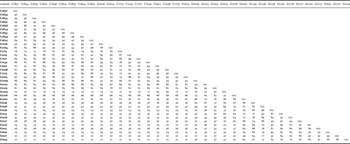
The result of this comparison for all the relevant contexts is shown in the similarity matrix in Table 4. The contexts have been arranged in proposed chronological order with the earliest at the top of the table and the latest at the bottom. If this were a perfect ‘R matrix’, that is to say meeting the seriation model perfectly, then the rows and columns would have the highest values on the diagonal and then the similarities would fall, as one moved along the rows or down the columns away from the diagonal, monotonically (that is to say they would not fall and then rise again). This is plainly not the case – indeed, many rows and columns break the rule, and there are some contexts which fit the model poorly (for example in the range G2016–G2013). Such anomalies are not unexpected and the zigzags on the graph would lead us to anticipate this – the seriation is not a perfect one, but shows the effect of some of the ‘noise’ factors mentioned above. There remain, as a consequence, some uncertainties in placing contexts which are not decided by the stratigraphy, and it is possible that G2016 and/or G2014 should be placed after rather than before C1713. All the same, the general tendency for the high similarity values to cluster close to the diagonal of the matrices indicates that the seriation and the stratigraphic sequence are not seriously inconsistent with each other.
Similarity matrix for the contexts C0837–G1104.

ABSOLUTE DATING
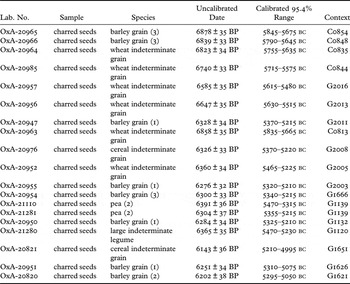
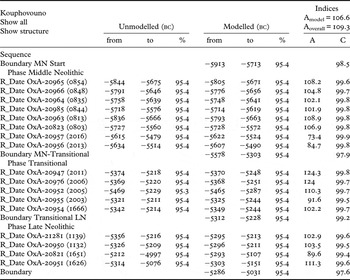
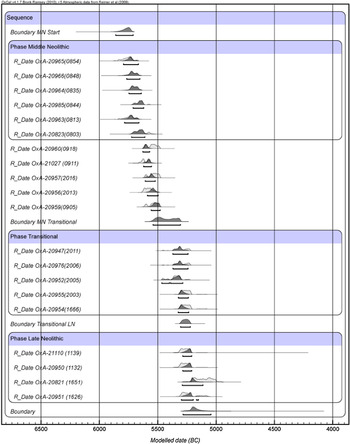
In order to tie down the relative sequence based on stratigraphy and seriation to absolute dates we turn to radiocarbon dating. A series of seed samples was selected and submitted for analysis by the Oxford Accelerator Mass Spectrometer. Seeds were chosen on the principle that they are short-lived and therefore record more precisely than fragments of wood charcoal the date of their deposition. We were conscious that there was also a risk in pursuing this policy, namely the danger that carbonised seeds of earlier date could, through accident, have found their way into a later context. This problem of association between sample and the context to be dated is not an unusual occurrence in archaeology, but at Kouphovouno, by using a Bayesian approach to combine the information from the relative sequences with the radiocarbon calibration (for a general introduction see Buck, Cavanagh and Litton Reference Buck, Cavanagh and Litton1996) it is possible to recognise outliers and as a consequence include only those dates consistent with the stratigraphic sequence for the analysis. The OxCal program version 4.1 of the Oxford Radiocarbon Accelerator Unit was used for the calculations (Bronk Ramsey Reference Bronk Ramsey2009) employing the IntCal09 calibration curve. The samples selected and their associated dates (including calibrated ranges before the Bayesian analysis) are given in Table 5. We list here the samples relevant to our interest in this paper in the deep soundings in Areas C and G and the dating information about the transitional period. In Table 6 we show the results of the Bayesian analysis; the dates have been identified by their laboratory numbers with the number of the context in brackets. The samples are listed in stratified sequence and divided into the three phases Middle Neolithic, transitional and Late Neolithic. The parameter A is a measure of how well the individual date estimates agree with the stratigraphic model; a value of over 60 is considered acceptable and the values recorded are well above this threshold. Two 14C estimates (OxA-21110 and OxA-21280) were omitted because they had poor agreement with the model, evidently because the seeds were earlier in date than the contexts from which they were derived. But there is a particular problem with OxA-21110: this resulted from a second assay on the sample from context G1139, also dated as OxA-20820 – the correct procedure would be to combine the two estimates and incorporate the result of their combination into the modelling process. In fact, running the model with both the raw second estimate of the date and the combined dates identified the sample as an outlier. This in turn suggests that the boundary between the transitional phase and Late Neolithic is particularly sensitive to estimates earlier than 5300 bc. We have included the later of the two estimates in the OxCal run, though its omission makes no significant difference to the result, and it is quite possible that the seed sample, from which the estimate for G1139 was taken, was residual (Table 6.).
Radiocarbon estimates for contexts in soundings in C and G arranged in stratigraphic order (earliest at the top). Estimates from the Oxford Radiocarbon Accelerator Unit. Note the calibrated range has been rounded to the nearest five years.

Calibrated radiocarbon estimates from Kouphovouno in stratified sequence, with the date ranges for the samples in dates bc before and after modelling. In the last two columns A is a measure of the agreement of the individual estimate with the model, with values above 60 considered to indicate good agreement. C is an indication of how effective the model is by measuring the convergence of the MCMC (Markov Chain Monte Carlo) algorithm; values above 95% indicate consistent convergence.

We also present these data in graph form (Fig. 13): the areas on the graphs with a lighter grey fill indicate the probability densities of the calibrated dates before the modelling and the dark grey fill shows the more closely constrained densities as a result of incorporating the information derived from the stratigraphy.
Marginal posterior densities for the sequence of dates from the contexts in Areas C and G.

The graphs indicate that the duration of the Middle Neolithic deposits excavated at Kouphovouno was perhaps some three or four centuries falling between 5900–5700 and 5580–5300 bc. The transitional phase lasted a century and a half or more from the end of Middle Neolithic down to somewhere between 5310–5230 bc. These results are not surprising. The dates are consistent with the standard chronologies which place the start of Late Neolithic in the Peloponnese at roughly 5300 bc (Alram-Stern Reference Alram-Stern1996, 98–101; Coleman Reference Coleman and Ehrich1992; Demoule and Perlès Reference Demoule and Perlès1993); taking the first appearance of Black Ware as the criterion for the earliest Late Neolithic our Transitional would belong to its earliest phase and so the start of Late Neolithic would fall a little earlier, perhaps a century or more before 5300 bc. The Late Neolithic deposits at Kouphovouno considered here drew to a close before 5000 bc.
COMPARISON OF THE KOUPHOVOUNO CHRONOLOGY WITH OTHER SITES
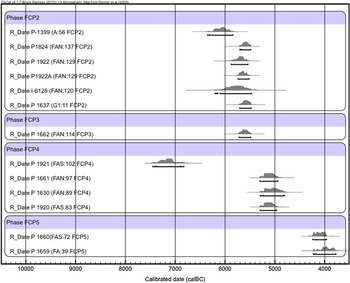
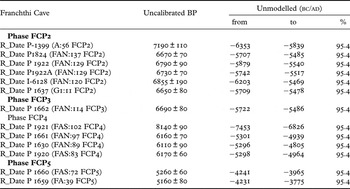
In the light of our analysis of the dating at Kouphovouno is it possible to tie in our sequence with sites elsewhere in the Peloponnese? The obvious starting point is Franchthi. The 14C dates from that site and covering Franchthi Ceramic Phases 2–5 are listed in Table 7 and illustrated in Fig. 14. The dates have been recalibrated using the IntCal09 calibration curve and the OxCal program, to work from the same basis as the Kouphovouno dates above; the difference from the earlier calibrations is small and does not affect our argument. We have not modelled the data. A:56 was a mixed deposit assigned to Franchthi Ceramic Phase 2.2 (Vitelli Reference Vitelli1993, 64), FAN137 was a Franchthi Ceramic Phase 2.2 context (Vitelli Reference Vitelli1993, 70), FAN 129 was Franchthi Ceramic Phase 2.4 (Vitelli Reference Vitelli1993, 76) and FAN 120 from the Franchthi Ceramic Phase 2–3 boundary. The Franchthi Ceramic Phase 2 deposits in G1 were close to the surface and evidently mixed (Vitelli Reference Vitelli1999, 20 n. 3). FAN 114 lay in the Franchthi Ceramic Phase 3 sequence (Vitelli Reference Vitelli1999, 11), FAN 97, 89 in Franchthi Ceramic Phase 4.2 (Vitelli Reference Vitelli1999, 14), FAS 83 in Franchthi Ceramic Phase 4.3 (Franchthi Ceramic Phase 4–5 boundary). FAS 72 and FA 39 were assigned to Franchthi Ceramic Phase 5, that is to say the Final Neolithic period.
14C dates from Franchthi Cave.

Franchthi Cave deposits with 14C dates.

On the basis of the pottery typology, we estimate that the earliest Middle Neolithic phase at Kouphovouno is contemporary with Franchthi Ceramic Phase 2.3; the Middle Neolithic dating sequence from the sounding in Kouphovouno Area C fits in well with the Franchthi dates (compare Fig. 13 and Fig. 14), though the relatively late date from FAN137 opens, in theory, the possibility of an overlap of the earliest levels in the Kouphovouno sequence with Franchthi Ceramic Phase 2.2. There is just one 14C estimate for Franchthi Ceramic Phase 3, and this falls entirely within the same range as the Middle Neolithic dates. However, a major hiatus marked the transition from Franchthi Ceramic Phase 2 to Franchthi Ceramic Phase 3 at Franchthi, with the Paralia site abandoned before the start of Franchthi Ceramic Phase 3 and throughout the Franchthi Ceramic Phase 4 phase. Within the Cave, in the main FA sounding, the very end of Franchthi Ceramic Phase 2 and the boundary with Franchthi Ceramic Phase 3 is identified with a rocky red stratum (the assigned units for this are FAN 121–119 and FAS 118–116); the beginning of Franchthi Ceramic Phase 3 is associated with a dark yellowish-brown stratum (Vitelli Reference Vitelli1993, 85–7). Partly on the basis of the single 14C date from FAN 114, it was suggested that the gap in occupation from the end of Franchthi Ceramic Phase 2 to the beginning of Franchthi Ceramic Phase 3 was short: ‘a generation or less’ (Vitelli Reference Vitelli1999, 11). If, however, the charcoal sample for estimate P-1662 was older than the context from which it was taken (we have seen that this can be the case at Kouphovouno, and the outlier P-1921 from Franchthi alerts us to the possibility that at that site too earlier samples can occur in later contexts), then the gap between the end of Franchthi Ceramic Phase 2 and the start of Franchthi Ceramic Phase 3 could have been longer. The calibrated 14C dates from Franchthi Ceramic Phase 4 fall, effectively, in the last part of the sixth millennium bc (FAN:97 5301–4939 bc, FAN:89 5296–4805 bc and FAS:83 5298–4964 bc), fitting quite well with those at the end of our sequence (G1651 5293–5107 and G1621 5303–5151 bc, see the upper part of the Harris matrix for Area G in Fig. 10, see also Table 5). If we put aside its 14C date, then in absolute terms Franchthi Ceramic Phase 3 could fall somewhere within our transitional and earliest Late Neolithic phases.
Radiocarbon dates from other Neolithic sites in the Peloponnese are less closely tied in with the question of our transitional phase. Vitelli has reported an Early Neolithic sample from Lerna (7585 ± 125 BP – Vitelli Reference Vitelli2007 17 n. 13). At Alepochori the use of the caves ranges ‘for the Αʹ Kouveleïki Cave from 5300 to 3820 bc and for the B′ Cave from 4458 to 3700 bc’ (Kontaxi Reference Kontaxi2007, 182), which would support our suggestion that some production of Urfirnis pottery continued into the Late Neolithic period. The series of dates from the Alepotrypa Cave seems to range from the later fifth millennium bc over the Final Neolithic period (Zouridakis and Papathanasopoulos Reference Zouridakis and Papathanasopoulos1995), though we await with great interest the results of a new series of samples recently taken from the site (William Parkinson pers. comm.). The Cave of the Lakes at Kastria, Achaia, has two levels (Sounding A2 levels 21 and 22, at a depth of 3.54–3.92 m) with calibrated dates contemporary with the Middle Neolithic at Franchthi and Kouphovouno (DEM 272 6527 ± 55 BP, 5614–5372 bc; DEM 273 6828 ± 39 BP, 5785–5638 bc) but only 16 sherds, none of them closely diagnostic, were recovered from these levels. So although they confirm some human activity in the cave during Kouphovouno Middle Neolithic/Franchthi Ceramic Phase 2, they do not throw light on the change in material culture during the transition from Middle to Late Neolithic (Sampson Reference Sampson1997, 83–4, 527–31). In sounding Γ, layers 29–32, at a depth of 4.9–5.35 m, were assigned to Late Neolithic Ia, but the assemblage was again small, consisting of just 44 sherds in total and largely undiagnostic, though these levels included a tall pedestal base (Sampson Reference Sampson1997, 85 and 84 fig. 30b). No 14C dates were associated with this phase, though it was stratified below the Late Neolithic Ib material. The Late Neolithic Ib dates from the cave ranged from 4500 to 4000 bc, consistent with the pottery finds belonging to the transition to Final Neolithic (Late Neolithic Ib in Sampson's system – note that no Urfirnis pottery was reported from the site [Sampson Reference Sampson1997, 83–5]).
This is not the place to review the absolute chronology of sites outside the Peloponnese, though it is worth pointing to the dates from the Kitsos Cave in Attica (Lambert Reference Lambert1981, ii 681–4), where the finds from the earlier of the Neolithic levels included Urfirnis (Type 11: Céramique polie Rouge Orange, Lambert Reference Lambert1981, i 294–5), stratified together with Late Neolithic types (the specific finds are: sondage 1: couche 4n; centre sale: couches 3 et 4c; banquette: couches 4b, 4c; sondage 3: couche 3; sondage 2: couche 3). For a description of the stratigraphy and associated pottery (characteristically Grey Ware and Matt Painted) see Lambert Reference Lambert1981, i 73–90. The radiocarbon estimates (4900–4200 bc) also indicate a Late Neolithic date (see Alram-Stern Reference Alram-Stern1996, 217 and Coleman Reference Coleman and Ehrich1992, 258), confirming that (imported?) Urfirnis pottery reached Kitsos during the fifth millennium, several centuries after the end of the Middle Neolithic period.
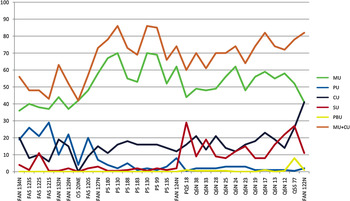
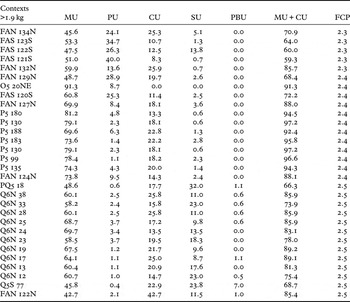
In turning to the relative abundances of the various Middle Neolithic pottery styles we are again reliant on Franchthi, but are confronted with a number of difficulties, and the following is proposed as a tentative comparison with our analysis of Kouphovouno. In the first place the classifications do not entirely overlap: ‘most of the sherds that I have assigned to Urf ware … would be called Urfirnis by my colleagues [but] that is not true of all of the sherds’ (Vitelli Reference Vitelli1993, 11). Furthermore, if we have understood correctly, the sherd frequencies in the Franchthi frequency tables (Vitelli Reference Vitelli1993, 223–48) are percentages based on the weight of the sherds, whereas ours are based on sherd counts and this will bias comparison of the two series in unknown ways. In order to make any evaluation fair we selected from the Ceramic Subphases 2.3–2.5 those assigned units which appeared uncontaminated (those not in parentheses in the lists, Vitelli Reference Vitelli1993, 70, 76 and 80). Furthermore, we used only those units which yielded a total pottery weight of 1.9 kg or more, an estimate of the weight which would correspond with our limit (a count of at least 200 sherds) for inclusion in the Kouphovouno seriation – units with relatively few counts can produce unduly extreme values as just a few sherds make a big difference in percentage terms. Because we have omitted the less abundant units and some of the varieties from Franchthi, the ranges in our Table 7 do not coincide with those in Vitelli Reference Vitelli1993, 75 table X and 79 table XI. Finally, again with the aim of making any comparison as fair as possible, we have counted only the Urf varieties (monochrome Urf = MU, patterned Urf = PU, Coarse Urf = CU, scribble burnished Urf = SU, and pattern burnished Urf = PBU). In order to make the comparison more transparent, we recalculated the figures given in the Franchthi frequency tables, so that they are percentages only of the Urf wares, that is MU + PU + CU + SU + PBU = 100 (just as with the figures for Kouphovouno). Note also that we make no claims about the precise sequences of the units within each Franchthi Ceramic Phase. Bearing all these caveats in mind, we trust it is still possible to make broad comparisons. The data are assembled in Table 8. We have also included a column which is the sum of monochrome Urf and Coarse Urf, as these two put together probably come closer to our Middle Neolithic monochrome than either by itself. These are shown in graph form in Fig. 15.
Graph illustrating the abundances of Urf varieties in Franchthi Ceramic Phase 2 (MU = monochrome Urf, PU = patterned Urf, CU = coarse Urf, SU = scribble burnished Urf, PBU = pattern burnished Urf).

Relative percentages of Urf wares from Franchthi Ceramic Phases (FCP) 2.3–2.5. MU = monochrome Urf, PU = patterned Urf, CU = Coarse Urf, SU = scribble burnished Urf, PBU = pattern burnished Urf.

To characterise the findings very broadly: it appears that during Franchthi Ceramic Phase 2.3 (134N–132N), and perhaps a little into Franchthi Ceramic Phase 2.4, MU + CU form roughly 40–60%, in Franchthi Ceramic Phase 2.4 (FAN 129N–FAN 124N) MU + CU rise to 80–90% or more and in Franchthi Ceramic Phase 2.5 (PQ5 18–FAN 122N) they range from 60–80%. At Kouphovouno we do not quite get the lows of Franchthi Ceramic Phase 2.3 or the peak of Franchthi Ceramic Phase 2.4, but all the same the values of the two sequences compare relatively well. The steep decline in the percentage of monochrome Urfirnis recorded in the transitional phase at Kouphovouno is not yet apparent in Franchthi Ceramic Phase 2.5. The same sequence for PU starts at 10–30% and falls to less than 10% in Franchthi Ceramic Phase 2.4 and to less than 4% in Franchthi Ceramic Phase 2.5. At Kouphovouno, on the other hand, the Middle Neolithic levels are above 10% and only fall below 10% during the transitional phase. Finally, SU is generally lower than 5% during Franchthi Ceramic Phase 2.3 (though with an outlier of 13.8% in FAS 122S); it forms less than 5% in Franchthi Ceramic Phase 2.4 but comes into its own with values of 10–30% in Franchthi Ceramic Phase 2.5. At Kouphovouno the values of scribble burnished likewise start below 5% in the earliest levels of Area C Sounding, and reach a peak in the later Middle Neolithic levels (see Fig. 12). The gradual decline in the popularity of scribble burnished, witnessed in the transitional phase at Kouphovouno, is not yet apparent in Franchthi Ceramic Phase 2.5.
We would conclude from this comparison that, in the general trends in the waxing or waning popularity of the varieties of Urfirnis/Urf, there is a broad similarity between the Franchthi Ceramic Phase 2.3–2.5 units at Franchthi and the Middle Neolithic contexts at Kouphovouno. We would also argue that the trends suggest that our transitional contexts are not to be observed at Franchthi. It may be, however, that there are some regional differences.
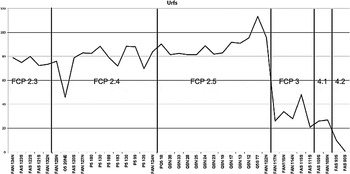
Finally it is possible to trace the fall in the occurrence of the Urf varieties into the Late Neolithic at Franchthi (Franchthi Ceramic Phases 3–4). In Fig. 16 we have selected, as before, those stratigraphic units whose pottery weighed 1.9 kg or more. We have taken the sum of all the Urf varieties (MU + PU + SU + PBU) for the Franchthi Ceramic Phase 2.3–2.5 units and the published figures for Franchthi Ceramic Phases 3–4.2. The graph shows that Urf pottery in the larger Franchthi Ceramic Phase 2 contexts normally ranges between ~70 and 95%, in Franchthi Ceramic Phases 3–4.1 it falls to 20–30% and in Franchthi Ceramic Phase 4.2 it is 10% or less. Note that the fall from the high levels (>80%) in Franchthi Ceramic Phase 2.5 to the Franchthi Ceramic Phase 3 levels is very steep, whereas at Kouphovouno the decline is more gradual, with intermediate values of 40–80% in the transitional phase (see Fig. 12). Bearing in mind all the qualifications outlined above, it is still striking that in Franchthi Ceramic Phases 3–4.1 the proportion of Urf is in the range 20–30%, very similar to the proportions recorded in the Late Neolithic contexts at Kouphovouno.
Franchthi Urf pottery in stratigraphic units >1.9 kg as a proportion of all the pottery.

On the basis of these observations we would suggest firstly that the pottery indicates a longer gap between Franchthi Ceramic Phase 2 and Franchthi Ceramic Phase 3 at Francthi than just a generation or two, perhaps closer to the 150 years or so represented by our transitional phase. Secondly we would suggest that the levels of 20–30% Urf could be interpreted as evidence that these varieties continued to be produced in the earlier phases of Late Neolithic (Franchthi Ceramic Phases 3–4.1).
RESIDUALITY
One of the major problems on multiperiod sites such as Kouphovouno is that of residuality: artefacts produced and used at an earlier date can be incorporated into contexts laid down at a later time. A dramatic illustration of the phenomenon was observed at Kouphovouno. A series of burials, a good number of them with no grave offerings, were placed in graves whose earthen fill contained no pottery later than the Early Bronze Age, but the burials were dated by 14C of the human bone to the Middle Bronze Age. The event, the filling of the grave, was carried out in the second millennium bc, but the pottery shovelled over the skeleton dated centuries earlier. Without the 14C dates it would have been very tempting to date these burials to the earlier period, but in fact the pottery accompanying them was already old when it was redeposited.
In our particular study there is a problem of recognising whether certain ‘Middle Neolithic’ styles continued to be produced in the Late Neolithic period, let us say after about 5400 bc, or whether the Middle Neolithic monochrome, patterned and scribble burnished sherds were incorporated fortuitously into later deposits. Although residuality is a common problem in archaeology, there seems to be no clear theoretical approach to defining or recognising it. In the attempt to define percentages of these types as residual, we looked in the first place to Late Neolithic levels dated by stratigraphy later than those forming the main part of our discussion. We were careful to select deposits which followed the same criteria applied to those used in the seriation, namely deposits with more than 200 sherds and whose average weights of the ‘fine’ and ‘coarse’ fractions indicated that they had not been subject to frequent redeposition and hence mixing. We restricted the sample to pure Late Neolithic contexts because of the added difficulty of distinguishing Middle Neolithic Urfirnis monochrome from Early Helladic Urfirnis monochrome, the confusion of which would undermine any attempt to use the statistics from the post-Neolithic contexts at Kouphovouno. The later Late Neolithic contexts thus distinguished are: G0608, G0610, G0611, G0615, G0617, G0620, G0621, H0702, H0709 and H0714. The range of pottery types was summed and averaged following the same method as that applied to the Middle Neolithic, transitional and Late Neolithic levels discussed above, so that we could compare like with like. Our reasoning is that at the time these later Late Neolithic deposits were laid down the ‘Middle Neolithic’ styles were certainly no longer in production – an assumption supported by the absence of such styles from some sites of exclusively Late Neolithic date found elsewhere in the Peloponnese – and consequently they would give us a guide to the average level of residual Middle Neolithic. The results of this exercise are summarised in Table 9. In the first column of figures we have the mean of the sherds from all the contexts summed and calculated as a percentage, whereas in the second and third columns of figures we have the statistics from individual contexts.
Percentages of monochrome, patterned and scribble burnished sherds in later Late Neolithic contexts at Kouphovouno (G0608, G0610–1, G0615, G0617, G0620–1, H0702, H0709 and H0714).

Thus the figures in Table 9 can be taken as a baseline for recognising background levels of residual pottery which we can use to compare with those from the transitional (i.e. earliest Late Neolithic) contexts. Inspection of the graph (Fig. 12) indicates that Middle Neolithic monochrome down to G1136, that is to say from Transitional into the post-transitional, Late Neolithic phase, records percentages greater than 30%, i.e. more than twice the average in our comparator group, and greater than the maximum recorded in any of the later Late Neolithic contexts (26.1%). Likewise the Middle Neolithic patterned sherds over a similar span record levels of 5% or more (G1208 4.78%), again more than twice the background level defined in Table 9, and greater than the maximum in any of the comparator contexts. The proportion of scribble burnished during and just beyond the transitional phase (G2009–G1136) averages 4.9%, that is to say more than twice the background residual average, though in this case it falls below the maximum recorded in one of the background contexts (G0617 with 7.4%, though this is an outlier). On the basis of these comparisons we would argue that Middle Neolithic monochrome, patterned and scribble burnished pottery continued to be produced during the transitional phase here defined and into the mature phase of the Late Neolithic period, side by side with Black Ware, Grey Ware, Matt Painted, Polychrome and Other Late Neolithic types. From G1138 onwards the averages come closer to the ‘residual’ levels, but are still higher (21%, 2.6% and 2.6% respectively). In theory, a counter-argument might propose that the proportion of residual pottery is likely to have been greater in levels dating to periods closer in time to each other, and hence our comparison is not a fair one. In practice, to be sustained, such an argument would require a detailed modelling of the processes of deposition and this the evidence simply does not allow. On our current understanding, therefore, we would argue that the evidence points strongly to continued production of the Middle Neolithic styles through the transitional phase here defined.
THE MIDDLE–LATE NEOLITHIC TRANSITION
The contexts excavated in the sounding in Area G span the Middle Neolithic–Late Neolithic transition. On the basis of the seriation analysis, a number of other contexts can also be characterised as transitional. More than half of the diagnostic pottery is still Middle Neolithic in style and this remains the case until G2000/G1138. Some of these sherds must be residual but Urfirnis pottery would seem to have been made and used at Kouphovouno in the Late Neolithic period. We are convinced of this in part on the basis of the stratigraphy in Area G, which we have examined in the seriation analysis. There is also a difference in the type of pottery found. Whereas the sherds which we define as residual tend to be small and worn, some of the Middle Neolithic pottery in transitional contexts consists of larger and better preserved sherds which would therefore appear to be in situ.
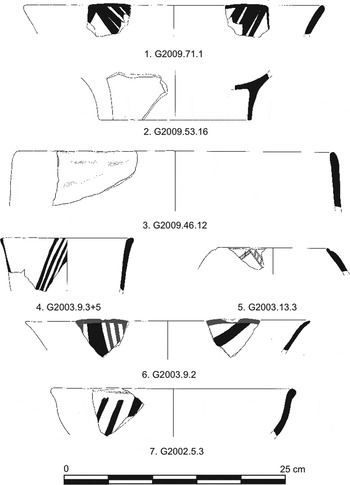
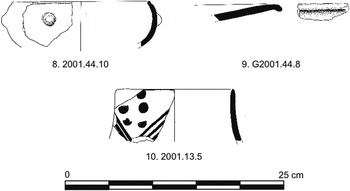
In levels dating to the earliest Late Neolithic (our Transitional), characteristic shapes of the Urfirnis tradition include the standard repertory (carinated bowls, shallow flared bowls [Fig. 17:1], deep bowls, collared bowls, pedestalled bowls [Fig. 17:2], bowls with everted rims, and collared jars, as well as coarse Urfirnis); their decoration includes linear patterns: groups of diagonals, zigzags, chevrons, cross-hatching, and groups of thin lines framed by thicker. A good number of the rims from bowls and jars are painted monochrome with a lustrous black paint. Late Neolithic shapes include bowls with a bead rim (Fig. 17:5, Fig. 18:8), incurved bowls, flaring bowls (Fig. 17:4), shallow bowls (Figs. 17:6, 17:7, 18:9) pedestal bases, and jars (Fig. 18:10); there are also coarse open vessels, normally in a buff fabric (2.5YR.6/3–2.5YR.7/3) with large tongue-shaped lugs (Fig. 17:3, cf. Franchthi Ceramic Phase 3, Vitelli Reference Vitelli1999, 30–1, fig. 15).
Vases from the deep sounding in Area G, Kouphovouno: (1) shallow flared Urfirnis bowl with linear decoration in and out; (2) pedestal Urfirnis bowl base painted monochrome in and out; (3) Late Neolithic deep bowl in coarse buff ware; (4) Matt Painted flared bowl, diagonal lines out, traces of painted decoration in; (5) Black Ware bead rim shoulder bowl with incised decoration; (6) Polychrome flared shallow bowl with broad diagonal band in, and thick and thin diagonals out; (7) Matt Painted shallow bowl decorated with diagonal lines (drawings by Jenny Doole).

Vases from the deep sounding in Area G, Kouphovouno: (8) Black Ware bead rim shoulder bowl with applied knob; (9) Grey Ware shallow incurved bowl with rounded rim; (10) Matt Painted jar with convex flared rim decorated with rim band, chevrons and circles (drawings by Jenny Doole).

We define the start of the Late Neolithic period as the point in the sequence when Black Ware first appears, that is in G2009, followed in due course by Grey Ware and Matt Painted. In 14C years the boundary between Middle Neolithic and this earliest transitional phase lies between 5578 and 5303 bc. Phelps (Reference Phelps2004, 44 and 65) comments that Black Ware and possibly Black-on-Red Ware were in use before the end of the Middle Neolithic period but, like Weinberg (Reference Weinberg1970, 597–8 and 601–3), he takes the view that the Late Neolithic period began with the appearance of Matt Painted pottery. The stratigraphy in Area G suggests that Black Ware is present first, though there were a few Grey Ware and Matt Painted sherds in G2009. The proportion of Black Ware then increases significantly in G2003, whereas Grey Ware and Matt Painted remain minor components. Therefore our preference, at least at Kouphovouno, would be to start the Late Neolithic period when Black Ware appears, as Lavezzi (Reference Lavezzi, Williams and Bookidis2003, 68) does at Corinth. It is the dominant Late Neolithic ware and, as we will see, the earliest Matt Painted pottery cannot always be differentiated from the latest Urfirnis. As the Late Neolithic period progresses Black Ware often makes up over 50% of the diagnostic pottery and as much as 70% in some contexts. There is slightly less Black Ware in the latest Late Neolithic contexts.
Vitelli (Reference Vitelli1999, 9) believes that the Middle Neolithic sherds in Late Neolithic contexts at Franchthi were redeposited. There may have been a break between Franchthi Ceramic Phase 2 and Franchthi Ceramic Phase 3 which resulted in a completely different ceramic tradition (Vitelli Reference Vitelli1999, 35). However, at Corinth some continuity of Urfirnis is assumed (Lavezzi Reference Lavezzi1978, 423; Phelps Reference Phelps2004, 66). At Aria (Douzougli Reference Douzougli1998, 58–9) and Kouveleiki Cave Αʹ (Koumouzeli Reference Koumouzeli1989, 143) there is no Middle Neolithic phase, yet a few Urfirnis sherds were found. The evidence from the Kitsos Cave also indicates that Urfirnis continued in production after 5000 bc. So, despite the major differences, which Vitelli rightly stresses, it would appear that the Middle Neolithic–Late Neolithic pottery transition was a gradual process.
A stylistic overlap would explain why some sherds at Corinth and Franchthi ‘combine Urfirnis and Matt Painted characteristics. There may be an Urfirnis slip on one side and a typical Matt Painted finish on the other. The style and decoration may be Matt Painted and the technique and fabric Urfirnis or vice versa’ (Phelps Reference Phelps2004, 66). A feature of the pottery from the transitional contexts at Kouphovouno is the lack of contrast between the surface colour and the colour of the paint.
There is much more burnished pottery in the Late Neolithic period. This could be linked with the increase in scribble burnished decoration. At Franchthi scribble burnish appears in Franchthi Ceramic Phase 2.2, the second of the five Middle Neolithic phases, accounts for a small percentage of the pottery in Franchthi Ceramic Phase 2.3 (4.5% of Urf), is still not very common in Franchthi Ceramic Phase 2.4 (1.8%) and only becomes a major component in Franchthi Ceramic Phase 2.5 (16.6%) (Vitelli Reference Vitelli1993, 149, 162, 169 and 173). Many Urfirnis sherds from transitional contexts at Kouphovouno were given a streaky monochrome wash on which diagonal lines were overpainted and then polished or burnished before the paint had completely dried, which produces a blurry effect. Sometimes the diagonal lines were added after the surface had been burnished and are slightly rougher to the touch. The paint used to decorate Middle Neolithic painted pottery has been identified as iron oxide, whereas in Late Neolithic there is greater experimentation with new colours, notably on the Matt Painted and Polychrome wares (see the observations above with Figs. 3 and 4). This experimentation is characteristic of much of the Balkan peninsula, for example with the introduction of a manganese pigment on various wares including Thessalian Black-on-Red and the Graphite ceramics of northern Greece and Bulgaria (Farnsworth and Simmons Reference Farnsworth and Simmons1963; Letsch and Noll Reference Letsch and Noll1983; Demoule, Gallis and Manolakakis Reference Demoule, Gallis and Manolakakis1988, 23, 55; Schneider et al. Reference Schneider, Knoll, Gallis and Demoule1991).
We can see how the Late Neolithic wares may have evolved as a result of this phase of experimentation but this does not explain why these changes occurred. There is no stratigraphic evidence of a break in occupation at Kouphovouno between the Middle Neolithic and Late Neolithic periods. The pottery from the transitional contexts in Area G also indicates continuity, since Urfirnis remained the preferred style of decoration for some time. It can be difficult to distinguish monochrome Urfirnis and Black Ware sherds, which suggests that the same glossy finish was still appreciated but the technique gradually changed. It was simpler to burnish the surface rather than master the more complex three-stage process required to fire Urfirnis pottery correctly. Some sherds could be classified as Urfirnis or Matt Painted and this is another link between the Middle Neolithic and Late Neolithic styles. Nevertheless, there were fundamental changes in the way that pottery looked and was used. Households had a much wider range of coarse ware vessels, some of which were evidently storage jars. The decoration was also more varied than had been the case in the Middle Neolithic period. Although the different Late Neolithic wares did not appear simultaneously and their popularity fluctuated, they clearly overlapped. Black Ware, Grey Ware and Matt Painted pottery is present in most Late Neolithic contexts at Kouphovouno, and often Polychrome as well. Remarkably, except for the rhyta, we do not find any obvious correlation between particular shapes and styles of decoration. Black Ware, Grey Ware and Matt Painted shallow bowls, shoulder bowls and jars can have identical profiles.
The shallow bowls on high pedestal bases continue the Middle Neolithic emphasis on display, but most of the Late Neolithic vessel shapes break with tradition. The bowls are not as deep as they had been and their capacity is often less than 1.5 litres, which suggests that they were designed to serve individuals (Mee Reference Mee, Mee and Renard2007, 212). Generally there is a reduction in the size of bowls, whereas many of the jars are larger. These changes imply that a different set of practices determined how food and drink were consumed.
At other sites in the Peloponnese we see the same shapes in a similar range of decorative styles. There must have been contact between these communities, and links with central and northern Greece were closer as well (Vitelli Reference Vitelli1999, 97; Phelps Reference Phelps2004, 76, 82–4, 94–5 and 100–1). The rhyta symbolise the wider connections that were established in this period. Even if they were not used in exactly the same way at sites across the Balkans, they surely represent shared beliefs or practices. Yet the rhyta from Kouphovouno appear to have been locally made. Ian Whitbread (pers. comm.) has analysed 52 Late Neolithic samples and identified 17 fabric types. Because of the number of fabrics, he assumes that there were several potters or groups of potters based at Kouphovouno in this period. Some may have specialised in a particular style of decoration, though different wares can have the same fabric composition. He suggests that there may have been a change in the way that pottery production was organised. Whereas members of a family could have assisted with the painted decoration on Middle Neolithic vessels, in the Late Neolithic period there is more of an emphasis on the way that pottery was fired, which the potter would have controlled.
The greater diversity of Late Neolithic pottery, in comparison with the uniformity which characterises the Middle Neolithic period, could well have been a response to social pressures, as Vitelli (Reference Vitelli1999, 99–100) has argued. She wonders whether the changes were driven by stress or conflict and this is certainly a possibility. Nevertheless, the fact that there were now more settlements in Laconia could have facilitated communication. The Alepotrypa and Kouveleiki Αʹ caves were occupied and Late Neolithic pottery is also reported from the caves at Schoini, Kataphygi and Vri (Efstathiou-Manolakou Reference Efstathiou-Manolakou, Cavanagh, Gallou and Georgiadis2009, 7 and 12–13). Tomkins (Reference Tomkins2009, 134–47) believes that many Neolithic cave sites in the Aegean were a focus for ritual activities where different communities may have come together at particular times of the year to forge ‘new social relationships and identities’. A regional or even supra-regional role could be envisaged for the Alepotrypa Cave, which was accessible by land and sea. The burials and the range of artefacts deposited in the cave indicate that this was certainly a special place.
If the Late Neolithic pottery styles symbolised identity, they did so not as a marker that clearly distinguished one whole village community from another. The similarities are more obvious than the differences between sites. Quite possibly we should think in terms of groups within communities or even vertical divisions which cut across households. Stylistic variation may have been intended to convey information about the uses as well as the users of the pottery, in terms of what was considered appropriate for a particular occasion.
The contrast between the Middle Neolithic and Late Neolithic periods, between stylistic uniformity and diversity, reflects a change in the way that pottery was used and perceived. In the Middle Neolithic period there was an emphasis on the presentation and consumption of food and drink in social contexts which stressed a shared set of values and sense of identity. Group and community affiliations could be signalled and are implicit in the different ways that the pottery was made, the different technological styles. Nevertheless, the focus on uniformity was clearly designed to promote integration. Did the symbolic role of pottery diminish in the Late Neolithic period? Connections were maintained with other communities, though there is greater variation, for example in the style of Polychrome pottery (Phelps Reference Phelps2004, 96–7). With the increase in the number of settlements, we would expect differences between regions, as communication networks became more localised. Yet the rhyta do indicate a shared ideology which extended well beyond the Peloponnese. It is within communities that the changes in the pottery seem particularly significant. The fact that there were more storage vessels could be seen as a belated ‘response to potential’, the realisation that ceramic containers were particularly well suited for this purpose (Brown Reference Brown, van der Leeuw and Torrence1989, 205–8). But it is also possible that households had adopted a more independent storage strategy (Halstead Reference Halstead, Laffineur and Niemeier1995, 16–19). Nevertheless, the introduction of the different decorative styles is not easily explained. We do not believe that there was any major break at Kouphovouno or that the arrival of new settlers prompted this change (Lavezzi Reference Lavezzi, Williams and Bookidis2003, 68). There may have been a desire for diversity after the uniformity of the previous period (Mee Reference Mee, Mee and Renard2007, 213). Nevertheless, a symbolic dimension cannot be ruled out and this would have reflected divisions within the community.
There was now an emphasis on individuality in the way that food and drink were consumed, though kin group and community relationships could still be promoted (Pappa et al. Reference Pappa, Halstead, Kotsakis, Urem-Kotsou, Halstead and Barrett2004, 39). Had feasts also become more competitive, occasions when power and status were acquired, the type of feasts which Dietler (Reference Dietler, Wiessner and Schiefenhövel1996, 92–6) characterises as ‘entrepreneurial’? It may be significant that more livestock animals were slaughtered before 12 months at Kouphovouno in the Late Neolithic period, which suggests a greater emphasis on meat production (Rivals, Gardeisen and Cantuel Reference Rivals, Gardeisen and Cantuel2011, 530). New work on plant and animal isotopes at Kouphovouno also indicates a change from Middle Neolithic to Late Neolithic in the management regime of animal stock (Vaiglova et al. forthcoming). Was there greater social inequality? Halstead (Reference Halstead1992, 55–6; Reference Halstead, Laffineur and Niemeier1995, 16–19) believes that this was the case at Late Neolithic Dimini, where boundary walls divided the settlement into separate courtyard groups. Souvatzi (Reference Souvatzi2008, 156–60) acknowledges that the internal variability could represent notions of a more individualised identity but argues that the evidence indicates an ideology of communal integration and cohesion rather than a hierarchical social structure. Obviously Kouphovouno is not Dimini and Laconia is not Thessaly, where there were 14 Late Neolithic pottery styles (Souvatzi Reference Souvatzi2008, 181). Nevertheless, the developments in this period do imply that more complex forms of social organisation were established. If our interpretation of the pottery is correct, personal identity was stressed and this would have affected the way that relationships were structured at Kouphovouno. Material culture had therefore become a more sophisticated medium to articulate how people were defined socially (Hegmon Reference Hegmon and Stark1998, 277).
ACKNOWLEDGEMENTS
The Kouphovouno Project is co-directed by William Cavanagh (University of Nottingham), the late Christopher Mee (University of Liverpool) and Josette Renard (Université de Montpellier). We would particularly like to thank the members of the Archaeological Service of the Greek Ministry of Culture who have given us so much assistance over the past 10 years: Mrs M. Tsouli, Mrs A. Vasliogamvrou, Dr A. Mantis, Mrs A. Panagiotopoulou, Dr Th. Spyropoulos, Mrs Stella Raftopoulou, Mr Nassos Themos and Mrs Elena Zavvou. We are most grateful to David Blackman, James Whitley, Cathy Morgan and all the staff of the British School at Athens for their advice and support. The excavations were funded by the British Academy, the British School at Athens, the Society of Antiquaries of London, the Institute for Aegean Prehistory, the Universities of Liverpool, Lorient, Clermont-Ferrand and Nottingham, the École française d'Athènes, the French Ministry of Foreign Affairs, and the Royal Geographical Society. Special thanks are also due to the anonymous referee and the editor, who made a number of useful suggestions to improve the article.