A high proportion of terminally ill patients in acute-care and post–acute-care hospitals are treated with antibiotics in their final weeks of life, despite the limited efficacy of this treatment.Reference Albrecht, McGregor, Fromme, Bearden and Furuno1–Reference Granowitz and Brown6 Moreover, almost half of the patients with documented advanced-care directives nevertheless received antibiotics in their final daysReference Thompson, Silveira, Vitale and Malani2, Reference Chun, Rodgers, Vitale, Collins and Malani7–Reference Phua, Kee and Tan9 and only 1 study reported withholding antibiotics.Reference Stiel, Krumm and Pestinger10 Overuse of antibiotics at the end of life contributes to the evolution of multidrug-resistant organisms (MDROs), which increases morbidity, mortality, and healthcare costs.Reference Furuno, Noble and Horne11–Reference Levin, Simor, Moses and Sprung14 To reduce this risk, the antibiotic stewardship program (ASP)Reference Barlam, Cosgrove and Abbo15 recommends withholding antibiotics in EOL patients when survival is no longer a goal. When planning interventions to implement these recommendations, Gaw et alReference Gaw, Hamilton, Gerber and Szymczak16 examined why physicians continue to prescribe antibiotics; however, they did not focus on EOL patients with advanced directives. Their main finding was the importance of respecting a patient’s wish to continue antimicrobials, meeting family expectations, and pain management.Reference Gaw, Hamilton, Gerber and Szymczak16 Other factors that affect overuse of antibiotics are pressure from patients and families, absence of advanced directives, perception of antibiotics as the optimal quality treatment,Reference Bjorkman, Berg, Roing, Erntell and Lundborg17–Reference Hinkka, Kosunen, Lammi, Metsänoja, Puustelli and Kellokumpu-Lehtinen20 and in post-acute care, complex conditions of the elderly.Reference Lacey21, Reference Parsons, McCorry and Murphy22 Both consultations with infectious disease (ID) physicians and physician burnout have not been previously examined in relation to EOL antibiotic overuse. Infectious diseases physicians are the leaders of ASPs, and one reason for discontinuing antibiotics at EOL is receiving input that antibiotics are no longer indicated.Reference Gaw, Hamilton, Gerber and Szymczak16 Physician burnout is characterized by the depletion of emotional, cognitive, and physical resources, and burnout may impede effective coping with the conflicts and emotional demands of caring for patients and families.Reference Maslach, Schaufeli and Leiter23
In addition, the ASP in Israel does not recommend withholding antibiotics in EOL patients when survival is no longer a goal, but a similar recommendation appears in the Terminally Ill Patients Law. This law states that EOL patients whose life expectancy is <2 weeks can refuse antibiotics, even with acute septicemia.24 Implementation of this statement has not been examined. In view of all these factors, the objectives of this study were (1) to investigate physicians’ knowledge, the current status of antibiotic use, and several factors (sociodemographic and organizational factors, ID physician consultation, and burnout) associated with antibiotics days of therapy (DOT) in EOL patients with advanced directives in acute-care and post–acute-care hospitals and (2) to compare study variables across medical specialties. We hypothesized that sociodemographic and organizational factors, ID consultation, and physician burnout would be related to antibiotic DOT.
Methods
Study design and setting
This study was a descriptive cross-sectional study conducted in 27 hospital wards in 4 acute-care hospitals (2 oncology wards, 2 geriatrics wards, and 16 internal medicine wards) and 2 post–acute-care hospitals (4 skilled nursing care wards, 2 chronic mechanical ventilation wards, and 1 oncology ward).
The study sample comprised 213 physicians (attending, residents, and interns) and their 932 patients. In 27 research wards, data were collected on patients who had died in the 4 months preceding the administration of questionnaires to the physicians who had cared for them. The data included the name of the physician who had prescribed antibiotics to an EOL patient with an advanced directive. Descriptive data concerning patients in the 2 weeks preceding death (ie, the EOL period) were collected, with a focus on the timing of advanced-directive decision making and antibiotic use.
We excluded 65 physicians, some of whom had worked <3 months and some of whom did not complete or partially completed the research questionnaire. Also, 236 patients who died during the first 24 hours of hospitalization were excluded from the 1,168 total patients who died in the 4 months prior to data collection.
Procedures
This study was approved by the Helsinki Committee at all care settings, and physicians were asked to sign an informed consent document. Study tools were revised based on a pilot study that we conducted with 24 physicians and 90 patients. Physicians completed questionnaires during their daily session in the presence of the researcher, and 6 research assistants reviewed 932 patient records.
An EOL patient was defined as a patient with a terminal illness with at least 2 vital systems harmed, based on the Israeli “Terminally Ill Patient Law”24 and The Gold Standard Framework Prognostic Indicator Guidance.Reference Thomas25 Advanced directive documentation was defined as physician free-text record concerning patient preference for EOL care when survival is no longer a goal. In the pilot phase, diagnoses of EOL patients with advanced directives were confirmed by a palliative specialist.
Patient data
The following data were collected for each patient included in the study: (1) EOL patient diagnosesReference Thomas25, 26 and Charlson comorbidity score,Reference Charlson, Pompei, Ales and MacKenzie27 (2) advanced directive documentation, (3) medical treatments, and (4) MDRO definition (see the Appendix online).
Physician prescribing
We collected 2 types of physician prescribing data. First, we collected antibiotic DOT prescribed by the physician. The DOT was defined as the total number of days that a single antibiotic (parenteral or oral) was administered, regardless of dosage. The DOT was further specified per 1,000 patient days.Reference Polk, Fox, Mahoney, Letcavage and MacDougall28 Second, we collected data regarding consultations by ID physicians, as ordered by a physician.
Physician questionnaire data
The questionnaire contained 33 questions related to 3 subjects: (1) sociodemographic details (eg, gender, religious orientation, country of origin Israel/Former Soviet Union /other) and organizational factors (ie, seniority, managerial status, physician status, hospital/ward classification, and participation in simulation-based education for dealing with EOL issues), (2) knowledge, and (3) burnoutReference Maslach, Schaufeli and Leiter23 (Appendices 2 and 3 online).
Data analysis
Descriptive statistics, correlation coefficients, and χ2 tests were computed to examine associations between variables. Group differences, including 4 medical specialties and 3 patient groups (EOL patients with advanced directives, EOL patients without advanced directives, and patients with curable disease) were tested by ANOVA (Table 1). Dichotomous sociodemographic factors were assessed by t test. The unique contribution of each variable to the explained variance in antibiotics use was examined by hierarchical multivariate regression analyses. A priori, significance was set at P < .05. Data were analyzed using SPSS version 22 software (IBM, Armonk, NY).
Distribution of Various Treatments Among EOL Patients According to Advanced Directives (Yes/No) Documentation Based on Medical Records

Note. EOL, end of life; ADs, advanced directives.
* P < .05; **P < .01; ***P < .001.
Results
Patient sample characteristics
Of 932 patients of physicians who completed the questionnaire, 695 (74.5%) were hospitalized in internal medicine wards, 128 (14%) were in post–acute-care wards, and 68 (7%) were in oncology wards, with only a few in geriatric medicine wards. Of these 932 patients, 664 (71.2%) were EOL patients. Furthermore, 36.6% had a cancer diagnosis, 31.3% had dementia, 17% had cardiovascular disease, and 15% had other end-stage diseases (eg, lung, kidney, or liver). The mean patient age was 77.7 years (SD, ±13.7). The average length of stay in the hospital was 13.4 ± 27.2 days, and the mean Charlson score for EOL patients was significantly higher (5.3 ± 2.5) than for non-EOL patients (3.5 ± 2.2; F(2,929) = 49.48; P < .01).
Of 435 EOL patients with advanced directives, 10% requested do-not-resuscitate (DNR) status in the event of cardiac arrest; 38% specified that they requested no invasive interventions; and 52% asked for palliative care. One-third of advanced directives were completed ≥8 days before death; 24% were completed within 4–7 days before death; and 46% were completed ≤3 days before death. The distribution of mean days between advanced directives and patient date of death in the various medical wards is shown in Table 2. The rates of most treatments in EOL patients with advanced directives were significantly lower than in EOL patients with no advanced directives, except for antibiotics and blood product (Table 1).
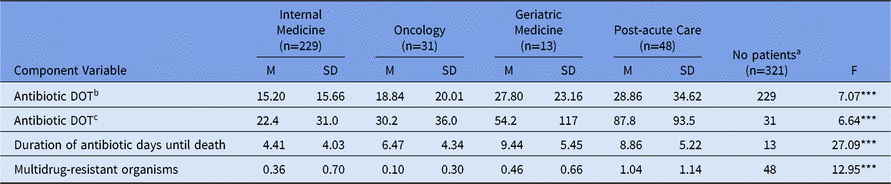
Distribution of Antibiotic Days of Therapy by Physicians and Multidrug-Resistant Organisms, in EOL Patients With Advanced Directives, Between Medical Specialties, Based on Medical Records
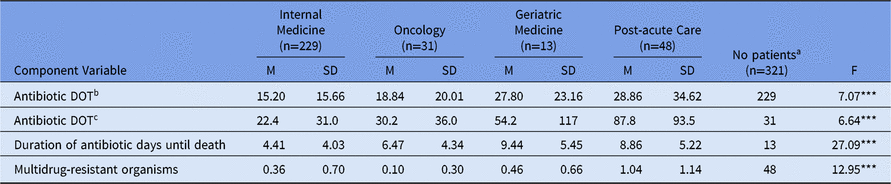
Note. DOT, days of therapy; M, mean; SD, standard deviation.
a Based on 321 total EOL patients with advanced directives.
b Antibiotic prescribing by the total number of physicians (N=333) as follows: medicine (n=265), oncology (n=28), geriatric (n=17), and post-acute care (n=23).
c Antibiotic prescribing by 136 of 213 physicians responding to the questionnaire as follows: medicine (n=108), oncology (n=13), geriatric (n=6), and post-acute care (n=9).
* P < .05; **P < .01; ***P< .001.
The rate of MDRO specimens among EOL patients was 29.9% (96 of 321), and 10% of these patients had >1 MDRO (31 of 321). For 370 MDRO cultures, clinical sites included were urine (n = 137, 37%), blood (n = 81, 22%), sputum (n = 67, 18%), wound (n = 50, (13.5%), and clostridium difficile (CD) (n = 35, 9.5%). The mean MDRO rate in post-acute care was significantly higher than for the internal medicine and oncology wards. In addition, we detected a significant positive correlation between antibiotic DOT and MDRO cultures (r = 2.2; p < .001) (Table 2).
Physicians’ antibiotic prescribing and ID physician consultations among EOL patients with advanced directives
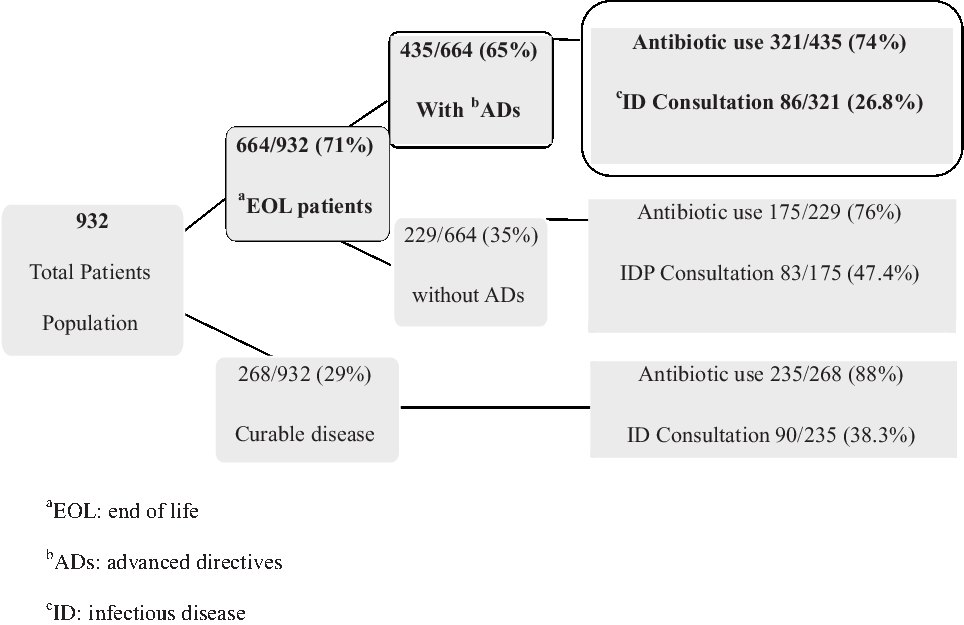
Of all 321 EOL patients with advanced directives who were treated with antibiotics (Fig. 1), 284 (72.6%) received antibiotics until the last day of life. Antibiotics were withdrawn from 19 of these patients as follows: 11 by internal physicians, 5 by ID physicians, 2 by palliative physicians, and 1 by an ethics committee.
Patient’s sample including antibiotic use by physicians and Consultations with infectious disease physician rate during their last two weeks of life based on medical record.

Distribution of antibiotic DOT
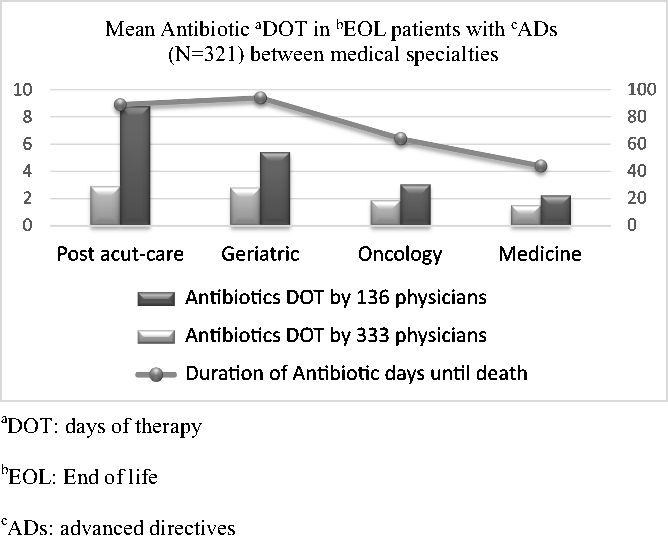
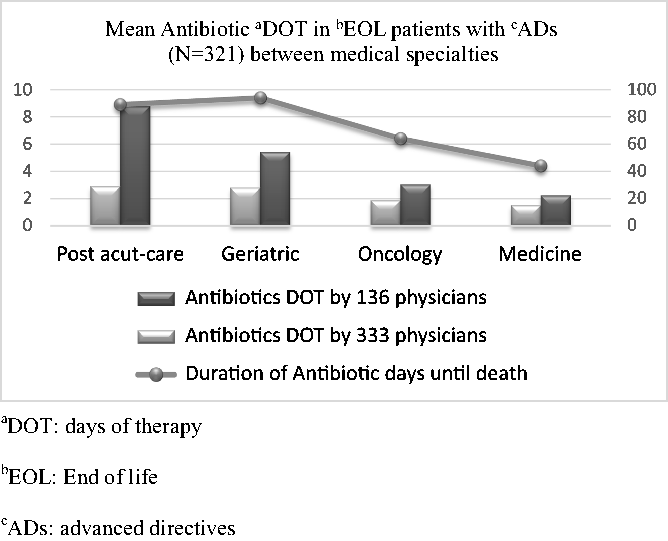
Among all physicians who responded to the questionnaire, the mean antibiotic DOT in EOL patients with advanced directives was significantly higher in post-acute care than in patients in the internal medicine and oncology wards. Among all physicians, the mean antibiotic DOT and mean duration of antibiotic days until death were significantly higher in patients in geriatric wards and in post-acute care than in patients in internal medicine wards (Table 2, Fig. 2).
Distribution of Antibiotic days of therapy by physicians and the Duration of Antibiotic days until patient date death, in EOL patients with advanced directives between medical specialties based on medical records (N=321).
ID physician consultation
Among all patients, the mean ID consultation rate was 0.35 (±.47). Among EOL patients with advanced directives, the mean ID consultation rate was significantly lower (0.27 ±.44) than for EOL patients without advanced directives (0.47 ±.50) and for patients with curable disease (0.38 ±.48; P < .001) (Table 1). Distribution consultations ordered by various medical specialists showed that physicians of patients in the oncology and geriatrics wards were more likely to consult ID physicians about EOL patients than physicians of patients in internal medicine wards and post-acute care (Table 3).
Distribution of Infectious Disease Consultation Demanded by Physicians, Among EOL Patients With Advanced Directives, Between Medical Specialties Based on Medical Recordsa

Note. ID, infectious disease; EOL, end of life; M, mean; SD, standard deviation.
a Based on 321 total EOL patients with advanced directives.
* P < .05; **P < .01; ***P < .001.
Physician sample characteristics
Questionnaires were distributed to 278 physicians and 213 were completed (response rate 76%). Approximately half the respondents were female (48.3%); the mean age was 39.4 (±10.8) years; the mean years of seniority was 12.5 (±11.6); and 68% of the responding physicians were secular. Of all the respondents, 38.5% were attending physicians; 46% were residents; 15.5% were interns; and 17.4% held managerial positions. Approximately half of the respondents (45.6%) had participated in simulation-based education programs on EOL issues.
Only half of the physicians were familiar with the Israeli guidelines concerning withholding antibiotics at EOL or knew that use of antibiotics at EOL increases the risk of infection with MDRO. Knowledge did not significantly differ among medical specialties.
The overall rate of burnout among all physicians was 44.5%; a high level of emotional exhaustion was reported by 38%; and high depersonalization was reported by 51%. The mean emotional exhaustion level for ID physicians was significantly higher (29 ± 10.18) than that for internal medicine, geriatric medicine, and post–acute-care physicians (Table 4). We detected no significant differences in depersonalization among medical specialties.
Physician Burnout Between Various Medical Specialties Based on Physician Questionnairea

Note. M, mean; SD, standard deviation.
a Based on 213 total responding physicians.
* P < .05; **P < .01; ***P < .001.
Predictive factors for antibiotic prescribing by physicians in EOL patients with advanced directives
Physician participation in simulation-based education for dealing with EOL issues predicted higher antibiotic DOT (β = −.32; P < .05). In post–acute-care hospitals, antibiotic DOT was significantly higher than in acute-care hospitals (β = .464; P < .05). In acute-care hospitals, the mean antibiotic DOT for patients in geriatric wards was higher (27.80 ± 23.16) than for patients in internal medicine wards (15.20 ± 15.66; P < .01. In terms of physician burnout, we found, unexpectedly, that depersonalization was a negative predictor of antibiotic DOT (β = −0.3; P < .05). In terms of ID consultations among EOL patients with advanced directives, mean antibiotic DOT was higher when patients had ID consultations (21.6 ± 23.34) than when patients did not have ID consultations (16.2 ± 19.79; P = .060). We detected no associations among sociodemographic and other organizational factors, emotional exhaustion, and antibiotic DOT.
Discussion
At EOL, when patients choose not to prolong their suffering in their final stages, physicians refrain from various treatments.Reference Yadav, Gabler and Cooney29 , Reference Oulton, Rhodes, Howe, Fain and Mohler30 However, based on the literature and the present research results, antibiotics are not among those treatments.Reference Thompson, Silveira, Vitale and Malani2 , Reference Chun, Rodgers, Vitale, Collins and Malani7 – Reference Phua, Kee and Tan9 This finding carries significant implications for the MDRO problem because EOL patients often suffer from infections, and these patients constitute more than half of all inpatients in acute-care and post–acute-care hospitals.Reference Albrecht, McGregor, Fromme, Bearden and Furuno1 – Reference D’Agata and Mitchell4 As in previous studies,Reference Albrecht, McGregor, Fromme, Bearden and Furuno1 – Reference D’Agata and Mitchell4 in our EOL study population, the proportion of cancer patients was the highest, followed by patients with dementia. We found documentation by the physician concerning advanced directives for more than half of the EOL patients in this study. This wide compliance with the instructions of the Israeli Terminally Ill Patients Law is probably a direct outcome of various interventions,31 including simulation-based education that almost half of the physician sample had undertaken.Reference Brezis, Lahat and Frankel32
Antibiotic prescribing by physicians for EOL patients with advanced directives
The prescribing of antibiotics for EOL patients with advanced directives in hospital populations ranges from 30% to 88%.Reference Albrecht, McGregor, Fromme, Bearden and Furuno1 – Reference Oh, Kim and Kim3 , Reference Chun, Rodgers, Vitale, Collins and Malani7 – Reference Phua, Kee and Tan9 In the present study, the rate of antibiotics prescribing in patients with advanced directives in the last 2 weeks of their lives was relatively high, 74%. Antimicrobial exposure is the most important factor associated with the acquisition of MDRO infections among EOL patients.Reference Levin, Simor, Moses and Sprung14 Several studiesReference D’Agata and Mitchell4 , 31 have found the mean MDRO rate to be high in post-acute care, and we found that the mean antibiotic DOT was the highest there as well. Hence, intervention programs should focus on post–acute-care hospitals. Only 1 study in the reviewed literature reported the withdrawal of antibiotics.Reference Stiel, Krumm and Pestinger10 In oncology wards, following a team decision, antibiotics had been discontinued for a third of the EOL patients.Reference Stiel, Krumm and Pestinger10 Frequent reasons given were deterioration of general condition (41.4%) and ineffective therapy (25.7%).Reference Stiel, Krumm and Pestinger10 In the present study, the percentage of antibiotics discontinued was very low, 5%.
Physician knowledge and participation in simulation-based education
Physicians are inclined to see antibiotic treatment as palliative therapy intended to relieve pain rather than an aggressive treatment that aggravates the MDRO problem.Reference Barlam, Cosgrove and Abbo15 Still, because only physicians can reduce antibiotic use, we chose to investigate several variables associated with antimicrobial prescribing by physicians. In practice, based on the literatureReference Gaw, Hamilton, Gerber and Szymczak16 , Reference Pulcini, Williams, Molinari, Davey and Nathwani33 and our present research results, only half of physicians are aware that antibiotics use among EOL patients increases their risk of becoming infected by an MDRO. In addition, only half the physicians in our sample were aware of the Israeli law guidelines stating that antibiotic treatment can be withheld at a terminal stage even in the case of severe sepsis.
Surprisingly, the antibiotic DOT prescribed by physicians who had participated in simulation-based education was higher than among other physicians. This finding indicates that simulations of withholding antibiotics for patients requesting not to prolong their suffering appear to be necessary.
Physician burnout, ID physician consultation, and antibiotic DOT
Physician burnout is highly significant in shaping behavioral attitudes toward patients. Half of the physicians in this study demonstrated high levels of depersonalization, and ID physicians had a particularly high rate of emotional exhaustion (66.7%). In contrast, the overall rate of physicians had relatively low rate of emotional exhaustion (28%), similar to a previous report among physicians from similar specialties treating EOL patients.Reference Yoon, Hunt, Ravella, Jun and Curlin34 Deckard et alReference Deckard, Hicks and Hamory35 reported that among ID physicians, burnout rates were 43.5% for emotional exhaustion and 40.3% for depersonalization. According to a 2018 survey,Reference Grisham36 these rates are continuing to rise as the result of new infectious disease outbreaks.
In addition, our hypothesis that a burned-out physician would prefer to avoid harsh conversations with families and would also continue antibiotics in EOL patients with advanced directives was not confirmed. Physicians who displayed high levels of depersonalization prescribed significantly lower antibiotic DOT than those who exhibited low levels of depersonalization. A possible explanation for this finding is that most physicians view antibiotic treatment as a necessary procedure for alleviating patient suffering and that the antibiotics therapy signifies a beneficial procedure.Reference Gaw, Hamilton, Gerber and Szymczak16 – Reference Hinkka, Kosunen, Lammi, Metsänoja, Puustelli and Kellokumpu-Lehtinen20 A burned-out physician does not provide his patients with high-quality treatmentReference Salyers and Bonfils37 and therefore prescribes fewer antibiotics. However, these findings may be related to other factors.
Our finding that antibiotic DOT was higher in EOL patients with advanced directives after a consultation with an ID physician is probably related to the severity and complexity of the infection. Additionally, ID consultations occurred more frequently on oncology wards than on other wards. This finding was expected because EOL cancer patients have a high proportion of infections, and oncologists are known to support prescribing antibiotics at any cost.Reference Hinkka, Kosunen, Lammi, Metsänoja, Puustelli and Kellokumpu-Lehtinen20
According to Stiel et alReference Stiel, Krumm and Pestinger10 and our research findings, the treating physician usually discontinues antibiotics; consultation with ID physicians is infrequent in EOL patients with advanced directives. These findings reinforce the significance of implementing operational guidelines intended for treating physicians, described by Juthani-Mehta and BaghbanReference Baghban and Juthani-Mehta38 in 2017. Their recommendations include identifying the patient’s wishes, explaining to him that antibiotics use involves invasive procedures, confirming that a high temperature derives from infectious disease, and explaining that antibiotics cannot cure the patient’s terminal illness but can prolong suffering.
This study has several limitations. First, the study sample was recruited from the largest, but only 1 of 4, healthcare services in Israel. Further research should involve other healthcare services. Second, evidence of advanced directives was found in medical records indicating whether the decision was made by a family member; however, the records did not always show whether the family member acted as a guardian or a proxy on behalf of the patient. Third, among 43% of EOL patients with an incurable disease, we only found harm for 1 vital organ system. Regarding antibiotic use, severity of infection can affect antibiotic DOT. Finally, the statistical analysis of the association between physician-related factors and antibiotic DOT was based only on 41% of physicians who prescribe antibiotics.
Despite these limitations, this is the first study, to the best of our knowledge, to examine an association between antibiotic DOT in EOL patients along with variables that might influence physician antimicrobial prescribing behavior.
In summary, in the present sample, we detected overuse of antibiotics in EOL patients with advanced directives and respectively high rates of MDRO. In the treatment of EOL patients with advanced directives, physicians only occasionally consulted with ID physicians, and the potential change agents—these Israeli ID physicians—reported high levels of emotional exhaustion. In light of these conclusions, we recommend the following: (1) to supplement appropriate guidelines by an AS program in Israel; (2) to add a simulation-based education to deal with EOL issues that discuss the conflict concerning prescribing antibiotics; and (3) to encourage physicians to consult with ID physicians. Implementing these recommendations could provide a foundation for systematic modifications and improvements in public health protection against MDROs.
Acknowledgments
The authors thank Smadar Kitai, palliative care nurse practitioner, for her contribution during the pilot testing phase of the study. We also thank Dr. Lisa Saidel-Odes for her contribution during the research phase and Prof. Norm O’Rourke for his contribution to the preparation of the manuscript. The findings and conclusions in this article are those of the authors and do not necessarily represent the official position of the Israel National Institute for Health Policy Research.
Financial support
This study which was submitted as an academic PhD thesis was supported in part by the Israel National Institute for Health Policy Research.
Conflicts of interest
All authors reported no conflicts of interest relevant to this article.
Supplementary material
To view supplementary material for this article, please visit https://doi.org/10.1017/ice.2019.203