1 Introduction
Sentences in English are generally considered to require overt subjects. In a traditional description of English, (1a) below would be considered grammatical, while (1b) would be considered ungrammatical:
- (1)
(a) I walked the dog yesterday.
(b) Walked the dog yesterday.
But in fact this is not true; (1b) and sentences like it lacking subject pronouns are common in colloquial spoken English, as noted by Schmerling (Reference Schmerling1973), Thrasher (Reference Thrasher1974), Zwicky & Pullum (Reference Zwicky and Pullum1983b), and the introductory linguistics textbook by Akmajian et al. (Reference Akmajian, Demers, Farmer and Harnish1995: ch. 7).
This phenomenon has a written counterpart in ‘diary drop’ (Haegeman Reference Haegeman1987, Reference Haegeman1990, Reference Haegeman1997; Haegeman & Ihsane Reference Haegeman and Ihsane1999, Reference Haegeman and Ihsane2001); subject pronouns can frequently be dropped in certain registers of written English, such as diaries but also text messages, emails and other forms of informal communication,Footnote 2 as in (2) and (3) below.
(2) Should really go to the gym tomorrow.
(3) Don't think I can make it tonight.
I will argue that subject pronoun drop (SPD) in spoken English is the result of a general process of weak syllable drop at the left edge of prosodic phrases, in order to satisfy a constraint requiring prosodic phrases to start with accented syllables (Selkirk's (Reference Selkirk, Goldsmith, Riggle and Yu2011) StrongStart constraint). I will also make an initial exploration of the proposal that this analysis may be extended also to SPD in written English, although certain syntactic assumptions (specifically concerning the syntactic position of sentence-initial modifiers, based on work by Haegeman Reference Haegeman2002, Reference Haegeman2007) need to be made in order to account for the different surface distributions of SPD in speech and in writing.
In section 2, I will explore the data concerning dropped left-edge material in spoken English, with a focus on the data concerning subject pronouns. Section 3 proposes a phonological analysis of these data in the framework of Optimality Theory (Prince & Smolensky Reference Prince and Smolensky1993/2004) and specifically in an optimality-theoretic analysis of the syntax–phonology mapping (Selkirk Reference Selkirk, Beckman, Dickey and Urbanczyk1995, Reference Selkirk, Smelser and Baltes2001, Reference Selkirk, Goldsmith, Riggle and Yu2011). In section 4, I explore the data concerning SPD in written English. In section 5, I recap a previous syntactic analysis of SPD in written English (Haegeman Reference Haegeman2007), and suggest the possibility of a synthesis of Haegeman's syntactic approach and the phonological approach proposed in this article for spoken English. Section 6 notes avenues for further work, and concludes.
2 Deleted material in spoken English
2.1 Data
As noted in the introduction, subject pronouns are frequently omitted in both spoken and written English. In order to facilitate comparison later in this article with the written cases, we will investigate in some detail the conditions under which subject pronouns are omitted in spoken English. The following sentences are all fully grammatical in a colloquial style (e represents the gap where a subject would ordinarily be present):Footnote 3
- (4)
(a) e won't be in the office tomorrow.
(b) A: Why didn't you and your flatmates go to the party?
B: e didn't fancy it.
(c) A: Am I invited to the party?
B: e must be, surely.
(d) A: Why didn't [he/she/they] come to the party?
B: e didn't fancy it, I suppose.
(e) e seems to be quite noisy over there.
(f) e always rains on Mondays.
These examples show that subject pronouns, of various persons and with various referents, can be easily dropped in simple declarative sentences.
However, there are several configurations in which subject pronoun drop (SPD) is not permitted. Schmerling (Reference Schmerling1973: 580), Napoli (Reference Napoli1982: 94f.), Zwicky & Pullum (Reference Zwicky and Pullum1983b: 165) and Akmajian et al. (Reference Akmajian, Demers, Farmer and Harnish1995: 273f.) all note that verbs with clitic forms – namely am, are, is, have, has, had, will and would – seem unable to stand without a subject if they are uncliticised:
- (5)
(a) *e am thinking of leaving tomorrow.
(b) *e are going to get in trouble.
(c) *e is going to the party.
(d) *e have been to Turkey.
(e) *e has left already.Footnote 4
(f) *e will rain tomorrow.
(g) ?*e would go to the party if I could.
(h) *e had met John before then.
However, Akmajian et al. and Zwicky & Pullum note that such structures are acceptable if the verb appears in its clitic form:
- (6)
(a) e 'm thinking of leaving tomorrow.
(b) ?e 're going to get in trouble.
(c) e 's going to the party.
(d) e 've been to Turkey.
(e) e 'll rain tomorrow.
(f) e 'd go to the party if I could.
(g) e 'd met John before then.
Napoli notes that verbs affixed with -n't can also stand without subjects:
- (7)
(a) ?e aren't going to get in trouble.
(b) ?e isn't going to the party.
(c) e haven't been to Turkey.
(d) e hasn't left yet.
(e) e won't rain tomorrow.
(f) e wouldn't go to the party (even) if I could.
(g) e hadn't met John before then.
In addition, in situations where the cliticisable verbs are contrastive, SPD is possible:Footnote 5
- (8)
(a) A: Turkey?
B: e haven't been there.
A: Egypt?
B: e haven't been there.
A: Cyprus?
B: e have been there!
(b) A: You've never been to Turkey.
B: e have too!
Focused subjects may not be dropped:
(9) A: Who runs this place?
(a) B: I run this place.
(b) B: *e run this place.
- (10)
(a) I for one don't recall seeing him
(b) *e for one don't recall seeing him.Footnote 6
SPD is also not permitted in embedded clauses, whether the root subject is overt or not, and whether or not the subject of the embedded clause is coreferential with the subject of the root clause, as shown by the following examples (11a–d). In these examples, e can be read as either being coreferential with the root subject or not, without changing the ungrammaticality.
- (11)
(a) *I don't think e should go.
(b) *e don't think e should go.
(c) *I don't know who e should see.
(d) *e don't know who e should see.
Napoli (Reference Napoli1982: 97f.) notes that SPD is in fact generally impossible in cases where there is preposed material, whether auxiliary verbs or wh-words as in (12), or fronted modifiers or adjuncts as in (13).
- (12)
(a) *Are e going to the party?
(b) *Why are e not going to the party?
- (13)
(a) *Tomorrow, e won't be in the office.
(b) *When I was in Paris, e visited the Louvre.Footnote 7
2.2 Left-edge deletion
From the data presented in section 2.1, we can see that SPD is only licit in one location: initially.
(14) Utterance-initiality
Subject pronouns which are dropped in spoken English must be utterance-initial.
The fact that deletion of subject pronouns in English is a left-edge phenomenon of this sort is noted by Thrasher (Reference Thrasher1974), Napoli (Reference Napoli1982) and Quirk et al. (Reference Quirk, Greenbaum, Leech and Svartvik1985: 895–9). However, both Napoli and Quirk et al., as well as Schmerling (Reference Schmerling1973) and Zwicky & Pullum (Reference Zwicky and Pullum1983b), point out that this generalisation can be extended to a wide variety of other apparent deletion processes in spoken English; there is much other material which can be deleted on the left edge of a sentence. I cite below some examples from Napoli (her (1), adapted).
- (15)
(a) You seen Tom? (Have you. . .)
(b) Seen Tom? (Have you seen. . .)
(c) Paper boy's here. (The paper. . .)
(d) ’Fessor arrived yet? (Has the professor. . .)
(e) Good thing you decided to come along. (It's a good. . .)
From these data we discover that the process of omission which we explored with respect to subject pronoun drop is in fact a much more general phenomenon. We might suspect here that what we are dealing with is a general, unbounded process of ‘erosion’ from the left edge, perhaps under identity with some understood discourse antecedent (as for example suggested in Thrasher Reference Thrasher1974), but that this is a process of erosion which can apply to phonological constituents, even down to the level of the syllable, in the case of (15d). It seems unlikely, however, that this could be a syntactic process; we do not expect syntactic deletion to have effects at the syllabic level. Zwicky & Pullum (Reference Zwicky and Pullum1983b) adduce a convincing argument for the phonological nature of such deletion, pointing out the difference in pronunciation of (16a) and (16b):
(16) (Zwicky & Pullum's (4), (5))
(a) (It)'s really cold in here. (/srili/)
(b) (There)'s really no hope. (/zrili/)
Zwicky & Pullum point out that the choice of the allomorph of the auxiliary is, between /s/ and /z/, is conditioned on the phonology of the preceding pronoun. If this pronoun were syntactically deleted, we would not expect the allomorphy between /s/ and /z/ to appear. Zwicky & Pullum, operating on the assumption that syntactic processes occur before morphophonological ones, argue from this evidence that the process deleting the pronoun is a late morphophonological rule, occurring after the selection of the allomorph of the auxiliary.
Another argument for the phonological status of the process deleting left-edge material is that there appears to be sensitivity to stress. The deletion cannot progress beyond a stressed syllable, as shown in (17).
- (17)
(a) *’Per boy's here. (The paper boy's. . .)
(b) *’Lidays were nothing special. (The/My holidays were. . .)
Napoli (Reference Napoli1982: section 4.5) draws the generalisation that what is being deleted is the prehead of the phrase, that is, ‘the part preceding the first main accent’; and argues that there is a phonological rule in colloquial English permitting the deletion of the prehead. In the following section, I will seek to formalise a constraint-based analysis of material omission in spoken English, drawing on Selkirk's (Reference Selkirk, Goldsmith, Riggle and Yu2011) StrongStart constraint.
3 Left-edge weak syllable deletion: an OT account
In this section, I set out a possible analysis of the data in the framework of Optimality Theory (OT; Prince & Smolensky Reference Prince and Smolensky1993/2004) and in particular Selkirk's theory of syntax–phonology mapping (Selkirk Reference Selkirk, Beckman, Dickey and Urbanczyk1995, Reference Selkirk, Smelser and Baltes2001, Reference Selkirk, Goldsmith, Riggle and Yu2011).
3.1 An OT analysis of syntax–phonology mapping
I follow Selkirk (Reference Selkirk, Beckman, Dickey and Urbanczyk1995et seq.) in assuming that the mapping between syntax and phonology takes place in an optimality-theoretic framework. The input to the syntax–phonology mapping is a syntactic phrase marker. The generator function Gen generates a set of possible prosodic constituencies for the terminals in that phrase marker (including, inter alia, candidates in which some syntactic terminals are not present in the prosodic representation). The members of this set – the candidates – are then evaluated by the function Eval with respect to the input and to a set of constraints. Some constraints are constraints on the well-formedness of the candidate (Markedness constraints); while other constraints are constraints on the faithfulness of the candidate to the input (Faithfulness constraints). These constraints can, in general, be freely ranked with respect to each other, with each possible ranking of constraints representing a possible language. The winning candidate is the one which incurs the fewest violations of the highest-ranked constraint on which it differs from the other candidates. This winning candidate is the output of the grammar.
I assume that there are faithfulness constraints that require matching of the edges of syntactic constituents to the edges of prosodic phrases. Specifically, we have the constraints in (18) below (Selkirk Reference Selkirk, Goldsmith, Riggle and Yu2011, parenthetical additions mine).
- (18)
(a) Match(Clause, ι)
The left and right edges of a clause (which I take to be CP) are mapped to the left and right edges of an Intonational Phrase (ι).
(b) Match(Phrase, φ)
The left and right edges of a phrase (which I take to be any maximal projection XP which is not a CP) are mapped to the edges of a Phonological Phrase (φ).
(c) Match(Word, ω)
The edges of a lexical word (which, following Selkirk (Reference Selkirk, Beckman, Dickey and Urbanczyk1995, Reference Selkirk, Goldsmith, Riggle and Yu2011), I take to be a head X0 of the categories N, A, V only, to the exclusion of D, T, P, C, and other functional heads) are mapped to the edges of a Prosodic Word (ω).
3.2 Left-edge drop
3.2.1 Constraints motivating left-edge drop
Given this, we are now in a position to specify the constraints which motivate left-edge drop, in both cases adopting constraints due to Selkirk. First, I note the prosodic hierarchy – the hierarchy denoting the relative ‘strengths’ of different prosodic constituents.
(19) Prosodic hierarchy (Selkirk Reference Selkirk and Fretheim1978et seq.)
Utterance
Intonational Phrase (ι)
Phonological Phrase (ϕ)
Prosodic Word (ω)
Foot (Ft)
Syllable (σ)
- (20)
(a) StrongStart (Selkirk Reference Selkirk, Goldsmith, Riggle and Yu2011)
A prosodic constituent optimally begins with a leftmost daughter constituent which is not lower in the prosodic hierarchy than the constituent that immediately follows. (Assign a violation for each prosodic constituent which does not satisfy this condition.)
(b) Match(ω, Lex) (after Elfner Reference Elfner and Carnie2011, Selkirk Reference Selkirk, Beckman, Dickey and Urbanczyk1995, Reference Selkirk, Goldsmith, Riggle and Yu2011)
Every phonological word must contain an instance of a lexical word. (Assign a violation for each phonological word which does not satisfy this condition.)
Crucially, I here assume that weak pronouns and cliticisable verbs are not counted as lexical words, but rather as functional words (and that they are not phrasal; a weak pronoun is merely a D head, and a cliticisable verb is a T head). As such, if these elements are parsed into their own phonological words, this incurs a violation of (20b) above.
3.2.2 The analysis of left-edge drop
We are now in a position to explore an optimality-theoretic account of left-edge deletion. Let us first consider a situation where only the Match constraints in (18) are active. In such a case, the syntactic structure in (21a) would be mapped to the prosodic structure in (21b). (Here and generally, for clarity I omit, as much as possible, components of the prosodic constituency which are irrelevant for the discussion. For example, I do not show the division of the prosodic word (ω going) into its two syllables.)
(21)


However, the Match constraints are not the only constraints which are active. The prosodic structure in (21b) violates StrongStart twice. It contains two phonological phrases ϕ which consist of a σ followed by a ϕ (namely, [ϕ (σ He) [ϕ is going]] and [ϕ (σ is) [ϕ going]], respectively). As a σ is lower in the prosodic hierarchy than a ϕ, such representations are penalised by StrongStart.
If StrongStart were to rank higher than a constraint of the Max type, which penalises deletion, then the pressure to satisfy StrongStart would cause the deletion of the prosodically weak elements which violate StrongStart.Footnote 8 I suggest that this is the result we see in English; the subject pronoun is deleted and the auxiliary cliticises to the following word. I show this in tableau form in (22), below. I coalesce the three Match constraints matching syntactic structure to phonological structure into a single constraint Match(S[yntax], P[honology]), for the sake of brevity; nothing hinges on this. The winning candidate is indicated by a pointing hand; fatal violations of constraints (violations which take a candidate ‘out of the running’) are indicated by an exclamation mark.
(22)
Let us step through the possible outputs in this tableau, and the reasons why unsuccessful candidates are rejected. The form in (a) is the form that has a fully faithful syntax–phonology mapping; no deletion, and no alteration of the prosodic structure from what the Match constraints would deliver. However, as discussed above, this form violates StrongStart twice. An obvious first attempt at repair would be to ‘promote’ the phonological status of the pronoun and auxiliary to the status of phonological phrases, as in candidate (b), in order to obviate the violation of StrongStart. However, this will also entail parsing the pronoun and auxiliary into their own prosodic words,Footnote 9 which incurs two violations of Match(ω, Lex).
The form in (c), allowing the auxiliary to cliticise to the pronoun, removes one violation of StrongStart at the expense of a violation of the Match constraints matching syntactic phrases to phonological phrases (the left edge of the TP [is going] is no longer at the left edge of a phonological phrase). However, the syllable He's still violates StrongStart. A rather outlandish possible repair, placing all the phonological material in one prosodic word as in (d), violates the Match(S, P) constraints twice, as the left edge of the TP [is going] and the left edge of the VP [going] no longer align with the left edges of phonological phrases. Furthermore, this does not even actually remove the StrongStart violation; the word [ω (σ He's) (Ft going)] contains a syllable as left-sister to a foot, and so has a weak start.
The form in (e), with the auxiliary cliticised to going, is the winning form. It does not violate StrongStart. It violates the Max constraint only once, penalising the deletion of he. The form in (f), in which no trace of the auxiliary remains, incurs one more violation of Max than (e), and is therefore dispreferred. While the form in (e) does violate the Match(S, P) constraints, as the V [going] is no longer aligned with a Prosodic Word, these constraints are sufficiently low-ranked as not to affect the outcome.
3.2.3 Focused verbs
We have seen that this grammar can generate the strings at issue, such as 's going where the subject deletes and the verb cliticises. There are various other patterns we must account for. For example, we must also account for the fact that material does not delete if focused.Footnote 10 (From here on, I will discount the candidates in (d) and (f) above, as they are harmonically bounded by (c) and (e) respectively; that is, (d) and (f) incur a superset of the violations of (c) and (e), even with respect to the additional constraints that I will shortly introduce, and are therefore always losing candidates.) We can generate this pattern if we assume that there is a constraint Align(Foc, ϕ), after Selkirk (Reference Selkirk2002, Reference Selkirk, Lee, Gordon and Buering2006), requiring the left and right edges of a syntactically Focus-marked constituent to be aligned with the left and right edges of a Phonological Phrase. If this constraint is undominated, and the remaining constraints are ranked as before, then we obtain the result, shown in tableau (24), that the focused element (here the auxiliary verb) is not cliticised nor deleted, but rather parsed into its own phonological phrase, Match(ω, Lex) notwithstanding. However, the initial unstressed material is still dropped.
(23) The machine should work.
Is working.
(24)
3.2.4 Utterance-internal material
We also need to capture the fact that utterance-internal material does not delete; for example, embedded subjects are preserved:
- (25)
(a) Think he left.
(b) *Think left.
As it stands, the present analysis seems to predict that embedded subjects should be deleted; if all CPs are mapped to intonational phrases, then weak starts to embedded CPs should be penalised just as much as weak starts to root CPs. However, this is not the case. The reason for this is that utterance-internal functional elements have a repair available to them that left-edge functional elements do not: cliticisation to preceding prosodic words. This is illustrated in tableau (26) below.
(26)
The candidate in (a) violates StrongStart twice; both the constituents [thinks [you left]] and [you [left]] incur violations.Footnote 11 The candidate in (b) removes one violation of StrongStart, but at the cost of incurring a second violation of Max, over and above the violation already sustained for the deletion of he. However, this second Max violation can be avoided by cliticising the pronoun you to the verb thinks, as in (26c), which does not violate StrongStart. Such a form violates Match(S, P), but these constraints are again ranked too low to rule out (26c). The form in (26c) seems to be a natural pronunciation:
- (27)
A: Why didn't he stay?
- B:
(a) He thinks you left.
(b) Thinks ya left.
(c) ??Thinks you left.
(d) *Thinks left.
Under this account, this is the general explanation for why deletion takes place on the left edge of an utterance only. Deletion is a more costly repair than encliticisation. If a weak-start element can cliticise to an element to its left (and therefore move into a different prosodic domain, one in which the weak element is at the end of the domain and is therefore no longer a weak start), it will do this, rather than deleting. Elements that are on the left edge of an utterance (or that can only cliticise to elements which are themselves weak starts, as in the case of is in He is, where both the pronoun and the auxiliary are weak starts) do not have this option, and in order to repair the violation of StrongStart, such weak left-edge elements must delete.
3.2.5 Non-deletion of unrecoverable material
As it stands, the analysis overpredicts deletions. Any configuration where an initial head takes a phrase as its complement is predicted to be parsed into a prosodic element with a weak start; the head will be parsed into a Prosodic Word, while its right-sister will be parsed into a Phonological (or Intonational) Phrase. This consequence is desirable for categories such as D or T, which are susceptible to deletion; it is not desirable for verbs, however, in configurations such as the one below.
(28)
In (28b) both the pronoun he and the verb ate are weak starts. The pronoun he can delete, but the verb ate will never delete. It cannot be ‘rescued’ by cliticisation to preceding material since there is nothing for the verb to cliticise to, assuming that the correct surface form is ate the chips. The present analysis predicts that ate, as a weak start, should delete, although it does not. How to stop it? This appears to be a case of avoiding unrecoverable deletion; only material that can be reconstructed from context is a candidate for deletion. Pronouns, determiners, auxiliaries and initial syllables of multisyllabic words are generally candidates for deletion, but entire lexical verbs are not.
The need for such a constraint becomes obvious when one considers examples such as (29).
- (29)
(a) Don't think he'll go.
(b) [ϕ [σ don't] [ϕ think he'll go]]
I do not commit myself to a particular analysis of the syntax of negation here, nor the nature of the processes that cause its affixation to the ‘dummy’ do (for the affixal nature of English -n't, see Zwicky & Pullum Reference Zwicky and Pullum1983a). The key point is that the element don't is a weak start, being left-sister to a Phonological Phrase. However, it does not drop, and presumably this is due to the fact that the indication of polarity given by -n't is unrecoverable under deletion; think he'll go, with deleted don't, would provide exactly the wrong information to the listener.
In principle, such a constraint against unrecoverable deletion could be formalised as a (high-ranked) constraint within the OT grammar (for example, a constraint MaxLexWd, penalising the non-realisation of lexical words), or as a meta-constraint (perhaps pragmatic) on acceptable utterances. It appears unlikely that a constraint of the MaxLexWd type could be low-ranked in any language's grammar, so it may well make more sense to conceive of the constraint as the latter of these options; but I will not discuss this further here. The key point is that some material, which is predicted on purely phonological grounds to drop due to being a weak start, is in fact preserved, and appears to be preserved due to a general ban on unrecoverable deletion.
3.2.6 Registers without drop
We have seen that these proposed constraints can capture the majority of the deletion facts, modulo the concerns raised about non-recoverable deletion in section 3.2.5. We now need to check whether other, standard registers of English, without dropping from the left edge, can also be generated from a grammar using these constraints. I assume here that register variation can be modelled by a process of reranking constraints; different registers of English are generated by ranking constraints differently with respect to each other.
A register of English which does not delete from the left edge, but which does cliticise the auxiliary – resulting in the string He's going – is generated by a grammar which ranks Match(ω, Lex) and Max above StrongStart and Match(S,P). In this case, one violation of StrongStart can be eliminated by the cliticisation of the auxiliary to the subject (at the cost of a violation of Match(S,P)). However, the violation of StrongStart caused by He's must be tolerated; deletion would violate Max, and promotion of He's to a full phonological phrase would violate Match(ω, Lex), as shown in tableau (30) below.Footnote 12
(30)
The register in which the full string He is going is faithfully reproduced can be captured by assuming that StrongStart is very low-ranked, essentially ensuring full faithfulness to the syntactic input; this is shown in (31).
(31)
3.2.7 Gradual deletion; not ‘all-or-nothing’
We still need to account for the gradual nature of the deletion from the left edge. The deletion is not an ‘all-or-nothing’ process; it is possible to delete only some weak left-edge material while leaving other material. That is, we see the pattern in (32), where underlining indicates phrasal stress.
- (32)
(a) Has the professor arrived yet?
(b) Has the professor arrived yet?
(c) Has the professor arrived yet?
(d) Has the professor arrived yet?
(e) *Has the professor arrived yet?
The optimality-theoretic account proposed above predicts an ‘all-or-nothing’ effect. Note the syntactic structure of a sentence like Has the professor arrived yet?, and the prosodic structure that would be assigned by the Match(S, P) constraints:
(33)
In the prosodic structure above, there are three constituents which violate StrongStart: the CP/ι started by has (a ι containing a σ as left-sister to a ϕ), the DP/ϕ started by the (a ϕ containing a σ as left-sister to a ϕ), and the N/ω professor started by the syllable pro (a ω containing a σ as left-sister to a Ft). Given the OT analysis proposed above, if Max is ranked above StrongStart, as in (34), we predict all of the weak left-edge material to remain; if StrongStart is ranked above Max, as in (35), we predict all the weak left-edge material to be deleted.
(34)
(35)
In order to capture the distribution of possible deletions from the left edge, I propose to decompose StrongStart into subconstraints penalising particular instances of weak starts:
- (36)
(a) StrongStart-ι
Assign a violation to any ι whose leftmost daughter is lower in the prosodic hierarchy than the constituent immediately following.
(b) StrongStart-ϕ
Assign a violation to any ϕ whose leftmost daughter is lower in the prosodic hierarchy than the constituent immediately following.
(c) StrongStart-ω
Assign a violation to any ω whose leftmost daughter is lower in the prosodic hierarchy than the constituent immediately following.
Furthermore I propose that these constraints are in a stringency hierarchy – a universal ranking – shown in (37).Footnote 13
(37) StrongStart-ι >> StrongStart-ϕ >> StrongStart-ω
This stringency hierarchy has the consequence that if a weak start of a prosodic word is not tolerated (that is, Max is ranked below StrongStart-ω), then a weak start of a phonological phrase or intonational phrase is also not tolerated, and if a weak start of a prosodic word is tolerated but a weak start of a phonological phrase is not (that is, Max is ranked between StrongStart-ϕ and StrongStart-ω), then a weak start of an intonational phrase is not tolerated.
Using these constraints in this stringency hierarchy, we can generate all and only the possible deletions ‘from the left edge in’ by varying the position of Max in the hierarchy, as shown in (38–41) below.
(38)
(39)
(40)
(41)
3.3 Conclusion
In this section I have argued that the phenomenon of initial weak syllable drop in English, as noted by Napoli (Reference Napoli1982), can be analysed as a repair strategy to eliminate prosodic elements with a weak start, violating Selkirk's (Reference Selkirk, Goldsmith, Riggle and Yu2011) StrongStart constraint. In order to account for the gradual or recursive nature of the repair – that is, the fact that the deletion is not necessarily ‘all or nothing’ – I propose to decompose StrongStart into three constraints penalising a weak start to an Intonational Phrase, a Phonological Phrase and a Prosodic Word. Reranking the Max constraint penalising deletion into different positions with respect to these decomposed constraints generates the ‘gradual’ effect. Having proposed this analysis of left-edge material drop in spoken English, I now turn to a phenomenon which appears similar, namely that of omission in written English.
4 Subject drop in written English
It has been extensively noted that some types of material can be dropped in certain registers of written English which one might term ‘reduced’, or ‘block language’ (Straumann Reference Straumann1935). Such registers include diaries, text messages, telegrams, newspaper headlines, recipes and forms of electronic communication such as e-mails or messages on online forums or social networking sites. Omission phenomena include subject drop in diaries (Haegeman Reference Haegeman1987b, Reference Haegeman1990, Reference Haegeman1997, Reference Haegeman2007; Haegeman & Ihsane Reference Haegeman and Ihsane1999, Reference Haegeman and Ihsane2001; Horsey Reference Horsey1998), object drop in recipes (Haegeman Reference Haegeman and Simon-Vandenbergen1987a), and article and copula drop in newspaper headlines (Straumann Reference Straumann1935; Mårdh Reference Mårdh1980; Weir Reference Weir2009). In the following section, I will again explore the specific case of subject drop in diaries (and other registers such as text messages). I will lay out the configurations in which subject drop is permitted, and those in which it is forbidden. As can be seen, the distribution is different from the cases in spoken English which have been discussed above.
4.1 Unambiguously permitted environments for subject drop
In simple declarative sentences such as those in example (42), subject pronoun drop appears to be generally available in the relevant registers.
- (42)
(a) e won't be in the office tomorrow.
(b) e went to gym yesterday.
(e) e seems to be quite noisy over there.
(f) e always rains on Mondays.
In contrast to spoken English, however, SPD is also possible with certain forms of preposed material, as shown in (43):
- (43)
(a) Tomorrow e won't be in the office.
(b) So e shall now stop writing for a day. (Haegeman Reference Haegeman1990: 164, quoting a Virginia Woolf diary)
SPD is also possible with affirmative cliticisable verbs, again in contrast to spoken English:
- (44)
(a) e am going to the gym tomorrow.
(b) e have been feeling a bit ill lately.
(c) e will go to the gym tomorrow.
(d) e would go to the party if I could.
(e) e had been feeling a bit unwell.
4.2 Marginal configurations: embedded null subjects
SPD is also permissible in embedded clauses, although it is a marginal construction which appears to be available to certain writers. Haegeman & Ihsane (Reference Haegeman and Ihsane1999) report sentences such as (45a), from a real (but published) diary, namely Journals 1954–1958 by Allen Ginsberg; and (45b–f), from Helen Fielding's fictional Bridget Jones's Diary:
- (45)
(a) When e saw him at noon, he'd been in North Beach all last night
(b) e think e will cross that bit out as e contains mild accusation
(c) e cannot believe e have not realised this before
(d) e understand where e have been going wrong
(e) e give all clothes which e have not worn for two years or more to homeless
(f) but only string e have got is blue
4.3 Forbidden configurations
Haegeman & Ihsane (Reference Haegeman and Ihsane1999: 129) also discover, however, that dropped subjects are not found in root yes/no or wh-interrogatives in the diaries that they investigate. The sentences below, for example, are ungrammatical (and are all equally ungrammatical whether the omitted pronoun is taken to represent the first, second or third persons):
- (46)
(a) *Should e go to the gym on Saturday?
(b) *Do e go to the gym often enough?
(c) *Who did e see last night?
(d) *Where should e go for my birthday?
Note that instances of subject–verb inversion more generally are also infelicitous for SPD:
- (47)
(a) *Only then did e watch it.
(b) *Had e seen that man, I would have shaken him by the hand.
(c) *Never have e seen such a spectacle. (on an inversion reading)
In addition, Haegeman (Reference Haegeman1997) points out that there is an asymmetry in the nature of possible preposed material before subject pronoun drop: non-arguments can be preposed but arguments cannot:
- (48)
(a) Tomorrow, e will go to gym.
(b) *More problems, e don't need.
4.4 Summary
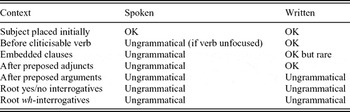
The data for the case of subject drop in written English is presented above. Table 1 sets out the key differences in distribution between subject drop in informal spoken English and in certain registers of written English.
Some differences in grammaticality of subject pronoun drop in different contexts in spoken and written English.

5 Analysing deletion in written English
5.1 Phonology or syntax?
Can the phonological, left-edge deletion procedure described in section 3 above for spoken English be extended to written English?Footnote 14 The distributions clearly differ, so to a certain extent the analyses used to account for the distributions have to differ. For example, the sentence in (49) is ungrammatical in spoken English but grammatical in the diary register.
(49) Tomorrow will go to gym.
There is also a difference in the acceptability of null subjects before cliticisable verbs. While written English allows strings such as Will go to gym tomorrow, spoken English does not allow such strings. If we were to ‘import’ the phonological analysis presented above for spoken English to the written case, we would need to find some way of ensuring the preservation of cliticisable (but not cliticised) verbs such as will.
Various syntactic analyses of subject drop have been proposed, mainly in work by Liliane Haegeman or work inspired by her; see for example Haegeman (Reference Haegeman1990, Reference Haegeman1997, Reference Haegeman2007), Horsey (Reference Horsey1998), Haegeman & Ihsane (Reference Haegeman and Ihsane1999, Reference Haegeman and Ihsane2001). Here I will recap the most recent development of work in this area, the phase-based treatment proposed by Haegeman (Reference Haegeman2007).
5.2 The phase-based analysis of subject drop: Haegeman (Reference Haegeman2007)
Haegeman (Reference Haegeman2007) presents an analysis of subject drop in diaries in terms of phases and phase-based spellout (Chomsky Reference Chomsky, Martin, Michaels and Uriagereka2000, Reference Chomsky and Kenstowicz2001, Reference Chomsky, Freidin, Otero and Zubizarreta2008). In such a phase-based system, spellout of a syntactic structure is gradual; particular heads are designated as phase heads, which send their complements to the sensorimotor interface (phonological form) and the conceptual-intensional interface (logical form).
Haegeman makes use of developments in the cartographic analysis of clausal structure (Rizzi Reference Rizzi and Haegeman1997 and much subsequent work), specifically the proposal of Rizzi & Shlonsky (Reference Rizzi, Shlonsky, Gärtner and Sauerland2007) that there exists a ‘Subject Phrase’, a ‘structural zone connecting the CP and the IP systems’. Sentential subjects move to the specifier of this position. The key suggestion of Haegeman's phase-based analysis is that, in diary dialect, a particular head lower than the head Force0 (assumed to constitute the root of the phrase marker by e.g. Rizzi Reference Rizzi and Haegeman1997) may be designated as the highest phase head of a sentence. Concretely, in diary dialect, Subj0 would be designated as the highest phase head. The sentential subject would move to [Spec, SubjP]. However, if Subj0 were designated as the highest phase head, this would entail that, at spellout, only the material in the complement of Subj0 would be sent to PF, as there would not be any higher phase head which would select Subj0 or [Spec, SubjP] and send the material contained therein to PF. The subject, in [Spec, SubjP], would not be spelt out. For example, in a structure such as (50), only the underlined material would be spelt out.
(50) [SubjP Ii [SubjP Subj [TP ti [TP will [VP go to the gym]]]]
Such an analysis predicts that subject drop should be infelicitous with fronted material, as is indeed the case. If Subj0 is the highest phase head, then anything that moves to a position above Subj0, whether that be an auxiliary or a left-dislocated topical argument, is predicted to not be sent to spellout. There is no way of deleting only the subject and preserving the topic or the auxiliary, as shown in (51, 52) below.
- (51)
(a) *More problems, e don't need.
(b) [More problemsi [SubjP Ij [SubjP Subj [TP tj don't need ti]]]]
- (52)
(a) *Should e go to the gym?
(b) [Shouldi [SubjP Ij [SubjP Subj [TP ti [TP tj [VP go to the gym]]]]]]
However, this line of reasoning is problematic given the facts about fronted modifiers – that is, the grammaticality of sentences such as Tomorrow e will go to gym in diary register. Haegeman proposes that in such cases, the modifier does not move all the way to the clausal left periphery. Rather, it is merged in a TP-adjoining position; the subject then raises above it to [Spec, SubjP]. Haegeman adduces sentences taken from British journalistic style, where a modifier intervenes between an overt subject and an auxiliary, as evidence for this structure; for example, (53) below (from Haegeman Reference Haegeman2007: exs. 41 and 45; see also Haegeman Reference Haegeman2002 for further discussion of this sentence-medial adverbial position).
- (53)
(a) Asked if the Prime Minister yesterday had made his position more ‘explicit’ regarding the rebate and its negotiability, the PMOS replied: no.
(b) [SubjP The Prime Ministeri [TP yesterday [TP ti [TP had made. . .]]]]
Such a structure appears to be common to (at least British English) journalistic writing, as Haegeman (Reference Haegeman2002) notes. Haegeman (Reference Haegeman2007) suggests that this structure is also possible in diaries. Given the possibility of a sentence-medial position for modifiers, we have an account for why modifiers can remain in a sentence where the subject is dropped; the modifier is in a position below the Subj0 that acts as phase head, and as such is sent to spellout.
- (54)
(a) Tomorrow will go to the gym.
(b) [SubjP Ii [SubjP Subj [TP tomorrow [TP ti [TP will [VP go to the gym]]]]]
5.3 Failure to spell out: phase or StrongStart?
I would like to propose that it may be the case that the phonological analysis can account for the distribution of dropped subjects in written English, if we accept Haegeman's structural proposal to account for sentence-medial adverbs in English. It may be the case that, while syntactic differences between spoken and written English have to be appealed to in order to explain the differences in distribution between the two registers, the actual deletion itself in both registers is the result of a left-edge deletion process, as discussed in section 3. While for reasons of space I cannot fully explore this issue here, I would like to make a tentative proposal in this direction. It may be that the failure of material at the root of the phrase marker to spell out is not for phase-based reasons, but rather motivated by the same sort of process as I have proposed occurs in spoken English, namely, the desire to avoid a weak start. If we assume that subject pronouns can move above modifiers in diary English, then they constitute weak starts, as shown in (55) below.
- (55)
(a) I tomorrow will go to the gym.
(b) [ι [ϕ [σ I] [ϕ [ϕ tomorrow] [ϕ will go to the gym]]]]
The syllable I is left-sister to the Phonological Phrase tomorrow will go to the gym, and so violates StrongStart.
We can therefore potentially derive the subject-drop behaviour in written English from the same source as spoken English. The phonological grammar remains the same, but diary English has the option – not available in spoken English – of generating modifiers such as tomorrow in a high TP position, providing a configuration where the subject is deleted to satisfy StrongStart, but the modifier (which is not a weak start, being a Phonological Phrase) is not a weak start and so can remain.
This is only the sketch of an analysis along these lines; full exploration of it must await further work. A full analysis would have to account for the fact that cliticisable verbs, ungrammatical in conjunction with subject drop in spoken English, are nevertheless grammatical in written English, in sentences such as Will go to the gym tomorrow. It would also have to account for the fact that deletions do not generally happen at the syllabic level in writing; sentences such as ’Fessor arrived late to the lecture (for The professor. . .), while not impossible, do not seem typical of ‘diary dialect’ (seeming rather more like an attempt to represent ‘genuine’ speech in written form). The phonological analysis shares with Haegeman's analysis the problem of being unable to account for embedded subject drop, in the ‘dialects’ which allow this. I will conclude this section, however, by noting a potential advantage for the phonological line of argument. Not just pronouns are dropped in written English; other elements, such as articles, are also dropped, in diaries and also in headlines (Mårdh Reference Mårdh1980; Weir Reference Weir2009):
- (56)
(a) Will go to the gym tomorrow.
(b) A man bites a dog.
The phase-based analysis could perhaps handle such cases by specifying the D head, occupied by the article, as a high phase head which spells out only its complement (in the cases above, the NPs gym, man, dog), to the exclusion of the article, as in (57) below.Footnote 15 Again, underlining indicates spellout.
(57) [DP [D a] [NP dog]]
It is not clear, however, what the status of the syntactic object thus produced is. If such a DP is constructed and merged into an argumental position, say the complement of VP, and a phase head such as v is then merged above it, why do we not expect the article to be sent to spellout by the higher phase head, as in (58)?
(58) [v Pv [VP bites [DP [D a] [NP dog]]]]
By contrast, a phonological explanation may go some way towards accounting for cases of article drop; articles are functional elements which are weak starts to prosodic domains, and which are therefore susceptible to deletion to satisfy StrongStart.
(59) [ϕ [σ a] [ω dog]]
Detailed elaboration of this proposal must be left to future work, however.
5.4 Spoken English and syntactic deletion
I have proposed that left-edge deletion of material in spoken English is phonological, and that perhaps the deletion of subjects (and other material such as articles) in written English can receive the same treatment. Could we, however, rather extend the syntactic analysis of subject drop in written English, such as the phase-based analysis proposed by Haegeman (Reference Haegeman2007), to the spoken case? Is it plausible that some speakers have a phase-based subject-drop process available even in speech?
The surface distributions of the two phenomena are certainly different; modifiers can appear before a null subject in written English, but not in spoken English, for example. So the phase-based analysis cannot be imported into the spoken case ‘as-is’. This difference, however, could be accounted for under the phase-based analysis simply by assuming that the sentence-medial position for modifiers is not available in spoken English, so there is no position for the subject above a modifier. Indeed, sentences such as (60) seem extremely stilted in spoken English.
(60) ??I tomorrow will go to the gym.
The principal reason, however, for dispreferring a syntactic explanation in the spoken case is rather the fact that it fails to generalise. We have seen that the sentences below are all grammatical in informal speech:
- (61)
(a) I don't think so.
(b) I'm going to the cinema.
(c) Are you going to the cinema?
(d) The man over there seems to think so.
Can the phase-based analysis account for this? In principle, a phase-based analysis could account for (61a–c), depending on the choice of the root phase head. The key problem is (61d). As discussed in section 5.3 above, it is unclear how to ensure that phase-based failure to spell out can occur DP-internally. Presumably the DP the man over there (perhaps with the not spelt out) and the TP seems to think so, after being Merged with each other, will themselves both be selected by a higher phase head in order for them to be spelt out both at PF and LF. In this case, how can the determiner the avoid being sent to spellout? The phase-based analysis of dropped material appears unable to handle this case.
More problematic for the phase-based analysis of dropped material are cases such as (62), where drop is happening at the level of the syllable.
(62) 'Fessor left early.
It certainly seems as if this phenomenon is of the same sort as the other cases of drop presented in (61). Like those deletions, it is sensitive to the position of stress, and it is consistently left-edge. But it surely cannot be the case that this is due to a phase-based deletion process; such a process cannot be operating at a level below the word.
The conclusion we can draw from examples like (62) extends beyond the phase-based account of Haegeman (Reference Haegeman2007); it casts doubt on the feasibility of any syntactic account of left-edge deleted material in spoken English. The deletion of syllables word-internally is the domain of phonology, not syntax. Given that the process by which syllables delete appears to be subject to exactly the same constraints as other left-edge deletions (of auxiliaries, subject pronouns, etc.) in English, it is preferable to provide a unified analysis – which the phonological analysis presented here does.Footnote 16
6 Conclusion and further work
I have argued that there are systematic differences between the types of recoverable deletion which are permitted in colloquial spoken English, and those which are permitted in registers of written English such as diaries and text messages. I have proposed that the deletions which occur in spoken English are phonologically conditioned, and have proposed an analysis in which the deletions are motivated to satisfy the constraint StrongStart, requiring prosodic constituents to start with a prosodically strong element.
Deletions of similar elements in written English cannot receive exactly the same analysis, as the surface distribution is different. In particular, such deletions are not strictly left-edge phenomena, as deletions in the spoken case are. I have suggested that, at least in the case of ‘diary drop’, there may be a possibility of extending the phonological analysis proposed for spoken English to the written case, while accounting for the differences in the surface distribution of the phenomenon by appealing to independent evidence for a sentence-medial position for modifiers in written English.
An important area for further work will be to explore the relation between the phonological analysis proposed in this article for subject drop (and drop of other elements) in adult English, and the phenomenon of subject drop in child English. There is a considerable literature on subject drop in child English (see for example Hyams Reference Hyams1986, Reference Hyams1994, Reference Hyams, de Villiers and Roeper2011; Gerken Reference Gerken1991, Reference Gerken1994; Rizzi Reference Rizzi1994; Roeper & Rohrbacher Reference Roeper and Rohrbacher1994). In particular, there is a debate concerning whether null subjects in child English are to be analysed as a syntactic phenomenon, or as a metrical/phonological phenomenon. The latter position is the one maintained by Gerken (Reference Gerken1991, Reference Gerken1994), who proposes that children generally delete weak initial syllables. In terms of the present account, this can be analysed as an initial high ranking of StrongStart in a child's grammar, with the constraint being ranked lower only at a later stage of acquisition. If deletion of initial weak syllables is generally present in adult speech as well as child English, this provides support for Gerken's view that child null subjects are phonological/metrical rather than syntactic.
Further work may also seek to explore whether the present analysis can be extended to other cases of dropping in written ‘block language’, such as article drop in headlines, or object drop in recipes or in the instructional register. A fruitful avenue for further work may be to explore to what extent the various types of dropping in ‘block language’ can be subsumed under one analysis, be that phonological or syntactic in nature.