


The symmetric, stationary subgame-perfect Nash equilibrium in Volden and Wiseman (2007) is characterized by cutpoints between regions of purely collective, mixed, and purely particularistic budget allocations. The cutpoints in our published article were derived by finding conditions under which the proposer receives a higher utility in one region than in another. However, a stationary equilibrium requires that the proposer would not unilaterally offer a different type of proposal, given that all other players continue to play their present strategies.Footnote 1 Reanalyzing the game in this way, we find that the qualitative nature of the equilibrium for the closed-rule and open-rule games is unchanged, although the cutpoint αMP between the mixed and particularistic parts of the equilibrium must be altered as follows:
CLOSED RULE GAME
For the closed-rule case, this cutpoint should be  . Hence, our statement of the closed-rule equilibrium (p. 81) and Figure 1 should be altered to reflect this change, and the following related corrections are needed. First, in Figure 2,
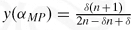 instead of
 . Second, the negative comparative statics for the effect of δ on αMP in Propositions 1, 3, and 4 should be zero, thus leading to no positive or negative predictions about the effect of legislator impatience on the incidence of collective good provision, on coalition size, or on the use of open rules.
It is important to note that this result does not imply that the amount of resources that is devoted towards collective goods in the “mixed” case is unrelated to δ, but rather that the formateur's decision to make a mixed vs. particularistic proposal is unrelated to δ. This is because, at the critical αMP cutpoint, the formateur must guarantee coalition partners the same (discounted) utility regardless of whether she offers a mixed or particularistic proposal, in order to induce acceptance. The quantities being offered to coalition partners, whether they be particularistic or mixed proposals, are functions of δ; but because these quantities must be equal to one another at this cutpoint, αMP is not a function of δ.
The substantive interpretation of this new finding is that the roles of (a) legislators' relative valuations of collective goods, (b) the return on collective good investment, and (c) the legislature size, as described in Propositions 1, 3, and 4, are not conditional on the degree to which legislators discount the future. This means that, regardless of the ease of coalition formation or legislator impatience, the main features of the paper hold. This finding reinforces the point that the main argument running throughout the article is consistent for any level of legislators' valuations of the future. Specifically, for all ranges of δ, it remains the case that policy proposers can exploit coalition partners' strong preferences for public goals to actually provide fewer public goods in equilibrium while directing more public goods to themselves. Moreover, the explanations offered in the paper for why policy reforms to limit special interest spending often fail, for when oversized coalitions form, and for when legislators prefer open or closed rules are found to hold more consistently, in light of this erratum. Put simply, the relationships uncovered and explained throughout the article for these other parameters of interest should no longer be seen as strengthened or weakened depending on δ, as they had been described in the published article.
EXTENSION: THE OPEN RULE GAME
For the open-rule case, αMPo should be: αMPo = q + qk(δ, n). All other properties of the closed-rule baseline model and open-rule model are identical to what was presented in the published version of Volden and Wiseman (2007).
EXTENSION: A DIVERSE LEGISLATURE
For similar reasons, the following cutpoints for the diverse legislature extension should replace those in the published work: 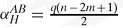 and
 . Moreover, unlike Case IIc in the article, no pure strategy equilibrium exists for
 . Rather, a mixed strategy equilibrium exists of the following form.Footnote 2 If a collective leaning legislator is recognized, she proposes to put the entire dollar towards the collective good, and receives unanimous approval. If a particularistic-leaning proposer is recognized, with probability
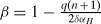 , she makes a particularistic proposal similar to Case IId, allocating particularistic goods to
 randomly-chosen particularistic-leaning legislators, placing nothing in the collective, and keeping the rest for herself. With probability (1 − β) she makes a minimum winning mixed proposal similar to Case IIb, providing just enough collective spending to receive the support of all m collective-leaning legislators, giving particularistic goods to
 randomly-selected particularistic-leaning legislators, and keeping the rest for herself. Despite these differences, all substantive claims about the diverse legislature extension in the published article continue to hold.
 , and thus also holds in region IId, along with the pure strategy equilibrium identified in the published article.



Comments
No Comments have been published for this article.